A V-belt is usually the cheapest part on a drive. It's also the fastest way to stop a production line. Walk a quarry, a cement mill, a feed mill, a sawmill or a water treatment works with us and the same three questions come back. Which section fits this pulley? How many belts does the drive really need? And why did the last set die in four months when the set before it ran three years?
We've been a conveyor belt manufacturer since 1988, and V-belts have shipped out of the same plant since the early years. That matters more than it sounds. A drive problem and a conveying problem land on the same maintenance desk, and the fix for one is often the root cause of the other.
This is the long version, written for the people who place the order — maintenance engineers and plant buyers, plus the EPC contractors who have to hand a drive over. We'll cover the wedge principle that transmits the torque, then the section table that lines A/B/C/D/E up against SPZ/SPA/SPB/SPC. Grooves get a section of their own — how they decide what fits, and how to re-decide once they're worn. And one selection, worked from a 30 kW nameplate all the way to a four-belt order.
Two housekeeping notes before we start. Every number below comes from our own DIN and ISO based rating tables, and we'll send the data sheet if you ask for it. And final selection always runs against the real driver, the real driven machine and the real duty cycle on your drawing. A nameplate on its own never tells the whole story.

01How a V-belt Actually Transmits Power
Short answer first. A V-belt doesn't grip like a flat belt. It wedges. The belt sits in a V-groove and touches the pulley on two angled flanks instead of one flat face, so the normal force acting on those flanks gets amplified by the groove geometry. At a 38° included angle that amplification is roughly 1 / sin(19°) — call it 3.1. Which is why a B-section belt only 17 mm across the top carries a load a flat belt would need three times the width to handle.
Torque comes from the difference between tight-side tension and slack-side tension. Multiply that difference by belt speed and you have the power the drive transmits. No magic in any of it. The wedge just puts far more friction surface to work at the same shaft tension.
Datum line, and why bottoming out kills a drive
Every belt section has a datum line — the cord plane where the load-carrying tensile members sit. Seat the belt correctly and that plane sits at the pulley datum diameter, with the top of the belt standing slightly proud of the rim. That's the whole point of the design. Flank contact does the work, so the flanks have to stay in contact.
A belt that bottoms out in the groove has already lost the drive. The flank faces lift off. The wedge disappears. What's left is a rubber block slipping on a metal trough, and slip makes heat fast. We've opened drives where the pulley was too hot to touch after twenty minutes of running. Nine times out of ten the belt was simply sitting on the groove floor, because the section was wrong or the groove had worn wide.
Groove angle is not constant, and that is deliberate
Sections are drawn with a 40° flank angle, but pulley grooves are cut to close on that angle as the pulley gets smaller. Under about 118 mm datum diameter you'll typically see a 32° to 34° groove. Mid-range pulleys run 36° to 38°. Large pulleys get the full 40°. Why? Bending. Wrap a belt round a small pulley and the back of the belt is compressed while the section spreads outward, so a narrower groove angle keeps the flanks matched. Cut a 40° groove in a 90 mm pulley and the belt rides on its top edge only. It'll slip and squeal, then fail in weeks.
Speed limits we work to
Power rises with belt speed. So do centrifugal losses, because the belt's own mass tries to lift it out of the groove. Classic wrapped sections are comfortable up to roughly 30 m/s. Narrow sections in SPZ to SPC profiles handle 40 m/s and slightly more where the pulley diameters allow it. Past that limit, contact pressure drops and per-belt capacity falls away quickly, so a longer, slower drive is nearly always the cheaper answer. As a transmission belt manufacturer we'd rather quote a two-groove drive running at 22 m/s than push a single belt past its limit and carry the warranty risk that comes with it.
One from last year, because speed limits get ignored until something breaks. A cement plant asked us to take a 132 kW fan drive from 24 m/s to 31 m/s on the existing pulleys. We said no and quoted a larger driven pulley instead. Eleven weeks later the fan next door, over-driven the same way, threw a belt and took the guard with it. Slower was cheaper. It usually is.
02Section Table: A/B/C/D/E Against SPZ/SPA/SPB/SPC
Two naming systems cover almost everything you'll meet in the field. The classic series — A, B, C, D and E — grew out of the inch-based cross sections still sitting on half the drives in North America and much of Asia. The narrow series SPZ, SPA, SPB and SPC comes from the metric DIN and ISO tradition, and it carries more power for the same width, because the section is taller and closer to a wedge. A classic B and a narrow SPB have almost the same top width. The SPB is 2 mm taller, and in a matched drive it will out-carry the B by a comfortable margin. Every dimension below comes from the section drawings we cut to as a V-belt manufacturer, not from a catalogue reprint.
The dimensional comparison
Top width is what most people measure with a caliper. The dimension that decides whether a belt fits a worn pulley is the datum width — the width across the cord plane. Keep both numbers handy when an unmarked belt meets an unmarked pulley.
| Section | Series | Top width | Datum width | Height | Flank angle | Typical datum length range |
|---|---|---|---|---|---|---|
| A | Classic | 13 mm | 11 mm | 8 mm | 40° | 500-4,000 mm |
| B | Classic | 17 mm | 14 mm | 11 mm | 40° | 630-6,000 mm |
| C | Classic | 22 mm | 19 mm | 14 mm | 40° | 900-8,000 mm |
| D | Classic | 32 mm | 27 mm | 19 mm | 40° | 1,500-11,000 mm |
| E | Classic | 38 mm | 32 mm | 23 mm | 40° | 2,000-12,000 mm |
| SPZ | Narrow | 9.7 mm | 8.5 mm | 8 mm | 40° | 630-3,550 mm |
| SPA | Narrow | 12.7 mm | 11 mm | 10 mm | 40° | 800-4,500 mm |
| SPB | Narrow | 16.3 mm | 14 mm | 13 mm | 40° | 1,250-8,000 mm |
| SPC | Narrow | 22 mm | 19 mm | 18 mm | 40° | 2,000-12,500 mm |
| 3V / 5V / 8V | US narrow | 9.5 / 15 / 25 mm | 8.5 / 13.5 / 23 mm | 8 / 13 / 18 mm | 40° | Matches SP series closely |
Typical dimensions from our standard V-belt drawing set; confirm against the belt you are replacing and the pulley drawing before ordering.
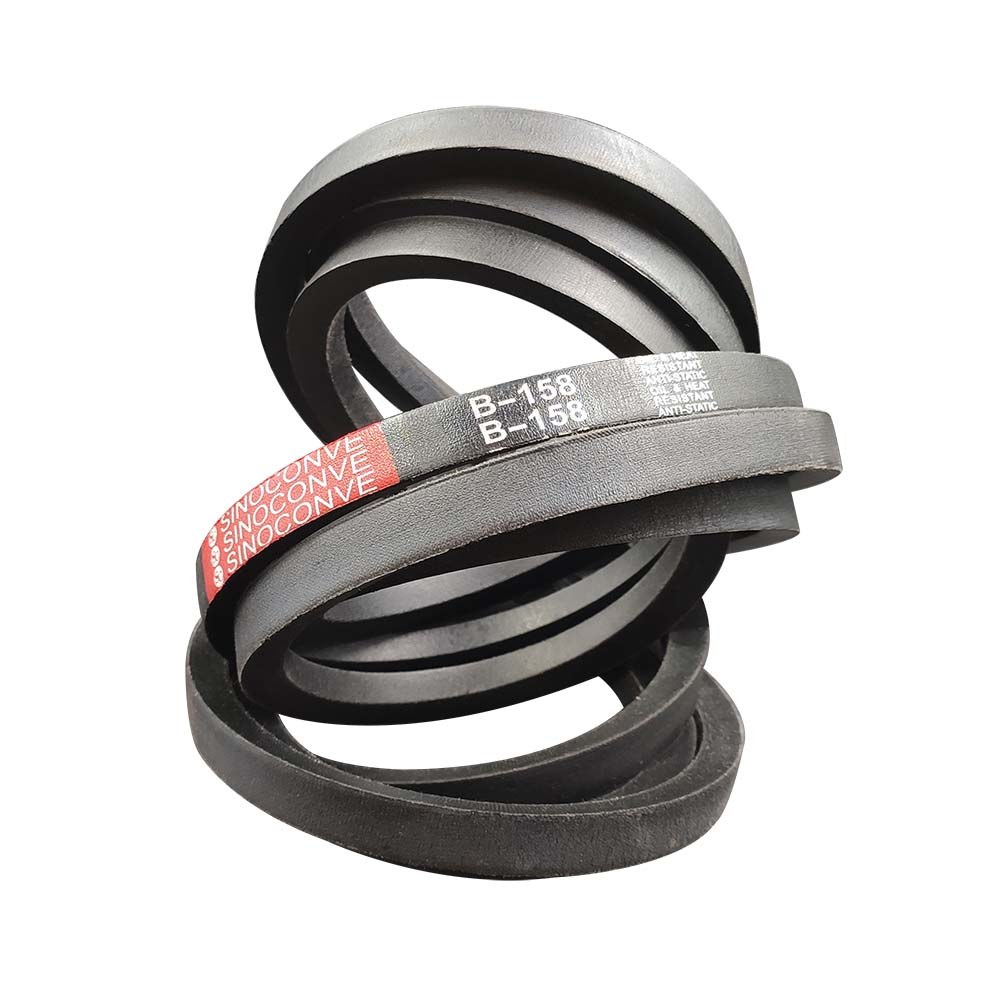
A wrapped B-section belt in oil and heat resistant compound, cut to the order length at our plant.
What the code on the belt actually means
Classic belts are labelled by section letter and outside length in inches, so an A-158 is an A-section belt about 158 inches outside. Narrow belts are labelled by datum length in millimetres instead, which is why an SPB 2650 measures 2,650 mm along the datum line. Those two lengths differ by roughly the belt height, and that catches people out. Fit an SPB 2650 where the old belt was marked 2650 outside length and you lose about 13 mm of centre distance adjustment — on a drive that may not have it to spare.
Matched sets, and why we still ship them
On a multi-belt drive the belts share the load, and they only share it fairly if their lengths match. Two millimetres of difference is enough to load the short belt harder, and it dies first. Where a drive runs more than two belts we measure and mark every belt in the set, so the erector can pair them by number. That one habit removes a whole category of warranty conversation.
03Pulley Groove Matching and Worn-Groove Re-selection
This is the chapter most guides skip. It's also the one that decides whether your new belts last two years or four months. Section and groove are a matched pair: the belt is made to one datum width and one flank angle, the pulley is cut to accept that width at that angle at a specific datum diameter. Break the pairing and the wedge stops working. Doesn't matter how good the belt is.
How the pairing breaks down
First failure mode, and the one people understand fastest: a belt too small for its groove. It drops deeper, the top edge sinks toward the rim, and the flanks lose full contact. Slip starts at the small pulley, where the arc of contact is shortest. Then there's the opposite case — a belt too large, which won't seat at all. It rides on the top corners and the flanks never touch. And the one we see most often is a groove that is simply worn out.
Wear works from the flanks inward. Every hour the belt runs, it polishes and gradually cuts the angled faces. The groove widens at the datum line, the belt sits deeper, and datum diameter shrinks. On the driven pulley that changes the speed ratio. A conveyor that ran at 1.6 m/s starts dragging at 1.5 m/s, and nobody connects the slowdown to the pulley — because the pulley still looks fine from the outside.
How we measure a worn groove in the field
You need a steel rule, a straight edge across the pulley face, and a groove gauge if you have one. Put the correct-size belt in the groove, pull it firm by hand, and measure how far the top of the belt stands above the pulley rim along the datum line. Healthy pulley, correctly sized belt — it stands slightly proud of the rim. That projection is your verdict.
| Belt top position vs pulley rim | What it means | What we do |
|---|---|---|
| 0.5 to 1.5 mm proud of the rim | Correct seating; flanks fully engaged | Replace belts only |
| Flush with the rim | Groove opened up; belt has dropped toward the floor | Monitor, log, plan a pulley swap at the next outage |
| 1 to 3 mm below the rim | Flank contact reduced; slip and heat likely | Replace the pulley, or re-cut if it has material to spare |
| More than 3 mm below, or belt visibly rocking | Bottomed out on the groove floor; no wedge at all | Pulley is scrap. New pulley, correct groove angle for the diameter |
Where that table comes from, honestly: a limestone plant sent us four photographs and one measurement last season. Belt top 2.5 mm below the rim on the driven pulley. Proud by about 1 mm on the driver. Same section, same belt set, two very different grooves on one machine. The driven pulley was killing the belts, and the belt material took the blame for two years.
When the groove is worn, do you step up a section?
Our answer is usually no, and here's the reasoning. When a groove has worn wide, a belt one section up will sometimes look like it seats better, because its flanks reach points on the groove face that the original belt could no longer touch. It buys you weeks, not years. The flank angle is still wrong for the new belt, the load concentrates on a narrow band of belt face, and the cover wears through quickly. You haven't fixed the drive. You've moved the failure from slipping to collapse.
There is one honest exception, though. If a pulley is only slightly worn and the drive is a low-duty, low-speed application — a fan, a small agitator, a few hours a day — we have seen an SPB set keep a worn B groove running until the next shutdown. We write it up as a temporary measure and we put the pulley on the spares list. Nothing about that arrangement should be treated as a permanent fix.
Re-selecting after a pulley change
When the pulley is replaced, re-run the selection. Don't copy the old belts. New pulleys often come with a slightly different datum diameter, because the supplier cuts to a standard size rather than your old worn dimension. A modest change moves the belt length, and a drive with little take-up travel won't accept it. Before quoting a replacement set on an old drive we ask for three numbers: driver speed under load, the measured outside diameter of both pulleys, and the available take-up travel. With those three we can usually name the section, the length and the belt count in one pass.
04Worked Selection Example: 30 kW Hammer Mill Drive
Real numbers, not textbook ones. The drive we'll use runs a hammer mill in a limestone plant. On the input side sits a 30 kW four-pole motor turning at 1,470 rpm. The rotor should turn at roughly 800 rpm under load. Add ten to twelve hours a day and a rotor that isn't always empty on start, and you've got heavy starting on a common duty. Which is exactly why buyers argue about belt count on drives like this one, and why it makes a fair example.
Before the arithmetic, one thing we always say to people buying belts for a plant like this. The team that maintains the industrial conveyor belt on the yard is usually the same team that looks after a crusher drive like this one, and the same team that looks after the rubber conveyor belt feeding the mill. Drive and conveying problems get solved by the same hands. A conveyor belt supplier who understands both saves the plant a second phone call.
Service factor comes first, before any other number
The motor nameplate is not the load. A belt drive has to survive starting current, stall torque and the occasional jam, so we start with a service factor that reflects how unforgiving the driven machine is. Typical values from our selection tables look like this.
| Driven machine | Running hours per day | Service factor |
|---|---|---|
| Centrifugal fan or pump | Up to 10 | 1.1 - 1.2 |
| Belt conveyor, uniform feed | 10 - 16 | 1.4 |
| Positive displacement compressor | 10 - 16 | 1.4 - 1.5 |
| Bucket elevator, screw conveyor | 16 - 24 | 1.5 - 1.6 |
| Hammer mill, vibrating screen | 10 - 16 | 1.5 - 1.6 |
| Jaw crusher, 24-hour duty | 16 - 24 | 1.7 - 1.8 |
Service factors from our standard tables; adjust for unusual ambient, frequent starting or a drive subject to jamming.
Hammer mill, ten to twelve hours a day, heavy shock. We take 1.5. If the plant told us the mill runs around the clock, we'd move to 1.6 without discussion.
Design power — the number everything else hangs on
Design power is the figure the whole selection is built on, and it's motor rating multiplied by service factor. Here that's 30 kW times 1.5, which gives 45 kW. Every number from this point forward uses 45 kW, not 30 kW. We have watched a lot of DIY selections come apart at exactly this step, because using the motor rating alone quietly builds in a 33 percent shortfall — and a shortfall shows up as slip under load, usually in the first busy week after commissioning.
Then we pick the section
Speed on the horizontal axis, design power on the vertical, and the chart drops this drive into the narrow SPB band. The other sections would work in theory. The pulley just gets wider and heavier, and that costs more than the pulley. Here's the comparison we'd actually put in a quotation.
| Option | Power per belt at 1,470 rpm | Belts required | Grooved face width | Practical verdict |
|---|---|---|---|---|
| SPA | about 6.0 kW | 8 | about 100 mm | Wide, tall pulley; more belts to keep matched |
| SPB | about 13.2 kW | 4 | about 65 mm | Compact pulley, lower overhung load |
| Classic C | about 7.0 kW | 7 | about 150 mm | Only if pulleys are already C-section |
So, SPB. Four belts on a 65 mm grooved face keeps the pulley light and the shaft overhung load down, and four belts are easy to match and easy to tension evenly.
Datum diameters, and what the ratio actually gives you
Take a standard SPB datum diameter of 224 mm for the driver. The target ratio is 1,470 divided by 800, or 1.84. Multiply out and the driven pulley wants 412 mm, so we go looking for the nearest standard size. That is 400 mm, which gives an actual driven speed of 1,470 times 224 divided by 400 — 823 rpm. The mill accepts 780 to 850 rpm, so we're inside the window. We'd note the small speed increase in the quotation, so the plant engineers see it before they buy rather than after.
Belt speed check, while the diameters are still on the pad
Belt speed is pi times datum diameter times speed, divided by 60,000 when the diameter is in millimetres and the speed is in rpm. For this drive: 3.1416 times 224 times 1,470 divided by 60,000, which comes to 17.2 m/s. That's comfortable for an SPB wrapped belt, and it leaves room if the plant later raises motor speed on a VFD. Had the figure come out above 30 m/s, we'd have gone back and increased the driver diameter rather than accept the loss of grip.
Belt length, from a centre distance you can actually build
Centre distance should sit between 0.7 and 2.0 times the sum of the two datum diameters. Here the sum is 624 mm, so the workable band is 437 mm to 1,248 mm. We aim at 800 mm — normal here, and slightly generous. The datum length then falls out of the standard formula: two times centre distance, plus 1.571 times the sum of the diameters, plus the square of the diameter difference divided by four times centre distance. Running it through gives 1,600 plus 980 plus 10, or 2,590 mm.
The nearest standard datum length is SPB 2650. Because we've lengthened the belt by 60 mm, actual centre distance comes back to about 830 mm — still well inside the band. This is the step where a plant with tight take-up travel gets caught, and it's why we ask for the take-up figure before we confirm a belt length.
Arc of contact, and the power one belt really carries
The small pulley never gets the full 180 degrees of wrap. The correction comes from the diameter difference divided by centre distance: 176 divided by 830, or 0.21. Each 0.01 of that ratio costs about 0.6 degrees of wrap, so the driver pulley sees roughly 167 degrees instead of 180. That pulls the power rating down by a factor of 0.97.
The base rating for SPB at 1,470 rpm with a 224 mm datum diameter at this ratio is 13.2 kW per belt. A length factor of 1.02 applies, because 2,650 mm is longer than the reference length. Corrected: 13.2 times 0.97 times 1.02, or 13.1 kW per belt. Divide the design power of 45 kW by 13.1 and you get 3.4 belts. Round up. Four.
The finished selection in one table
| Step | Quantity | How it is obtained | Value |
|---|---|---|---|
| 1 | Motor rating and speed | Nameplate | 30 kW at 1,470 rpm |
| 2 | Service factor | Hammer mill, 10-12 h/day, shock | 1.5 |
| 3 | Design power | 30 kW x 1.5 | 45 kW |
| 4 | Section | Selection chart, 1,470 rpm and 45 kW | SPB |
| 5 | Datum diameters | Standard sizes for a ratio of 1.84 | 224 mm and 400 mm |
| 6 | Driven speed | 1,470 x 224 / 400 | 823 rpm |
| 7 | Belt speed | 3.1416 x 224 x 1,470 / 60,000 | 17.2 m/s |
| 8 | Calculated datum length | Formula at 800 mm centre distance | 2,590 mm |
| 9 | Selected belt | Nearest standard datum length | SPB 2650 |
| 10 | Actual centre distance | Re-solved for the 2,650 mm belt | about 830 mm |
| 11 | Arc of contact | Correction from 176 / 830 | 167 degrees, factor 0.97 |
| 12 | Power per belt | 13.2 x 0.97 x 1.02 | 13.1 kW |
| 13 | Number of belts | 45 / 13.1, rounded up | 4 |
| 14 | Order | Matched set of four, marked | 4 pcs SPB 2650 |
The small print that decides whether it works
Take-up travel has to cover installation slack and normal stretch. For a 2,650 mm belt we allow about 25 mm of shortening over the life of the set, plus enough free travel to get the belts on without levering them. If the motor slide rail is already at the end of its slot, the drive needs attention before the belts do.
Groove count is four on both pulleys. Mixing a four-groove driver with a five-groove driven pulley is fine mechanically, but nobody does it on purpose — it just invites someone to fit a fifth belt that isn't matched to the other four. Keep the counts equal and write them on the machine tag.
Then there's the order itself, which is where a lot of this arithmetic quietly dies. Minimum order quantity on V-belts is 30 to 50 pieces per size. If a mill is down and can't wait, say so in the enquiry — an urgent four-belt set usually moves in 15 to 20 days.
05Cogged vs Wrapped vs Raw-Edge: A Decision Matrix
Section and belt count are settled. The next decision is construction, and it changes how long a drive lasts far more than most buyers expect. Three families cover nearly every industrial drive: wrapped, raw-edge, and cogged.
What the three constructions actually are
A wrapped belt carries a fabric jacket over the top, the bottom and both flanks. The jacket holds the rubber together, resists oil and dust, and takes the abuse when the drive runs slightly misaligned. The trade-off is stiffness. Wrapped belts bend less willingly, so they need larger minimum pulley diameters, and they build heat faster at high speed.
Raw-edge has no jacket at all. The flanks are bare compounded rubber, cut or moulded to the final profile. Bare rubber has a higher coefficient of friction against a steel groove, so a raw-edge belt transmits more power at the same tension, runs cooler, and tolerates smaller pulleys. That's also the weakness. No jacket, so oil and grit get straight to the compound, and abrasion eats it.
Cogged belts sit inside the raw-edge family, with moulded teeth on the underside. Every classic cogged v belt and the narrow profiles bend more easily, because the teeth remove material exactly where the belt would otherwise be compressed. Smaller pulleys, higher speeds, less heat. On a drive already at its geometric limit, cogs are often the only fix that doesn't involve new pulleys.
Want a longer comparison of how these behave against each other in service? We wrote it up separately in classic V-belts vs cogged and in our notes on wrapped V-belt specification.
Decision matrix
| Attribute | Wrapped | Raw-edge | Cogged |
|---|---|---|---|
| Flank friction | Baseline | Higher | Higher |
| Power per belt | 100% | about 115% | about 115% |
| Minimum pulley diameter | Largest | Smaller | Smallest |
| Heat build-up | Highest | Lower | Lowest |
| Oil and grease | Good | Poor | Fair if compounded for it |
| Dust and grit | Best | Fair | Cogs can pack with material |
| Outdoor and UV exposure | Good | Fair, needs cover | Fair, needs cover |
| Shock absorption | Best | Fair | Fair |
| Typical duty | Crushers, mills, dusty rooms | Clean industrial drives | Small pulleys, high speed |
How we apply the matrix on a real enquiry
Dusty room, oil mist, outdoor yard: wrapped, and we ask about the compound rather than the shape. Clean workshop, mid-size pulleys, tighten the drive without buying new pulleys: raw-edge or cogged. Small pulley that a wrapped belt cannot bend around: cogged, and we calculate the minimum diameter rather than guessing.
One field note on dust, because it surprises people. An open cog on a belt running in a cement or foundry room collects fine material in the tooth gaps. The belt then runs out of balance at speed, and the packed carry-over abrades the pulley groove. In those rooms a wrapped belt usually lasts longer, even though it is the less efficient construction. Choose for the environment, not for the catalogue headline.
For a wider view of how profiles and lengths map onto real orders, our V-belt buying guide covers the sizing and ordering side in more detail.
06Industrial vs Agricultural Duty: Shock, Dust and Weather
A belt that runs five years in an enclosed gear room can fail in a season on a baler. Same section. Same construction — and completely different duty. When we quote, we ask which side of the fence the drive sits on, because the two environments punish belts in opposite ways.
What industrial duty looks like
Industrial drives are steady. A fan, a pump, a conveyor gearbox or a compressor turns at a fixed speed for thousands of hours, usually with a guarded drive and a dry, shaded environment. Load varies gently, so belts suffer mostly from time and heat rather than sudden overload. The failure pattern is predictable: gradual wear, gradual stretch, and a set replaced on a schedule instead of in an emergency.
Dust is the variable that changes everything here. A cement mill or a foundry has fine abrasive material in the air, and it settles into grooves, into cog gaps and onto the pulley face. Material packed into a groove changes the effective groove angle, and then the belt sits higher or lower than it should. Which is why we tell maintenance teams to blow the grooves out at every belt change, not to brush the pulley face and call it clean.
What agricultural duty looks like
Agricultural drives are the opposite of steady. A combine header, a round baler, a grain auger — each one sees stop-start work and stone jams, then the occasional full stall, all in the open air. Belts see sun and rain, mud and chaff, then months of idling between seasons. On top of that, pulleys are often as small as the machine design allows, because nobody has spare space on a header.
That small pulley is why so many agricultural drives use cogged or raw-edge belts. Remove the jacket, cut cogs into the underside, and the belt wraps a pulley that a wrapped belt of the same section simply cannot follow. We also fit more heat and oil resistant compounds on agricultural belts, because engine compartments and hydraulic leaks are part of the picture.
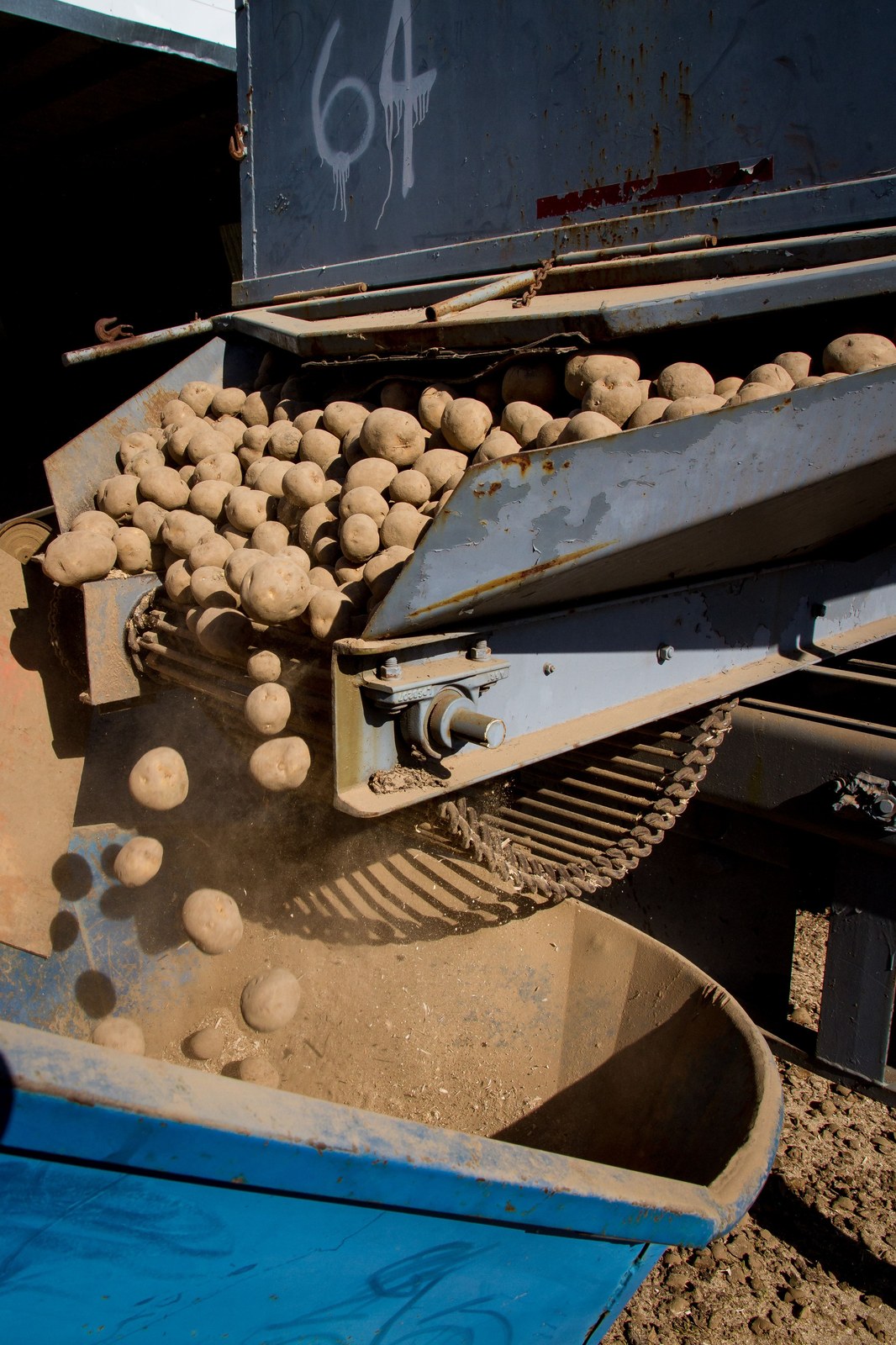
Agricultural drives in the open air: small pulleys, heavy shock loads and plenty of dust.
Head to head on the details that matter
| Factor | Industrial drive | Agricultural drive |
|---|---|---|
| Typical power per drive | 5 to 200 kW | 2 to 40 kW |
| Load character | Steady, predictable | Shock, jam and stall |
| Environment | Enclosed, dusty or oily | Open air, sun, rain, mud |
| Pulley sizes | Generous, designed in | As small as the machine allows |
| Preferred construction | Wrapped for dusty rooms | Cogged or raw-edge |
| Service factor | 1.1 to 1.6 | 1.5 to 1.8 |
| Replacement pattern | Planned, on hours | Reactive, before the season |
| Storage between seasons | Not usually an issue | Tension must be released |
What the industrial V-belt market is doing in 2026
Talk to anyone working inside the industrial v belt market and two themes come up within the first few minutes: consolidation and lead time. Buyers who once kept six belt brands on the shelf are narrowing to two or three, mostly because matching sets across brands is a headache and mixing brands on one drive shortens life. Then there's timing. A plant that ran its own store room for twenty years now wants a supplier who can ship in weeks rather than months, and the belts moving fastest are the narrow sections and the cogged profiles.
Our own order book says the same. Classic B and C still dominate repairs on older equipment, because that's what the pulleys are cut for. New drives are almost always specified in SPZ to SPC, and a growing share of those orders ask for cogged construction. Narrow cogged belts carry more power per millimetre of pulley face, and face width is expensive — in steel and in overhung load.
One more thing worth saying about sourcing strategy. Dealers who stock wholesale conveyor belts for grain handling, aggregate yards and fertilizer plants usually buy their V-belts from the same supplier, and a distributor who carries both keeps the customer's maintenance budget in one place. On the agricultural side we work with a number of dealers who stock V-belts alongside their chevron and cleated products, and that conveyor belt distributor relationship is usually what holds the account together.
07Multi-Ribbed PK and PJ Belts: Where the Boundary Sits
At some point, a buyer asks whether a set of four or five V-belts should be replaced by one multi-ribbed belt. It's a fair question. The answer depends on the drive rather than on fashion.
What a PK belt is
A multi-ribbed belt, sold as a pk belt, pk profile or poly-V belt, is a flat-backed belt with a row of small longitudinal ribs moulded into the underside. The PK profile uses a 3.56 mm rib pitch; PJ is finer, at 2.34 mm. A 6PK belt has six ribs, a 12PK has twelve. The whole belt is one piece, so a 6PK replaces four or five separate V-belts running side by side. Thin section, small ribs — so it bends around very small pulleys, runs cool at high speed, and can be driven from the back with an idler, which is what makes serpentine accessory drives possible in the first place.
Where PK wins, and where it does not
| Criterion | Set of V-belts | Multi-ribbed PK or PJ |
|---|---|---|
| Number of driven accessories | One or two per belt set | Up to five or six from one belt |
| Pulley diameter | Minimum set by the section | Much smaller for the same power |
| Maximum practical power | Very high, single or multi | Moderate; large rib counts get wide |
| Dusty or gritty rooms | Tolerant | Ribs pack with grit |
| Alignment tolerance | Forgiving, within reason | Strict; edge ribs fail first |
| Single belt replacement | Possible on a multi-belt drive | Whole belt comes off |
| Shock and jam loads | Handled well by V-groove grip | Rib stripping under heavy shock |
| Noise and vibration | Moderate | Lower, smoother at speed |
Our rule of thumb after years of quoting both: move to multi-ribbed when the drive is fast, the pulleys are small, and you need to feed several accessories from one shaft. Stay with V-belts when the drive is slow and heavily loaded, when the room is full of abrasive dust, or when the plant wants the option of replacing one belt instead of the whole set. An air compressor running 24 hours a day on a 400 mm pulley does not need a pk belt. A forestry chipper feeding three pumps from a 120 mm shaft pulley does.
Converting a drive to PK without getting it wrong
The arithmetic is straightforward. The tolerances are not. Work out the design power the same way as before, then divide by the rated power per rib at your speed and pulley diameter to get the rib count, and round up. Then check two things that V-belt drives normally let you get away with. Pulley alignment is the first: a PK belt spreads its load across many narrow ribs, and half a millimetre of angular misalignment will load the edge ribs and tear them off long before the rest of the belt is worn. Second is pulley face width and groove depth, because a PK pulley is not a V-groove pulley with more grooves. The rib form differs, and so do the pitch and the crown.
Where a drive needs exact speed matching rather than grip, the answer is usually a different product altogether. A synchronous timing belt holds the ratio without slip, and we supply those alongside our V-belt range. Plants that centralize belt purchasing usually find one supplier for V-belts, PK belts, timing belts and conveying products easier to audit, and a supplier who also runs a full conveyor belt factory can usually combine shipments so your store room is not dealing with five delivery windows.
08Installation, Tensioning and Maintenance Intervals
Most short belt life we investigate traces back to installation, not to the belt. A drive that was never aligned and never correctly tensioned will eat a matched set in months. Get the basics right and the same set runs for years.
Before the belts come out of the wrapper
Lock out the drive, then clean the grooves. Loose rust and packed dust change the effective groove angle, and a belt seated on debris never finds the datum line. Run a straight edge across both pulley faces and check alignment; on a short drive, a rule laid against the pulley faces will show you what you need to know. Check the pulley grooves for burrs and for that worn-groove condition from section 03. Then check the motor slide rail travel, because there's no point installing belts on a drive with no adjustment left.
Tensioning with the deflection method
We tension by deflection, because it needs nothing more than a rule and a spring gauge. Press the middle of the longest span. The target is a deflection of about 16 mm for every 1,000 mm of span. On our 830 mm drive that is roughly 13 mm of movement, and the force needed to push the belt that far tells you whether the tension is right.
| Section | Deflection per 1,000 mm span | Typical force per belt |
|---|---|---|
| SPZ / A | 16 mm | 25 - 40 N |
| SPA / B | 16 mm | 35 - 55 N |
| SPB / C | 16 mm | 40 - 80 N |
| SPC / D / E | 16 mm | 70 - 120 N |
Indicative deflection figures from our tension tables. Ask us for the exact value for your section, pulley diameter and ratio.
Two practical notes. Tension by moving the motor, never by levering a belt over a pulley with a bar, because that fractures cords even when the belt still looks fine. And check the tension once more after the first 24 to 48 hours of running, because new belts settle into the groove and the span grows.
Maintenance intervals we recommend
Weekly, look at the drive from outside the guard. Dust thrown off. A glazed sheen on the belt back. Any belt riding lower or higher than its neighbours. Monthly, check deflection on all belts and correct tension as a set. Quarterly, clean the grooves, re-check alignment, look at the pulley faces for ridging. Once a year, or every 4,000 running hours, measure the grooves and log the numbers in the machine history — so the next person sees a trend, not a surprise. Cutting V-belts rarely fail without warning, and the warning is almost always on the pulley.
Spares deserve a line of their own. Store belts in the original coil, in the dark, away from ozone sources like electric motors and welding sets, and never hang a belt on a peg by one point, because it takes a set. In a hot, dry store room, rubber ages faster than most maintenance plans assume. Belts leave our plant coiled and strapped, tagged with section and length, so they arrive at the store room round rather than folded.
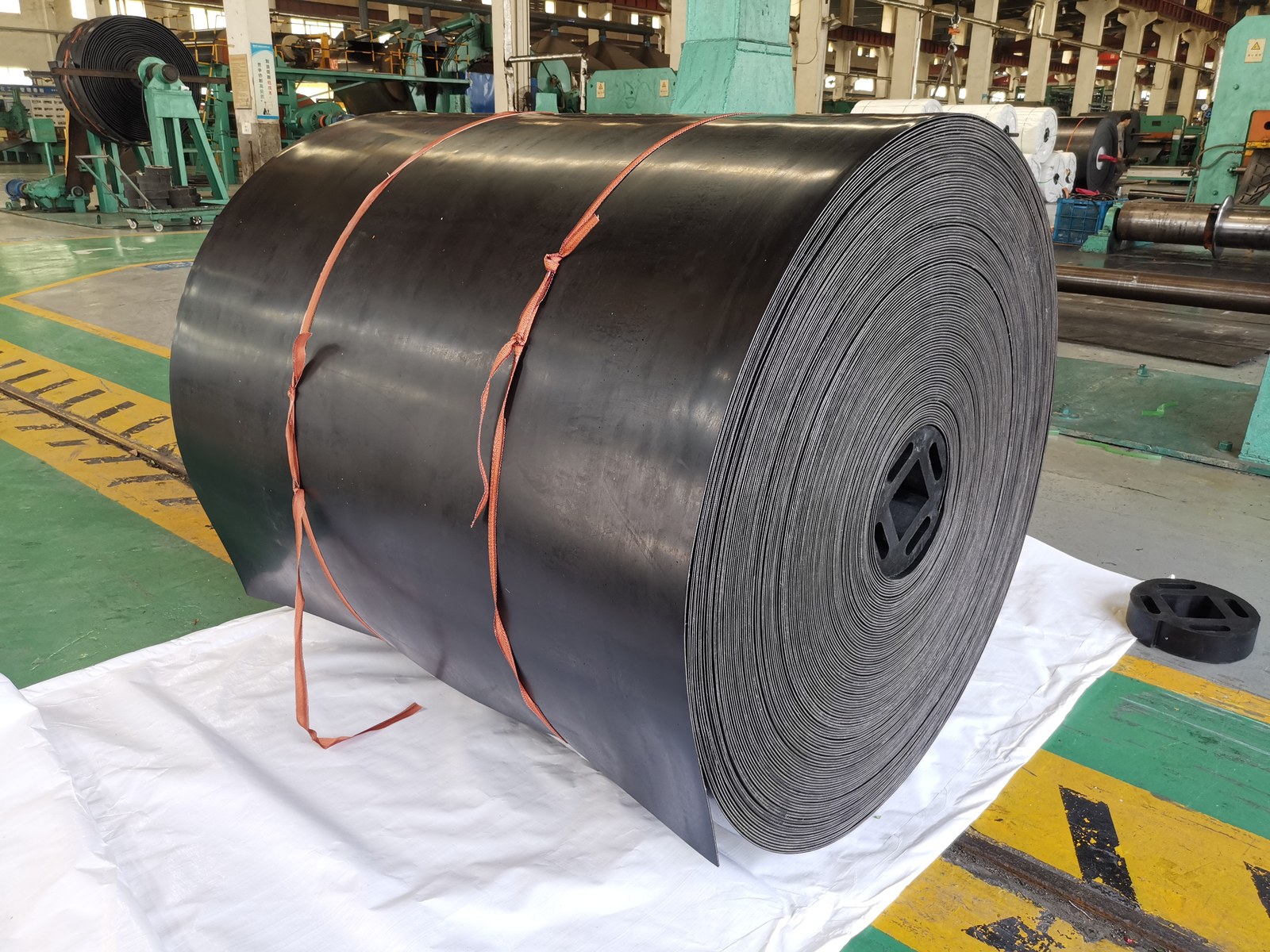
Finished belt stock, coiled and tagged, ready for the container. V-belt sets are packed the same way.
09Failure Modes: Slip, Roll-Over, Breakage and Wear
Read the belt and the pulley together, and the cause usually names itself. The table below is the short version of what we look for when a customer sends pictures of a failed set.
Symptom to cause chart
| What you see | Most likely cause | What we check first | Action |
|---|---|---|---|
| Squeal under load, speed drops | Low tension, or belt bottoming in the groove | Deflection figure and top-edge projection above the rim | Retension, or replace the pulley |
| Black dust and glazed flanks | Long-term slip; often oil contaminated | Groove cleanliness and nearby leaks | Clean, fix the seal, re-check section |
| Belt turns over onto its back | Misalignment, wrong section, debris in the groove | Straight edge across faces; groove inspection | Re-align, clean grooves, correct the section |
| Snapped belt with clean tensile break | Over-tension, jam or shock, damaged pulley | Pulley surface for burrs and step wear | Dress or replace the pulley; reset tension |
| One belt of a set fails repeatedly | Unmatched set, or the worn groove takes the load | Measured lengths of the other belts | Replace as a matched set |
| Cracks across the belt back | Heat, ozone, or a pulley below minimum diameter | Ambient temperature and driver pulley size | Move to a cogged belt or enlarge the pulley |
| Broken cogs or missing rib sections | Undersized pulley, dust packing, abrasion | Minimum diameter against our cogged belt table | Resize, or switch to wrapped construction |
| Uneven wear, one flank polished | Angular misalignment or a bent shaft | Shaft runout at the pulley hub | Realign or repair the shaft |
The failure we get asked about most
Slip is the one that fills our inbox, and it's almost never the belt's fault. In our experience roughly three quarters of reported slip cases come back to tension that was set once and never checked, or to a groove that has opened up over years of running. The remaining quarter splits between contamination and genuine overload — and genuine overload is easy to spot, because the belt back is glazed across its full width rather than in patches.
Roll-over deserves a mention too. It looks dramatic, and the belt always gets the blame. A belt does not turn over unless something pushes it out of the groove — misalignment, a section too narrow for the groove, or tramp material riding in the groove. Replace a set that turned over without checking those things, and it turns over again.

10Frequently Asked Questions
What is the difference between A/B/C/D/E and SPZ/SPA/SPB/SPC sections?
The classic letters are the older inch-based cross sections, and they're still on a very large installed base of drives. SPZ to SPC are the narrow metric sections from the DIN and ISO tradition. A classic B and a narrow SPB are close in top width, but the SPB is taller and carries more power for the same pulley face. They're not interchangeable — the groove profile and the datum width both differ.
How do I work out which section my pulley takes?
Measure the groove width at the datum line and the pulley diameter, then compare both against the section table. If you have a belt to hand, drop it in the groove and check how far its top edge stands above the rim. Proud by half a millimetre to one and a half millimetres means the pairing is right. Send us the measurements and two photographs, one square on the pulley face and one from the side, and we'll confirm the section for you.
Can I replace a wrapped belt with a cogged belt on the same pulleys?
Usually yes, and it's a common upgrade on drives with small pulleys. A cogged belt carries roughly fifteen percent more power per belt, so a like-for-like swap normally improves the margin. Two conditions apply, though. The grooves have to be in good condition, and a cogged belt in a dusty room will collect material in the tooth gaps.
How many belts does a 30 kW drive need?
Take the example in section 04. A 30 kW motor at 1,470 rpm driving a hammer mill needs a service factor of about 1.5, which gives 45 kW of design power. In SPB at that speed, four belts cover it with margin. Change the duty to a steady fan and the same motor might need only three. The number comes from the duty and the section, never from the motor rating on its own.
How do I measure the length of a belt I need to replace?
On a classic belt, the number after the letter is the outside length in inches. On a narrow belt it's the datum length in millimetres. If the marking has worn off, cut the old belt and measure it flat, then subtract about one belt height to convert outside length to datum length.
What are your minimum order quantity, lead time and payment terms?
For V-belts our normal minimum order quantity is 30 to 50 pieces per size. Samples ship in 2 to 5 days and regular production runs about 30 days; if a line is down we can move an urgent set in 15 to 20 days. Payment is by T/T with 30 percent deposit and the balance before shipment, or by L/C. OEM and ODM work, private label printing and custom compounds are all available across the V-belt range.
Can you supply V-belts and conveyor belts on the same order?
We can. V-belts, timing belts, PK belts and the full conveyor range come out of the same plant, and consolidating them removes a delivery window and a supplier audit from your store room. Tell us the sizes, the quantities and the destination port when you ask for a quotation, and we'll come back with one schedule covering both product families.
11Related Products You May Need
| Product | Where it fits |
|---|---|
| V-Belt | Wrapped, cogged and narrow sections from SPZ to SPC, plus classic A to E, supplied in matched sets. |
| Rubber Conveyor Belt | The workhorse belt for aggregate, cement and bulk handling lines that feed the same plant drives. |
| EP Rubber Conveyor Belt | Fabric ply construction for long hauls and higher tensions, EP100 to EP400. |
| Steel Cord Conveyor Belt | For the longest and heaviest runs where fabric plies run out of strength. |
| Chevron Conveyor Belt | Profiled belt for inclines where a smooth belt would let the load slide back. |
| Timing Belt | Synchronous drives that need an exact ratio without any slip at all. |
Need a quotation for a specific drive or a mixed container? Send the section, the length, the belt count and your destination port to our sales team, and we'll come back with pricing and a schedule.
Related Blog Posts
- V-belt buying guide: profiles and sizes — the ordering side of the same subject, written for buyers who already know their section.
- Classic V-belts vs cogged belts — how much extra power cogged construction really delivers on the same pulleys.
- Wrapped V-belts for industrial drives — compound choices, jacket properties and where wrapped belts still beat everything else.
- Cogged V-belt manufacturer vs wrapped supplier — what to compare when two quotes look similar on paper.
- Poly-V belt guide: ribbed belts — the multi-ribbed side of the boundary we discussed in section 07.