
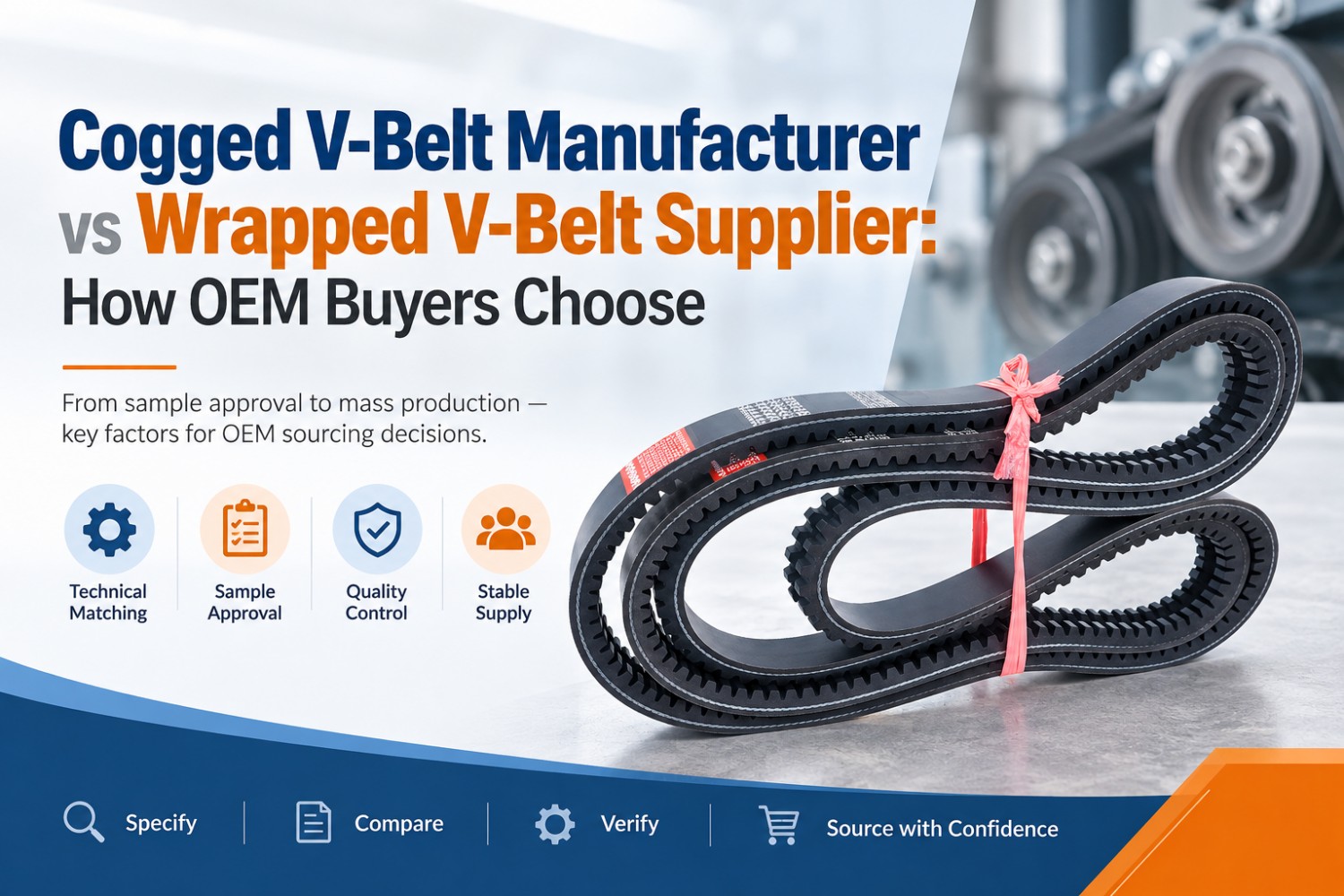
Cogged V-Belt Manufacturer vs Wrapped V-Belt Supplier: How OEM Buyers Choose
Two V-belts can fit the same sourcing spreadsheet and still create very different OEM risks. One supplier may reproduce an approved cogged belt reliably across repeat batches; another may quote a wrapped belt at an attractive price but leave the construction, length basis, marking or inspection criteria unclear. The purchasing problem is therefore larger than choosing between cogged and wrapped construction.
For an OEM buyer, the real decision is whether the supplier can translate a drawing, sample or existing belt into a controlled production specification—and then reproduce it when the order moves from sample quantities to mass production. A capable cogged V-belt manufacturer or wrapped V-belt supplier should be evaluated on technical matching, sample approval, production consistency, inspection evidence, customization and commercial execution, not simply on the lowest quoted unit price.
Choose the belt construction from the drive requirement first. Then qualify the manufacturer around its ability to reproduce the approved specification. Cogged construction can be useful where bending flexibility is important, while wrapped construction remains practical for many conventional drives. Neither construction compensates for an incorrect profile, ambiguous length designation, unsuitable pulley geometry or weak production control.
1. Cogged vs Wrapped Is a Drive Decision Before It Is a Supplier Decision
OEM sourcing often starts with a commercial question: should we buy from a cogged V-belt manufacturer or a wrapped V-belt supplier? Engineering should come first. These constructions behave differently, so the correct supplier shortlist depends on what the machine actually requires.
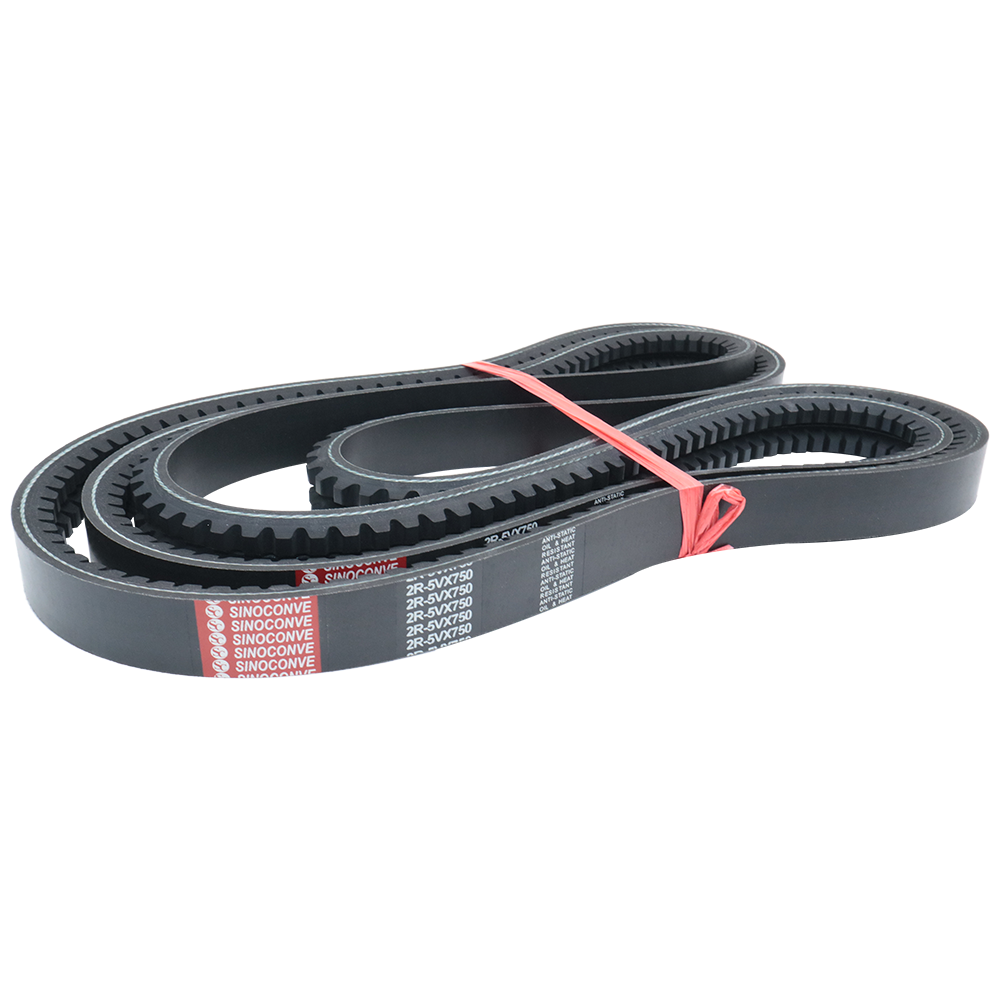
A wrapped V-belt has an external fabric envelope around the belt body. It remains widely applicable to conventional industrial drives where the specified section, pulley arrangement and operating conditions suit wrapped construction. A raw-edge cogged V-belt uses molded notches that allow the belt to flex more readily during repeated bending. The cogs are not timing teeth; power is still transmitted through friction between the V-belt and pulley groove.
That distinction becomes relevant when pulley diameter, drive compactness, operating speed and thermal conditions make belt flexing more demanding. Buyers evaluating these conditions can compare SINOCONVE's rubber cogged V-belt range with the broader industrial V-belt range.

| Buying Factor | Cogged / Raw-Edge V-Belt | Wrapped V-Belt | OEM Verification |
|---|---|---|---|
| Construction | Notched inner profile, commonly with raw-edge sidewalls | Fabric envelope around the belt body | Do not approve by dimensions alone; define construction on the specification |
| Flexing | Cogging generally provides greater bending flexibility | Suitable where the drive geometry agrees with the wrapped design | Provide pulley diameters and drive layout when suitability needs review |
| Replacement sourcing | Preserve the approved construction unless a change is technically validated | Preserve the approved construction unless a change is technically validated | Send belt code, dimensions, photos or approved sample |
| OEM risk | A visually similar belt is not proof of interchangeability | Freeze the approved specification before mass production | |
For replacement programs, this point is especially important. Switching from wrapped to cogged—or the reverse—should not be treated as a purchasing substitution simply because the nominal size appears similar. Pulley compatibility, belt profile, length convention and the machine manufacturer's drive requirements still need to be respected.
2. What an OEM Buyer Should Qualify Beyond the Belt Type
A supplier saying “we can make this size” answers only the first qualification question. OEM production needs repeatability. The belt approved during development has to remain recognizable in later orders by dimensions, construction, marking, packaging and whatever performance or inspection requirements the OEM has formally specified.
This is why the qualification process should separate product capability from production capability. Product capability asks whether the factory can manufacture the required belt. Production capability asks whether it can manufacture the same approved product consistently when purchasing releases repeat orders.
“Stable quality” is difficult to audit. “Which dimensions and construction details are checked against our approved specification before shipment?” is much more useful. Convert every important supplier claim into something your engineering or quality team can verify.

2.1 Drawing and specification control
If the OEM provides a drawing, the supplier should be able to identify what controls production rather than treating the drawing as an attachment to the RFQ. Relevant information can include belt profile, dimensional convention, length designation, construction, marking, quantity per machine and any OEM-specific requirement.
Length terminology deserves particular attention. V-belt dimensions may be described through different dimensional systems, so an isolated length number is not always enough to define the product. Current ISO 4184:2025 covers classical sections Y, Z, A, B, C, D and E and narrow sections SPZ, SPA, SPB and SPC using the datum-length system. For an OEM, however, citing a standard does not replace a complete approved drawing or purchasing specification.
2.2 Sample or existing-belt matching
Not every OEM begins with a complete technical drawing. Legacy machines, aftermarket programs and imported equipment may start with an existing belt or physical sample. In that situation, the supplier should clarify what can be identified from the sample and what still requires confirmation from the buyer.
SINOCONVE supports OEM/ODM production based on customer drawings, samples and special requirements. Standard or small test samples can also be provided for evaluation. This allows the approval process to happen before the buyer commits to a larger production quantity.
2.3 Custom marking and packaging
For an equipment brand or distributor, the belt itself is only part of the deliverable. Logo, color, packaging and other OEM requirements may need to remain consistent from one order to the next. These requirements should be included in the approved sample or specification instead of being handled as informal instructions after production begins.
SINOCONVE supports drawing/sample customization, logo customization, color customization, packaging customization and OEM/ODM orders. For V-belts, the stated MOQ is generally 30–50 pieces depending on the model. Buyers should confirm the exact MOQ for the selected reference during RFQ.
3. Sample Approval Is a Gate, Not Proof of Mass-Production Consistency
A good prototype can prove that a supplier is capable of making one acceptable belt. It does not by itself prove that later batches will reproduce it.
This is one of the largest differences between prototype sourcing and OEM procurement. Once a sample is approved, purchasing needs a controlled reference for subsequent production. Otherwise, changes that appear minor to a supplier—marking, dimensional interpretation, construction detail or packaging—can create receiving problems or assembly-line discrepancies for the OEM.
SINOCONVE's OEM V-belt manufacturing guide covers this transition from drawing or sample through approval and mass production in more detail.
| Approval Stage | What the OEM Should Define | Purchasing Risk if It Is Left Open |
|---|---|---|
| RFQ | Profile, length designation, construction, application, quantity and customization | Suppliers may quote products on different technical assumptions |
| Sample | Dimensions, fit, construction, marking and agreed evaluation requirements | A visually acceptable sample may not represent the required production specification |
| Approval | Which drawing, sample and specification revision becomes the production reference | Later orders can drift from the originally accepted configuration |
| Mass production | Inspection scope and acceptance requirements | Repeatability problems may be found only after shipment or assembly |
| Repeat order | Approved revision, labeling, packaging and any change-control requirement | A repeat PO may not necessarily reproduce the approved belt unless the reference is controlled |
4. Compare Manufacturers Using Evidence You Can Put in a Supplier File
OEM qualification becomes easier when procurement stops asking broad questions such as “Is your quality good?” and starts requesting evidence that can be reviewed internally.
For SINOCONVE orders, raw materials are inspected before entering production, production is subject to in-process inspection, and finished products undergo final testing and inspection before shipment. ISO certificates and product test reports can be provided, while third-party testing can be arranged when customers have special standard requirements.
That information is useful, but OEM buyers should still define what evidence is relevant to their own product. A certificate, a generic laboratory capability statement and an order-specific inspection record answer different questions. One should not automatically be treated as a substitute for another.
4.1 Ask what is inspected for your part number
The useful question is not how many tests a factory can name. It is which characteristics are controlled for the belt being purchased and how acceptance is recorded. The inspection plan should follow the approved product requirement rather than a generic checklist copied across every V-belt.
4.2 Confirm the applicable specification or standard edition
If a drawing or purchasing specification references an industry standard, record the exact reference and edition where relevant. For example, ISO 4184 was revised in 2025. An old specification referring to an earlier edition should not silently be interpreted as the current edition without engineering review.
More importantly, conformity to a dimensional standard does not automatically prove every characteristic an OEM may care about. Material requirements, construction, application-specific performance, marking and packaging may need separate definition.
4.3 Make change control part of repeat purchasing
A supplier change is not the only source of variation. An uncontrolled change inside an existing supply relationship can also create risk. OEM buyers should decide which changes require notification or re-approval—for example, changes affecting an agreed construction, dimensions, marking or other characteristics frozen during qualification.
5. RFQ Data That Separates Serious Manufacturers from Fast Quotations
A useful RFQ gives competing suppliers the same technical basis. Without that, the purchasing team may believe it is comparing prices when it is actually comparing different interpretations of the belt.
For established belt profiles and replacement identification, SINOCONVE's V-belt buying guide for OEMs and distributors provides additional guidance on profile and length identification.
“Same as sample” is useful only when the sample is clearly identified and both parties agree on what must be reproduced. For a repeat OEM program, convert critical sample characteristics into controlled purchasing information wherever possible.
| RFQ Item | What the Buyer Should Provide | Why It Matters |
|---|---|---|
| Belt identification | Part number, printed code, drawing or approved sample | Prevents sourcing from appearance alone |
| Construction | Wrapped, cogged/raw-edge or other required construction | Avoids an unapproved construction substitution |
| Dimensions | Section/profile and clearly defined length designation | Reduces ambiguity between dimensional conventions |
| Drive information | Machine type and, when technical verification is required, relevant pulley and operating data | Helps identify a construction or compatibility problem before sampling |
| Environment | Relevant heat, oil, dust, water, outdoor exposure or other conditions | Operating conditions can affect the required belt specification |
| OEM requirements | Logo, color, belt marking and packaging requirements | Allows approval before mass production rather than after printing or packing |
| Commercial quantity | Sample quantity, forecast or order quantity and destination | Supports realistic MOQ, production and shipment planning |
6. Price Comparison Should Include the Cost of an Unclear Specification
A lower quotation can be a genuine sourcing advantage when two suppliers are quoting the same approved requirement. The problem appears when the technical basis is different.
If Supplier A quotes the exact construction, dimensional convention, OEM marking, inspection requirement and packaging specification while Supplier B quotes only “V-belt, same size,” their prices are not yet comparable. Procurement should close the specification gap before negotiating the difference.
The same logic applies to samples. Repeated sampling caused by incomplete RFQ data creates engineering time, freight cost and project delay even if the sample itself is inexpensive. For an OEM program, purchasing efficiency comes from reducing ambiguity early rather than correcting it during mass production.
7. Delivery Capability Matters, but It Should Be Evaluated Against the Approved Product
OEM buyers need predictable delivery, especially when a belt becomes part of an equipment bill of materials or aftermarket spare-parts program. SINOCONVE states a general production lead time of about 30 days. For urgent requirements, an accelerated production arrangement may reduce this to approximately 15–20 days, subject to the actual order.
Lead time should still be confirmed against the specific model, quantity, customization and approval status. A customized belt that is still awaiting sample confirmation is not at the same production stage as a repeat order released against an approved specification.
SINOCONVE also states that V-belt MOQ is generally 30–50 pieces depending on the type. This can be relevant to OEM development runs, distributors introducing a new reference, or buyers who want to validate a product before increasing order volume.
8. A Practical Supplier Comparison Scorecard for OEM Purchasing
The final supplier decision should combine engineering compatibility and commercial execution. A scorecard does not need to be complicated; it needs to prevent price from becoming the only measurable factor.
| Qualification Area | What to Verify | Warning Sign |
|---|---|---|
| Technical matching | Profile, length basis, construction and application information are understood | Immediate “same product” confirmation from only a photo or incomplete size |
| Sample control | Approved sample is linked to a defined production requirement | No clear reference for what mass production must reproduce |
| Inspection evidence | Supplier can explain relevant incoming, process and final checks | Quality is described only through general claims |
| OEM capability | Drawing/sample production, logo and packaging requirements can be controlled | Customization details are discussed only after the order is placed |
| Commercial execution | MOQ, lead time, payment terms and shipment requirements are explicit | Important conditions remain verbal or undefined |
| Repeat orders | Approved specification can be referenced again | Each PO effectively starts product definition again |
9. Where SINOCONVE Fits an OEM V-Belt Sourcing Program
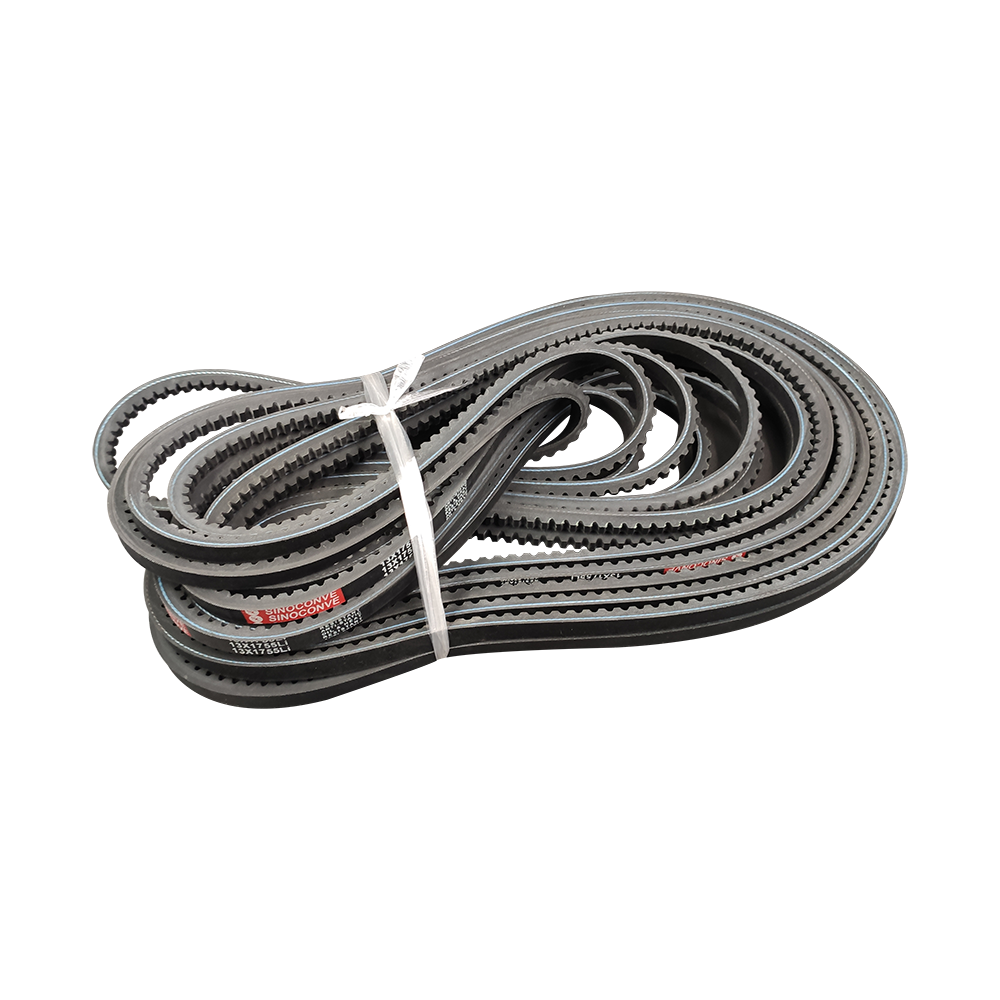
Ningbo Sinoconve Belt Co., Ltd. supports transmission belt and V-belt supply for industrial customers, including OEM/ODM requirements. The company can work from customer drawings, samples and special requirements, with customization covering product marking, logo, color and packaging.
For OEM qualification, standard samples or small test samples can be provided. Quality control includes raw-material inspection, in-process inspection and final inspection before shipment. ISO certificates and product test reports can be supplied, and third-party testing can be arranged where a customer has specific standard requirements.
The point for a buyer is not to accept these statements as a substitute for qualification. Use them as the starting scope for your RFQ: identify the belt, define what must be reproduced, request the evidence relevant to your program, approve the sample and keep that approved requirement connected to subsequent orders.
10. FAQ for OEM V-Belt Buyers
Is a cogged V-belt always better than a wrapped V-belt?
No. Cogged construction can provide greater bending flexibility and may suit drives where flexing is demanding, while wrapped belts remain appropriate for many conventional industrial drives. The pulley geometry, specified belt profile, operating conditions and original drive requirement should determine the choice.
Can an OEM replace a wrapped V-belt with a cogged version of the same nominal size?
Do not approve the substitution from nominal size alone. Confirm profile and pulley compatibility, length convention, drive conditions and any machine-manufacturer requirements. For an existing OEM design, a construction change should be technically reviewed before it becomes a production substitution.
What should I send a cogged V-belt manufacturer for an accurate quotation?
Start with the belt code or drawing, profile, clearly identified length, required construction, quantity and application. If technical matching is needed, add relevant pulley dimensions and operating conditions. OEM marking and packaging requirements should also be defined before sample approval.
Can SINOCONVE produce from a sample or drawing?
Yes. SINOCONVE supports OEM/ODM production based on customer drawings, samples and special requirements. Standard samples or small test samples can also be provided for customer evaluation.
What is SINOCONVE's MOQ for V-belts?
The stated MOQ is generally 30–50 pieces, depending on the V-belt type. The exact quantity should be confirmed for the required model during quotation.
How long does V-belt production take?
General production lead time is approximately 30 days. For urgent requirements, SINOCONVE may arrange an accelerated production schedule of approximately 15–20 days, subject to the specific product and order conditions.
Should an OEM ask for a certificate or a test report?
They serve different purposes. A management-system certificate does not replace evidence that a particular product or batch meets an agreed specification. Define which documentation your quality process actually requires and connect it to the approved product.
What should be frozen after sample approval?
At minimum, freeze the characteristics that determine whether later production is the same approved product: applicable drawing/specification revision, profile and dimensions, construction, agreed marking, packaging and any specified inspection or acceptance requirements.

11. Prepare the RFQ Before Comparing the Final Price
For an OEM buyer, choosing between a cogged V-belt manufacturer and a wrapped V-belt supplier should end with a controlled specification, not a generic product description. Before requesting a final quotation, prepare the existing belt code, drawing or approved sample, required construction, profile and length information, order quantity, relevant operating conditions, and OEM marking or packaging requirements.
SINOCONVE can review these details for sample matching and OEM/ODM production. Send your RFQ to sales@sinoconve.com or use the SINOCONVE RFQ and contact page. The more clearly the approved belt is defined before production, the easier it becomes to compare suppliers on the same technical basis.