
Why raw edge cogged V belts keep showing up in industrial drive systems
A raw edge cogged V belt is often chosen when a conventional wrapped belt starts to look a little too stiff for the job. The basic issue is simple: many machines need compact drives, decent grip on pulleys, and stable power transmission without making the motor work harder than it should. In that setting, a raw edge cogged V belt can be a practical answer because its notched inner profile improves flexibility, which matters on small pulley diameters and in high speed drive layouts.
For engineers and sourcing teams, the real decision is not whether the belt can move power. Almost any industrial drive belt can do that. The question is whether the belt will run smoothly, handle heat and contamination, and keep service intervals reasonable in the actual machine. That is where the construction details start to matter.
What the belt is designed to do
At a basic level, this type of power transmission belt transfers rotational energy between pulleys or sheaves. The raw edge construction exposes the working flanks of the belt, while the cogged underside helps the belt flex repeatedly without fighting itself. That combination is especially useful in drives where bending fatigue and slip are the enemies.
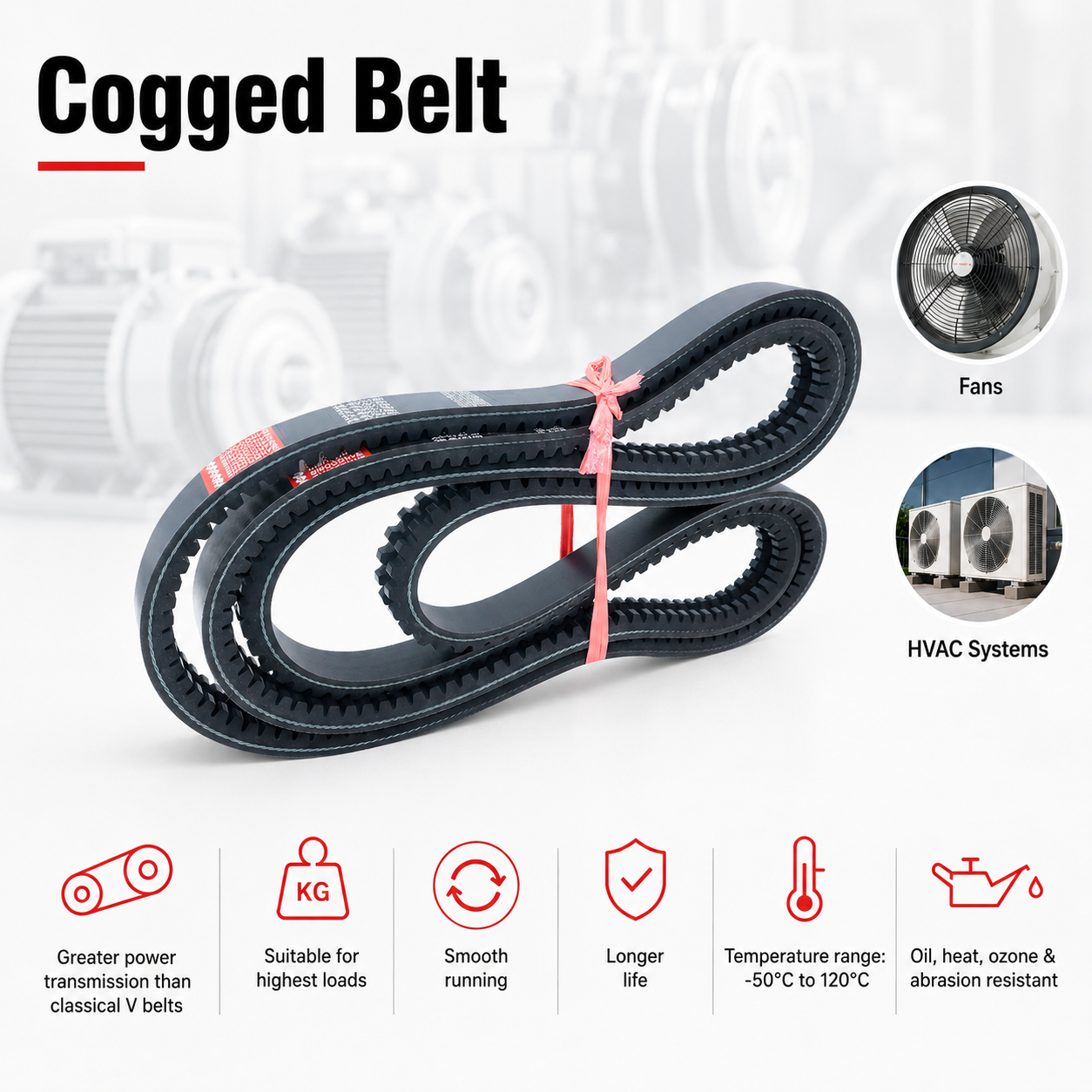
Supplier information commonly associates these belts with features such as high load capacity, low elongation, operational safety, and long service life. The belt family described here is also presented as oil, heat, ozone, and abrasion resistant, with a static conductive design that references ISO 1813. As always, buyers should confirm which of those claims apply to the exact size and variant they are purchasing, not just the family name on a catalog page.
Quick comparison: where cogged belts fit best
Compared with a smooth-backed rubber drive belt, a cogged profile usually offers better flexibility and cooler running in tight drive geometries. Compared with a wrapped belt, it often gives a more direct feel in demanding applications, especially where pulley engagement and bending performance are both important.
That said, a cogged belt is not automatically the right answer for every drive. If the system is lightly loaded, contaminated, or poorly aligned, the belt style alone will not save it. In some machines, a different belt profile or a matched set may be more appropriate. The drive design still sets the limits.
Typical applications and what they tell you
The product information points to industrial motors, compressors, pumps, generators, fans, agricultural machines, and HVAC systems. Those are not random examples. They are exactly the kinds of machines that rely on stable pulley-based transmission and spend much of their life in continuous rotation. A belt in a fan cabinet sees a different duty cycle from one in a generator set or a farm machine, but the shared requirement is the same: dependable torque transfer with as little drift as possible.
The temperature windows shown in the supplied data also suggest two slightly different product statements: one belt family is listed at -55°C to 70°C, while another description cites -50°C to 120°C. Buyers should not treat those numbers as interchangeable. They may reflect different constructions or marketing graphics. That is worth checking before a purchase order goes out.
Selection criteria engineers should not skip
Pulley geometry and bend radius
If the belt has to wrap around small sheaves, flexibility becomes a major factor. A cogged V belt is often selected precisely for this reason. Still, the pulley groove profile must match the belt section, or the drive will never run correctly.
Heat, oil, and ozone exposure
Plant environments are rarely gentle. A belt near compressors or generators may see elevated temperature, mist, or airborne contamination. The stated resistance properties matter because they help the belt hold its shape and surface integrity over time, but they do not replace proper guarding or maintenance.
Static conductivity
For some drives, static conductive behavior is not a nice-to-have. It is part of the safety conversation. The reference to ISO 1813 is useful here, but buyers should verify the scope of compliance for the specific belt and size, especially if the application sits in a sensitive or regulated environment.
Common mistakes in belt sourcing
One common error is treating all cogged belts as equivalent. They are not. Cross-section, cord package, temperature rating, and intended service duty all change the outcome. Another mistake is assuming that a printed claim like “high load capacity” automatically means the belt can carry any load in any arrangement. Real drives still depend on center distance, pulley alignment, and tensioning practice.
A smaller but frequent issue is ordering from a description alone without confirming the marking on the belt, such as the visible “D-100” and branding shown on the sample product. Markings help, but they are not a substitute for a full dimensional check.
Buyer advice for sourcing teams
If you are comparing suppliers, ask for the exact belt profile, operating temperature range, and the basis for any resistance or conductivity claims. If the application is a high speed drive, ask how the belt behaves under prolonged cycling rather than only at nominal load. And if you need replacement consistency, check whether you are buying a single belt or a matched set. That detail gets overlooked more often than it should.
For maintenance teams, the practical watchpoints are familiar: inspect for glazing, cracking, fraying, and unusual dusting; confirm pulley alignment; and do not over-tension in the hope of curing slip. Over-tension can shorten bearing life faster than it improves drive performance.
A useful next step
For machines that need flexible power transmission, stable pulley engagement, and resistance to heat or oil exposure, a raw edge cogged V belt is often worth specifying early in the design or replacement process. The best procurement decision comes from matching the belt construction to the actual drive duty, not just the catalog heading. If you are evaluating options, collect the pulley dimensions, speed range, load profile, and environmental conditions first. The belt choice usually becomes much clearer after that.