

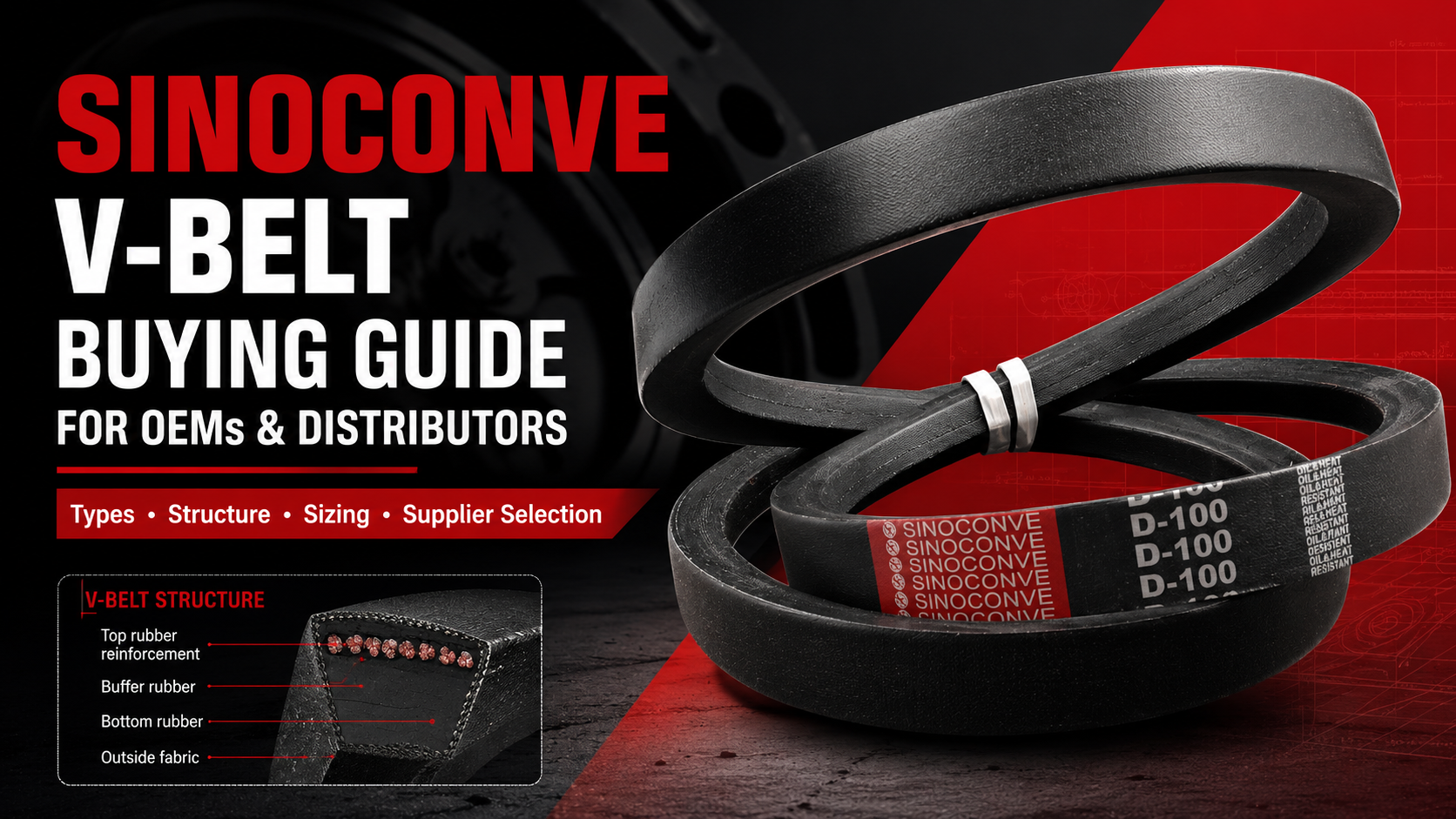
For an OEM or distributor, a V-belt order is rarely just “rubber belt + size.” The part has to fit an existing pulley system, carry the intended duty, use the correct length convention, and remain repeatable from one shipment to the next. A belt that looks close on a bench can sit too high or too low in the groove, alter take-up position, or create uneven load sharing in a multi-belt drive.
This buying guide focuses on the information that should be settled before an RFQ: V-belt profile family, cross-section, length designation, construction, drive conditions and application. It also separates replacement identification from new-drive selection. That distinction matters. A distributor matching a worn belt should preserve compatibility first; an OEM designing a new drive has more freedom to optimize the drive around power, speed, pulley diameter, space and service conditions.
1. Start With the Buying Situation: Replacement or New OEM Design?
The same catalog can serve two very different jobs. For replacement business, the safest starting point is the installed drive: identify the existing belt marking, pulley groove, belt count, tensioning range and any evidence of abnormal wear. Do not convert from one profile family to another merely because the nominal top width looks similar. The belt and sheave geometry must work as a system.
For a new OEM drive, profile selection is an engineering decision. Motor power alone is not enough. The design should consider driver and driven speeds, duty cycle, starting load, pulley diameters, center distance, available take-up, number of grooves, environmental exposure and the equipment manufacturer's service factors or rating method. Final belt quantity and pulley sizing should be checked with the applicable drive-design data rather than estimated from a generic horsepower range.
1.1 What distributors should capture from a replacement belt
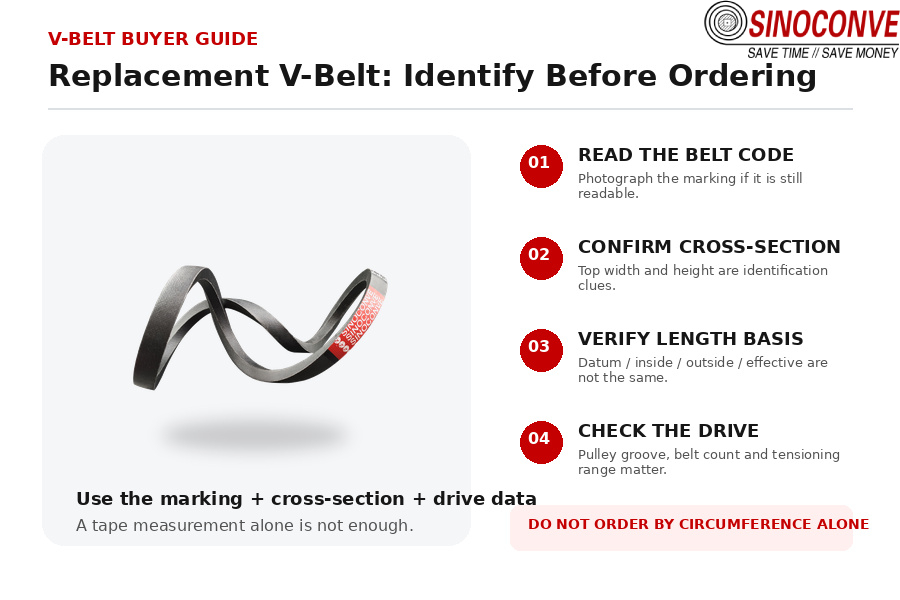
· Readable belt code and brand, if available; photograph both the marking and cross-section.
· Top width, approximate height and circumference as identification clues—not as the sole basis for ordering.
· Pulley groove count, pulley condition and whether the drive uses a matched multi-belt set.
· Machine type, motor power/speed, driven speed and the failure symptom if the old belt did not reach expected service life.
1.2 What OEM engineers should add
· Rated and peak/design power, driver speed and driven speed.
· Small and large pulley diameters, center distance and available adjustment.
· Daily operating hours, starts/stops, shock load and temperature or contamination exposure.
· Space constraints, maintenance access and whether a compact drive or reduced belt count is a design priority.
2. V-Belt Profiles: Match the Cross-Section to the Pulley
Industrial V-belts transmit torque by wedging against the sides of a matching grooved pulley. That is why profile identification comes before length. Two belts can have similar widths yet require different groove geometry. The current ISO framework also treats belt and pulley compatibility as a defined system: ISO 4184:2025 covers classical and narrow V-belt sections and datum-system lengths, while ISO 4183:2026 specifies principal grooved-pulley dimensions for those sections.
2.1 Classical profiles
Classical sections remain common in installed machinery and replacement channels. ISO 4184:2025 includes Y, Z, A, B, C, D and E classical sections. For distributors, these codes are useful starting points, but the printed designation and length basis still need confirmation before cross-referencing.
2.2 Narrow/wedge profiles
SPZ, SPA, SPB and SPC are narrow V-belt sections covered by the same ISO datum-width system. Their deeper, narrower geometry is used where higher power density or a more compact drive is required. In North American practice, 3V, 5V and 8V are also widely encountered narrow-section families. Similar-looking families should not be treated as automatically interchangeable; confirm the pulley standard and supplier cross-reference.
2.3 Cogged/raw-edge, wrapped, banded and double-sided constructions
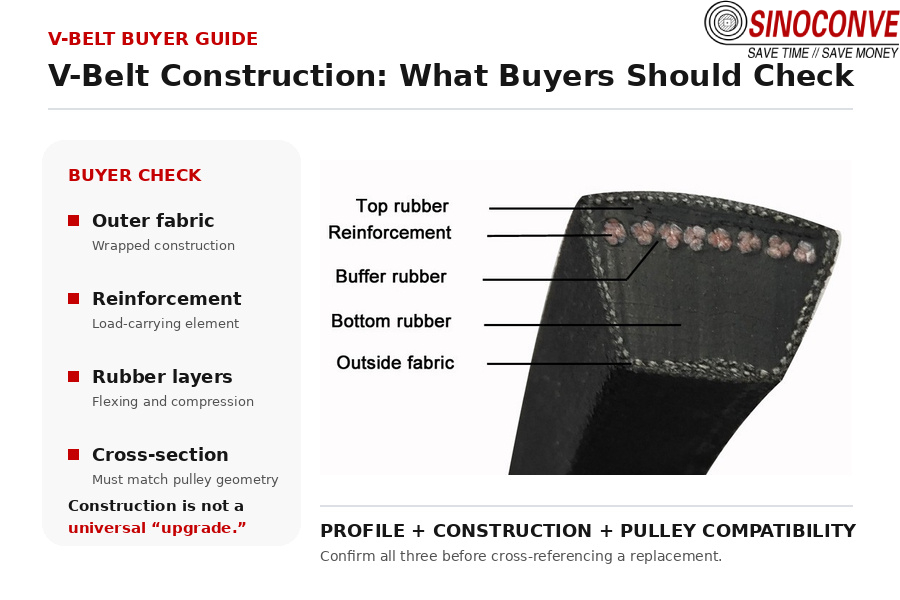
Profile tells you the groove family; construction tells you how the belt is built for the duty. Wrapped belts have an outer fabric envelope. Raw-edge cogged versions use molded notches to improve bending flexibility and are often considered where smaller pulley diameters or heat generated by flexing are concerns. Banded belts tie multiple ribs together and can help stabilize drives exposed to pulsation, shock or belt whip. Double-sided V-belts transmit power from both sides in serpentine arrangements. These constructions are not universal upgrades: pulley geometry, allowable minimum diameter, tensioning and the drive layout still govern suitability.
|
Family / construction |
Common designations |
Best buying use |
Verify before ordering |
|
Classical |
Z, A, B, C, D, E |
Installed-base replacement; general industrial drives |
Exact section, pulley groove, length basis |
|
Narrow / wedge |
SPZ, SPA, SPB, SPC; 3V, 5V, 8V |
Compact or higher power-density drive designs |
Which standard/family the pulley uses |
|
Cogged / raw-edge |
AX/BX/CX; cogged narrow variants |
Applications needing greater flexing capability |
Pulley diameter, speed, temperature, supplier rating |
|
Banded |
Joined multiple V sections |
Shock, pulsation or belt-stability problems |
Pulley compatibility and drive layout |
|
Double-sided |
Hexagonal / double-V families |
Serpentine drives with power transfer on both sides |
Pulley arrangement and correct section |
3. V-Belt Sizes: Why Profile and Length Must Be Specified Together
A useful V-belt size is not a single circumference. It is a profile plus a defined length. Depending on the belt family and regional convention, a designation may refer to datum/pitch length, inside length, outside length or an effective length. Those values are not numerically identical because they are measured at different positions in or around the belt.
For ISO classical and narrow V-belts, ISO 4184:2025 is the current reference for recommended datum lengths, datum-length tolerances and measurement conditions. This is particularly important for international sourcing: an RFQ that says only “B section, 80 inch” leaves room for a costly interpretation error if the 80 inches refers to a different length basis.
3.1 Do not convert a worn belt by circumference alone
A used belt may have wear, deformation or a marking that no longer represents a simple tape measurement. If the code is unreadable, combine physical measurements with pulley-groove identification and machine data. For a critical replacement, a sample is often more useful than a single handwritten dimension.
3.2 Multi-belt drives need consistent belt length
In a multi-groove drive, belts are expected to share load. Mixing old and new belts can concentrate load on the new belts because the set no longer behaves uniformly. For replacement, change the complete set and specify that the belts are intended to run together. Consistency of section and length is a procurement requirement, not just a maintenance preference.
4. Application Conditions Change the Right V-Belt Specification
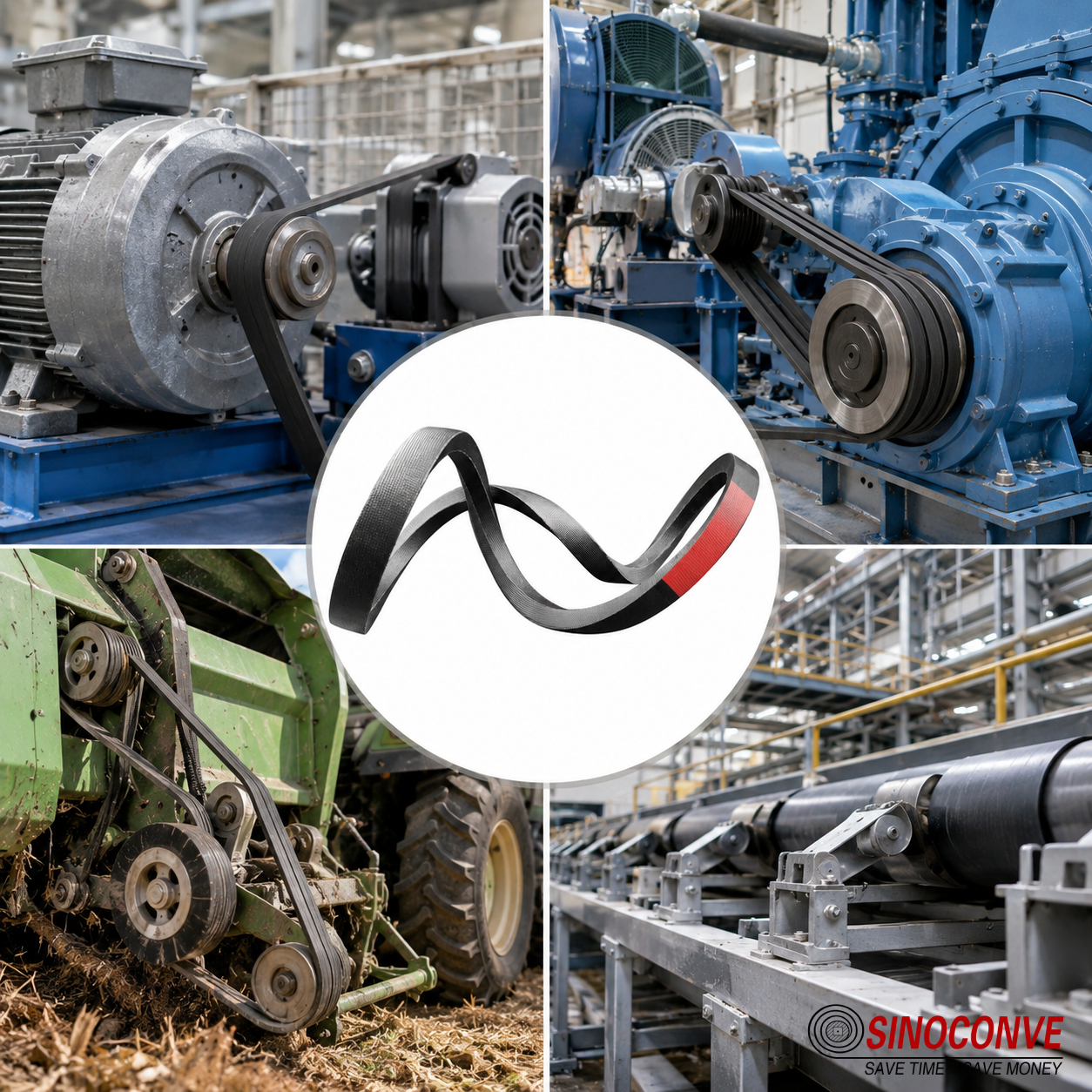
A belt that is dimensionally correct can still be wrong for the application. OEMs and distributors should describe the operating conditions that influence compound, construction and drive rating. SINOCONVE identifies automotive, general machinery, agricultural/engineering machinery, textile/printing and broader industrial uses among its transmission-belt markets. The correct specification within those markets still depends on the actual drive.
4.1 General machinery, fans, pumps and compressors
These drives may look routine, but continuous operating hours, speed, pulley diameter and alignment quality strongly affect the result. For replacement orders, investigate glazing, cracking, edge wear or repeated retensioning rather than assuming the old belt simply “wore out.”
4.2 Agricultural and engineering machinery
Dust, outdoor exposure, shock loading and variable duty can make belt stability and maintenance access more important than nominal power alone. Give the supplier the equipment type and duty pattern, especially when the belt experiences frequent starts or load reversals.
4.3 Textile, printing and other higher-speed equipment
Noise, vibration and speed consistency may be commercially important. Pulley condition and alignment deserve attention because a new belt cannot correct a worn groove or misaligned shaft. If the application has strict vibration or dimensional requirements, put them in the RFQ instead of relying on a generic “industrial V-belt” description.
5. Diagnose the Old Drive Before Reordering
|
Observed problem |
Possible causes to investigate |
What to verify before the next order |
|
Rapid sidewall wear |
Pulley misalignment, worn grooves, wrong profile |
Pulley groove condition, alignment, exact section |
|
Glazing or slip |
Insufficient tension, overload, contamination, worn pulley |
Drive load, tensioning method, pulley condition |
|
Cracking / heat damage |
Excessive flexing, small pulley, high temperature or aging |
Pulley diameter, speed, ambient/drive temperature, construction |
|
One belt fails early in a set |
Mixed belt condition or unequal load sharing |
Replace full set; specify consistent set |
|
Belt rides too high/low |
Incorrect profile or worn/incorrect groove |
Cross-section and pulley standard before length |
Installation remains part of the system. Industry maintenance guidance consistently emphasizes correct pulley alignment and belt tension. After fitting, rotate the drive to seat the belts and recheck tension using the method specified for that drive. If the pulleys are worn or misaligned, changing belt brands alone is unlikely to solve the underlying failure.
6. What an OEM or Distributor Should Put in a V-Belt RFQ
A strong RFQ reduces back-and-forth and makes quotations comparable. For repeat distribution business, it also becomes the basis for SKU control and future replenishment.
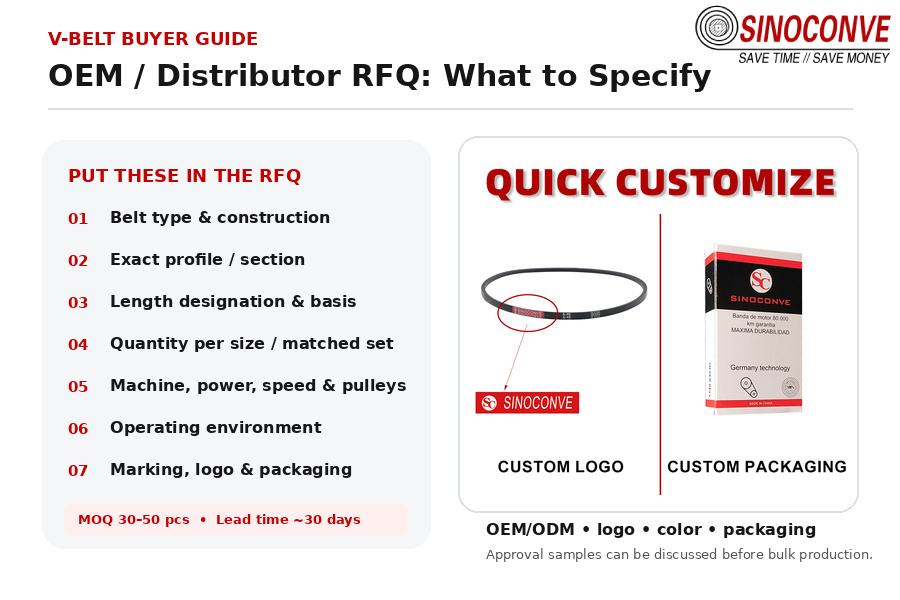
· Belt type and construction: wrapped, cogged/raw-edge, banded, double-sided, or other required form.
· Profile/section: for example A, B, SPZ, SPA, SPB, SPC, 3V or 5V—using the exact family required by the pulley.
· Length designation exactly as marked, including the length basis or applicable standard where known.
· Quantity per size and whether belts will run as matched sets.
· Machine/application, motor power and speeds, pulley diameters and center distance for new designs or uncertain replacements.
· Operating conditions: hours, starts, shock, ambient temperature, oil/water/dust exposure and outdoor use.
· Required marking, logo, color, packaging, documentation and target market.
· Sample, drawing or clear photos when the existing designation is uncertain.
SINOCONVE's confirmed commercial information states that V-belt MOQ is generally 30–50 pieces depending on the model. V-belts are custom-produced rather than held as finished stock. Standard lead time is generally about 30 days; urgent orders may be handled in roughly 15–20 days subject to confirmation. OEM/ODM, logo, color and packaging customization are supported, and standard or small test samples can be discussed before bulk ordering.
7. Supplier Evaluation: Look Beyond a Size List
For distributors, product breadth matters only if repeat orders remain consistent. Ask how the supplier controls raw materials, in-process production and final inspection; how dimensional or performance requirements are documented; and what happens when a quality issue is confirmed. SINOCONVE states that it performs incoming-material checks, in-process inspection and final testing before shipment, and can provide ISO certificates and product test reports. Where a customer has a special standard requirement, third-party testing can be arranged subject to project confirmation.
Commercial fit also matters. SINOCONVE was established in 1988 and reports more than 35 years of manufacturing experience. Its transmission-belt offering includes rubber V-belts alongside timing belts and automotive/PK belts. For V-belts, the company states that molds cover market models and that custom production can be based on drawings, samples or special requirements. Buyers should still confirm the exact requested section, construction, length system and applicable standard on the quotation and approval sample.
8. Final Buying Check Before Purchase Order
· Is this a replacement or a new drive design?
· Does the belt profile match the actual pulley groove family?
· Is the length basis unambiguous—not just a bare number?
· For a multi-belt drive, is the complete set being replaced and ordered consistently?
· Have duty, speed, pulley diameter, center distance and environment been disclosed where they affect selection?
· Are marking, packaging, test documentation and approval-sample requirements written into the order?
· Has the supplier confirmed MOQ, production lead time and any customization before the PO is released?
If you are sourcing V-belts for an OEM program or distribution range, send SINOCONVE the existing belt code or sample plus the application, pulley information, quantity by size and target market. For a new drive, include power, driver/driven speed, pulley diameters and center distance. That information allows the technical and sales teams to confirm the correct product family before quotation rather than trying to resolve compatibility after production.
9. Frequently Asked Questions
9.1 Can I order a V-belt from top width and circumference only?
Those measurements can help identify an unknown belt, but they are not the preferred final specification. Confirm the profile, pulley groove and the length convention used by the belt designation.
9.2 Are A/B/C belts interchangeable with SPZ/SPA/SPB/SPC belts?
No automatic interchange should be assumed. They belong to different profile families. Even where dimensions appear close, the belt must match the pulley geometry and the drive should be checked before conversion.
9.3 What is the difference between datum length and outside length?
They are measured on different reference paths. ISO classical and narrow V-belt designations use a datum-system framework, while other belt families or catalogs may use outside, inside or effective length. Always state the convention with the number.
9.4 Should I replace only the failed belt in a multi-belt drive?
Normally the complete set should be replaced. Mixing used and new belts can produce unequal tension and load sharing, which can shorten service life.
9.5 What information is most useful when the belt marking is unreadable?
Provide clear photos, top width and height, approximate circumference, pulley-groove details, machine model/application and, if practical, a physical sample. These clues are stronger together than any one measurement.
9.6 What is SINOCONVE's V-belt MOQ and typical lead time?
The confirmed MOQ is generally 30–50 pieces depending on the model. Typical production lead time is about 30 days; urgent production may be possible in approximately 15–20 days, subject to order details and confirmation.


