
Poly V Belt: A Comprehensive Guide to Ribbed Belts
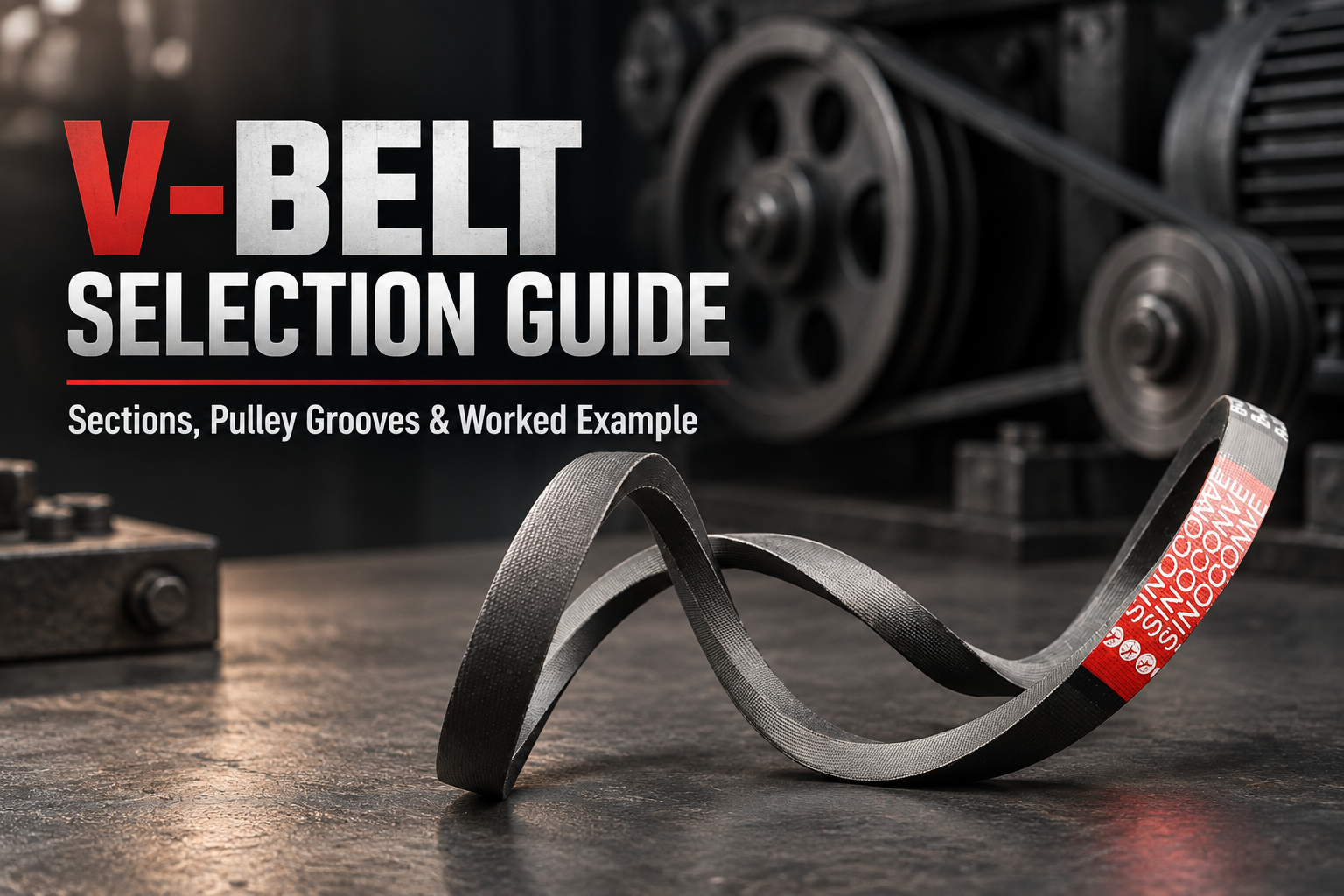
Classical V-belts work. But pack more ribs into the same width and you get more grip, less slip, and a belt that handles variable loads without the bulk. That shift is why the poly V belt now drives most modern automotive accessory systems, HVAC equipment, and precision industrial machinery. This guide covers construction, what separates poly V from PK belt standards, where each profile fits, and what to look for during installation and maintenance.

How a Poly V Belt Works
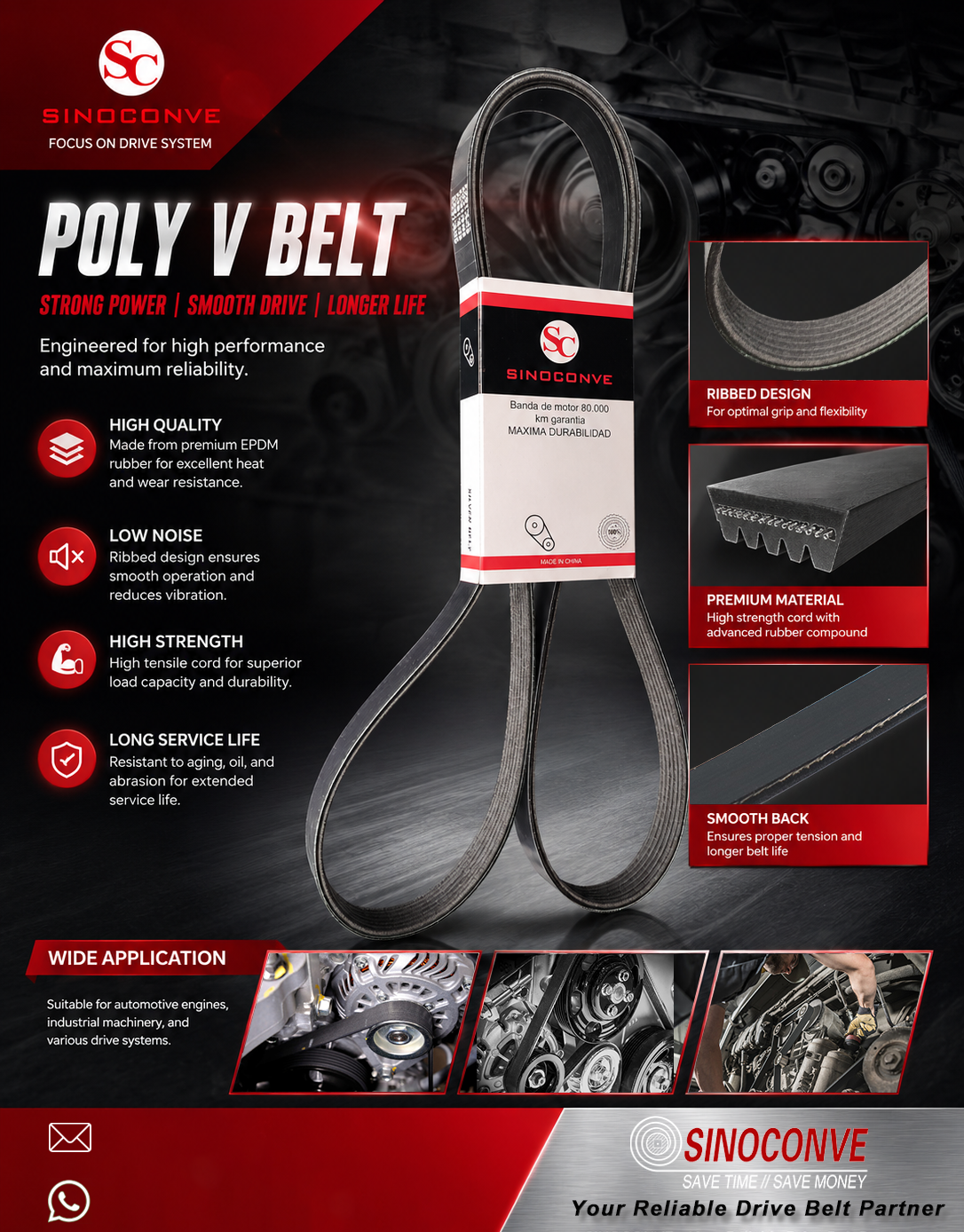
The V-shape is what does the work. Each rib on the belt seats into a matching groove on the pulley, and because of the angle, tension in the belt pushes the ribs sideways into the groove walls. More tension means more contact pressure — and since that pressure is distributed across all ribs simultaneously, a poly V belt transmits the same torque as a wider classical V-belt at lower operating tension. Lower tension means lighter bearing loads and less stress on the shaft.
The smooth back surface is a separate design feature that gets underappreciated. It lets the belt run over backside idler pulleys without damage — the rib face never contacts a flat idler. That makes serpentine routing possible: one belt, one tensioner, six or seven driven accessories in sequence. Without a smooth back, that layout requires multiple individual belts.
Construction and Materials
Rubber compound
EPDM is the standard compound for automotive poly V belts, and for good reason. Engine bays are not stable environments — temperature swings from below freezing on a winter morning start to over 100°C at operating temperature, ozone from electrical components, and occasional oil or coolant contact from a slow leak. Neoprene-based belts handled this environment for decades but showed cracking and hardening earlier than EPDM. The compound change extended belt intervals significantly and is now the baseline for OEM and replacement supply.
For industrial applications outside the automotive context, CR (chloroprene) compounds are sometimes specified where oil resistance is the dominant requirement rather than temperature range.
Tension cord
Polyester cord is the standard tension member in most poly V belts. It provides good tensile strength, low elongation under working load, and adequate fatigue resistance for the flex cycles a belt accumulates across its service life. Aramid cord is used in higher-performance applications where load spikes are sharper or where minimum elongation is a design requirement — the tradeoff is that aramid is more sensitive to bending fatigue over small pulley diameters.
Rib geometry
Rib pitch — the spacing between rib centers — determines which pulley system the belt is compatible with. This is not adjustable; the pitch is fixed by the belt standard, and the pulley groove geometry must match exactly. Running a belt on mismatched grooves produces accelerated rib wear and eventually rib cracking or jumping.
Poly V Belt vs PK Belt: What the Distinction Actually Means
The PK belt is a standardized ribbed belt profile defined by ISO 9982 and equivalent DIN standards, with a rib pitch of 3.56 mm. It is the most widely used profile in automotive serpentine drive systems globally. When a parts catalog lists a belt as 6PK1550, that means 6 ribs, PK profile, 1550 mm pitch length — a fully defined specification that is interchangeable across manufacturers who hold to the standard.
Poly V belt is the broader category. PK sits inside it, along with PH (1.6 mm pitch), PJ (2.34 mm pitch), PL (4.70 mm pitch), and PM (9.40 mm pitch). Each profile targets a different application range based on torque load and drive geometry.
In practice: automotive equipment almost always means PK. Compact precision equipment — medical devices, office automation, small motors — typically uses PH. Heavy industrial drives with higher torque requirements move into PL or PM. If the existing belt designation is not readable, measure the pulley groove pitch. That number maps to the profile.
Poly V Belt Profile Comparison
| Profile | Rib Pitch | Typical Application | Power Level |
|---|---|---|---|
| PH | 1.6 mm | Medical devices, office automation, small motors | Light |
| PJ | 2.34 mm | Home appliances, light industrial drives | Light-medium |
| PK | 3.56 mm | Automotive serpentine, HVAC, packaging machinery | Medium-heavy |
| PL | 4.70 mm | Industrial machinery, compressors, generators | Heavy |
| PM | 9.40 mm | Heavy industrial, high-torque drives | Very heavy |
Where Poly V Belts Are Used
Automotive engines
The PK belt in an automotive serpentine drive powers the alternator, power steering pump, water pump, AC compressor, and cooling fan from a single belt looping off the crankshaft pulley. The belt runs at engine speed for the vehicle's lifetime — typically 60,000 to 100,000 km before replacement. The combination of EPDM compound, polyester tension cord, and backside idler capability makes the ribbed belt the only practical solution for this application geometry.
HVAC and industrial blowers
Air handling units, ventilation fans, and compressors use PK and PL ribbed belts for their combination of high efficiency and compact drive geometry. The continuous-duty cycle of HVAC equipment puts fatigue resistance ahead of most other belt properties — a belt that runs 8,000 hours per year needs more from its tension cord and rubber compound than one that sees seasonal use.
Precision and medical equipment
PH profile ribbed belts appear in laboratory centrifuges, diagnostic equipment, and precision instruments where the combination of high speed, low torque, and minimal noise is the requirement. The finer pitch allows small-diameter pulleys and quieter operation than PK construction would produce at the same drive geometry.
Installation and Maintenance
No lubrication. Ever. Oil or grease on the rib surface kills grip almost immediately and glazes both the belt and pulley groove. Installation without forcing: if the belt will not seat with normal hand pressure after the tensioner is released, something is wrong — wrong belt length, wrong profile, or the tensioner has not fully released.
Automotive applications handle tension automatically through spring-loaded tensioners. Industrial drives often do not. On those systems, skip the finger-press deflection check — it is not accurate enough. Use a tension gauge. A belt running slack will glaze and slip; one running too tight puts bearing load well above what was designed for and burns through the tension cord faster than the application demands.
Three conditions to look for during inspection: cracks running lengthwise across the ribs signal compound hardening — usually age or heat exposure. Shiny, glassy rib faces mean the belt has been slipping, from contamination or slack tension. Missing chunks of rib material point to overload or groove damage in the pulley. None of these improve on their own. Replace the belt and fix the root cause.

FAQ
Is a poly V belt the same as a PK belt?
No. PK is one profile within the poly V belt family — 3.56 mm pitch, standardized for automotive use, the most common one you will encounter. The poly V category also includes PH, PJ, PL, and PM. All PK belts are poly V; the reverse is not true.
How do I know which poly V belt profile I need?
Look at the existing belt first — the profile code is stamped on the back (e.g. 6PK1550 means 6 ribs, PK profile, 1550 mm pitch length). Belt worn beyond reading? Measure the pulley groove pitch with a caliper. Each poly V profile has a unique pitch and only fits its own grooves. The equipment manual has it too if neither of those options works.
Can a ribbed belt run on smooth (flat) pulleys?
The smooth back surface of a poly V belt can run over a flat backside idler — this is standard practice in serpentine drives. The ribbed face cannot run on a flat pulley; it requires matching grooves to seat correctly. Running ribs against a flat surface produces noise, rapid rib wear, and eventual belt failure.
Why does my ribbed belt slip after installation?
Three usual suspects: wrong tension, contamination, or a profile mismatch. Contamination is the one people try to wipe off — do not bother. Oil soaks into the rib surface and the grip does not come back. Fit a new belt and find the leak. Tension needs to be checked against the spec. Profile mismatch means the belt is running in grooves it does not fit — check the pitch.
What is the service life of a poly V belt in automotive use?
Somewhere between 60,000 and 100,000 km for most passenger vehicles, though the actual interval depends on the vehicle manufacturer's specification. EPDM belts do not crack as early as neoprene ones did, which makes visual inspection less reliable as a trigger — follow the manufacturer's replacement interval rather than waiting for visible damage.
Sinoconve Poly V Belt Range
Ningbo Sinoconve Belt Co., Ltd. manufactures poly V belts across PH, PJ, PK, PL, and PM profiles to ISO 9982 and DIN standards. EPDM and CR compound options are available, with polyester and aramid tension cord configurations for standard and high-performance applications. PK belt configurations from 3PK to 12PK across standard pitch lengths are in regular production; custom lengths and rib counts are available for OEM applications.
Products are supplied for automotive replacement, industrial drive, and precision equipment applications. OEM production with custom branding and packaging is supported. Contact: sales@sinoconve.com.