
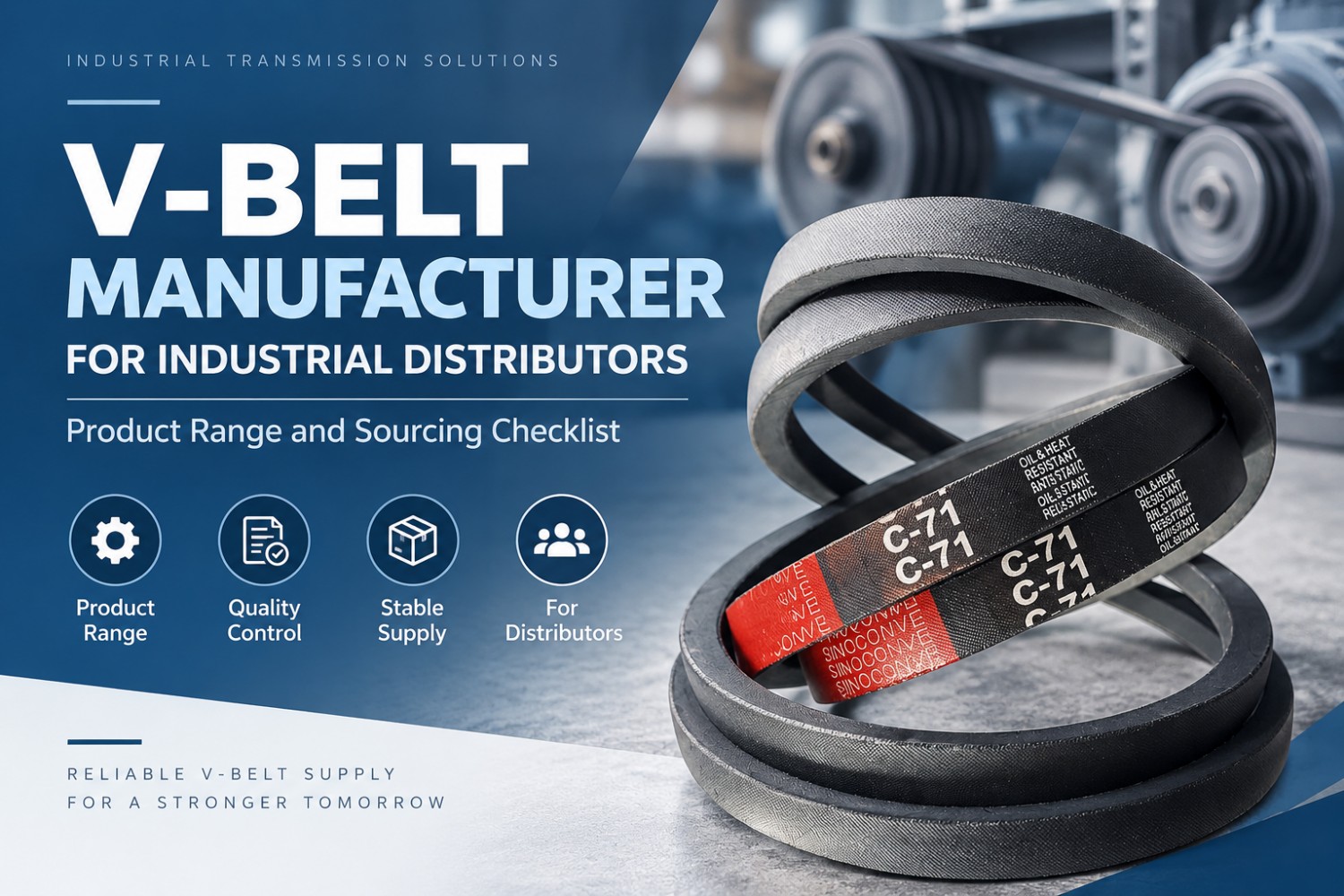
V-Belt Manufacturer for Industrial Distributors: Product Range and Sourcing Checklist
For an industrial distributor, choosing a V-belt manufacturer is not just a question of finding a factory that can quote A, B, SPA or SPB belts at an acceptable price. The harder part comes after the first shipment. Will replacement orders match the approved belt? Can one supplier cover enough fast-moving and specialist sizes without forcing excessive inventory? Can private-label markings and cartons stay consistent? And when an end customer questions a belt, what inspection evidence can the distributor obtain?
These questions matter because distributors carry the commercial risk between the manufacturer and the local market. A low purchase price can quickly lose its advantage if the assortment contains incompatible profiles, repeat orders vary, slow-moving SKUs consume working capital, or quality questions cannot be traced back to a specification.
This guide explains how distributors, wholesalers and importers should evaluate a V-belt manufacturer by product coverage, technical compatibility, MOQ, batch control, OEM capability and RFQ discipline.
Quick Answer for Distributors
Do not qualify a V-belt supplier from its catalog size or unit price alone. Verify the exact belt profiles and length designation, construction, application conditions, sample-to-batch consistency, inspection documentation, SKU-level MOQ, private-label requirements, packaging and repeat-order identification. The objective is not simply to buy rubber V-belts; it is to build a range that can be replenished reliably.

1. Start with Product Range, but Do Not Stop at the Catalog
A broad range matters to a distributor because industrial customers rarely buy one V-belt size forever. A wholesaler may serve motors, pumps, fans, compressors, agricultural machinery, workshop equipment and general industrial drives. Different customers can therefore request different profiles, lengths and constructions.
SINOCONVE's current industrial V-belt range includes wrapped and cogged V-belt options across multiple profile families. For a distributor, however, seeing a profile in a product catalog should be treated as the beginning of technical confirmation rather than automatic proof that every requested SKU is interchangeable with an existing local product.
The RFQ should identify the exact belt designation used in the target market. This is especially important when the distributor is consolidating products previously purchased from several suppliers.
| Product Family | Distributor Use | What Must Be Verified | Sourcing Risk |
|---|---|---|---|
| Classical V-belts | General industrial replacement ranges | Section, length designation, pulley compatibility and construction | Similar markings can hide specification differences |
| Narrow V-belts | Industrial drives using profiles such as SPZ, SPA, SPB and SPC | Exact profile, datum/effective length convention and pulley groove | Incorrect profile selection can create fit and drive problems |
| Cogged V-belts | Applications where a cogged construction is specified | Profile, dimensions, construction and approved application | Do not substitute solely because nominal dimensions appear similar |
| Wrapped V-belts | Common industrial and replacement applications | Section, length, drive conditions and required construction | A familiar appearance does not establish interchangeability |
2. Build the SKU List Around Compatibility, Not Names Alone

One of the easiest purchasing mistakes is treating every belt carrying a familiar section name as equivalent. A V-belt works as part of a belt-and-pulley system. The belt sides engage the pulley groove; it should not simply run on the bottom of the groove. Profile geometry, pulley condition, length designation and tension therefore matter alongside the belt material itself.
This has a direct commercial consequence for distributors. If a customer sends only a short description such as “B belt” or “SPB belt,” the manufacturer may still lack enough information to confirm the replacement. An old belt can also be worn, stretched or marked under a different length convention.
For unfamiliar or high-volume SKUs, send the complete marking, requested section and length, application information, quantity and any available drawing or approved sample. Where interchangeability is uncertain, confirmation before bulk ordering is safer than building a cross-reference from appearance alone.
RFQ Warning
Do not ask a factory to quote a distributor's complete SKU list from part numbers alone unless both parties have already agreed what those numbers mean. Add the corresponding profile, length designation and reference specification, or provide samples/drawings for uncertain items.
3. Use the Correct Standard and Length System in the RFQ
Standards are useful when they define the same technical language for buyer and manufacturer, but writing “ISO standard” in an RFQ is too vague.
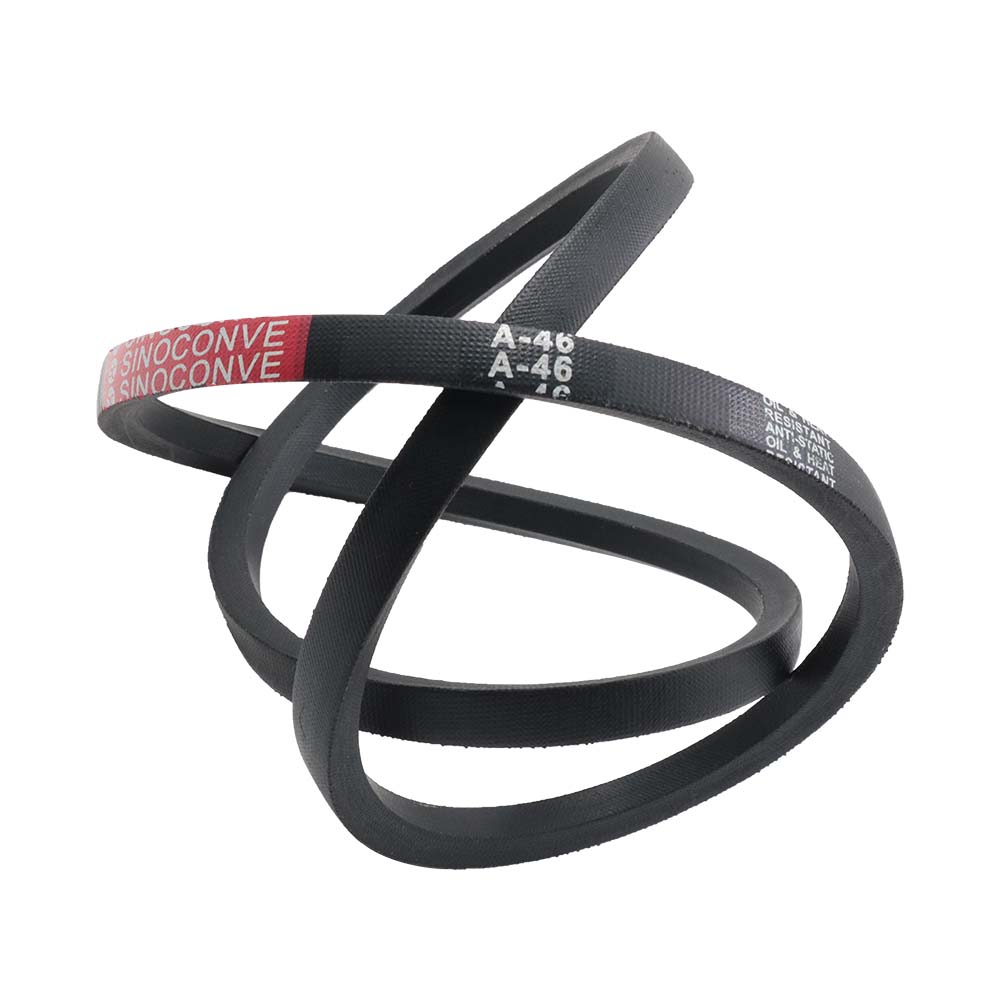
For example, ISO 4184:2025 addresses classical V-belts in Y, Z, A, B, C, D and E sections and narrow V-belts in SPZ, SPA, SPB and SPC sections using the datum length system. V-belt terminology also distinguishes dimensional systems used to describe belts and pulley grooves.
The practical lesson for a distributor is simple: specify the profile and the length convention that applies to the SKU rather than assuming that a nominal number means the same thing in every catalog.
If an end customer has a drawing, existing specification or required standard, include it in the quotation package. If there is no formal standard requirement, the manufacturer should still receive enough dimensional and application information to identify the intended belt correctly.
4. MOQ Has to Work with the Distributor's Inventory Model
MOQ is not just a negotiation point. It determines how much cash a distributor ties up in each SKU.
A bulk order can look attractive when evaluated by total quantity, while still creating poor inventory economics if every individual size carries a high minimum. Fast-moving A or SPA sizes may justify deeper inventory. A specialist replacement size with uncertain demand may not.
SINOCONVE's confirmed commercial information states that the typical V-belt MOQ is 30–50 pieces, depending on the model. Products are primarily manufactured to order rather than maintained as a general finished-stock program. Distributors should therefore confirm MOQ against the actual mix of models in the RFQ rather than applying one number to the entire assortment.
Before comparing quotations, ask how the MOQ works for:
- each belt model and size;
- mixed-SKU orders;
- custom or non-standard requirements;
- private-label belt markings;
- custom cartons or packaging;
- sample or trial orders before range expansion.
This gives purchasing teams a more useful measure than unit price alone: inventory commitment per sellable SKU.
5. Private Label Requires More Control Than Printing a Logo
For a distributor building its own brand, private label changes the sourcing relationship. Once the distributor's name appears on the belt or carton, inconsistent products become a local brand problem rather than an invisible factory problem.
SINOCONVE supports customization, including logo and packaging requirements and OEM/ODM cooperation. Requirements can be discussed from drawings, samples or other agreed technical information. The important step for a distributor is to freeze what has actually been approved before repeat production.
A private-label approval record should identify the product specification together with the marking and packaging requirements. Belt model, printed information, distributor part number, carton label and packing quantity should point to the same SKU.
For a more detailed look at sample approval and repeat production, see SINOCONVE's guide to working with an OEM V-belt manufacturer.
6. Qualify Repeatability, Not Just the First Sample
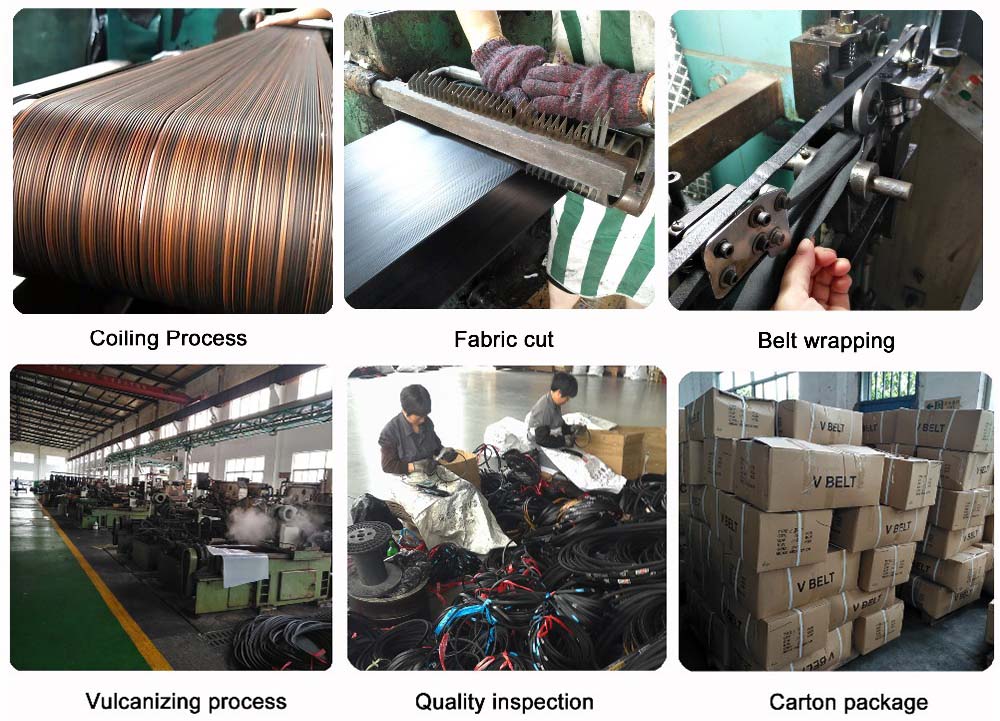
A sample answers one question: can the proposed product meet the agreed requirements at the approval stage? Distribution requires another question to be answered: can later batches reproduce the approved product closely enough for repeat customers?
This distinction matters because a distributor may reorder the same SKU many times. Customers expect a replacement ordered six months later to correspond to the product they previously approved.
Before opening a long-term account, discuss how the manufacturer identifies the approved specification and controls repeat orders. For custom or private-label programs, the purchase order should refer back to the agreed model, dimensions, markings, packaging and any required inspection criteria.
Buyer Check: Sample Approval
SINOCONVE can provide standard samples or small test samples for discussion where applicable. For a new distributor range, use the approved sample together with written specifications. A physical sample alone should not replace controlled SKU information for future orders.
7. Ask What Quality Evidence Will Come with the Order
“Good quality” is not a useful supplier qualification criterion because two factories can make the same statement while providing very different evidence.
SINOCONVE's confirmed quality process includes incoming raw-material inspection, production-stage inspection and final testing or inspection before shipment. ISO certificates and product test reports can be provided, and third-party testing can be arranged when a customer has special standard requirements.
For distributors, the scope of required documentation should be discussed before the purchase order rather than after a customer raises a complaint. Ask what documentation applies to the specific V-belt being purchased and whether additional testing is required by your market or end customer.
A certificate and a product test report also answer different questions. A management-system certificate should not automatically be treated as evidence that every individual V-belt SKU has passed every possible product test. Buyers should connect each document to the requirement it is supposed to verify.
8. Compare Lead Time with Your Replenishment Cycle
A distributor needs lead-time reliability more than an unusually short promise on one order. Replenishment planning depends on knowing when a production order can realistically be shipped.
SINOCONVE's confirmed general production lead time is approximately 30 days. For urgent requirements, a faster production arrangement may be discussed, typically around 15–20 days, depending on the actual order and production schedule.
Those figures should still be reconfirmed for the specific RFQ. Product mix, quantity, customization and packaging can affect the production plan.
For stock planning, separate products into fast-moving replenishment SKUs and slower or project-driven items. The same reorder policy does not need to apply to both. A distributor with stable demand data can place repeat orders before safety stock is consumed rather than treating every shortage as an emergency order.
9. Compare V-Belt Manufacturers on the Same RFQ
Supplier comparison becomes unreliable when each factory receives a different level of information. One supplier may quote a standard wrapped belt, another a cogged construction, and a third a private-label package. The prices look comparable in a spreadsheet even though the offers are not technically or commercially equivalent.
Issue the same controlled RFQ to shortlisted suppliers.
| RFQ Item | What the Distributor Should Provide | What to Verify in the Quotation |
|---|---|---|
| Belt identification | Profile, length designation, existing marking or drawing | Quoted model corresponds to requested specification |
| Construction | Wrapped, cogged or other required construction | No unapproved substitution |
| Application | Machine type and relevant operating conditions | Supplier has enough information to review suitability |
| Quantity | Quantity by individual SKU | MOQ is clear at SKU level |
| Private label | Logo, belt marking, part number and artwork requirements | Approval method and repeat-order control |
| Packaging | Carton, label and packing requirements | Packaging scope is included in the quotation |
| Quality documents | Required certificate, inspection or test documentation | Document type and scope are clearly stated |
| Delivery | Required shipment date and destination | Production lead time and shipping terms are separated |
10. Supplier Price Should Be Compared with Supply Risk
Factory-direct pricing matters to wholesalers, but it should not be isolated from the rest of the purchasing decision. A lower unit price can be offset by excessive MOQ, an incorrect SKU, packaging rework, inconsistent repeat orders or emergency freight caused by poor replenishment planning.
A useful supplier comparison therefore looks at the complete commercial arrangement: technical match, unit price, MOQ by SKU, sample process, customization cost, documentation, production lead time, packaging and communication when a problem occurs.
SINOCONVE's factory manufacturing history dates to 1988, providing more than 35 years of manufacturing experience. For distributors, however, company history should still be considered together with current product capability and order-specific evidence. Longevity by itself does not replace technical confirmation of the V-belt being purchased.

11. What to Check Before Placing a Bulk V-Belt Order
- Confirm the SKU: belt profile, length designation and construction must be unambiguous.
- Confirm compatibility: do not approve substitutes from appearance or nominal naming alone.
- Review the assortment: separate fast-moving stock from slow-moving and project-specific sizes.
- Check MOQ by model: calculate the inventory commitment rather than looking only at total order quantity.
- Approve branding: freeze belt marking, distributor part number, logo and packaging artwork before mass production.
- Define inspection evidence: state what reports or other documentation are required before shipment.
- Confirm lead time: distinguish manufacturing time from international transportation time.
- Protect repeat orders: keep approved specifications and purchase references for each recurring SKU.
12. Frequently Asked Questions
12.1 What is the MOQ for SINOCONVE V-belts?
The typical MOQ is 30–50 pieces depending on the V-belt model. A distributor ordering multiple sizes should confirm whether the required quantity is acceptable for each SKU during quotation rather than assuming that one MOQ applies to the complete mixed order.
12.2 Can distributors order private-label V-belts?
Yes. SINOCONVE supports OEM/ODM cooperation and customization including logo and packaging requirements. For repeat wholesale orders, the technical specification, belt marking and packaging artwork should be approved and controlled together.
12.3 How long does V-belt production take?
The general production lead time is approximately 30 days. Urgent orders may be discussed for a faster production arrangement, typically around 15–20 days depending on the order and current production schedule. Confirm the applicable lead time when the RFQ is issued.
12.4 Can I request V-belt samples before a bulk order?
Standard samples or small test samples can be provided where applicable. For a distributor launching a new range, sample evaluation is particularly useful for unfamiliar or high-volume SKUs, but the approved product should also be documented in writing for future replenishment.
12.5 Should I source wrapped and cogged V-belts as interchangeable products?
No. Construction should follow the intended drive requirement. Even where dimensions appear similar, a distributor should not substitute one construction for another without checking the specification and application. The wrapped V-belt guide provides additional information on wrapped belt selection and drive conditions.
12.6 What information is needed for an accurate wholesale V-belt quotation?
At minimum, provide the belt profile and length designation, quantity by SKU and required construction. Add drawings, samples or existing markings when identification is uncertain. Private-label buyers should also provide logo, marking and packaging requirements, while orders with specific quality requirements should identify the required standard or test documentation.
12.7 How should a distributor evaluate a V-belt manufacturer's quality claim?
Ask for evidence relevant to the order rather than accepting a general statement. Confirm the inspection process, what product documentation can be supplied, how samples are approved and how the specification will be controlled when the same SKU is reordered.
13. Prepare a Distributor RFQ That Can Be Repeated
The strongest sourcing program is one that makes the second, fifth and tenth order easier to control than the first. Before requesting a quotation, prepare your SKU list with the required V-belt profile, length designation, construction, quantity per model, existing markings or drawings where relevant, private-label requirements, packaging and required quality documentation.
SINOCONVE can review V-belt requirements for distributors, wholesalers, industrial importers and private-label programs. Start with the current V-belt product range, or send the RFQ through the SINOCONVE contact and quotation page. Technical and purchasing inquiries can also be sent to sales@sinoconve.com.
Related V-Belt Products
- Industrial V-Belts and Cogged V-Belts — Review SINOCONVE's current V-belt category and available product families.