
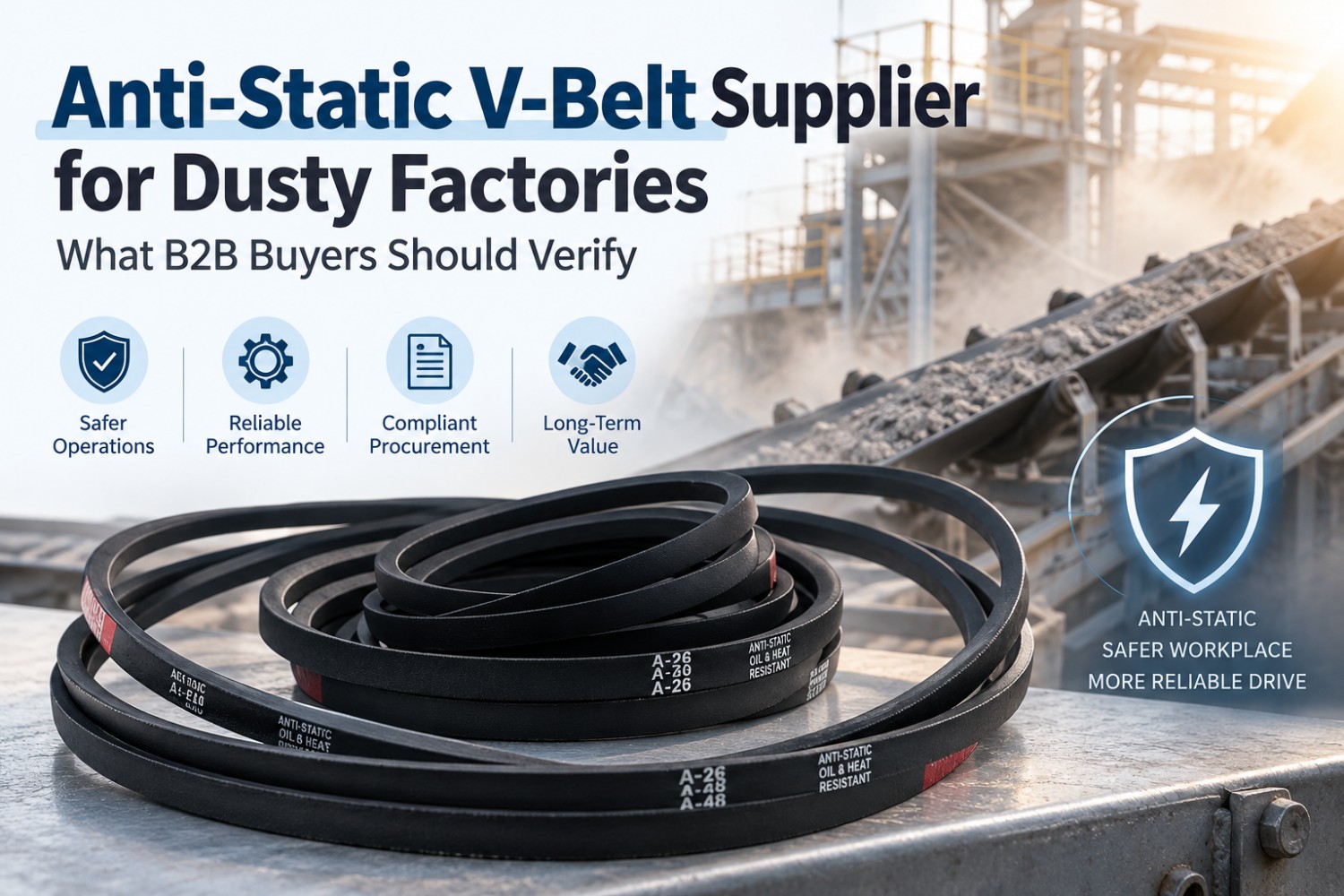
Anti-Static V-Belt Supplier for Dusty Factories: What B2B Buyers Should Verify
In a dusty factory, specifying an anti-static V-belt is not simply a matter of adding “anti-static” to an RFQ. Dust around mixers, mills, fans, extraction systems and other belt-driven equipment can make electrostatic charge a safety concern, particularly where the process creates a fire or explosive-atmosphere risk. The purchasing question is therefore not whether a supplier uses the right wording in a catalog. It is whether the offered belt is suitable for the drive, whether its electrical conductivity requirement is clearly defined, and whether the supplier can provide meaningful evidence for the product being purchased.
For procurement teams qualifying an anti static V belt supplier, that changes the sourcing process. Belt profile, length and construction still matter, but so do the applicable standard, test method, batch documentation, traceability and RFQ accuracy. A low quotation is difficult to compare if these items remain undefined.
Quick Answer for Industrial Buyers
Do not qualify an anti-static V-belt by the label alone. Confirm the exact belt type and size, the required electrical-conductivity standard, how conformity will be tested, what report or inspection record will accompany the order, and whether the production batch can be traced to the approved specification. For applications involving combustible dust or explosive atmospheres, belt qualification must also sit within the factory's wider engineering and safety assessment.
1. Why “Anti-Static” Needs a Defined Purchasing Requirement
A moving belt can accumulate electrostatic charge. In an ordinary drive, that may not be the first criterion used to select the belt. In an environment where ignition risk exists, however, the ability to dissipate electrical charge can become part of the safety specification.
This is why buyers should distinguish between a general industrial V-belt requirement and a documented anti-static requirement. The words may appear next to the same belt profile, but they create different supplier-verification questions.
ISO 1813:2025 addresses electrical conductivity of antistatic V-ribbed belts, joined V-belts and single V-belts, including wide-section and hexagonal belts. It specifies maximum electrical resistance and corresponding production-control and individual-proof measurement methods for new belts intended for applications involving explosive atmospheres or fire risk.
Procurement Warning: A supplier statement such as “anti-static rubber” or “static conductive belt” should not replace a defined acceptance criterion. The buyer should establish which standard, customer specification or approved test requirement applies to the actual belt being ordered.
The standard also should not be interpreted as proof that an entire machine, production line or dusty factory is safe from electrostatic ignition. A belt test concerns the belt property covered by that test. Site safety depends on the complete installation and operating environment.
2. Start Supplier Qualification with the Exact Belt Specification
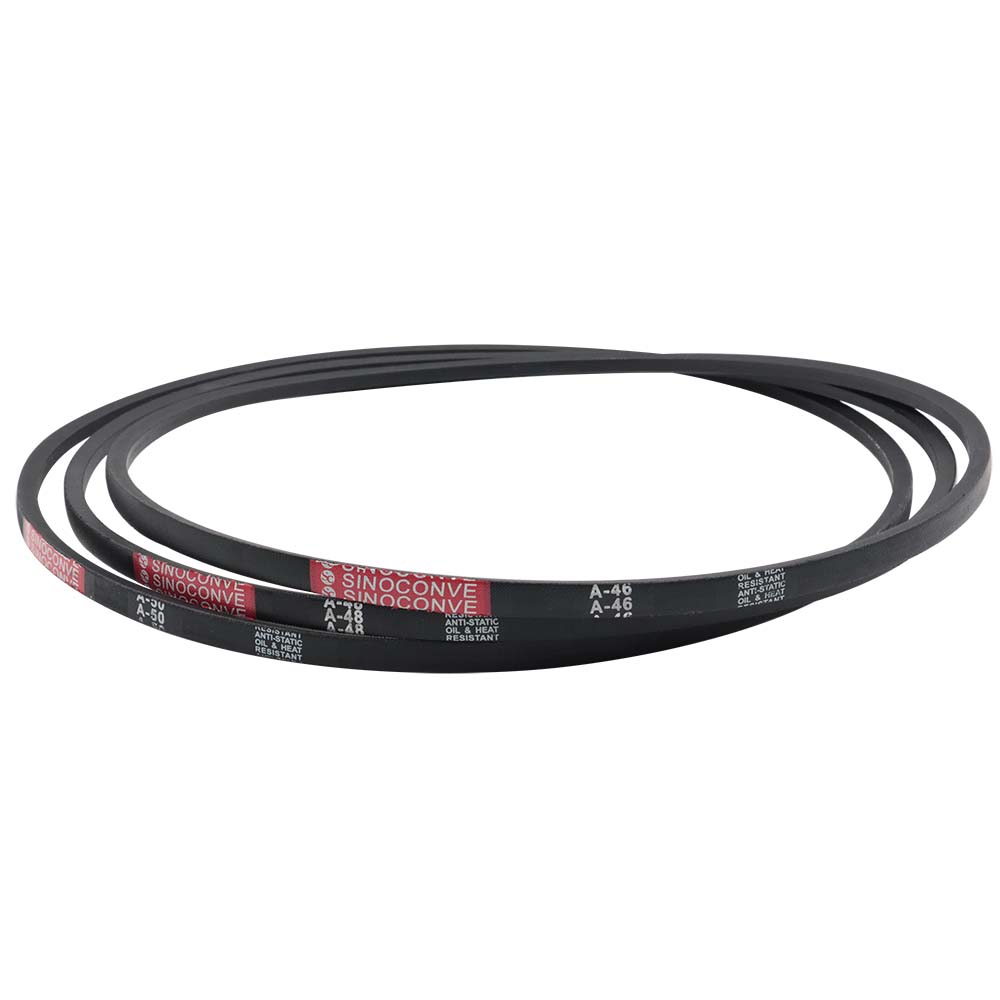
Electrical performance does not eliminate basic mechanical compatibility. Before asking for an anti-static declaration, purchasing should identify exactly which power transmission belt is required.
For a replacement drive, the starting information normally includes the existing belt marking, profile, length designation, quantity per drive and construction. Photos of the belt and pulley can help when markings are incomplete. For an OEM or newly designed drive, the supplier may also need pulley and operating data so that the proposed belt is not selected by nominal dimensions alone.
This matters because V-belts are not interchangeable merely because two products look similar. Classical, narrow, cogged, wrapped, joined and ribbed constructions serve different drive arrangements. SINOCONVE's current V-belt category, for example, includes multiple wrapped and rubber cogged V-belt options. The requested profile and construction should therefore be written explicitly into the RFQ.
| RFQ Item | What the Buyer Should Provide | Why It Matters |
|---|---|---|
| Belt identification | Existing marking, profile, length designation, photos or approved drawing | Prevents an anti-static belt with the wrong mechanical fit from being quoted |
| Construction | Wrapped, cogged, joined or other required construction | Construction must remain compatible with the drive and approved specification |
| Anti-static requirement | Applicable standard, customer specification or acceptance requirement | Turns a marketing description into a verifiable procurement criterion |
| Operating environment | Dust type, contamination, temperature and relevant site conditions | Helps identify requirements beyond electrical conductivity alone |
| Drive information | Equipment, pulley arrangement and available operating data when selection support is required | Allows technical review rather than selection by belt marking alone |
| Order information | Quantity, packaging/OEM requirements, destination and required delivery date | Allows the supplier to confirm commercial feasibility with the technical offer |
Buyers replacing an existing belt can use the V-belt buying guide for profiles, lengths and applications to organize this mechanical information before issuing an RFQ.
3. Verify the Standard and Test Evidence, Not Just the Product Description
This is usually the most important qualification step for an anti-static order.
A supplier may offer a belt described as anti-static, but industrial procurement should ask what that description means in measurable terms. If ISO 1813:2025 is specified, the buyer and supplier should agree that the relevant belt falls within its scope and determine what production-control or proof documentation is required for the order.
3.1 Ask what exactly will be tested
The quotation, technical confirmation or purchase specification should identify the belt being evaluated. A generic statement about a material compound is not the same as evidence for the finished belt type covered by the purchase requirement.
Ask the supplier to clarify:
- whether the finished belt is evaluated for electrical conductivity;
- which standard and edition are referenced;
- which belt type and size the documentation identifies;
- whether the document is a production-control record, individual proof result, internal inspection report or third-party report; and
- how the report can be connected to the supplied product or batch.
The distinction matters in supplier audits. A company certificate demonstrates something different from a product test report. Likewise, a test result for one belt does not automatically establish that every different construction or future production lot has identical electrical characteristics.
3.2 Check the edition of the referenced standard
Procurement databases often retain standards for years. ISO 1813:2014 has been withdrawn and replaced by ISO 1813:2025. New sourcing specifications should therefore avoid copying an old standard reference without checking its current status.
There may still be contracts, legacy drawings or customer specifications that cite an earlier edition. In that situation, purchasing should not silently change the requirement. Clarify with the responsible engineering or customer-approval authority which edition is contractually required.
4. Separate Anti-Static Performance from the Rest of the Drive Risk
A conductive belt can still be the wrong belt for a machine.
Dusty factories create several simultaneous challenges. Abrasive contamination may affect pulleys and belt surfaces. Oil or chemicals may be present near some processes. High ambient or process temperature can change material requirements. Repeated starts, shock loading, vibration and pulley wear can create mechanical problems that have nothing to do with static dissipation.
The correct purchasing logic is therefore:
Condition → Risk → Specification Implication
Potential static accumulation in a relevant hazardous environment → ignition concern → define and verify the required electrical-conductivity property.
Dust and abrasive contamination → pulley/belt wear or loss of drive condition → inspect the drive and confirm suitable belt construction.
Oil, heat or chemical exposure → possible material degradation → state the exposure in the RFQ rather than assuming “anti-static” also means resistant to every environmental factor.
Multiple belts on one drive → uneven load sharing if the set is mismatched → confirm matched replacement requirements and pulley condition.
This is also why maintenance history is valuable sourcing data. If the existing transmission belt shows glazing, cracking, abnormal dust, repeated slipping or uneven wear, procurement should send that information to the supplier instead of treating the next purchase as an exact repeat order.
5. What a Useful Anti-Static V-Belt Test Report Should Let You Verify
A report has purchasing value only if the buyer can understand what was tested and connect the result to the requirement.
| Evidence to Check | Buyer Question | Warning Sign |
|---|---|---|
| Product identification | Can I identify the tested belt type or sample? | Report is too generic to connect to the ordered product |
| Standard/test method | Which method and edition were used? | Only “anti-static test passed” is stated |
| Measured result | Does the document report a measurable result against the acceptance requirement? | No result or acceptance basis can be identified |
| Traceability | How does the evidence relate to the shipment or production lot? | An old report is presented without explaining its relationship to the order |
| Testing party | Was this an internal QC test or independent third-party test? | The source of the result is unclear |
Not every order requires third-party testing. The required level of evidence should follow the customer's specification, application risk, approval process and contract. What matters is that both sides agree on the evidence before mass production, rather than discovering a documentation gap at shipment.
6. Audit the Supplier's Quality Process Around the Belt
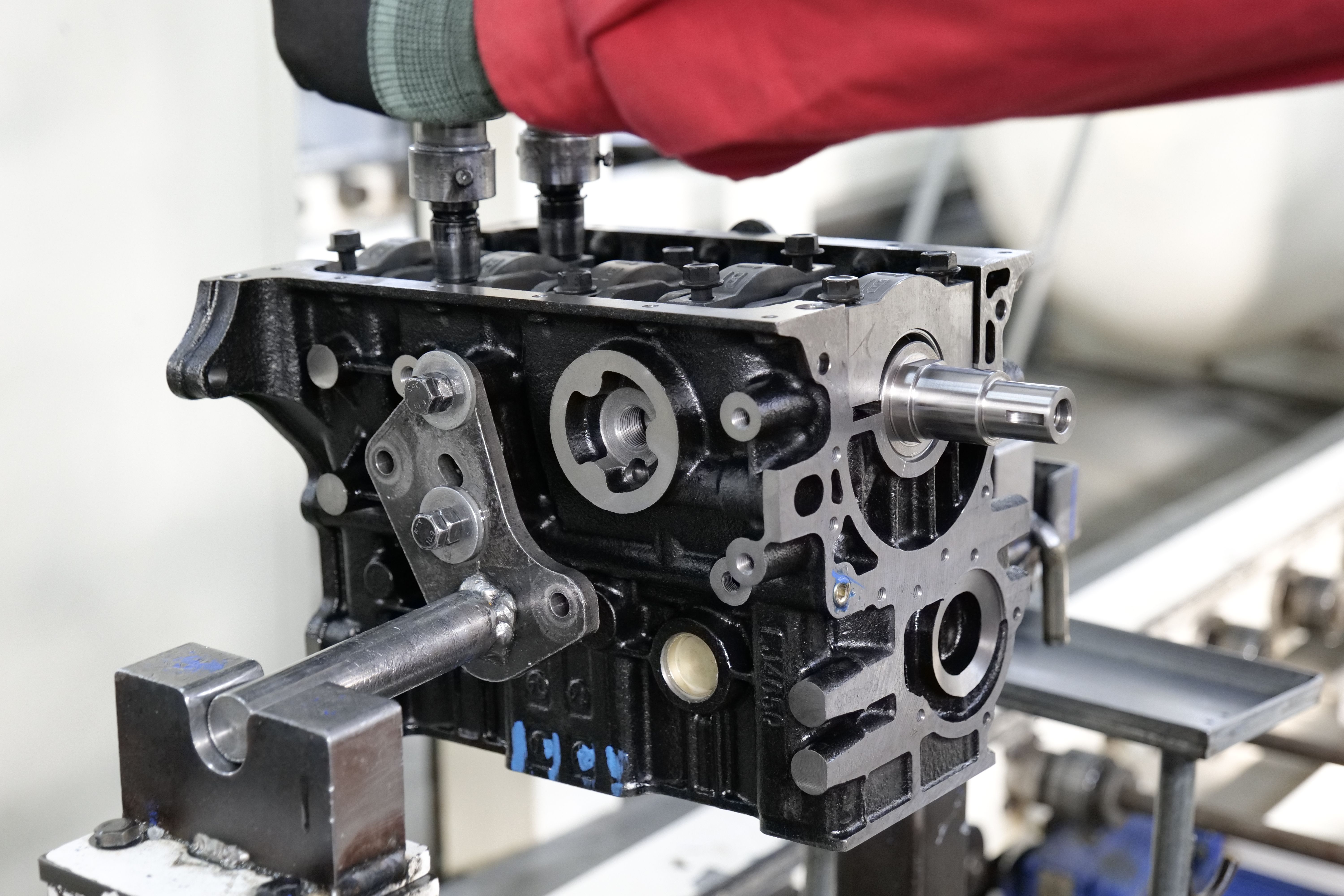
A single acceptable sample does not answer the bulk-order question: can the supplier reproduce the approved requirement?
For a B2B buyer, supplier qualification should therefore extend from the test result into the manufacturing and QC process. Useful audit questions include how incoming materials are checked, what is inspected during production, how finished belts are tested, how nonconforming material is controlled, and which documents can be supplied before shipment.
SINOCONVE states that its quality process includes raw-material inspection before production, in-process inspection and final testing before shipment. Product test reports can be supplied, and third-party testing can be arranged when customers have special standard requirements. These points should still be written into the order-specific agreement when they are required for acceptance.
For procurement teams that need a broader supplier assessment beyond anti-static performance, the V-belt manufacturer sourcing checklist covers specification compatibility, batch control, documentation, MOQ, OEM requirements and repeat-order management.
7. Samples Should Validate the Specification Before the Bulk Order
Sample approval is especially useful when the buyer is changing suppliers, importing a belt for the first time, developing a private-label range or working from an existing sample rather than a complete drawing.
SINOCONVE can provide standard samples or small test samples for evaluation. The useful approach is to decide in advance what the sample is expected to prove. Dimensional fit, marking, construction and required anti-static evidence should not be mixed into an informal “sample looks OK” approval.
For an OEM project, the approved sample should become part of a controlled specification for mass production. SINOCONVE supports OEM/ODM production based on customer drawings, samples and special requirements. Its existing guide to working with an OEM V-belt manufacturer explains why the transition from sample approval to repeatable production needs its own controls.
Buyer Tip: If electrical conductivity is an acceptance requirement, settle the required evidence during sample qualification. Waiting until the bulk shipment is ready can create a commercial dispute even when the physical belts have already been manufactured.
8. Commercial Terms Still Matter After Technical Approval
An industrial procurement decision is not complete when the technical specification passes. MOQ, production planning, packaging, payment and repeat-order consistency can determine whether the supplier is practical for ongoing purchasing.
Based on SINOCONVE's current company information, the typical V-belt MOQ is 30–50 pieces depending on the model. Normal production lead time is approximately 30 days; urgent requirements may be handled through an accelerated production arrangement, typically around 15–20 days, subject to order confirmation and production conditions.
SINOCONVE also supports logo, color and packaging customization as well as OEM/ODM requirements. Because the products are manufactured to order rather than maintained as general finished-goods inventory, buyers should confirm the exact SKU mix and required delivery date before placing time-sensitive orders.
For payment, the currently provided commercial terms include 30% deposit before production and 70% before shipment, or L/C. These terms should be reconfirmed for the individual quotation rather than assumed for every transaction.
9. A Practical Supplier Qualification Sequence
A structured qualification process makes quotations easier to compare because competing offers are responding to the same requirement.
- Identify the belt. Confirm profile, length designation, construction, marking and quantity.
- Describe the application. State the machine, operating environment and relevant dust, temperature, contamination or load conditions.
- Define the anti-static requirement. Specify the applicable standard or customer acceptance criterion rather than using “anti-static” alone.
- Agree on evidence. Determine whether production-control documentation, individual proof, an internal report or third-party testing is required.
- Qualify the sample where appropriate. Verify fit, construction, identification and required test evidence before bulk production.
- Review manufacturing controls. Ask how the approved requirement is carried from material inspection through production and final inspection.
- Confirm commercial terms. MOQ, quantity, packaging, private labeling, production schedule, payment and shipment requirements should match the quotation.
- Define repeat-order identification. Make it possible for purchasing to reference the previously approved product when the next RFQ is issued.
This sequence also exposes weak quotations quickly. If one supplier quotes only a belt size and price while another confirms construction, standard, testing, documentation and production requirements, the two quotations are not technically equivalent.
10. Common RFQ Mistakes That Increase Purchase Risk
Sending only “anti-static V-belt + size.” This leaves the supplier to interpret what anti-static means and may omit construction, length convention or acceptance criteria.
Accepting a company certificate as product evidence. Management-system documentation and product-specific electrical testing answer different questions.
Using an obsolete standard reference without checking it. Legacy drawings may still contain ISO 1813:2014 even though ISO 1813:2025 is now the current edition.
Assuming anti-static means resistant to every factory condition. Electrical conductivity does not automatically establish suitability for oil, heat, chemicals, abrasion or a particular mechanical load.
Approving a sample without defining bulk-order consistency. Sample approval is most useful when the approved dimensions, construction, marking and required inspection evidence become reproducible purchase requirements.
Leaving test documentation until shipment. If the customer's receiving procedure requires a particular report, define it in the RFQ and purchase order.
11. Questions B2B Buyers Commonly Ask
Is every industrial V-belt anti-static?
No assumption should be made from the words “industrial V-belt” alone. If electrical conductivity is required, specify it explicitly and ask the supplier to confirm the applicable test requirement for the offered belt.
Which standard should I ask about for an anti-static V-belt?
For belt types within its scope, ISO 1813:2025 is the current international standard covering electrical conductivity characteristics and test methods for antistatic V-ribbed belts, joined V-belts and single V-belts. The actual purchase requirement should still follow the applicable engineering specification, customer requirement and site safety rules.
Does an ISO 1813-compliant belt make a dusty machine explosion-proof?
No. Electrical conductivity of the belt is only one property. It does not certify the entire machine, installation or factory environment as safe for an explosive atmosphere. Hazard control has to consider the complete system and applicable site requirements.
Should I require third-party testing for every bulk order?
Not automatically. The required verification level depends on the contract, customer approval requirements, application risk and agreed quality plan. SINOCONVE states that product test reports can be supplied and third-party testing can be arranged for special standard requirements. Buyers should specify the required documentation before production.
Can I request samples before ordering?
Yes. SINOCONVE can provide standard samples or small test samples. For a new supplier qualification, define what must be checked on the sample so that approval has a clear technical meaning.
What information helps obtain a more accurate V-belt quotation?
Provide the belt designation and length, construction, existing marking or drawing, quantity, machine/application, relevant operating conditions, anti-static standard or acceptance requirement, required test documentation, OEM/packaging needs, destination and required delivery date.
What is SINOCONVE's MOQ for V-belts?
The current typical MOQ is 30–50 pieces, depending on the V-belt model. The exact MOQ should be confirmed against the requested sizes and specifications during quotation.
12. Prepare a Verifiable RFQ, Not Just a Price Request
For dusty industrial applications, the best supplier comparison starts before prices arrive. Define the belt mechanically, state the anti-static requirement, identify the evidence needed for acceptance and tell suppliers enough about the operating environment to flag specification gaps.
SINOCONVE has more than 35 years of confirmed factory manufacturing experience and supplies industrial belts for international B2B markets. For an anti-static V-belt inquiry, send the existing belt marking or drawing, profile and length, quantity, application conditions, required standard, test-document requirement and destination. The team can then review the request against the available V-belt range before quotation.
For technical confirmation or an RFQ, use the SINOCONVE contact and quotation page or email sales@sinoconve.com.

Related SINOCONVE Products
- Industrial V-Belts — Browse SINOCONVE wrapped and cogged V-belt categories for industrial power transmission.
- Rubber Cogged V-Belts — Explore cogged V-belt options and available profile families.
- SINOCONVE Product Catalog — Review V-belts and other industrial belt product categories.
Related Technical Blogs
- V-Belt Manufacturer for Industrial Distributors: Product Range and Sourcing Checklist
- V-Belt Buying Guide for OEMs and Distributors: Profiles, Lengths and Applications
- OEM V-Belt Manufacturer for Industrial Equipment Brands: From Sample to Mass Production
- Transmission Belt Guide: Choosing and Maintaining a V Belt