

Timing belts for packaging machinery come from a small set of industrial belt manufacturers and the regional distributors who carry their stock, not from the packaging OEM itself, because the OEM normally points you toward whichever belt house its servo and gearbox suppliers approved during the original design. The honest question behind a search for who supplies them is therefore not who sells them, but who can keep your line indexing to the same position eighteen months from now. We rank candidates in a fixed sequence: duty match first, sample trial second, dimensional and batch consistency third, spares and lead time fourth, commercial terms last. Almost every failed belt decision we have been called in to untangle began with that list worked in reverse.
That sequence is not a preference. It follows from the way a packaging line actually stops. A belt that measures perfectly but suits the wrong duty will fail on a sixty-stop-per-minute indexer within a few weeks. One that performs beautifully on a sample bench but drifts between production batches will fail every time a fresh reel is loaded. And a belt that is right in every technical respect still shuts the line down if its only source sits twelve weeks away and you hold a single spare.

01What "Who Supplies Timing Belts" Really Asks
Suppliers in this market fall into four groups, and they are not interchangeable. First comes the belt manufacturer that owns the profile tooling, blends its own compound, and controls both the joint and the endless process. Second is the converter that buys open-ended belt and welds it to length, a legitimate but narrower capability. Third is the industrial distributor holding somebody else's stock on a shelf. Fourth is the OEM's own aftermarket channel, convenient and almost always the most expensive. Underneath the labels, all four are answering one question: can this partner reproduce my belt, to the same numbers, on my line's schedule.
A Belt Maker Is Not the Same as a Belt Reseller
Anyone can quote a part number. Far fewer can explain what changed in the compound between the belt that ran clean for three years and the replacement that keeps throwing teeth. That difference surfaces the instant something goes wrong. A converter welding PU stock into a finished loop controls the joint but not the material, so when a batch goes soft it has nowhere to look. A maker that extrudes and grinds its own profile controls both ends of that chain, and it is why such a maker can usually separate a geometry problem from a compound problem from an installation fault instead of guessing. We sit on the maker side of that line, which is what lets us promise that a repeat order will behave like the original. Our industrial timing belt range is built on that basis, from open-ended stock through to finished endless loops.
Why the Answer Changes With Your Machine Class
A cartoner indexing thirty times a minute, a form-fill-seal machine drawing film continuously, a labeller stopping on a registration mark, and a case sealer running all day at one speed do not want the same belt geometry or the same compound. A supplier strong on slow, heavy, high-torque drives may never have tooled a fine-pitch profile at all. Competence travels with the machine class, so the first filter is simple: has this candidate got belts running on your machine type right now, in the field, where you can telephone the maintenance lead and ask how they have held up. A catalog proves nothing. A reference site proves a great deal. Buyers who skip that reference step are the ones who later discover their chosen partner carries a light profiling line as an afterthought. When the machine is a lighter, cleaner packaging head rather than a quarry conveyor, a belt built for a dust resistant conveyor belt environment is also worth holding in the same sourcing file, because plants rarely buy from only one belt family.
02The Supplier Capability Checklist We Hand to Buyers
Buyers ask for a quotation; what they should ask for first is evidence. The checklist below is the one we suggest a purchasing engineer carry into the first call, because it separates suppliers who can support a packaging line from those who can only ship a box. Work down it in order and most of the field drops away by row three. The point is not to interrogate anyone. It is to learn, quickly and politely, how much of the belt's life the supplier genuinely controls.
The Four Questions Behind Every Row
Each line of the checklist reduces to four questions: do you make it, can you measure it, can you repeat it, and how fast can you replace it. A supplier that makes the belt answers the first without checking. One that measures it properly owns a lab and will send you numbers rather than adjectives. Repeatability shows up in batch records and in whether the same drawing comes back unchanged. Replacement speed is a stock-and-lead-time fact, not a sales claim. Ask those four and the rest of the checklist answers itself.
| Stage you are checking in the review | What to ask the supplier for | How you verify that claim yourself | Pass criterion we would accept as sufficient |
|---|---|---|---|
| Profile and length control on the finished belt | The finished profile drawing with tooth form and the pitch-line length quoted in millimetres | Take two belts from separate reels and compare them tooth by tooth on the same gauge | Both belts sit inside the quoted length tolerance and match the drawing within about 0.1 percent |
| Compound and hardness of the rubber body | A named compound with its hardness in Shore A and the temperature band it is rated to | Ask for the incoming rubber certificate for the lot that will make your belts | Hardness falls inside the stated band, which for most packaging grades is roughly plus or minus three Shore A |
| Joint and endless capability of the maker | Whether the belt is moulded endless, welded, or spliced, and the load the joint holds at break | Request a tensile test performed on a joined belt rather than on open stock | The joint retains most of the parent belt strength instead of a token fraction of it |
| Dimensional and batch consistency between reels | The batch code, the mixing date, and the record that ties your shipment to one production lot | Compare the code printed on the belt with the code on the packing list and the test sheet | All three documents agree, and the previous shipment carries a different but fully traceable code |
| Stock depth and lead time by profile and width | Which pitches and widths are held as finished stock and which are made strictly to order | Ask for the current stock list and then place a small trial order against a stated date | The trial order arrives on the promised date without a silent substitution of profile or width |
| Application support after the order is placed | The name of an engineer who will read your duty data and answer questions once the invoice is paid | Send one real problem before you buy and watch how long and how useful the reply is | A specific, numeric answer comes back rather than a suggestion to open a service ticket |
| Failure analysis when a belt comes back early | Whether returned belts are cut open and reported, or simply swapped under warranty without a look | Ask what a failure report contains, then request one redacted copy from another customer | The report names a cause and the corrective action the supplier has already taken on its own line |
Two of those rows deserve a warning. The first is the joint, because a welded loop and a moulded endless belt can look identical in a photograph and behave nothing alike over a million cycles. The second is batch consistency, which stays invisible until it bites. A supplier that cannot tie your shipment to a mixing record cannot help you when the third reel behaves differently from the first, and by then the line is already down. If you want to see how we handle those records, they sit behind a short splicing buyer checklist that covers the same evidence trail.
03Matching the Belt to the Machine Duty
Packaging machinery splits into two broad duty families, and the belt that suits one is usually wrong for the other. Intermittent machines index in steps: the belt accelerates, stops, and holds a position while a tool acts on the pack. Continuous machines draw film, board or web at a steady rate, sometimes for sixteen hours without a full stop. Ask any supplier to say which family your machine belongs to before they quote, and listen carefully. An answer of "it depends on the price" tells you plenty.
Intermittent Indexing Versus Continuous Film Feed
An indexing drive spends most of its energy on acceleration and deceleration, so the belt meets repeated torque peaks rather than a steady pull. The peaks do the damage. They land on the tooth roots and on the cord, and they reward a belt with a stiff cord and precise tooth geometry. A continuous film drive is gentler per cycle but runs hot, because belt flexing at speed generates heat that has nowhere to go on a small pulley. Two machines on the same factory floor, the first stopping eighty times a minute and the second never stopping, need genuinely different specifications from the same supplier.
We have measured that difference on a filling line running two shifts. A continuous web drive with a 30 mm wide belt held a stable 58 °C at the pulley after four hours, while an adjacent indexing head with the same belt size touched 74 °C in the same window because every stop dumped another slug of energy into the teeth. Numbers like those decide cord choice. They also explain why a belt that survives on one machine sheds teeth on the neighbour, and why a buyer who assumes the two drives are equivalent will keep buying the wrong reel.
Where the Duty List Gets Misread
Most mis-selections come from reading a duty list too literally. A machine described as continuous may in fact stop for every film splice, which reintroduces the shock the word was supposed to exclude. A machine typed as indexing may index so gently that a far cheaper belt would last for years. The reliable inputs are the ones you can measure on the machine itself: stops per minute on the fastest head, pulley diameters at both ends, ambient temperature at the guard, and the acceleration the servo actually commands rather than the figure printed in the manual. Collect those four and the duty family stops being a matter of opinion.
04Positioning Accuracy and Repeatability on Indexing Machines
Packaging work cares about where the pack stops, not how fast the belt can move, and that single fact reorders the whole specification. A drive that reaches the correct position quickly but lands half a millimetre off every cycle is useless to a machine that seals on a registration mark. A slower belt that returns to the same point within 0.05 mm cycle after cycle is worth every cent of its extra cost. Repeatability, not raw speed, is the property to buy, and it belongs to the whole drive rather than to the belt alone.
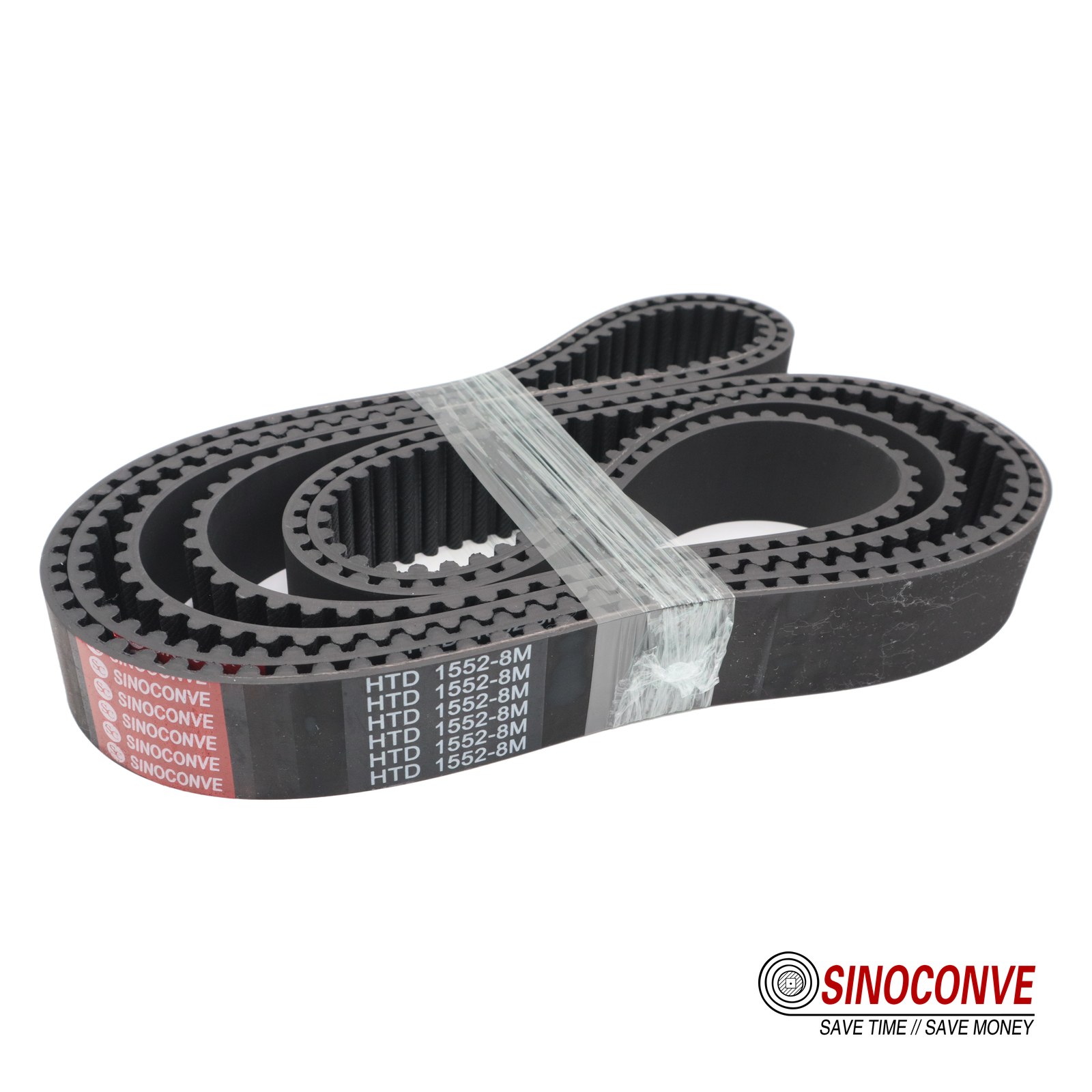
A finished loop is the article you buy; everything in the drive has to agree with it before it is fitted.
Why Repeatability and Accuracy Are Not the Same Number
Accuracy is how close the first stop lands to the target. Repeatability is how tightly the thousandth stop agrees with the first. A drive can be inaccurate and perfectly repeatable: it always stops 0.8 mm long, which you correct once in the servo offset and then forget. What destroys a packaging line is the opposite, a drive that averages the right position but scatters its stops by half a millimetre in both directions, because no offset can correct a moving target. When you evaluate a supplier, ask for repeatability data and treat an accuracy figure on its own as an incomplete answer.
The belt's contribution to that scatter is real but bounded. Tooth-to-pulley fit, cord stretch under load, and the uniformity of the belt's own length all move the stopping point. On a 24-tooth pulley at 8 mm pitch, one tooth spans far more than the tolerance most machines can absorb, so the whole job is to keep backlash and stretch small rather than to chase a single bench number. A well-made belt from a capable maker keeps its own contribution inside a few hundredths of a millimetre on a clean drive. A budget belt can double that and still pass a static inspection, which is exactly why the trial described later matters so much. As a conveyor belt manufacturer that also builds very light profiled belt for indexing heads, we would rather send you the repeatability record than a promise, and we expect the same of anyone you compare us against. The record itself comes from a conveyor belt factory that has been moulding and splicing belt for more than three decades, which is the only reason we can offer it at all.
05Clean, Wet and Food-Contact Environments
Many packaging belts live in a washdown that would destroy a standard drive belt inside a month. Food and pharmaceutical lines are rinsed with detergent, sprayed with water at pressure, and wiped with solvents that attack the wrong rubber quickly. The belt has to survive that routine, keep its grip, and never shed material into the product. Judging a supplier here means asking what the compound does after two hundred cleaning cycles, not what it did on the day it was made.
What the Cleaning Routine Actually Attacks
Detergent and hot water work on a belt in three ways at once. They soften the surface layer and accelerate wear, they creep into a poorly bonded tooth and lift it, and they carry away the plasticiser that keeps a light-coloured belt flexible. A compound chosen for abrasion resistance alone can fail all three tests. The belts that last in this setting are usually the ones specified for chemical exposure first and mechanical load second, which is the reverse of how a general industrial drive is normally selected. A capable conveyor belt supplier will ask about your cleaning chemistry before quoting a compound, because that answer changes the grade.
Oils are the other quiet threat. A packaging line uses lubricant on chains and bearings, and a little of it always finds the belt. A belt that swells two percent on contact with mineral oil changes its own length, and a length change on a fixed center distance is a tension change. Over a few hundred hours that shows up as an edge fraying or a tooth rounding off at one end of the loop. Ask the supplier to name the oil and the cleaner its compound tolerates, and be suspicious of an answer that claims everything. The maintenance discipline behind that answer is worth reading up on, and our notes on belt cleaning methods and schedules cover the practical side for the wider plant.
It also helps to know what you are not buying. A packaging belt is a precision transmission item, and a supplier that mostly moves heavy rubber for mines and quarries may carry a light profiling line as a sideline rather than as a core business. Ask what share of its output is light, profiled belt. A small share is not automatically disqualifying, but it usually means slow service on odd sizes even when the material itself is sound, and it means the engineering advice you get may be shaped by haulage rather than by indexing. If your site also runs a bulk feed or an outfeed conveyor, understand that you are buying from two different toolkits and check both, which is why a spray cleaning reference can sit usefully beside a timing belt drawing in the same maintenance folder.
06Frequent Starts, Stops and Shock Loading
Every stop is harder on a belt than the start that preceded it. When an indexer brakes, the driven mass keeps moving, and that inertia has to be absorbed somewhere in the drive train. On a well-built machine the servo absorbs it. On a machine with a worn coupling or a loose pulley, the belt absorbs it instead, and the teeth take the hit. This is why two identical belts on two identical machines can have completely different lives, and why the belt is so often blamed for a fault that actually lives in a bearing.
The Stop Is Harder Than the Start
During acceleration the belt is under tension and the load helps keep the teeth seated. During a hard stop the tension can momentarily reverse, which is the worst condition a trapezoidal tooth ever meets. A belt with a shallow tooth form and a soft compound will climb out of the groove under that reversal, skip a tooth, and throw the pack off position. The fix is rarely a tighter belt; over-tensioning simply adds bearing load without helping the tooth stay put. Choosing a belt with deeper, more positive tooth engagement is the engineering answer, and it carries a small cost premium that pays back the first time a jam releases suddenly.
We once traced a persistent index error on a blister line to a single worn key in the driven pulley rather than to any belt property at all. The belt was replaced four times before anyone thought to look at the shaft. A supplier worth keeping will ask you to check backlash, pulley wear and coupling condition before it accepts an order, because a serious transmission belt manufacturer would rather lose a sale than sell into a mechanical fault it cannot fix. That question, asked before the purchase rather than after, is one of the cheapest quality screens available to a buyer.
07Noise and Vibration as Selection Inputs
Operators notice a loud machine long before a maintenance engineer notices a worn belt, and the two signals are related. Tooth impact produces sound at a frequency equal to the tooth count on the smaller pulley times its revolutions per second, so a 20-tooth pulley turning 25 times a second sings at 500 Hz. A belt that suddenly changes pitch or volume is telling you its engagement is changing. Treating noise as a complaint to be muffled rather than a measurement to be taken throws away good information.
What a Noise Change Actually Reports
A rising whine usually means the belt is running too tight or the pulley has worn, so the tooth now bottoms out instead of seating cleanly. A new rattle points at tension loss, because a loose belt flaps on the slack side between teeth.A growl at one particular speed is often a resonance in the machine frame rather than anything wrong with the belt.Recording the sound on a phone at a fixed distance once a month costs nothing and gives you a trend; a sudden step in that recording tells you to look, long before the belt fails.
The design choice behind the noise matters too. A finer pitch with more teeth in contact runs more quietly than a coarse pitch doing the same job, because the impact energy per tooth falls. Where a packaging machine sits next to an operator station, that difference is worth designing for. It also tends to buy longer life, since lower impact energy means slower fatigue at the tooth root. A V-belt manufacturer working with the same engineering bench will happily trade a little load capacity for a quieter mesh rather than simply uprating the belt, and a packaging buyer should ask for exactly that trade.
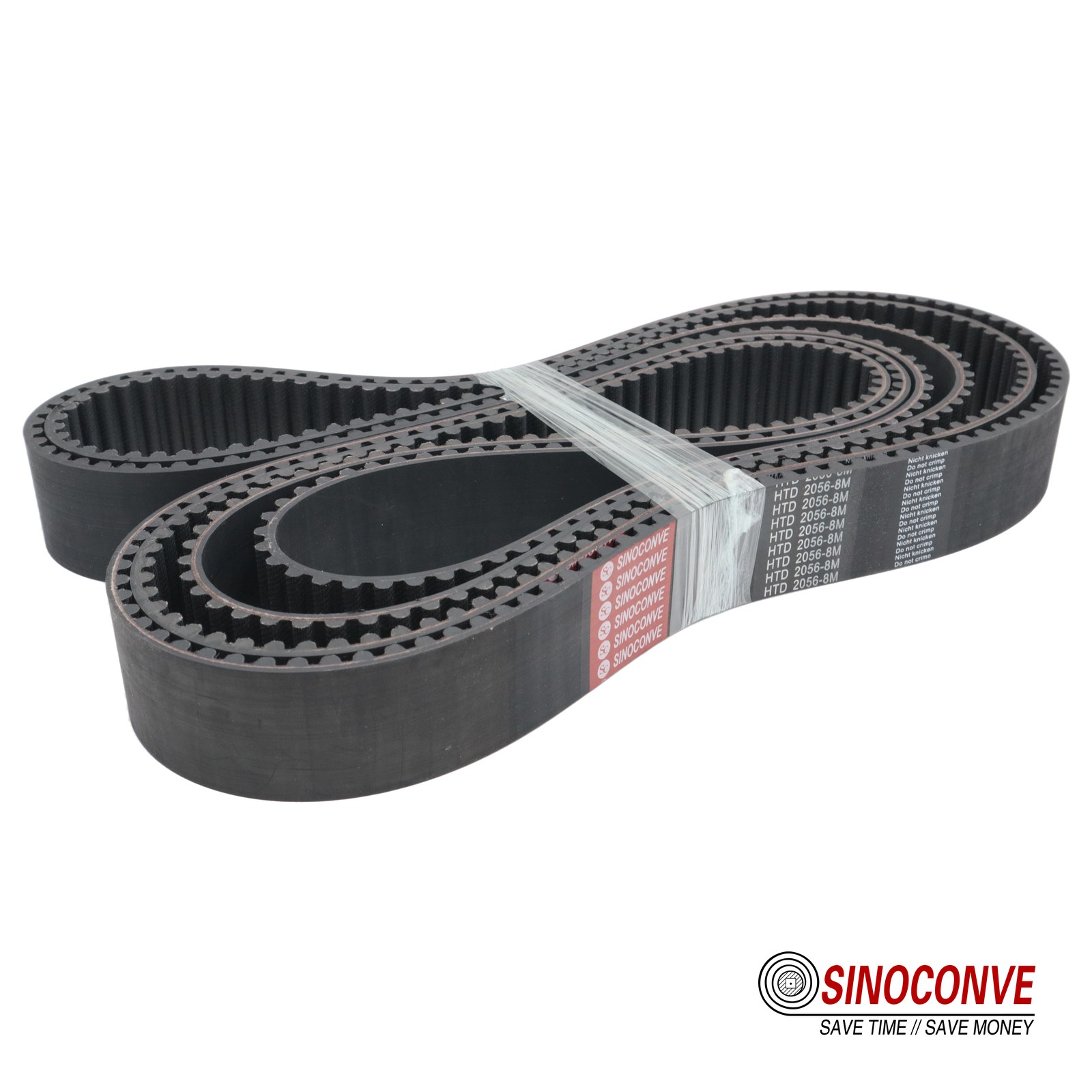
Pulley condition decides most of what an operator hears, so a noise trend is really a record of tooth engagement.
08Running a Sample Belt Through a Real Trial
A quotation tells you how a belt is supposed to behave; only a fitted trial tells you how it behaves on your machine. We treat a sample belt as a test article rather than as a free gift, and a serious buyer should do the same. Fit one belt on the most demanding head rather than the easiest one, run it for a defined period, and record four things while it runs. If a supplier resists that process or calls it unnecessary, you have learned how it will behave when a production belt is late.
What to Instrument Before the First Run
Four measurements carry almost all the useful information. The first is the pitch-line length, taken cold before fitting and again at operating temperature, which reveals stretch and thermal growth. The second is the run-in temperature rise at the driving pulley, because a belt that climbs more than about 15 °C above ambient in the first hour is working harder than its drive should demand. The third is positioning repeatability, taken from the servo's own position feedback across at least two hundred cycles. The fourth is tension loss, measured at mid-span after the trial ends. Record noise as a fifth, informal reading if the machine sits near people.
| What the trial measures on the machine | How to take that reading reliably | Accept band we would write into the order | Why this number decides the verdict |
|---|---|---|---|
| Pitch-line length cold and at running temperature | Wrap a steel tape around the fitted belt with the drive slack, then repeat once the machine is warm | Cold length inside the drawing tolerance, with hot growth under about 0.15 percent of the loop length | A belt that grows too much on a fixed center distance loses tension and drifts out of position |
| Run-in temperature rise at the driving pulley | Point an infrared thermometer at the pulley rim every fifteen minutes for the first hour of running | Steady state within roughly 15 °C of the ambient air around the guard, and flat after the first hour | A rising curve means excess friction, and friction means the tooth or the tension is wrong |
| Positioning repeatability measured across on-machine repeated cycles | Read the servo position feedback over at least two hundred identical index moves and chart the spread | Total scatter comfortably inside the machine's own registration window, with no upward drift across the run | This is the property the packaging machine actually needs, so it is the one that settles the purchase |
| Tension and tooth wear after the trial period | Check mid-span deflection under a known push and inspect the loaded teeth under a bright light | Deflection still inside the commissioning figure, and tooth flanks showing polish rather than scuffing | A belt that loses tension in a short trial will do the same over a full production year |
Judging the Trial and Closing the Loop
Give the trial a fixed window. Between eight and forty running hours is enough to expose a badly matched belt and short enough to keep a line from being held hostage by it. Measure on the first day, again at the midpoint, and once at the end. A belt whose numbers are still stable at the end of that window is a belt you can write into a purchase order with confidence. A belt whose temperature or repeatability has already moved is a belt you return, politely, and the conversation ends there.
Turning a good trial into a reliable supply is the step most buyers skip. The trial proved one belt in one run under one set of conditions. What you need next is a purchase order that names the pitch and tooth form, the length in teeth and in millimetres, the width with a tolerance, the compound and its hardness band, and the batch record you expect to see on delivery. Add the reference batch code from the trial belt so the first production shipment can be compared against a known-good article. The same discipline guides how a heavier line handles an industrial conveyor belt order, and it works because the evidence, not the price, carries the decision.
Field note from our engineers: The single most useful record a packaging plant can keep is the pair of repeatability readings taken on day one and after one month on the same belt. That pair tells us whether the drive is settling or drifting, and it has saved more arguments between maintenance and purchasing than any specification sheet we have ever supplied.
09Batch Consistency and the Evidence to Keep
A belt that performs perfectly the first time says nothing about the fifth reel. Batch consistency is the quiet property that separates a supplier you can build a maintenance plan around from one that keeps you guessing every quarter. The failure it causes is not dramatic. The pack simply stops landing where it used to, or a belt that used to run cool starts to warm up, and the cause traces back to a mixing run that was slightly different from the last.
The Batch Code Is the Only Real Proof
Ask to see the code that ties a belt to a mixing date and a compound lot, and then check that the code appears on the belt, the packing list and the inspection sheet. A supplier that can show all three is running a controlled process, and a supplier that cannot is asking you to trust a memory. Keep every test sheet your orders arrive with, filed by code. When something changes three reels later, the previous sheets become the reference that turns a vague complaint into a specific, provable one, and that is the only version of the conversation a busy supplier answers quickly.
Volume changes the calculus. A plant that buys single belts as needed may tolerate a little batch variation because a bad reel is caught and returned. A plant that holds wholesale conveyor belts across several packaging heads and a bulk feed cannot, because a soft reel will be installed somewhere and only discovered weeks later. If you buy a rubber conveyor belt for the same site, insist that the same traceability rule covers both lines rather than only the heavier one. Sites that source their light belts from a conveyor belt distributor and their bulk belt direct from a maker often find the two evidence standards do not match, and reconciliation after a failure is far harder than setting the rule up front.
10Spares Strategy, Lead Time and Minimum Order
A correct belt in the wrong place at the wrong time is worth nothing. Spares strategy is where a supplier's real service capability shows, because it is the part of the relationship that only matters when a line is down. The aim is not to fill a store room; it is to guarantee that the two or three belts whose failure stops a whole line are always within arm's reach, while everything else can wait for a scheduled delivery.
Tiering Spares by Machine Criticality
Sort every belted drive on site into three tiers before ordering a single spare. Tier one holds the drives whose failure stops output entirely, and those deserve a belt on the shelf plus a confirmed lead time from the supplier. Tier two holds drives that slow the line but do not stop it, and those can share a spare between several similar heads. Tier three holds everything else, and those can run to the supplier's normal delivery. Most plants over-stock tiers two and three and under-stock tier one, which is the worst of both worlds: money tied up in belts that rarely fail and nothing on hand for the drive that stops the shift.
Lead Time Is a Programme, Not a Number
Treat lead time as a schedule you manage rather than a figure a salesman quotes. A common pitch and width held as finished stock may ship in days, while a custom profiled endless loop will take weeks because the tooling and the moulding both have their own rhythm. Ask what is genuinely on the shelf, what is made to order, and how much notice the made-to-order items need. If you buy from an extended conveyor belt catalogue that also covers rollers and heavier belt, you can usually consolidate shipments and cut freight without cutting the delivery discipline.
| Machine criticality tier on the plant | What the failure actually costs you | Stock rule we would set with the buyer | Supplier commitment we insist you obtain |
|---|---|---|---|
| Tier one, drives whose stop halts the whole line | Every hour of downtime is lost output, and a rushed substitution often damages the machine further | Hold one identical belt on site and keep a second on a standing order at the supplier | A written lead time for that exact profile, reviewed twice a year against real consumption |
| Tier two, drives that slow the line but keep it moving | Reduced output and extra attention from the maintenance team, but the shift still ships | Share one spare across the group of similar heads instead of holding a belt for each one | Confirmation that the shared profile is genuinely interchangeable across those machines |
| Tier three, all remaining belted drives | A short repair window that can be planned into a normal maintenance shut without upsetting output | No stock on site at all, and order each belt against the planned maintenance date | Standard delivery inside the quoted window with the profile and width unchanged from the last order |
Minimum order quantities deserve a plain question. If a supplier will only make a custom profile in batches of ten, the belt that costs little per unit can be expensive once ten of them sit on a shelf and age. Ask what the smallest practical run is and whether the same tooling covers a profile you already use elsewhere on site. Standardising two or three heads onto one profile often cuts both the minimum order and the spare count, and it is the kind of simplification a capable maker will suggest before you think of it yourself.
11Documentation and Engineering Support
The paperwork around a belt matters more than buyers expect. When a machine is upgraded, a line is duplicated, or a supplier changes, the drawings and records are what let a new belt be made without re-engineering the drive from scratch. A supplier that hands over a tidy document set is telling you it expects the relationship to last. One that treats the drawing as a secret is telling you the opposite.
What a Drawing Set Should Contain
At minimum, a drawing set should carry the tooth form and pitch, the pitch-line length in both teeth and millimetres, the width with its tolerance, the backing and compound with the hardness band, and any special feature such as a coating, a guide, or a fabric face. It should also name the temperature range the belt is rated to and the chemicals it is expected to meet. With those items on file, a replacement can be quoted and made from the drawing alone, without another site visit and without a fitter crawling into a guard to count teeth. Keep the set with the machine documentation rather than in a purchasing folder, because the people who need it first are on the floor.
Good engineering support looks similar. It answers duty questions with numbers, flags a mismatch before an order is placed, and can explain why one belt behaves differently from another on the same frame. When that support is genuine, it shows up early and in writing. The team behind our PU timing belt range works that way for packaging and automation customers, reading duty data before quoting rather than after a complaint. We think that habit is the difference between a belt vendor and an engineering partner, and it is worth testing before you commit a production line to anyone.
12The Mistakes We See Buyers Make
Four mistakes account for nearly every disappointing belt decision we have been asked to review, and none of them is a technical error in the narrow sense. They are evaluation errors, made before a single belt was ordered, and they cost far more than the price difference anyone was chasing.
Four Mistakes and What They Cost in the Field
The first is buying on price alone, which usually means comparing two quotes that are not for the same article. A quote that omits the compound, the joint method or the length tolerance is not cheaper; it is simply unspecified, and it will be filled with whatever is convenient on the day. The second is judging on a free sample, because one belt in the hand proves nothing about the reel that arrives six months later. The third is ignoring batch consistency, which is the mistake that hurts most slowly. The fourth is forgetting the spare altogether, so a correct belt becomes unavailable exactly when it is needed.
| Mistake we see most often in the field | What it looks like on the plant floor | What it actually costs the business | The better move at buying stage |
|---|---|---|---|
| Comparing quotes that describe different articles | Two prices arrive, one naming a compound and a joint method and the other naming only a size | The cheaper belt proves unsuited to the duty and fails early, so the saving is spent on downtime | Make every quote name the same items, then compare only the bids that are genuinely comparable |
| Choosing a supplier from a free sample alone | The sample fits and runs, so an order is placed without any trial on the real machine | The sample was a hand-picked article, and production reels behave differently under real load | Run the supplied belt as a fitted trial on the hardest head before committing to a production order |
| Ignoring the batch-to-batch variation between reels | The first reel is perfect and the fourth drifts, and nobody on site can explain the change | Index errors, premature wear and a maintenance team that loses confidence in the whole supply chain | Require a traceable batch code and keep each inspection sheet filed against the code it belongs to |
| Leaving the critical spare out of the plan | A tier-one head fails with no replacement on site and the nearest supplier is weeks away | Every hour of stopped output, plus the real risk that a rushed substitute damages the machine | Set a stock rule by criticality and confirm the lead time for tier-one profiles in writing |
Each of those mistakes is cheap to avoid and expensive to repeat. A buyer who fixes all four is not doing anything clever, just refusing to skip steps that the failure history of every plant we visit has already paid for.
13Putting the Decision Together
Pulling the whole decision together takes less time than it sounds. Ask who makes the belt, what evidence the maker can supply, and whether that evidence survives a trial on your own machine. If those three answers hold, the price negotiation becomes an ordinary commercial conversation instead of a gamble.
The supplier who can answer all three is the one worth keeping. That supplier will be a maker more often than a reseller, because only a maker controls the profile, the compound and the joint at the same time. Such a supplier welcomes a fitted trial rather than resisting it, and its paperwork is tidy enough to survive a change of maintenance engineer. Every packaging line we have helped stabilise ended up with exactly that kind of partner, and none of them arrived there by chasing the lowest quote.
So the answer to who supplies timing belts for packaging machinery is not one name. It is the short list of makers and distributors that can prove duty match, repeatability and supply reliability on your machines, in that order, and then keep proving it every time a reel is loaded.
A stable supply relationship is what keeps a packaging line running the same way in year three as it did in week one.

14Frequently Asked Questions
Who actually makes the timing belts used in packaging machines?
A small number of specialist belt makers do the manufacturing, and everyone else in the chain resells or converts their output. The maker controls the profile tooling, the compound and the joint, which are the three things that decide whether a replacement behaves like the original. Distributors and OEM aftermarket channels add convenience and local stock, and they earn their margin when a line is down and a belt is needed within a day. For a critical head, we would still trace the belt back to the maker.
How many suppliers should a plant qualify?
Two is workable and three is comfortable, provided at least one of them makes the belt rather than only reselling it.
Can I judge a supplier from a free sample?
Not from the sample alone, because a single belt proves nothing about consistency between batches. Use it as the start of a trial rather than the end of an evaluation.
What should a sample trial actually measure?
Measure pitch-line length cold and warm, run-in temperature rise at the driving pulley, positioning repeatability across repeated cycles, and tension loss at the end of the period. The repeatability reading is the one that matches what the packaging machine needs. Give the trial a fixed window of eight to forty running hours so the result arrives before the decision must be made.
Why do two belts from the same supplier behave differently?
Usually because they came from different mixing batches, or because one is welded and the other is moulded endless. A batch code and an inspection sheet will separate the two cases. If the supplier can produce neither, treat the difference as permanent rather than accidental.
How much spare stock should a packaging line hold?
One belt for every tier-one drive and a shared spare for each group of tier-two drives, and nothing more than that.
What lead time is reasonable for a custom profiled belt?
Stock profiles and widths can ship in days, while a custom endless loop commonly takes several weeks because the tooling and the moulding each follow their own schedule. Ask for the figure in writing and review it against real consumption twice a year. A lead time nobody checks is a lead time nobody meets.
Does a cheaper belt ever make sense on a packaging machine?
On a tier-three drive running a gentle duty, yes, and on a tier-one indexing head, almost never.
What should I check first when a new belt fails early?
Check the installation before the belt. Confirm pulley alignment, tension and the condition of the shaft key and coupling, because most early failures are mechanical faults that the belt merely reported. Then compare the failed belt's batch code with the code on the trial belt. If the codes differ, you are looking at a consistency problem rather than a design problem. Only once both checks come back clean is the belt itself the prime suspect.
Related Products You May Need
- Timing belts for packaging machinery built as open stock or finished endless loops.
- PU timing belts for lighter indexing heads and clean packaging duties.
- V-belts for the driven accessories around the same packaging line.
- PVC conveyor belts where the pack itself has to travel between stations.
- Full product catalog covering timing, V-belt and conveyor lines for the whole plant.
Related Blog Posts
- Conveyor belt splicing buyer's checklist and the twelve items to verify before you order.
- Belt cleaning methods and schedules for plants that wash down every shift.
- Return side belt cleaning and the discipline it demands from a maintenance team.
- Dust resistant belt options for packaging rooms that share a site with bulk handling.
- Conveyor roller types and load ratings for the transport side of the same line.