

Buying an endless rubber conveyor belt comes down to three questions, and we answer them in this order because each one narrows the next. Does the loop truly have to be endless, or will a field vulcanised splice do the same job with far less disruption? Can the maker actually cure a ring in your length, width and ply count? And what proof do you demand before the belt leaves the works? Get any of the three wrong and the belt will still run. It just will not last.
Our engineers have opened enough dead loops to say this plainly. Most premature endless belt failures we inspect were never endless in the first place. Somebody ordered a spliced belt and called it endless, or accepted a mechanical fastener in a duty that flexes the belt forty times a minute. On a 500 mm head pulley turning at 2.5 m/s, an 8 mm step at the joint does more damage than 20 °C of extra cover heat ever will. The specification matters more than the label.

01What Endless Really Means in a Belt Specification
In trade language, endless describes a loop that was cured closed during manufacturing rather than joined afterwards. The plies run continuously around the ring, so the load path is unbroken from the carrying side through the return side. Buyers use the word loosely, and that looseness costs money. A belt cut from a roll and spliced in a service press is a closed loop as well, but the construction 200 mm from the joint is not the construction 3 m away from it.
We draw a clear line in our own quotations. A rubber conveyor belt that leaves our works described as endless has left it as a ring, with every tension member intact the whole way around. If two ends still have to be joined on your site, that is a splice, and it belongs in a separate conversation about joint efficiency. Both products are useful. Mixing them up in a request for quotation is where projects lose weeks of commissioning time.
Why the Distinction Shows Up Only After Commissioning
A vulcanised splice can test at 85 to 90 percent of carcass strength when it is made properly, and that figure sounds acceptable on paper. The trouble is what happens at the joint during every revolution. The splice is thicker than the belt body by the amount of the step, and each pass over a pulley forces that thicker section to bend and straighten again. At 2 m/s on a 400 mm pulley, a 12 mm thick belt flexes roughly 26 times a minute. The joint pays for that flexing every single cycle.
Genuinely endless construction deletes the problem instead of managing it. There is no step, no overlap, no extra thickness to hammer the pulley lagging, and no locally stiffer zone to argue with the training idlers. Across a 40 m centre drive we commissioned in 2023, the endless loop held length within 4 mm over eight months of two-shift running, while the spliced spare on the same line had drawn 22 mm by month five. Both belts were the same grade and the same ply count.
02True Endless, Field Vulcanised Splice and Mechanical Fastener Compared
Three ways to close a belt loop stand in front of every buyer, and they differ far more than the purchase order suggests. We have stripped the same EP 630 three-ply carcass in all three forms and pulled the samples on our own test bed. The pattern was consistent enough that we now quote them as separate product families rather than options on one line item.
Genuinely endless construction keeps the full carcass rating because no material boundary exists inside the loop. A properly executed hot vulcanised splice at a quarry site recovers most of that rating when the technician follows the cure chart, yet the recovery depends on weather, cleanliness and press condition, none of which we control from Ningbo. Mechanical fasteners trade strength away in exchange for a two-hour changeout, and in fine wet sand they also trade away the belt edge around each fastener plate.
The table below summarizes what we see in our own press records and in failure reports sent back from mining and port sites. Numbers are typical values from our test bed, not guaranteed minima for every carcass grade. Temperature ratings and abrasion classes still have to be matched to the material being carried, which is why we always ask for the duty before we quote the joint.
| Type of loop construction being compared | Share of carcass strength left at the closure | Evenness of thickness and tension around the loop | Duties where this closure type earns its keep |
|---|---|---|---|
| True endless, cured as a ring in the mould | Full carcass rating is available because no material boundary crosses the loop | Wall thickness varies less than 0.3 mm around the ring and tension stays even side to side | Short centres, small pulleys and any line where a step would wreck tracking |
| Hot vulcanised splice made on site | Typically 85 to 90 percent of carcass strength when fingers and cure chart are respected | A local stiff zone remains at the overlap and thickness can run 1 to 2 mm proud | Long overland conveyors where shipping a completed ring is impractical |
| Mechanical fastener plates bolted through the carcass | Roughly 50 to 65 percent of carcass strength, and the loss is concentrated at the holes | Fastener row is stiffer than the belt, so the edge behind each plate works loose | Emergency repairs and low-speed duties where a two-hour restart beats a two-day one |
Field note from our engineers: at a 42 °C clinker corridor we measured the same 1,200 mm wide belt in two forms. The spliced loop ran 6 mm out of square after nine months and had begun to wear the left edge; the endless replacement, installed on the same frame, sat within 2 mm after fourteen months. Nothing about the frame changed between the two runs.
Reading Joint Efficiency Without a Laboratory
Joint efficiency numbers travel badly between suppliers. Ask instead for the cure chart that was used, the platen pressure and the dwell time, and compare them with the carcass grade you are buying. A three-ply EP belt cured at 145 °C under 1.2 MPa for 25 minutes tells a different story from one pressed for 12 minutes because the crew needed the line back. For comparison work on fastener systems, our splicing methods guide walks through the field sequence.
The Failure Signature of Each Closure Type
Fastener joints tell you they are dying by throwing plates. You will find loose bolts in the chute and a row of torn holes along the belt edge, usually within one shift of the first plate letting go. Splice failures are quieter and nastier, because the belt opens along the finger seam and the tension members pull apart over several metres without much visible warning. Endless loops fail somewhere else entirely, which is the point we make in the next section when we talk about where the real service limit sits.
03Manufacturing Routes: Moulded Rings and Rejoined Loops
Two production routes lead to a closed belt, and buyers rarely ask which one they are buying. The answer decides what length is practical, what the tolerance will be, and how much the loop will cost to replace. We run both routes in the same building, which makes the comparison easy to state honestly.
Moulded endless production builds the ring from the start. Fabric plies are laid as continuous spirals or as bespoke cut plies that already meet around the circumference, then the whole assembly is pressed and cured in a ring mould. Nothing is joined after cure. This route gives the tightest dimensional control and the most even tension, and it is the route we use for every belt that will bend over a pulley under 400 mm.
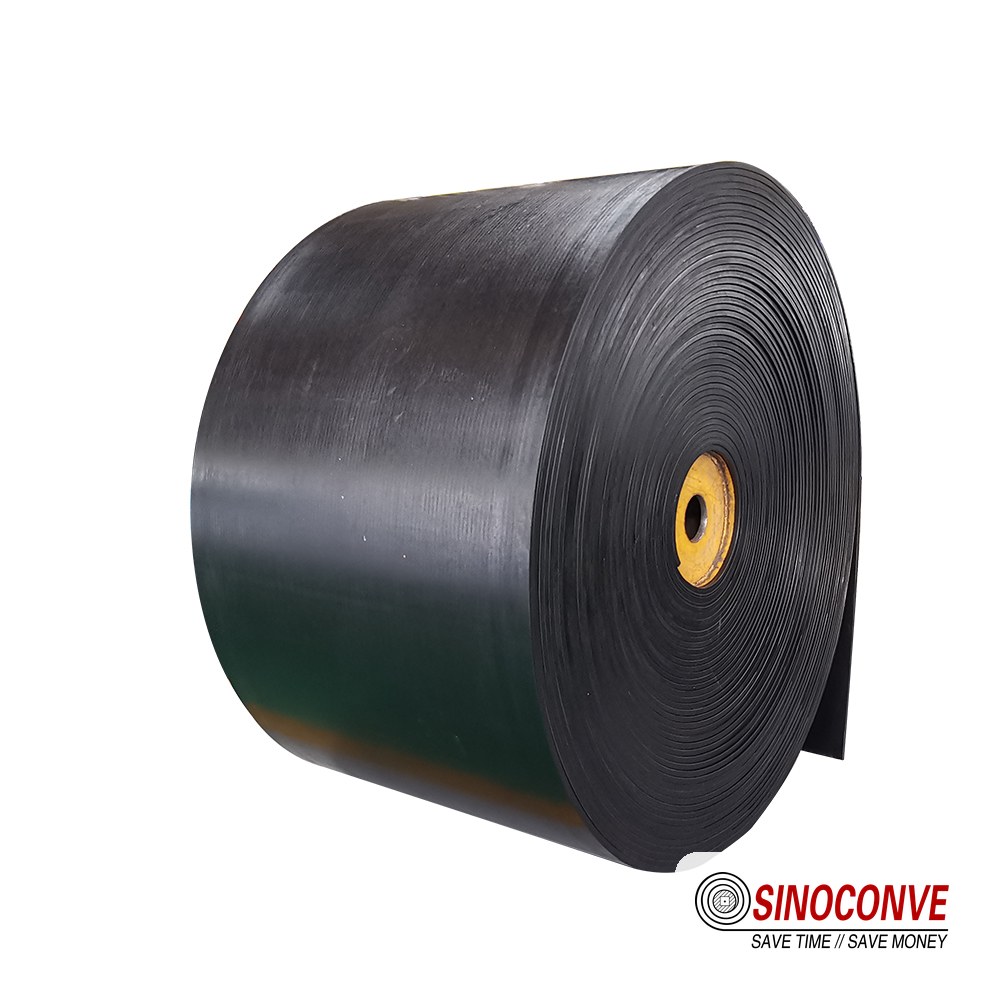
The rejoined route starts with a flat length, cured first and then closed by a stepped or spiral finger joint that is itself vulcanised. Stepped joints suit heavier carcasses because the load transfers through several staggered steps. Spiral or finger joints spread the same load over a longer path and work well on thinner belts and on textile carcasses up to four plies. Both are legitimate manufacturing methods. Neither produces a belt that behaves exactly like a moulded ring.
| Production route we use to close the loop | How the ring is closed after shaping | Length and ply range we can hold | Point in the duty that decides the choice |
|---|---|---|---|
| Ring mould route, cured endless in one press cycle | Carcass plies are continuous around the circumference before any heat is applied | Loops from roughly 2 m to 30 m long, widths to 2,400 mm, up to four textile plies | Best choice when pulley diameter is small or the duty needs even tension across the width |
| Stepped finger joint closed after the belt is cured | Each ply ends in a series of steps that are overlapped and pressed under heat | Long loops beyond mould capacity, heavy carcasses to six plies, widths to 2,200 mm | Chosen when the loop is too long to press as a ring but still has to arrive closed |
| Spiral or finger seam after cure | Cured belt ends are cut into long interlocking fingers and then re-vulcanised | Thin and medium belts with the same length reach as the stepped route | Finger geometry spreads load along the seam so the local stiffness rise stays modest |
04What We Can Build and Where the Limits Sit
As a conveyor belt manufacturer we would rather publish our ceiling than promise something the press cannot hold. Ring mould capacity decides the honest answer, and the press decides it long before the quotation stage. A loop that will not fit the mould becomes a rejoined loop, and we tell the buyer which route they are paying for.
On the moulded route our practical window runs from about 2 m to 30 m of developed length. Below 2 m the ring gets stiff enough that handling it without kinking becomes the real problem, and above 30 m the mould simply is not big enough for the carcass we would need. Widths go to 2,400 mm on textile carcasses and 1,800 mm is a comfortable day-to-day maximum. Four plies is where we stop for moulded rings in EP and NN construction.
Longer loops still ship endless, just not moulded. Beyond 30 m we build the belt flat, cure it, and close it with a stepped or spiral seam, which we do for overland and port installations where a 90 m loop is normal. The limit there is transport, not production. A 1,400 mm wide, 90 m ring weighs several tonnes and needs a steel-frame shipping cradle, and that cradle has to be designed as part of the order.
Requests We Turn Down
Three requests come back as a no, and buyers should know them in advance. We will not mould a steel cord ring; the cord has to be continuous through the loop and the vulcanising route for cord carcasses is a different process entirely. We will not guarantee an endless loop that has to be slit narrower after cure, because slitting cuts through the edge that was moulded square. And we will not quote a moulded ring with a chevron profile taller than 25 mm, since the profile blocks distort the ply path where they meet.
05Length, Perimeter and Diagonal Tolerances
Length is the number that decides whether the loop will tension correctly, and it is the number most often quoted as a percentage that nobody can check on site. A belt that arrives 60 mm long on a 20 m centre has to be taken up by the tensioning carriage, and a carriage with 400 mm of travel absorbs that easily. The same 60 mm on a short 3 m centre may exceed the take-up available and force a re-cut.
We work in millimetres per metre rather than a blanket percentage. For a moulded ring in EP or NN carcass we hold developed length to plus or minus 1.5 mm per metre, which is 30 mm on a 20 m loop. Rejoined loops get plus or minus 3 mm per metre, because the seam length depends on how the fingers are cut and cured. Our inspection sheet records actual measured length, not a tolerance band.
Perimeter alone does not tell you whether a loop is square. The number that matters for tracking is the difference between the two diagonals measured across the flat loop, and we hold that to 4 mm on moulded rings and 8 mm on rejoined ones. A loop can be exactly the right length and still pull to one side because one diagonal runs 12 mm longer than the other, which is why we measure both before crating.
| Dimension that we control on the loop | Value we hold on a moulded ring | How it is measured before crating | What goes wrong when it drifts |
|---|---|---|---|
| Developed length of the finished loop | Plus or minus 1.5 mm for every metre of loop circumference | Belt laid flat under light tension and read against a calibrated tape | Take-up carriage runs out of travel and the crew shortens the loop on site |
| Diagonal difference across the flat loop | No more than 4 mm between the two opposing diagonal readings | Both diagonals corner to corner on the flat ring, same tension each time | Loop pulls hard to one side and the carrying edge wears into the skirt rubber |
| Squareness of the cut belt edges | Edge runs within 0.5 mm per 100 mm of belt width from true | Steel square and feeler gauge at six points around the ring | An out of square edge drags on the loading skirt and frays within weeks |
| Total loop weight for lifting plan | Declared on the packing list to the nearest 10 kg of finished belt | Weighed on the shop floor scale after edge trimming is complete | Crane and sling plan is undersized and the ring buckles during offloading |
How to Check Length Without Unrolling the Whole Loop
You do not need to lay 90 m of belt on the ground to verify length. Mark one point on the loop, roll it along a straight reference until the mark comes back, and read the distance travelled. We do this on a clean floor with the belt under finger tension, and the reading repeats within 5 mm. For an industrial conveyor belt that will sit on a fixed centre, that one number tells you whether the loop belongs on your frame.
06Thickness, Width and Tension Uniformity
Thickness variation is the quiet killer of endless belts, and it hides in sections you cannot see once the belt is on the frame. We hold total belt thickness within plus or minus 0.3 mm at any point around a moulded ring and within plus or minus 0.6 mm on a rejoined loop. A local bump of 1.5 mm under a plough or a scraper blade produces a wear stripe that grows into a split.
Width we hold to plus 5 mm and minus 0 mm from the ordered figure, because a belt that runs narrow loses cover over the pulley edges while one that runs wide rubs the structure. Cover thickness gets its own measurement on each face, and we record it at nine points. On a 1,200 mm wide belt with a 6 mm top cover rated at 18 MPa tensile strength, that nine point map is what proves the ring is not running thin on one edge.
Tension uniformity side to side is where an endless ring earns its premium. Every ply carries load evenly because no seam interrupts the path, and the practical proof is even running after a short wear-in. We measure tension indirectly through the elongation the loop takes at a known take-up load, and we will send that curve with the belt on request.
Why an Uneven Ring Tracks Badly Even When It Is Straight
Consider a loop with 150 mm of slack on the left side and 90 mm on the right at the same take-up load. The tight side carries more tension, stretches slightly less under the drive load, and the belt migrates toward the slack side. Nothing about the frame causes this, and adjusting idlers will not fix it. A spliced loop shows the same symptom whenever the finger overlap is deeper on one edge than the other.
07Why Endless Loops Track Better on Short Centres
Short centres punish every dimensional error in a belt, and that is why small pulley duties belong to endless rings. When the centre distance is only six or seven times the pulley diameter, the belt is in a bend or a transition for most of its travel. Any local stiffening at a seam makes the belt lead into the next pulley at a slight angle, and over a thousand revolutions that angle becomes edge wear.
Training needs a predictable response. An endless loop responds to a small idler adjustment within one or two revolutions, while a spliced loop with a stiff joint responds unevenly because the joint itself changes the belt line as it passes. We have watched crews chase a tracking fault for a full shift on a spliced belt that disappeared the moment the same frame was fitted with an endless ring of identical construction.
Frequency matters as much as geometry. A loop running at 1,200 revolutions per hour over a joint that is 1.2 mm proud at 2.5 m/s is being flexed 1,200 times an hour, or roughly 9,600 times per eight-hour shift. Multiply that across a year and the arithmetic stops being forgiving. This is the same reasoning that pushes us toward an endless EP belt tracking guide conclusion for short, fast lines every single time.
Crowned Pulleys and the Role of Even Tension
Crowning works by steering a belt toward the highest point of a crowned pulley, and it only steers predictably when tension across the width is reasonably even. A crowned pulley with a belt that is 25 percent tighter on one side will still drift, because the tension difference beats the crown angle. Endless construction removes the largest single source of side-to-side tension variation, which is why crown and endless loop are a matched pair rather than two independent decisions.
08Duties Where an Endless Loop Is Not Optional
Some duties tolerate a joint, and some do not. We sort them by pulley geometry, speed and cleanliness rather than by tonnage, because a 40 t/h food line can be far more demanding of the belt than a 400 t/h lump ore line. Where a joint has nowhere to hide, an endless loop stops being a refinement and becomes the only sensible purchase.
Small pulleys come first. Below a 315 mm pulley diameter, a hot splice of any thickness will over-flex and eventually crack at the step. High speed comes next, and anything above 3 m/s starts loading the joint with flex cycles faster than a splice can shrug off. Precision conveying follows, because a belt that changes length slightly at each pass cannot hold sensor triggers or checkweigher positions. Hygienic service adds its own logic, since a seam is a place where product collects and cleaning crews cannot reach.
We keep hearing the same argument from buyers who want to save money on a joint, and it usually ends with a replacement order within a year. If the duty appears anywhere in the table below, weigh the endless loop against the joint plus the downtime that follows. Our engineers will always tell a customer when a splice is genuinely the better answer, and there are real cases where it is.
| Duty condition that forces the choice | Why the endless loop solves it | What a joint costs you here |
|---|---|---|
| Head or tail pulley under 315 mm diameter | No step exists, so the carcass bends through a tight arc without local over-stress | Splice step cracks along the finger tips within a few hundred thousand cycles |
| Belt speed above 3 m/s on a continuous line | Uniform thickness keeps the belt line stable at speed and prevents joint bounce | Every joint pass sets up a small impact that loosens the belt on the pulleys |
| Precision indexing and sensor trigger positions | Loop length stays constant, so a part arrives at the photo eye at the same moment | Joint creep shifts the trigger point and the line starts rejecting good parts |
| Food, pharmaceutical and cleanroom contact surfaces | A smooth unbroken surface leaves no crevice where residue can sit and grow | Seam gaps fail swab tests and force extra manual cleaning every shutdown |
| Lines that must hold even tension across the full width | Every ply carries its share around the whole loop, so side to side load stays level | Tension difference at the seam pulls the belt off centre and wears one edge |
Where a Joint Is Still the Right Call
We are not selling endless loops into situations that do not need them. A 1.8 m wide overland conveyor with a 600 mm pulley, running at 1.6 m/s and carrying iron ore, works perfectly well with a properly cured splice, and shipping a moulded ring of that size costs more in freight and handling than the joint ever will. Talk to a conveyor belt supplier who will say so rather than push the expensive option. The same honesty applies to wholesale conveyor belts bought in volume for scheduled shutdowns, where a stocked spliced spare beats a long lead time.
Duties That Look Mild but Are Not
Two applications surprise buyers regularly. Packaging lines that start and stop 300 times a shift look gentle, yet each start delivers a shock load through the whole loop, and a mechanical fastener lets go first. Sand washing plants look messy rather than fast, but the fine abrasive slurry works into any seam and grinds the finger edges from the inside. Both complaints reach us as "the belt failed early", and both trace back to a joint that should never have been specified.
09Buyer Verification Checklist Before You Accept the Loop
We would rather have a buyer reject a belt at our gate than at their plant, so this section is written as a genuine inspection list. Every row can be checked with a tape, a square, a scale and the paperwork that should travel with the ring. If a maker cannot supply the evidence, that is information in itself.
Start with the dimensional record. Ask for the measured developed length, both diagonals, the width and the nine point cover thickness map, each signed against the order number. Then ask for the carcass details: ply count, ply material, tension rating per ply, and the cover grade with its tensile strength in MPa and abrasion loss in mm³ under the DIN 53516 test method.
Finish with the handling evidence. Confirm the weight declared on the packing list, the cradle or pallet design, and the lifting points marked on the frame. A ring that arrives on a flat pallet with no support under the crown will have taken a permanent set before you open the shrink wrap, and that set becomes the tracking fault nobody can explain three months later.
| What to ask the maker for | Evidence that actually counts in a dispute | How you verify it at your gate | Trigger that lets you reject the ring |
|---|---|---|---|
| Declared developed length of the finished loop | Signed inspection sheet showing the measured figure rather than a tolerance band | Roll the marked loop along a straight floor and read the distance for one turn | Reading sits more than 1.5 mm per metre away from the ordered figure |
| Both diagonal measurements of the flat loop | Two figures recorded corner to corner with the loop flat and lightly tensioned | Lay the loop flat and repeat both diagonals with your own tape measure | The two diagonals differ by more than the agreed squareness allowance |
| Cover thickness map across the width | Nine point reading on each face taken with a depth gauge after cure | Spot check six points with your own gauge before the belt goes on the frame | Any point runs more than 0.5 mm below the ordered cover thickness |
| Carcass and cover certification paperwork supplied | Ply count, tension rating, cover grade, tensile strength in MPa and abrasion loss in mm³ | Cross-check the figures against the order and against the duty you described | Cover class or ply count does not match what was ordered and paid for |
| Packing and lifting arrangement for the ring | Cradle drawing, declared gross weight and clearly marked lifting positions on the frame | Inspect the cradle for crown support and check the lifting marks before the crane lifts | Ring rests unsupported on a flat deck or carries no lifting markings at all |
One Question That Separates Real Makers From Traders
Ask who pressed the ring and on which press. A conveyor belt factory that cures its own loops can tell you the platen size, the cure temperature and the dwell time in one sentence, and can walk you through the inspection sheet line by line. A trader has to phone somebody else for the answer, and that delay usually shows up as a vague reply.
10Installation Tension and the Running-In Period
An endless belt has to be installed at the right tension, and the correct value is lower than most crews expect. Over-tensioning an endless loop does not make it track better; it stretches the carcass permanently and shortens the service life of the pulley bearings at the same time. Pull the loop onto the frame with the take-up backed off, then add tension gradually while the belt is turning slowly.
A practical starting point is enough take-up to stop the belt slipping on the drive pulley under full load, plus roughly 10 percent more travel in reserve. We watch the belt at the drive pulley during the first slow revolutions. If the belt slips, add take-up in small increments; if the return side looks tight and flat with no sag, you have gone past the useful point and should release some.
Running-in takes a shift, not a month. Expect the loop to settle by 0.2 to 0.4 percent of its length in the first eight hours as the plies compact. That is 40 to 80 mm on a 20 m loop, and the take-up must have room for it. After the first shift, re-check tracking at every idler, look for any edge contact with the skirts, and record the take-up position so the next inspection has a baseline.
Reading Tracking During the First Shift
Track the belt with the frame loaded, not empty. A loop that runs perfectly on an empty frame can move 15 mm off centre once material is on it, because the load changes the tension distribution around the drive. Watch the return side as well as the carrying side, since the return strand often shows a tracking problem earlier and with less risk to the structure.
What Belt Drives and Endless Conveyor Loops Share
The tensioning logic is not unique to conveyors. A V-belt manufacturer will tell you the same thing about a drive belt: too little tension slips, too much destroys bearings, and the sweet spot sits somewhere in between. The same principle drives every transmission belt manufacturer recommendation you will read, whether the belt carries stone or turns a fan.
11Tracking, Edge Wear and What to Watch Monthly
A well built endless ring gives you a long, boring service life, and the early signs of trouble are easy to miss because they arrive slowly. We ask customers to look at four places every month and write the readings down. Numbers on paper beat memory every time, particularly when the same crew rotates between shifts.
Watch the belt position at the head pulley first. Measure from the frame to the belt edge on both sides and record both figures. A drift of 5 mm over a month is normal settling; a 20 mm drift in a fortnight means something has changed, and it is usually a seizing idler rather than the belt. Then inspect the edges for fraying and for a shiny polished strip along the outer 30 mm, which is the signature of continuous contact with a skirt or a structure.
Look at the pulley lagging as well, because it tells you whether the belt is being driven evenly. Patchy wear on one side of the lagging mirrors uneven belt tension, and that pattern points back to loop geometry or to a splice that has crept. Finally, listen to the drive. A rhythmic knock once per revolution of the head pulley is a step, a lump or a damaged plate travelling around the loop, and it will not fix itself.
When the Wear Is Coming From Carryback, Not From the Belt
Edge and cover wear that looks like a belt defect is often material sticking to the return side and grinding as it passes under the pulleys. A return side cleaning programme usually removes that wear source for a fraction of the cost of a new ring, and our note on dust resistant belt selection covers the cover grade side of the same problem. Any conveyor belt distributor can supply a scraper, but only the belt maker can tell you whether the wear pattern actually comes from the belt.
12Storage, Handling and Lifting an Endless Ring
Storage damage creates more endless belt faults than running ever does. A ring that sits on the floor under its own weight takes a permanent set at the two contact points, and the set shows up as a tracking wobble the first day it turns. Store the loop standing on a cradle with support under the crown, or hang it on a properly sized drum, never on a single hook that pinches one section.
Temperature matters as much as support. Keep the loop away from direct sunlight and from heaters, and hold storage between 5 °C and 30 °C where the compound stays flexible. Below about 0 °C a standard EP carcass gets stiff enough that forcing it onto a frame risks cracking the cover, and we have seen cover splits appear along a fold line that was created in a cold warehouse two winters earlier.
Lifting needs spreader bars and fabric slings, not wire rope. Two slings at quarter points, each rated well above the loop weight, keep the ring round while it travels. Never lift a loop by a single sling through the centre, because the belt above the sling takes the whole weight in compression and creases. That crease becomes the crack initiation point later in service.
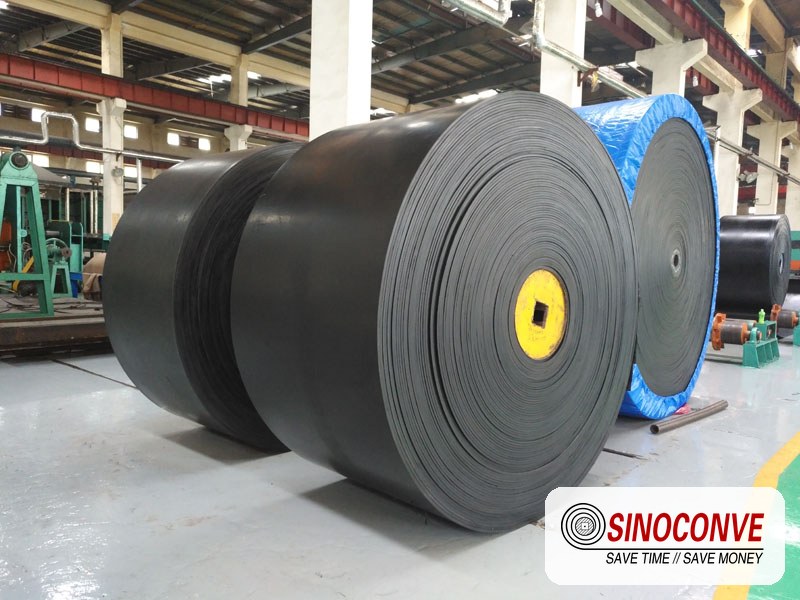
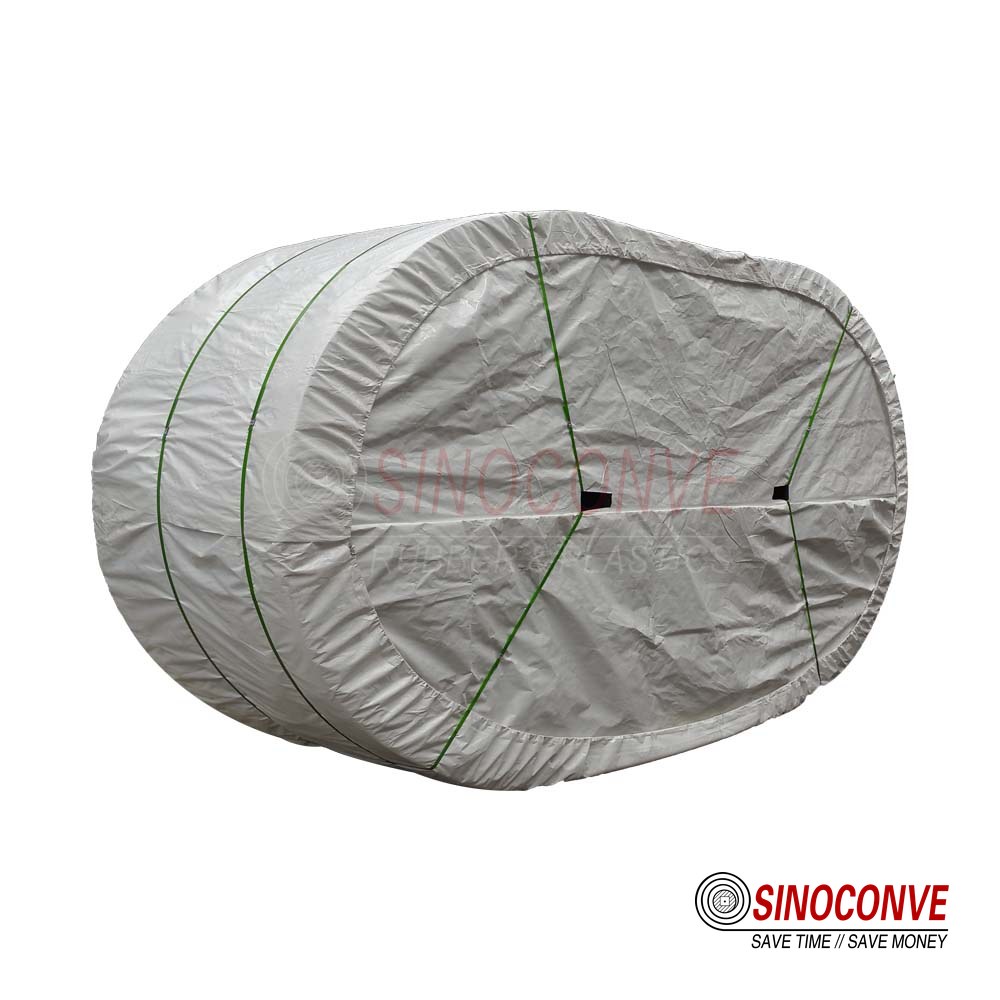
Every endless rubber conveyor belt ring leaves our works on a cradle that supports the crown.
Long Term Storage and the Shelf Life Question
Rubber has a shelf life, and a loop stored badly for three years is not new stock. Rotate by installation date, keep the storage area dark and ventilated, and avoid stacking anything on top of a ring. If a loop must sit for more than a year, inspect it before installation, look for surface cracking on the covers and check that the loop still lies flat without a twist.
13The Cost and Downtime Trade-Off, Worked Through
Nobody chooses a construction on engineering grounds alone, and we understand that. The endless loop costs more to buy than a spliced belt of the same carcass, and the difference is real. What buyers often get wrong is the other half of the comparison, which is the cost of the first failure and the downtime that goes with it.
We will not put a currency figure on the belt, because it depends on grade, ply count, width and freight lane, and any number we printed would be wrong for half our customers. Instead here is the calculation we walk through with a buyer who is weighing the two options. Build the total cost of ownership from four terms and use your own figures in each one.
The first term is the delivered cost of the belt itself. The second is the installation cost, and for a spliced belt that includes press hire, a skilled crew, consumables and the hours the line is stopped. The third term is the expected service life, which for the same duty we would set at roughly twice as long for a moulded ring on a short, fast line. The fourth term is the cost of one unplanned stop per year, which for a primary crusher feed line or a shiploader is usually the largest number on the page.
| Cost term you put in the calculation | How to estimate it with your own data | How the endless option shifts it |
|---|---|---|
| Delivered cost of the belt itself | Compare the two quotations per square metre of belt face, not per metre of length | Rises, because the ring uses more press time and cannot be shipped flat on a reel |
| Installation labour and press time on site | Multiply crew hours on site by the fully loaded hourly rate your maintenance budget uses | Falls sharply, since the loop is lifted onto the frame and tensioned in an hour or two |
| Expected service life measured in months | Use your own replacement history for the same duty rather than a catalogue figure | Typically doubles on short centre, high speed duty where joint flexing was the limit |
| Cost of one unplanned production stop | Write down the hours lost and multiply by the contribution your line makes in that time | Drops if the failure mode moves from a joint to ordinary cover wear you can plan for |
A Worked Frame You Can Fill In
Take a 24 m centre feeder running ten hours a day. Suppose the spliced belt lasts 14 months and the endless ring lasts 28 months on the same duty, and one unplanned stop costs you six hours of line time. Over a four year window you are comparing roughly three and a half spliced belts against two endless rings, plus two unplanned stops against none. Put your own cost for a belt, a spliced install and an hour of lost production into those counts and the answer usually stops being close.
When the Arithmetic Says Buy the Splice
The endless loop does not win everywhere, and we say so. On a slow line with a large pulley, a splice lasting three years is entirely reasonable, and the extra spend on a ring buys little. That is a legitimate decision, and the honest way to reach it is with your own replacement history rather than with a supplier's brochure.
14Field Notes from Sites Running Endless Loops
Two visits from the past year are worth passing on, because both ended with a change to the specification rather than to the belt. Neither case involved a manufacturing fault, and both were visible in the first week of running if anyone had been watching the right measurement.
At a washed sand plant the endless loop was tracking 25 mm off centre by day three. The crew assumed the ring was out of square and asked for a replacement.Our engineer measured the diagonals, found them within 3 mm, and then found a return idler seized solid 6 m from the tail. Replacing that idler cost a fraction of a new belt, and the loop has run straight since. The lesson is that a tracking complaint is a measurement problem before it is a belt problem.
The second visit was to a food packaging hall where a short endless belt was being restarted 400 times a shift. Edge cracking appeared after eleven weeks. The compound had been ordered for ambient service, and the cleaning regime involved a hot wash that pushed the surface past 80 °C twice a day. Switching to a cleaner contact surface and a heat tolerant compound solved it. Nothing about the construction was wrong; the environment had never been described to us at the quotation stage.
Both stories point the same way. Tell the maker what the belt will actually meet, in numbers, and the chance of a first-time-right loop rises sharply. We will always ask for the duty, the pulley diameters, the speed and the cleaning regime before we quote an endless ring.

15Frequently Asked Questions
Is an endless rubber conveyor belt actually stronger than a spliced one?
Yes, on any duty where the belt has to bend repeatedly, because the finished ring keeps the full carcass rating instead of recovering only part of it at a seam.
What loop sizes can be cured as a true ring?
Our moulded route covers developed lengths from roughly 2 m up to 30 m. Widths reach 2,400 mm on textile carcasses and the ply count tops out at four for a moulded ring. Longer loops are built flat and closed with a stepped or spiral seam, which pushes the practical length past 90 m.
How tight a length tolerance should I demand?
Ask for millimetres per metre rather than a blanket percentage, and 1.5 mm per metre on a moulded ring is a figure a factory can actually measure and defend.
Can a damaged endless belt be repaired on site?
Small edge tears and cover gouges are repairable with a hot patch or a cold cure compound, and we supply both. What cannot be repaired is a split that crosses the full width, because the repair becomes a joint in the middle of a duty that was chosen specifically to avoid one. On a high speed line, a full width repair generally means ordering the next ring. The temporary fix will get you through a shift, not through a season.
Why does my endless belt still drift to one side?
Check the frame before the belt. Seized return idlers, a loading point that is off centre, and a head pulley that is not square to the belt line account for most drift we investigate. Diagonal measurements below the agreed allowance rule the loop out as the cause.
Do I need a crowned pulley with an endless loop?
Crowning helps on short centres, and an endless ring makes that crown work more predictably because tension stays even side to side.
How long should an endless belt last in a crushing circuit?
Life depends far more on the duty than on the label. We see 18 to 24 months on a secondary crusher discharge line with a 500 mm head pulley and two shift operation. A primary feed line taking 1,200 mm lumps through a 315 mm pulley runs shorter, sometimes 10 to 14 months, because impact and tight bending both work on the same carcass. Record every replacement date and the real interval will tell you more than any catalogue figure.
Can you ship a long endless loop overseas?
Yes, and we do it on steel cradles rather than pallets. A 1,400 mm wide, 90 m ring needs crown support and clearly marked lifting points, and we design the cradle as part of the order. Freight is quoted on volume as well as weight, because a large ring takes a great deal of deck space.
Is the endless construction worth the extra spend on a slow line?
Usually not, provided your pulley is large and your duty is gentle, so run the four term calculation with your own replacement history before you decide.
Related Products You May Need
- Rubber conveyor belts in EP, NN and steel cord carcass constructions for heavy duty work
- EP rubber conveyor belt for quarry duty
- Steel cord belts engineered for long overland runs where a field splice would open early
- Heat resistant belt for clinker handling
- Chevron and incline belts for steep conveying duties on mobile plant
- PVC light duty belt for packaging
- V-belts for industrial and agricultural drives including banded and cogged profiles
- Timing belts for precision drives on machinery
- Conveyor rollers and idlers matched to the same frames and belt widths
- Full product catalogue from our Ningbo works
Related Blog Posts
- Conveyor belt splicing buyer's checklist: twelve things to verify before ordering
- Rubber conveyor belt cover grades explained
- EP conveyor belt tracking guide for field teams running short centre drives
- Heavy duty rubber belts in mining duty
- Steel cord belt durability in bulk material handling and long overland runs
- Return side belt cleaning that removes carryback
- Quarry crusher belt selection notes for aggregate plants