
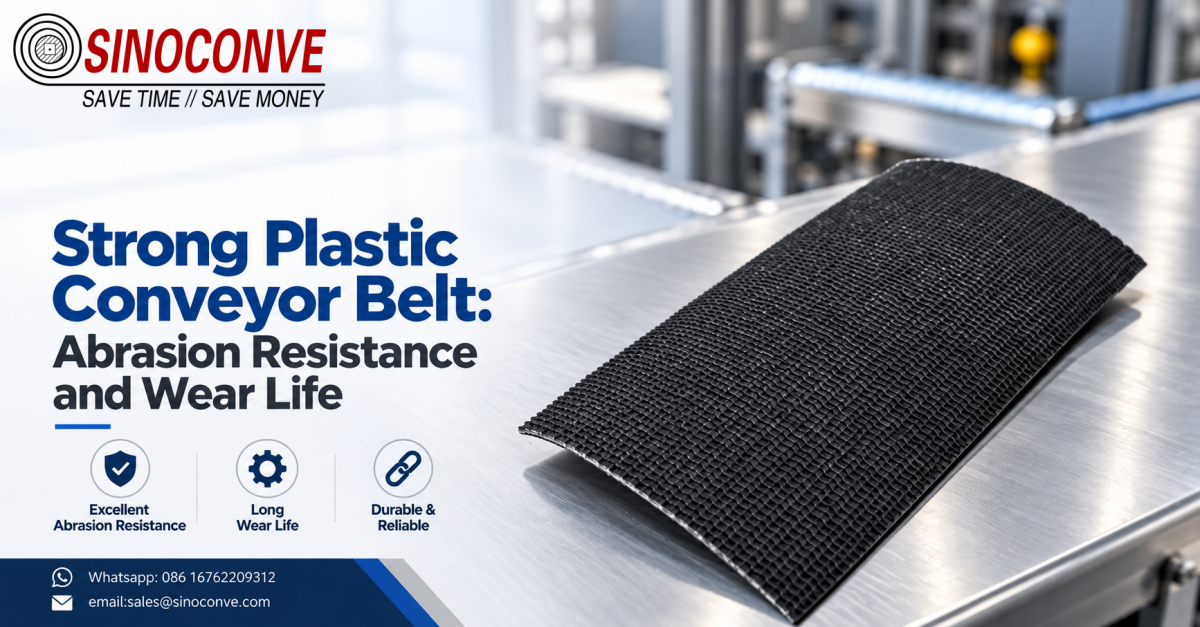
Ask ten different suppliers for the same strong plastic conveyor belt and you will collect ten different stories about abrasion, each resting on a different claim about the material. One points at the resin family, another at a glass fibre loading, and a third at little more than a thicker moulding. Every seller may be repeating something true. None of those single claims, on its own, tells you how many seasons the belt will survive beneath your chute. Wear is a system result.
Four variables decide how quickly a plastic belt loses material. The polymer body sets the baseline, because crystallinity and molecular structure govern how the surface behaves under load. Fillers and reinforcements shift that baseline, sometimes upward and sometimes sideways. The surface geometry controls how much the product actually slides against the belt face, and that effect is frequently larger than the resin choice itself. Last comes the medium, because water, oil, fine powder and a dry dusty stream each attack the same belt in a different way.
This page stays on the material layer. We will work through the polymer body, the filler routes, the four mechanisms that remove material from a belt face, and the way surface geometry changes the rate at which that happens. Along the way we separate the honest performance drivers from the marketing ones and set out the questions worth asking before you approve a drawing.
One point we repeat at the start of every technical note. We are a working conveyor belt factory, not a testing house and not a certifying body. We can tell you which question to ask and how to read the answer. The test data itself has to come from the material supplier, and it has to name the method that produced it.

01Why a Strong Plastic Conveyor Belt Is a Claim, Not a Specification
The phrase strong plastic conveyor belt sells well and specifies almost nothing. Strength in a plastic belt can mean the tensile strength of the part, the stiffness of the moulding, the impact toughness of the resin, or the scratch resistance of the surface. Those four properties do not move together. Change one and you disturb the others, often in the direction the buyer did not intend.
A buyer who asks for a stronger belt and receives a stiffer part may have just made the belt more brittle. That is the trap. Stiffness and toughness are separate properties, and most catalogues never separate them. On a conveyor we have seen a stiffer grade of the same acetal family crack through a sprocket pocket at the loading end while the softer grade it replaced had merely worn thin.
So the first move is to translate the word. Which failure are you actually trying to prevent? A belt that wears thin too fast, a belt that cracks at a pocket, or a belt that cannot hold its pitch after a wet season. Each answer points at a different part of the specification.
Wear life is the hardest of the three to promise, because it depends on your site. Two lines running the same polymer, the same pitch and the same load can report completely different service records if one feeds a dry screening deck and the other feeds a wet wash. We build that distinction into every quotation. Our engineers would rather spend ten minutes on the feed condition than quote a resin name and hope.
Separate what the part must do from what the surface must do
A conveyor belt part carries a load and moves it forward, and both jobs happen at the same time on the same piece of plastic. The bulk of the material under the surface provides the load path. A very thin layer at the top provides the friction and the wear interface. Treating the whole part as one material property is where specifications go wrong.
Think about a modular belt row. Most of its stiffness comes from the ribs and the body underneath, not from the top face. Abrasion, though, is decided almost entirely at that top face. You can raise stiffness without improving wear at all, and you can improve wear without adding a single point of stiffness.
Because a conveyor belt manufacturer sells surface and body as one item, the buyer has to pull the two apart in the enquiry. Write down the load the part must carry and, separately, describe what rubs against the face. Those two lines do more to fix the material than any brand name.
What a sales sheet usually leaves out
Most plastic belt literature lists the resin and stops there. It rarely names the filler content, the additive package, the batch, or the temperature range the compound was actually validated for. Those are exactly the variables that decide wear.
We have asked suppliers, on behalf of customers, for the filler loading on a claimed abrasion-grade part and received a shrug. When the answer finally came it was a range wide enough to cover three different products. A specification you cannot pin down is not a specification.
Field note from our engineers: A fruit-packing plant replaced the washable plastic belt on its grading line with a lower-grade "heavy duty" module that felt harder in the hand. It wore through at the infeed lip far faster than the belt it replaced. The harder part was stiffer, and the stiffer part transferred every lump of soil and leaf directly into the edge. Hardness is not the same as wear resistance, and the surface was not the failure point.
02What the Term Actually Covers on a Plastic Belt
Before the mechanisms, it helps to name the parts of the claim. A plastic conveyor belt is a moulded polymer product, usually assembled from linked modules, and its abrasion behaviour is governed by three nested layers that behave differently.
The outermost layer is the contact face, the part the product touches and drags across. Just beneath it sits the reinforced body, which carries the pull and resists deflection between supports. Underneath both, the hinge line and the connecting elements transfer load from row to row. Abrasion usually starts at the contact face and only becomes a structural problem when it reaches the body.
The difference between wearing out and breaking
Two belts can fail on the same line for reasons that have nothing to do with each other. One thins gradually until the modules no longer hold their pitch. The other cracks suddenly at a pocket or a runner. The first is a wear problem and the second is a stress problem, and they call for opposite changes to the formulation.
Adding filler usually helps the second case and can hurt the first. Adding a tough impact modifier helps the first case and can soften the part for the second. Nobody can optimise both at once, which is why we ask what actually failed last time before quoting a replacement.
Where rubber and plastic genuinely differ
A conveyor belt supplier working in rubber and one working in plastic describe abrasion with the same word and mean different things. Rubber absorbs a lot of local energy by deforming and recovering. A hard polymer does not deform nearly as much, so more of that energy goes into the surface itself.
That single difference explains most of the confusion. A rubber conveyor belt often survives a sharp, high-angle impact that a rigid plastic module would notch. In exchange, the plastic belt resists slow sliding abrasion and chemical attack far better in many light-duty settings. Neither material wins everywhere.
We treat the rubber side of that comparison as a separate subject, and the page that already covers it in depth is linked at the end of this article rather than repeated here.
Dry sand, wet sand, oil-soaked swarf and warm clinker are four different abrasives even when they share the same particle size range. Water can lubricate a sliding contact and reduce wear, or it can carry grit into a gap that dry product would never reach. Oil softens some polymers and swells others. Fine powder works its way past edges and compacts in the tight clearances.
So the same belt, the same pitch and the same speed can last very differently in two plants. We have watched a grade that ran for years in a dry mineral stream fail within months once the same stream arrived wet. Nothing about the belt changed. The medium did.
03The Polymer Body: How PP, PE, POM and PA Wear Differently
Four resin families cover the great majority of plastic conveyor belts sold into industry.Polypropylene, polyethylene, acetal and polyamide each bring a different balance, and the wear behaviour of each one follows from its structure rather than from any marketing label.
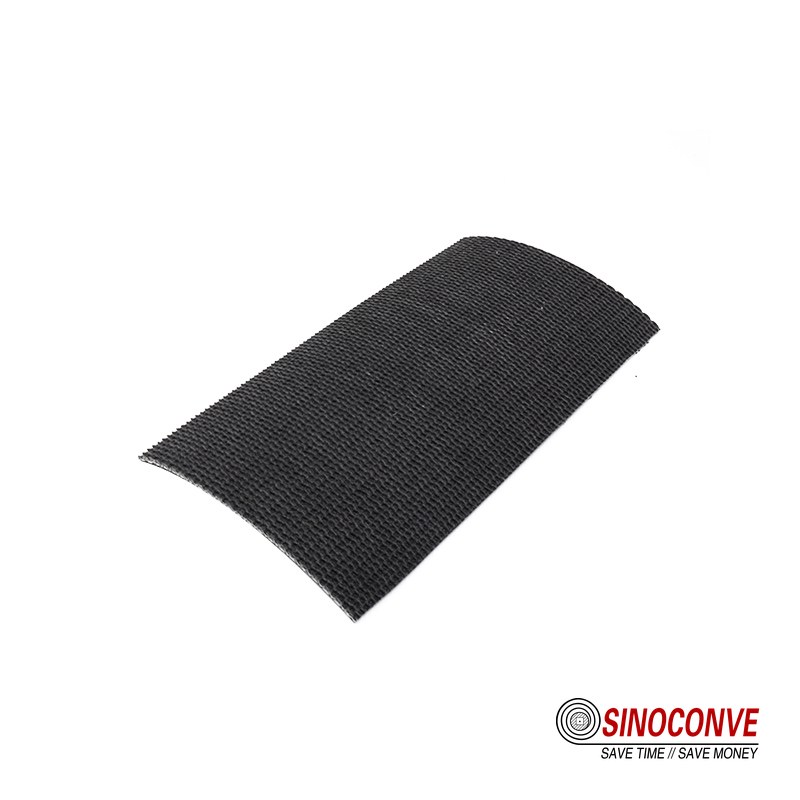
The same module shape can be moulded in four different polymers. The geometry is identical and the wear life is not.
Polypropylene: the chemical-tolerant workhorse
Polypropylene wins on resin availability and on resistance to many chemicals, which is why it appears in so many light conveying lines. Its weakness is mechanical. The surface is relatively soft, so it scratches and scuffs under hard or sharp product, and it grows brittle as the temperature falls. On a cold morning in an unheated shed a polypropylene module can crack where the same module was perfectly serviceable in summer.
We still recommend it often, and we say why in plain terms. If the stream is mildly abrasive, the load is light and the chemistry is awkward, polypropylene offers the most belt for the least material per module. Push it into heavy sharp product and the same economy disappears.
Polyethylene: tough, slippery, and not very stiff
Polyethylene absorbs impact better than polypropylene and slides product across its face with less drag. That combination suits freezer rooms, low-friction transfers and gentle bulk that must not stick. Its limitation is stiffness. Under a heavy concentrated load a polyethylene module deflects, and a deflecting module wears unevenly because the load never lands where the designer expected.
The low friction that helps a product slide also reduces grip. On an incline the same slipperiness that eases a flat transfer lets product slip back. Polyethylene is a specialist, not a default.
Acetal and polyamide: the two engineering choices
Acetal, usually written POM, is the stiff favourite of high-load and low-friction duty. It holds its shape, runs quietly at speed, and keeps a low coefficient of friction against steel and against itself. It carries the heaviest material burden of the four, and a rigid part is less forgiving of a bad chute.
Polyamide, written PA, is the tough one. It resists abrasion and repeated impact well, which makes it attractive under loading zones. Its complication is moisture. Polyamide absorbs water from the air and from the product, and as it does the part changes dimension. On a wet line those changes can alter pitch and clearance enough to matter, so a polyamide specification should always come with a stated moisture condition and a dimensional check.
The table below is the version we use when a customer describes a duty in two sentences and wants a first cut. Read the row that matches your feed, then use the notes beneath it to challenge the choice.
| Polymer family used in modular belts | Where it usually wins on a real line | Where it usually hurts the owner | Duty profile it tends to suit |
|---|---|---|---|
| Polypropylene, the widely available commodity workhorse resin | It resists many chemicals and is very easy to replace | It is soft, scratches easily and turns brittle when cold | Light loads with chemical exposure and mild abrasion |
| Polyethylene, the impact-tolerant and slippery option | It absorbs shock and lets product slide along easily | It is not stiff, so it sags under heavy point loads | Freezing rooms and gentle bulk that must not stick |
| Acetal, or POM, the stiff engineering choice | It holds its shape and runs with low friction at speed | It carries the heaviest material burden of the four common families | High load, tight pitch and low-friction conveying |
| Polyamide, or PA, the tough wearing choice | It resists abrasion and repeated impact very well | It takes up moisture and changes dimension as it does | Wet or abrasive duty where dimensions can be checked |
Those are tendencies, not verdicts. A filled polypropylene part can outlast an unfilled acetal one in a specific stream, and a toughened polyamide can run where a stiff acetal would rather crack than bend. The resin sets the starting point. The formulation decides the finish.
04Fillers and Reinforcement: What They Change and What They Give Up
Hardly any production belt is a pure resin. Almost every wear grade is a compound, and the additives are there for a reason. Understanding those reasons is how you judge whether a quoted gain is real.
Two families of additive do most of the work. Reinforcements add stiffness and dimensional stability, and mineral fillers do part of the same job for less. A second group is about surface behaviour, covering internal lubricants and toughening agents. Each one wins a property and gives something else up in return.
Why glass fibre is added, and what it takes away
Glass fibre raises stiffness, improves dimensional stability and lets a part carry more load before it deflects. On a heavily loaded run where deflection is what destroys the belt, that is the single most valuable change you can make to the compound.
The trade is brittleness. A fibre-reinforced part is harder to machine and less tolerant of a sudden impact, and it can chip at an edge where an unfilled part would merely deform. We have seen a fibre-reinforced module split at the runner when a lump landed just off-centre, on a line where the unfilled grade had only ever worn.
The compounding routes we see most often
The four routes below cover the bulk of what is quoted as an abrasion or heavy-duty grade. None is free. Each one trades a property the buyer did not mention for a property the buyer asked about.
| Compounding route added to the resin | What it improves on the belt surface | What the owner pays for that gain | When we would actually ask for it |
|---|---|---|---|
| Glass fibre reinforcement at a moderate loading | Stiffness, dimensional stability and load capacity rise | The part becomes more brittle and harder to machine | Heavily loaded runs where deflection is the failure mode |
| Mineral filler such as talc or chalk | Stiffness rises a little and the resin is diluted at the same time | Impact strength drops and the surface can chalk out | Static, low-impact duty where the specification stays deliberately basic |
| Internal lubricants and low-friction surface additives | Product slides instead of dragging on the belt face | Grip is lost, so inclines and accumulation suffer | Flat, fast transfer lines with a smooth product |
| Impact modifiers and rubber-like toughening agents | The belt stops cracking when a lump falls onto it | Stiffness and heat resistance often fall away | Loading zones under a crusher or a transfer chute |
Notice that no row in that table improves wear in the abstract. Each one changes a specific behaviour. That is why we ask a supplier to state the loading and the additive package rather than the word reinforced.
A fibre-reinforced grade that performs very well on a dry, well-supported run can fail on a warm, unsupported one, because the same fibre that adds stiffness also adds a notch sensitivity the warm duty does not forgive. The compound did not change between the two lines, and the outcome did.
Where a plastic belt has to work near an incline, a driven roller set or a rotating drive, the belt material stops being the only moving part in the decision. Belt and drive have to be matched, which is the territory of a transmission belt manufacturer rather than of the conveying surface, and we say so plainly to customers who ask us to fix a wear problem that actually starts at the drive.
05The Four Wear Mechanisms, and What Each One Looks Like on Site
Abrasion is not one event. Material leaves a belt face by at least four routes, and each route leaves a different signature on the part. Learning to read those signatures is the fastest way to tell a material problem from an operating one.
We classify them as abrasive, adhesive, fatigue and chemical. A real failure is usually a mixture, but one route almost always dominates, and the dominant route is what the replacement has to address.
Abrasive and adhesive wear are not the same damage
Abrasive wear is the slow grinding of a hard, fine material against the face. Sand, mineral dust, cement and screened aggregate all act this way. The signature is a dull, evenly thinned surface with faint parallel scratches in the direction of travel. It looks boring, and that is the point. Nothing dramatic has happened, and the whole face has quietly given up material.
Adhesive wear is a sharp edge cutting and ploughing instead of grinding. A torn lump of rock, a broken casting, a bent metal corner dragged under load will plough a furrow and lift material to the side. The signature is a small number of deep grooves with raised ridges beside them. It is local and dramatic.
The two call for opposite responses. Abrasive wear is helped by a harder, better-reinforced face. Ploughing is helped by a tougher resin and, more effectively, by changing where and how the product lands.
Fatigue and chemical routes creep in quietly
Fatigue wear comes from repetition rather than from a single contact. Every pass over a sprocket flexes the module, and every flex spends a little of the material's tolerance. The signature is a network of fine crazing near the sprocket line and the belt edges, often before the face looks worn at all.
Chemical and environmental degradation is the slowest and the least visible of the four. Acids, oils, cleaning chemicals and repeated temperature swings attack the polymer and its additives rather than the shape. The signature is chalking, a colour shift, and a surface that feels soft or sticky to the touch. By the time a surface looks chemically tired, the mechanical properties underneath have usually moved as well.
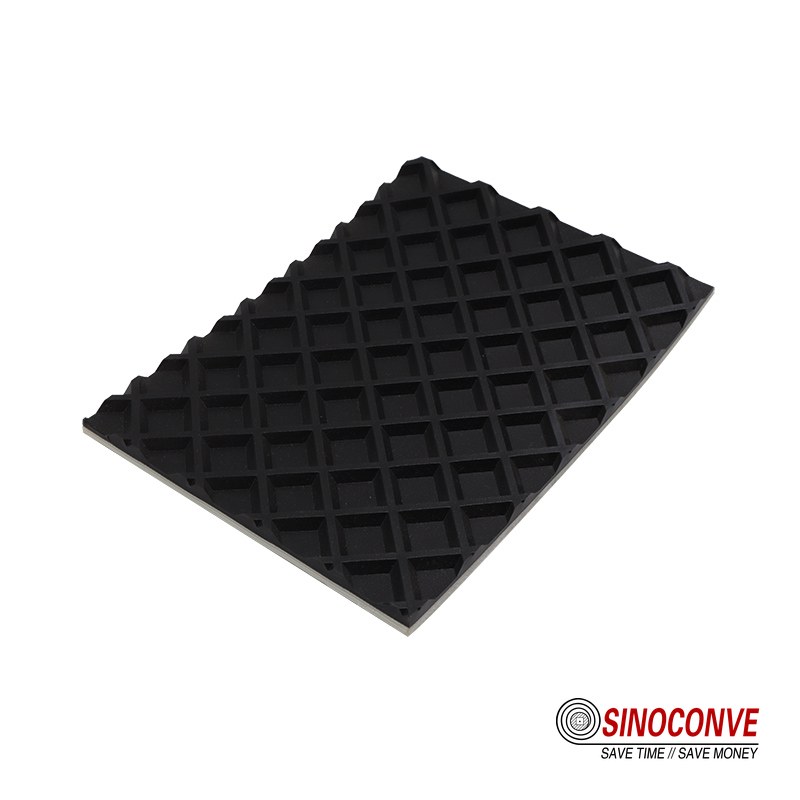
A worn module face. Even thinning points at grinding, deep grooves point at ploughing.
Putting the four signatures next to each other makes the diagnosis faster on a site visit. The table below is the one we carry in the van.
| Wear mechanism acting on the belt surface | What an inspector actually sees on site | What that pattern says about the material | First change we would make in the specification |
|---|---|---|---|
| Abrasive wear from fine powder and grit | A dull, evenly thinned face with faint parallel scratches | The filler and the resin wear at noticeably different rates | Cut the free fall and keep grit from landing on the face |
| Adhesive wear and ploughing from sharp lumps | Deep single furrows and torn ridges along the travel direction | The resin toughness is too low for the impact angle | Raise impact resistance and soften the loading chute |
| Fatigue wear under repeated flexing cycles | A network of fine crazing near the sprocket and the edges | Part thickness and hinge-line stress are the real problem | Add part support and re-check the smallest sprocket used |
| Chemical attack and environmental degradation of the polymer | Chalking, colour change and a soft, sticky surface | The medium is attacking the polymer or its additive package | Change the resin family and confirm the fluid exposure list |
If you are buying replacement modules through a conveyor belt distributor, send them the photograph of the failure, not just the part number. A distributor who can read a wear signature will pick a better grade than one who is reading a catalogue field.
06How Surface Geometry Changes the Wear Rate
Geometry is the most underrated lever on a plastic belt, and it usually adds nothing to change at the design stage. Two belts running the same resin in the same stream can wear at very different rates purely because of how their surface is shaped.
The reason is slip. Every time a piece of product slides across the belt face it removes a little material, and the amount removed scales with how far it slides and how hard it presses. Reduce the slip and you reduce the wear, and that effect often beats moving to a harder grade.
Open area, mesh depth and the friction they set
An open-grid or mesh belt lets water, fines and small debris fall through, which keeps the contact face cleaner and cooler than a closed surface. Cleaner contact means fewer hard particles trapped between the product and the plastic, and trapped particles are what turn a mild stream into an abrasive one.
Depth matters as much as openness. A deeper, thicker grid keeps the product resting on the raised strands rather than filling the pockets, so the relative motion happens on a small area at high pressure. A shallower pattern spreads the same load over more of the face. The two behave differently and the choice should follow the product, not the visual appeal of the belt.
Reducing slip solves more than a harder resin
Where product is accelerating sharply, meeting an incline, or being stopped against a guide, the face and the product are moving at different speeds. That difference is the engine of sliding wear. Matching the belt speed to the feed, softening the transfer, or adding a short lead-in all cut the slip directly.
We have watched a line stop eating belts simply by slowing the intake a little and giving the product a smoother landing. The resin never changed and the modules lasted substantially longer. If a customer is choosing between a higher-grade material and a small change to the chute, we usually recommend the chute and keep the material option in reserve.
The same geometry logic runs through packaging and light-duty lines, where the surface pattern is chosen to grip or to release a product rather than to shrug off rock. We keep that discussion on the surface-pattern side of a separate guide to cleated PVC conveyor belt applications, because the drivers there are grip and product stability rather than abrasive wear.
When a plastic belt drives a roller set or works alongside a rotating transmission, wear on the conveying surface is only half the story. The driven components have their own wear allowance, and matching them is closer to the job of a V-belt manufacturer than of a conveying specialist. We flag that boundary early so a wear complaint does not turn into an argument about the wrong component.
07Matching the Material to the Duty: A Combination Guide
No single resin property predicts field life, and no filler fixes every duty. What does predict it, reasonably well, is the combination of the feed, the medium, the thermal condition, the load and the cleaning routine taken together.
That is why we work from a matrix rather than a list of grades. The same product can need a stiff engineering resin in one plant and a return to a rubber belt in the next, purely because the moisture and the impact profile differ.
Working across the matrix
Read across from the feed that matches your load point. The final column is a direction, not an order. It tells you which way to lean while you collect the evidence that settles the choice.
| Feed condition seen at the load point | Moisture and oil present in the stream | Thermal condition of the conveyed material | Load and impact level we expect | Cleaning routine used on the line | Material direction we would lean toward |
|---|---|---|---|---|---|
| Dry, fine and mildly abrasive sand | Bone dry with no free liquid at all | Ambient and stable through the whole shift | Light load with very little impact energy | Dry brushing or a vacuum only | A filled engineering resin with good stiffness |
| Wet gravel with free water draining off | Free water plus a little carryback slurry | Cool and seasonally very cold overnight | Heavy lumps landing on the belt face | Hosed down at the end of each shift | A tough resin, or a move back to a rubber belt |
| Oily metal scrap carrying cutting fluid | Oil film plus fine metallic dust | Warm from the machining operation upstream | Medium load with sharp and irregular edges | Wiped down and rarely fully washed | A chemical-tolerant resin with a hard face |
| Hot clinker or hot recycled aggregate | Dry, dusty and free of any liquid | Continuously warm to hot at the surface | Heavy and extremely abrasive in service | Dry cleaning through the whole day | This is usually rubber belt territory, not plastic |
Two of those rows point away from plastic altogether. That is deliberate. A strong plastic belt is the right answer far more often than a general catalogue suggests, and the wrong answer often enough that we would rather say so than quote a model number that will disappoint. Final selection always rests on a trial sample run under the real feed, and the correct answer is the one your own measurements support.
08Why Two Abrasion Claims Cannot Be Compared Directly
Two suppliers can both describe a belt as abrasion resistant and mean two different things, because there is no single test that everyone runs. One may be quoting a rotating-drum abrasion test, another a taber-type wheel result, and a third a wear figure that came from a customer complaint never repeated. Reading those three side by side is meaningless until you know what each one measured.
What we ask a supplier to put in writing
Ask for the test method by name, the specimen condition, and the criterion that was used to judge a pass. A wear figure without those three pieces of context is a number without a home. We have opened a data sheet that quoted an impressive abrasion result and discovered the coupon had been run dry, at room temperature, with no filler exposure at all, on a line that runs wet aggregate year-round.
The same discipline applies to a tear or a tensile figure. Ask whether the result came from a trouser-tear or angle-tear test, or from a tensile test on a dumbbell specimen, and ask at what condition. A supplier who cannot name the method is telling you something useful about the depth of the file.
This is not a complaint about the industry. It is a practical instruction. When you write the enquiry, put the words method, condition and judgement criterion next to your abrasion request, and leave a blank for the answer. Suppliers who know their product will fill it in, and the ones who do not will reveal themselves before the order.
We see the same gap on heavier conveying. A customer comparing plastic modules against a heavier industrial conveyor belt has to compare like with like, and the only fair basis is a stated method on both sides rather than a bold claim on one.
09Life Verification and the Purchasing Language That Protects You
A wear claim only becomes useful when it is tied to a document you can hold. The material layer of that file is short, and it is worth building before the first order rather than after the first failure.
The document set worth requesting before you buy
Start with a material certificate that names the resin and the compound, not just the trade name. Ask for the filler and reinforcement declaration in plain terms, a statement on flame and antistatic behaviour if your site needs one, and a coupon test report that carries the method and the condition alongside the result. Finally, insist on batch traceability, because a belt is only as good as the batch it came from.
Batch traceability is not bureaucracy. The same grade from the same supplier can leave two plants with slightly different filler dispersion, and filler dispersion decides wear. We have seen two deliveries of a nominally identical part wear at visibly different rates on the same line, and without a batch number there is no way to raise the question with anyone.
When a customer moves to us from another source, we ask for the failed part and the paperwork together. The part tells us how it wore and the paperwork tells us what was claimed. Comparing the two is often the fastest route to a grade that will last, and it avoids repeating a specification that never worked in the first place.
For a buyer stocking several lines at once, it helps to settle the grade with one supplier and keep it consistent rather than shopping each line separately. A single consistent grade ordered across a plant is easier to trace and easier to improve, and the range that supports that approach is laid out on our wholesale conveyor belts page for buyers who work at that scale.
Moulding and assembly on our own floor. Batch control starts at the machine, not the warehouse.
10Reading a Failed Belt: Normal Wear or Wrong Material?
When a belt comes off a line early, the first question is not which grade to buy next. It is whether the belt was worn out by normal service or killed by a mismatch. The two answers point in opposite directions, and choosing well saves money.
Uniform loss against local damage
Normal wear is even. The whole face thins together, the pattern on the module stays recognisable, and no single area carries all the loss. A belt that dies this way is telling you the duty is simply heavy and the material is doing its job, only not fast enough for your expectation.The answer is a better grade, more support, or a slower feed.
A wrong-material failure looks different. The damage is localised, whether that is a ring of crazing around the sprocket holes, a band of cracking along one edge, or a cluster of deep grooves in one landing zone. Localised damage means one part of the system is loading the belt in a way the material cannot absorb, and no amount of thickness will fix a chute that directs a sharp lump into the same spot all day.
When the fault is operating practice, not the plastic
Some failures have nothing to do with resin. Mistracking drags the belt edge against a frame and wears it away in a straight line. A jam that clears under load tears a module face. A drain that stops draining leaves grit on the belt to grind overnight. Each of these leaves a signature that points at the line rather than the material.
We ask for a photograph, the running hours, and the position of the damage before we quote. Those three facts separate a material change from an operating fix in most cases, and we would rather sell you nothing than sell you a grade that cannot help.
Field note from our engineers: A recycled-glass plant kept replacing a plastic belt every few months because one edge wore into a thin ribbon. Three replacements later, the cause turned out to be a single misaligned support that pushed the belt against a guide for part of every revolution. Realigning the support ended the pattern. The belt had been blamed for a frame problem through four purchase orders.
11Where a Plastic Belt Stops Being the Right Answer
Plastic belts earn their place on a great many lines, and there is a clear boundary beyond which they stop being the sensible choice. Knowing the boundary is more valuable than defending the material.
The first boundary is heat combined with heavy abrasion. A hot, dusty, highly abrasive stream, the sort that comes off a kiln or a hot recycle line, punishes a rigid polymer in a way a rubber cover absorbs. The second boundary is high-angle impact with sharp, heavy lumps, where a tough rubber cover deforms and survives while a hard module notches and cracks.
The third boundary is a brutal mechanical load with little support between rollers. A plastic module is happiest when the frame supports it closely. Stretch the support spacing and the module bends where it was never meant to, and bending is the beginning of fatigue wear. Where a line is both heavy and poorly supported, a fabric or steel-cord belt is simply the better answer over its whole life.
There is a commercial boundary as well. A light, flat, clean, moderately abrasive duty is precisely where a PVC conveyor belt and its moulded plastic cousins beat a heavy rubber belt on material use, on energy and on hygiene. Move the same line into wet, sharp and hot service and the advantage reverses, quietly and permanently.
We keep a wider view of the whole range on our full product catalog page, so a customer can see where plastic, fabric rubber and steel cord each sit before narrowing to one family. Choosing the family first, and the grade second, avoids most of the avoidable mistakes.
12How This Page Differs from Our Other Abrasion Guides
We publish several pages about abrasion, and they are deliberately kept apart so that none of them repeats another. This page owns one narrow slice, and it is worth stating which slice that is.
Abrasion on rubber belts in quarry and steep-angle service, including cover-gum choice and the grade families that suit those sites, belongs to our guide on abrasion resistant belts for quarry and steep angle conveying. Nothing about cover grades or quarry duty is repeated here, and a reader who needs that side should start there.
The geometry of an open-hinge belt, meaning how the hinge line sheds debris, how it is cleaned, and how the pin wears over time, is the subject of a separate article on the open hinge abrasion behaviour of modular belts. That page owns the hinge and the pin. This page deliberately stays on the polymer body, the filler package and the contact face, and it does not reopen the hinge-cleaning question.
A third page deals with whole-machine selection for quarry and aggregate duty, at the level of choosing the belt for a plant rather than for a material. This article is not that either. What sits here is the material layer on its own: how polypropylene, polyethylene, acetal and polyamide behave, how fillers change them, how the four wear mechanisms can be told apart, and how the surface shape changes the rate. Between the four pages, a buyer has the material view, the hinge view and the plant view without duplicating any of them.
If you are unsure which layer your problem sits on, describe the failure to us and we will point you at the right page and the right grade. That conversation takes ten minutes and usually saves a wasted purchase, so it is the one we invite first. You can reach the team through our contact page for a review of a failed part or a new duty.

13FAQ: Strong Plastic Conveyor Belts and Wear Life
What is a strong plastic conveyor belt?
It is a moulded polymer belt, usually built from linked modules, that carries a load across a moving face. Strong is the word that needs unpacking. On a plastic belt, strength can mean the stiffness of the part, its resistance to impact, or the scratch resistance of its surface, and those three do not rise together.
Is plastic stronger than rubber for conveyor belts?
Neither material is stronger in the abstract, and the answer depends entirely on the duty. Rubber deforms and recovers, so it absorbs sharp, heavy impact that would notch a rigid polymer module. Plastic resists slow sliding abrasion, chemical attack and washdown far better in a great many light and medium duties, and it is easier to keep clean. What decides the choice is the feed condition at your load point, not a preference for one material. Tell us the impact angle and the medium, and the right family follows.
Which plastic is best for abrasion resistance?
Acetal holds shape and runs with low friction, polyamide resists abrasion and impact well but takes up moisture, polyethylene absorbs shock and slides easily, and polypropylene is the chemical-tolerant commodity choice that turns brittle when cold.
Does adding glass fibre improve wear life?
It improves stiffness, dimensional stability and load capacity, and it usually makes the part more brittle at the same time, so it helps only where deflection is the real failure mode.
Why does the same grade wear differently on two lines?
Because the medium, the impact angle, the support spacing and the cleaning routine differ, and slip at the contact face often matters more than the resin itself.
When should I not use a plastic belt?
Three situations push you away from plastic. A hot, highly abrasive stream coming off a kiln or a hot recycle line is rubber territory, because a rubber cover absorbs what a rigid polymer cannot. Sharp, heavy lumps dropped from height, and a frame that leaves wide unsupported spans, point the same way. If your line sits in any of those three, a fabric or steel-cord belt is usually the better answer across its whole life.
How do I verify the material before ordering?
Ask for four documents and read all of them. Request a material certificate naming the resin and the compound, a plain-language filler and reinforcement declaration, a coupon test report that states the method and the specimen condition, and batch traceability for the delivery you will receive. The test report matters most, because a wear figure without a named method and condition cannot be compared with anyone else's claim. If any of the four is missing, treat the abrasion claim as unproven until it arrives.
How do I compare two suppliers who both claim abrasion resistance?
Compare the method, not the adjective. Ask each one to name the test, describe the specimen condition, and state how a pass was judged, then line up the two answers. A supplier who can do that is describing a real product, and the one who changes the subject is not.
Related Products You May Need
- PVC conveyor belts — light, flat and washable for clean conveying lines.
- Rubber conveyor belts — fabric carcass for impact, heat and heavy abrasive duty.
- Chevron conveyor belts — profiled surfaces for inclined transfers and slippery product.
- V-belts — drive belts for the machinery that feeds and drives a line.
- Conveyor rollers — idlers and rollers that support the belt and set its span.
- Full product catalog — belts, rollers and drive components from one factory.
Related Blog Posts
- Abrasion resistant belts for quarry and steep angle conveying
- Abrasion resistance on the open hinge conveyor
- Abrasion resistant conveyor belts for quarry and aggregate
- Cleated PVC conveyor belt guide
- Rubber conveyor belt cover grades explained
- PVC conveyor belt specification and buying
- Rubber conveyor belt selection guide for industrial lines
- Heavy duty rubber conveyor belts for the mining industry