
When a Band of Belts Becomes the Difference Between Uptime and Downtime
A banded V belt looks simple enough at first glance: a set of V-belts joined side by side to act as one unit. In the field, though, that small change in construction can make a real difference when a machine is prone to shock load, belt whip, or uneven pulley tracking. For sourcing teams and maintenance engineers, the question is not whether a standard V-belt can move power. It is whether the drive can stay stable when the machine is pushed hard, started repeatedly, or asked to run through vibration that would make single belts misbehave.
That is why banded belts show up so often in demanding equipment, including crusher drive setups and other heavy duty machinery. They are used where alignment matters, pulley groove contact needs to stay consistent, and a loose belt is more than a nuisance. If you are choosing between individual V-belts and a banded assembly, the practical decision is usually about stability, maintenance discipline, and how much shock the drive sees in daily service.
A field example: why grouped belts are often selected
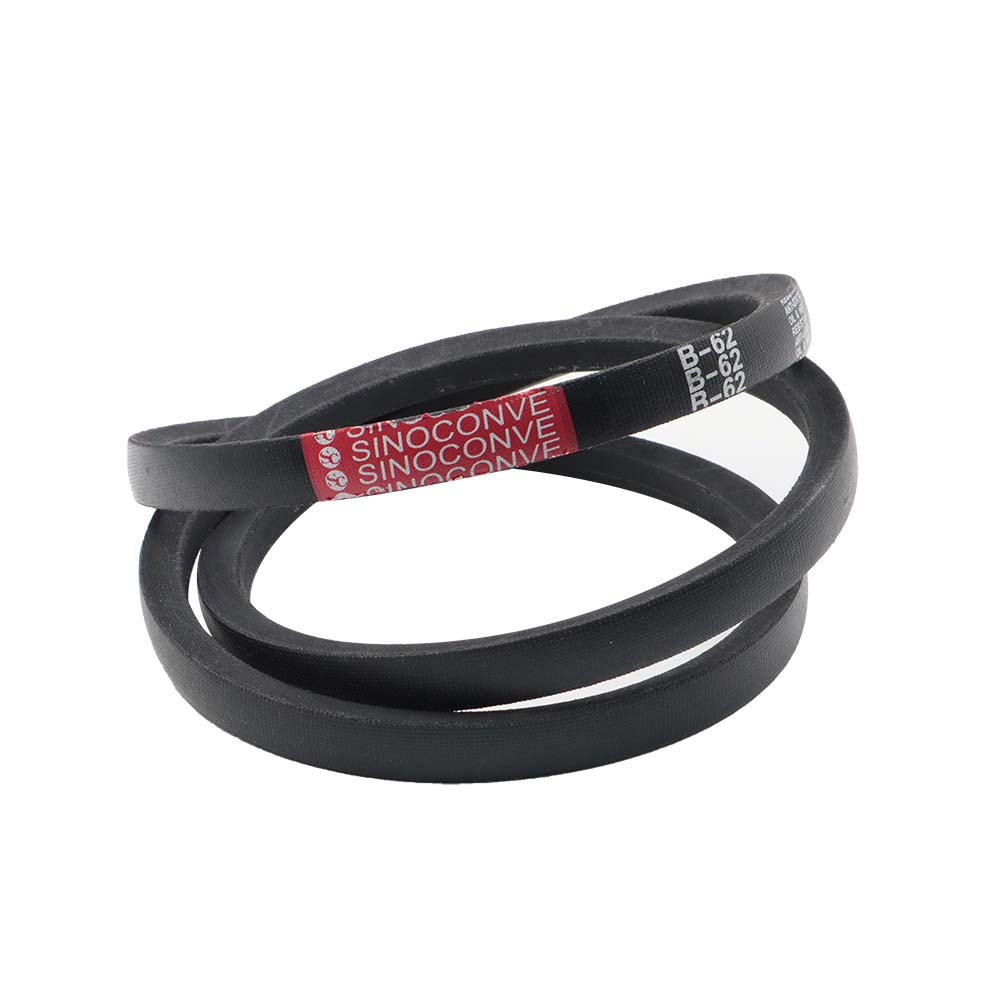
The product image supplied here shows three black belts stacked together, one marked SINOCONVE and another marked B-62. That marking is useful because it gives buyers a starting point for cross-checking size and compatibility, even if the full specification is not visible. The belts appear to have a fabric-wrapped outer surface and a trapezoidal V-profile, which is consistent with molded or wrapped reinforced rubber V-belts used in industrial power transmission.
In day-to-day plant work, a grouped belt arrangement can be chosen because it helps the belts share load more evenly and reduces the tendency for one belt to lag behind the others. That matters in machines with pulsing loads, such as some crusher drive applications, where the drive is constantly dealing with sudden resistance rather than smooth rotation. It also matters on older equipment where pulley condition is not perfect and the drive needs a little more forgiveness.
What the buyer is really deciding
When a sourcing manager evaluates a banded belt, the decision is not just “does it fit.” It is more like this: will the belt package keep tension, track properly, and survive the mechanical abuse of the application without forcing frequent shutdowns?
There are a few practical checks worth making early:
1. Size and profile compatibility
The visible B-62 marking suggests a specific belt size designation, but buyers should still confirm the pulley groove profile, center distance, and the exact replacement format required by the equipment. A close-looking belt can still be wrong for the drive.
2. Matched operation
If the belts are intended to work as a banded set, they should behave like a set in use. That is the point of the construction. If they are not properly matched or the drive is assembled carelessly, the benefit can disappear quickly. This is one of those unglamorous maintenance details that gets ignored until the belts start squealing under load.
3. Application severity
Light conveyor service and a crusher drive are not the same problem. Heavy duty machinery with frequent starts, irregular load, or abrasive dust asks more of the belt package than HVAC or small pump service. Buyers should be realistic about the duty cycle rather than assuming all V-belts behave the same.
Why banded construction is attractive in rough service
Single belts can work well in many machines, but they can also twist, flutter, or drift if the drive is subjected to vibration or shock. Banded belts help suppress that movement because the belts are tied together as one assembly. In practical terms, that can mean less belt wandering, a more stable drive, and less time spent re-tensioning after installation.
That said, banded belts are not a cure-all. If pulley alignment is poor, bearings are worn, or the drive is contaminated by oil and debris, the belt will still suffer. The band can improve control, but it cannot fix a neglected mechanical system. Buyers sometimes expect too much from the belt itself; the better approach is to treat it as one part of a broader drive condition check.
Selection advice for engineers and procurement teams
For standard industrial use, buyers usually start with the equipment manual, existing belt markings, and the physical drive layout. The visible brand marking and size code are helpful, but they are not the whole spec. Confirm whether the application requires a single belt, a paired set, or a banded assembly. Then verify the pulley condition, the tensioning method, and whether the machine tends to start under load.
If the machine is a crusher or another high-impact drive, it is worth being conservative. In that setting, belt stability often matters more than squeezing a little extra flexibility out of the drive. If the belts are part of a retrofit, check that the guards, tensioning range, and shaft spacing still suit the selected belt format.
Common mistakes that cost time later
The most common error is treating all V-belts as interchangeable because the profile looks close enough. Another is replacing one worn belt in a set without considering whether the rest of the drive has aged unevenly. In a banded format, the assembly is supposed to behave as a unit, so piecemeal thinking tends to create uneven wear or poor tracking.
A second mistake is ignoring the real cause of belt failure. If the old belt failed because the pulley was damaged or the machine was overloaded, the replacement may fail too. That sounds obvious, but in production environments it is easy to chase the part and miss the condition that broke it.
Quick takeaway for buyers
If your equipment sees shock load, vibration, or repeated starts, a banded V belt is often worth serious consideration. The construction can improve drive stability and reduce the chance of belt movement in heavy duty machinery. For the belt shown here, the visible cues — black wrapped construction, three-belt group, SINOCONVE marking, and B-62 size marking — provide a useful starting point for verification, but not a complete specification.
For procurement, the next step is straightforward: confirm the drive dimensions, compare the belt marking against the equipment requirement, and check whether the application really calls for a banded assembly rather than individual belts. That small bit of discipline usually saves more downtime than it costs in review time.
FAQ
Can a banded V belt replace individual V-belts in any drive?
Not automatically. The pulley geometry, center distance, and drive layout need to suit the banded format.
Are banded belts mainly for crusher drive applications?
No. They are also used in pumps, compressors, agricultural machinery, HVAC equipment, and other industrial systems. Crusher drive service is just one of the tougher examples.
What should I verify before ordering?
Check the belt size marking, pulley profile, number of belts in the set, and the application’s load severity. If possible, compare against the removed belt and the machine manual.
Is the visible label enough to place an order?
Usually not on its own. It is a useful clue, but buyers should confirm the full specification before issuing a production or maintenance purchase.