
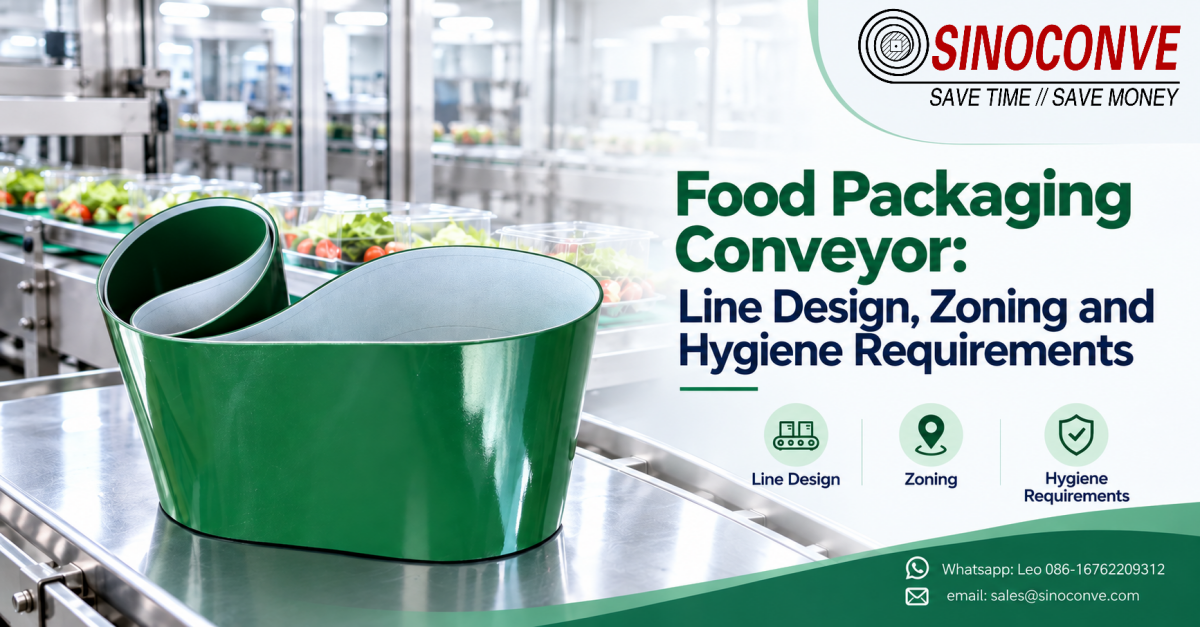
 A food packaging conveyor is designed zone by zone, not belt by belt. Three zones cover almost every plant we walk into: raw, cooked and packing. Decide hygiene class, cleaning regime and belt type separately for each one, and decide them in that order. A belt that sails through inspection in the packing hall can still fail a raw-area wash-down audit, because what fails is rarely the cover compound. It is the drainage under the belt, the trapping points along the frame, and the way water and product cross from one zone to the next.
If a line crosses a zone boundary, you need a controlled transfer with no open return run exposed to the higher-care side. That one rule resolves more audit findings than any belt upgrade we have ever sold. What follows is written for the person who has to hand a document to a contractor on Monday morning: a zone matrix, a zone-to-belt rule table, a cleaning regime table and a drainage checklist. None of it removes the need for a site survey. All of it makes that survey shorter.

01What a Food Packaging Conveyor Line Actually Contains
Walk a packaging line from the goods-in door to the palletiser and you cross six or seven distinct conveying duties, not one. Each duty handles product in a different state, and that state drives every belt decision downstream. Write the topology down first. Hygiene class, cleaning chemistry, drainage fall and frame material all hang off this single drawing.
We ask for a simple version: one page, with the product state marked at every metre. Most plants already have it buried in a CAD file. Almost nobody has marked the exact point where product stops being raw. That missing mark is where half of our site arguments start.
| Section | Function | Product State | Typical Belt Surface | Hygiene Class |
|---|---|---|---|---|
| Intake and de-boxing | Receive raw or chilled product, strip outer packaging | Raw, still sealed or boxed | PVC, smooth, blue | B |
| Preparation feed | Feed slicers, fillers and formers | Raw, exposed cut faces | PU or PVC, smooth, easy-clean | A |
| Post-cook transfer | Move product off the cooker or oven | Cooked, hot, moist surface | PU, smooth, white or blue | A |
| Cooling run | Bring core temperature down before packing | Cooked, cooling, condensate present | PU, smooth or open mesh | A |
| Packing infeed | Orientation and singulation of packs | Sealed primary pack | PVC or PU, low-friction | B |
| Case and pallet run | Move cases, trays and pallets out | Secondary packaging | PVC rough top or cleated | C |
The Four Functional Segments
Strip the drawing back and four segments do all the work: intake, preparation, post-cook handling and packing. Intake sees sealed and boxed goods, so a Class B surface is usually enough. Preparation and post-cook handling see exposed product and need Class A. Packing returns to sealed packs and relaxes to Class B again, with one exception sitting inside it: the infeed that occasionally catches a leaking pack.
The mistake we see most often is a single belt specification stretched across all four segments. As a conveyor belt manufacturer, we understand the appeal of one part number and one spare roll in the store. On a line with a wash-down raw area, that shortcut costs more in scrapped product than it ever saves in inventory. We have watched a plant rebuild a whole packing infeed after a two-day recall, all to avoid keeping two belt widths in stock.
What the Line Is Not
Not every run belongs in the hygiene chart. Case conveyors, pallet runs and reject lanes carry sealed secondary packaging. They can use a rough-top or cleated surface on an open frame, and they should be marked Class C on the drawing so nobody reopens the question every quarter. An hour spent re-specifying a pallet run is an hour not spent on the raw-area transfer, which is where audits actually fail.
02Zoning the Line: Raw, Cooked and Packing Areas
Zoning is a legal and commercial boundary before it is an engineering one. Most food-safety schemes treat raw and cooked as separated areas with controlled flow between them. Conveyors are the hardest place to honour that separation, because product and water both travel along them, and a belt is a continuous surface that ignores your wall.
Any conveyor belt supplier who claims one belt can serve the whole line is guessing about your layout. The honest answer depends on how many boundaries the line crosses. Count them before you buy anything, and draw the arrows before you order steel.
| Zone | Product Condition | Allowed Crossing Direction | Cleaning Regime | Verification |
|---|---|---|---|---|
| Raw preparation | Exposed, uncooked, high microbial load | Toward cooked only, never back | Daily full wash-down | Swab plus visual |
| Cooked handling | Exposed, heat-treated, ready to eat | No return to raw, ever | Daily wash-down with sanitising step | Swab plus ATP |
| Packing hall | Sealed primary pack | May receive from both sides; product must not return | Daily dry clean, weekly wet | Visual plus ATP |
| Ancillary and case | Sealed secondary pack | Free flow, no product contact | Weekly dry clean | Visual |
Why the Zone Chart Matters
The chart is not decoration. It decides which doors lock, which drains run which way, and which staff change footwear at the end of a shift. On a conveyor it decides where transfer plates sit and whether an open return run is allowed to pass beneath a boundary. We have seen a 3.2 m open return segment defeat an otherwise sound zoning scheme, purely because a leaking pack dripped onto the raw side of a wall. The belt was clean. The layout was not.
03Hygiene Class by Zone: What Changes and Why
Hygiene class is our shorthand for how clean a surface must be and how you prove it. It is not a property of the belt material alone. A smooth belt on a badly drained frame behaves like a lower hygiene class than a lightly textured belt on a well-drained one, because contamination pools wherever water sits and stops moving.
An industrial conveyor belt built for a quarry will survive for years and still fail a food audit in a single visit. The carcass strength is not the issue. The surface finish, the edge construction and the cleanability are what get written up in the report.
| Class | Surface Requirement | Cleaning Method | Verification | Typical Belt Family |
|---|---|---|---|---|
| Class A | Non-porous, seamless, no exposed fabric edge | Foam or spray wash-down, sanitising rinse | Swab and ATP | Homogeneous PU, food grade PVC |
| Class B | Smooth, closed edges, colour-controlled | Wet wash or damp wipe | Visual and periodic ATP | Food grade PVC |
| Class C | Durable, food-contact safe, texture allowed | Dry clean and vacuum | Visual | PVC rough top, cleated |
| Class D | No product contact; sealed bearings and drives | Rinse as needed | Visual | Standard PVC or rubber, open frame |
Two things tighten as the class rises: surface finish and frame detailing. A Class A run needs a belt with no exposed fabric ply, because an open edge wicks water in and never fully dries between shifts. It also needs a frame you can actually reach with a hose or a spray bar, which in practice means cantilevered supports and no box sections that hold stagnant water.
Colour sits inside the class rather than beside it. Blue is common in packing halls, but the controlling idea is contrast and detectability, not blue for its own sake. We come back to that in section 11.
If you want the checkable version of this list, start from our food grade PVC conveyor belt check and map it onto your own zone chart. Teams that want to see how this vocabulary is used across the wider sector can read our food packaging industry page before they write their specification.
04Cross-Zone Transition and Transfer Points
Almost every contamination event we investigate traces back to a transition, not to a belt run. A transition is any point where product moves between conveyors, changes direction, drops a level, or crosses a hygiene boundary. Each one is a place where product can stall, crumb can gather, and water can travel against the direction you intended.
Count the transitions on your drawing. If the number surprises you, the layout is asking too few conveyors to do too many jobs. Add a short dedicated transfer instead of stretching one belt across two duties. Steel is cheaper than a recall.
| Node Type | Isolation Measure | Main Risk | Design Check |
|---|---|---|---|
| Raw to cooked transfer | Physical barrier, one-way flow, separate drains | Cross-contamination carried on belt or in water | No shared return run passing under the wall |
| End-to-end transfer | Overlap plate with 20 to 30 mm gap, no ledge | Product jam and crumb build-up | Plate flush with belt, gap set for the smallest pack |
| Drop transfer | Chute with closed sides and steep walls | Product damage plus airborne dust | Impact bars fitted under the discharge |
| Direction change | Nose bar or transfer roller set to pack radius | Pack toppling and edge damage | Radius matched to the largest footprint |
| Personnel walk-through | Airlock or boot change, no belt passing the line | Airflow and footwear carry contamination | Belt never crosses the boundary itself |
Designing a Controlled Transfer
A controlled transfer has three parts: a defined product path, a defined water path, and a defined cleaning access. Miss any one and the node will fail eventually, usually in the first wet season. We specify a 20 to 30 mm gap on end-to-end transfers because it is wide enough to shed crumbs and narrow enough that a pack cannot nose-dive into it.
On raw-to-cooked crossings we insist on a simple rule. No return run passes under the dividing wall. Water follows belts, and a dripping return run turns a clean boundary into a bridge. Where a line must cross, a conveyor belt distributor can often supply a short, easy-clean transition belt cheaply, but the geometry remains your responsibility. A better belt on a badly detailed transfer is still a badly detailed transfer.
05Line Layout Basics: Runs, Turns and Elevations
Layout decides how much belt you own and how much of it you can reach. Two numbers matter above all others: the minimum centre distance between drums, and the clear height above the belt. Get those wrong and a clean line quietly becomes an unreachable one.
| Parameter | Typical Range | Why It Matters | Watch-Out |
|---|---|---|---|
| Straight run length | 1.5 to 4.0 m per module | Keeps tracking stable and access open | Runs past 6 m without take-up invite mistracking |
| Minimum centre distance | About 2.5 times drum diameter | Leaves room for a nose bar and cleaning | Very short centres fold the belt edges |
| Curve radius | 1.0 to 1.5 times belt width | Controls edge stress and pack path | Too tight, edges crack within months |
| Clear height at wash points | 300 to 450 mm | Fits a spray bar and a human hand | Under 250 mm blocks manual cleaning completely |
| Elevation between zones | 80 to 150 mm step where practical | Uses gravity to bias water away from dry areas | Flat crossovers let wash water pool |
| Sidewall and cleat clearance | Full flange height plus 25 mm | Stops the belt rubbing the frame | Ignored, sidewalls wear through fast |
Small decisions at this stage are cheap. Raising a packing infeed by 120 mm costs almost nothing during fabrication and costs a shutdown afterwards. We try to bias every wet zone so its floor falls away from the neighbouring dry zone, which usually means one deliberate step rather than a long flat run that never quite drains.
When to Use Cleats or Sidewalls
Steep lifts and tight vertical transitions are the two cases where a flat belt stops being enough. Our sidewall conveyor belts handle near-vertical lifts inside a packing hall, while a standard rubber conveyor belt remains the workhorse for long horizontal runs on mixed-duty lines. Cleats solve incline. Sidewalls solve containment. They are not interchangeable, and bolting cleats onto a belt that also has to flex around a small drum is one of the most common errors we are asked to fix.
06Slope and Decline Rules for Packaged Product
Slope limits depend on the pack, not on the belt. A sealed bag of flour slides at a very different angle from a shrink-wrapped tray of chilled meat. The figures below are the starting point we use. The final value always comes from a test with your actual pack on the actual surface.
| Product Form | Starting Slope Limit | Anti-Roll Measure | Note |
|---|---|---|---|
| Sealed flow pack, smooth film | 12 degrees | None below the limit | Most sensitive to condensation film |
| Shrink-wrapped tray | 15 degrees | Low-rise cleat | Friction drops sharply when the film is damp |
| Rigid carton, flat base | 18 degrees | Side guide rails | Corners bruise if rails are set tight |
| Bagged powder | 20 degrees | Cleats at 300 mm pitch | A dust film acts like a lubricant |
| Tray with loose contents | 10 degrees | Full sidewall, reduced speed | Contents shift and spill above the limit |
| Case, pallet-ready | 22 degrees | Cleated or rough top surface | Usually outside the hygiene chart |
Two field realities override the table. Condensate halves friction, so a line that behaved perfectly at 15 degrees dry can slide at 11 degrees ten minutes after a wash-down. Speed also interacts with slope: dropping line speed by 15 per cent has rescued more inclined runs for us than any change of belt compound.
Reading Slope Against Product Shape
When in doubt, measure instead of assuming. Put the real pack on an offcut of the real belt, tilt it, and watch. We do this on a bench with a simple angle gauge before any incline is signed off, and it costs ten minutes. Saving that ten minutes has more than once cost a customer a full redesign after commissioning. On inclined duties the drive also works harder, so it is worth asking a transmission belt manufacturer to confirm the V-belt profile carrying motor torque to the gearbox, and a V-belt manufacturer for the spares list you will actually need at 3 a.m. on a Sunday.
07Choosing Belt Type by Zone, Not by Machine
This is the core of the article and it is deliberately short. Do not pick a belt by the machine it feeds. Pick it by the zone the belt sits in, because the zone sets the hygiene class, the cleaning chemistry and the colour rule. Once the zone is fixed, the belt family usually falls out of the table on its own.
| Zone | Belt Family | Surface Finish | Color Requirement | Reason |
|---|---|---|---|---|
| Raw preparation | Homogeneous PU or food grade PVC | Smooth, closed edge | Blue or other high-contrast | Exposed product, daily wash-down |
| Post-cook and cooling | Homogeneous PU | Smooth or light texture | White or blue | Heat, moisture and ready-to-eat contact |
| Packing infeed | Food grade PVC | Smooth, low friction | Blue preferred | Sealed packs, orientation accuracy |
| Cold feed | Food grade PVC, cold-rated | Smooth, stays flexible below zero | Any visible colour | Retains flexibility at low temperature |
| Case and pallet | PVC rough top or cleated | Textured | Not colour-critical | Grip on secondary packaging |
| Steep lift inside a hygiene area | PU with cleats or sidewall | Cleated top, smooth underside | Blue or white | Containment without losing cleanability |
The Rule We Give Contractors
Write the zone at the top of every belt line on the drawing, then write the hygiene class next to it. When a contractor later queries a specification, the argument becomes about the zone rather than about a catalogue number. That framing has settled more disputes for us than any datasheet, because nobody enjoys standing up in a review meeting and defending Class C in a raw area.
When you compare costs across a full line, remember that wholesale conveyor belts are priced per metre of a given width and finish. One wide belt is not automatically cheaper than two narrower ones once you add the extra drum, the frame and the cleaning access. We price those combinations together for customers precisely because the cheapest per-metre option is often the most expensive line to run.
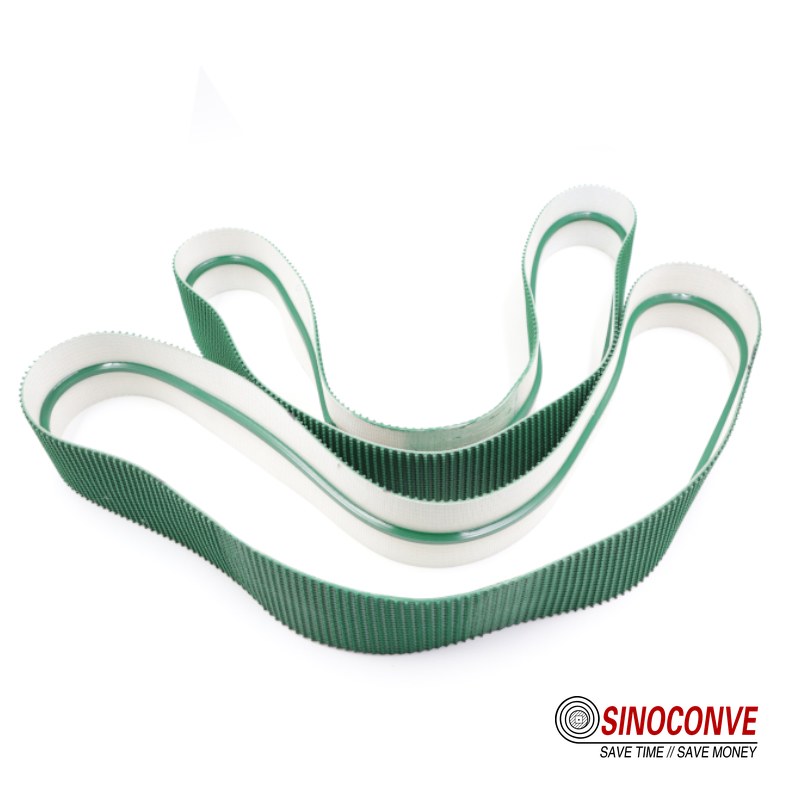
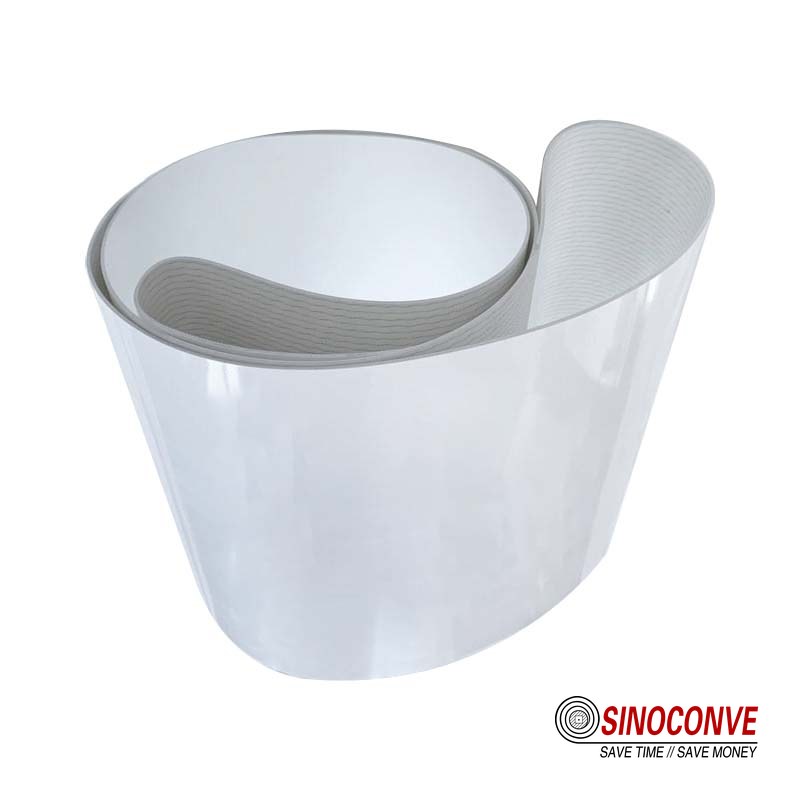
For the two main families the split is simple. A PVC conveyor belt is the default for packing halls, intake and secondary handling. A PU conveyor belt for food handling takes over wherever exposed cooked product, oil or repeated wash-down is involved. Where a process is strict about hygiene records, the PU conveyor belt for food processing route also gives you a surface that survives aggressive chemistry better than a standard PVC compound.
Field note from our engineers: A bakery line joined its raw side to the packing hall with a 3.2 m open return run and no tray underneath. The audit flagged it as a cross-contamination risk before anyone had even swabbed it. We added a catch tray with its own drain, re-poured the local floor at 1:80, raised the transition 120 mm and fitted a 50 mm water stop. The re-audit passed on the first visit.
08Cleaning Regime per Zone: Wet, Foam and Dry
Cleaning regime is where zone decisions turn into a daily routine, and it is where belts die early. The method that cleans a surface properly can also destroy it. The chemistry that strips protein residue from a chicken line can attack the plasticiser in a cheap PVC compound within a few hundred cycles.
| Zone | Method | Frequency | Chemistry | Water Temperature | Evidence |
|---|---|---|---|---|---|
| Raw preparation | Foam and rinse, full wash-down | Each production day | Alkaline detergent, food-safe | 45 to 55 C | Swab and visual |
| Post-cook handling | Spray wash plus sanitising rinse | Each production day | Neutral to mildly alkaline | 40 to 50 C | Swab plus ATP |
| Cooling and packing hall | Dry clean, vacuum, damp wipe | Daily; full wet weekly | Light food-safe detergent | Ambient | Visual plus periodic ATP |
| Cold feed | Damp wipe, no flooding | Each shift | Food-safe sanitiser | Below 30 C | Visual |
| Case and pallet run | Dry clean, occasional rinse | Weekly | None or mild | Ambient | Visual |
Three numbers decide whether a belt lasts a year or most of a decade: water temperature, nozzle pressure and chemical concentration. Push any one past the compound limit and the surface starts to craze. Once it crazes it absorbs residue, and once it absorbs residue no amount of scrubbing brings it back. On one line we tracked surface cracking after about 18 months at 55 C and 10 bar. The same duty on a proper food-grade compound at 45 C and 8 bar ran to roughly 30 months between changes.
Field note from our engineers: A ready-meal packer was washing a general-purpose dark belt at 55 C and 10 bar. Fine crazing appeared across the carry side within 18 months and swabs started failing along the micro-cracks. We moved the line to a food-grade compound, dropped the water to 45 C and the nozzle pressure to 8 bar, and the replacement interval stretched to about 30 months with no change to cleaning validation.
Buyers weighing compounds should read our PVC conveyor belt selection notes before they fix the wash recipe, because the belt and the wash plan lock each other in. A belt bought purely on first cost usually forces a gentler wash, and a gentler wash is not always what the hygiene plan permits.
09Drainage, Floor Fall and No-Trap Geometry
Drainage is the least glamorous part of a food packaging conveyor and the part that decides most audits. Water has to leave the belt, then leave the frame, then leave the room. In that order. If it does any of those steps in the wrong sequence, it carries residue through a zone that was meant to stay clean.
| Location | Floor Fall | Drainage Detail | Trap Risk | Fix |
|---|---|---|---|---|
| Beneath the belt | 1:80 toward the drain | Catch tray with an outlet, no open channel | Return run drips back into the product lane | Tray with a lip and a dedicated drain |
| Floor beside the frame | 1:100 minimum | Linear channel with a removable grate | Standing water at the frame base | Grate flush with the slab, continuous fall |
| Transition point | 1:60 local fall | Local drain directly under the overlap | Wash water crosses the hygiene boundary | Add a water stop and a separate drain |
| Frame legs and feet | 1:100 | Sealed floor plates, no closed box sections | Product and water collect inside the box | Cantilever supports with open profiles |
| Motor and gearbox bay | 1:120 away from the drive | Bunded plinth with its own drain | Rinse water floods the drive housing | Guard plus bunded base |
| Belt carry side | Not applicable | Crowned or grooved top on wet runs | Water film carries residue downhill | Raise the discharge end by about 20 mm |
No-Trap Geometry in Practice
A trap is any geometry where product or water can sit beyond the reach of a hose. The usual suspects are inside corners, overlapping frame sections, unsealed bolt heads and the pocket behind a drive guard. We apply one rule when reviewing a drawing: if a 10 mm gap exists, assume something will be pushed into it and something else will grow there. Closing those gaps at the design stage costs a fraction of closing them afterwards, when the line is already in production. Our sand washing conveyor belt work in wet, abrasive environments taught us the same lesson twice: geometry outlasts material.
10Material Trapping Points: Where Product Accumulates
Trapping points are the practical outcome of everything above. Product gathers wherever there is a ledge, a gap, a low spot or a sudden change of belt speed. Each one turns into a hygiene finding sooner or later, and most of them have a standard remedy that costs very little.
| Location | Cause | Symptom | Remedy |
|---|---|---|---|
| Under the transfer plate | Gap too wide or plate sitting proud | Crumb ring that resists brushing | Set the plate just below the belt line |
| Frame junction | Overlapping sections leaving a ledge | Damp powder caked at the joint | Continuous, sealed frame joints |
| Return run under the product lane | Open return with nothing underneath | Drip marks appearing on product | Tray feeding a dedicated drain |
| Scraper mount | Blade no longer matching the belt surface | A paste-like residue line | Resurface or replace the blade |
| Idler and roller ends | Open bearings or exposed threads | Fine dust bridging across the end | Sealed units with smooth end caps |
| Belt edge | Curled or frayed edge wicking moisture | A dark edge line running the belt length | Trim the edge or move to a sealed edge |
Dust and fine powder deserve their own mention because they behave differently from wet residue. They do not drain, they do not rinse and they settle into every upward-facing pocket. Where a plant handles flour, starch or powdered seasoning, we usually recommend a dust resistant conveyor belt build with closed edge construction, then pair it with a vacuum point at the first transfer rather than a wash-down.
11Belt Surface Finish and Color Control in Packing Halls
Finish and colour are the two belt properties most often written into a specification by people who are not quite sure why. Both do real work. Finish decides how easily the belt releases product and how clean it comes back after a wash. Colour decides how quickly an operator spots a fragment, a worn patch or a foreign object on the belt.
| Property | Specification | Function | Where It Matters Most |
|---|---|---|---|
| Smooth gloss | Low roughness, fully closed surface | Easy release, minimal residue hold | Packing infeed and cooked product |
| Light texture | Shallow embossed pattern | Grip without deep traps | Inclined packing runs |
| Mesh look | Open appearance, sealed plies | Airflow and surface drainage | Cooling runs |
| Blue | High-contrast food colour | Detectability against product | Packing hall and cooked areas |
| White | Neutral and lightly cleanable | Visual cleanliness check | Ready-to-eat contact surfaces |
| Dark compound | Dark general-purpose cover | Cost saving only | Case and pallet handling |
Color Is a Control, Not a Preference
A belt colour is a control point, not a brand statement. Its job is to make a foreign fragment obvious within a second or two. If your product is pale, blue works well. If your product is dark, white usually works better. What never works is a belt colour that matches the product, because then a torn fragment disappears into the very material it came from.
The finish you choose connects straight back to what the belt is made of. Read our notes on the food grade PVC conveyor belt range for the available surface options, and our overview of PVC conveyor belt types if you need to weigh a smooth run against a textured one. As a conveyor belt factory in Ningbo, we keep both finishes on the same belt width so that a change of surface does not force a change of frame.
12Wet-Zone Hardware: Frames, Fasteners and Drums
Hardware in a wet zone is judged by a single question: will it still move in three years? Frames, fasteners and drums all sit in the splash path even when the belt itself is spotless, and the wrong grade of steel is the quiet reason a line stops on a Monday morning.
| Component | Material or Grade | Protection | Why It Fails If Ignored |
|---|---|---|---|
| Main frame | 304 stainless, 2 mm wall upwards | Continuous welds, ground smooth | Painted mild steel pits through within a year |
| Fasteners | A2 or A4 stainless, dome head | Sealed, no exposed threads | Plated bolts corrode and seize solid |
| Drums and pulleys | Stainless shell, sealed bearings | Protected bearing housings | Open bearings fail on the first wash-down |
| Nose bars | Polymer or stainless | Radius matched to the belt | Steel bars scuff and score the surface |
| Guards and covers | Stainless, quick-release | Tool-free removal | Fixed guards get left off after cleaning |
| Take-up units | Stainless screw or polymer | Covered, with a travel scale | Open threads collect product and jam |
Hardware That Survives a Wash-Down
Two small details separate a frame that lasts from one that does not. The first is weld dressing: an undressed weld bead is a crevice, and a crevice in a wet zone is a reservoir. The second is drainage of the frame itself, which means drilling or designing drain holes at every low point rather than trusting the floor fall to do all the work. Neither detail costs much at fabrication. Both are expensive to add later.
Drives need the same treatment. A motor sitting in a splash zone should be set on a bunded plinth, with the guard removable without tools, so that a wash-down does not fill the terminal box. In practice we see more electrical stops caused by water ingress than by any belt defect.
13Changeover and Allergen Segregation Across Zones
Allergen control is where the zone chart is tested under time pressure. A changeover that looks clean at line speed can leave protein in a corner, on a scraper blade, or trapped under a transfer plate. The belt is rarely the worst offender, but it is always the most visible one.
| Step | Action | Residue Risk | Typical Time |
|---|---|---|---|
| 1. Stop and clear | Remove all product and packaging | Product left in dead ends | 5 to 10 minutes |
| 2. Dry clean | Brush, vacuum and scrape | Powder packed into frame joints | 10 to 15 minutes |
| 3. Wet clean | Foam or spray, aimed at known traps | Residue under transfer plates | 15 to 25 minutes |
| 4. Rinse and inspect | Flush and light-check the belt | A film missed on the return run | 5 to 10 minutes |
| 5. Sanitize | Apply and allow full contact time | Chemical left in surface grooves | 10 to 15 minutes |
| 6. Release check | ATP or swab before restart | Releasing on a visual only | About 5 minutes |
On lines that run allergen-containing products, we group the changeover into a full wet clean rather than a dry sweep, and we keep a dedicated brush and vacuum kit stored inside the zone so it never travels into a raw area. Allergen changeover is not the place to save twelve minutes. A single failure costs far more than a year of slower changeovers.
14Verification: Swabs, ATP and Visual Checks
Verification is how you prove a line is clean without waiting for a laboratory. Three tools do almost all of the work: the eye, the swab and the ATP meter. They answer different questions, and a plant that leans on only one of them will eventually miss something important.
| Method | What It Detects | Limit Basis | Record |
|---|---|---|---|
| Visual inspection | Residue visible to the eye, surface damage | Pass or fail against a photo standard | Daily sheet, signed |
| ATP swab | Organic residue as a hygiene proxy | Site-set relative light unit threshold | Daily log with the reading |
| Protein swab | Allergen residue on shared lines | Qualitative result or a site-set limit | Changeover record |
| Microbial swab | Hygiene status after cleaning | Compared against the site baseline | Periodic laboratory report |
| Temperature check | Cooked product and wash water | Recipe limits | Shift log |
| Tension and tracking check | Mechanical condition tied to hygiene | Manufacturer range | Maintenance log |
Records That Convince an Auditor
An auditor rarely argues with a reading. What they argue with is a gap in the record. A daily ATP log with a consistent threshold, plus a belt inspection sheet that notes edge condition and surface appearance, will carry more weight than a spotless line with no paperwork. Our view is blunt: if the check was not written down, then as far as the audit is concerned it did not happen. Nothing about that is bureaucratic. It is how a plant proves its own good habits.
15Commissioning the Line Before Handover
Commissioning is the last chance to fix a layout error at someone else's cost. We treat it as a hygiene test and not only a mechanical one. A line that runs beautifully and drains badly is not commissioned, whatever the run sheet says.
| Check Item | Acceptance Criterion | Owner | Record |
|---|---|---|---|
| Belt tracking under load | Runs centred for 30 minutes at full speed | Mechanical contractor | Tracking sheet |
| Wash-down pass | No standing water 10 minutes after rinsing | Hygiene team | Drainage map |
| Zone boundary integrity | No belt path and no water path crosses | Project engineer | Marked-up drawing |
| Transfer gaps | All set between 20 and 30 mm | Mechanical contractor | Gap log |
| Hardware grade check | All wetted parts stainless as specified | Quality assurance | Material list sign-off |
| Swab and ATP baseline | Readings below the site threshold | Hygiene team | Baseline report |
If you want a buyer-facing version of these checks, our PVC conveyor belt buyer checklist covers the belt-specific points, and the product catalog shows the widths and finishes we hold for food lines. Every item on the list should end up with a name and a date against it. A commissioning pack that lives only in somebody's memory is not a commissioning pack.
16KPIs for a Food Packaging Conveyor Line
A food packaging conveyor rarely fails loudly. It drifts. Belt life shortens by a few weeks, wash time creeps upward, swab failures move from an annual event to a monthly one, and nobody notices until a customer does. These indicators catch the drift while it is still cheap to correct.
| Indicator | Measurement Basis | Target Range | Warning Sign |
|---|---|---|---|
| Belt change interval | Months between replacements | Site baseline plus or minus a fifth | Falling by more than a third |
| Cleaning time per changeover | Minutes per clean | Stable or falling | Rising month on month |
| ATP pass rate | Share of swabs under threshold | 95 per cent or higher | Repeat failure at the same point |
| Unplanned stoppages | Events per month | Below the plant baseline | Clustering at one transfer |
| Waste at transfer | Share of throughput | Site target | Rising after a belt change |
| Water and chemical use | Litres and kilograms per clean | Stable | Rising while cleaning quality falls |
None of these metrics needs new equipment. They need a log, a pen and a willingness to read the same numbers every month. That habit, more than any single component, is what separates a line that runs for a long time from one that gets rebuilt twice.

17Frequently Asked Questions About Food Packaging Conveyor Lines
How many zones does a food packaging conveyor normally need?
Three in most plants, and four once you count case and pallet handling. Raw, cooked and packing cover the food-contact side. The number only becomes a problem when a line tries to run with two, because then one belt is expected to serve two hygiene classes at the same time.
Can one belt type serve the whole packaging line?
No. A single specification always becomes a compromise that satisfies neither end of the line. The raw end needs a closed, wash-down-friendly surface; the packing end needs low friction and colour control. Two part numbers in the store are far cheaper than one recall.
Where exactly should the raw-to-cooked transition sit?
Put it where the barrier already is, not where the belt happens to be shortest. The transition belongs at the physical wall, on the cooked side of the door, with its own drain and no shared return run beneath it. Moving a transition ten metres to save belt length is one of the more expensive shortcuts we see in food plants, because the audit finding arrives later and costs more.
What floor fall do I need under a wash-down belt?
1:80 beneath the belt feeding a catch tray, and 1:100 minimum on the open floor beside the frame. Around a transition, tighten it to about 1:60 with a local drain. The exact figure matters less than the direction: the fall must never run toward a drier zone.
Is a blue belt always required in a packing hall?
Not always, because the requirement is contrast rather than blue. Blue is the common choice since it stands out against most pale foods, but on a dark product white often detects a fragment faster. What fails an audit is a belt that blends into the product it carries.
How do I stop product accumulating at a transfer point?
Close the gap and separate the water path from the product path. A 20 to 30 mm overlap with the plate sitting flush, plus a local drain under the node, removes most crumb build-up. If residue still gathers, belt speed or pack spacing is usually the real cause.
What slope can packaged product tolerate before it slides?
Measure it. Our starting figures run from about 10 degrees for a tray with loose contents to 22 degrees for a case, but film finish, product temperature and condensate shift those numbers by several degrees either way. Ten minutes with the real pack on the real belt settles the question faster than any catalogue table.
Which cleaning method damages a PVC belt fastest?
High-temperature water delivered at high pressure onto a soft compound. Crazing begins long before any visible cracking, and once the surface carries micro-cracks it holds residue permanently. Dropping water temperature and nozzle pressure usually extends belt life more than changing supplier does.
How do I verify a wash-down without a lab?
Use an ATP meter. It reads organic residue in seconds and returns a number you can trend over months. Set a site threshold, log every reading, and treat any repeat failure at the same location as a mechanical problem rather than a cleaning problem.
What changes at changeover between allergen-containing products?
Everything about the order of the steps, and the time you allow for them. Add a protein swab before release, keep dedicated brushes stored inside the zone, and accept a slower clean instead of a faster one. Releasing on a visual check alone is how a shared line turns into a recall.
Do I need different frames in wet and dry zones?
Yes, at least in grade. A dry packing hall can live with a lighter frame, but any run inside a wash-down zone needs stainless with dressed welds and drain holes at every low point. Mixing the two grades by accident is common when a single frame drawing is reused across the whole line.
What does a failed swab usually point to on the line?
A trap, almost every time. Check the frame joints, the return run and the space under the transfer plate before blaming the belt. Belt surfaces clean easily; geometry is what keeps residue out of reach of the hose.
Related Products You May Need
- PVC conveyor belt
- V-belt
- Timing belt
- Rubber conveyor belt
- Heat-resistant conveyor belt
- Product catalog
Related Blog Posts
- Food grade PVC conveyor belt buyer check
- PU conveyor belt for hygienic food handling lines
- PVC conveyor belt types and selection guide
- PVC conveyor belt selection: what buyers should know
- Conveyor belt cleaning methods, schedules and when scrapers will not work
- Rubber conveyor belt vs PVC conveyor belt: which one fits your line
- Conveyor belt splice vs mechanical fastener joint