
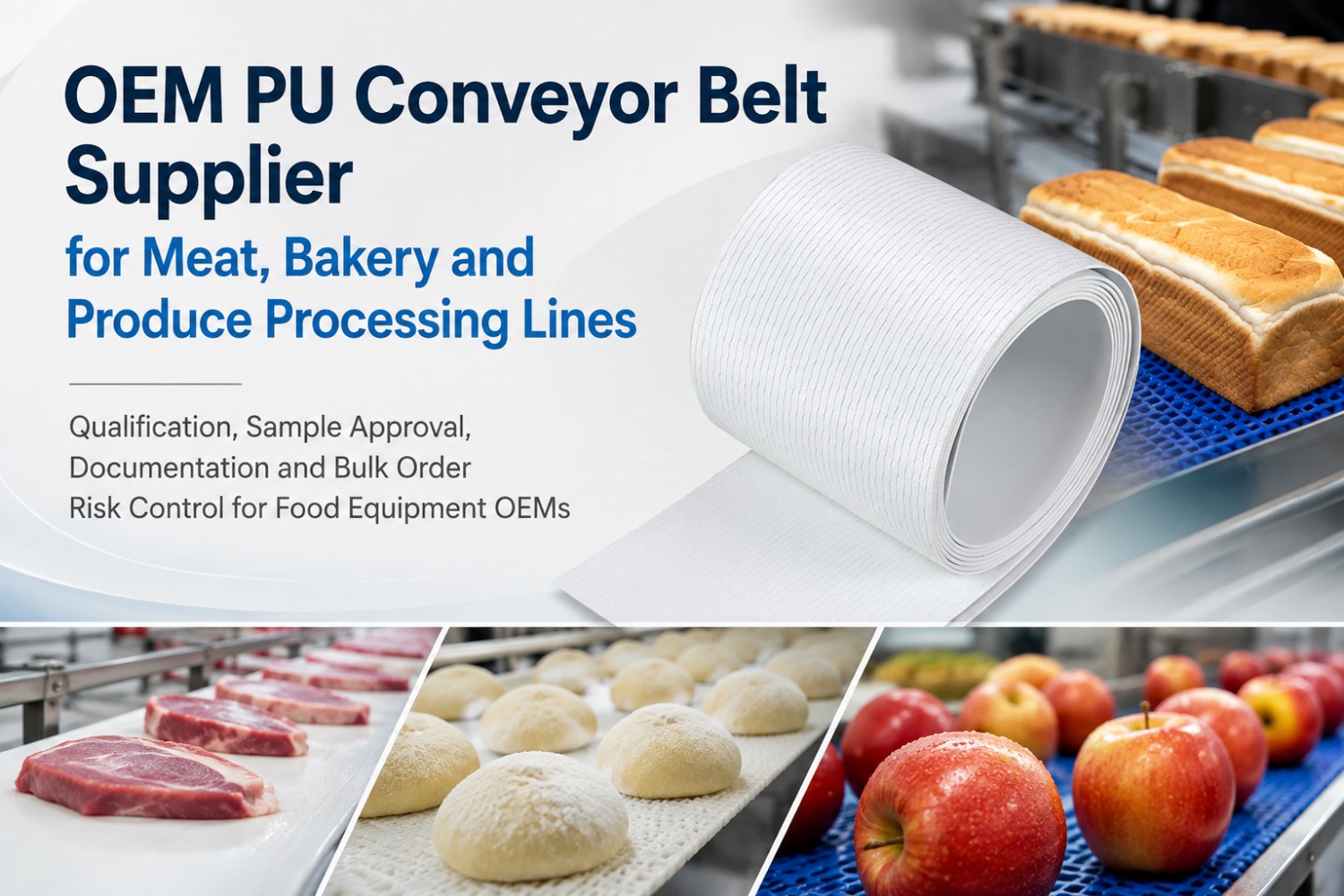
OEM PU Conveyor Belt Supplier for Meat, Bakery and Produce Processing Lines
A food equipment OEM rarely buys a PU conveyor belt as an isolated component. The belt has to fit an existing conveyor design, handle a defined food product, run over the specified pulley geometry, tolerate the plant's cleaning routine, and arrive with documentation acceptable to the end market. A belt that passes a short trial but changes tracking, surface behavior, or splice quality in later batches can create a much larger problem once multiple machines have been delivered.
That changes how an OEM should evaluate a PU conveyor belt supplier. Price and nominal dimensions matter, but they are only part of supplier qualification. Sample approval, drawing control, food-contact requirements, production consistency, inspection records, customization capability, packaging, and change control all affect purchasing risk. For meat, bakery, and produce processing equipment, the right sourcing process starts with the application and converts it into a specification that both buyer and supplier can verify.
Quick Answer for Food Equipment OEMs
Do not qualify a PU conveyor belt supplier from a catalog description alone. Send the actual machine and process requirements, approve a representative sample, define what cannot change after approval, and agree on the inspection and documentation required for production orders. The more critical the belt is to hygiene, tracking, product release, or machine geometry, the more important this process becomes.
1. Why Food Equipment OEMs Need a Different Supplier Qualification Process
An end user replacing one belt can often compare a new belt against the old one. An OEM faces a different risk. The belt may become part of a machine platform that is sold repeatedly, which means an apparently small belt change can affect many installations.
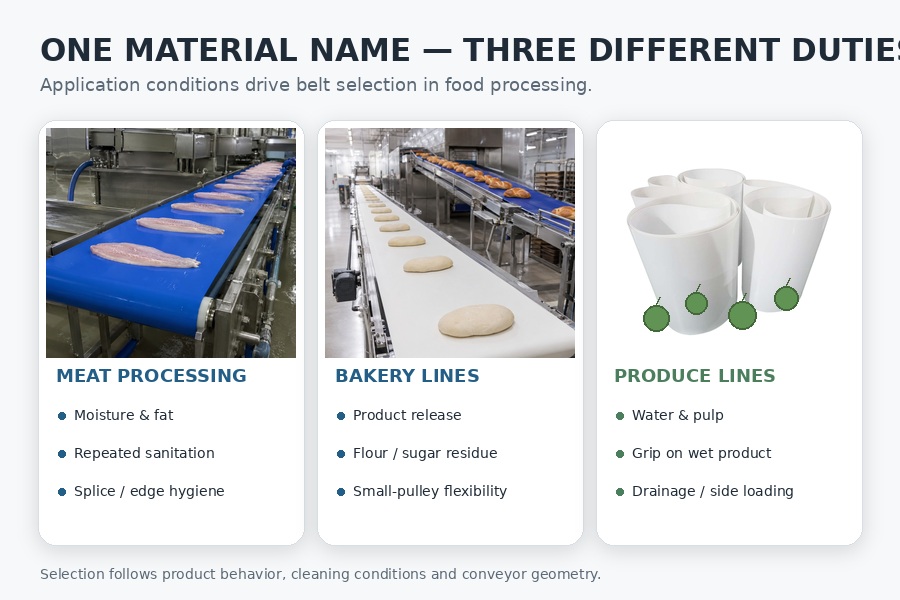
Consider three typical lines. On a meat processing conveyor, moisture, fat, cleaning chemicals, edge condition, and sanitation access can influence belt performance. On a bakery line, product release, flour or sugar residue, belt flexibility, and transfer geometry may matter more. On a produce line, water, pulp, rolling products, side loading, grip, and drainage can become the dominant factors.
The material name "PU" does not resolve these differences. Even within the same general belt material, construction, surface finish, thickness, reinforcement, edge treatment, profiles, guides, and joining method can change how the belt behaves.
For an OEM buyer, supplier qualification therefore has two layers:
- Application qualification: Is the proposed belt suitable for the actual product, conveyor geometry, cleaning method, and operating environment?
- Supplier qualification: Can the supplier reproduce the approved configuration, inspect it consistently, document it, and control changes across repeat orders?
This distinction is important. A good sample from an uncontrolled production process is still a sourcing risk.

2. Start the RFQ With the Food Process, Not Just Belt Dimensions
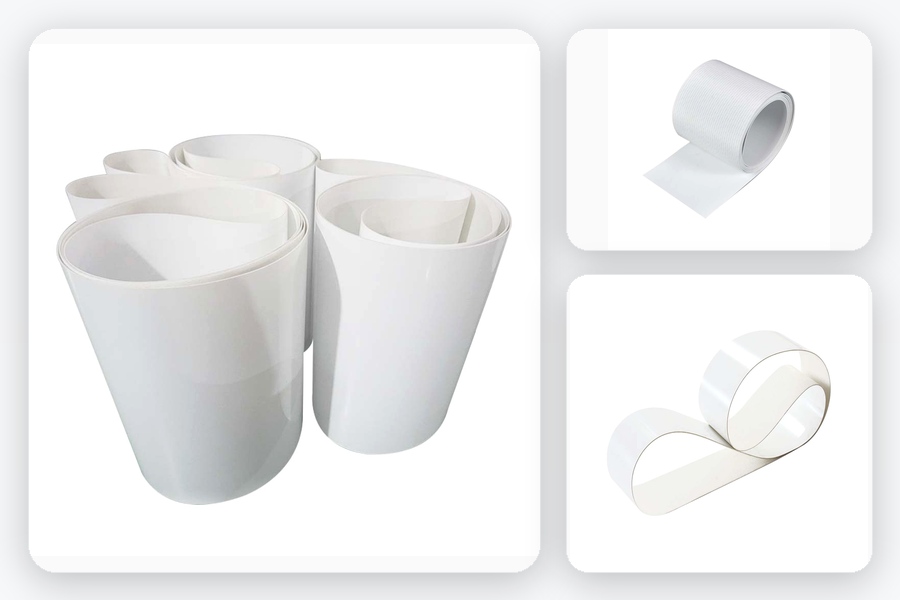
A request such as "PU belt, white, 800 mm wide" leaves too many engineering decisions undefined. The supplier may be able to quote it, but the quotation does not prove that the belt fits the machine.
A stronger food conveyor belt RFQ describes what the belt actually has to do.
| RFQ Information | What the OEM Should Provide | Why It Matters |
|---|---|---|
| Food product | Raw meat, dough, baked product, fruit, vegetables, packaged food, or other material | Product moisture, oil, stickiness, abrasiveness, and shape affect belt selection. |
| Contact condition | Direct food contact, indirect contact, or packaged-product handling | Determines which food-contact documentation must be reviewed. |
| Belt dimensions | Width, endless length, thickness requirement, and dimensional tolerances where critical | Supports machine fit and repeat-order consistency. |
| Conveyor geometry | Drive pulley diameter, nose-bar or small-pulley details, return arrangement, incline, guides, and conveyor drawing | Bending conditions and tracking requirements cannot be judged from belt width alone. |
| Surface requirement | Required release, grip, texture, profiles, cleats, sidewalls, or guides | Surface behavior affects product movement, transfer, cleaning, and positioning. |
| Cleaning process | Cleaning chemicals, concentration where known, water temperature, frequency, pressure, and sanitation method | Chemical and thermal exposure can affect belt surfaces and joints over time. |
| Operating conditions | Product and ambient temperature, speed, load, operating hours, and wet/dry conditions | Allows the supplier to review the actual duty rather than assume a general food application. |
| Compliance requirement | Destination market, customer specification, required declaration, test report, or applicable regulation | "Food grade" by itself is not a complete compliance specification. |
If the OEM is replacing an existing belt, photos, drawings, the current specification, and a physical sample can shorten the technical review. SINOCONVE supports conveyor belt customization based on customer requirements and OEM/ODM development from drawings, samples, and specified requirements.
3. Qualification Point One: Food Contact Must Be Verified, Not Assumed
Color is not evidence of food-contact suitability. A white or blue belt may make contamination or product residue easier to see, but the visual appearance does not establish regulatory compliance.
The buyer should identify the destination market and contact condition before sample approval. For equipment intended for the United States, the OEM should determine which applicable FDA food-contact requirements and supplier documentation are needed. For equipment entering the European market, food-contact material requirements may involve Regulation (EC) No 1935/2004 and other applicable measures depending on the material and intended use.
The practical procurement question is therefore not simply, "Is this an FDA belt?" It is:
- What exact belt construction and material are being supplied?
- Will it directly contact unpackaged food?
- What food types and contact conditions apply?
- Which market will the finished equipment enter?
- What declaration, report, or supporting documentation does the OEM or end customer require?
- Does the documentation correspond to the belt being quoted and sampled?
OEM Purchasing Warning: Do not turn "food grade" into a generic checkbox. Define the required evidence during RFQ and confirm it again before approving the production specification.
4. Qualification Point Two: Hygienic Performance Depends on More Than PU
A suitable PU conveyor belt can support hygienic food handling, but the belt material cannot compensate for poor conveyor design. Hygienic design guidance for food conveyor systems places importance on cleanability, accessibility, belt support, guides, drive components, and other areas where residue can accumulate.
This matters especially on wet meat and produce lines. A belt surface may be relatively easy to clean while the edge, splice, guide interface, return path, or conveyor frame remains difficult to access. If those areas retain water or food residue, changing belt material alone will not solve the sanitation problem.
Food equipment OEMs should review the belt as part of the complete hygienic system:
- Can operators reach the belt and return path during cleaning?
- Does the conveyor allow drainage rather than holding wash water?
- Can residue accumulate around guides, supports, edges, or the splice?
- Will the belt surface provide enough grip without creating unnecessary cleaning difficulty?
- Is the joint appropriate for the cleaning and product-contact conditions?
- Can the belt be tensioned and tracked without creating inaccessible contamination points?
For a deeper application-level discussion, SINOCONVE's guide to PU conveyor belts for food handling and hygienic lines explains how product behavior, cleaning routines, pulley geometry, surface finish, and edge treatment interact.
5. Meat, Bakery and Produce Lines Do Not Need the Same Belt
5.1 Meat Processing Equipment
Raw meat and other wet protein applications can expose a belt to moisture, fat, trimming residue, repeated sanitation, chilled environments, and physical damage. Here, a supplier should not recommend a belt from the application name alone.
The OEM should describe whether the conveyor is used for trimming, inspection, deboning support, transfer, packing, or another process. Cleaning chemicals and procedures should be disclosed, and areas where knives or sharp product edges can reach the belt deserve specific attention.
Splice and edge construction also become important because difficult-to-clean areas can undermine an otherwise suitable belt surface.
5.2 Bakery Processing Lines
Bakery applications can look easier because many lines are relatively dry, but their requirements vary considerably. Loose flour, sugar, oils, dough, baked products, cooling sections, packaging transfers, and hot products create different belt conditions.
A smooth PU surface may be appropriate where release and easy cleaning are priorities. Another surface may be needed where the product must resist sliding. The OEM also needs to check the smallest pulley and transfer point because compact bakery machinery often places greater emphasis on belt flexibility.
PU should not be specified automatically for every bakery conveyor. For dry and light-duty applications, a properly selected food-grade PVC conveyor belt may also deserve evaluation. The decision should follow the product, cleaning process, machine geometry, and required documentation rather than a material preference.
5.3 Fruit and Vegetable Processing
Produce creates another set of variables. Whole fruit can roll; cut produce can release moisture; washing stages can carry water and pulp onto the return side; delicate products can be damaged at transfer points.
A smooth belt may release product well but provide insufficient grip on an incline. Adding profiles or side containment can control movement, but every additional feature should also be reviewed for cleaning access and return-side clearance.
OEMs designing sorting, grading, washing, inspection, or packing equipment can also review SINOCONVE's guidance on light conveyor belts for fruit handling before defining the RFQ.
6. Sample Approval Should Test the Application, Not Just Appearance
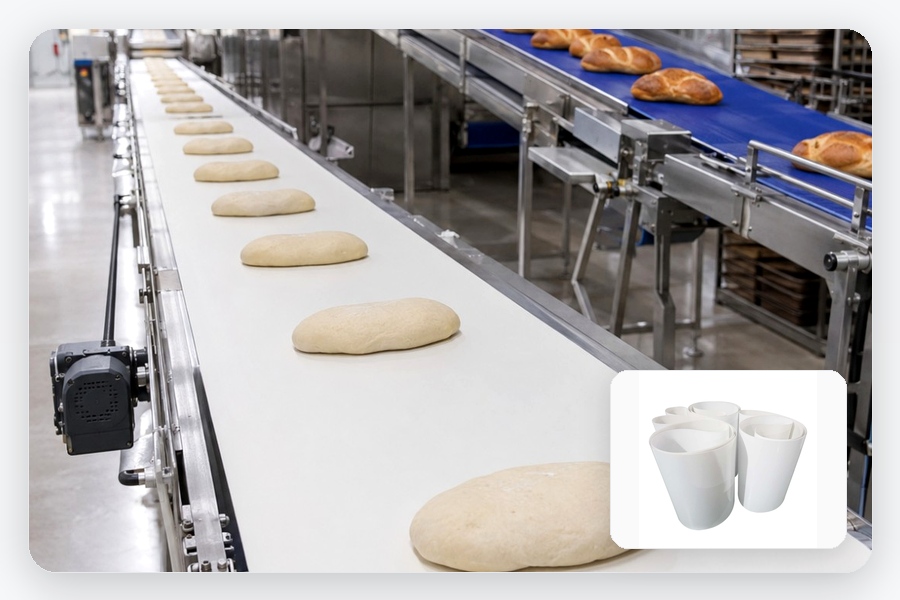
For OEM purchasing, a sample is most useful when it answers specific technical questions. SINOCONVE can provide standard samples or small test samples for customer evaluation, but the OEM should define what it wants the trial to prove.
A sample review can include dimensional checks, surface and color confirmation, flexibility around the actual machine geometry, tracking behavior, product release or grip, joint condition, cleaning response, and any other feature that is critical to the equipment design.
If possible, test the sample under conditions that resemble real operation. A short unloaded run cannot show everything that will happen during production.
| Sample Check | What to Verify | Why OEM Buyers Should Record It |
|---|---|---|
| Dimensions | Width, length, thickness and critical tolerances | Creates a measurable reference for repeat orders. |
| Surface | Texture, release, grip and product behavior | Prevents approval based only on visual similarity. |
| Tracking | Behavior on the actual conveyor and under representative loading | Identifies geometry or construction problems before machine delivery. |
| Splice and edges | Joint profile, edge finish and cleanability | These areas can affect hygiene, tracking and service behavior. |
| Cleaning | Response to the intended sanitation process | Helps identify incompatibility before serial production. |
After approval, the OEM should identify the sample or specification as the purchasing reference. Any critical material, construction, surface, splice, or dimensional change should be reviewed before it is accepted for subsequent production.
7. Production Consistency Is More Important Than a Perfect First Sample
The commercial risk appears when the first sample works but the production batch does not match it. This is why bulk order supplier qualification should examine quality control as well as development capability.
SINOCONVE's documented quality process includes incoming raw-material inspection, production-stage inspection, and final testing before shipment. Product test reports can be provided, and third-party testing can be arranged when a customer has special standard requirements.
For an OEM program, however, the buyer should still define which characteristics need to be controlled. A general inspection report is not a substitute for an agreed product specification.
Depending on the machine, critical characteristics may include belt dimensions, construction, surface, color, joint configuration, profiles or guides, edge finish, packaging identification, and required documentation. The approved drawing or technical specification should make these requirements clear enough that incoming inspection can compare future batches against the same reference.
8. OEM Customization Should Be Controlled by Drawings and Revision Data
Custom capability is useful only when the custom configuration can be reproduced. Food equipment builders frequently need more than a standard roll: endless fabrication, specified dimensions, guides, profiles, special surfaces, packaging, logos, or other machine-specific requirements may be involved.
SINOCONVE supports OEM/ODM cooperation and customization according to customer drawings, samples, and special requirements. For repeat equipment programs, the buyer should convert that customization into controlled technical information rather than relying on emails or verbal descriptions.
Recommended OEM Order Record
- approved drawing or specification revision;
- belt width and endless length;
- construction and surface requirement;
- splice or endless-joint requirement;
- profiles, guides, sidewalls, or other fabrication details where applicable;
- edge requirement;
- food-contact or customer documentation required with the order;
- packaging and product identification;
- approved sample reference where one exists.
This becomes especially valuable when an OEM has several machine models using similar-looking belts. Clear part numbers and revision control reduce the chance of installing the right material in the wrong configuration.
9. What Evidence Should an OEM Ask for Before a Bulk Order?
Supplier qualification should produce evidence that can be checked by purchasing, engineering, and quality teams. The exact documentation depends on the application and destination market, but an OEM can use the following structure.
| Qualification Area | Evidence to Request | Main Risk Controlled |
|---|---|---|
| Technical fit | Approved drawing/specification and representative sample | Wrong belt for the machine or process |
| Food-contact requirement | Applicable declaration or documentation defined for the destination market and contact condition | Unsupported compliance assumption |
| Quality | Agreed inspection items and relevant test report | Batch-to-batch variation |
| Customization | Drawing, revision number, fabrication details and approved sample reference | Uncontrolled OEM changes |
| Repeat orders | Stable product identification and agreed change-control process | Production belt differs from qualified belt |
| Shipment | Packaging and identification matched to OEM part numbers where required | Damage or part-number confusion at receiving |
The important point is traceability between the requirement, approved sample, purchase order, inspection, and delivered belt. A large folder of unrelated certificates does not provide the same control.
10. Common OEM Sourcing Mistakes That Increase Purchase Risk
Approving by color and dimensions. Two belts can look similar while behaving differently in bending, tracking, grip, cleaning, or product release.
Using "food grade" as the complete specification. Food-contact requirements depend on the material, contact conditions, destination market, and documentation expected by the OEM or end customer.
Testing the belt without the real product. An unloaded conveyor test may not reveal slipping, sticking, side loading, residue buildup, or transfer problems.
Ignoring cleaning conditions during RFQ. A belt that performs well during production can still be unsuitable if the sanitation process attacks the surface or joint.
Approving a sample without locking the specification. Sample approval should create a controlled reference for subsequent orders, not merely confirm that one piece looked acceptable.
Comparing suppliers only by unit price. For an OEM, a lower belt price can be outweighed by machine rework, repeated sample approval, incoming inspection problems, field replacements, or customer documentation delays.
11. A Practical PU Conveyor Belt Supplier Qualification Sequence
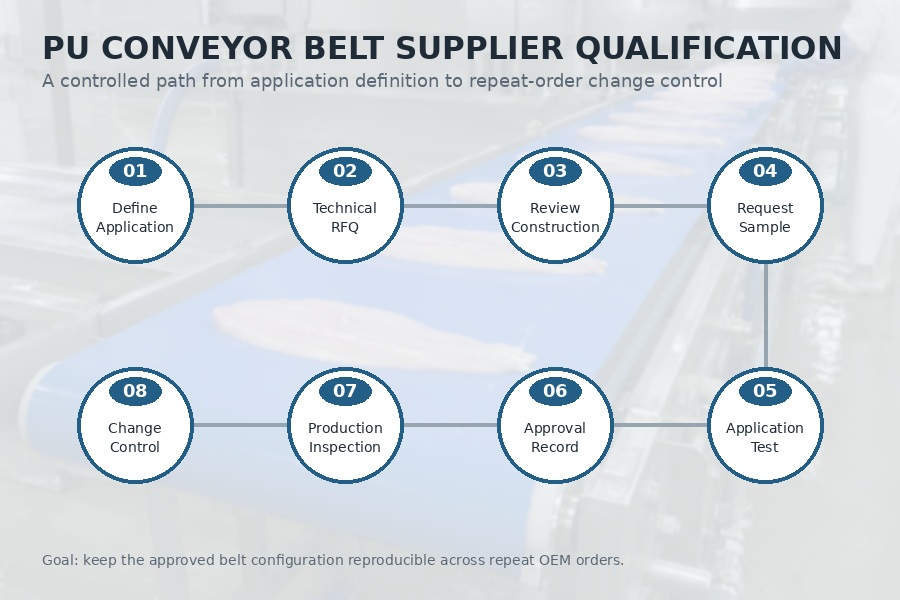
- Define the application. Identify the food product, contact condition, cleaning method, conveyor geometry, operating conditions, and destination market.
- Issue a technical RFQ. Include drawings, dimensions, current belt information, photos, and required documentation where available.
- Review the supplier's proposed construction. Resolve unclear points before treating the quotation as technically acceptable.
- Request a representative sample. Make sure the sample reflects the construction intended for production.
- Run an application-based test. Evaluate machine fit, tracking, product handling, cleaning, and other critical conditions.
- Record sample approval. Link the approved configuration to a drawing, specification, part number, or other controlled reference.
- Define production inspection. Agree on critical dimensions, fabrication details, documents, and any required test reporting.
- Control repeat orders and changes. Review changes that could affect the approved belt before they enter serial equipment production.
This process requires more work before the first bulk order, but it reduces ambiguity later. For OEM programs, that is usually the point of qualification.

12. FAQ for Food Equipment OEM Buyers
Is every PU conveyor belt suitable for direct food contact?
No. PU describes a material family, not automatic food-contact approval. Buyers should verify the exact belt construction and the documentation required for the intended market, food type, and contact condition.
Should an OEM request a belt sample before placing a bulk order?
For a new belt specification or supplier, sample evaluation is a useful risk-control step. SINOCONVE can provide standard or small test samples. The buyer should define what the test needs to verify rather than approving the sample from appearance alone.
What should a food equipment OEM include in a PU conveyor belt RFQ?
At minimum, provide belt dimensions, food product, direct or indirect contact condition, conveyor layout, pulley information, surface requirement, cleaning method, temperature and operating conditions, required documentation, quantity, and drawings or current-belt information where available.
Is PU always better than PVC for bakery conveyors?
No. PU can be a strong option for many food handling applications, while PVC can also suit dry, packaged, and light-duty food conveying. Product behavior, cleaning conditions, pulley geometry, required surface properties, and compliance requirements should determine the choice.
What should be locked after sample approval?
The OEM should record the characteristics that made the sample acceptable, such as construction, dimensions, surface, splice, edges, fabrication details, required documentation, and the applicable drawing or specification revision.
How can buyers reduce batch-to-batch risk?
Use a controlled specification, define inspection criteria, keep an approved sample or documented reference where practical, identify repeat orders consistently, and require review of changes that could affect critical belt characteristics.
13. Prepare the Right Data Before Requesting an OEM Quote
Before Sending Your RFQ
A useful quotation starts with a useful RFQ. For a meat, bakery, or produce processing line, prepare the belt width and endless length, food product, contact condition, conveyor drawing, pulley dimensions, surface requirement, cleaning process, operating temperature, required documentation, order quantity, and photos or samples of the existing belt if it is a replacement.
SINOCONVE supports conveyor belt customization and OEM/ODM development based on customer requirements, drawings, and samples. Standard or small test samples can also be discussed before bulk purchasing. To review a project, send the application information to sales@sinoconve.com or submit the details through the SINOCONVE contact and RFQ page.
Related SINOCONVE Resources
- PU Conveyor Belt for Food Handling and Hygienic Lines — application and selection considerations for food-processing conveyors.
- Food Grade PVC Conveyor Belt: What Buyers Should Check — useful when comparing PU and PVC for bakery and light-duty food lines.
- Light Conveyor Belt Solutions for Fruit Handling — selection considerations for fruit sorting, washing, grading, and packing equipment.
- SINOCONVE Conveyor Belt Products — browse conveyor belt and power-transmission product categories.
- Request an OEM Conveyor Belt Quote — send drawings, samples, specifications, and purchasing requirements for technical review.