
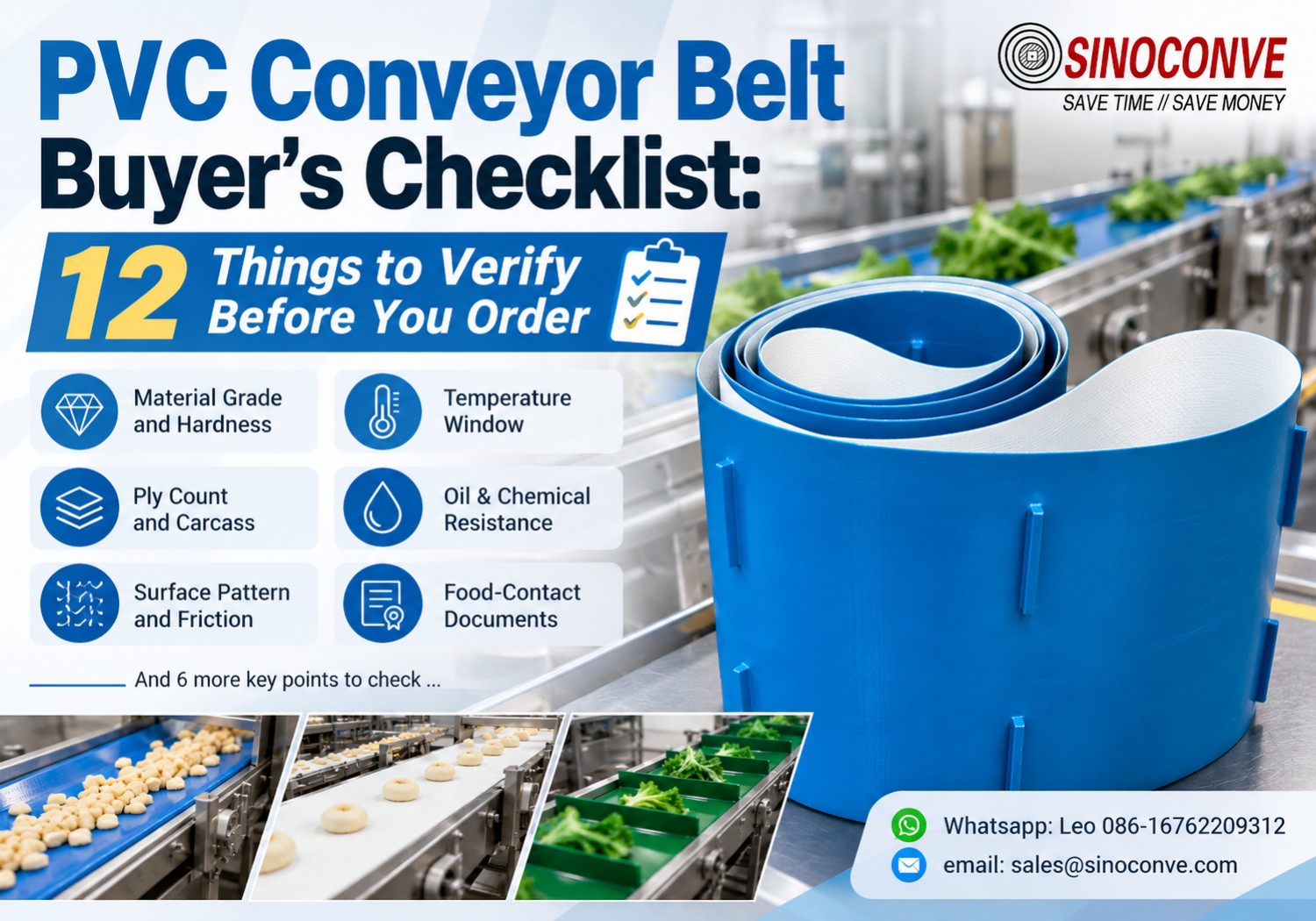
PVC Conveyor Belt Buyer's Checklist: 12 Things to Verify Before You Order
A light-duty belt looks simple on a quotation. Width, length, thickness, price per metre. Then the belt lands on site, the splice lets go three weeks in, or the surface turns chalky after the first caustic wash — and the argument about whose spec was wrong begins. Almost every one of those arguments was decided weeks earlier, in a detail that never made it onto the drawing.
We press PVC and PU belting in Ningbo and we also quote against customer drawings every day of the week. That double view is why this list exists. Twelve checks, and none of them take more than ten minutes at quotation stage. Skip five of them and you are ordering a belt that will teach you the lesson on your own line instead.
Use it with anyone. Send it to every conveyor belt manufacturer on your shortlist and ask them to answer point by point. The ones who answer without dodging are the ones you keep.

Two assumptions sit under everything below. First, PVC and PU are not the same belt at two prices. They trade different properties, and section 01 puts numbers on that trade rather than adjectives. Second, this list is written for light-duty work: belt tension under roughly 50 kg/m of width and pulley diameters above 60 mm. Above those figures you need an engineering review, not a checklist.
| # | What you verify | Who usually gets it wrong | Cost when it is wrong |
|---|---|---|---|
| 01 | Material grade and hardness | The buyer, by accepting "food grade PVC" with no Shore A figure attached | A compound 15A too soft that scores through in six weeks |
| 02 | Ply count and carcass | Both sides — the drawing simply omits it | Stretch, tracking drift, splice failure at the hinge |
| 03 | Surface pattern and friction | The buyer, on any incline steeper than about 15° | Product slides back, throughput drops, edges fray |
| 04 | Colour and food-contact use | The buyer, after copying a competitor's spec sheet | Failed audit, or 20% paid for blue you never needed |
| 05 | Thickness and tolerance | The supplier, quietly, by shipping to minus tolerance | It passes goods-in and fails at month nine |
| 06 | Splice method and joint strength | The buyer, by leaving the method unnamed | The most common light-duty failure we are called to |
| 07 | Temperature window | The buyer, and it is an easy one to avoid | Cracking at the cold end, plasticiser loss at the hot end |
| 08 | Oil, grease and cleaning chemicals | Both sides | Swelling, hardening, white bloom, false "bad batch" claims |
| 09 | Edges, guide strips and cleats | The buyer | Belt climbs, cleats tear out, sidewalls leak product |
| 10 | Food-contact documents | The buyer, at audit time rather than order time | A line sitting idle while paperwork is chased |
| 11 | Packing and roll direction | Nobody, until the belt is on the floor | A splice where you did not want one, scrap ends |
| 12 | Total cost of ownership | The buyer's spreadsheet | A 30% cheaper belt costing 60% more per operating year |
01Material Grade and Hardness: PVC Shore A Against PU
The first line of any light-duty quote says "PVC" or "PU". That word is not a specification. Two PVC belts from two suppliers can sit 20 Shore A apart and behave like different materials on the same line. Hardness is where the real negotiation starts, and it is also where most cheap quotes hide their margin.
Typical light-duty PVC belting lands between 60 and 85 Shore A. General conveying sits at 65–75. Anything reading 80 or above is a stiffer compound aimed at cut resistance and better tracking on short centres. PU is harder across the board: 80–95 Shore A, with 85A and 90A covering most food and packaging work.
Harder is not better. A 90A PU belt tracks well and resists scoring, but it is unforgiving on small pulleys. Below a 50 mm nose bar it will not wrap cleanly and it fatigues along the hinge line. Softer PVC drapes over small rollers and makes a better endless splice, yet a 65A belt under a sharp metal scraper loses its edge within months.
What Shore A actually tells you
Shore A is a penetration reading, not a strength number. It records how far a hardened pin sinks into the compound under a fixed load across 15 seconds. Two belts showing the same 75A can still differ by 2× in tensile strength and 3× in tear resistance, because plasticiser and filler load move the reading without touching the polymer backbone. Ask for the number plus a compound code. "75 Shore A" alone is marketing.
Why a 90A quote sometimes arrives as 82A
Plasticiser is the cheapest ingredient in a PVC compound, and hardness is the easiest property to drift downward. A belt that measures 82A in our lab at 23 °C will read nearer 79A on a warm afternoon in a 38 °C warehouse. If the number matters to your process, write a tolerance into the purchase order: 85 ±3 Shore A, tested at 23 °C to ISO 7619-1, verified on three sections per roll. Goods-in inspection then takes about forty seconds with a handheld durometer.
| Property | PVC, typical light-duty | PU, typical light-duty | When the number decides the order |
|---|---|---|---|
| Abrasion loss, DIN 53516 / ISO 4649 | 150–250 mm³ | 60–120 mm³ | Whenever the carry side sees abrasive dust, grain hulls or recycled flake rather than clean cartons |
| Low-temperature brittleness | −10 °C to −25 °C, wide spread by plasticiser type | Polyether PU −30 °C to −40 °C; polyester PU closer to −20 °C | Cold stores, winter loading docks, frozen vegetable lines |
| Oil and grease resistance | Moderate. Aromatic oils pull plasticiser out and the belt goes stiff | Good to very good, with a hydrolysis caveat in hot wet service | Bakery, snack frying, any line with a daily oil mist |
| Cut and tear resistance | Lower. A nick propagates fast across the weft | Higher, roughly 2–3× on equal thickness in publicly quoted comparisons | Sorting lines with metal corners, glass, or sharp-edged packaging |
| Splice method and joint efficiency | Heat fusion, butt or overlap: 60–75% of belt tensile | Heat fusion or toothed endless: 70–85% | Short centre distances and high cycle counts, where the joint is the working part |
| Cleaning-agent tolerance | Fine with alkaline and neutral CIP, poor with ketones and aggressive solvents | Better with fatty residue, but polyester grades degrade in hot water above about 50 °C | Any plant running a documented CIP cycle with contact time written down |
| Indicative unit cost | Often quoted around $18–32 per metre for 2-ply, 3.0 mm, 800 mm wide | Around $45–80 per metre for a comparable PU build | Every order. But compare it against section 12, not against the other column |
Field note from our engineers: A snack plant in Fujian replaced a 3 mm PVC belt with 4 mm PU because the PVC surface was swelling under a daily oil mist. The PU lasted well, but the line kept throwing the belt on the nose bar. Cause was the wrap: the 90A PU was three times stiffer than the belt it replaced and the 45 mm end pulley gave it too little contact. They dropped to a 2 mm PU on the same carcass and the tracking problem disappeared. Thicker is not automatically the answer.
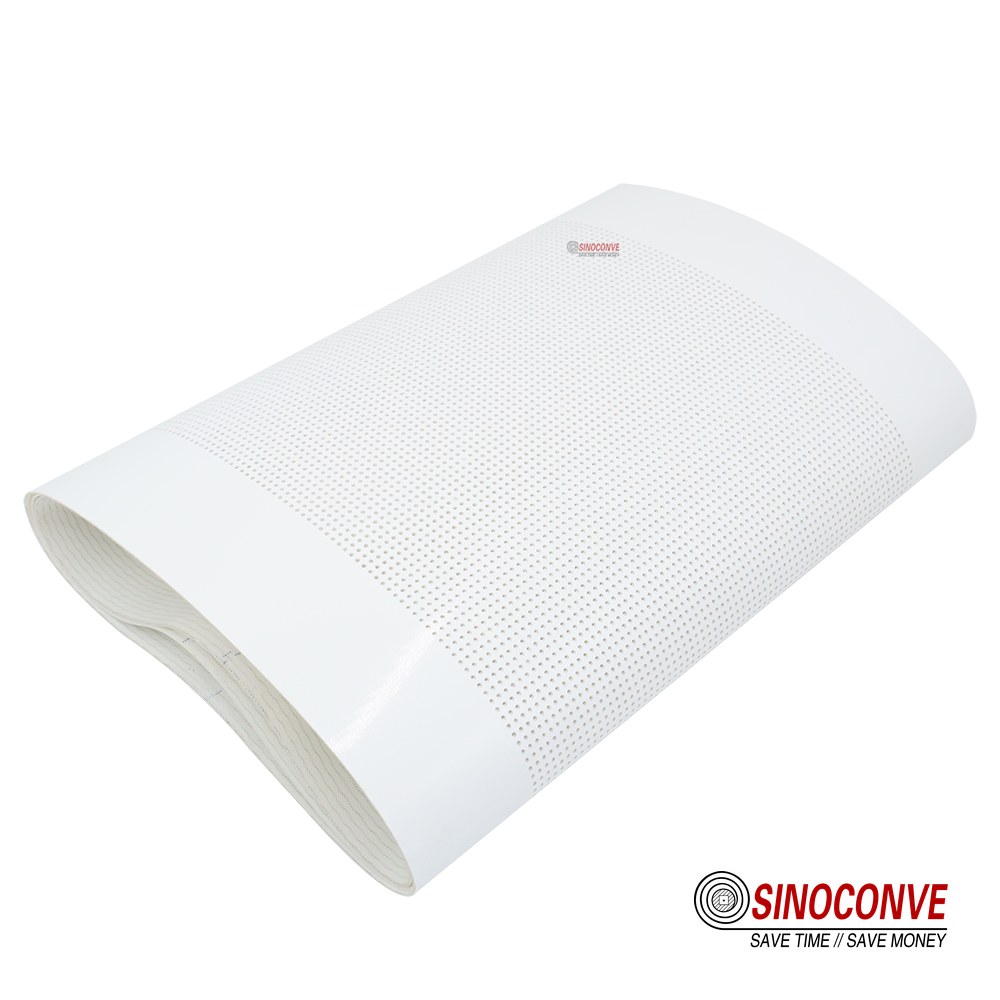
Same width, same 3 mm nominal thickness. The PVC face on the left is softer and duller; the PU face on the right holds a tighter grain.
02Ply Count and Carcass: What Is Actually Inside the Belt
Ask a vague question and you get a vague belt. "Two ply" means nothing until you know the fabric, the weave, the ply weight and whether an extra tension layer sits between them. This is the check that separates a conveyor belt supplier who builds to a drawing from one who builds to a price.
One ply, two ply, or three — and when a tension layer appears
A single-ply PVC belt in the 2–3 mm range carries light unit loads over short centres and is the cheapest thing that works. Two-ply constructions in the 3–5 mm band take the majority of packaging and food work; the second ply is there for puncture resistance and to hold the splice, not to carry more tension. Three-ply enters when the belt must track over long runs, or when the load is irregular and the splice sees shock loading every cycle.
The layer people forget is the tension member. On a 60 m run with a 300 mm drive pulley, even a light belt will elongate under load and creep until the take-up runs out of travel. A single woven tension layer, or an anti-stretch insert, removes most of that. It adds perhaps 8–12% to the belt price and can remove two re-tensioning visits from the first year. On runs under 15 m we usually tell customers to skip it. Longer than 25 m and it pays for itself.
Questions to put in writing
Fabric type (polyester warp with polyamide weft is the common default), ply weight in g/m², total carcass thickness in mm, and the nominal belt tensile in N/mm. If the answer to any of those is "standard", ask for the datasheet. Our longer walk-through on fabric and ply choices sits in the PVC conveyor belt types and selection guide, and if you are still writing the drawing, what buyers should know before choosing a PVC belt covers the same ground from the purchasing side.
One detail that decides joint quality later: whether the fabric was cut square to the belt axis. A carcass skewed by 2° over 800 mm is invisible on the roll and shows up as a belt that runs to one side for life.
03Surface Pattern and Friction: The Number Behind Every Incline
Flat, matte, fine-rib, diamond, longitudinal groove, super-grip. Six patterns cover almost every light-duty job, and the difference between them is measured, not felt. Friction coefficient against your actual product is the number that matters, and it changes with dust, moisture and oil film.
On a clean, dry industrial conveyor belt with a fine-rib surface, a static friction coefficient of roughly 0.4–0.5 against cardboard is normal. Wet glass or PET pushes that down toward 0.2, and an incline of 15° needs about 0.27 just to hold position with no margin at all. That is why the same pattern works beautifully in one plant and fails in the next.
Do the incline arithmetic before you choose a pattern
Tilt angle, product weight, and whether the product is boxed or loose. A loose granular product on a 20° incline needs a cleated belt — no surface pattern holds grain at that angle once vibration starts. A 12° decline carrying cartons needs almost nothing beyond a flat, low-friction face, because you want the boxes to release cleanly at the transfer. Getting this backwards is common: buyers add grip where they need release.
Test the sample, not the catalogue
Ask for a 300 mm sample of the exact compound and pattern, then run it on site with your product at your line speed. If a supplier will not cut a sample from production stock, that is an answer in itself.
04Colour and Food-Contact Suitability: White, Blue, Green
Colour on a light-duty belt is a working decision, not decoration, and the wrong colour choice costs money in two opposite directions. Pick white where blue was needed and you may fail a retailer audit. Pick blue where white was fine and you have paid a premium for nothing.
White and off-white belt faces dominate dairy, bakery and dry-goods packaging. The reason is practical: soil and residue show immediately, so cleaning verification is fast and visual. Blue is standard in meat, poultry and fish rooms because blue fragments contrast against product and are easy to spot if a belt edge ever chips. Green turns up mostly on fresh produce and vegetable lines, where green handles the acidic juice and wet environment of a fruit wash without the staining that builds up on white.
Colour does not make a belt food safe
The compound and the pigment declaration do. A white belt made with a non-compliant pigment is no more suitable for food contact than a black one, and a compliant belt is compliant regardless of whether it is white, blue or green. What you are actually buying is a compound plus a set of declarations. Section 10 covers the documents.
Detectability, when it is genuinely required
Some meat and retail specifications ask for belt material a downstream metal detector or X-ray unit can pick up. If your customer spec carries that clause, say so at enquiry stage: the additive goes into the compound batch and cannot be retrofitted. Without the clause, do not pay for it.
A food grade white PVC face on a packaging line. The flat matte finish keeps wiping simple and shows residue early.
05Thickness and Tolerance: Where Cheap Quotes Quietly Win
Here is a trick we see every month. A belt is quoted as 3 mm, delivered at 2.6 mm, and passes goods-in because nobody measured it. On the roll it looks identical. On the line it lasts eight months instead of two years, and by then the invoice is long settled.
Thickness on a coated belt is never a single number. It is nominal plus a tolerance band, and the band is where cost lives. A supplier quoting ±0.5 mm on a 3.0 mm belt can legally ship the bottom of that band on every metre. A supplier quoting +0.2/−0.0 mm cannot. Those two quotations describe different products at the same headline figure.
Write the tolerance, then check it
Spell it out: "3.0 mm +0.2/−0.1, measured with a dial gauge to 0.01 mm at five points across the width, both ends of each roll". Then actually measure at goods-in. Five readings take a minute and a half. Record them on the receiving sheet next to the roll number. If you keep those records for two years, you will eventually know which supplier ships honest thickness without arguing about it.
Field note from our engineers: A logistics customer in Ningbo asked us to match a competitor's 2.8 mm belt that had lasted fourteen months. We measured their worn sample at 2.31 mm at the centre and 2.58 mm at the edges — a 0.27 mm wedge across 600 mm of width. That wedge, not the compound, was wearing the guide rollers on one side. Their "2.8 mm spec" had never had a tolerance attached to it, so there was nothing to complain about. Now their purchase order carries the band in writing.
| Nominal thickness | Band we see quoted | Typical duty | Readings to take per roll |
|---|---|---|---|
| 1.5 mm | ±0.15 | Documents, envelopes, small cartons on close centres | Five |
| 2.0 mm | ±0.2 | Light sorting, e-commerce totes, dry snacks | Five, plus both ends |
| 3.0 mm | ±0.2, and ±0.3 from some sources | The workhorse for food and packaging lines | Five, plus both ends |
| 4.0 mm | ±0.3 | Heavier cartons, bakelite trays, small parts | Nine, in a grid |
| 5.0 mm and up | ±0.4 | Aggregate, ore chips, scrap on short transfers | Nine, in a grid |
06Splice Method and Joint Strength: Where Belts Die
Nine out of ten light-duty complaints we hear start at the joint. Not the compound, not the pattern, not the price. The joint. It is also the one item that most purchase orders leave totally unspecified, which means the decision gets made by whoever is holding the press on the day.
Every splice is a local interruption of the belt's structure, so it will never be stronger than the belt itself. The realistic target is a percentage. Heat-fused butt or overlap joints on PVC typically reach 60–75% of nominal belt tensile; a well-made toothed endless joint on PU can reach 70–85%. Mechanical lacing reaches lower but can be fitted on site in twenty minutes without a press, which is why maintenance teams keep it in the kit.
The press itself has to be trusted before the joint can be. We press on the same platens that build our V-belts, and as a transmission belt manufacturer we calibrate every platen monthly for temperature evenness across its full face. A 5 °C drift from one end of a 1,200 mm platen to the other is enough to under-cure one side of a joint and leave it visibly darker.
Four ways to join a light-duty belt
Fusion is the default for PVC because the compound melts and re-bonds. Toothed endless splices suit PU and thin belts where you want a joint thickness close to the parent belt. Mechanical fasteners win when the line cannot be stopped for a press cycle. Step splices belong on thicker, heavier builds. Your choice is really a question about downtime, joint thickness and how the joint will be inspected afterwards.
That last point matters more than buyers expect. If maintenance cannot inspect a joint easily, nobody notices it starting to fail until the belt is on the floor. A laced joint announces itself. A fused joint does not. If your team prefers visible warning signs, say so and take the lacing — that is a legitimate engineering reason, and no V-belt manufacturer would argue against choosing the joint you can check.
| Joint type | Typical joint efficiency | Downtime to install | Where we recommend it |
|---|---|---|---|
| Heat-fused overlap | 60–75% of belt tensile | 45–90 minutes with a press | Standard PVC work, medium centres, belts that can come off |
| Heat-fused butt | 55–70% | Similar, but needs a straight cut to within 0.5 mm | Where joint thickness must stay close to belt thickness for scrapers or wipers |
| Toothed endless | 70–85% | Longer — fingers must be cut and fitted dry first | PU and thin belts on high-cycle lines, small pulleys, knife-edge transfers |
| Mechanical fasteners | 35–55%, and it varies with the hook pattern | 15–25 minutes, no press, on site | Emergency repairs, lines that cannot stop, belts you want to inspect weekly |
07Temperature Window and Low-Temperature Brittleness
Every compound has two ends, and both are usually written as a single vague line on the quote. You need the number at each end, because the failure mode is different at each end and neither one is obvious on arrival.
Standard PVC belting handles roughly −10 °C to +70 °C in continuous service, with short excursions higher. Special plasticiser systems push the cold end to about −25 °C and the hot end toward +90 °C for short periods. Above that, the plasticiser starts migrating out of the compound, the surface goes glossy and then brittle, and the belt smells faintly of solvent when warm. That smell is the announcement.
PU behaves differently. Polyether-based grades stay flexible to around −30 °C or −40 °C and are the sensible choice for cold stores and winter loading docks. Polyester-based PU is tougher and more abrasion resistant but hydrolyses in hot, wet service, which is why we ask every customer for the wash-water temperature before recommending a PU grade. If the answer is above about 50 °C, polyester PU is the wrong material, whatever the price.
Ask two questions, not one
Ambient temperature is not belt temperature. Ask what the surface actually sees — an infrared reading on a running line beats a room thermometer — and how long the extreme lasts. A 95 °C spike for ninety seconds in a wash cycle is not the same requirement as 95 °C for six hours of production.
When the top end goes past about 100 °C continuously, the light-duty discussion is over. At that point the belt becomes a rubber conveyor belt problem, and the right answer is a heat-resistant rubber grade on a fabric or steel carcass rather than any PVC or PU compound. We would rather tell you that early than sell you a belt that fails in the first summer. Our heat resistant conveyor belt range covers that conversation.
| Compound | Continuous window, typically quoted | Short excursions | How it fails |
|---|---|---|---|
| Standard PVC | −10 °C to +70 °C | To +80 °C briefly | Cold: hairline cracks at the edges. Hot: plasticiser loss, glossy then brittle face |
| Cold-flex PVC | −25 °C to +60 °C | Colder, but not hotter | Softens early on warm lines; loses the tracking stiffness it was bought for |
| Heat-stabilised PVC | −10 °C to +90 °C, short cycle work | To about +100 °C for seconds | Distortion near the splice long before the face wears out |
| Polyester PU | −20 °C to +80 °C, dry | Depends entirely on moisture | Hydrolysis in hot wet service: the face goes tacky, then crumbles from the inside |
| Polyether PU | −30 °C to −40 °C cold end, +80 °C hot end | Wash cycles to +85 °C are usually fine | Costs more, resists hydrolysis, less abrasion resistant than polyester PU |
08Oil, Grease and Cleaning Chemicals: Read the CIP Sheet
Two belts can leave the same factory with the same compound code and behave completely differently in two plants, because the difference is not the belt. It is what the belt gets washed with, how strong, and for how long.
PVC is comfortable with alkaline and neutral cleaners. It does not like ketones, esters or aggressive solvent blends, and it does not like aromatic oils, which pull plasticiser out of the compound. The failure takes weeks, not hours. First the surface dulls. Then it hardens in patches. Then it cracks along the weft when the belt bends over the smallest pulley on the line.
PU resists fats and oils far better, which is why bakeries and snack lines migrate to it. The catch is hydrolysis, already covered in section 07: a polyester PU that lives in 55 °C wash water will not last. Polyether PU survives the water, but if your cleaning routine includes a solvent-based sanitising step, check that too, because no PU grade enjoys concentrated solvent contact.
Three questions to ask your own hygiene team
What is the cleaner concentration as mixed, not as supplied? What is the contact time the belt actually sees, including foam dwell time? And what is the water temperature at the nozzle? Write those three answers down and give them to every supplier you ask for a quote. A supplier who ignores them is quoting to a price, not to your line. This is the same ground we covered in the food grade PVC conveyor belt buyer's check, and it is worth ten minutes before you sign anything.
What swelling looks like before it becomes a failure
Measure a 100 mm length of belt and mark it with a paint pen. Mark the width too. After one month in service, measure again. A width gain of more than about 1.5% is early swelling, even if the belt still runs fine. Catch it at that stage and you change a cleaner or a wash temperature. Catch it at 4% and you change a belt. This is a twenty-second check nobody does.
09Edges, Guide Strips, Cleats and Sidewalls
Straight edges sound like a default. They are not. A belt that runs on crowned pulleys over a long centre can be ordered with straight edges and will be fine. The same belt on short centres with a fixed guide will climb the rail within a shift, and the fix is either a guide profile welded to the back or a different edge treatment entirely.
Four options cover most light-duty conveyors. Straight cut edges are cheapest and fine where pulleys are crowned and aligned. Edge-sealed belts close the fabric so moisture and crumbs cannot wick into the carcass, which matters on wash-down lines. V-guided belts follow a fixed track and hold position where the frame is long and alignment is hard to maintain. Cleated and sidewalled profiles turn a flat belt into a shallow conveyor in its own right.
Cleat height is a real engineering number, not a preference. For loose grain and pellets, 25–40 mm T-cleats at 200–300 mm pitch hold product on inclines up to roughly 30°. Below 25 mm, grain slides over the top at anything past about 18°. Above 50 mm on a narrow belt, the cleats start to lean and pull the belt sideways when empty. If you are ordering cleated belting for the first time, the cleat PVC conveyor belt guide goes through profile types and pitches, and there is a worked example for wet produce in the fruit conveyor belt sidewall solution write-up.
If you stock belts rather than run them
Buyers who hold inventory for resale face a different problem: too many variants, too little shelf life. If you are a conveyor belt distributor covering packaging, food and logistics accounts, standardise on two surfaces and three widths, and hold the exotic patterns to order. PVC compounds do have a shelf life, and a roll left in an unheated warehouse through a cold winter will crack at the edges when it is finally unrolled in spring.
Storage before installation
Rolls stand on a core, above 15 °C, out of direct sun. A joint made on a 5 °C belt looks perfect and fails early.
10Food-Contact Documentation: What Should Arrive With the Roll
Food contact is a paperwork check as much as a material check, and it is the item most often left until an audit forces the issue. Then a line stops while someone emails a supplier who has already moved on to the next project.
The regulatory framing is straightforward. For the United States, compounds intended for food contact are usually expected to satisfy FDA requirements for the relevant food-contact use. In the European Union, food-contact plastics are normally assessed against Regulation (EU) No 10/2011, including migration limits and the overall migration test regime. Those are the two reference points we are asked about most often, and the correct question is not "is it food grade" but "what documentation supports this specific compound for this specific contact condition".
The document pack to request before you order
A written declaration of compliance naming the compound and the contact conditions it covers. A material safety data sheet for the finished belt. A migration test report from a recognised laboratory if your customer requires it, and note that this report is normally per compound, not per width or per metre. A statement on which cleaners and temperature ranges the compound was assessed for. An allergen and animal-derived-material statement if you handle those categories. That is five items. If a supplier can only provide two, you have your answer about the rest of the order too.
One point about scope, because it trips up a lot of buyers: a declaration covering the belt face does not automatically cover a cleat, a sidewall, a guide strip or a fabric carcass that was sealed with a different compound. If the food touches it, it belongs in the declaration. Ask for that in writing and, if you ever visit the conveyor belt factory, ask to see the batch records behind a certificate rather than the certificate alone.
11Packing, Roll Direction and Shipping
This is the check that nobody performs, and it is the one that reliably produces a bad first impression. The belt is correct in every dimension, arrives on a pallet, unrolls beautifully, and is facing the wrong way for the machine. So the crew twists it, or the splice ends up on the wrong face, and a perfectly good belt starts life with a defect built into it.
Which face goes out, and why it is written on the roll
A belt has a carry face and a pulley face. On a coated belt they are not always identical: the carry face may be textured, the pulley face smooth or friction-coated for the drive. If the supplier winds the roll so that the carry face is on the outside, the belt feeds onto the line in the correct orientation by default. If they do not, someone on site makes a judgement call at seven in the morning.
Put it in the purchase order. "Carry face out. Label each roll with roll number, length, width, thickness, compound code and the direction arrow." A laminated label taped inside the core costs almost nothing and removes an entire class of installation error. We label every roll this way, including the direction arrow, and it is the single cheapest quality measure on this whole list.
Cores, wrapping and a sea voyage
Core diameter is normally 100–150 mm for light-duty rolls; smaller cores kink stiff compounds, larger cores waste container space. A roll should travel on the core, braced against movement, with the outer wraps protected against edge damage and a moisture barrier around the body. A 40-foot container crossing to Europe or Latin America sees big swings in humidity, and unprotected belt edges can show white bloom on arrival even though nothing is wrong with the compound itself. It wipes off, but it frightens people.
Weights matter for handling more than freight cost. A 3.0 mm belt at 800 mm is roughly 3.8–4.2 kg per metre, so a 100 m roll lands near 400 kg. If you buy in wholesale conveyor belts volumes for several sites, split the shipment into site-sized rolls at the factory rather than on your own dock.
Field note from our engineers: Eighteen rolls of 2 mm white belting crossed to Northern Europe in a February container. Six had been stacked flat in the forward bay and pressed under the weight above. Unrolled in a heated plant the next week, all six ran with a visible wave across the width for the first two metres. Nothing was wrong with the material. The rolls that travelled upright on their cores were perfect.
12Total Cost of Ownership and Warranty Boundaries
The cheapest quote and the cheapest belt are almost never the same product. One number you can compare across three suppliers in a morning. The other one you find out about over two years, and by then nobody remembers who approved the purchase.
The comparison has four lines: belt price, splice cost, installation downtime, and the number of re-tensioning visits the belt needs in its first year. Divide the total by expected life in years. That gives cost per operating year, and it is the only figure worth arguing about.
Work one through. A 40 m light-duty line, 600 mm wide, two thirds of a shift available for a belt change.A standard PVC build might be quoted at $20–28 per metre; a PU conveyor belt for the same line at $48–65 per metre. On the PVC, plan on a re-tensioning visit at month two and possibly again at month five on a long centre. On the PU, one visit is usually enough. If the PVC lasts 16 months and the PU lasts 40, the PVC is not the cheap option, even though the quote said so. That is the arithmetic the spreadsheet rarely performs.
| Cost line | Typical PVC 3 mm, 2-ply | Typical PU 3 mm, 2-ply | How to put your own number in |
|---|---|---|---|
| Belt, supplied endless, per metre | $18–32 | $45–80 | Ask for your exact width and length, joined and ready to hang |
| Splice labour | 4–8 man-hours on site | 6–10 | Your own shift rate multiplied by hours, not ours |
| Re-tensioning visits in year one | One, sometimes two on centres over 25 m | Usually one | Count the visits your current belt actually booked last year |
| Unplanned stop, per event | Often the largest line in the table | Same risk, lower frequency | Lost output per hour times hours to recover. Your number, not a rule of thumb |
| Expected life, dry packaging duty | 18–36 months | 30–60 months | Use your own maintenance history first, supplier figures second |
| Cost per operating year | Belt plus splice plus retensioning, divided by life | Same method, same divisor | The only column that should decide the order |
What a warranty usually covers, and what it never does
Light-duty belt warranties in this trade normally run 6–12 months from dispatch and cover manufacturing defects plus splice workmanship done by the supplier. That is the standard shape of it, and the exact terms always come down to what is agreed on the order.
What they exclude is consistent across the industry: damage from jams and foreign objects, mistracking caused by the conveyor frame rather than the belt, storage outside the recommended range, cleaner incompatibility that the buyer did not disclose, and operation outside the stated temperature window. Read those exclusions and you will notice something. Almost every one of them is decided by information only you have — your frame, your product, your cleaning routine, your warehouse. That is why the twelve checks in this article matter more than the warranty clause.
Which points to the practical move: write the boundary lines into the order itself. State the cleaning chemicals, the surface temperature, the storage conditions and the pulley diameters. A supplier who knows all four cannot argue about them later, and a claim, if it comes, gets settled on facts rather than on recollection.
Field note from our engineers: A flour mill in Shandong claimed on a belt nine months into a twelve-month warranty. The face had gone hard and glossy over the full width. Turned out the mill ran a weekly dry-heat sanitation cycle at 85 °C for four hours, and nobody had thought to mention it at enquiry stage because "we do not wash with water, so there is nothing to declare". The belt had been quoted for 70 °C continuous. That claim failed on a temperature point, and it could have been avoided with one line on the enquiry sheet.
13Scenario One: Grain, Flour and Food-Processing Lines
This is where the checklist bites hardest, because the demands pull in opposite directions at once. A line handling grain or flour wants abrasion resistance, a cleanable surface, and a material that satisfies a hygiene audit. It also runs in a dusty, dry environment where static build-up is real and where a jam can bury the belt under 40 kg of product in seconds.
For dry grain and flour, a 2-ply PVC belt at 3.0 mm still does most of the work and does it economically. Add the anti-static option if the line runs faster than about 1.5 m/s or if the dust is fine and dry, and specify a sealed edge so flour cannot wick into the carcass. Cleats enter the picture the moment the incline passes about 18° with loose product. And every joint should be fused, not laced, because a laced joint in a food area is a crevice that no hygiene team will sign off on.
For a true food grade conveyor belt application, the documentation matters as much as the compound. If the belt touches product directly, the declaration has to name the compound and the contact conditions, and it has to cover cleats and sidewalls too. Our food and packaging industry page summarises the usual document set, and for grain intake and storage work the agriculture applications section is a better starting point because it covers outdoor and unheated installations.
Three things we always ask a food plant
Does product sit on the belt overnight, or is the line emptied at shift end? What is the surface temperature at the hottest process step? And does the belt get scraped or wiped at the transfer points? That last answer usually changes the recommendation: a doctor blade bearing on a soft PVC face grooves it within months. Tell your supplier where the scrapers sit — a two-line addition to the drawing, and it prevents the most predictable failure on the line.
14Scenario Two: Packaging and Converting Lines
Packaging is the opposite problem to grain. There is almost no abrasion, because a carton is soft and clean. Instead, the belt is expected to release the product cleanly at exactly the right moment, run thousands of cycles a day, and hold its position through a machine that indexes back and forth.
That changes the material logic. A PVC conveyor belt types and selection guide will tell you the same thing we tell packaging customers daily: for accumulation zones you want a controlled, low-friction face, not the grippiest one on the shelf. Cartons that grip too well tip over when the upstream line stops. On indexing machines the belt is being asked to accelerate and decelerate product without slip, which is a tension and carcass question more than a surface question.
Accumulation zones and the release problem
Wet and dry release are separate specs. A white conveyor belt that releases dry cartons perfectly may hold a shrink-wrapped tray coming out of a warm tunnel, because warm film and belt face interact differently.
Small pulleys and the wrap problem
Packaging machines are full of small pulleys, often 30–60 mm. That is where a hard, stiff belt fails and a softer one survives. If the drawing shows a pulley under 50 mm, say so explicitly, because it rules out hard PVC compounds and thick carcasses before anyone starts discussing price. It also pushes you toward a thinner belt, which in turn brings back the tension question from section 02. Everything in this list is connected, and the small pulley is usually the constraint that decides the rest.
One more packaging habit worth breaking. Short belts that run 24 hours a day will see their splice cycle millions of times a year. On belts under 3 m, we recommend keeping one spare joined and hanging, because the change takes twenty minutes and the alternative is a stopped line at shift change. That spare costs less than four hours of downtime in most plants, and it is the easiest capital you will ever justify.
15Scenario Three: Logistics, Sorting and E-Commerce
Logistics is where the belt is judged on uptime and nothing else. These lines run two or three shifts, they carry everything from poly bags to 25 kg parcels, and the operators notice a tracking problem within one shift. Nobody here cares about abrasion figures. They care that the belt stays centred, that the surface does not mark the parcels, and that a jam does not strip the splice.
A light duty conveyor belt in this environment is usually specified in the 2–3 mm range, 2-ply, straight or edge-sealed, with a matte low-friction face that lets parcels slide into a diverter without tipping. Colour is usually dark or green rather than white, because soiling on these lines is constant and nobody is auditing hygiene. If your sorter handles food-adjacent shipments, that logic flips and you are back to section 04.

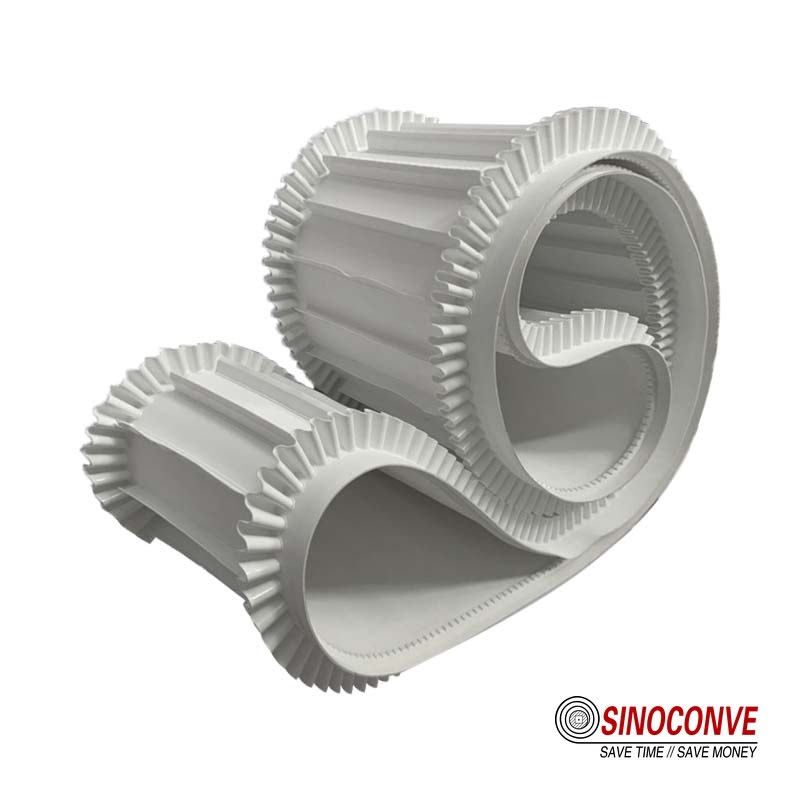
A light duty PVC belt at a diverter. Note the shallow troughing and the matte face, both of which keep parcels from tipping on the switch.
Where these lines actually destroy belts
Transfer plates, where a proud edge catches the belt underside. Diverter gaps, where a parcel wedges and the splice takes the whole torque. And nose bars, where the belt flexes a million times a year at a radius the compound was never designed for. Ask for the transfer plate gaps in millimetres and the nose bar diameter in millimetres, and put both on the enquiry. Suppliers who build for these lines will recognise the numbers instantly. The logistics and warehousing page covers the standard configurations, and if you are integrating OEM equipment, the notes on OEM PVC belting for logistics automation are worth reading before you release the drawing.

16Frequently Asked Questions From Buyers
Can I use a PVC belt for food contact, or do I need PU?
PVC is fine for most dry and cool food contact, and it is what a large share of bakery, dairy and dry-goods lines run on today. PU becomes the better answer when the product is fatty or oily, when the belt face has to resist scuffing from hard food items, or when cleaning involves solvents. Ask your supplier to confirm the compound against FDA expectations, or against Regulation (EU) No 10/2011 if you ship into Europe, and to state the contact conditions the declaration covers. If both materials pass on paper, run the cost per operating year comparison from section 12 and let that decide. Our PVC conveyor belt range lists the standard compounds and typical applications.
How do I know whether my line needs a light duty conveyor belt or a heavy rubber one?
Two numbers settle it. Belt tension per unit of width and the smallest pulley diameter on the run. If tension stays under roughly 50 kg/m of width and pulleys are above 60 mm, you are in light-duty territory and PVC or PU will do the job. Push past either figure and the discussion moves to a fabric or steel-carcass rubber belt. Cases in between are where the argument happens, and that is where a supplier should ask you for the drawing rather than guess.
What is the lowest temperature a PVC belt can handle?
Standard PVC is generally quoted to about −10 °C continuous. Cold-flex compounds with heavier plasticiser loading reach roughly −25 °C, and below that you are looking at PU or at a rubber grade instead. There is one caveat that catches people out: a cold-flex PVC is softer, so it may track less positively on a line that was set up for a standard compound.
Is a white belt always the food grade option?
No, and that assumption costs buyers money in both directions. Food suitability comes from the compound and its declarations, not from the colour. White is popular because residue shows up instantly, which makes cleaning verification easy. Blue is chosen in meat and fish rooms because fragments contrast against the product. Green suits wet produce lines. Any of them can be compliant, and any of them can be non-compliant if the pigment or plasticiser is wrong.
Do I have to specify the splice method on my purchase order?
Yes, and this is the cheapest discipline in the whole list. If you leave it out, the method gets chosen by whoever is available that day, and the joint is the failure point in the large majority of light-duty complaints we handle. Say "heat-fused overlap, joint efficiency stated in writing" or "toothed endless, joint thickness within 0.3 mm of belt thickness", and ask for the joint efficiency figure with the quotation. If a supplier cannot quote a number, they have not tested their own joints.
How much thickness variation is acceptable in a PVC belt?
On a 3.0 mm belt, a band of +0.2/−0.1 mm is a reasonable expectation and a band of ±0.5 mm is a warning sign, because a supplier quoting that width of band may ship the bottom of it on every metre. What matters as much as the band is the consistency across the width. A belt that measures 2.98 mm at both edges and 2.71 mm in the middle will track badly and wear one side of the guide rollers first.
Will a PU belt always outlast a PVC belt?
No. This is the claim we push back on most often. PU wins on abrasion and cut resistance in dry service, and loses badly in hot wet service if you specify a polyester grade, because hydrolysis takes the face apart from the inside. We have seen a polyester PU fail in eleven months on a wash-down line where the PVC belt it replaced had run for two years. Match the material to the environment first, then compare prices. Our comparison of rubber versus PVC belting for material handling sets out a similar trade-off between two other material families.
What documents should arrive with a food grade belt?
Five, ideally: a declaration of compliance naming the compound and the contact conditions, an MSDS for the finished belt, a migration test report where your customer requires one, a statement listing the cleaners and temperature range the compound was assessed for, and an allergen or animal-derived-material statement if those categories apply to you. Ask for them with the sample, not after delivery. Chasing documents while a line sits idle is an expensive way to learn this lesson.
How long can PVC belting sit in storage before fitting?
A few years is normally acceptable in good conditions. The conditions are what matter: above 15 °C, out of direct sun, standing on a core rather than stacked flat, and away from anything that off-gasses solvent. A roll kept cold through a winter and then unrolled in a warm plant will show edge cracking, and a joint made on a cold belt will fail early even if it looked perfect on the press.
What single detail causes the most light-duty belt failures?
The splice, by a wide margin, and it is almost always a specification gap rather than a manufacturing one. Someone fits a joint in a method nobody agreed, on a belt whose carcass nobody documented, at a temperature outside the stated window. What is the second most common cause? Thickness shipped at the bottom of an unspecified tolerance, which is why section 05 exists.
If you want the wider version of this material, our frequently asked questions page covers the technical queries we get most often, and the full product catalog shows the compounds, patterns and widths available as standard stock. For a broader view of where these belts fit across different industries, see PVC belting solutions by industry.
17Related Products You May Need
- PVC conveyor belt — our core light-duty line, 1.5 mm to 6 mm, matte and ribbed faces, straight or sealed edges.
- Rubber conveyor belt — for abrasive, hot or heavy duty.
- EP fabric conveyor belt — polyester and polyamide carcass grades for longer centres and higher tension than any light-duty PVC can carry.
- Heat resistant conveyor belt — compounds for carry-side temperatures where PVC and PU both stop working.
- Chevron conveyor belt — cleated and profiled surfaces.
- Timing belt — synchronous drive belting for indexing conveyors and packaging machinery, in standard and custom pitches.
- V-belt — industrial drive belts.
18Related Blog Posts
- PVC conveyor belt types and selection guide — start here if you are still choosing a construction.
- The 2026 PVC belt guide: types, surface patterns and how to choose — the full material and structure map behind this checklist.
- PVC conveyor belt selection: what buyers should know — written from the purchasing side of the table.
- Cleat PVC conveyor belt guide — cleat profiles, pitches and incline limits in detail.
- Food grade PVC conveyor belt buyer's check — the document pack, hygiene routine and compound questions, expanded.
- Efficient PVC belting solutions for material handling challenges — practical fixes for tracking, release and transfer problems.
- Fruit conveyor belt and PVC sidewall solution — a worked incline example with sidewalls.
- OEM PVC belting for logistics automation — for integrators specifying belts into sorting equipment.