
Packaging Machine Belts: Hygiene, Grip and Line-Design Requirements
Packaging machines rarely depend on one universal belt. A single line may use flat PVC or PU conveyor belts for product transfer, coated timing belts for indexed motion, endless belts for mark-free pull-down, side belts for case sealing, perforated vacuum belts for film or pouch control, and rough-top belts for an incline. The correct starting point is the station function, not a material label. We map every transfer, drive, contact surface, pulley and cleaning exposure before choosing packaging machine belts. That system view prevents a belt that works at the infeed from being copied into a sealing, labeling or accumulation station where its behavior is unsuitable.
In our engineering reviews, the costly errors are often small: a splice that strikes a 20 mm nosebar, a cover that grips well when dry but releases poorly after oil mist settles, or a belt width copied from an old drawing without allowing for new guides. This guide gives procurement and maintenance teams a station-by-station method. Buyers who need a starting product range can review our PVC conveyor belt options for packaging lines, then qualify the exact construction against the machine data.

01Map the Packaging Line Before Naming a Belt
A useful line map follows the product from its first controlled contact to the final accumulation table. Infeed receives a loose product, tray, pouch blank or carton. Metering separates it into a repeatable pitch. Indexing places that item beneath a filler, sealer, cutter or label applicator. Sealing adds heat and pressure. Pull-down belts draw film through a vertical form-fill-seal machine. Labeling and coding require stable presentation. Checkweighing measures a moving package, outfeed clears it, and accumulation absorbs downstream interruptions. These stations can sit within five meters of one another yet impose very different demands.
Define the Motion at Each Station
First decide whether the belt transmits torque through teeth or moves a package through friction. A timing belt controls angular position and pitch. A flat conveyor belt depends on contact, wrap and surface friction. Side belts squeeze a carton from two directions. A vacuum belt adds pressure differential to hold flexible media. An accumulation belt deliberately permits controlled slip beneath stopped packages. Calling all five items “conveyor belts” hides the engineering distinction that controls selection.
Record motion as continuous, intermittent, reversing or synchronized. Also note acceleration. A belt moving at 30 m/min continuously can be easier on a package than one reaching only 12 m/min but stopping 80 times per minute. Index repeatability, dwell time and permitted package skew belong in the same station record. If the package must arrive within plus or minus 1 mm, friction alone may not be the correct positioning method.
Separate Product Contact from Package Contact
A wrapped carton and an exposed bakery product do not create the same documentation path. Identify what actually touches the belt: unpackaged food, primary wrapping film, a sealed pouch, a tray base, corrugated board or a reusable tote. Direct contact raises questions about cover formulation, edge sealing, cleanability and traceability. Secondary packaging may prioritize abrasion, static behavior and print protection instead. Our food and packaging application overview helps frame those environments without replacing a line-specific risk review.
Do not infer contact status from the machine name. A “cartoner” may receive unwrapped bars for part of its travel. A “pouch line” may carry only sealed packs after the jaws. Walk the actual path or mark a current drawing. Product contact can begin and end within one machine enclosure.
| Station | Primary Job | Likely Belt Family | First Selection Question |
|---|---|---|---|
| Infeed | Receive and stabilize product flow | Flat PVC or PU belt | Is contact direct, wrapped or carton-only? |
| Metering | Create product spacing | High-grip flat belt or lugged timing belt | How much acceleration can the product accept? |
| Indexing | Hold a repeatable machine pitch | Timing belt with profiles or fixtures | What positional tolerance is allowed? |
| Sealing | Support material near heat and pressure | Temperature-qualified flat or endless belt | What are actual belt and ambient temperatures? |
| Pull-down | Advance forming film without damage | Endless vacuum or covered timing belt | Can the surface grip without marking film? |
| Labeling and coding | Present package at stable speed | Smooth stable flat belt | What speed variation can the sensor tolerate? |
| Checkweighing | Transfer with minimal disturbance | Light, stable endless belt | Will splice impact affect measurement? |
| Outfeed and accumulation | Clear, buffer or queue packages | Low-friction or roller-supported belt | Must the package slide while the belt runs? |
02Use a Belt-Family Matrix by Station
The matrix below is a shortlist, not a purchase specification. It prevents category errors early in a project. A flat thermoplastic belt is normally considered for general transport and easy-clean surfaces. A synchronous belt earns its place where pitch, registration or matched movement matters. An endless or seamless construction can reduce splice disturbance on a compact machine. A vacuum belt controls light film or sheets. Cleats, guides and profiles manage spacing or lateral control, while rough-top covers add grip on inclines.
SINOCONVE is a Ningbo, China manufacturing operation with product lines that include PVC and PU light-duty belts, timing belts, V-belts, and EP or NN fabric and steel-cord rubber belts. That range helps us recognize when a packaging station belongs to the light-duty portfolio and when an upstream bulk-handling conveyor needs a different construction. For heavy bulk duties, consult a qualified conveyor belt manufacturer and review the appropriate rubber conveyor belt construction. Packaging transfer should not inherit a quarry specification merely because both systems use rotating pulleys.
Flat PVC and PU Transfer Belts
Flat belts cover the widest range of packaging transfers. Surface options may be smooth, matte, fine-textured, diamond-patterned or rough-top. Fabric plies provide dimensional support; covers establish contact behavior and cleaning characteristics. The buyer should state color only after function. Blue can improve visual contrast in some food areas, but color does not prove suitability. A document review must cover the precise belt construction and intended contact condition.
For a wider treatment of surface patterns and constructions, use our PVC conveyor belt types selection guide. The current article remains focused on matching those options to packaging stations. The main PVC packaging belt product hub is the appropriate RFQ entry when width, length and machine details are available.
Timing, Endless and Side-Belt Functions
Timing belts transmit motion through tooth engagement, so they suit indexing, flighted transport and paired side drives where speed matching matters. Coatings may be added for contact behavior, but this system-level guide does not repeat the construction details owned by our coated timing belt article. Use that page after the station map shows that a synchronous drive is justified.
Endless belts can avoid a lap or finger splice passing around a small pulley, although “endless” must be defined carefully in an RFQ. It may mean a truly seamless sleeve, a fabricated endless splice or merely a belt supplied as a closed loop. Side belts commonly run as matched left and right units on carton sealers. Their cover, length tolerance and speed equality affect whether a box remains square beneath the tape head.
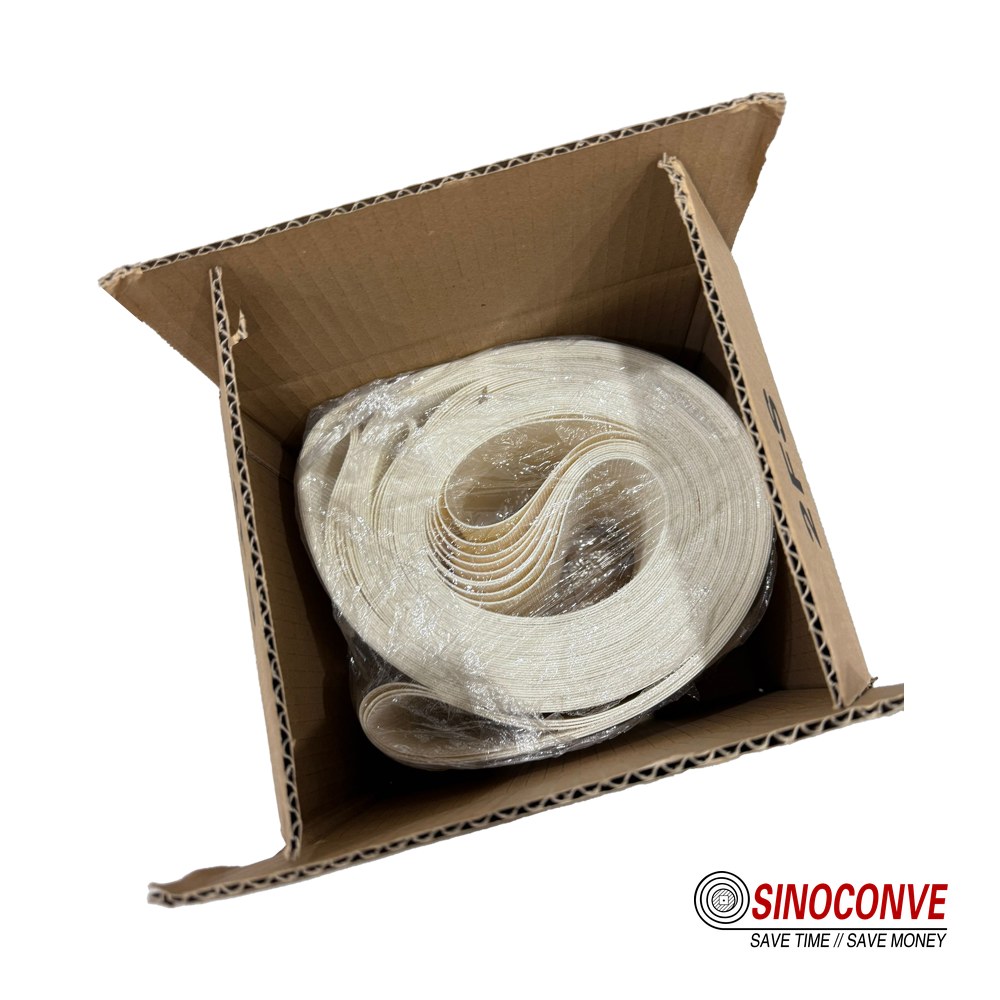
One packaging line can combine flat transfer, indexed timing and vacuum-assisted belt functions.
| Belt Family | Best-Fit Stations | Engineering Strength | Common Misapplication |
|---|---|---|---|
| Flat PVC or PU | Infeed, transfer, labeling, outfeed | Broad surface and fabric choices | Expected to index precisely through friction alone |
| Timing belt | Indexing, metering, paired drives | Positive tooth engagement and repeatable pitch | Selected only by top-surface grip while tooth geometry is ignored |
| Endless or seamless | Pull-down, checkweighing, compact transfer | Reduced splice disturbance | Ordered without defining how the loop is manufactured |
| Vacuum or perforated belt | Film, labels, pouches, light sheets | Positive hold-down without heavy pressure | Hole pattern conflicts with vacuum plenum or tracking guides |
| Rough-top or high-grip | Incline, acceleration, carton control | Higher traction at moderate pressure | Excess grip prevents release or damages print |
| Cleated, guided or profiled | Spacing, incline and lateral control | Mechanical product location | Profile pitch misses machine timing or transfer gap |
03Set the Hygiene Tier and Documentation Path
Hygiene is a design condition, not a color. We divide packaging applications into direct food contact, incidental or controlled contact, secondary packaging, and nonfood logistics. Then we separate dry wipe-down, low-pressure wet cleaning and repeated washdown. The same belt family may use different cover compounds, edges and splices across these tiers. Procurement should request documentation for the exact item quoted rather than a generic brochure for a broad product family.
Direct Food Contact
For direct contact, record food type, contact time, temperature, moisture, fat or oil level, and cleaning method. Bread dough, frozen vegetables and unpackaged confectionery challenge surfaces differently. An oily product can change friction during a shift. Fine flour can fill a texture and reduce its effective grip. A wet sanitation cycle may expose the belt edge and splice to chemistry that the top cover tolerates but the internal fabric does not.
Review the supplier declaration, material identification, batch traceability and any migration or food-contact documents required by the destination market and the buyer's own quality system. Our food-grade PVC buyer checks outline the evidence questions. We do not treat a visual inspection or a particular shade of blue as certification.
Secondary Packaging and Dry Areas
Secondary packaging usually shifts attention toward carton grip, printed-surface protection, static, dust and wear. Cleaning may involve a brush, vacuum or mild wipe rather than a foam-and-rinse cycle. That can permit a broader construction choice, but it does not remove hygiene obligations. A damaged carton, leaking primary pack or allergen spill can turn an apparently dry area into a cleaning problem.
Warehouses and parcel hubs add barcode scanning, label adhesion and repeated edge impacts. Our logistics and warehousing applications show the wider operating context. A specialized conveyor belt supplier may serve heavy upstream handling, while light package presentation still requires a thin, stable belt designed around small pulleys and sensors.
Field note from our engineers: On a washdown review, ask where rinse water actually travels after it leaves the top cover. We have seen specifications focus on the visible surface while water repeatedly entered an unsealed edge near a return roller. The useful correction was not “more food grade.” It was a compatible construction, sealed edges, a cleanable splice and drainage that kept standing liquid away from the belt.
04Engineer Grip and Release as a Pair
Grip is valuable only when it appears at the correct moment and releases at the next transfer. A high-friction surface can stop pouch slip during acceleration, then refuse to hand the pouch to a cross conveyor. Soft covers conform around irregular products and increase real contact area, but they can mark glossy cartons or retain crumbs. Harder covers usually release more cleanly and resist indentation, though they may need additional wrap or lower acceleration to prevent slip.
Cover Hardness, Texture and Contact Pressure
Shore hardness is one input, not a complete prediction of grip. Texture height, pattern spacing, package material, pressure, contamination and speed all influence the interface. Ask for the test method behind any friction figure because static and dynamic coefficient values vary with counterface and conditions. A coefficient measured against clean steel at room temperature does not directly predict a printed polyethylene pouch carrying oil at 6°C.
On side-grip belts, contact pressure is particularly important. Increasing squeeze can improve traction until cartons deform, labels scuff or bearings carry excessive radial load. Verify the narrowest and widest case, not just the nominal sample. If a cover is soft enough to compress several millimeters, its effective belt path and speed matching may change under load.
Crumbs, Oil, Powder and Tack
Contamination changes friction during production. Sugar dust can initially raise drag and later behave like rolling particles. Flour packs into a rough pattern. Oil may lower friction on one surface while swelling or softening an incompatible cover over time. Tack can help control film, yet a tacky belt may collect paper fibers and make cleaning intervals shorter. State the contaminant and expected concentration rather than writing “dirty environment.”
Release behavior matters at knife edges and dead plates. A sticky pack that follows the belt around a nosebar can cause a jam even when tracking is perfect. Test the most flexible and warmest package, because it may drape farther than a cool, rigid sample. When choosing between broad material families, use the dedicated PVC versus rubber conveyor belt guide; this article does not repeat that comparison.
| Observed Need | Candidate Feature | Risk to Check | Practical Trial |
|---|---|---|---|
| Pouch slips during acceleration | Soft high-grip cover or controlled vacuum | Marking and poor release | Run full and partly filled pouches through maximum ramp |
| Carton rotates between side belts | Matched covers and controlled compression | Unequal belt speed or length | Mark both loops and compare travel over 20 cycles |
| Product sticks at discharge | Lower-tack, harder or smoother cover | Insufficient incline traction | Observe warmest package over actual nosebar |
| Powder fills surface texture | Cleanable shallow profile | Reduced grip between cleaning cycles | Measure slip at start and end of a normal shift |
| Printed carton scuffs | Smooth nonmarking cover | Lower traction during start-stop motion | Inspect dark and glossy print after repeated passes |
05Check Small Pulleys, Nosebars and Short Centers
Packaging equipment often compresses several operations into a short frame. Small drive pulleys reduce envelope size, while nosebars close the transfer gap between belts. That geometry increases reverse flexing, splice stress and sensitivity to belt thickness. A construction that runs comfortably over a 100 mm pulley on a long conveyor may heat, crack or wander when forced around a 15 mm nosebar every few seconds.
Minimum Pulley Diameter Is Construction-Specific
Request the permitted minimum pulley diameter for the quoted belt, with the direction of flex stated. Back flexing over idlers can require a different limit from normal cover-out flexing. The number of plies, fabric type, cover thickness, splice and ambient temperature all matter. Do not take a diameter from a similar-looking catalog item and apply it to a thicker profile or cleated version.
Measure the pulley where the belt runs. Nominal shaft or bearing dimensions do not provide the belt diameter. If the pulley is crowned, record center and edge diameters. Also note whether the belt wraps 60°, 120° or 180°. More wrap can raise traction but increases flex cycles and contact heating.
Splice Geometry Can Decide the Result
A finger splice distributes bending more gradually than a bulky overlap in many light-duty constructions. Yet finger length, pitch, adhesive or welding process and edge finish must suit the belt. A splice that is mechanically strong can still be unacceptable if its thickness creates vibration at a checkweigher or catches a scraper. Specify whether the splice passes a nosebar, vacuum plenum, vision station or product transfer.
Short centers reduce the belt's opportunity to settle between pulleys. Small length errors then consume a larger share of the tensioning range. Record center distance with the take-up at a defined position. Where matched pairs are used, give a tolerance expectation and install both belts from the same approved set when practical.
Field note from our engineers: When a compact checkweigher shows a repeating weight disturbance, mark the belt splice and compare the error timing with one full revolution. If the disturbance follows the mark, inspect splice thickness and pulley transition before adjusting the load cell. That five-minute observation can separate a belt-impact problem from an instrumentation problem.
06Choose Timing Accuracy or Friction Conveying Deliberately
Friction conveying is appropriate when a package needs movement rather than exact phase relationship. It tolerates some controlled slip and usually simplifies the conveyor frame. Timing belts are appropriate when teeth must establish a repeatable relationship between the drive pulley and belt. Flights, pockets or fixtures can then locate a product relative to cutters, fillers or robots. The choice should follow allowed positional error, not an assumption that synchronous motion is always better.
When Friction Is Enough
An outfeed carrying sealed cartons to accumulation may need stable tracking and adequate traction but not submillimeter registration. A flat belt can be economical and easier to clean. The control system may use a sensor to trigger labeling or reject action, making minor belt slip irrelevant. Give the engineer the acceptable package spacing variation and speed range, because these values define “enough.”
Friction transport also offers a degree of overload relief. If a package jams, it may slide rather than forcing every load into teeth or profiles. That is not an excuse to ignore guarding and torque limits. It simply changes the failure path. Product damage, heat and cover wear remain possible.
When Positive Drive Is Necessary
Positive drive becomes useful when the belt itself establishes machine pitch, when two lanes must stay phased, or when attached profiles carry packages into a processing station. Tooth profile, pitch, width, tensile member and pulley geometry then belong on the drawing. The timing belt product range is the correct starting category; final details should follow the machine pulley and load.
A buyer working with a transmission belt manufacturer may also encounter V-belts in auxiliary drives. They transmit power through wedge friction and should not be confused with toothed indexing belts. Likewise, a V-belt manufacturer needs pulley groove and drive power data, while a packaging conveyor inquiry starts with belt path, product contact and station behavior.
07Specify Vacuum, Static Control and Fabrication
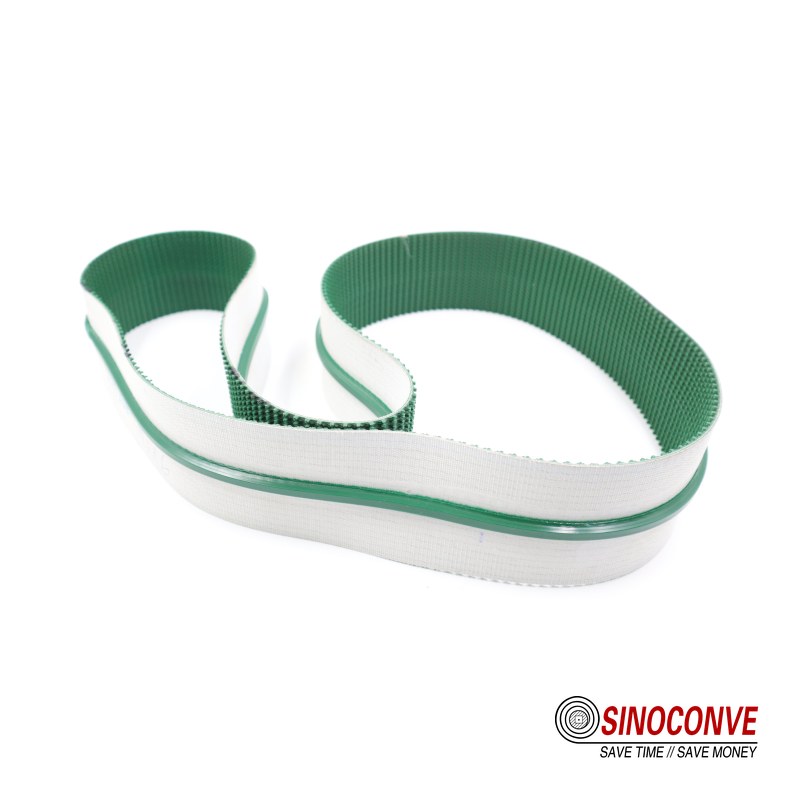
Packaging belts often perform more than horizontal transport. Perforations connect a product to a vacuum plenum. Longitudinal guides resist lateral movement. Cleats create spacing. Sidewalls retain loose pieces. Machined pockets locate components. Conductive features may help control static where lightweight film or labels attract dust. Each fabrication alters flexibility, balance, cleanability or the available splice area, so it must appear on a dimensioned drawing.
Vacuum Hole Pattern and Plenum Alignment
State hole diameter, pitch, rows, edge distance and datum. A hole pattern copied from the old belt without referencing the machine centerline can shift relative to the plenum after trimming. Effective open area matters, but more holes are not automatically better. Excess perforation can reduce strength, increase leakage and give debris more places to lodge.
Provide pump or blower information, expected vacuum level if known, product porosity and the area that must remain held. A porous carton blank behaves differently from plastic film. Check whether the product can cover enough holes to build pressure differential. Also verify that the return path does not expose open holes to liquid or loose waste.
Guides, Cleats, Sidewalls and Profile Datum
A guide should run in a matching groove with clearance. If it is expected to force a poorly aligned conveyor back into position, heat and wear will follow. Specify guide width, height, location from a stable edge, material and splice treatment. State whether it runs on the pulley face or only through slider beds and return guides.
Cleat pitch must be measured from a declared datum, such as leading face to leading face. Include cleat angle, thickness, height and edge offsets. For timing belts, relate the profile to a tooth center. For flat belts, relate it to the finished endless length and splice. Sidewalls need clearance at transfers and cleaning access at their corrugations. Fabric direction matters too: longitudinal stability and transverse troughability depend on construction, while a machine may demand stiffness across the belt to prevent cupping.
Static behavior deserves a risk-based review around film, powder, electronics and solvent vapor. Ask for the relevant electrical property and test method; do not use the vague phrase “antistatic” as the entire requirement. For other industries, standards such as ISO 284 commonly address electrical conductivity expectations, but the applicable packaging-machine requirement must come from the machine risk assessment and local rules.
08Qualify Temperature and Cleaning Exposure
Temperature at the belt can differ sharply from room temperature. A heat-seal jaw cycles near the conveyor, hot packs leave a shrink tunnel, frozen products create condensation, and steam cleaning briefly raises surface temperature. Record normal operating temperature, short-duration peak, exposure time and whether the belt is moving or stopped. A stationary belt beside a heat source can develop a local hot spot that an ambient thermometer misses.
Measure Where the Belt Actually Runs
Take temperature near the cover, splice and return path under representative production. Infrared readings are useful for comparison but depend on emissivity and viewing angle; a contact probe or other validated method may be needed. If the package enters at 85°C and cools during transfer, state both entry temperature and residence time. Avoid reducing that profile to “warm product.”
Thermal cycling can matter as much as peak temperature. Repeated heating and cooling changes cover modulus and can work the splice. Low temperature can stiffen a belt around a small pulley. Where a truly high-temperature bulk conveyor is involved, the requirement belongs in a separate heat-resistant belt review, not in a light packaging-belt assumption.
Name the Chemical, Concentration and Routine
“Washdown” is incomplete. List detergent, sanitizer, concentration, water temperature, contact time, rinse step and cycles per day. Include accidental exposures to oil, flavoring, sugar syrup or ink solvent. Compatibility should cover the top, underside, splice, edge seal, guides and profiles. A top cover may remain sound while an adhesive line softens.
Cleaning design includes access. Deep rough-top patterns can provide grip yet shelter residue. Very soft surfaces may be harder to scrape without damage. A smooth belt can clean quickly but may require different incline geometry. The PU belt hygiene guide discusses hygienic handling considerations in more depth. Always reconcile the belt choice with the site's sanitation procedure.
| Exposure Item | Data to Put in RFQ | Why It Changes Selection |
|---|---|---|
| Product temperature | Normal, peak, duration and belt speed | Affects cover modulus, release and splice life |
| Ambient and cold-room cycle | Minimum, maximum, condensation and warm-up | Changes flexibility, tension and tracking |
| Detergent | Trade name or chemistry, concentration and pH | Cover and splice compatibility depend on dose |
| Sanitizer | Active chemical, contact time and rinse status | Repeated exposure may differ from brief splash |
| Mechanical cleaning | Brush, scraper, pressure and frequency | Texture and soft cover can wear or trap residue |
09Work Through Three Station-Level Examples
Examples are most useful when they show the questions, not when they pretend to produce a universal part number. The following cases demonstrate how the line map narrows the belt family. Final construction still depends on machine drawings, samples and operating data.
Example A: Vertical Pouch Line
A snack pouch line receives sealed bags from vertical form-fill-seal equipment. Inside the bagger, paired pull-down belts grip forming film and advance it by a controlled length. Downstream, a short flat belt accepts the warm pouch, a metering conveyor spaces it, and an incline feeds a case packer. These are three jobs.
The pull-down station may require synchronous paired belts, a compliant contact surface and vacuum perforation depending on the machine. The inquiry needs tooth profile, exact endless length, width, hole pattern, centerline and pulley drawing. The downstream transfer values gentle release and small-pulley flexibility. The incline may need a shallow high-grip texture, but trials should include oily seasoning dust because clean-room friction will overstate real performance. Cleats are considered only if friction and incline geometry cannot hold the lightest and fullest pouches consistently.
Example B: Random Carton Sealer
A random carton sealer handles varying case widths and heights. Two vertical side belts capture the case and carry it beneath tape heads. The critical package is often not the heaviest; it may be the narrow, lightly filled carton that deforms under squeeze. Belt pairs need compatible surface finish, thickness and effective length so they do not yaw the case.
We would record the width range, case board grade, printed or coated surface, speed, adjustment mechanism and smallest drive pulley. We would inspect how the backing rollers load the belts. A soft cover can improve grip at lower pressure, yet excessive compliance may cause heat or tracking sensitivity. The acceptance trial should include square arrival beneath both tape heads and visible scuff inspection, not merely confirmation that the box moved.
Example C: Parcel Label and Verification Station
A parcel conveyor passes a scale, label applicator, camera and reject device. Here stable speed and a flat presentation surface support label placement and barcode reading. A thick splice or pulsing tension can disturb a lightweight parcel. At accumulation, however, too much grip increases carton-bottom wear while stopped parcels queue.
We might divide the machine into a stable, low-mass checkweigh belt followed by a smooth transfer and a lower-friction accumulation section. Sensors must see the full package range, and static behavior deserves review for plastic mailers. For broader system context, refer to our warehouse conveyor belt guide. It explains parcel movement, while this guide identifies belt duties inside the packaging and labeling stations.
10Control Tracking Without Hiding Machine Errors
A belt tracks in response to pulley alignment, frame geometry, load distribution, tension, belt construction and contamination. A guide can resist lateral drift, but it should not be asked to overcome a skewed pulley continuously. Heat and guide wear are evidence of lateral force. Before changing belt type, verify that shafts are square, rollers rotate freely and the slider bed has not shifted.
Establish a Mechanical Baseline
Lock out the machine under the site's procedure. Measure pulley parallelism from a common datum rather than from guarding that may be bent. Check that the take-up moves evenly on both sides. Look for adhesive, film tails or product buildup around pulley faces. On short conveyors, a movement of less than 1 mm at an adjustment screw can be significant; make small corrections and record them.
Run the belt empty at low speed, then under representative centered load. If it tracks empty but moves under load, inspect product entry and support. If it shifts at one point in every revolution, examine splice squareness or local belt damage. Do not keep adding tension. Excess tension loads bearings, reduces flex life and can distort a light frame.
Use Guides and Crowns for Their Intended Roles
Crowned pulleys can assist tracking on suitable flat-belt layouts, but crown geometry must match belt width and construction. Longitudinal V-guides help retain position where side loads or compact geometry justify them. They require correctly aligned pulley and bed grooves. A guide rubbing hard on one side is a symptom, not successful tracking.
When purchasing from a conveyor belt factory, send a machine sketch showing the guide relative to the finished edge and splice. If sourcing through a conveyor belt distributor, keep that same revision-controlled drawing in the order record. Descriptions such as “guide in the middle” are not sufficient when the vacuum plenum and pulley groove must share a centerline.
11Build an RFQ That a Manufacturer Can Engineer
A good RFQ lets the supplier identify conflicts before manufacturing. Start with machine function and product, then add dimensions and operating conditions. An old belt is useful as a sample only if it still represents the intended design. Worn width, stretched length and polished texture should not silently become the new specification.
Dimensions and Machine Geometry
Give endless length, width and thickness with units and tolerances where they matter. State whether length is measured under a defined tension. Include drive and tail pulley diameters, nosebar diameter, center distance, take-up travel, wrap direction and reverse bends. For timing belts, add tooth profile, pitch, pulley tooth count and any tooth removal. For matched side belts, identify the pair and operating spacing.
Fabrication needs a drawing. Dimension perforations, guides, cleats, sidewalls, grooves, slots and profiles from stable datums. Show direction of travel and cover side. If the belt must be installed over a closed frame, say whether an on-site splice is possible. Access constraints can rule out an endless loop even when it performs well.
Load, Speed and Duty Cycle
State product weight per item, items on the belt, maximum distributed load and any concentrated impact. Include belt speed in m/min, acceleration, starts per minute, operating hours per day and reversing duty. A 5 kg carton moving steadily is not equivalent to the same carton accelerated sharply on a one-meter metering belt.
Describe tensioning method and available take-up. If motor power and drive arrangement are known, include them. Do not use motor nameplate power as a substitute for belt pull; it is context for review. For an industrial conveyor belt carrying aggregate, ratings such as EP class and cover grade dominate. On packaging equipment, low mass, flexing and fabrication accuracy are usually more relevant.
Samples, Drawings and Acceptance Criteria
Send representative products and an unworn belt sample if available. Protect food samples and follow customs or shipping restrictions. Photographs should show the full belt path, pulley arrangement, splice, tracking guides and contamination, with a scale in close views. Remove confidential labels if needed, but do not crop away the transfer geometry.
Define acceptance in observable terms: package does not slip during maximum ramp; label skew remains within the machine requirement; splice passes the scale without a repeatable signal; edges remain within guide clearance; surface releases the warm pouch. Avoid “works well.” A buyer asking for wholesale conveyor belts should still separate each station construction and revision rather than aggregate unlike belts under one vague description.
| RFQ Field | Minimum Useful Detail | Typical Error Prevented |
|---|---|---|
| Station and product | Function, contact status, package material and dimensions | One belt copied across incompatible stations |
| Finished dimensions | Endless length, width, thickness, units and tolerance | No take-up range or frame interference |
| Pulley data | Diameters, wrap, crown, tooth profile and reverse bends | Premature flex cracking or tooth mismatch |
| Motion | Speed, acceleration, cycle rate, indexing tolerance | Slip, unstable spacing or unnecessary synchronous cost |
| Environment | Temperatures, moisture, oil, powder and cleaning chemicals | Cover swelling, hardening or splice attack |
| Fabrication drawing | Datums, travel direction, holes, guides, cleats and profiles | Reversed or offset custom work |
| Required records | Declaration, batch identity, inspection and traceability needs | Documents that do not match supplied construction |
12Inspect Incoming Packaging Machine Belts
Incoming inspection should happen before the maintenance window. Compare the belt with the approved order, drawing and document package while there is time to resolve questions. Keep it clean, supported and protected from sharp bends. A correct belt stored poorly can reach installation with edge damage or a permanent set.
Verify Identity and Dimensions
Confirm purchase order, item code, revision, quantity and paired-set identification. Measure width and thickness using appropriate tools without crushing a soft cover. Check endless length by the agreed method and tension. For timing belts, verify pitch and tooth form against the pulley or approved drawing rather than judging the teeth by eye.
Inspect color and texture for consistency, then look closely at edges, splice and fabricated features. Hole patterns should match row count, diameter and datums. Guides should be straight, secure and located correctly. Measure several cleat pitches across the loop; one correct interval does not prove the complete pattern. Record findings with photographs and calibrated-tool IDs according to the buyer's quality procedure.
Conduct a Controlled Installation Trial
Install under the machine maker's and site's safety instructions. Ensure the frame, pulleys and bed are clean. Set tension through the specified take-up or elongation method; guessing by hand feel is unreliable, especially with short belts. Rotate manually where permitted, check clearances, then jog at low speed. Watch the splice and any guide as they pass every pulley.
Increase speed in steps and add product progressively. Observe tracking, package orientation, grip, release, noise, heat and sensor behavior. Run long enough to include normal contamination and temperature, not just five clean packages. Record the initial settings so maintenance can restore a known baseline later.
13Troubleshoot by Symptom and Station
A symptom table helps the maintenance team avoid random belt changes. Start by asking what changed: product, sanitation chemical, speed recipe, guide setting, pulley, splice or room temperature. Keep one variable at a time. If several adjustments are made together, the line may restart but the root cause remains unknown.
Slip, Skew and Poor Release
Slip under acceleration can result from insufficient wrap, low contact pressure, contamination, hard glazing or a cover mismatch. Measure drive pulley speed and package movement before ordering a “grippier” surface. Skew often points to uneven entry, unequal side-belt speed or nonparallel pulleys. Poor release may need lower tack, a smaller transfer gap, an air assist or changed discharge geometry rather than greater tension.
If traction deteriorates late in the shift, compare clean and contaminated surfaces. Document how many hours pass before the change. A cleaning interval that restores performance indicates a different problem from permanent cover wear. Repeated cleaning that no longer restores grip suggests polishing, chemical change or altered texture.
Edge Fray, Guide Wear and Splice Impact
Edge fray usually means lateral contact, frame interference or damaged support. Find the rub mark. Do not trim the edge repeatedly without correcting alignment. Guide wear on one face identifies the direction of force. Check whether a product impact pushes the belt sideways only under load.
A splice impact produces a repeatable event once per belt revolution. Correlate noise, vibration, checkweigher disturbance or label error with a visible splice mark. Measure thickness across the splice and adjacent belt. If the joint is sound but too stiff for the nosebar, a different splice geometry or construction may be necessary.
Cracking, Swelling and Surface Marks
Cracks across the belt can signal pulley diameter below the construction limit, cold stiffening, chemical attack or fatigue. Swelling and tack change point toward chemical or oil compatibility. Compare exposed and protected areas, then preserve a sample. Product marks require inspection of pressure, surface texture, trapped debris and temperature. A cover replacement alone will not help if the side-belt actuator applies excessive squeeze.
Field note from our engineers: Write the belt revolution time on the maintenance sheet after commissioning. When a defect later repeats every 7.4 seconds, that single reference helps the team decide whether to inspect the belt loop, a pulley revolution or a product-cycle event. Pattern timing is often more useful than a long list of replacement parts.
| Symptom | First Checks | Do Not Assume |
|---|---|---|
| Package slips | Contamination, acceleration, wrap and pressure | The softest cover is automatically best |
| Belt wanders | Pulley square, frame, load entry and take-up equality | A guide should carry constant side force |
| Splice clicks at transfer | Joint thickness, stiffness and nosebar diameter | More tension will flatten the event safely |
| Surface becomes tacky | Cleaner dose, oil, heat and dwell time | The same material name means identical chemistry |
| Label position varies | Speed stability, package slip, sensor trigger and bed flatness | The applicator alone causes every error |
14Manage Supply, Drawings and Lifecycle Cost
Price per belt is visible; production risk is harder to see. A slightly cheaper replacement that needs two installation attempts, marks saleable cartons or interrupts a labeler can cost more than its purchase saving. Compare total lifecycle factors: expected operating hours under the stated duty, cleaning time, installation labor, planned spare stock, drawing control and consequences of a line stop. Do not invent a service-life promise without operating evidence.
Approve a Construction, Not a Color Description
Maintain an internal specification for each station. It should identify dimensions, construction or approved supplier item, cover surface, underside, splice, edge treatment and fabrication drawing revision. “Blue food belt” is not controlled enough. Two blue belts can differ in thickness, fabric, hardness, minimum pulley diameter and chemical response.
For repeat purchases, provide the approved revision and request written review before substitution. A substitute may be acceptable, but it should be evaluated against function. Keep the outgoing belt long enough to compare wear and failure mode. Purchasing teams evaluating the product catalog can group demand commercially while retaining station-level technical identities.
Plan Spares Around Criticality
A unique fabricated vacuum belt with a complex hole pattern presents different supply risk from a common straight flat belt. Set spare quantity according to lead time, line criticality, storage life considerations and interchangeability. Keep long belts on suitable supports; avoid tight folds, direct sunlight, heat sources and contamination. Rotate stock through a documented first-in approach where appropriate.
For regional resale, a conveyor belt distributor should preserve machine references and drawings rather than reducing every inquiry to width and length. Our own factory capabilities include forming, vulcanizing, inspection and joining services across relevant belt lines. Commercial timing, minimum quantities and warranty terms must be confirmed against the actual drawing and operating condition.
15Use a Final Selection Gate Before Ordering
Before approval, return to the line map. Confirm that every station has a declared function and that the chosen belt family supports that function. Then verify mechanical fit, product contact, hygiene tier, grip and release, environment, fabrication, documentation and acceptance test. This final gate is short enough to use but specific enough to stop many preventable mismatches.
Technical Gate
Can the belt bend around every pulley and reverse bend? Does the splice clear the nosebar and sensors? Are tracking features aligned to actual grooves? Does the cover control the lightest and heaviest product without marking? Will the package release at the transfer? For an indexed station, are tooth profile, pulley and profile pitch linked on one drawing? For vacuum transport, do holes align with the plenum over the entire take-up range?
Quality and Commercial Gate
Do the submitted records identify the exact quoted construction? Are drawing revision, tolerances, travel direction and finished endless dimensions clear? Is the incoming inspection method agreed? Are spare quantities and packaging suitable for storage? Has the supplier stated which details remain subject to sample, drawing or application confirmation?
As an experienced manufacturer, we prefer receiving the difficult facts early: greasy powder, a 16 mm nosebar, 70 starts per minute, a narrow take-up window or a carton finish that scuffs easily. Those facts allow an honest selection. They are more valuable than a broad request for the “best” packaging machine belt.

16Frequently Asked Questions
What belt is best for a packaging machine?
There is no single best family. Choose by station: flat PVC or PU for many transfers, a timing belt for registered indexing, an endless belt for low-disturbance compact motion, a vacuum belt for light film, or high-grip construction for inclines and side drives. Machine geometry and cleaning exposure then narrow the construction.
Can one belt specification serve the whole packaging line?
Usually not. An infeed, sealer, checkweigher and accumulation zone perform different work. Standardize only where dimensions, motion, contact, temperature and surface behavior genuinely match.
How do I specify a belt for a small nosebar?
Provide the actual nosebar diameter, wrap angle, belt direction, reverse bends, speed and splice path. Ask the supplier to confirm the minimum pulley diameter for the exact construction and splice. A thin appearance alone does not establish flex suitability.
Does a rougher surface always stop package slip?
No. Texture can improve traction, but wrap, pressure, acceleration and contamination may be the controlling variables. A very rough or tacky cover can also hold the package at discharge, collect debris or mark printed material.
When should I use a timing belt instead of a flat belt?
Use positive tooth engagement when machine phase, profile pitch or repeated index position matters. Use friction conveying when the task is simply to move or accumulate packages and modest slip is acceptable. Sensors and control logic may reduce the need for mechanical registration at some stations.
What information is needed for a vacuum belt?
Send endless dimensions, belt construction requirements, pulley sizes, hole diameter, row count, pitch, edge offsets, centerline datum, plenum drawing and travel direction. Add product size, porosity, speed and expected vacuum conditions. A marked-up old belt is helpful, but a controlled drawing is safer.
Is a blue belt automatically approved for direct food contact?
No. Color is a visual property. Review documentation for the exact construction, intended contact, destination market and buyer requirements, then verify edge and splice details as part of the hygienic design.
Why do paired carton-sealer belts turn boxes sideways?
The pair may differ in effective speed, length, cover wear, pressure or tracking. Start by marking both belts, checking pulley diameters and observing travel over multiple cycles. Also inspect whether one side contacts the carton earlier.
How should cleaning chemicals be stated in an RFQ?
Name the detergent and sanitizer chemistry, concentration, pH where available, water temperature, contact time, rinse method and cycles per day. Include product oils and accidental exposures. “Chemical resistant” is too broad to evaluate responsibly.
What should incoming inspection cover?
Confirm item and drawing revision first. Measure finished length, width and thickness by the agreed methods; verify surface, underside, splice, edges, guides, cleats and perforations; then check required records. Conduct the machine trial gradually and retain results as a baseline.
17Related Products You May Need
- PVC Conveyor Belts for transfers, labeling, infeed and outfeed stations.
- Timing Belts for indexed motion and synchronized packaging-machine drives.
- V-Belts for suitable auxiliary power-transmission duties.
- Rubber Conveyor Belts for separate heavy-duty upstream handling requirements.
18Related Blog Posts
- Packaging Machine Belt: Coated Timing Belt for the synchronous coated-belt topic.
- PVC Conveyor Belt Types and Selection Guide for construction and surface options.
- Food-Grade PVC Conveyor Belt Buyer Checks for purchasing evidence.
- PU Conveyor Belts for Hygienic Food Lines for sanitation-focused applications.
- Warehouse Conveyor Belt Guide for parcel sorting and logistics context.