
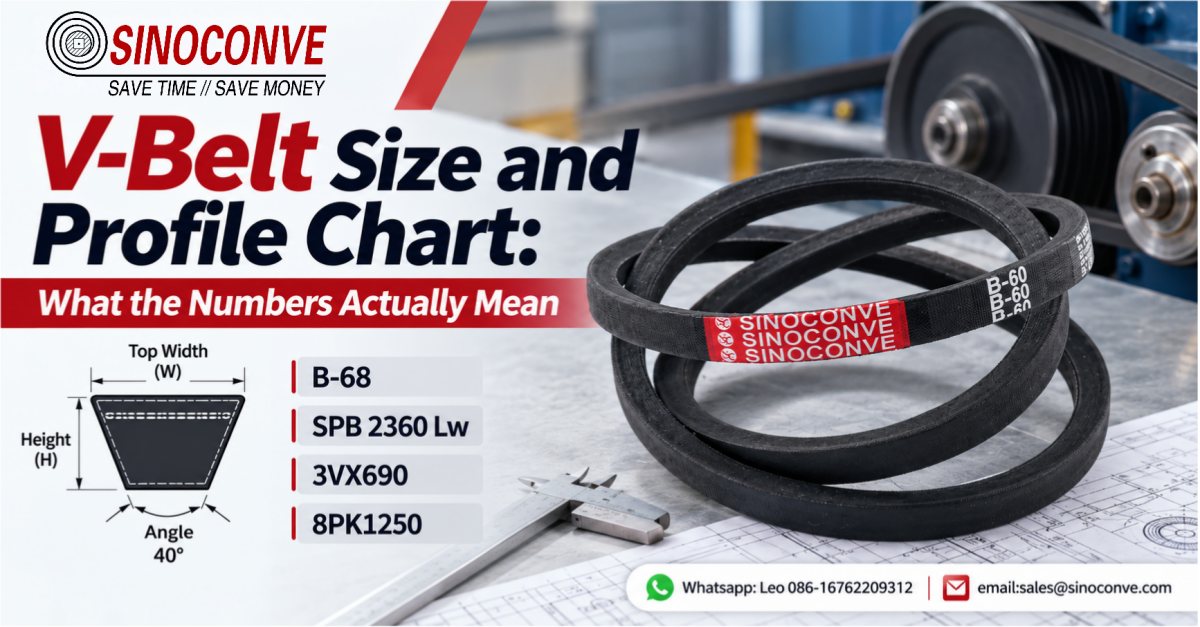
V-Belt Size and Profile Chart: What the Numbers Actually Mean
The belt comes out of the crate with the printing gone. Someone wiped the sidewall with solvent, or a year in a 45 °C pump room did the job for them. What is left is a rubber loop, a top width that measures 13 mm on the caliper, and a maintenance planner who wants a replacement before the weekend. This page is written for that afternoon. It is not a selection guide and it is not an argument about cogged belts versus wrapped belts. It is a decoder: how to read a V-belt code, how to measure a belt that has no code left, how to move between the four numbering systems that end up in the same storeroom, and how to write the order so the wrong belt does not arrive.
We build drive and conveyor belts in Ningbo, so we see the paperwork that follows a wrong number. A banded V-belt ordered as "SPB 2360" when the drawing meant 2360 mm inside length arrives about 38 mm short at the datum line, and the motor slide runs out of adjustment before the drive ever reaches tension. The belt is not defective. The number was read on the wrong basis. That single confusion accounts for more replacement errors in our inbox than every other mistake combined, which is why the three length definitions get their own section below.

01Reading a V-Belt Code Without Guesswork
A V-belt number is not a random string. Every industrial designation is built the same way: a section token, a length token, sometimes a construction letter, and sometimes a rib count. The difficulty is that each system puts those pieces in a different order and measures the length along a different line. Once you know which slot holds what, most labels stop being cryptic.
The Four Positions in Every V-Belt Number
Position one is the cross-section family. Position two is the nominal length and, if the writer was disciplined, the length basis. Position three, when it exists, describes the construction: wrapped, raw edge, cogged, or a set of joined belts. Position four is the rib or strand count, which a single V-belt does not have. Ribbed and banded belts both do, and that is where buyers get burned: "8PK1250" and a set of eight SPB belts look nothing alike and both carry a meaningful 8.
SPB 2360 Lw: Section, Datum Length, and Why the Suffix Matters
Take the most common European narrow code we receive: SPB 2360 Lw. SPB is the section. The B in SPB does not mean the same thing as the B in a classical belt; it is simply the third size in the narrow wedge family, and it sits between SPA and SPC. The number 2360 is the nominal length in millimetres. The letters Lw declare the basis: from the German for effective length, that is the circumference measured along the datum line, the imaginary line inside the belt where the tensile cords sit and where the belt neither stretches nor compresses as it bends.
Drop those two letters and the code becomes ambiguous in a way that costs money. "SPB 2360" alone might be quoted by one supplier at 2360 Lw and by another at 2360 Li. The two belts differ by roughly 60 mm on that section, which is more than a typical motor slide can absorb. If your drawing says Lw, write Lw on the purchase order. It takes four keystrokes and prevents a return shipment.
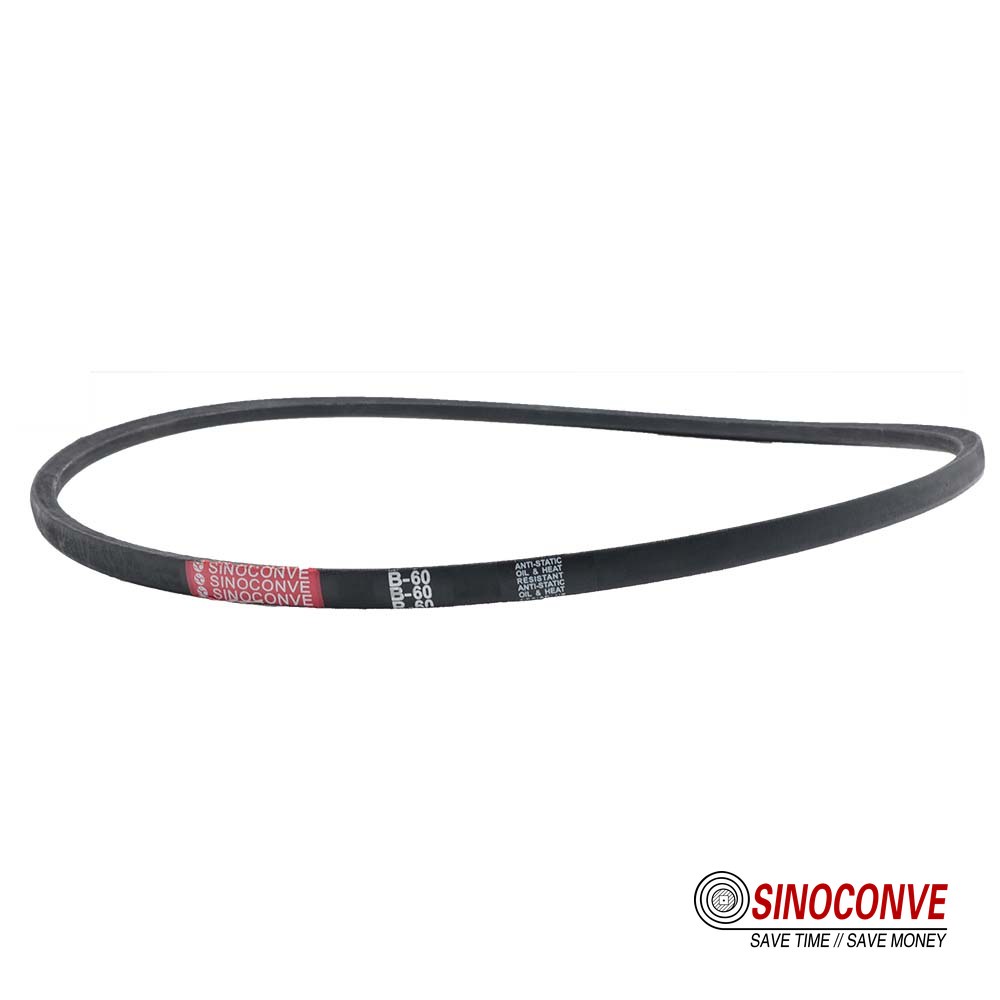
B-68: Classical Section in an Inch Code
Now a North American style string: B-68. B is the classical section, 21/32 inch top width by 13/32 inch height in inch series, or 17 mm by 11 mm in the ISO/DIN metric version of the same letter. The 68 is a length code, and here is the part that shocks people the first time: on classical belts, that number is almost always the inside circumference in inches. B-68 means 68 inches of inner circumference, which is 1727 mm of Li. The datum length of that belt is roughly 40 mm longer, near 1767 mm Lw. The outside length is longer again.
So the same physical belt can honestly carry a label that reads 1727, one that reads 1767, and one that reads 1796. All three are correct. Each one measures a different line on the same piece of rubber. A transmission belt manufacturer who quotes without naming the basis is not being careless on purpose; the habit is inherited from whichever standard the catalogue was first written against.
3VX690: Narrow Section, Cogged Edge, Tenths of an Inch
Third pattern: 3VX690. Here 3V is the narrow US section, the X says the belt is molded-notch, that is cogged, and 690 is not 690 of anything small. On US narrow belts the number is the outside circumference in tenths of an inch, so 690 means 69.0 inches of outside length, about 1753 mm of La. Read it as a decimal point that the printer forgot to include, and the string stops looking arbitrary.
8PK1250: Rib Count Plus Millimetres
Fourth pattern: 8PK1250. This is a ribbed belt. The 8 is the number of ribs running parallel along the underside, PK names the rib pitch family, and 1250 is the effective length in millimetres. There is no "Li" for a PK belt in normal trade; the trade runs on effective length. Order a PK belt by inside length and you are ordering a belt that is short by roughly 2π times the rib height, which on a PK section lands near 6 to 8 mm, small enough to tension by hand and large enough to sound like a bearing problem two weeks later.
| Code as printed | Section token | Length token and unit | Construction token | What the number actually measures |
|---|---|---|---|---|
| SPB 2360 Lw | Narrow wedge, 16 mm x 13 mm | 2360 mm, declared datum | Wrapped unless an X appears | Circumference at the cord line |
| B-68 | Classical, 17 mm x 11 mm | 68 in, inside length | Wrapped | Inner circumference, no tension |
| 3VX690 | Narrow US, 9.5 mm x 8.3 mm | 69.0 in, outside length | X = molded notch | Outer circumference |
| 8PK1250 | Ribbed PK, 8 ribs | 1250 mm, effective | Ribbed, not notched | Effective circumference |
| SPA 1180 Li | Narrow wedge, 13 mm x 10 mm | 1180 mm, declared inside | Wrapped | Inner circumference. Note the section |
| A 68 / 10 x 1700 | Classical, 13 mm x 8 mm | Two conventions, one line | Wrapped or notched | First is Li in inches, second is Li in mm |
Six code patterns that arrive in the same e-mail, decoded position by position.
Two things about the table deserve a second look. The classical row "A 68" and the metric row "10 x 1700" can describe the same belt, because 10 mm is the width code the metric world uses for the section the inch world calls A. And the last column is the only one that matters when you compare a quote against a drawing, because it tells you which line on the belt the supplier is going to measure.
02Lw, Li, and Ld: Three Length Systems, One Belt
Cut a V-belt and lay it flat and you have one length. Keep it as a loop and you already have three, because the top face travels a longer circle than the bottom face. The industry never settled on one of them; each standard picked a favourite, which is why a storeroom can hold three belts that are all "2360" and none of them will fit the same drive.
Inside Length Li: The Tightest Number
Li is the inner circumference, measured around the base of the belt with no tension on it. Think of it as the length of a string pulled snug around the inside of the loop. It is the shortest of the three numbers and the easiest to measure badly, because the base of a wrapped belt is covered in fabric and the caliper or tape likes to ride up onto the sidewall. Li is the number classical belts are quoted on, which is why moving a spares list from a classical section to a narrow wedge one usually costs a buyer 40 to 60 mm on the first order.
Datum Length Lw and Effective Length Ld
Lw is the effective or datum length: the circumference of the imaginary line inside the belt where the tensile cords sit. That line is the neutral axis of the bend. Above it the rubber is in tension, below it the rubber is in compression, and at that line the belt keeps its length whether it is straight or bent over a 100 mm pulley. Ld is the same idea under a different name. German-language catalogues and several large European makers print Lw; other catalogues print Ld for the identical line, and a few print Lp on ribbed belts. Treat Lw, Ld and Lp as synonyms unless the catalogue's own definition table says otherwise, and never assume the letters travel with the standard.
This is the number that matters for drive fit: centre distances and pulley pitch diameters are calculated on the datum line, and a modern narrow-profile drive asking for a 2360 belt means 2360 Lw.
Outside Length La: Useful on the Bench, Dangerous on a Drawing
La is the outer circumference, measured around the top face. It is the only one of the three you can measure quickly with a rope or a tape on a mounted drive, which is why mechanics reach for it and why purchase orders should not. La is the longest number, and it carries a second problem: it grows when you bend the belt, because bending stretches the outer face. Tape a belt into a tight loop and your La reading can be 10 to 15 mm longer than the same belt laid out in a relaxed circle.
Why One Belt Reports Three Numbers
The three lengths are not independent, and the arithmetic between them is simpler than most tables suggest. For any V-belt, the inside, datum and outside circumferences sit on three concentric circles inside one cross-section, so the gaps between them scale with the height of that section:
La − Li ≈ 2π × h, where h is the belt height in millimetres.
Test it against the four narrow wedge profiles. An SPZ is 8 mm high, and 2π × 8 gives 50.3 mm; catalogues publish 51 mm for La minus Li on SPZ. SPA is 10 mm high: 2π × 10 = 62.8 mm against a published 63 mm. SPB is 13 mm high: 81.7 mm against 82 mm. SPC is 18 mm high: 113.1 mm against 113 mm. Four for four, within a millimetre, using nothing but the profile height and a circle. That is not a coincidence, and it is the fastest sanity check you can run on a conversion table somebody sends you on a Friday.
| Name | Symbol | Line measured | Usually the nominal length for | How it fails in practice |
|---|---|---|---|---|
| Inside length | That | Inner circumference, belt relaxed | Classical belts, inch codes | Quoted to a narrow-profile supplier who expects Lw |
| Datum or effective length | Lw, Ld, Lp | Circumference at the tensile cord line | SPZ, SPA, SPB, SPC, XP, PJ, PK, PL | Treated as a synonym for La by someone reading a rope |
| Outside length | The, The | Outer circumference at the top face | US narrow series in some catalogues | Measured bent, so it reads long and orders long |
| Pitch length | Lp | Rib pitch line on ribbed belts | PK and PJ ribbed belts | Mixed with Li by a supplier using a pulley-based formula |
Four length names, four different lines, and one belt underneath all of them.
The Conversion Table, and How Far Off You Land
The offsets below are the ones European catalogues most often publish for narrow wedge belts, cross-checked against the belt height rule above. Read the third column as the cost of getting the basis wrong.
| Profile | Height h | Lw − Li | La − Lw | The − He | Example: a 2360 Lw belt measures |
|---|---|---|---|---|---|
| SPZ (10 mm wide) | 8 mm | 38 mm | 13 mm | 51 mm | 2322 mm Li, 2373 mm La |
| SPA (13 mm wide) | 10 mm | 45 mm | 18 mm | 63 mm | 2315 mm Li, 2378 mm La |
| SPB (16 mm wide) | 13 mm | 60 mm | 22 mm | 82 mm | 2300 mm Li, 2382 mm La |
| SPC (22 mm wide) | 18 mm | 83 mm | 30 mm | 113 mm | 2277 mm Li, 2390 mm La |
Datum and length offsets for the narrow wedge family; the last column shows the same nominal belt under three different labels.
Sixty millimetres on an SPB drive is not a rounding error. A typical motor slide or take-up screw on a belt drive offers 25 to 50 mm of travel, and a new belt is normally installed with the motor pulled in, not pushed out. Order the Li number when the drive needs Lw and you have used up the adjustment before the belt is even tight. Go the other way, ordering Lw where the drawing means Li, and the belt may not go on at all without levering the sheave, which is how the first cords get damaged and how a "defective" belt story starts.
Field note from our engineers: A cement plant in Southeast Asia sent a photo of a failed banded drive with the note "too short, tensioner maxed out". The order sheet said SPA 2500. The original nameplate said SPA 2500 Lw. The buyer's spare-parts clerk had priced it from an old classical stock list where the number in that column was Li, so the belt that arrived was 2455 mm at the datum line. We re-cut it to 2500 Lw and it slid onto the sheaves with 18 mm of slide travel left. Same section, same digits, 45 mm apart.
When you cannot confirm the basis, quote both numbers to the supplier and ask which one their catalogue column uses. A serious conveyor belt manufacturer answers that in one line, because they solved it for their own drawing office years ago. The same bookkeeping runs through a rubber conveyor belt, except that the master length there is fixed by the splice instead of a cord line, and a wrong basis shows up as an open joint rather than a slack drive.
03The Three Cross-Section Dimensions, and the 40° Wedge
Every V-belt section is defined by two dimensions and one angle. Get the dimensions right and you can identify the belt; assume the angle is 40° because a chart says so and you will misidentify belts on old drives all day. As a V-belt manufacturer that cuts moulds for these sections, we measure all three before quoting.
Top Width b: Measure the Flat, Not the Bludgeoned Part
The top width, often written b, is the widest part of the cross-section, measured across the flat upper face. On a new wrapped belt it is a clean number: 9.5 mm for a 3V, 13 mm for an A or SPA section, 17 mm for a B, 22 mm for a C or SPC, 32 mm for a D. On a used belt it is worse than useless if you measure the wrong 30 mm of belt. Sidewalls that have been running in a worn sheave are polished and slightly barrel-shaped, and the top face swells where the belt has been compressed. Take three readings a hand's width apart in the least damaged window, keep the caliper jaws light enough that you are not compressing rubber, and believe the narrowest honest reading.
Height h: Perpendicular to the Top Face, Never Along the Slope
Height, h, runs from the top face straight down to the base of the belt, at 90° to the top. Slide the caliper along the slanted sidewall instead and you will measure the flank length, which is always longer than the height. On a 17 mm B section the error is about a millimetre and a half, which is enough to push you toward the wrong profile row in a chart. A worn belt also loses height where the base fabric has scuffed away; 0.5 to 1 mm of loss on a belt with 10,000 hours on it is normal and should not send you hunting for a special section.
Why 40° Is Only a Nominal Angle
The 40° wedge is the number printed on every chart, and it is a design intent rather than a measurement you will recover from a used belt. Groove angles change with pulley diameter: a small sheave uses a narrower groove, often 32° to 36°, so the belt wedges deeper and grips; a large sheave in the same drive may be cut at 38° to 40°. The belt itself is moulded near 40° when new, then wears toward a slightly blunter angle in service, and the sheave wears the opposite way. This is why a caliper on the flanks of an old belt can suggest 36° while the chart says 40°. Match the belt to the section chart and the sheave groove to the pulley drawing, and leave the angle on the used belt out of the conversation.
The two dimensions you can measure on a bench, and the one angle you should read from the standard instead.
| System | Section | Top width b | Height h | Length basis in trade use |
|---|---|---|---|---|
| Metric classical | Z / 10 | 10 mm | 6 mm | That |
| Metric classical | A / 13 | 13 mm | 8 mm | That |
| Metric classical | B / 17 | 17 mm | 11 mm | That |
| Metric classical | C / 22 | 22 mm | 14 mm | That |
| Metric classical | D / 32 | 32 mm | 20 mm | That |
| Narrow wedge | License plate | 10 mm | 8 mm | Lw or Ld |
| Narrow wedge | SPA | 13 mm | 10 mm | Lw or Ld |
| Narrow wedge | SPB | 16 mm nominal, 16.3 mm finished | 13 mm | Lw or Ld |
| Narrow wedge | SPC | 22 mm | 18 mm | Lw or Ld |
| US narrow | 3V | 3/8 in (9.5 mm) | 21/64 in (8.3 mm) | Effective, per catalogue |
| US narrow | 5V | 5/8 in (15.9 mm) | 35/64 in (13.9 mm) | Effective, per catalogue |
| US narrow | 8V | 1 in (25.4 mm) | 7/8 in (22.2 mm) | Effective, per catalogue |
| Light duty | 3L, 4L, 5L | 9.5 / 12.7 / 16.7 mm | 5.6 / 7.9 / 9.5 mm | Outside, tenths of an inch |
| Ribbed | PJ, PK, PL | Rib pitch 2.34 / 3.56 / 4.70 mm | 3 to 10 mm | Effective, mm |
Twelve families that share a storeroom and almost nothing else. Nominal values, as published in the trade; finished dimensions may differ by a few tenths of a millimetre.
The SPB row is worth a full stop. A buyer who measures 16.3 mm on a new belt and searches a chart built on rounded nominal figures will not find a match and may call the belt non-standard. It is not.
04Measuring a Belt That Lost Its Label
Half the belts we are asked to identify arrive with no marking at all, and a third of those have been running in a worn sheave for years. This is the routine we use on the bench, in this order, because each step can invalidate the next.
Start With a Clean, Unworn Window
Wipe the belt with a dry rag, not solvent. Pick the section that spent the least time pressed into a sheave, usually 200 mm in from where the printing used to be, and avoid cracking, glazing or a flattened base. On a banded belt, ignore the tie band at the top; it holds the strands together and adds nothing to the section measurement. A conveyor belt supplier receiving a photo of a belt with a missing label will ask for exactly this: one clean window, three readings, and a ruler in frame for scale.
Top Width Without Squeezing the Rubber
Close the caliper until the jaws touch, then stop. Rubber gives, and a firm squeeze on a 13 mm A section can read 12.4 mm, which is close enough to a 10 mm Z section to cause an argument. Take three readings along the clean window. If they spread by more than 0.4 mm, the belt is worn unevenly and you should treat the smallest reading as the outer limit and the largest as evidence of bulging. A belt that measures 17.4 mm at the top with a heavy bulge has been running hot and over-tensioned, and its original 17 mm is still the number you order.
Height, Straight Down
Measure height perpendicular to the top face and expect it to read a little under nominal on any used belt. A B section that is nominally 11 mm might read 10.4 mm after two years of service, and 9.8 mm means the base fabric is gone and the belt was running metal-to-metal in the groove. Note the number, then do the arithmetic from the section chart rather than from the measurement: a 10.4 mm height with a 17 mm top width is still a B section, not a special.
Judging the Wedge Angle on a Worn Belt
You can lay the belt side on a piece of white paper and trace the flank, then compare the traced angle against a printed protractor. Use it as a cross-check only. A used belt will trace somewhere between 34° and 40°, and both ends of that range can belong to a perfectly standard belt. What the trace does tell you is whether the flanks are still flat. Once they cup or round over, the wedge has stopped doing its job and no amount of correct coding will make the drive pull properly.
Measuring Length: Roll It, Do Not Wrap It
This is the step where most people lose 20 mm. A rope or a tape wrapped around the belt in a circle measures the outside length, and it measures it long, because bending the belt stretches the outer face. What you want is the datum length, and the closest a bench can get to it is the rolling method. Tape two measuring rules end to end along a flat floor, tape a stop block at the start, put a small cable tie around the belt as a start marker, and roll the belt one full turn along the rules without letting it twist or climb. Read where the marker comes back to the stop. Do it twice. On belts from 1,000 mm to 3,500 mm we see repeatability inside 2 mm, which is closer than any wrapped measurement you will get by hand. If the belt is still mounted, run a rope of similar thickness around the pulley path and label the result as an outside estimate, not a purchase order number.
When the Measured Number Is Not a Stocked Size
Stocked lengths move in steps. On narrow wedge sections the steps are commonly 10, 20 or 25 mm depending on the range, so a belt that rolls out at 2365 mm between datum marks may only be available as 2350 or 2380. Put both options to the drive owner, not the supplier. Take the longer belt if there is take-up travel left, the shorter one only if the centre distance can be reduced, and never accept a belt 40 mm long with a plan to fit a slightly bigger pulley. That changes the ratio, the belt speed and the bearing load, which is a drive redesign rather than a belt swap.
Field note from our engineers: A quarry in Shandong sent us a belt with the marking burnt off and a caliper reading of 12.8 mm top width by 7.9 mm height. The nearest rows were a 13 mm A section and a 10 mm Z section. The height settled it: a Z is 6 mm high, and no amount of wear turns 6 mm into 7.9 mm. It was an A section running on a sheave with the wrong groove, which also explained the glazing on both flanks. The belt was coded right, the sheave was wrong, and replacing only the belt would have burned the next one in a month.
05Four Systems, One Groove: How the Families Compare
Four naming systems end up in the same maintenance store because they came from four design traditions: ISO/DIN classical, ISO/DIN narrow wedge, North American classical and narrow, and light-duty fractional horsepower. The conversion table below is deliberately cautious. Sections that look interchangeable on a chart usually are not, and the reasons are dimensional rather than commercial.
Classical Against Narrow Wedge
The classical A section is 13 mm wide and 8 mm high. The narrow SPA section is also 13 mm wide, but 10 mm high, and that difference changes where the belt sits in the groove. Push an SPA belt into a classical A sheave and it bottoms out on its base, so the flanks stop gripping and the drive slips under load while feeling perfectly tight to a finger. Go the other way and an A section in an SPA sheave rides high, gains contact area it was never designed for, and dies early at the shoulder. The width is a coincidence. The height is the rule.
US Narrow 3V, 5V and 8V Against SPZ, SPA and SPB
American narrow sections sit close to their European cousins but not on top of them. A 3V is 9.5 mm by 8.3 mm against SPZ at 10 mm by 8 mm. A 5V is 15.9 mm by 13.9 mm against SPB at 16 mm by 13 mm. An 8V at 25.4 mm by 22.2 mm has no narrow wedge twin at all, and its nearest neighbours in the metric world are a 32 mm D section or a 22 mm SPC, neither of which is a substitute. On a drive built to an American drawing, an industrial conveyor belt that uses 5V sections and a spare-parts list written in SPB is a genuine trap, because the widths are within half a millimetre of each other and the belts will physically enter the groove. Check the sheave drawing, then the belt code, in that order.
| Section | Top width x height | Closest section in another system | Can it be substituted? | What must be verified first |
|---|---|---|---|---|
| Z / 10 | 10 x 6 mm | SPZ (10 x 8 mm) | No | Groove depth and the 2 mm height difference |
| A / 13 | 13 x 8 mm | SPA (13 x 10 mm) | No | Whether the belt bottoms out on its base |
| B / 17 | 17 x 11 mm | SPB (16 x 13 mm), 5V (15.9 x 13.9 mm) | No | Groove angle for the pulley diameter in use |
| C / 22 | 22 x 14 mm | SPC (22 x 18 mm) | No | Whether the sheave was cut for a wedge or a classical section |
| D / 32 | 32 x 20 mm | No wedge peer; 8V is 25.4 x 22.2 mm | No | Nothing. Order the correct section |
| License plate | 10 x 8 mm | 3V (9.5 x 8.3 mm) | Only with a full drive check | Sheave groove series and the length basis of both codes |
| SPB | 16 x 13 mm | 5V (15.9 x 13.9 mm) | Only with a full drive check | Sub-millimetre width difference and set matching |
| A (inch) | 1/2 x 5/16 in | 4L light duty (identical nominal size) | No, despite identical dimensions | Duty class and the length basis. 4L is outside length |
| PJ | Rib pitch 2.34 mm | PK (3.56 mm), PL (4.70 mm) | No, even at the same rib count | Rib pitch and pulley groove spacing |
Approximate neighbours, not interchange approvals. Two sections can look like the same belt and still wreck a drive.
06Construction Letters: What the Extra Characters Tell You
Section and length get all the attention, and the letters tacked on after them quietly decide whether you receive the belt you wanted. The table in this section decodes the tokens we see most often on industrial and agricultural belts. None of them change the section dimensions; they describe how the belt is built, how it is grouped, and which length line its number refers to.
One practical note. Spare-parts bins often hold belts bought through a wholesale conveyor belts channel with the code written by hand on the wrapper, and a hand-written "B 68" with no suffix causes more wrong orders here than any printing error.
The X in BX, 3VX and XPZ
An X in the code marks a molded-notch or cogged belt. The cogs sit on the compression side, the underside, and their job is to let the belt bend around a small pulley without the base rubber folding on itself. BX and 3VX keep the parent section dimensions of B and 3V, so they fit the same sheaves as their smooth-sided relatives. What changes is the power a small pulley can carry and the amount of heat the belt tolerates in that bend. When we run a raw edge cogged V-belt next to a wrapped belt of the same section on a test bed, the difference shows up as belt temperature after four hours, not as a different caliper reading.
Wrapped, Raw Edge, and the Absence of a Letter
Wrapped belts carry no construction letter at all. Their flanks are covered with fabric, top and bottom included, and the code stops at the section and the length. Raw edge belts have exposed rubber compounds on the flanks, usually with a notched base, and they normally carry the X or the XP marker so a buyer knows what they are getting. A code with no letter is therefore most likely a wrapped belt, and that matters on drives with small pulleys and high ambient heat, where a wrapped belt will run hotter and fail sooner than the raw edge version of the same section.
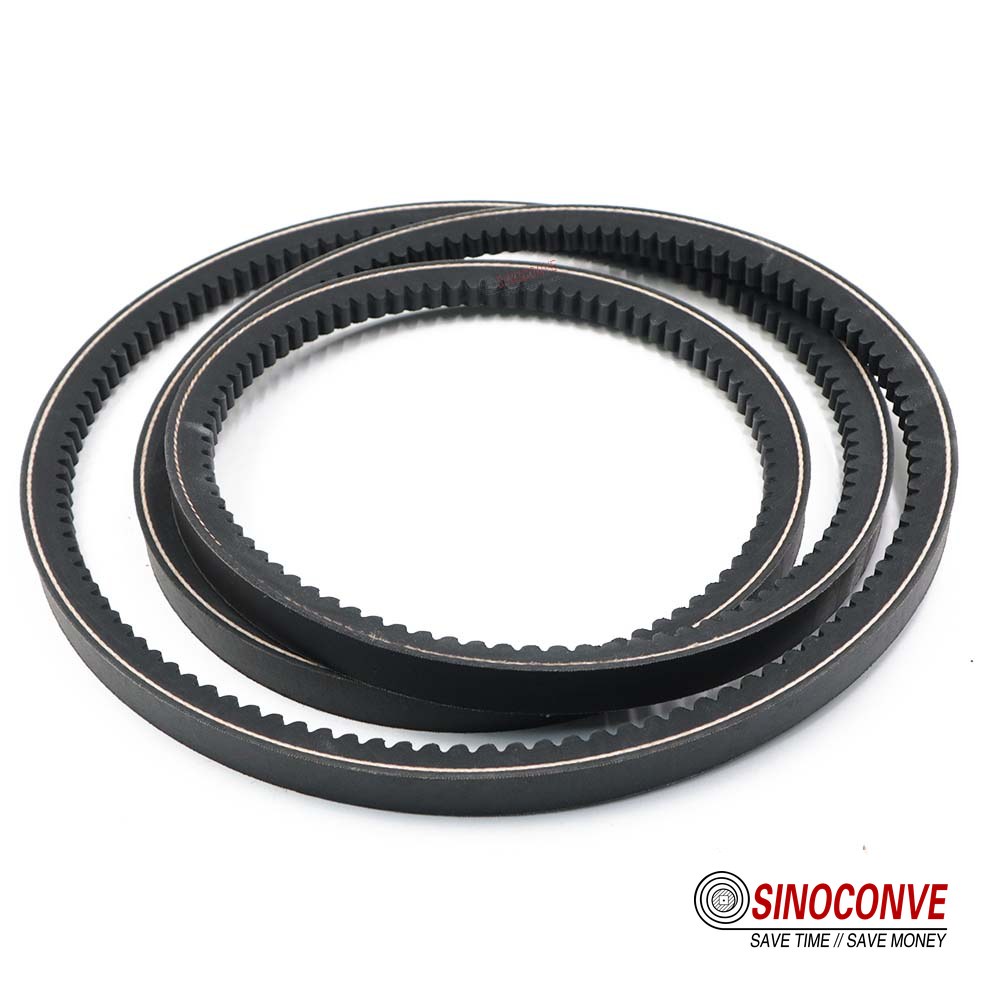
Molded notches on the compression side: the visual signature of the X in BX, 3VX and XPZ.
| Token | Where it appears | What it declares | The mistake it invites |
|---|---|---|---|
| X | After the section: BX, CX, 3VX, 5VX, 8VX | Molded notch on the base, same section size | Reading it as a different width and ordering elsewhere |
| XP | Before the section: XPZ, XPA, XPB, XPC | Narrow wedge section, raw edge, cogged | Assuming the SP version disappears when pulleys get small |
| Lw, Ld, Lp | After the length number | Datum or effective length is the basis | Ignoring it and reading the digits as inside length |
| That | After the length number | Inside length is the basis | Quoting it to a supplier whose column is Lw |
| The, THE, The | After the length number, common on automotive codes | Outside length is the basis | Using a rope measurement as proof the belt is wrong |
| Leading digit plus P family | 8PK1250, 5PJ800, 12PL2100 | Rib count, then pitch family, then effective length in mm | Swapping PJ for PK at the same rib count |
| /2, /3, /4 or a set number | After the length, or stamped on the wrapper | Belts supplied and length-matched as a group | Buying three single belts for a three-groove drive |
| AV prefix or a two-digit width code | AV 13 x 780, 10A, 13A | Automotive belt, usually raw edge, tight length band | Substituting it on an industrial drive on width alone |
Tokens that sit outside the section and length fields, and the specific error each one triggers.
If you buy through a conveyor belt factory that also cuts V-belts, ask them to confirm the construction letter in writing on the order acknowledgement. It is the cheapest insurance in this whole article, because the belt that arrives unmarked is the one that gets installed wrongly and blamed on the rubber.
07Ordering a banded V-belt: Rib Count, Sets, and Tolerances
A banded V-belt is several V-belts joined by a flat tie band across the top so they act as one unit. Plants reach for them on pulsating drives: crushers, hammer mills, reciprocating compressors, and anything where a single belt would slap and flip. Ordering one adds two fields to the code that a plain belt does not have, and they are the two fields most often left blank. Your conveyor belt distributor will fill them in for you if the request reaches them before the order is placed.
What the Tie Band Does, and What It Costs You
The tie band keeps the strands in the same groove plane and stops one belt from rolling into its neighbour when the load pulses. The cost is flexibility. A banded belt cannot be bent as tightly as the single belts it replaces, so the minimum pulley diameter usually steps up, and back-side idlers are a bad idea on most banded constructions because bending the band the wrong way works the bond between band and strands. If your drive has a small sheave on the motor and a reverse-bend idler on the slack side, measure both before you convert a multi-belt drive to a banded one.
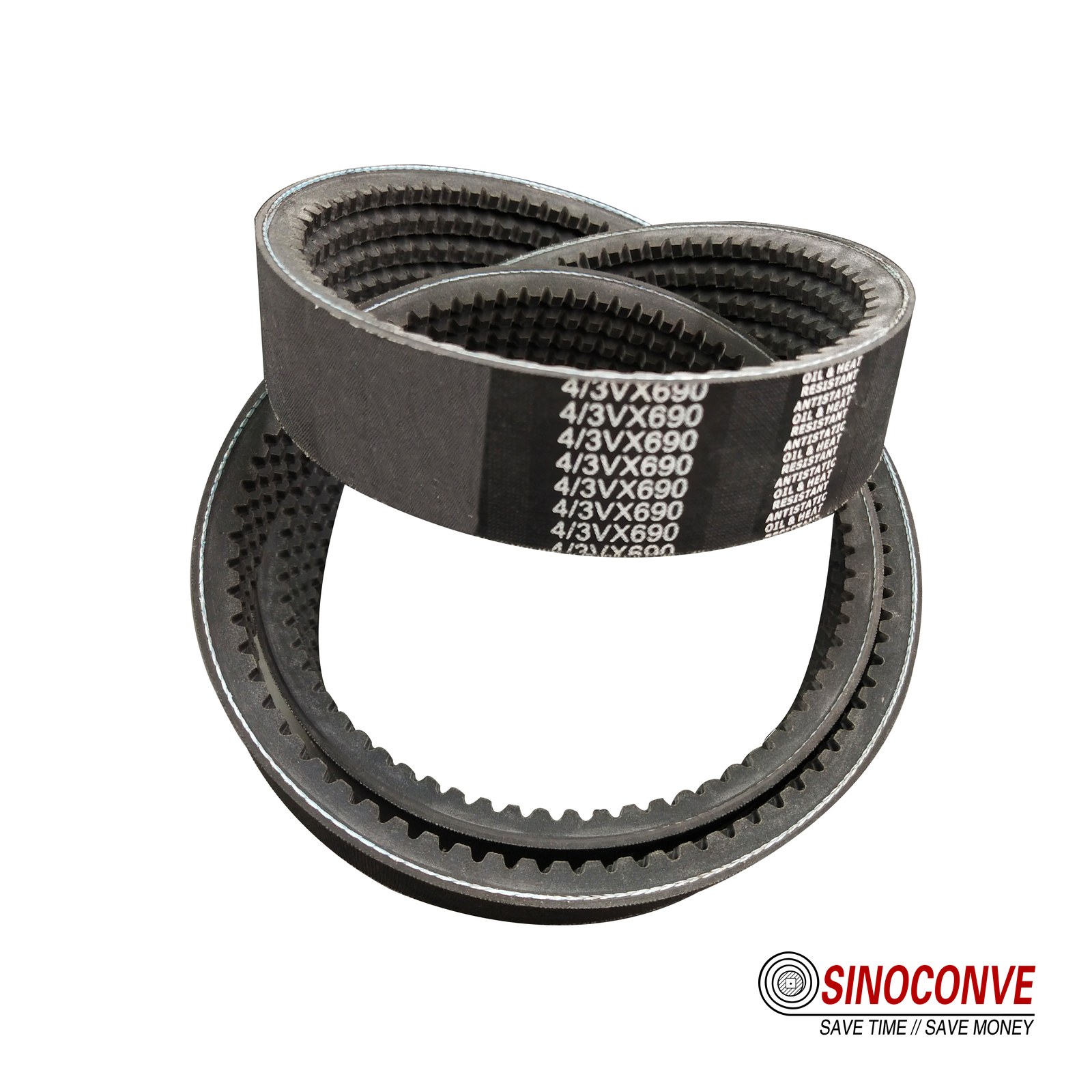
The tie band that makes a banded V-belt behave as one belt, and the ribs that still do the gripping.
Rib Count: Two Digits That Change the Power Rating
The number in front of the section is the strand count. A 3-strand banded belt carries roughly three times the power of a single strand of the same section, with a small allowance for the band's own stiffness. Two rules follow from that. Never reduce the strand count to fit a narrower set of sheaves; the drive was sized on total belt width, and a 2-strand band on a 3-groove sheave will slip and overheat on the empty groove. And when you convert a set of four single belts to a banded belt, keep four strands, not three, unless the drive was re-rated on paper.
Matched Sets: What "Matched" Actually Guarantees
Matched means the belts in the set are length-matched to each other within a stated band, so they share load instead of letting the shortest belt carry everything. It does not mean the belts are identical to the last millimetre, and it is not the same as a banded belt. Three single belts from the same production batch are usually close enough for a light drive; a 6-strand drive at 1,500 rpm with a 900 mm centre distance is not a light drive, and there the set tolerance is the difference between even load sharing and one belt doing 60% of the work.
Ask for the tolerance in millimetres, not for the word "matched". Trade figures commonly quoted for industrial wrapped V-belts sit in the region of a few millimetres of length spread across a set, and the exact band depends on section and maker. If your supplier cannot state the number, plan to fit a banded belt instead.
Field note from our engineers: A pulp mill in Indonesia ran four separate SPB belts on one drive and replaced them one at a time over three years. When the last single belt was new and the other three were two years old, the new belt failed in seven weeks with a scorched base. Nothing was wrong with the belt. The set had stretched to a spread of about 9 mm, so the new belt took the load first and paid for it. They moved to a 4-strand banded belt at the next shutdown and the drive has run without a single-belt failure since. Cost per belt went up; cost per tonne went down.
08Agricultural V-Belts: Same Arithmetic, Different Paperwork
Farm drives read differently from plant drives and behave the same way underneath. Codes often arrive as a two-digit width plus a millimetre length, sometimes with an AV prefix, sometimes as a letter pair that only the OEM catalogue recognises. B, SPB and C sections carry most of the load on choppers, mixers, threshers and blowers, because those drives combine high torque with pulleys small enough to demand a cogged construction. Two practical differences matter. Length bands are tighter than industrial practice, so a belt that is 15 mm long is usually a wrong belt rather than a candidate for adjustment; and twin and triple drives are common, which means matched sets come up far more often than on plant equipment. Guidance on how these drives are specified sits in our notes on agricultural V-belts, and the wrapped versus raw edge trade-off on dusty drives is covered under rubber V-belt applications. Season matters too: we quote harvest-time replacements in days, not weeks, and a code read correctly saves a fortnight of downtime when the machine is standing in a field.
09Twelve Checks Before the Purchase Order Leaves
Run this list against any V-belt order that is going onto a production drive. It takes four minutes and it catches almost every substitution error we see arrive as a claim.
| Check | What to write on the order | Why it saves money |
|---|---|---|
| 1. Section | Full section token, e.g. SPB, not "B series" | B and SPB differ by 2 mm of height |
| 2. Length basis | Lw, Li or La written out | 40 to 83 mm of error on the wrong basis |
| 3. Length value | Millimetres for metric, inches for inch codes | Stops a 2360 being read as a 93 inch belt |
| 4. Construction | Wrapped or raw edge, stated explicitly | Changes heat tolerance on a 90 mm pulley |
| 5. Rib or strand count | Number of strands or ribs | An empty sheave groove slips and blisters |
| 6. Set requirement | Matched set, with the tolerance in mm | One belt stops carrying the whole drive |
| 7. Banded or singles | One banded belt or N single belts | Pulsing drives need the tie band |
| 8. Pulley limits | Smallest pulley diameter on the drive | Bending below the minimum kills the base |
| 9. Substitution approval | Written confirmation before shipping | Turns a return into a phone call |
| 10. Pack quantity | Belts per box or sleeve | Storage deformation starts in the box |
| 11. Non-standard lengths | State the measured number and ask what exists | Stocked steps are 10, 20 or 25 mm |
| 12. Application | Drive, duty, speed, ambient temperature | Lets the maker flag a mismatch before cutting |
Twelve lines that fit on one page and prevent most replacement failures.
10The Mistakes We See Most Often in Claims
Almost every "wrong belt" complaint we handle turns out to be one of these eight, in roughly this order of frequency.
Treating Li as Lw. The single biggest cause, and it usually surfaces as a belt that is short by 38 to 83 mm depending on the section. Treating 3V as SPZ. Half a millimetre of width difference and 0.3 mm of height difference is enough to change how the belt seats. Treating a 13 mm A section as an SPA. Same width, two millimetres of height, and the belt ends up riding on its base instead of its flanks. Ignoring the groove angle. A sheave worn from 38° to 42° will kill new belts of any correct section within weeks. Ordering singles for a set drive. Length spread across the set is what decides load sharing, not belt age. Measuring a used belt and ordering that number. Worn flanks and a stretched cord mean the original code was 10 to 25 mm different. Using an automotive belt on an industrial drive. Automotive codes carry tighter length bands and different compounds, and the width match is a coincidence. Assuming a same-section belt from another maker will match. Cross-maker fits are usually fine on new drives and often fine on worn ones, which is exactly why the failure arrives without warning.
Drive-side symptoms are covered in V-belt failure modes; tensioning schedules sit in the transmission belt guide.
11When the Label Is Gone: What We Ask For
Send us a belt with no marking and we ask for four things: a photo of the section with a ruler in frame, the three width readings, the three height readings, and the rolling measurement of the datum length. Add the smallest pulley diameter and the drive speed and we can usually place it in one reply.
The Standards Behind the Numbers
The classical profiles trace back to DIN 2215 and ISO 4184; the narrow wedge family to DIN 7753; the American families to the ARPM publications that grew out of RMA practice. What they share is the datum system, which is why a length quoted without a basis is not a length at all, and a conversion table without a column header is worth nothing.
Write It the Way You Want It Read
On the order, write the section, then the number, then the basis, then the construction: SPB 2360 Lw, wrapped, 4 strands, matched set within 2 mm. Put the machine tag number on the same line. Do that consistently and your spares list becomes readable by people who have never seen the drive. Skip it and you have a banded V-belt that fits nothing, in a crate, on a dock, waiting for a return authorisation that nobody wants to raise. Our banded V-belt notes cover the drive-side selection logic if you are converting a multi-belt drive this quarter.

12Frequently Asked Questions
What does the number on a V-belt actually measure?
It depends on the family and sometimes on the maker. On classical belts the digits are usually inside length; on narrow wedge belts they are almost always datum or effective length; on US narrow codes the block is the outside circumference in tenths of an inch. Same digits, three different lines on the same cross-section.
Can I fit an Li belt where the drawing says Lw?
Only if the drive has that much adjustment left, which it usually does not. On an SPB section the gap is 60 mm. Order the basis the drawing states, or ask the supplier to quote both numbers side by side before you commit.
Is a banded V-belt the same as a matched set?
No. A matched set is several separate belts whose lengths were checked against each other; a banded belt is one product with a tie band joining the strands. Both solve uneven load sharing, and the banded version also stops strands from rolling into each other on a pulsing drive.
How do I measure a belt that has no marking left?
Clean one unworn window, take three width and three height readings perpendicular to the top face, then roll the belt one full turn along a flat floor between tape marks to get the datum length. Wrapping a rope around the loop gives you the outside length instead, and that reading runs long.
Is 3V the same as SPZ?
Close, not the same. A 3V measures 9.5 mm by 8.3 mm; an SPZ measures 10 mm by 8 mm. On a sheave cut for one series, the other will fit and will still be the wrong belt. Confirm the sheave groove series before you swap families.
What does the X mean in BX68 or 3VX690?
Molded notch, meaning a cogged base. The section dimensions stay the same as the plain B or 3V, so the belt enters the same groove. What changes is how tightly it can bend and how it sheds heat on small pulleys.
Why does my new SPB measure 16.3 mm when the chart says 16 mm?
Because the chart prints a nominal dimension and you are holding a moulded part. Both numbers are published and both are correct for their own column. A few tenths of a millimetre either way is normal and not a reason to reject a belt.
Should I replace every belt in a set at once?
Yes, unless the drive is light and the belts are young. A new belt alongside three stretched ones takes the load first and fails early, which is how a seven-week belt life gets blamed on the supplier. Replace as a set, and keep the spares as a matched set.
13Related Products You May Need
- V-belts and narrow wedge sections — classical, narrow, banded and cogged constructions cut to your length basis.
- Timing belts — synchronous drives where a slip-free ratio matters more than belt price.
- Rubber conveyor belts — EP and NN fabric carcass grades for the conveying side of the same plant.
- PVC conveyor belts and the full product catalog for package-handling lines.
- Frequently asked questions about ordering, tolerances and lead times.
14Related Blog Posts
- V-belt buying guide: profiles and sizes — how to choose a profile once you can read the code.
- Classic V-belts vs cogged belts — which construction suits which drive.
- Banded V-belt drive system selection.
- Poly V-belt comprehensive guide and PK belt vs PJ belt.
- Wrapped V-belts: what buyers should know.
- V-belt ultimate guide 2026 and heat-resistant conveyor belt specification table.