
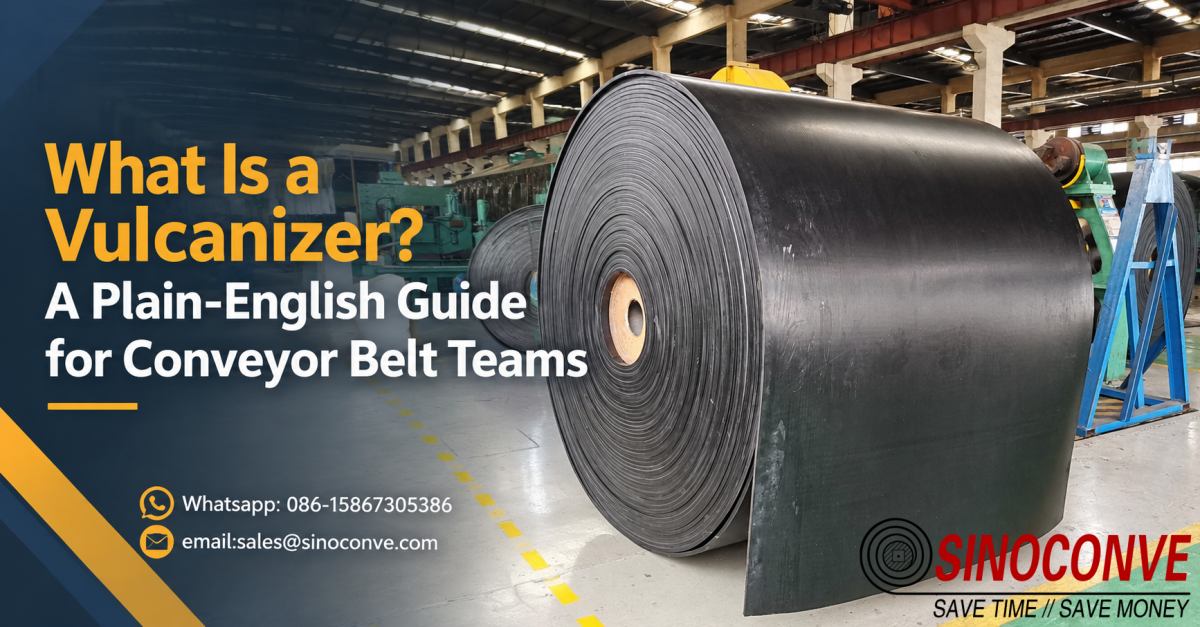
A vulcanizer is the piece of equipment that applies heat and pressure to cure rubber, driving the cross-linking reaction that turns soft plastic compound into a strong elastic solid. In conveyor belt work the term nearly always means a belt vulcanizing press, the machine that joins two belt ends into a splice as strong as the carcass or closes a torn cover. Step outside conveying, though, and the same word can describe a curing oven, a repair kettle, or a press that moulds and cures rubber goods such as roller lagging and abrasion lining. So the honest short answer is this: a vulcanizer is a curing device, and which device it is depends on the trade asking the question.

Plants search for this answer because one word covers at least four different machines, and hiring or buying the wrong one burns a shutdown window that nobody gets back. The pages below separate what a vulcanizer does, how the common builds differ, what sits inside the frame, and when a site is better served by a vulcanizing service than by owning hardware. Thirty years of running these presses on quarry, cement, port and steel plant conveyors taught us something uncomfortable: the gap between a splice that lasts eight years and one that opens in eight weeks sits less in the machine than in how it is set, operated and inspected. As a conveyor belt manufacturer that also splices in the field, we watch both halves of that equation every week.
01What a Vulcanizer Is, in Plain Terms
One definition that happens to cover four different machines
A vulcanizer cures rubber by holding it at an elevated temperature under pressure for a set time, so the long rubber molecules lock together into a three-dimensional network. Unvulcanised compound stays plastic, tears easily and creeps under load. Cure it, and the same material springs back, resists abrasion and keeps its shape for a decade of service. Everything the machine does exists to deliver that heat and that pressure evenly across whatever it is closing.
Scope matters more than people expect. In belt maintenance the word points to a splice press, which field crews also call a belt vulcanizer, a vulcanizing press or simply "the press". Inside a factory that makes hoses, mats or pulley lagging, the same word can point to a curing autoclave or a platen press that shapes the product. A tyre shop keeps a small repair vulcanizer for heating a patch onto a casing. Four trades, four machines, one label.
Why a conveyor belt splice needs the belt version comes down to strength. A vulcanized joint lets the cords of one belt end bond to the cords of the other through fresh rubber, so the finished splice carries load like continuous belt rather than a clamped seam. That is what allows a single run several kilometres long to survive millions of flex cycles and still hold its tension. A mechanical fastener, by contrast, punches through the carcass and loads only a few square centimetres of it.
That naming confusion has a practical cost. A purchase request that says "vulcanizer" without a size, a platen width or a voltage can be read four different ways, and the reply may arrive as a quote for the wrong machine entirely. When a plant sends us an enquiry, the first three questions we ask are the belt width, the belt type and whether the joint must be made on the conveyor or in a shop. Those three answers usually settle which of the four machines is actually being described.
02What a Vulcanizer Actually Does: Heat, Pressure and Cross-Linking
Why heat and sulfur together change the rubber for good
Raise rubber compound to its curing temperature and the sulfur and accelerators already blended into it react with the polymer chains, tying them together at points along their length. That reaction is not reversible, which is exactly why a cured belt cover cannot be melted and re-formed the way a thermoplastic sheet can. Left at ambient temperature the same compound would stay soft for years, so heat is only the trigger; time under that heat is the dose.
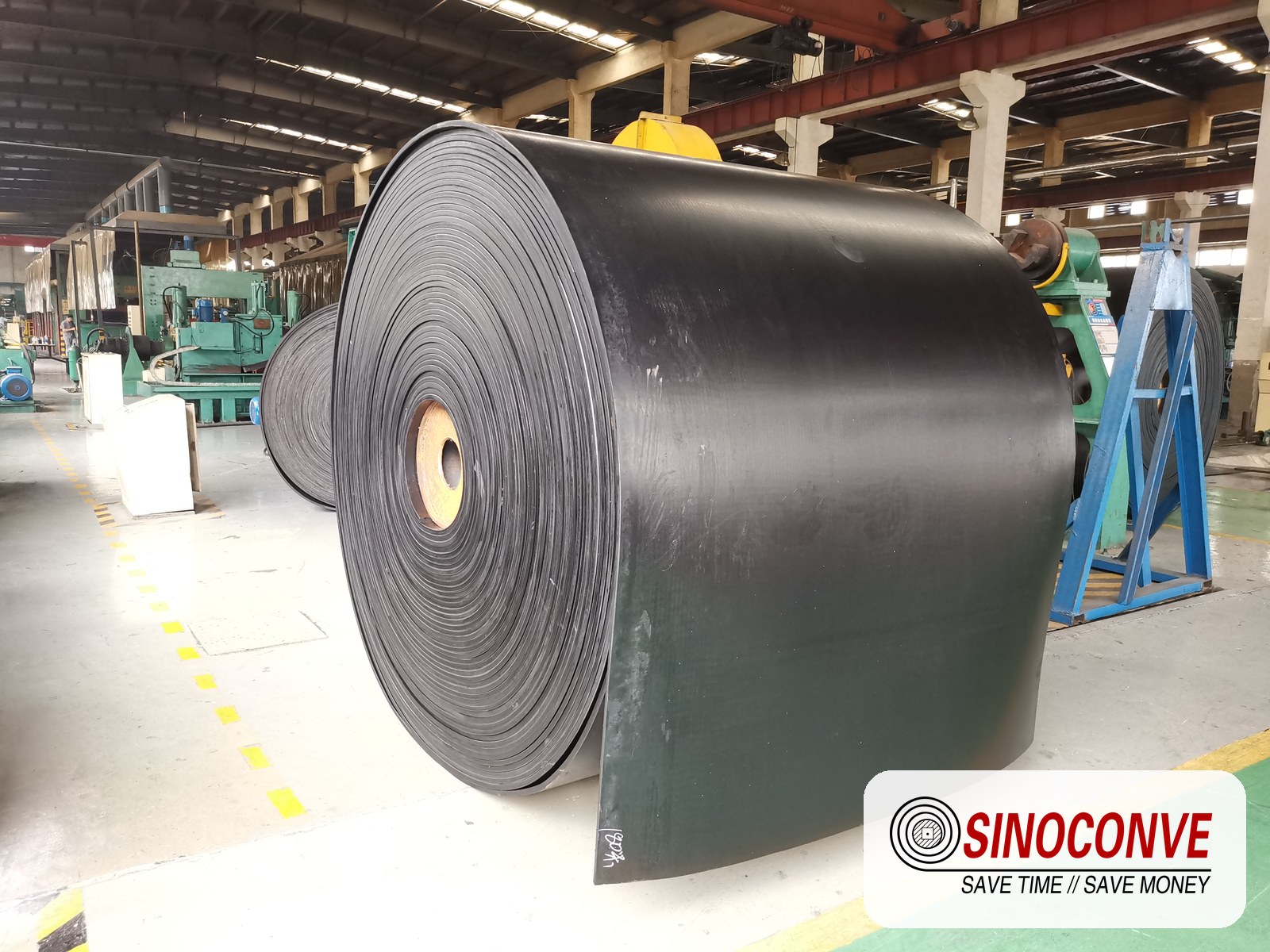
On a rubber conveyor belt this chemistry already ran once at the factory, which is why a new belt arrives with its cover firm and its tensile strength fixed. The vulcanizer's job at a splice is to repeat the reaction inside the narrow band where two ends meet, using fresh unvulcanised compound as the bonding layer. Get the heat, the pressure or the dwell wrong and the network never forms properly across that band, even though the belt around it looks perfect.
Why the pressure stage is not optional
Heat alone leaves voids, trapped air and a spongy joint, so the machine clamps the splice between two platens and squeezes it while it cures. Pressure closes the interface, forces the bonding compound into the cord structure and holds the belt flat so the finished splice keeps the same thickness as the body. A press that reaches temperature but loses clamp force during the cycle produces a splice that looks solid and fails early under shock load.
Cooling belongs to the same job. Rubber must stay under pressure until it has cooled enough to hold its new shape, otherwise the platen lifts, the joint relaxes and the edges curl. Water-cooled platens with channels running through the plates cut that wait to a few minutes on a thick belt; air-cooled plates take longer but need no water supply on site. On a 40 °C day in a transfer tower, we have watched a crew shave half an hour off a twelve-hour window simply by pre-chilling the cooling water and staging the plates before the belt arrived.
Thickness changes everything about how the machine behaves. Heat has to travel from the platen faces into the middle of a thick belt, and rubber is a poor conductor, so a 20 mm steel-cord splice soaks up far more heat than a 6 mm fabric one. That is why the same press setting that works on a light belt leaves a heavy belt under-cured, and why operators watch the belt rather than trust a fixed recipe. Compensation comes from a longer dwell and a slower ramp, not from a hotter plate.
03The Vulcanizer Family: Presses, Ovens and Repair Units
Four machines share the name and almost nothing else
Buyers lose money when they assume a vulcanizer is one thing. A belt splice press is portable, opens like a book and clamps two belt ends between matched platens. A curing oven is a fixed chamber that holds finished rubber parts at temperature in batches. A repair kettle cures patches and small components under steam pressure. A moulding press shapes and cures goods such as lagging pads or lining tiles, where the platen also forms the product. Different size, different control, different buyer.
The table below lines up the four so a procurement team can see at a glance which one a specification is actually describing. It is not a selection guide for belt machines, and it does not rank one against another; it simply separates the labels that get mixed up in quotes and emails.
| The machine many people call a vulcanizer | What it actually cures or forms | Where it normally lives and works | Why a buyer chooses this one |
|---|---|---|---|
| Belt splice press, moved and set up by the shift crew | It cures the joint between two belt ends and repairs local cover damage in place | It travels to the conveyor at the tail pulley or a maintenance bay | It avoids cutting and re-threading a whole belt run on site |
| Curing oven or autoclave, fixed inside the plant | It cures batches of moulded goods such as mats, pads and small sleeves | It sits in the production hall and runs on a batch timetable | It gives high, even throughput when output is shaped parts, not belts |
| Repair kettle, a small steam-pressure vessel | It cures patches, boots and odd rubber components one item at a time | It stays in the maintenance shop beside the bench and the tools | It suits a repair bench that never sees a full belt splice |
| Moulding press that shapes and cures in one step | It forms lagging pads, lining tiles and other rubber goods under heat | It stands in the rubber shop next to the mixing and trimming benches | It makes the finished part rather than closing an existing split |
Most plants that write "vulcanizer" on a purchase request mean the first row. That is the machine this guide explains in depth, because it is the one that touches belt reliability and shutdown planning. Sourcing the belt itself is a separate conversation, and a conveyor belt supplier is usually the right person to ask whether the belt and its splice schedule are matched before either is ordered.
A buyer who cannot tell these four apart may order a platen width that is wrong for the belt, or a control system that never reaches curing temperature. The fix is simple enough. Describe the job rather than the noun: say whether you are closing a belt joint, curing a batch of shaped parts or repairing one small component, then give the belt width and type. Those few facts let the machine select itself.
04Heating Methods: Electric Platens and Steam
Where the heat enters the rubber decides the day's logistics
Two heating methods dominate belt presses. Electric resistance elements buried in the platen are the common choice today, because a portable unit can run from a site generator or a supply socket and needs no boiler. Steam-heated platens still appear where a plant already has a steam main, and they hold a very even temperature across a wide platen, but they demand hoses, condensate handling and a boiler that is running when the shutdown starts.
Temperature control separates a professional press from a crude one. Elements in a good platen are zoned and sensed, so a 1,200 mm wide plate does not run 12 °C hotter in the middle than at the edges. Digital controllers with a thermocouple clamped to the plate let the operator watch the actual surface temperature rather than guess from a dial. Curing rubber depends on the temperature the belt sees, not on the number printed on a label.
How hot does it get? Belt splicing platens typically run somewhere between 140 °C and 160 °C, with heavy or special compounds pushing toward 170 °C to 180 °C for part of the cycle. Those are equipment capability figures, not a recipe. The exact dwell and the shape of the heating curve belong to each belt's own specification and to the published process notes, which we keep on a separate page.
05Frame and Structure: Box, Jaw and Beam Builds
The frame decides how evenly the belt is squeezed
Clamp force has to reach the middle of the splice, not just the edges, and the frame is what carries that load without flexing. A box-section press uses a rigid rectangular body that resists bowing across a wide belt, which is why it dominates thick, high-tension belts. A jaw or C-clamp design reaches in from the side and suits narrower belts and tight spaces. A beam frame spans the splice with crossbars and loads it through the middle, a compromise that travels well.
Stiffness matters because a frame that bends under load leaves the centre of the joint under-pressed. Operators often compensate by over-tightening the edges, which distorts the belt and thins the splice at the very points that take the most fatigue. On a 1,600 mm wide steel-cord belt, the difference between a rigid platen and a springy one is the difference between a splice that holds its thickness and one that feathers away from the joint line.
Alignment across the frame is just as important as stiffness. If the two platens are not parallel when they close, the splice cures thinner at one edge and thicker at the other, and the thin side becomes the first place to crack. Most presses give the operator a way to set that gap, and a feeler gauge or a straight edge laid across the joint before the cycle starts saves a failed splice later. Twenty minutes of setup beats a six-hour rework.
| Frame build on a belt press | How it applies and holds clamp force | Where this build earns its place | What field teams must watch out for |
|---|---|---|---|
| Box-section frame, a rigid rectangular body around the splice | It resists bowing across a wide belt and keeps the middle of the joint under steady squeeze | It suits thick, high-tension belts where splice thickness must stay uniform | Its weight needs lifting gear and a firm base under the conveyor frame |
| Jaw or C-clamp frame, loading in from the side of the belt | It grips a narrow band from one edge and pulls the plates together at the joint | It fits tight galleries and narrow belts where a full body will not go | Side loading can tip the platen unless the clamp is balanced evenly |
| Beam or crossbar frame spanning over the splice | It presses down through crossbars that spread the load across the joint line | It travels well and handles medium belts without a heavy lifting plan | Span stiffness drops fast once the belt grows wider than the beam design allows |
06Portable Field Units vs Fixed Shop Machines
Why the portable press wins on a live conveyor
A conveyor that carries 3,000 tonnes an hour cannot be dismantled to fix a 900 mm splice, so the press goes to the belt. Portable units split into plates, beams and a control box light enough for two people, and they set up on the belt where it lies. On a long overland run the alternative to a portable press is cutting the belt, pulling lengths back to a shop and re-threading them, which can cost a week of production for one joint.
The trade is precision for reach. A portable press often has a smaller platen and simpler controls than a shop machine, so the operator's skill in setting alignment and clamp pressure carries more of the result. Weigh one against the other honestly: if a plant splices once a year, the portable unit is the only sensible choice, because a fixed press would sit idle while the belt still needed a joint.
When a fixed shop press pays back instead
Shops that make belts to length, fabricate endless belts or run a steady repair workload gain from a fixed machine. There it can be levelled, guarded, plumbed and kept at a stable temperature, and the same press handles belt work, lagging and moulded parts without a road trip. Between the two lies the most common real-world setup: a fleet of portable presses for the field, backed by one fixed press in the workshop for anything that can be brought inside.
Storage and handling decide whether a portable press is still accurate after a few years. Plates stacked on a wet floor, cables dragged over gravel and control boxes left open all shorten the life of a machine that must hold temperature within a narrow band. A simple trolley, a dry cupboard for the thermocouples and a spare set of edge bars keep a portable unit working like one that lives indoors. Crews that look after their press are the ones whose splices stay consistent.
Distance is the deciding number for most sites. A portable press that reaches a joint in under an hour beats a fixed press that needs a six-hour belt transport each way, even though the fixed machine is more accurate on paper. When the conveyor itself is being replaced or extended, though, bringing the work to a properly equipped shop often produces the cleanest splice of all.
07Inside the Frame: Parts and How a Cycle Runs
The parts that decide whether a splice turns out well
Open a belt press and you find two working surfaces, the upper and lower platens, with the belt held between them. Each platen carries the heating elements and, in most modern units, cooling channels for water or air. Beneath the lower platen sit the pressure members, air bags or hydraulic or screw clamps, that push the plates together and keep pushing after the belt has been compressed. A control box ties the heating zones and the timer together so one operator can watch the whole cycle.
Surrounding that core are the parts that quietly make or break a joint. Insulation blankets and caul plates spread heat evenly and stop the belt scorching under a hot spot. Edge bars hold the splice square and stop compound squeezing out sideways. Thermocouples report the real plate temperature rather than a nominal set point. Take away any of these and the same press that turned out a clean splice last month will leave a soft edge or a cold centre this month.
How one repair cycle actually runs
A cycle starts long before the plates close, with the belt cut back to a clean square edge, the plies stepped or fingers cut, surfaces buffed and cleaned, and fresh compound laid in. The crew then squares the two ends, sets the press over the joint and brings the platens down. Pressure comes on first and holds while the plates climb to temperature, the timer runs the dwell, and then cooling begins with the belt still gripped. Only when the joint is cool enough to hold shape does the press open.
Where that cycle goes wrong is usually preparation, not the machine. Contamination from a dusty cover, a step cut a few millimetres short or a press clamped out of square will each produce a splice that fails at the joint line within weeks. Our own belt vulcanising process notes cover the step detail and the temperature curve, which this concept page deliberately leaves to that page. What happens inside a conveyor belt factory and what happens at the joint use the same chemistry, just at very different scale.
08How a Vulcanizer Relates to Other Splice Methods
Vulcanized, mechanical and cold bond: three answers to one problem
A vulcanizer is one of three ways to join a belt, and knowing which one fits a job is more useful than knowing the machine in isolation. A hot vulcanized splice cures fresh rubber through the joint and approaches the strength of the belt body, which is why high-tension and long runs depend on it. A mechanical fastener bolts or clips the ends together and can be fitted in under an hour with hand tools, at the cost of strength and of punching holes in the carcass. A cold-bond splice uses a chemical cement that cures at ambient temperature, sitting between the two in both strength and effort.
The choice is rarely about the best joint in the abstract. It is about downtime, belt tension, belt width and how soon the line must run again. A quarry that can wait four hours and needs a full-strength joint will vulcanize. A plant that must restart within the hour after a torn belt will often fit a mechanical fastener as a stopgap and schedule a proper splice for the next shutdown.
| The splice approach a crew may choose | How the joint carries the belt tension | Where this splice approach fits best | What this choice costs you in service |
|---|---|---|---|
| Hot vulcanized splice, cured by the press | It bonds cord to cord through fresh rubber so load passes as if the belt never ended | It suits high-tension, long and steep runs that must not open under shock | It needs a press, a trained crew and a shutdown window of several hours |
| Mechanical fastener, bolted or clipped on | It holds the ends together with metal plates that transfer load through punched holes | It suits short belts, temporary repairs and emergencies that cannot wait | It reaches only part of the belt's strength and can catch on scrapers and skirts |
| Cold-bond splice, cured by chemical cement | It glues the prepared plies together and cures slowly at whatever the air temperature is | It suits light and medium belts where a press cannot be brought in | It is sensitive to cold, damp and dust and cures far more slowly than heat |
Whichever route a site takes, the surrounding hardware matters as much. A poorly tracked belt wears its fasteners and its splice edges, so teams planning a joint often review rollers and cleaning at the same time. Our notes on the splicing methods and field tips cover that wider picture.
Cost and risk rarely pull in the same direction. A vulcanized joint costs more in labour and downtime than a fastener, but it also removes the regular re-clipping a mechanical joint needs and the belt-edge damage that fasteners can cause. Over a long-run belt turning 6,000 hours a year, the cheaper joint often turns out to be the expensive one. The trade is worth writing down before the next shutdown is planned.
09Joint Geometry: Lap, Finger and Stepped Splices
The press has to match the joint shape the belt needs
Not every splice is cut the same way, and the joint geometry decides how the press is used. A simple lap splice overlaps two ends and cures them together, which is quick but leaves a step on one face. A stepped splice cuts the plies back in layers so the ends interleave and the joint runs nearly flush, the usual choice for fabric-carcass belts under real tension. A finger splice cuts interlocking zigzag fingers across the end, giving a long joint line and a good spread of load in both directions.
Steel-cord belts use their own arrangement of cord ends laid in a specific pattern, and they demand the most from a press because the joint must hold at the highest tensions a conveyor sees. On any geometry, the press has to reach the full joint length and hold it flat while the rubber cures, or the interlocking layers will not sit true. That is why a splice on a wide belt may need two or three presses bolted together, or a single press run in stages.
Finger and stepped geometry also changes how much of the joint a single press must cover. A narrow belt may need only one platen, while a wide one is cured in sections, with each section overlapped so the joint runs continuous. Getting that overlap right is a craft skill, and it is one of the reasons an experienced splicing crew costs more than a beginner. The geometry is cut to suit the belt's construction, not to suit the press.
Field note from our engineers: On a clinker line in 42 °C ambient heat, we once watched a crew halve their cure time by pre-warming the platens on the truck before the belt was even cut. The joint came out clean and the line was running before the scheduled window closed. Small habits like that, rather than a bigger machine, are what keep a shutdown on schedule.
10Where Vulcanizers Get Used Beyond Belt Splices
Same heat and pressure, several different jobs
Belt splicing is the headline use, but the same press cures other rubber work around a bulk handling plant. Pulley lagging is bonded to a drum and cured under heat so it grips the belt without slipping. Wear lining sheets in chutes and bins are laid down and cured in place. Torn cover, split sidewalls and damaged edges are rebuilt with fresh compound and pressed. Each job leans on the same principle: clean preparation, heat, pressure and time.
A plant that handles an industrial conveyor belt often owns one press and uses it for all of these. The machines differ in size and in how much joint they can reach, not in what they fundamentally do. There is a family resemblance across the range, from the smallest repair unit to a press that closes a metre-wide steel-cord splice.
Other drives on the same site are cured differently and bought from different catalogues. A transmission belt manufacturer supplies V belts that are vulcanized once, at the factory, into a fixed shape, and a V-belt manufacturer holds the section and length tolerances that decide whether a multi-groove drive shares load. Those belts never see a field press, yet they come off the same idea of curing rubber under controlled heat.
Roller lagging, idler components and cleaning hardware sit alongside the press in a plant's maintenance plan, because a splice that is perfect and a belt that is not tracked will still wear out early. Linking the joint schedule to the rest of the conveyor is how a maintenance team keeps a whole line, not just one joint, out of trouble.
Condition monitoring belongs here too. A splice that is heating up, throwing rubber or shedding a thread of cord tells a maintenance team that something is moving before it fails. Walking the joint on the same route as the idlers and the cleaning scrapers catches most of these early signs, and it costs nothing but time. Plants that treat a joint as just another part of the conveyor, rather than a one-off fix, get the longest service out of both.
11Safety and Operating Notes
A hot, heavy, clamped machine deserves respect
A belt press is a simple machine that runs at skin-burning temperature while clamping tons of load, and most injuries around one come from treating it casually. Plates reach 140 °C to 180 °C and stay hot for a long time after the power is cut. Air bags and hydraulic clamps store energy and can release it suddenly if a fitting fails. Rubber compound gives off fumes when it cures, and a splice set up in a confined transfer tower needs air moving through before anyone works near it.
Good practice is not complicated. Only trained people run the press, gloves and long sleeves are worn around hot plates, and lifting gear is used instead of muscle for the heavier builds. The press is isolated before plates are handled, pressure is bled off deliberately, and the area is ventilated while curing. A short written record of each splice, with the belt tag, the date and who ran it, turns a vague history into something a planner can actually use.
Documentation is part of safety, not paperwork for its own sake. A splice record that names the belt, the press, the operative and the date lets a planner see how a particular joint has behaved over time and lets a crew learn from its own history. When a joint does fail, that record is often the difference between a guess and a diagnosis.
| A hazard commonly found around a vulcanizer | Where it comes from during the job | How a careful crew controls it |
|---|---|---|
| Contact burns from hot platen faces and edge bars | Plates sit at curing temperature and stay hot well after the cycle ends | Insulated gloves, long sleeves and a clear habit of never touching a plate to test it |
| Pinch and crush points where the frame closes | Air bags and clamps push the plates together with heavy force under power | Keep hands clear of the joint line, isolate the unit and bleed the pressure before adjusting |
| Curing fumes and smoke in a confined space | Hot rubber compound releases vapour that builds up in towers and tunnels | Move air through the work area and post a watch whenever the space is enclosed |
| Untrained operation and the absence of any written splice record | A crew that has never set a press can damage the belt and themselves | Restrict the machine to trained hands and log every splice with its belt tag and date |
12Buying a Machine or Buying a Service
The question is workload, not whether you can afford the press
Every plant that runs conveyors eventually asks whether to buy a vulcanizer or call a service. The honest test is how often the site needs a splice, how urgent those splices tend to be, and whether it has or can keep trained people. A mine that splices a belt a month will usually justify its own press, because the machine earns its cost back on avoided downtime alone. A small plant that splices once every two or three years is better served by a contractor who arrives with a press, a crew and a method.
Owning the machine also means owning the rest of the job: compound, insulation, edge bars, spares for the clamps, a place to store it all and the training to use it well. Those costs are real and easy to forget in the glow of a new press. A service agreement folds them into the work, and it can be a better answer for a plant whose maintenance crew is already stretched across a dozen systems.
| What a plant in this position is facing | Owning a vulcanizer makes sense when | Calling a vulcanizing service fits better when |
|---|---|---|
| How often the site joins or repairs belting | The plant splices or repairs belting most months and cannot wait for a contractor | Splices are rare and the machine would sit idle between jobs |
| How quickly the line has to run again | Downtime is expensive enough that an in-house crew must restore the belt overnight | Shutdowns can be planned ahead so a service crew arrives on schedule |
| Skill, space and spares the site can keep | Trained operators, storage and spare clamps are available and looked after | The maintenance team is already stretched and nobody can own the press |
| How the belt itself is sourced and held | The site stocks its own belting and wants the splice to match its own specification | Belting arrives from a wholesale conveyor belts range with the service bundled in |
There is a middle path that many distributors and larger plants take. They buy from a conveyor belt distributor, keep one press in the workshop for routine work, and reserve a specialist crew for the high-tension splices that carry the most risk. That mix keeps the everyday jobs in-house while leaving the demanding ones to people who do them every week.
Lead times matter as much as price when a press is on order. A portable unit that has to be imported can take weeks to arrive, and a plant that waits for it keeps calling a contractor in the meantime. Buying through a partner who stocks the machine, the compound and the spares together shortens that gap and brings the first splice forward, not back.
13Misunderstandings We Hear Every Month
A few beliefs that cost real money
One recurring myth is that a vulcanizer melts the belt ends together like a plastic weld. It does not. The press cures fresh rubber compound that bonds the prepared ends through a chemical reaction, which is why surface preparation and compound choice matter as much as the temperature setting. A second is that a bigger press always makes a stronger splice. Size buys reach across a wide belt, not quality; a well-run small press beats a badly run large one every time.
A third belief is that a vulcanized splice is permanent and needs no inspection. Joints are the busiest part of any belt, and they should be walked and checked like any other wear point. Finally, some teams assume a splice can be rushed by raising the temperature. Pushing heat beyond the compound's design range can scorch the cover and leave the centre under-cured, so a shorter cycle often produces a weaker joint than the one it was meant to beat.
One more misunderstanding is worth naming. Some teams believe the belt has to be removed from the conveyor for a proper splice. In practice the overwhelming majority of field joints are made on the belt, at the frame, because that is where the belt already lies and where alignment can be checked against the pulleys. Removing the belt adds handling, pumping and re-threading, and it rarely improves the joint. The press was built to travel for exactly that reason.

14Frequently Asked Questions
What is a vulcanizer?
A vulcanizer is a machine that cures rubber with heat and pressure. Around conveyors it is almost always a belt splicing press that joins two belt ends into a joint as strong as the belt itself, and around a rubber factory the same word can mean a curing oven or a moulding press.
What does a vulcanizer do?
It holds rubber at an elevated temperature under pressure for a set time so the compound cross-links into a strong elastic solid. In belt work that means turning two prepared ends plus fresh bonding compound into one continuous, load-bearing splice. The machine does not melt the belt; it cures new rubber that ties the old ends together.
What do they do in a vulcanizing shop?
A shop with a fixed press takes work that cannot be done on the conveyor, such as making belts to length, building endless belts and bonding lagging or lining. The press there is levelled, guarded and kept warm, and the crew can control dust, temperature and curing far better than in a windy transfer tower. Many sites keep one shop press for routine jobs and send field crews out with portable units for everything else.
Is a vulcanizer the same as a vulcanizing press?
In belt maintenance, yes. Field crews use vulcanizer, vulcanizing press and splice press interchangeably for the same machine. The difference is only vocabulary, not hardware, so a quote that says vulcanizing press and a request that says vulcanizer usually describe the same thing.
Do I need a vulcanizer or a vulcanizing service?
It depends on how often the plant splices and how fast the line must restart. A site that joins belting most months, and cannot wait for help, will usually justify its own press and trained crew. A site that splices once every few years is better off buying the service and avoiding the cost of compound, spares, storage and training. Our splicing buyer's checklist lists the questions worth settling before either route is chosen.
How hot does a vulcanizer get?
Belt splicing platens commonly run between 140 °C and 160 °C, and heavy or special compounds can push toward 170 °C to 180 °C for part of a cycle. What matters is the temperature the belt actually sees at the joint, not the set point on a dial, which is why serious presses sense the plate directly. The exact figure belongs to each belt's specification.
How long does vulcanizing take?
There is no single number. Cure time follows belt thickness and compound, then cooling adds its own wait before the press can open. A thin fabric belt can be done in well under an hour of press time, while a thick steel-cord splice can occupy a press for several hours once heating, dwell and cooling are counted together.
Can you vulcanize a conveyor belt on site?
Yes, and that is the usual way it is done. Portable presses are built to be carried to the belt, assembled over the splice and powered from a site supply or generator. On a long overland conveyor, splicing in place is the only practical option, because removing the belt to join it elsewhere would cost far more downtime than the press itself.
Do you always need heat to join a conveyor belt?
No. A mechanical fastener can join two ends in under an hour with hand tools, and a cold-bond splice cures with chemical cement at ambient temperature. Both are useful, especially for emergencies and light belts, but neither matches a hot vulcanized joint on strength or on how smoothly it runs past scrapers and skirts.
How do I keep a finished splice reliable?
Treat the joint as a wear point and inspect it on a regular route. A belt that is mistracked or buried under carryback wears its splice edges faster than the rest of the belt, so tracking and cleaning checks protect the joint as much as the cover. Our guide to belt tracking and alignment and our notes on return side cleaning cover the two checks that matter most.
15Related Products You May Need
- rubber conveyor belt - EP and NN carcass belts in cover grades matched to the material, the load zone and the joint schedule discussed above.
- steel cord conveyor belt - the high-tension belts where a vulcanized splice carries the most load and deserves the most care.
- heat resistant conveyor belt - for clinker, sinter and hot material where the cover compound has to hold up long after the splice is cured.
- chevron conveyor belt - profiled belts for inclined runs, frequently joined on site with the same press a team already owns.
- industrial conveyor belt - the EP1000 build for crusher and screening lines, where shock loads test both belt and joint.
- product catalog - the full range in one place when a plant is sourcing belting, rollers and drive belts together.
16Related Blog Posts
- Conveyor Belt Splicing Ultimate Guide 2026: Methods, Costs and Field Tips - the hub article for choosing between a hot splice, a fastener and a cold bond.
- Conveyor Belt Vulcanising Process - the step-by-step sequence and temperature curve that this concept page leaves to a dedicated article.
- Conveyor Belt Splicing Buyer's Checklist: 12 Things to Verify Before You Order - the questions to settle before hiring a crew or buying a press.
- Aggregate Conveyor Vulcanizing - how splicing work is planned around crusher and screening shutdowns in practice.
- Endless Rubber Conveyor Belt - when a belt is joined into a continuous loop instead of being spliced on the frame.
- Return Side Belt Cleaning - why carryback shortens the life of a splice and how to keep the return strand clean.
- EP Conveyor Belt Tracking Guide - alignment, training and the misalignment that quietly pulls joints apart.
- Conveyor Belt Cleaning Methods, Schedules and When Scrapers Will Not Work - keeping the belt clean so fasteners and splice edges last.
- Heavy Duty Rubber Conveyor Belt for Mining Industry Efficiency - the high-load belts where splice strength sets the operating limit.
- Conveyor Roller Ultimate Guide 2026: Types, Materials and Load Ratings - the rollers and idlers that keep a spliced belt running true.
- Steel Cord Rubber Conveyor Belt: Durability and Efficiency in Material Handling - the belt type that places the highest demand on a vulcanized joint.
- Flexible Sidewall Conveyor - how sidewall belts are joined and why their splices need particular attention.