
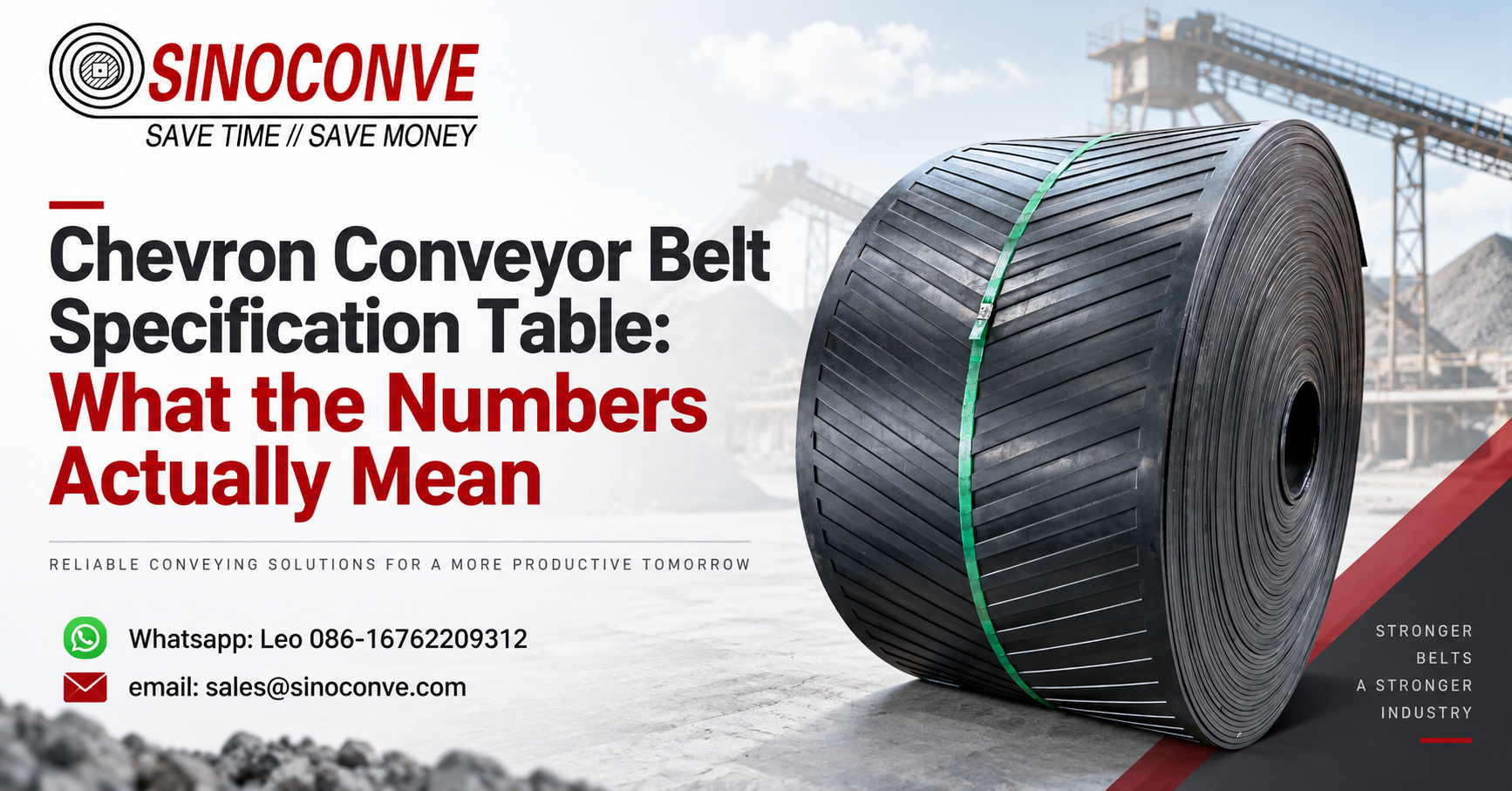
Chevron Conveyor Belt Specification Table: What the Numbers Actually Mean
Almost every chevron belt enquiry we open has the specification table filled in backwards. A buyer has an incline to climb, picks a pattern height that looks tall enough, then works out what tonnage the belt might shift. The pattern comes first. The calculation comes last. Nobody writes down what the belt has to do.
We run it the other way round. Required angle and required tonnage come first, because those are facts about your site. Pattern height, pitch, ply count and cover grade are answers. A datasheet is only useful once you are standing at the question end of it, and most of the numbers in that table are answers to questions the buyer never asked.
One clarification before the arithmetic. Why a patterned surface grips at all is a subject of its own, and our colleagues covered it in chevron conveyor belts incline anti slip. When the required angle goes past roughly 30 deg;, the discussion changes shape entirely and the sidewall family takes over, which is set out in sidewall conveyor belts incline transport. This article stays on the table and the arithmetic behind it: which rows you fill in, in what order, and from which measurements.

01Start at the Incline and Work Back to the Belt
A datasheet is written for a product family, not for your conveyor. It has to cover a quarry hauling granite at 6 °C in February and a fertiliser shed at 34 °C in August. That is why the numbers on it are bands rather than single values, and why reading it front to back tells you very little about your own line. Every conveyor belt manufacturer faces the same constraint. The document is a capability envelope. Your duty is one point inside it, and finding that point is your job, not the supplier's.
The Order We Work In, and Why It Rarely Changes
Angle first, because the maximum incline the belt will hold decides the pattern family, and the family decides the geometry rows. Tonnage next, since tonnage and angle together fix width and speed, and width is the number buyers lock in far too early. Tension third, once the geometry and the flow rate are known. Cover compound last: abrasion and impact work on the pattern tips and the loading zone, so a compound chosen before the geometry is chosen blind. Change that order and the job gets re-quoted two or three times.
Four Inputs a Datasheet Cannot Supply
Four things have to come from your plant, and none of them appears on any specification table we have received. The incline the belt has to hold, measured along the slope rather than taken from the two end points on a drawing. The belt speed you are willing to run. The material in its worst condition, which usually means wet, because that is the condition the angle calculation runs on. And the largest lump arriving at the loading point, since a single 400 mm block at 3 m/s decides the impact rating long before abrasion does. Get those four into the enquiry and the sheet becomes a menu you can read.
One more habit is worth breaking here. Buyers often send a drawing and nothing else. A drawing gives us centres, width and pulley diameters, which is genuinely useful. It cannot give us tonnage, and it will not say whether the material arrives wet after rain. The plant that writes four lines of duty data next to the drawing gets a usable quotation in one pass, and a made-to-order belt from a conveyor belt factory moves faster when nothing has to be assumed twice.
02The Three Profile Numbers, Taken One at a Time
A pattern row describes itself with three numbers and almost nothing else. Height in millimetres. Pitch in millimetres. The included angle of the V. Everything else you see on that row, from coverage width to pocket volume, is derived from those three. Reading them as a set rather than as three separate claims is the difference between a belt that holds the load and one that throws it back down the incline at the first surge.
Profile Height Buys Pocket Volume, and It Also Buys Cleaning Time
Heights on a chevron conveyor belt are usually quoted as 6, 10, 16, 25 or 32 mm, and buyers reach for the tallest because taller looks stronger. It is not stronger. Above the belt surface a pattern is a rubber wall, and a 25 mm wall is a lever arm acting on the splice and on every pulley it passes over. What height really buys is pocket volume at the base of each V row, roughly in proportion, so 16 mm holds about twice what 8 mm holds at the same pitch. The cost lands in cleaning and carryback rather than on the sheet.
Pitch Sets How Often the Belt Catches the Load
Pitch is the distance from one V row to the next, and 200 mm to 400 mm covers most of the work we do. Shorter pitch means more rows per metre, more pockets, and more interruptions to the material sliding back. It also means a busier belt surface. A 16 mm profile at 200 mm pitch behaves nothing like the same 16 mm at 400 mm pitch, even though a specification table would list both as "16 mm chevron". The ratio of height to pitch is the number that actually describes aggressiveness, and it is a number you have to divide yourself.
The V Angle Decides Where the Material Travels
Most profiles open forward, with the point of the V facing the direction of travel, so each row funnels material toward the centre of the belt as it is dragged up the slope. Included angles of 45 to 60 ° are common. A fishbone pattern does the opposite and spreads the load outward, which matters on a badly loaded belt, because material pushed outward meets the skirt rubber and the edge.
| Pattern row | What it governs on the incline | Typical values we quote | The cost that follows |
|---|---|---|---|
| Profile height, mm | Trapped volume at the base of each row, and how hard the pattern bites into a moving bed of material. | 6 / 10 / 16 / 25 / 32 mm | Cleaning difficulty, minimum pulley diameter, splice work that has to be cut clear of the pattern. |
| Pitch, mm | How many catch points exist per metre, so how quickly a sliding load is arrested. | 200 to 400 mm, most commonly 250 or 300 mm | Higher belt mass, more rubber to wear, and a stiffer belt over the return rollers. |
| V included angle, degrees | Whether the pattern pushes material toward the centreline or away from it. | 45 to 60 ° for single V rows | Edge loading and skirt wear if the pattern fights the way the chute delivers material. |
| Pattern coverage width, mm | How much of the belt is actually patterned, which decides the smooth strip left for skirt sealing. | Usually full width less 100 to 150 mm per side | Narrower coverage means less grip, wider coverage means the side rollers sit on rubber blocks. |
Notice what the table above does not contain: any row about angle. That is not an oversight. The angle a pattern holds is not printed on a datasheet, because it depends on the material, and the material is yours. This is the gap most buyers fall into, and the arithmetic that closes it has numbers in it. An industrial conveyor belt datasheet for a crusher line carries exactly the same omission, for the same reason.
03Pattern Families and the Material Each One Suits
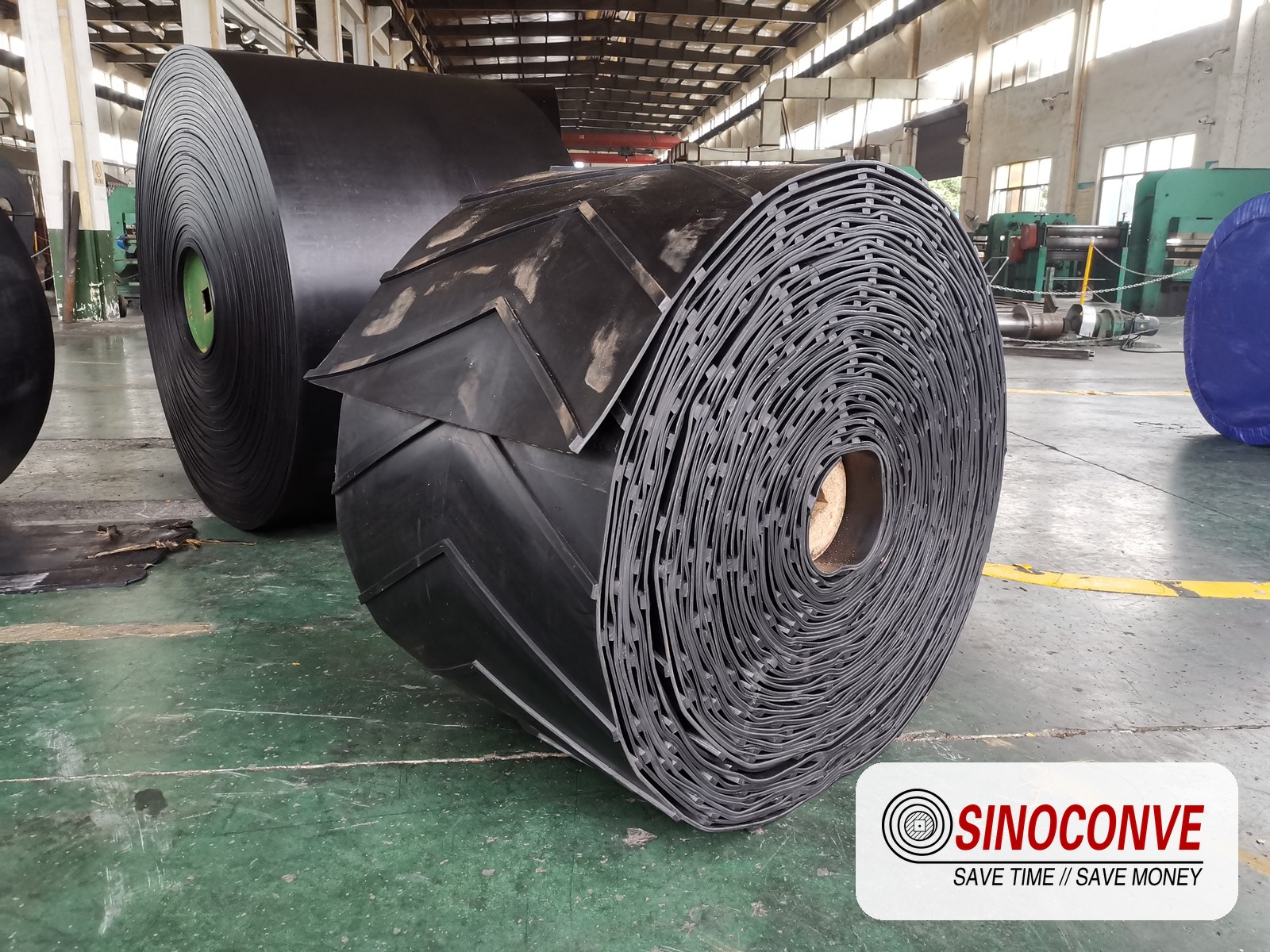
The word chevron covers a family of at least five shapes, and they are not interchangeable. Suppliers quote what their moulds allow. Ours run to several V heights, a crescent form, a multi-rib pattern and a closed U. Which of them suits your line is decided by two properties of the material and one property of the site, and none of those three appears on the specification table either.
Dry, Free-Flowing Material: A Single V Row Is Usually Enough
Crushed limestone, granite, dry sand and clinker pellets behave predictably on a single V row at 16 mm and 250 mm pitch. The rows arrest the load as it starts to slide, and the pockets fill and empty without much residue. If your site is dry for eight months and wet for four, that is a sensible compromise. On a wash plant, where the material is wet every shift, the same belt becomes a slide.
Wet and Sticky Material: Where Crescent and Multi-Rib Patterns Earn Their Price
Sticky material does two things dry material does not. It adheres to the pattern instead of falling away from it, and it lubricates the interface. Both effects reduce the angle the belt will hold. Crescent profiles, with their curved leading edge and deeper effective pocket, hold wet clay and filter cake better than a straight V of the same height. A multi-rib pattern holds a thin, wide bed, which is what you want when the load is shallow and slippery. Nobody pays for a multi-rib mould on dry aggregate.
The Same Word, Different Shapes
A customer asked us last month to match the pattern in a photograph of a competitor's belt. The photograph showed a fishbone. It is a legitimate anti-rollback shape, but it delivers material toward the edges, and his chute was already loading slightly off-centre. We made the belt with a standard V and asked him to shift the chute 80 mm. Tracking settled inside two shifts, and the rubber conveyor belt build has run nineteen months without an edge repair.
| Pattern shape | Material it suits | Angle band we would expect | Cleaning behaviour |
|---|---|---|---|
| Single V row, open end | Dry crushed rock, gravel, clinker, dry sand | 15 to 25 ° | Straightforward. Pockets empty themselves on dry material. |
| Closed U or box row | Damp aggregate where some carryback is acceptable | 18 to 27 ° | Harder. The closed end traps fines until a brush reaches them. |
| Fishbone, rows angled outward | Dry, well-graded material on a centre-loaded chute | 14 to 22 ° | Similar to a V, but it can aggravate off-centre loading. |
| Crescent, curved leading edge | Wet clay, filter cake, damp sand, washed fines | 20 to 30 ° | Difficult. Expect a rotary brush rather than a scraper. |
| Multi-rib or multi-V rows | Shallow beds, slippery material, small lump size | 22 to 30 ° | Difficult and slow. Many small pockets, each holding a little. |
Those angle bands are what we see in service rather than limits written into a standard. Treat the top of each band as a place where a chute test is worth the afternoon, and the middle as comfortable territory.
04Back-Calculating the Angle the Belt Will Actually Hold
Here is the step most enquiries skip. Somebody writes "18 ° incline" in the email, then orders a 16 mm chevron because a neighbouring plant uses one. The neighbouring plant hauls dry granite. This one hauls washed sand. Both belts are 16 mm chevron, and only one of them works.
The Working Rule We Use Before Any Test Is Ordered
Take the material's apparent friction coefficient against rubber, multiply it by a pattern factor and then by a service factor, and take the arctangent of the result. Written out, the maximum holding angle is roughly arctan(0.55 × μ × k), where μ is the friction coefficient in the material's worst realistic condition and k describes how hard the pattern engages the bed. On a smooth cover k is 1.0. A 10 mm V at 200 mm pitch sits near 1.25, a 16 mm V at 250 mm near 1.45, and a 25 mm crescent or multi-rib form near 1.6. The 0.55 absorbs idler vibration, the surge when the crusher dumps a pocket of fines onto the incline, and the difference between a bed of material on a moving belt and a block of stone on a rubber sheet in a laboratory.
Reading the Material, Not the Material's Name
Names mislead. Sand covers dry dune sand at a coefficient near 0.6 and saturated fine sand at close to 0.3, and those two materials need different patterns and different belt widths. Moisture moves the number more than particle size does, and so does temperature once material starts freezing to the cover. This is where a conveyor belt supplier who has stood on your incline earns their margin, because the answer depends on what the material does at 06:00 after rain. If you cannot measure the coefficient, use the table below and then run a chute test: fill a short length of belt with material, tilt it, and note the angle at which the bed moves.
| Material, worst realistic condition | Apparent μ against rubber | Smooth cover | 16 mm V, 250 mm pitch | 25 mm crescent or multi-rib |
|---|---|---|---|---|
| Dry crushed limestone, 0/20 mm | 0.55 to 0.65 | 18 ° | 25 to 26 ° | about 28 ° |
| Washed gravel, 8/20 mm | 0.45 to 0.55 | 15 ° | 21 to 22 ° | about 24 ° |
| Damp sand, 8 % moisture | 0.36 to 0.44 | 13 ° | 18 to 19 ° | 20 to 21 ° |
| Wet clay, plastic | 0.26 to 0.34 | 10 ° | 14 to 15 ° | 17 ° at best |
| Fine filter cake, 30 % moisture | 0.22 to 0.28 | 8 ° | 11 to 12 ° | 13 to 14 ° |
05Why One Belt Climbs 20 ° Dry and Stops at 12 ° Wet
This is the question we field more than any other, and the answer is not in the belt. Two shifts can run the same belt over the same incline with the same tonnage and get different behaviour before and after rain. The specification table did not change between those shifts. The material interface did.
The Lubrication Layer Nobody Budgets For
A thin film of water between material and rubber acts as a boundary lubricant, and it does not need much. On washed sand at 6 % moisture we have measured apparent friction dropping from about 0.55 to around 0.40, which is the difference between a 25 ° belt and an 18 ° belt from a change nobody would notice on a process diagram. Clay goes further, because a plastic clay smears across the pattern and effectively re-faces it with clay sliding on clay. That interface has a friction coefficient roughly half that of rubber, and no pattern height fixes it.
Field note from our engineers: A sand and gravel yard called us about a chevron belt that would not hold 16 ° on a wet morning, having run the same 14 ° section for years without trouble. The belt was a 20 mm V at 300 mm pitch, chosen from a quotation that listed profile height and nothing else. We measured the material at 9 % moisture at the loading point, worked the rule above and got 13.5 ° for that pattern on that material.Two changes fixed it: a 25 mm crescent profile on a 220 mm pitch, and a 150 mm longer skirt with a rubber curtain at the chute so the bed arrived flat instead of heaped. The conveyor went back to 16 ° in dry and wet conditions. The belt cost 11 % more per metre. The alternative, a sidewall belt and a new take-up, would have cost about four times that.
Where This Leaves the Specification Table
It leaves it as a document you read with a pencil in hand. Mark the rows your duty actually constrains, cross out the rows that are catalog decoration, and write the material's worst-case condition in the margin next to the pattern row. When we quote a replacement on a line like that, we ask for the moisture figure in writing, because it moves the outcome more than any other single number. Buyers who source wholesale conveyor belts from a catalogue without that figure are buying the same belt twice within a year.
06From Tonnage to Belt Width: The Cross-Section Back-Calculation
Capacity is the second input, and it is the one where buyers most often read the wrong table. The capacity figure for a smooth belt at 3.15 m/s on a flat-topped trough does not transfer to a patterned belt on an 18 ° slope. Three things change at once: the pattern occupies part of the load area, the bed slumps as the slope rises, and the maximum usable belt speed drops because a steeper belt throws material more easily at the head pulley.
Usable Width and Trough Angle Come Before Speed
Start from the belt width, not the tonnage. For a three-roll troughed belt the usable loading width is roughly 0.9 times the belt width less 50 mm, so a 1,000 mm belt gives about 850 mm of load-bearing surface. The area then depends on the trough angle and the surcharge angle the material forms at rest. A 35 ° trough carries noticeably more than a 20 ° one, and 45 ° more again, but pattern belts trough less cleanly than smooth belts and the side rollers press into rubber blocks. On most chevron installations we stay at 35 °.
What the Pattern and the Incline Take Away
Two corrections are applied to the geometric area before any tonnage figure can be trusted. The pattern itself removes area: on a 16 mm V we allow about 15 %, and on a 25 mm crescent nearer 20 %, because the bed cannot sit down into the pockets and still have its full surcharge above the belt line. The incline removes more, because material on a slope forms a flatter surface and the surcharge triangle shrinks. Between 15 ° and 20 ° we allow a further 15 %, and above 25 ° a further 25 %. Multiply the two and you have the correction factor for your line: about 0.72 on an 18 ° incline with a 16 mm pattern.
| Belt width, mm | Usable loading width, mm | Cross-section, 35 ° trough, m² | Smooth belt at 1.0 m/s | 16 mm pattern at 18 °, factor 0.72 |
|---|---|---|---|---|
| 650 | 535 | 0.043 | 217 t/h | 157 t/h |
| 800 | 670 | 0.068 | 343 t/h | 248 t/h |
| 1,000 | 850 | 0.110 | 554 t/h | 400 t/h |
| 1,200 | 1,030 | 0.164 | 827 t/h | 597 t/h |
Capacities above assume 1.4 t/m³ bulk density and scale linearly with both density and belt speed. Read them as a preliminary sizing tool, then confirm against your own idler geometry, trough angle and surcharge, because a 5 ° change in trough angle moves the area by more than a 10 % change in width. One more caution that belongs here: the table gives the tonnage a width can carry once the material is on the belt. It says nothing about whether the feeding chute spreads that tonnage evenly across the full usable width. A belt loaded onto half its width carries half the tonnage and tracks badly while doing it.
07Sidewall and Cleat Rows: Reading the Steep-Angle Columns
Once the required angle passes roughly 25 °, a plain pattern belt is being asked to do something it cannot do, and the specification table shifts family. Sidewall and cleat rows look similar to pattern rows at a glance, and they are read completely differently. A chevron profile slows sliding. A sidewall stops sliding from happening at all by giving the bed a physical wall, and a cleat divides the belt into cells that lift material the way a bucket elevator does. What the table is really describing in those rows is cell volume.
Sidewall Height Is a Measured Row, Not a Chosen One
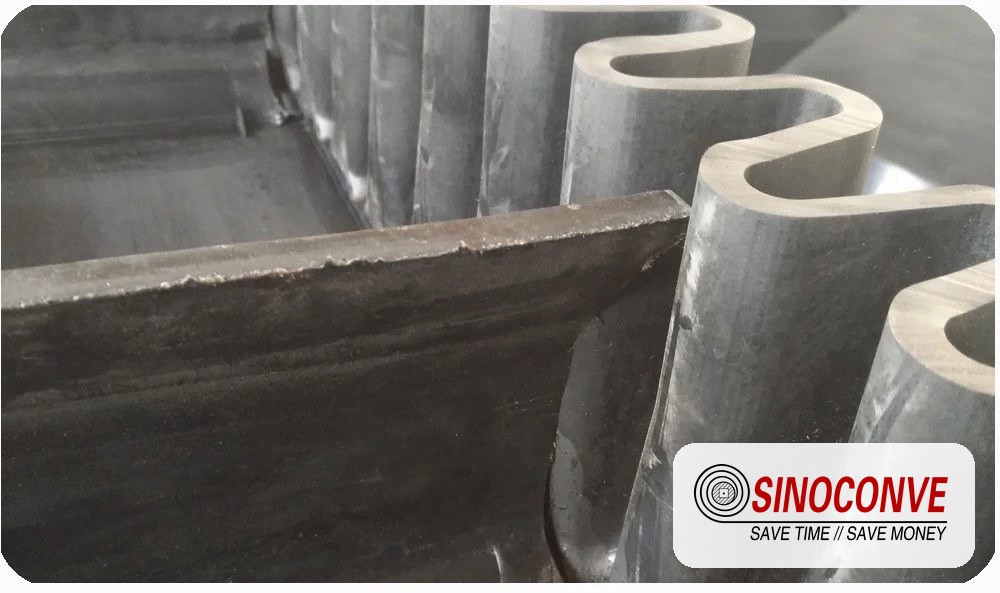
Sidewall height rows read 40, 60, 80, 100, 120, 160 and 200 mm and beyond, and the value you need comes from the bed depth the line demands. Too little and material spills over the wall on the steepest section. Too much and you have bought a taller, heavier belt with a larger minimum pulley diameter and a cell the material never fills. The wall should clear the deepest bed in the worst surge condition by about 20 %.
Cleat Spacing and the Cell Volume It Creates
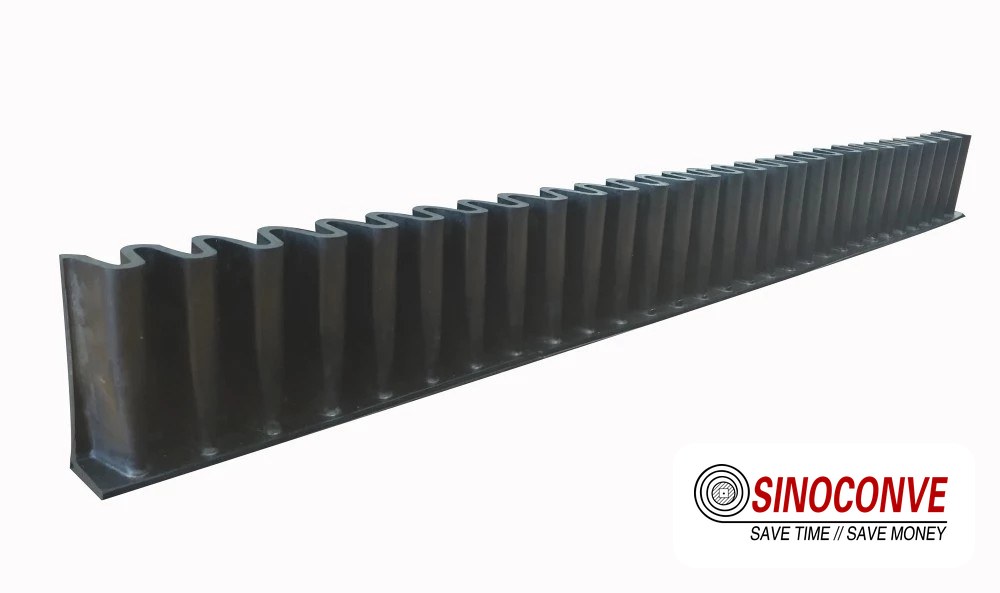
Cleats run across the belt between the sidewalls and turn it into a series of open boxes. Cell volume per pitch is three numbers multiplied: clear width between the walls, cleat spacing, and cleat height, with a fill factor we usually take between 0.7 and 0.85. On an 800 mm base belt with 60 mm walls, about 600 mm of clear width, cleats every 300 mm and 60 mm of cleat height, each cell holds roughly 8.6 litres at a 0.8 fill, or about 29 litres per metre of belt. On a 120 m incline that is 3.4 m³ of material in flight.
Corrugated Beats Flat as Soon as the Belt Has to Bend
The corrugation is not a pattern effect. It is a stress-relief feature. A flat vulcanised wall 100 mm tall will not survive a small-diameter pulley; the corrugations let the wall fold instead of tearing at the base. That is why the row appears on nearly every steep-angle sheet, and why pulley diameter matters as much as wall height. Taller wall, larger minimum pulley, more corrugations across the same height, and a base belt thick enough to carry the wall's load path. If your drawing shows a 400 mm head pulley and the quotation shows a 120 mm wall, one of the two documents is wrong. The selection detail sits in sidewall conveyor belts incline transport and sidewall rubber conveyor belt efficiency redefined.
| Row on a steep-angle sheet | What it decides | How it is normally quoted |
|---|---|---|
| Sidewall height | Maximum bed depth the belt can hold without spilling on the steepest section. | 40 to 200 mm in standard steps, taller by agreement. |
| Sidewall type | Whether the wall can fold around the pulleys or will tear at its base. | Corrugated for almost everything; flat only on very large pulleys. |
| Cleat height and spacing | Cell volume per pitch, which is the actual carrying capacity of the belt. | Cleat height 40 to 120 mm; spacing 200 to 500 mm. |
| Clear width between walls | The width term in every cell volume calculation you will do. | Base belt width less twice the wall thickness and its fillet. |
| Minimum pulley diameter | Set by wall height and cleat height together, not by the base belt carcass alone. | Quoted per wall height by the belt maker; check against the drawing. |
08Behind the Pattern: Plies, Rated Strength and Cover Grades
Tension First, Then Choose the Carcass
Take the 800 mm duty from the previous section: 250 t/h at 1.2 m/s on a 120 m incline of 18 °. Material mass per metre is 250 divided by 3.6 times 1.2, so about 58 kg/m. The lift component is that mass times gravity times the sine of the angle, roughly 175 N/m, which over 120 m is 21 kN before friction is counted. Add belt mass near 12 kg/m, idler rotating mass near 20 kg/m, a friction coefficient of about 0.025 against the normal load, and roughly 2 kN of loading resistances, and the steady effective tension is near 26 kN. With a single lagged pulley at 180 ° wrap the maximum belt tension is about 1.5 times that, or 39 kN, which across 800 mm is 49 N/mm. Apply a safety factor of 8 to 10 and the rated strength has to reach roughly 400 to 490 N/mm. That is an EP500 build in four plies, on a belt carrying only 250 t/h. The incline set that number, not the tonnage.
Cover Grade at the Pattern Tips
Abrasion on a patterned belt concentrates at the leading edges of the pattern, and the wear rate there runs higher than on a flat cover, because the pattern is what the material rubs against. Lose 3 mm from the tip of a 16 mm profile and you have lost close to a fifth of the height that provides the grip. A grade chosen on price alone turns a working incline into a slipping one long before the belt is worn out. The bands below are what DIN 22102 covers are usually quoted against, measured by DIN 53516 and stated as volume loss.
| Cover grade | Abrasion loss commonly quoted, DIN 53516 | Where it earns its place on a patterned belt |
|---|---|---|
| W | Up to about 90 mm³ | Sharp granite, basalt and slag on a steep lift, where tip wear drives the replacement date. |
| X | Up to about 120 mm³ | General quarry duty. The default on most chevron belts we build for aggregate. |
| Y | Up to about 150 mm³ | Lighter abrasive loads, sand and gravel with little oversize in the feed. |
| Z | Up to about 250 mm³ | Heat or fire duty where the compound chemistry takes priority over abrasion resistance. |
09Chevron vs Sidewall vs Rough Top: The Trade-Off Behind the Angle
When the Arithmetic Says No to a Pattern Belt
If your calculation returns 15 ° for a chevron on wet material and the drawing shows 22 °, buying a taller pattern is the wrong reflex. Beyond about 25 ° the bed is not stable in the way the calculation assumes. That is the boundary where a wall does work that friction cannot, and we would rather say so in the quotation than ship a belt that climbs in July and fails in October.
Fix the angle you need, then choose whichever option reaches it with the least disruption to everything else on the conveyor.
| Option | Practical angle | Fits best where | Maintenance load | We advise against it when |
|---|---|---|---|---|
| Rough top, no pocket | 12 to 20 ° for shallow beds | Bags, cartons, shallow beds of small particles | Low, though the surface holds fines and needs brushing | Bulk ore or rock is on the belt, because friction alone will not hold a deep bed on a slope |
| Chevron, single V | 15 to 25 ° dry, 14 to 19 ° damp | Aggregate, clinker, dry sand, most quarry incline work | Moderate. Rotary brush instead of a scraper, plus periodic pocket inspection. | Material is plastic and sticky, or the incline is over 25 ° |
| Crescent or multi-rib | 20 to 30 ° | Wet, sticky, fine material on a steep single lift | Highest of the pattern options. Small pockets defeat lazy cleaning. | Nobody is going to run a brush cleaner, because clay will pack the pattern solid |
| Corrugated sidewall with cleats | 30 to 90 ° | Steep lifts in confined space, dockside and plant transfers | Cell by cell inspection, wall base checks, and a heavier structure to support. | The required angle is under 22 °, where a pattern does the job for a fraction of the structure cost |
The Same Back-Calculation on a Drive Belt
Nothing in the method above is unique to flat belting. A transmission belt manufacturer publishes a datasheet with a power rating per belt, a minimum datum diameter and a service factor table, and buyers read the power rating and ignore the other two. The pattern profile has its counterpart in the wedge geometry: a narrow section carries more power per unit width and needs smaller pulleys, exactly as a taller pattern carries more grip and needs larger ones. As a V-belt manufacturer we spend as much time explaining minimum datum diameter as we do explaining profile height, because both are the row that quietly invalidates an otherwise correct selection. If your local conveyor belt distributor hands you a drive belt schedule with no diameter column, ask for it, in the same way you would ask for the pulley diameter on a steep-angle belt.
10Eight Misreads That Reach the Order Confirmation
None of these mistakes looks like a mistake at the enquiry stage. Each one survives quotation, survives the drawing approval, and shows up during the first wet shift or the first maintenance window, when the belt is already made and the arguments start. We have seen all eight in the last two years.
Misreads About the Pattern Itself
Buying height instead of grip. Standard practice on four enquiries out of ten. The pattern is chosen by the tallest number available, then the material turns out to be wet and the extra height only holds more of it in the pockets. A 25 mm pattern on dry gravel performs no better than 16 mm and costs more.
Then there is the assumption that any V behaves like any other V. Pitch is left out of the comparison, even though 16 mm at 200 mm pitch gives roughly twice the catch points per metre of the same height at 400 mm. Two belts described identically on a quotation can differ by three or four degrees of usable angle.
Ignoring the cover at the pattern tip. A chevron is not a wear part separate from the belt; its tips take the abrasion, and 3 mm of tip wear on a 16 mm profile removes a fifth of the grip. Quoting a Grade Z cover on a sharp aggregate incline because it was the cheapest line on the sheet comes due at the twelfth month.
Misreads About Everything Around the Belt
Capacity is next. Buyers take the tonnage from a smooth-belt table at a higher speed, apply no correction for the pattern or the incline, and order a width one or two steps too narrow. The arithmetic in section 06 is not exotic; it is a 28 % haircut on a typical 18 ° incline, and it is the difference between a working line and a chute full of spillage.
Forgetting the cleaner. A standard doctor blade cannot clean a chevron belt. The blade rides on the tops of the rows, the pockets stay full, and the pressure it applies to a 250 mm pitch pattern eventually tears the tips off. Every one of these belts needs a brush, a water spray, or both, from the day it goes on.
Last, the splice. Chevron belt joints are made in the flat area, so the pattern rows within roughly 50 to 100 mm of the joint are cut back to give the press a flat surface. The joint therefore has less area than a smooth belt of the same width, and higher tension per millimetre across it. The methods and the traps are set out in conveyor belt splicing ultimate guide 2026 methods costs and field tips, and it is worth reading before the belt is ordered rather than after the second failure at the same place.
11The Cleaning Rows Nobody Fills In
Why a Doctor Blade Cannot Do This Job
A scraper works by pressing a hard blade against a flat moving surface with a small, controlled force. Feed it 16 mm of rubber standing proud every 250 mm and three things happen quickly. The blade loses contact between rows, so the pockets keep their contents. It takes an impact each time a row passes, at a frequency set by speed divided by pitch, which is nearly five per second at 1.2 m/s. And the harder blade edge gradually shaves the tips off the pattern it is meant to be cleaning. Rotating brush cleaners are the practical answer, with a water spray ahead of them on dusty material.
What Carryback Actually Costs
Carryback on a patterned belt is not measurable the way it is on a smooth belt, because the pockets hold a fixed volume rather than a film. Work it out from the geometry. A 16 mm pattern at 250 mm pitch leaves a pocket holding close to a litre when it does not empty. If even half the rows arrive at the head pulley still loaded, a 1,000 mm belt at 1.2 m/s is returning about 2.4 litres per second, roughly three tonnes an hour of your product, back into the tail area. Some of it lands on the ground. Some builds under the return rollers, which is where the sealing questions in conveyor idler roller guide how to choose the right one become relevant.
Field note from our engineers: A customer with three parallel incline belts sent us photographs of a return strand. The rollers were still free, but their seals were packed with damp fines and two frames had worn through at the mounting slots. The pattern was 16 mm on a 300 mm pitch, and what they were buying was a heavy pitch on a fine material. We changed two things: pitch down to 220 mm, and a rotating brush fitted after the head pulley on all three belts. Carryback to the floor dropped visibly in the first shift, and the roller replacement rate on those three lines fell from roughly nine per month to two. Nothing else on the conveyors changed, and no belt was replaced to achieve it.
12Worked Example: 250 t/h at 18 ° on a 120 m Lift
The Brief, as Delivered
A sand and gravel plant needed to move washed sand up a stockpile incline. The email carried four lines of duty data and a drawing. Required rate 250 t/h. Incline angle 18 ° over 120 m. Material is screened sand at about 8 % moisture, bulk density around 1.4 t/m³, largest lump 60 mm. Ambient range 5 °C to 35 °C. The drawing showed an 800 mm wide conveyor with 35 ° troughing idlers, a 500 mm head pulley and a 1.2 m/s drive capable of 1.6 m/s.
Step One: Which Pattern Holds 18 ° on This Material?
Damp sand at 8 % moisture has an apparent friction coefficient near 0.40 against rubber, sometimes 0.36 on a bad morning. A 16 mm V at 250 mm pitch gives arctan(0.55 × 0.40 × 1.45), or 17.7 °, which is short of the requirement by half a degree and exactly the sort of margin that disappears in service. A 25 mm crescent form at 220 mm pitch takes the pattern factor to 1.6 and returns 19.4 °. That is what we would quote, noting that the 1.4 ° of margin rests on the moisture figure the plant gave us. The same reasoning on quarry work is set out in abrasion resistant conveyor belt guide for quarry and steep angle conveying.
Step Two: Width and Speed
An 800 mm belt on 35 ° troughing has a geometric cross-section near 0.068 m². Apply 20 % loss for the 25 mm pattern and 15 % for the incline and the usable area is about 0.046 m²: 233 t/h at 1.0 m/s, or 280 t/h at 1.2 m/s. That covers 250 t/h with 12 % in hand, so keep the existing width and leave the 1.6 m/s option unused. The same tonnage on a 650 mm belt would need 1.6 m/s, and at that speed on a 25 mm pattern the bed loses stability and throw-over at the head pulley becomes the new problem.
Step Three: Tension, Plies and the Pulley Nobody Checked
Mass per metre of material is 58 kg. Belt with the 25 mm pattern comes to roughly 18 kg/m, add about 20 kg/m of rotating idler mass and the friction term works out near 2.7 kN over 120 m at a coefficient of 0.025. The lift is 21 kN and secondary resistances about 2.5 kN, so the steady effective tension is near 26 kN. On a single lagged head pulley at 180 ° wrap, maximum belt tension is around 39 kN, or 49 N/mm across 800 mm. With a safety factor of 10 the rated strength has to reach 490 N/mm, which is a four-ply EP500 carcass, heavier than 250 t/h would suggest and entirely because of the lift. Carcass comparison is covered in ep vs nn conveyor belt guide. What the customer had not considered is the third item on our list: a 500 mm head pulley is tight for four-ply EP500, and outside anything we would sign off with 25 mm of pattern standing off the cover. The drum goes to 630 mm or larger, and the take-up needs about 2.4 m of stroke.
| Line on the datasheet | What the brief said | What the back-calculation produced |
|---|---|---|
| Profile and pitch | Not stated | 25 mm crescent or multi-rib, 220 mm pitch, pattern-free strip 150 mm each side |
| Belt width | 800 mm on the drawing, unverified | 800 mm confirmed, with a 12 % tonnage margin |
| Belt speed | Drive capable of 1.2 or 1.6 m/s | 1.2 m/s selected |
| Rated strength and plies | Not stated | 490 N/mm working requirement, four-ply EP500 |
| Cover grade | Not stated | Grade X, top 6 mm, bottom 2 mm; tip wear is the limiting life factor |
| Head pulley | 500 mm | 630 mm minimum, plus a cleat and wall clearance check |
| Cleaning | Existing scraper at the head | Scraper removed, dual rotating brush fitted |
| Take-up stroke | Not stated | About 2.4 m to cover reference-load elongation |
Five of the eight lines above were blank or wrong in the original brief, and every one of them was filled in from a measurement rather than a preference. The belt that came out of this exercise is the chevron conveyor belt family build, and the quarry it went to is typical of the work in our mining and quarrying notes. If you would rather check a cover compound against your own material before committing, rubber conveyor belt cover grades sets out what the letters mean on the sheet.
13What to Send Instead of a Filled-In Datasheet
The One-Page Back-Sheet
Eight lines do the work. Required tonnage in t/h, with the peak rather than the average. Incline angle measured along the slope, and the inclined length. Material name plus its worst condition, with a moisture figure if it is ever wet. Bulk density and largest lump size at the loading point. Required belt speed if the drive already exists. Belt width, trough angle, idler spacing and head pulley diameter off the drawing if the structure is fixed. Ambient temperature range, which changes the compound more than people expect. And whether a cleaning system exists at the head pulley, because that decides whether a pattern is viable at all. Send those with one drawing and we can return a full specification in a single pass. The same eight lines apply whether you are buying one belt or negotiating a wholesale conveyor belts programme.
Two Questions Worth Adding in Writing
First, ask what the belt will hold at the material's worst condition, not its typical one. A supplier who gives you a single angle figure with no material assumption attached has given you a sales number. Second, ask for the minimum pulley diameter that comes with the pattern you have been quoted, in writing, before the order. Both answers are cheap. Both are expensive to discover late. If you are comparing our sheet against another mill's, the FAQ page carries the short version of the same questions, and our blog index holds the longer treatments by product family.

14Frequently Asked Questions
What is the maximum incline a chevron conveyor belt can handle?
It depends on the material, and any answer that skips that is a guess. On dry crushed rock we see 22 to 26 ° in service with a 16 mm pattern at 250 mm pitch. On wet clay the same belt holds about 15 °. The pattern sets the ceiling, the material sets where you land, and moisture alone can move it four or five degrees.
Is a taller pattern always better for a steep incline?
No. Height buys pocket volume, not grip in proportion. Past a point that depends on the material, extra height just collects more carryback and forces a larger minimum pulley diameter. On dry, free-flowing material we often specify 16 mm where the buyer asked for 25 mm, and the belt performs the same with less cleaning work.
Can I use the capacity table for a smooth belt on a chevron belt?
Only after two deductions: 15 to 20 % for the pattern, then another 15 % for the incline above about 15 °. On a typical 18 ° incline that is a 28 % haircut. A width that looks generous on the smooth-belt table is often exactly right once those numbers are applied.
Which is better, a chevron belt or a sidewall belt?
Neither is better in the abstract, and the angle decides. Under about 22 ° a pattern belt usually does the job on the same structure, at lower cost and with a simpler head. Above 28 ° a corrugated sidewall with cleats takes over, because the material is held by a wall rather than by friction. Between the two, the head pulley diameter usually settles it.
Why does the same belt slip after rain?
Water forms a boundary film between the material and the rubber. We have measured apparent friction falling from about 0.55 to 0.40 on washed sand at 6 % moisture, which can cost six or seven degrees of holding angle. The belt did not change. The interface did.
Do chevron belts need special cleaning equipment?
Yes, and a standard scraper is the wrong tool. A doctor blade rides on the tops of the rows, leaves the pockets full, and takes an impact at every row, nearly five per second at 1.2 m/s and 250 mm pitch. We fit rotating brushes, with a water spray on dusty material, and two brush positions on wide belts carrying sticky fines.
How do I read the ply count on a chevron belt datasheet?
Add the plies rather than looking for a headline number. A fabric ply is rated by its own breaking strength in N/mm, so EP125 plies stack as 125, 250, 375 and 500, and a four-ply EP500 belt is a 500 N/mm carcass. Check it against the working tension your incline develops, not against the tonnage.
Does the pattern change the minimum pulley diameter?
It does, and this is the row that causes most of the site problems we see. The pulley has to take the carcass plus the thickness of the pattern standing off the cover, and the fabric reinforcement inside the pattern stiffens the belt where it curves. Ask for the minimum diameter that matches your pattern, in writing, before the order.
How much does a chevron belt cost compared with a smooth one?
Budget roughly 10 to 25 % more per metre than a smooth belt on the same carcass, with the upper end for tall crescent and multi-rib profiles. The number moves with width, ply count and the cover grade you choose for the pattern tips. Treat any range as indicative and confirm it against your own duty and drawings.
What information do you need to quote a chevron belt properly?
Tonnage including peaks, incline angle and inclined length, material with its worst-condition moisture, bulk density, largest lump size, and the mechanical details of the existing structure if it is staying. Cleaning equipment at the head pulley matters more than most buyers expect. Send those with a drawing and the quotation comes back in one pass instead of three.
15Related Products You May Need
- Chevron conveyor belt — the pattern range this article sizes, in single V, crescent and multi-rib forms
- Rubber conveyor belt
- EP rubber conveyor belt — the polyester and nylon carcass behind the ply counts calculated above, quoted with the rated strength in N/mm stated on the sheet
- Heat resistant conveyor belt — for the same incline duty where the material also arrives hot
- EP1000 stone crusher conveyor belt — where impact energy at the loading point, not the incline, is what sets the cover
- V-belts for conveyor drives
- Conveyor rollers — the return side that pays the price when a heavy pattern does not empty
- Full product catalog
16Related Blog Posts
- Chevron conveyor belts: incline anti-slip — why a patterned surface grips at all, which is the mechanism this article assumes rather than explains
- Chevron conveyor belt for steep bulk handling
- Sidewall conveyor belts for incline transport — the family that takes over above the angle band a pattern can hold, with wall height against duty covered properly
- Corrugated sidewall conveyor belt for steep conveying
- Sidewall rubber conveyor belt efficiency redefined
- The application of rough top rubber conveyor belts — surface friction without pocket volume, for shallow beds and packaged loads
- Cleated conveyor belt bulk handling selection
- Rough top conveyor belt guide for packaging and light duty lines
- Heat resistant conveyor belt specification table: what the numbers actually mean — the same reading discipline applied to the temperature and compound rows
- Abrasion resistant conveyor belt guide for quarry and steep angle conveying — where cover selection and steep-angle mechanics meet
- Conveyor belt splicing ultimate guide 2026: methods, costs and field tips
- Rubber conveyor belt ultimate guide 2026: types, grades and how to choose