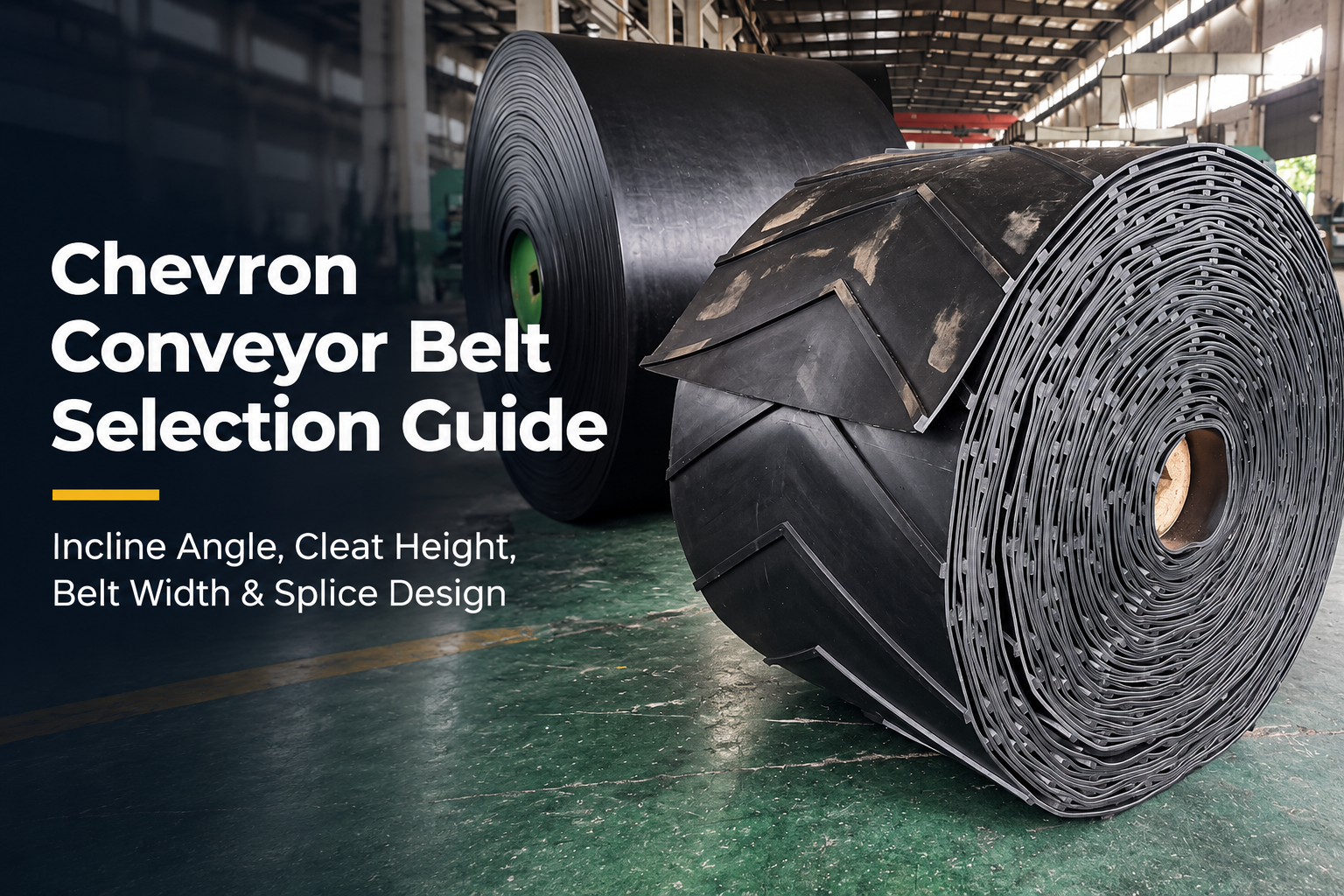

Material rollback is usually noticed late. The conveyor has already been installed, the angle is fixed, and the buyer only realizes the problem when grain, sand, crushed stone, fertilizer, or small packaged goods start sliding back on the belt. In that situation, a cleated conveyor belt is not just an accessory. It becomes part of the material control system.
A flat rubber conveyor belt can work well on horizontal conveyors and mild inclines. Once the angle rises, or the material is loose, wet, round, or easy to roll, the belt surface alone may not provide enough carrying control. Cleats create a raised profile across the belt surface, helping the material move with the belt instead of moving against it.
Still, not every site needs the same cleat. Some plants need a low-profile pattern to stop light sliding. Others need stronger molded cleats for steep lifting. Choosing only by price often leads to the wrong result: broken cleats, poor tracking, excessive vibration, or a belt that cannot pass smoothly around the pulley.
Where a Cleated Conveyor Belt Actually Helps
The cleated conveyor belt is most useful when the belt must carry material at an incline and the product cannot stay stable on a smooth surface. It is common in short transfer conveyors, mobile equipment, loading systems, packaging lines, agriculture, recycling plants, cement-related material handling, and some quarry or mining support conveyors.
The main purpose is not to make the conveyor look stronger. It is to keep the material in place during movement. On some sites, this means reducing rollback. On other sites, it means reducing spillage near the loading point or improving feed consistency into the next machine.
For heavy-duty bulk handling, the buyer should look at the whole operating condition: material size, lump impact, moisture, belt speed, incline angle, working hours, pulley diameter, and the cleaning method. A cleat that works for dry grain may not survive sharp crushed stone. A cleat that looks suitable for fertilizer may not be the right choice for hot clinker or abrasive material.
Cleated Conveyor Belt vs Flat Rubber Conveyor Belt
A flat rubber conveyor belt is easier to clean, easier to splice, and usually more flexible for long-distance conveying. A cleated conveyor belt adds material control, but it also changes how the belt bends, cleans, and runs through the system. This is why the choice should start from the conveyor layout rather than from the product name.
|
Item |
Flat Rubber Conveyor Belt |
Cleated Conveyor Belt |
|
Main use |
Horizontal or low-incline conveying |
Inclined or controlled material movement |
|
Material behavior |
Best when material stays stable on belt surface |
Useful when material rolls, slides, or needs separation |
|
Cleaning |
Usually easier with standard scrapers |
Needs careful scraper position; cleats can trap fines |
|
Pulley requirement |
Standard selection by belt strength and thickness |
Pulley diameter must also suit cleat height and belt flexibility |
|
Typical buyer concern |
Strength, cover grade, abrasion, elongation |
Cleat height, spacing, bonding, belt tracking, and rollback control |
In many plants, the wrong choice happens when the buyer treats a rubber cleated conveyor belt as a normal belt with added ribs. It is not quite that simple. The cleat profile affects material loading, cleaning, bending stress, and sometimes even the splice method.
Key Design Points Buyers Should Check
1. Incline Angle and Material Flow
Incline angle is the first practical question. A low incline may only need a rough-top surface or shallow pattern, while a steeper conveyor often needs higher cleats. But angle alone is not enough. Material shape matters. Round pellets roll more easily than crushed material with irregular edges. Wet material may stick, then drop suddenly. Fine powder may collect around the cleat base.
Before ordering a cleated conveyor belt, describe how the material behaves on the existing conveyor. Does it roll back immediately? Does it slide only when the belt starts? Does spillage happen near the loading zone, the middle section, or the discharge point? These details help the supplier recommend cleat height and spacing more accurately.
2. Cleat Height, Shape, and Spacing
Higher cleats are not always better. A very high cleat may carry more material on a steep conveyor, but it also requires enough pulley clearance and proper belt flexibility. If the pulley is too small, the cleat base can face repeated stress. Over time, this may cause cracking or separation.
Spacing also affects capacity and flow. Close spacing may help with small loose material, but it can reduce smooth discharge or create cleaning problems. Wider spacing may work for larger pieces or packaged products. For real production lines, the target is not the tallest cleat. The target is stable carrying with acceptable cleaning and service life.
3. Base Belt Strength and Cover Rubber
A cleated belt still depends on the base belt. The carcass strength, ply number, rubber cover grade, thickness, and elongation behavior must suit the load. If the base belt is too weak, good cleats will not solve stretching, edge damage, or tracking instability.
For a rubber cleated conveyor belt used in abrasive material handling, the cover rubber should be selected with abrasion in mind. For wet or mildly chemical environments, oil resistance or chemical exposure should be discussed. For hot material, heat resistance becomes more important than appearance. A cleat that looks clean in a catalogue may fail early if the rubber grade does not match the working condition.
Working Condition Matching Table
|
Application |
Common Material Behavior |
Selection Focus |
|
Agriculture and grain handling |
Rolling, sliding, light spillage on incline |
Moderate cleat height, stable spacing, easy cleaning |
|
Cement plant auxiliary conveying |
Dust, abrasion, sometimes warm material |
Abrasion-resistant cover, good cleat bonding, careful cleaning design |
|
Quarry or aggregate transfer |
Sharp edges, impact, uneven loading |
Stronger base belt, abrasion cover, impact-aware loading point |
|
Port or logistics loading |
Mixed bulk material, higher running hours |
Consistent tracking, stable delivery, wear-resistant cover |
|
Recycling or packaged goods |
Irregular shapes, separation needs |
Cleat pattern based on product size and discharge method |
Common Problems When the Wrong Cleated Belt Is Used
One common problem is cleat cracking near the base. This can happen when the cleat is too high for the pulley condition, the rubber compound is not suitable, or the belt is forced through a tight bend. Another problem is poor tracking. The buyer may blame the cleats, but the real cause can be uneven loading, pulley misalignment, poor belt tension, or an old conveyor frame.
Material carryback is also often underestimated. Cleats can hold fines, especially when the material is wet. If the cleaning system is designed for a flat rubber conveyor belt, it may not work properly after switching to a cleated conveyor belt. This does not mean cleats are wrong. It means scraper type, discharge design, and cleaning access should be reviewed together.
The most expensive mistake is ordering only by belt width and length. For flat replacement belts, that may sometimes work. For cleated belts, it is risky. The supplier should know the incline angle, material, pulley diameter, belt speed, cleat layout, and whether the belt will be vulcanized endless or joined on site.
What to Provide When Asking for a Quotation
A useful quotation request should give the supplier enough information to avoid guessing. At SINOCONVE, cleated conveyor belt selection usually starts with working conditions rather than only belt price. This saves time during confirmation and reduces the chance of receiving a belt that fits the dimension but not the job.
|
Information to Provide |
Why It Matters |
|
Belt width, total length, and thickness |
Basic production and fitting dimensions |
|
Incline angle and conveyor layout |
Determines whether cleats are needed and how high they should be |
|
Material name, size, weight, moisture, and temperature |
Affects cleat design, cover rubber, and wear resistance |
|
Belt speed and daily working hours |
Influences heat build-up, fatigue, and service life |
|
Pulley diameter and take-up arrangement |
Checks whether the belt and cleats can bend properly |
|
Existing cleat height, spacing, and shape if replacing |
Helps match the old system and avoid installation surprises |
|
Splice requirement: open length or endless belt |
Affects production method, installation, and transport packing |
Buyer Checklist Before Ordering
· Confirm whether the conveyor is horizontal, inclined, or steeply inclined.
· Check whether material rolls back, slides, sticks, or causes carryback.
· Measure existing belt width, length, thickness, and cleat profile if replacing an old belt.
· Share pulley diameter before choosing high cleats.
· Match rubber cover grade to abrasion, heat, oil, moisture, or chemical exposure.
· Ask whether the belt will be supplied open, endless, or prepared for on-site joining.
· Do not choose the thickest belt automatically; choose the belt that fits the load and conveyor structure.
Why Supplier Communication Matters
For customized rubber conveyor belts, the technical discussion can be more valuable than a fast price. A distributor or EPC buyer may already know the required belt size, but the end user often knows the real problem: rollback after rain, belt slip during start-up, fast wear near the loading point, or unstable tracking after replacement.
SINOCONVE normally checks belt width, strength, cover grade, material type, and site conditions before production. That process is not meant to make the order complicated. It is meant to avoid a belt that works for one month and then becomes a maintenance issue. A suitable cleated conveyor belt should help the plant save time and save money by reducing unnecessary replacement, clean-up, and downtime.
FAQ
What is a cleated conveyor belt used for?
A cleated conveyor belt is used when material needs extra control on an inclined or special conveyor. The raised cleats help reduce rollback and slipping, especially for loose bulk material, small packages, agricultural products, recycling material, and some construction or mineral materials. It is not only for steep conveyors; it can also improve feeding stability in short transfer sections.
Is a rubber cleated conveyor belt better than a flat rubber conveyor belt?
It depends on the conveyor layout. A flat rubber conveyor belt is often better for horizontal conveying, long-distance movement, and easier cleaning. A rubber cleated conveyor belt is better when the material slides, rolls, or needs controlled movement on an incline. The better choice is the one that matches material behavior, belt speed, pulley size, and cleaning conditions.
How do I choose the right cleat height?
Cleat height should be selected according to incline angle, material size, flow behavior, and pulley conditions. Higher cleats can help carry material on steeper conveyors, but they may create bending stress or cleaning issues if the conveyor is not suitable. Buyers should provide the incline angle, pulley diameter, and material details before confirming the cleat profile.
Why do cleats crack or separate from the belt?
Cleat cracking can come from several causes: unsuitable rubber compound, poor bonding, small pulley diameter, excessive bending, heavy impact at the loading point, or chemical and heat exposure. Sometimes the belt itself is not the only reason. Conveyor alignment, tension, scraper design, and material loading conditions should also be checked.
What information should I send to a cleated conveyor belt manufacturer?
Send belt width, length, thickness, cleat height, cleat spacing, material type, incline angle, pulley diameter, belt speed, working hours, and whether the belt needs to be open or endless. Photos of the old belt and conveyor are also useful. Good information helps the manufacturer recommend a practical belt instead of guessing from dimensions alone.
Final Recommendation
A cleated conveyor belt should be selected from the working condition, not from a catalogue picture. The right belt controls material movement without creating new problems in cleaning, bending, tracking, or installation. For light material, a simple cleat pattern may be enough. For abrasive or heavy-duty use, the base belt strength, cover rubber, cleat bonding, and conveyor structure need more careful checking.
For buyers comparing suppliers, price matters, but downtime usually costs more. A practical supplier should ask about the site before recommending a belt. That is where a well-selected cleated conveyor belt can do its real job: keep material moving, reduce waste, and make the conveyor easier to operate over time.