
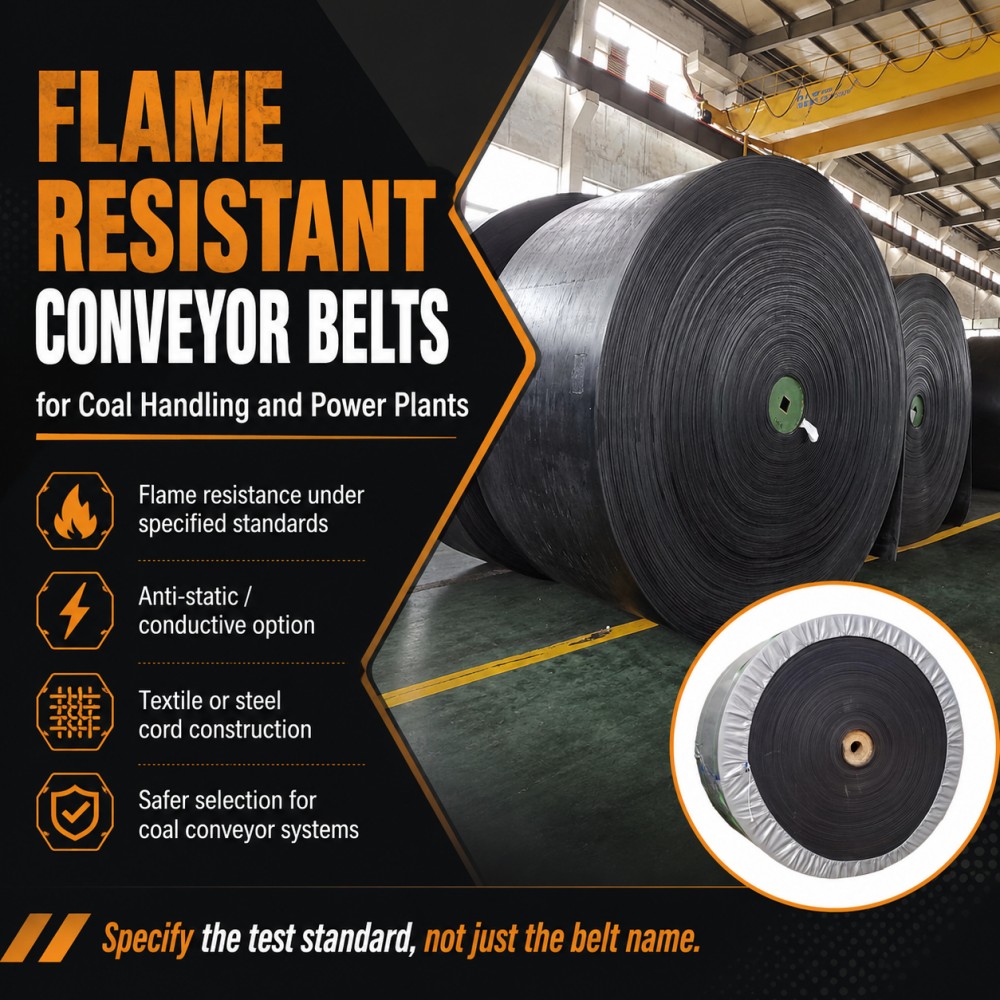
Two quotations can both say "FR coal conveyor belt" and still describe different products. One supplier may mean only a small-flame laboratory test. Another may include electrical conductivity, drum-friction performance, or a higher fire-safety category. The width and tensile rating can look identical while the safety scope is not.
That ambiguity matters in a coal handling system. Coal dust, carryback, enclosed galleries, long transfer routes, hot bearings, and a belt rubbing against fixed steel can turn a mechanical fault into an ignition source. A flame resistant conveyor belt helps reduce the chance that the belt will support or spread a fire, but it does not replace housekeeping, alignment control, detection, suppression, and disciplined maintenance.
For power plant buyers, the useful question is not simply, "Is this belt flame resistant?" It is: "Which test standard, safety category, construction, and operating conditions does this belt cover?"
What Flame Resistance Means for a Coal Conveyor Belt
A flame resistant belt is engineered to resist ignition and/or limit flame propagation under a defined test method. It should not be described as non-combustible or fireproof. Rubber covers, reinforcement, skim compounds, and splice materials form a complete belt construction, and its fire behavior must be assessed against the applicable specification.
ISO 340 is a laboratory-scale flammability test for textile and steel cord conveyor belts. That scope matters. Passing a small-scale test does not prove that an entire power plant conveyor will be safe during a fire involving coal, dust deposits, lubricants, electrical equipment, and ventilation airflow.
Electrical conductivity is a separate property. A flame retardant belt is not automatically anti-static, and an anti-static belt is not automatically flame resistant. ISO 284 addresses belt conductivity and the dissipation of static charge. In a coal handling area, the RFQ should state whether both properties are required.
Heat resistance is different again. A heat-resistant cover is selected to tolerate elevated material temperatures; it does not automatically provide the required flame-propagation performance.
|
Term |
Main purpose |
Buyer caution |
|
Flame resistant |
Limits ignition or flame propagation under a specified test |
Confirm the exact test and category |
|
Anti-static / conductive |
Helps dissipate static electrical charge |
Specify and verify separately |
|
Heat resistant |
Resists thermal aging from hot material |
Does not replace flame resistance |
|
Oil resistant |
Reduces swelling and softening from oils |
Needed only where contamination exists |
Where Fire Risk Develops on a Power Plant Conveyor
Friction at pulleys and seized idlers
A stalled belt under a rotating drive pulley can generate intense frictional heat. The same applies when a moving belt passes over a seized idler. Bottom-cover wear, polished rubber, smoke odor, hot bearings, or a local temperature rise are warning signs, not cosmetic defects.
Belt misalignment and edge rubbing
A coal conveyor belt that tracks against a stringer, chute wall, skirt plate, or guard can heat and abrade the edge continuously. Edge fraying is often blamed on belt quality, but the root cause may be off-center loading, pulley misalignment, damaged idlers, material buildup, or incorrect transition geometry. Installing a thicker edge will not correct the steering problem.
Carryback, spillage, and coal dust
Carryback can build up on return idlers and pulleys, interfere with tracking, contaminate bearings, and create additional fuel around the conveyor. Dust suspended in air can also present a flash-fire or explosion hazard under suitable conditions. Belt cleaning, transfer-point sealing, dust control, and routine deposit removal are therefore part of fire safety, not just housekeeping.
Hot work and electrical faults
Welding, cutting, overheated motors, damaged cables, and faulty brakes can provide ignition sources near the belt line. Work permits, isolation, fire watches, and post-work inspection must be coordinated with the plant's fire protection plan.
Choosing the Belt Construction
Power plant conveyors range from short feeder belts to long gallery or overland routes. Reinforcement must be selected from the actual tension calculation, not from the assumption that a stronger belt is always safer.
|
Construction |
Typical fit |
Points to verify |
|
Textile-ply belt |
Short to medium conveyors, moderate tension |
Ply rating, elongation, troughability, impact support, splice |
|
Steel cord belt |
Long centers, high tension, lower elongation |
ST rating, cord layout, pulley diameters, splice, rip risk |
|
Special or enclosed design |
Pipe, closed-trough, steep incline |
Flexing, overlap zone, transition design, supplier limits |
For textile belts, define the carcass type, tensile rating, number of plies where applicable, top and bottom cover thickness, and troughing requirement. A belt that is too stiff for the idler angle can run poorly even when its tensile strength is adequate.
For steel cord belts, the ST rating alone is not enough. Cord layout, breaker or rip-protection layers, splice length, pulley diameter, and transition design affect the system. The supplier should review the conveyor data rather than quote from width and ST rating only.
The cover compound may need to combine flame resistance with abrasion resistance, cut resistance, weathering performance, and electrical conductivity. More rubber is not automatically better. Excessive thickness adds belt weight and flexing demand, while an underspecified cover may wear through early and expose the carcass.
Standards and Test Evidence Buyers Should Request
The standard named in the purchase order should match the conveyor location and local rules. Above-ground power plant service is not the same regulatory environment as an underground coal mine.
|
Standard or framework |
Relevance |
What to confirm |
|
ISO 340 |
Laboratory-scale flammability for textile and steel cord belts |
Current edition, result, exact construction |
|
ISO 284 |
Electrical conductivity of conveyor belts |
Whether conductivity is required and documented |
|
EN 12882 |
Electrical and flammability categories for general-purpose, above-ground belts |
Required category and included tests |
|
MSHA 30 CFR Part 14 |
Approval for underground coal mine belts in the United States |
Use only when this approval scope is required |
|
Plant fire code or owner specification |
System-level fire protection |
Detection, suppression, interlocks, inspection duties |
A brochure statement such as "meets international standards" is not enough. Ask the supplier to identify the standard, edition, category or class, test method, sample description, and whether the report applies to the offered cover compound and carcass. A report for one belt family should not automatically be assumed to cover every thickness or reinforcement.
Splicing deserves the same attention. The splice introduces uncured or separately cured rubber, adhesives, fabric or cords, and workmanship variables. The supplier should specify the recommended splice system and site curing method. A poorly controlled splice can become the weakest mechanical point and may not preserve the intended fire-resistant properties.
What Existing Belt Damage Can Tell You
The old belt is often the best field report available. Photograph the top cover, bottom cover, edges, splice, pulley contact zones, and loading area before removal.
|
Observed mark |
Possible cause |
Check before ordering |
|
Glazed or hardened rubber near a pulley |
Slippage or frictional heating |
Take-up, lagging, drive control |
|
Longitudinal edge wear |
Mistracking or frame contact |
Loading, idlers, pulley alignment |
|
Bottom-cover scoring at regular intervals |
Seized or damaged idlers |
Roller rotation, shell and bearing condition |
|
Deep impact cuts near a transfer point |
High drop, large lumps, poor support |
Chute trajectory, impact bed, lump size |
|
Cracking or unusual hardening |
Temperature, aging, unsuitable compound |
Material temperature and supplier limits |
|
Splice separation or delamination |
Splice design, curing, tension |
Splice records, pulley size, take-up |
These marks do not prove a single root cause, but they help prevent a repeat purchase based only on the nameplate specification. A flame resistant conveyor belt installed on a misaligned, contaminated system can still fail mechanically and create heat.
Information to Put in the RFQ
A useful RFQ should include:
1. Conveyor duty: location, center distance, lift, incline, capacity, belt speed, and operating schedule.
2. Belt geometry: width, total length, trough angle, transition distances, and minimum pulley diameters.
3. Material data: coal type, bulk density, moisture, maximum lump size, fines content, feed temperature, and contamination.
4. Loading conditions: drop height, chute arrangement, impact support, feeder behavior, and surge loading.
5. Belt construction: textile or steel cord, tensile or ST rating, covers, thicknesses, edge type, and splice method.
6. Safety requirement: flame test standard, conductivity requirement, fire-safety category, plant specification, and documents.
7. Existing problems: edge wear, carryback, slippage, cover cuts, splice failures, or temperature alarms, with photographs.
8. Supply details: roll length, roll weight limits, shaft requirements, packaging, marking, splice materials, and schedule.
This information lets suppliers quote the same duty. Without it, a low price may simply reflect a lower fire category, thinner covers, a different carcass, or missing test documentation.
How to Compare Supplier Quotations
Compare each offer line by line rather than by price per meter. Check the full belt designation, reinforcement, cover thickness, safety standard, test category, anti-static property, splice materials, tolerances, marking, document package, and delivery form.
Also separate product evidence from company capability. Ask how raw materials are inspected, how compound batches are controlled, what finished-belt tests are performed, and how nonconforming material is isolated. A practical supplier should flag missing design data rather than silently quote around it.
FAQ
Is a flame resistant conveyor belt fireproof?
No. It is designed to resist ignition or limit flame propagation under specified test conditions. It can still burn under severe or prolonged exposure, especially when coal, dust, oil, or other fuels are present.
Does every coal conveyor belt need anti-static properties?
The requirement depends on the risk assessment, plant specification, and local regulations. In areas with combustible coal dust, conductivity is commonly considered, but it should be specified and tested separately from flame resistance.
Can a heat-resistant belt replace a flame retardant belt?
No. Heat resistance addresses elevated material temperature and thermal aging. Flame resistance addresses ignition and flame behavior. Some applications require both properties in one compound system.
Should a power plant use textile or steel cord reinforcement?
Use the conveyor tension calculation and operating geometry. Textile belts are common on shorter or moderate-tension routes, while steel cord belts suit long, high-tension conveyors. Pulley diameters, troughing, impact, and splice design must also be checked.
What documents should be requested with the order?
Request the product data sheet, belt designation, applicable test reports or certificates, agreed inspection documents, splice procedure, marking details, and any project-specific compliance statement.
Can a flame resistant belt prevent a coal conveyor fire by itself?
No. It is one control measure. Reliable fire safety also depends on tracking, clean idlers and pulleys, dust and carryback control, fire detection, suppression, interlocks, inspections, and safe hot-work procedures.
Final Selection Check
Confirm three things before releasing the purchase order: the safety standard matches the conveyor's actual location, the offered construction matches the mechanical duty, and the plant's fire protection measures address ignition sources around the belt.
SINOCONVE has 35 years of industrial belt manufacturing experience and applies raw-material inspection, process control, finished-product inspection, and performance testing. For a flame resistant conveyor belt project, the best starting point is still a complete conveyor data sheet and a clearly stated test standard. That is how buyers avoid comparing products that share the same label but not the same safety scope.