
Application of Rough Top Rubber Conveyor Belt in Inclined Handling
A rough top surface is not chosen because it looks stronger than a smooth belt. It is chosen when the product refuses to stay where the conveyor layout expects it to stay. Cartons creep backward on a short incline. Bagged goods shift before transfer. Wrapped packages twist just enough to miss the next guide rail. In these cases, a standard rubber conveyor belt may still move, but the product flow is no longer controlled.
That is the practical reason behind the Application of rough top rubber conveyor belt systems. The belt surface adds grip without using high cleats or deep profiles. For many packaging, logistics, woodworking, light manufacturing, and warehouse transfer lines, that middle ground is useful: more holding force than a smooth belt, less obstruction than a cleated belt.
What the Rough Top Surface Actually Changes
The working surface of a rough top rubber conveyor belt has a textured profile. The texture increases contact with cartons, sacks, wrapped goods, panels, or other products that need help staying stable during movement. It does not turn the belt into a heavy bulk material belt, and it does not replace a cleated belt where steep incline and loose material are involved.
The main change is friction control. A smooth belt may release products easily, but it can also allow light goods to slide when the conveyor angle changes. A rough top surface grips the product base more firmly. That can reduce rollback on inclined sections and soften the transition between conveyors, especially when the product bottom is paperboard, woven bag, plastic wrap, or a slightly uneven surface.
There is a trade-off. More grip can also mean more dust holding, more surface wear in one lane, or too much drag at discharge if the product needs clean release. For this reason, the belt should be selected by product behavior, not only by the words “rough top.”
Where Rough Top Belts Make Sense
The most useful applications are not always the heaviest ones. A rough top rubber conveyor belt often works best where product stability matters more than raw pulling force. The line may be light or medium duty, but the handling problem is still real.
|
Application area |
Why rough top helps |
Point to check before ordering |
|
Inclined carton transfer |
Adds grip so cartons do not slide backward before the next station |
Carton base material, incline angle, transfer speed |
|
Bagged goods handling |
Helps woven bags or plastic-wrapped goods stay stable on short rises |
Bag weight, surface dust, bag deformation |
|
Airport or parcel handling |
Reduces unwanted shifting during transfer and sorting |
Belt speed, product mix, guide rail contact |
|
Woodworking or panel movement |
Supports controlled movement without sharp cleats touching the product |
Panel finish, marking risk, dust extraction |
|
Light packaging discharge |
Improves product spacing where smooth belts release too early |
Discharge point, product bottom, downstream timing |
Application of Rough Top Rubber Conveyor Belt: Common Selection Mistakes
One mistake is using rough top as a universal answer for every incline problem. If the material is loose grain, sand, wet aggregate, or small bulk parts, the surface may still allow material to roll or scatter. In that case, chevron, cleats, sidewalls, or a different conveyor design may be needed.
Another mistake is ignoring the pulley layout. Rough top belts are not only judged by the top surface. The belt still has to bend around pulleys, run over rollers, track correctly, and pass through the return path without rubbing the frame. A thick or stiff belt on a small pulley may crack earlier than expected, even if the top surface grips well.
A third mistake is over-tensioning. When products slide, maintenance teams sometimes tighten the belt first. That may reduce slip for a short time, but it can increase bearing load, open the splice area, or accelerate surface wear. If the product still moves unpredictably after tension adjustment, the issue may be surface selection, incline angle, transfer point design, or product base material.
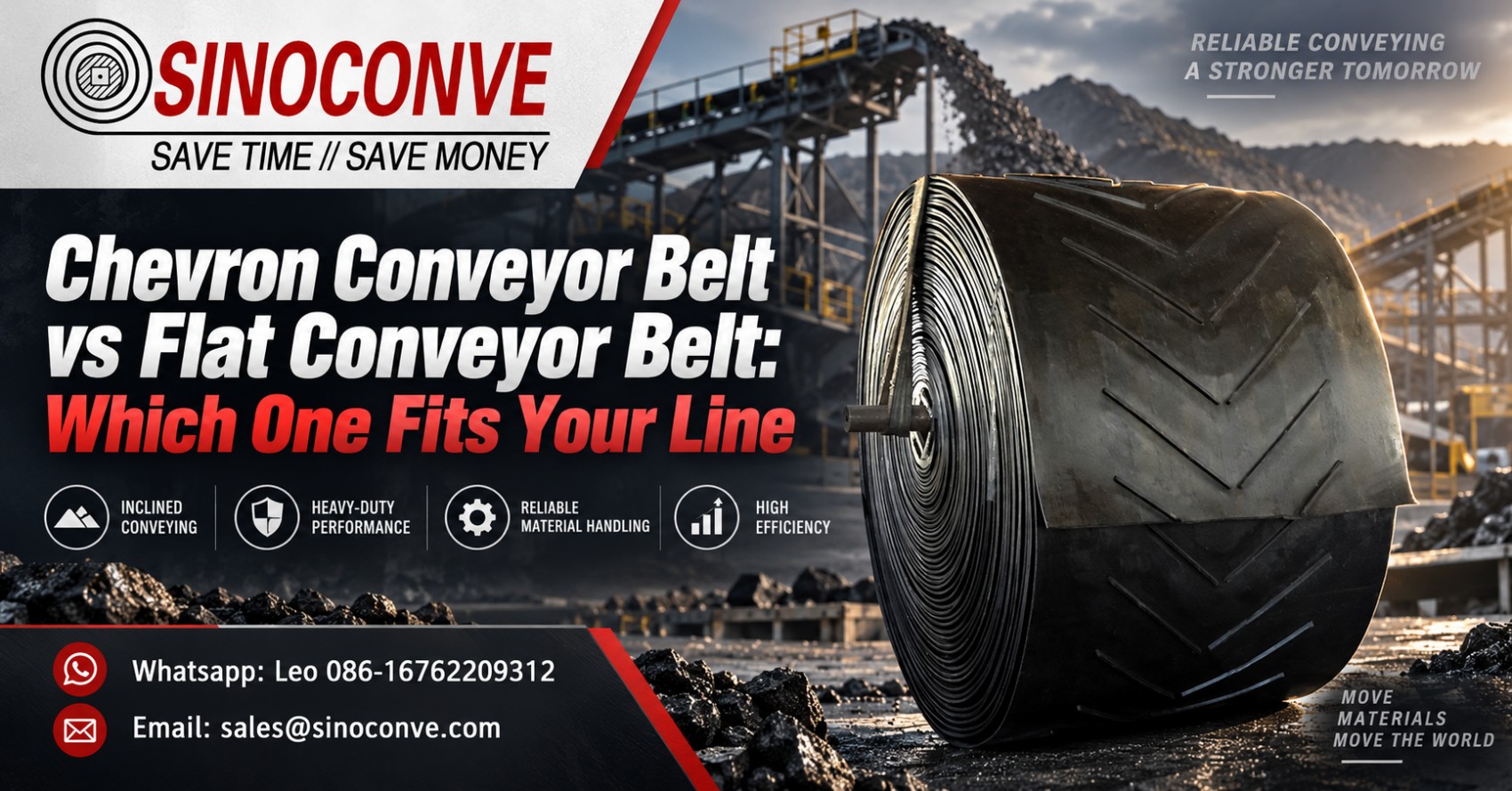
Rough Top vs Smooth, Chevron, and Cleated Belt Surfaces
Different belt surfaces solve different problems. A rough top rubber conveyor belt sits between smooth conveying and positive holding profiles. It is useful when friction is needed, but the line does not need raised cleats or deep chevron patterns.
|
Belt surface |
Better fit |
Risk if selected poorly |
|
Smooth rubber conveyor belt |
Flat transfer, easy release, products that should not drag |
May slip on inclines or during short transfers |
|
Rough top rubber conveyor belt |
Cartons, bags, parcels, panels, light goods on inclines |
Can hold dust or over-grip products that need clean release |
|
Chevron belt |
Loose or bulk material on inclined conveyors |
May be harder to clean and may not suit small pulleys |
|
Cleated belt |
Controlled spacing or steeper transfer of products or light bulk goods |
Cleat bonding, return clearance, and cleaning gaps must be checked |
What Usually Shortens Belt Life
Early failure is rarely caused by one factor. On a packaging incline, a polished strip in the center of the belt may show that cartons are sliding before they are carried. On a parcel line, uneven edge wear may point to tracking drift rather than poor rubber quality. On a woodworking line, dust can fill the surface texture and reduce grip, so the belt begins to behave like a worn smooth belt.
Loading also matters. If products land on the belt from height or hit the same section repeatedly, the surface takes impact and abrasion in a narrow zone. The belt cover may wear there first, even though the rest of the belt still looks usable. Cleaning methods can create their own problems. Aggressive scraping, unsuitable chemicals, or dry dust buildup may damage the surface texture before the belt carcass is worn out.
|
Observed problem |
Likely cause |
What to check first |
|
Products slide backward |
Surface grip too low, incline too steep, or product base too smooth |
Incline angle, surface texture, belt speed, product bottom |
|
Surface becomes polished |
Repeated product slip or one-lane loading |
Loading position, product contact area, belt speed |
|
Edge fraying |
Tracking issue, guide contact, or pulley misalignment |
Frame alignment, pulley face, return rollers |
|
Grip drops after cleaning |
Cleaner or chemical changed the surface behavior |
Cleaning method, residue, surface condition |
|
Joint area opens early |
Wrong splice method or repeated bending stress |
Pulley diameter, belt thickness, splice type |
How Buyers Should Specify a Rough Top Belt
A useful inquiry should describe the handling problem. Belt width and length are necessary, but they are not enough. The supplier also needs to know what the belt touches, where the product slips, whether the conveyor is inclined, and how the old belt failed.
For SINOCONVE, this is where the idea of Save Time, Save Money fits naturally. A clear photo of the old belt, the pulley area, and the transfer point can reduce back-and-forth communication. A surface matched to the actual product can reduce sample mistakes and repeated replacement. The goal is not to sell the roughest surface possible. The goal is to choose the surface that solves the real conveying problem.
|
Information to send |
Why it matters |
|
Belt width, length, and thickness |
Basic production and quotation details |
|
Product type and bottom surface |
Determines how much grip is actually needed |
|
Conveyor angle and speed |
Affects slip, rollback, and discharge behavior |
|
Pulley diameter and layout photos |
Checks whether belt thickness and splice can bend correctly |
|
Old belt photos and failure marks |
Helps avoid repeating the same selection mistake |
|
Cleaning method and working environment |
Shows whether dust, oil, moisture, or chemicals affect the surface |
|
Quantity and packaging requirement |
Supports sample planning, bulk production, labeling, and export packing |
Maintenance Notes That Actually Matter
The surface should be checked before it becomes completely smooth. Once the rough texture is filled with dust, polished by repeated slip, or damaged by misalignment, the belt may still run but no longer control the product. Watch the product behavior, not only the belt condition. If the same carton starts to drift at the same point every shift, the belt is telling you something.
Tracking should be corrected early. A rough top rubber conveyor belt with good surface grip can still fail quickly if the edge keeps touching the frame. The splice should also be inspected after installation, especially on short conveyors with frequent bending. A small clicking sound at the joint may be easier to fix early than after the joint begins to lift.
FAQ
What is the Application of rough top rubber conveyor belt systems?
They are commonly used for inclined transfer, carton handling, bagged goods, parcel movement, light packaging lines, and product handling where a smooth belt allows slipping.
Is a rough top rubber conveyor belt suitable for bulk material?
Sometimes, but not always. For loose bulk material on steep inclines, chevron or cleated belts may work better. Rough top is mainly useful for products with a contact surface, such as cartons, bags, panels, or packaged goods.
Will a rough top surface damage products?
It depends on the product surface and belt texture. For delicate packaging or finished panels, the texture should be checked with samples before bulk ordering.
Why does a rough top belt lose grip?
Common reasons include surface polishing, dust buildup, oil contamination, product slip in one lane, or cleaning methods that change the surface condition.
What should I send for a quotation?
Send belt size, product type, conveyor angle, pulley diameter, old belt photos, failure marks, surface requirement, working environment, quantity, and packaging needs.
Final Note for Buyers
A rough top rubber conveyor belt is useful when friction control is the real problem. It should not be selected just because the conveyor is inclined or because the old belt slipped. Check the product, the angle, the pulley layout, the old wear marks, and the cleaning routine first. Once those details are clear, the right rubber conveyor belt surface becomes much easier to choose.