

Fruit damage on a belt is a drop-height problem and a belt-softness problem before it is anything else, and both are settled at the drawing stage rather than on the running line. Hold every transfer drop under 150 mm where the fruit allows it, and specify belt hardness in the region of Shore A 55-70 for soft fruit such as peaches and ripe nectarines, moving toward Shore A 75-85 only for hard fruit. Here is the counter-rule that catches most buyers: a belt that grips cleanly on a 12-degree incline can still bruise fruit on level ground, because an aggressive surface pattern concentrates contact pressure into the skin instead of spreading it. Grip and bruising pull against each other, and the engineering job is finding the setting where both of them stay inside the grade tolerance your customer pays for.
What follows are the working documents we hand to buyers specifying a fruit line: a bruising threshold table, a Shore A selection table, a slope register, and an inspection route you can walk with a torch and a tape measure. None of it is theoretical. We build PVC and PU light belts in Ningbo for produce packhouses, cold stores and grading halls, and the complaints we are asked to solve are almost never about belt failure. They are about a mark on an apple, a scuff on a peach, or a black speck in a juice trough.
Three numbers control most of it. Drop height. Shore hardness. Surface texture. Get those three right and the line runs.

We sit on both sides of the belt business, which matters for produce work. The same plant that molds light PVC and PU belts also presses heavy fabric carcass, so when a packhouse engineer asks whether his next line should use a light belt or a heavy-duty rubber conveyor belt for the intake end, we answer from the press floor rather than from a catalogue. As a conveyor belt manufacturer, we run fruit-line belts and quarry belts through the same tension bench, and as a conveyor belt supplier we see the same failure reports from both ends of the trade.
One boundary before the tables start. This article is about what a fruit conveyor belt has to do: absorb impact without marking the skin, hold the product on a slope without crushing it, shed juice and wash water without trapping residue, and meet a grading line without a step or a speed jump it cannot forgive. Where a section touches a construction problem that already has its own page, we say so once and move on. The conveyor belt factory in Ningbo that backs all of this is described separately, and we do not repeat it here.
01The Fruit Damage Problem: Impact, Vibration and Contact
Three mechanisms mark fruit, and they are not interchangeable. Impact happens at the moment of contact, when a fruit arriving on a belt or a table decelerates faster than its skin can tolerate. Vibration happens continuously, all the way along the run, and it does its damage through many small contacts rather than one big one. Static contact pressure happens wherever fruit sits still against a surface, on an accumulation section, in a curve, or against a side guide, and it leaves flat spots and bruise patches that appear hours later in the cold store.
Impact accounts for the largest share of downgrades on most lines we survey. A 300 mm drop looks harmless in the drawing, and in the packhouse it becomes a bruise rate nobody can explain, because the mark takes a day to develop and the fruit is already palletised by then.
Vibration damage is quieter. A belt running at 0.6 m/s with a worn pulley, a proud splice and misaligned idlers shakes every fruit on it for twenty metres, and none of that is visible at a glance.
| Mechanism | Trigger Condition | Fruit Symptom | Countermeasure |
|---|---|---|---|
| Impact | Drop above 150-300 mm onto a firm surface | Immediate skin break, or a bruise visible in 12-24 hours | Lower the drop, add a soft landing zone, reduce belt speed at the transfer |
| Vibration | Proud splice, eccentric pulley, misaligned idlers, high speed on a long span | Pitting and scuffing, especially on the underside face | Crown and align the pulleys, keep the splice flush, drop the speed |
| Contact pressure | Accumulation, tight curves, hard side guides, aggressive pattern | Flat spots, pressure bruises on one face only | Softer cover, lower accumulation pressure, patterned face only where needed |
| Abrasion | Grit and sand travelling with the fruit | Surface dulling of the produce, shortened belt life | Wash before the line, keep a smooth non-abrasive face, clean the return |
| Thermal shock | Warm fruit entering a cold store on a stiff belt | Condensation on the face, then slip and chatter | Gradual temperature transition, wipe the face, allow for cover stiffening |
Damage mechanism map used on fruit-line surveys; the four mechanisms rarely appear alone.
Two of these five rows are usually the whole story on a given line, and telling them apart is the first useful thing a survey does. If bruising appears on one face only, you are looking at contact pressure. If the mark is on the leading edge and the fruit was dropped, you are looking at impact. If nothing is dropped and nothing accumulates, look at vibration before you look at the belt.
02Bruising Thresholds by Fruit Type
There is no single safe drop height, because a peach and a coconut do not belong on the same page. What we can give is a working band per fruit class, derived from published produce-handling guidance and from what we measure on packhouse lines. Treat it as a trial starting point, not a guarantee.
The table below is the one we take to site. The contact pressure column matters more than most buyers expect: on an accumulation section, a fruit that never falls can still be damaged by a steady load of a few tenths of a bar applied for minutes rather than milliseconds.
| Fruit | Safe Drop Height | Contact Pressure Guide | Belt Hardness |
|---|---|---|---|
| Peach, nectarine | Under 100 mm | Keep below about 0.3 bar | Shore A 55-62 |
| Ripe tomato, plum | Under 120 mm | Keep below about 0.35 bar | Shore A 55-65 |
| Berry, cherry, grape | Under 80 mm | Point load only, no accumulation | Shore A 50-60 |
| Apple, pear | 150-250 mm | Up to about 0.7 bar | Shore A 70-80 |
| Citrus, melon | 250-400 mm | Up to about 1.0 bar | Shore A 75-85 |
| Potato, root crop | 400 mm and above | Not usually critical | Shore A 80-88 |
Bruising thresholds used as trial starting points; firmness, temperature and skin condition shift every number.
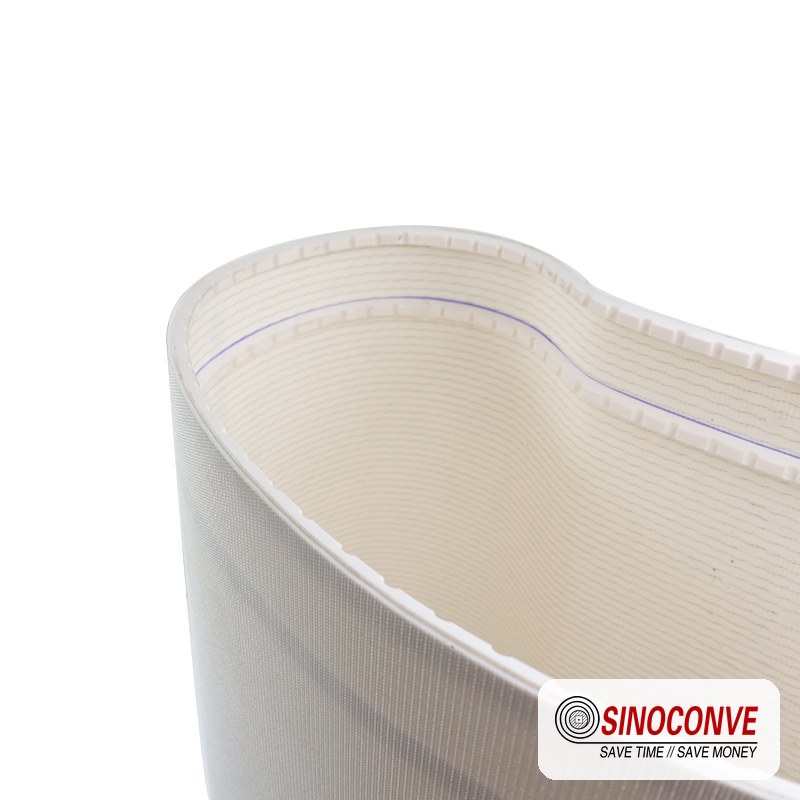
Read those bands as a gradient rather than a ladder of grades. A packhouse handling both apples and peaches will normally run the apple line at Shore A 75 and the peach line at Shore A 58, with completely different transfer geometry. Trying to serve both with one belt setting is the single most common compromise we are asked to bless, and it usually ends with the soft fruit downgraded and the hard fruit slipping.
03Belt Softness and Shore A Selection
Shore A hardness tells you how much a cover deforms under a given load, and that is exactly the property that decides whether a fruit bruises. A soft cover deforms around the fruit, so the contact area grows and the pressure per square millimetre falls. A hard cover deforms very little, so the fruit has to deform instead, and the skin is the part that loses. That is the whole mechanism in two sentences.
But soft is not free. A Shore A 55 cover has a higher rolling resistance, wears faster on an abrasive line, and tracks less positively on a crowned pulley. It also stretches more under the same tension, which shows up as tracking drift on a long run. The engineering answer is to go as soft as the load and the tracking allow, and no softer.
A worked selection example
Take a line carrying 40 tonnes per hour of peaches and nectarines, 800 mm wide, 18 m long, with one 10-degree incline and a 220 mm drop at the grading table. No belt will save a peach from a 220 mm fall onto a firm surface, so fix the geometry first: reduce the drop to about 120 mm with a short inclined chute. Then the cover: Shore A 58-62, smooth carrying face, low-friction backing so the belt still tracks. Then the speed: 0.45 m/s.
The same plant running apples at 60 tonnes per hour on a similar layout would use Shore A 75-80 with a light pattern, and would accept a 200 mm drop without complaint. Same hardware, different numbers, because the fruit is different.
| Fruit Class | Shore A Range | Surface | Reason |
|---|---|---|---|
| Stone fruit, ripe | 55-62 | Smooth, matte | Maximum deformation at contact; matte face avoids scuffing |
| Soft berries, cherry | 50-60 | Smooth, lightly textured only | Point loads dominate; pattern concentrates pressure |
| Apple fruit | 70-80 | Light pattern or rough top | Needs grip on 10-15 degree inclines without crushing |
| Citrus, melon | 75-85 | Rough top or studded | Thick rind tolerates pressure; roll risk is the bigger issue |
| Root and tuber crops | 80-88 | Heavy rough top, cleated | Abrasive load, steep inclines, no bruise sensitivity |
If your line runs both a soft class and a hard class, the honest answer is two belts with two hardness values, or a changeover schedule. One belt asked to do both will sit at a compromise hardness that bruises the soft fruit and slips under the hard fruit. Most of the PVC conveyor belt range we mold for produce work is available in those five hardness bands, so the choice is real rather than nominal.
04Grip vs Slip: Surface Texture Rules
Friction on a fruit line is a trade, not a feature. You buy grip with texture, and texture is paid for in contact pressure. A rough-top face with 1.5 mm studs will hold a melon on a 20-degree incline all day. The same face under a ripe peach converts every stud into a pressure point, and the packhouse finds out at final inspection two shifts later.
The rule we work to is simple enough to state and hard to follow: use the least texture that holds the product at the steepest angle and the highest speed the line will actually see, and put that texture only where it is needed. A line that is level for 30 metres and inclined for 4 metres does not need a fully studied belt. It needs a smooth carrying face and a drive that holds the load.
Friction drives are a separate discipline from belt-surface grip, and it is easy to confuse the two. Traction between a pulley and a belt is set by wrap angle, tension and groove geometry, engineered by a transmission belt manufacturer using the same friction laws as a V-belt drive. What the fruit sees is only the contact pressure of the carrying face. Two problems, two numbers, and mixing them up leads to over-textured belts.
Where the plant also runs a farm or intake drive on the same site, a V-belt manufacturer will tell you the same thing about groove wear that we will tell you about surface pattern: a worn contact surface does not transmit more, it transmits less. When a fruit belt starts slipping, check the pattern depth before you increase tension. Increasing tension on a worn, glazed face just loads the shafts and the bearings and leaves the slip exactly where it was.
| Surface Texture | Friction Behaviour | Slope Limit | Side Effect |
|---|---|---|---|
| Smooth matte | Moderate, very even | Up to about 8 degrees | Least bruising; product can drift on wet faces |
| Fine pimple, 0.4-0.6 mm | Good in all directions | 8-14 degrees | Holds juice in the valleys; needs a wash regime |
| Rough top, 1.0-1.5 mm | High along the run | 14-20 degrees | Pressure points on soft fruit; harder to clean |
| Studs, 2 mm and up | Very high, direction dependent | 20-25 degrees | Bruises pome fruit; traps debris at the bases |
| Positive cleats | Mechanical rather than friction | Above 25 degrees | Cleat edges mark fruit; needs a matched chute at the discharge |
The numbers in the slope column assume a dry face and a single fruit in contact. Everything changes with a full bed of fruit, a wet face, or a cold cover. That is why we treat the table as a design start and always ask for the worst realistic condition: fruit at 4 degrees C coming out of a cold store onto a wet belt is a different friction problem from warm fruit on a dry one.
05Slope and Drop Heights on Fruit Lines
Slope and drop are the two geometric decisions that decide whether a fruit line is gentle or brutal, and neither of them costs much to get right at the design stage. A 6-degree change in incline and a 100 mm change in drop height can each move the bruise rate by a percentage point or more on soft fruit, so they are worth arguing about before the frame is welded.
Our working rule for fruit lines is to keep the carrying incline under 15 degrees wherever the layout allows it and use a transfer, a chute or a second flight for anything steeper. Above 15 degrees the friction margin gets thin, the fruit starts to creep and rotate, and the surface texture needed to hold it starts to bruise it. Where the incline is unavoidable, a cleated conveyor belt guide covers the geometry of moving the weight with cleats instead of friction, and a farm chevron conveyor belt does the same job for field and intake work at higher angles.
Chevron and cleat profiles are the standard answer to the 20-degree-and-up problem, and the same page that covers their anti-slip behaviour also covers the roll-back risk on wet produce: chevron conveyor belts incline anti slip. We carry those profiles as a conveyor belt distributor alongside the light PVC and PU faces, and the choice between them is usually settled by fruit size rather than by angle alone. Small fruit falls between cleats, so a fine pimple face holds it better than a 25 mm cleat pitch.
| Incline | Recommended Drop at the Top | Anti-Roll Measure | Watch For |
|---|---|---|---|
| 0-8 degrees | Under 150 mm for soft fruit | Smooth matte face is enough | Wet faces let fruit drift sideways into guides |
| 8-15 degrees | 150-200 mm, use a chute | Fine pimple or light rough top | Cut-off speed; fruit accelerates down the slope |
| 15-20 degrees | 200-250 mm, buffered landing | Rough top, or shallow chevron | Roll-back on stop-start cycles |
| 20-28 degrees | Use a cleated flight, keep drops short | Cleats or chevron with a defined pocket | Cleat edges marking fruit at the discharge |
| Above 28 degrees | Not a friction problem any more | Contained flight, pocket or bucket design | Conveyor is the wrong machine; change the layout |
Drop height deserves a separate warning because it is the one number that gets lost between the drawing and the steel. A transfer designed at 100 mm becomes 300 mm the moment someone raises the grading table by 200 mm to suit a new pallet height, and nobody re-checks the fruit. We now ask for the as-built drop height, not the designed one, on every survey.
06Juice, Sugar and Residue: Hygiene Planning
Fruit leaks. Peach and plum lines release juice at every cut and every bruise, sugar syrup from a syrup-dosed line is worse, and the residue that lands on the belt goes into the valleys of the surface pattern and stays there. Left alone for a shift it turns sticky, then it ferments, then it becomes a biofilm that no amount of cold water will shift.
Hygiene on a fruit line is therefore a layout problem as much as a cleaning problem. Where does the juice leave the belt? Where does the wash water go? If the answer to either question is at the end of the run, near a drive pulley or above an electrical enclosure, the design has a fault that cleaning frequency cannot fix.
The route we prefer is: contain the wet zone, slope it, drain it, and keep as much of the run dry as the process allows. If the product is wet, a PU face with a smooth, non-porous surface sheds sugar film better than a rough top, because there are no valleys to hold it. The PU conveyor belt for food handling family is built around that idea, and it is usually the right starting point for a wash-down zone.
| Residue | Where It Collects | Cleaning Means | If Left |
|---|---|---|---|
| Fruit juice | Pattern valleys, belt edges, frame | Warm water rinse, then food-safe detergent | Sticky film that pulls fruit off line |
| Sugar syrup | Downstream of any dosing point | Higher water temperature, longer dwell | Fermentation and odour within a shift |
| Pulp and fibre | Return strand, pulley faces, under the frame | Mechanical scrape plus rinse; never on the product face only | Pulley build-up, then tracking drift |
| Soil and grit | Intake end, first 3-5 m | Dry removal first, then rinse | Abrasive paste that wears the cover |
| Water with sanitiser | Whole wash zone | Concentration and contact time per the sanitiser sheet | Chemical attack on the cover compound |
None of the four cleaning columns is a substitute for the fifth row. Sanitiser concentration is a compatibility question for the belt compound, not just for the fruit, and we ask buyers to send the sanitiser sheet with the enquiry so the compound can be matched. A chlorine-based sanitiser at typical packhouse strength is normally fine on PVC and PU food-grade faces; a strong acid or a hot caustic is not, and neither is a steam lance held still in one place.
07Cleaning Regime Without Damaging the Belt
Two things get destroyed on a fruit line by cleaning, and neither of them is the dirt. The first is the belt face, damaged by too much temperature, too much chemistry or a jet held in one spot. The second is the splice, damaged by the same water getting into an open joint and lifting the ply, or by a scraper blade that was set too hard after the last clean.
The regime we recommend is the boring one, executed every shift. Rinse the product face with warm water at moderate pressure while the belt runs at creep speed. Apply food-safe detergent at the label dilution, allow the dwell time, then rinse and squeegee the return strand. Leave the face dry, because a wet belt in a cold store picks up condensation and then slips.
Temperature is the parameter most often abused. Most PVC food-grade faces are comfortable with water up to about 60 degrees C, and many are rated higher for short contact, but we still advise keeping routine wash water in the 40-55 degrees C band so that the compound and the splice are not being aged every night. Steam is for the frame, not for the belt face.
| Method | Temperature Band | Effect On The Belt Face | Verdict |
|---|---|---|---|
| Low-pressure warm rinse | 40-55 degrees C | None measurable | Routine, every shift |
| Food-safe detergent, controlled dwell | 40-55 degrees C | None if rinsed off within the label dwell | Routine, with a rinse step |
| High-pressure jet, nozzle held close | Any | Edge lifting, splice intrusion, localised face erosion | Avoid on the belt; use on the frame |
| Steam lance, stationary | Above 90 degrees C | Compound softening, pattern deformation | Never on the belt |
| Caustic or strong acid foam | As supplied | Cover swelling or hardening; colour change | Check compatibility first |
| Dry brush on the return strand | Ambient | Gentle scuffing only if the bristle is soft | Good for grit, not for sugar |
If your sanitation plan demands a documented regime rather than a habit, the audit list on this page feeds straight into it: food grade PVC conveyor belt check. For the wider question of which cleaning method suits which soil, and when a scraper stops earning its place, we keep that on a separate page: conveyor belt cleaning methods. What matters on a fruit line is the verdict column above, not the method list.
08Belt Type by Fruit Category
Once hardness and texture are settled, the belt family decision is short. Light PVC for dry and semi-dry produce, light PU where wash-down and sugar are constants, and a heavier fabric carcass only where the load is truly industrial rather than horticultural. The mistake we see most often is a packhouse buying a quarry-grade belt for an intake conveyor because it looked stronger, then wondering why the apples arrive with scuff marks.
A heavy carcass has its place on a fruit site: the receiving hopper feed, the bulk bin tipper discharge, and any run where a front-end loader drops a tonne at a time. Everything downstream of that needs a light, hygienic face and a low-tension frame.
For most packhouse lines the first choice is a food grade fruit conveyor belt with a smooth or lightly patterned face and a food-compliant compound. If you are still weighing the surface option, the comparison of PVC conveyor belt types covers face patterns and carcass grades in the same place. Buyers consolidating several lines, or several sites, usually ask us for wholesale conveyor belts pricing on a mixed schedule, which is the cheapest way to buy if the fruit calendar is predictable.
| Category | Belt Type | Surface | Why |
|---|---|---|---|
| Stone fruit, ripe | Light PVC, 2-3 ply | Smooth matte, Shore A 58 | Maximum contact area, minimum marking |
| Wet or washed produce | Light PU, food grade | Smooth non-porous | Sheds sugar film, tolerates daily wash-down |
| Apple fruit | Light PVC with pattern | Fine pimple or rough top | Grip on 10-15 degree sorting inclines |
| Citrus and melon | PVC rough top or EP carcass | Rough top, Shore A 80 | Roll resistance and a heavy bin load |
| Intake and tipping | EP fabric carcass | Rough top, impact rated cover | Survives lump loads and loader drops |
| Frozen or chilled fruit | Cold-rated PVC | Smooth, low-friction backing | Stays flexible at 0 to minus 20 degrees C |
The right-hand column is the one to argue about at the quotation stage, because it is the only one that ties the belt back to a fruit behaviour rather than to a catalogue line. If a supplier cannot explain why a given face is right for a given fruit, the face is probably just what that supplier happens to stock.
09Grading and Sorting Line Interfaces
The interface between a conveyor and a grading machine is where a well-run line quietly loses money. Two problems live there, and they are both mechanical: a speed mismatch that makes fruit tumble, and a height step that makes it drop. Neither is dramatic, and both are easy to leave in place for years.
Speed matching is the first check. A belt running at 0.45 m/s feeding a singulator that wants 0.55 m/s will hand over fruit that rolls forward as it lands, and rolling fruit is bruising fruit. Speed mismatch also shows as gaps and surges, which the grading software reads as irregular infeed and compensates for badly. The rule is to match the handover speed within about 10 percent, and to align the transfer direction so the fruit keeps travelling the way it was already going.
The second check is the step. A 30 mm lip between belt and grading table does not sound like much, until it acts as a scraper that skins a peach at 40 tonnes per hour. Measure the step with the belt loaded, because a tensioned belt deflects and the design step is not the operating step. That one measurement explains a surprising number of complaints on an otherwise well-built line.
Where a packhouse also moves product through a palletising or carton area, the interface problem reappears in a heavier form, and the same principles are described for the general case in our guide to industrial conveyor belt transfers on aggregate and stone-crusher lines, where a badly set transfer costs a belt rather than a peach but the geometry is identical.
| Node | Speed Differential | Height Step | Damage Risk |
|---|---|---|---|
| Belt to singulator | Within 10 percent | Zero to minus 20 mm | Rolling and tumble if the belt runs faster |
| Belt to weighing cup | Match or slightly slower | 10-30 mm drop into the cup | Impact on one face if the cup lip is proud |
| Belt to pack table | Equal | Flush within 5 mm | Skinning and scraping at the lip |
| Belt to another belt | Within 10 percent, same direction | 0-150 mm with a chute | Tumbling at the gap if speeds differ |
| Belt to bin or crate | Slow at the discharge | Under 200 mm, buffered | Crate-edge impact as the fruit decelerates |
Where a fruit line climbs through a steep transfer and side retention matters more than surface finish, that narrower case is treated separately in fruit conveyor belt with a PVC sidewall. That page assumes the belt is already chosen and concentrates on holding product through the incline.
10Soft Transfer Points and Convergence
Every transfer is a place where the fruit gets handed from one surface to another, and every one of them is a chance to lose a grade. The engineering answer is to convert a fall into a slide. A short inclined chute, a curved lip, a buffer curtain or a slower receiving belt will each turn a 250 mm drop into a 60 mm roll, and a roll does not bruise.
Which buffer you use depends on fruit size and on the space the frame allows. For small, light fruit a fabric curtain across the gap costs almost nothing. For heavier fruit a powered transition roller is better, because a passive curtain can hold the fruit and create a jam. With hard-skinned fruit a rubber-lagged roller both cushions and drives, and removes the speed mismatch at the same time.
Convergence, where two lines merge into one, is the same problem in a different direction. Where fruit arrives from the side, you need either a merge angle under about 30 degrees or a defined pocket so the two streams do not collide. If the merge sits on an incline as well, the product-control question becomes a containment question, and the standard construction answer for that is described in our note on the fruit conveyor belt PVC sidewall solution. We mention it once here and do not repeat it, because containment on an incline is its own subject.
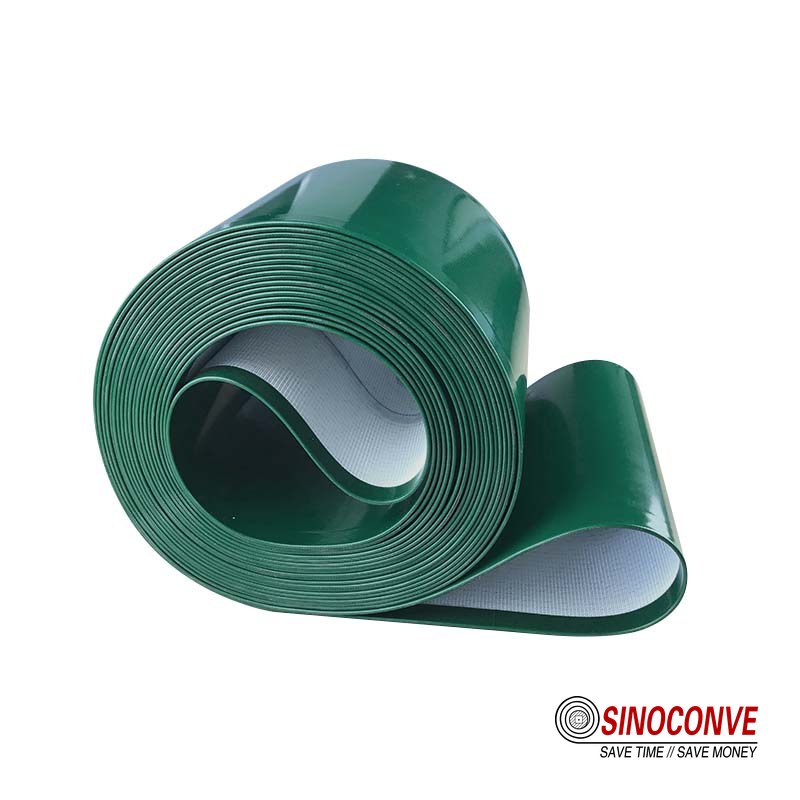
| Transfer Method | Effective Drop | Buffer | Best For |
|---|---|---|---|
| Inclined chute, 25-35 degrees | 60-90 mm equivalent | Low-friction liner | Medium fruit, fixed layout |
| Curved lip on the head pulley | 40-70 mm equivalent | None needed | Short transfers, tight space |
| Fabric or rubber curtain | Turns a fall into a slide | The curtain itself | Small, light fruit |
| Powered transition roller | Zero step, matched speed | Rubber lagging | Heavier fruit, high throughput |
| Slower receiving belt | Dampens the arrival | Speed differential under 10 percent | Any fruit, if the drive allows |
Field note from our engineers: On a peach and nectarine line running 40 tonnes per hour, the packhouse measured a bruise rate of about 4 percent at a 300 mm transfer onto the grading table. We lowered the transfer to 120 mm with a 30-degree chute and added a rubber curtain over the landing, and the same fruit measured about 1.2 percent at final inspection two weeks later. Nothing was changed on the belt itself.
11Cold Storage and Field Conditions
A fruit belt that behaves perfectly in a warm packhouse can turn into a different machine at 2 degrees C. PVC stiffens as it cools, so the same belt that tracked cleanly at 22 degrees C may need more take-up travel in a cold store, and the low-friction backing that was generous at room temperature becomes marginal. PU holds its flexibility better than PVC at low temperature, which is one reason wash-down and chilled zones often end up on a PU face.
Condensation is the other cold-store problem. A warm belt entering a cold room collects water on the face, and a wet face loses most of its friction. Fruit drifts sideways and piles against the guides, which operators report as "the belt pulling to one side" when the belt is tracking correctly and the load is not.
Field conditions bring the opposite set of issues: dust, sun and abrasive soil. A mobile intake conveyor working in open air needs a UV-stable compound and a face that will not glaze in dust. The requirements for those machines sit closer to general agricultural equipment than to a packhouse line, which is why we group them under the agriculture industry pages. Where a site runs outdoors through a cold season, the compound choice overlaps with the requirements set out for cold resistant conveyor belts, and the same low-temperature rules apply to a short fruit belt and to a long field belt. A farm drive on the same site will usually be a friction drive, and a V-belt manufacturer quoting for it will be sizing for the same low-temperature stiffness problem in the belt itself.
| Condition | Belt Behaviour | Note |
|---|---|---|
| Cold store, 0 to 5 degrees C | PVC stiffens, take-up travel increases | Allow 20-30 percent more take-up than the warm-room figure |
| Freezer, minus 20 degrees C | Standard PVC becomes brittle at the splice edge | Specify a cold-rated compound and allow a slower start-up |
| Condensation on a warm belt | Face friction drops sharply | Wipe or air-dry before the run starts; expect load drift |
| Open-air field work | UV ageing and dust glazing | UV-stable cover, clean the face before it glazes |
| Abrasive soil carry-back | Fast cover wear at the intake | Dry-clean the return; keep the first 3 m easy to inspect |
| High humidity, warm room | Mould risk on organic residue | Shorten the cleaning interval, dry the face |
Field note from our engineers: A 14-degree fruit incline running a Shore A 75 smooth face slipped lightly under wet pome fruit at 0.6 m/s. We changed to a Shore A 70 face with a shallow pimple pattern and dropped the line to 0.45 m/s. Slip stopped, and the pressure-mark complaints that had come with the original set-up fell instead of rising, which surprised the buyer more than the fix did.
12Surface Patterns: Studs, Pimples and Rough-Top
Pattern choice is a compromise between two numbers: the friction you need at the steepest and wettest moment, and the pressure the softest fruit can take. Height sets pressure, pitch sets how much of the fruit actually touches, and openness sets how hard the face is to clean.
What each pattern does well and badly
A fine pimple at 0.4-0.6 mm is the best general-purpose fruit face: it grips in both directions, drains reasonably, and does not concentrate load enough to mark pome fruit. Rough top at 1.0-1.5 mm is the workhorse for inclines, and the practical behaviour of it is set out in the rough top conveyor belt guide, with more installation detail in the note on rough top rubber conveyor belts.
Choosing by fruit, not by preference
Studs, at 2 mm and above, are for hard-skinned fruit on steep inclines only. On a peach line they are a bruising machine, because each stud concentrates the whole fruit weight on a few square millimetres.
| Pattern | Suit Fruit | Feature Height | Cleaning |
|---|---|---|---|
| Smooth matte | Stone fruit, berries | None | Easiest |
| Fine pimple | Most fruit | 0.4-0.6 mm | Easy |
| Rough top | Pome fruit, citrus | 1.0-1.5 mm | Moderate |
| Stud | Citrus, melon, root crops | 2 mm and up | Difficult |
| Cleated, positive | Bin feed, root crops | 10-50 mm | Hard at the cleat bases |
13Inspection Points for Fruit Lines
A fruit line fails slowly, and the failures show up first in places that nobody photographs. We walk a route rather than a checklist, in the same order every time, so that a change is obvious against the last visit.
The route we walk
Start at the head pulley and finish at the tail, then do the return strand on the way back. Torch, tape measure, and a marker for anything you intend to fix. If you find more than two items worth marking, stop the survey and plan a proper shutdown instead of patching.
What counts as a fail
Judgement matters more than numbers on a fruit line: a mark that appears on a face after one shift is a fail even if every dimension is inside tolerance.
| Check Point | Item | Criterion | Frequency |
|---|---|---|---|
| Head and tail pulley | Rubber lagging condition | No glazing, no embedded pulp | Weekly |
| Every transfer | Drop height as built | Within the fruit threshold | Monthly, and after any frame work |
| Carrying face | Pattern depth and glazing | Depth within 30 percent of new | Monthly |
| Splice | Flushness with the face | Under 1 mm proud; no lifted edge | Every shift, by hand |
| Return strand | Residue and grit build-up | No sticky film, no sand at the edges | Every shift |
| Tracking | Edge position under load | Within 10 mm of the unloaded position | Weekly |
14Splicing for Smooth Product Flow
A splice is the one place on a fruit belt where the surface is not uniform, and every fruit passes over it. A joint that is 2 mm proud gives a small bump at each revolution, which on a 20 m belt at 0.5 m/s is a bump every 40 seconds, all shift. That is the vibration mechanism from Section 01, manufactured on purpose.
Why an endless belt is worth the freight
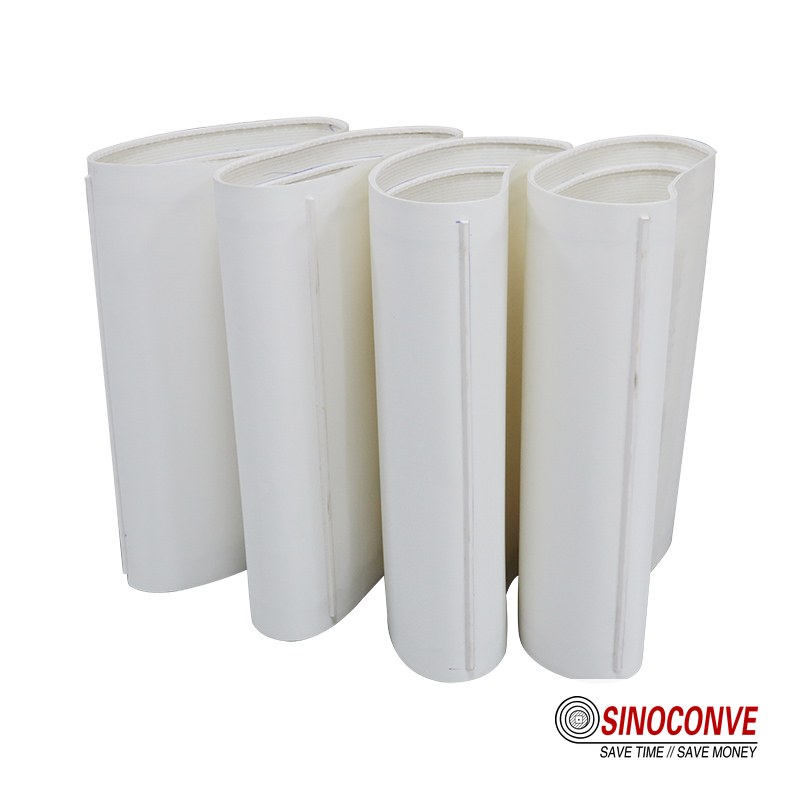
On a fruit line the strongest argument for a factory-made endless belt is not strength, it is flatness. An endless belt has no joint at all, so there is no bump and no adhesive line to catch juice. The trade-off is fitting and lead time, and the benefits and limits are covered in the note on endless conveyor belts.
If you must splice in the field
Use a stepped or finger joint on food-grade belts rather than a straight butt, and check the finished joint with a straight edge across the face before the belt goes back on the line.
| Joint Method | Face Flatness | Risk | Best Use |
|---|---|---|---|
| Endless, moulded or welded | No joint at all | Handling at fitting | All soft fruit, all wash-down zones |
| Stepped, hot-pressed | 0.5 mm proud at worst | Adhesive line can hold juice | Field repair on heavier belts |
| Finger joint | Good if pressed evenly | Needs clean, warm conditions | Light PVC lines in a workshop |
| Mechanical fastener | Visible step and metal | Marks fruit; hard to clean | Not on any fruit face |
15Buyer Checklist for a Fruit Belt
Send five things with the enquiry and the quotation stops being a guess. The fruit list with throughput. The geometry, including every drop height as built. The wash and sanitiser regime. The minimum and maximum ambient temperature. And the food-contact requirement that auditing will ask you for.
What to ask for as evidence
Ask for the compound data sheet and the declared food-contact statement, not a verbal assurance. For the wider set of checks a buyer can run before ordering a light belt, the PVC conveyor belt buyer checklist is the practical companion to this page, and the product catalog shows which of these faces we stock as standard.
Split the order if the fruit calendar allows
Two hardness values bought together on one schedule usually cost less than two single belts bought a season apart.
| Check Item | Requirement | Evidence |
|---|---|---|
| Cover hardness | Stated Shore A, matched to fruit | Compound data sheet |
| Food contact | Declared compliant for the intended use | Written declaration with the order |
| Surface pattern | Pattern and depth named, not "rough" | Sample or photo of the actual face |
| Splice | Endless preferred; flatness tolerance stated | Joint detail on the drawing |
| Temperature range | Covers cold store and wash-down figure | Compound data sheet, cold figure included |
| Delivery form | Endless fitted, or open for field joining | Agreed in writing before production |
16Life-Cycle and Changeover Economics
The cheapest fruit belt is rarely the one with the lowest price per metre. Downgraded fruit costs far more than belt, and a belt that runs one season longer while bruising two percent of the crop has already paid for a replacement several times over.
Where the money actually goes
On a typical packhouse line the belt is a small share of the annual cost of handling fruit; changeover labour, cleaning time and downgrades dominate. A slightly more expensive endless, food-grade belt usually wins that comparison.
Plan the changeover around the calendar
The best maintenance window is the two weeks between fruit varieties. Order early, fit then, and use the gap to re-check every drop height as it has actually been built.
| Cost Item | Basis | Typical Weight |
|---|---|---|
| Belt purchase | Per metre, by width and ply | One-off, every 2-4 seasons |
| Downgraded fruit | Percent of crop value | Usually the largest single line |
| Cleaning labour | Minutes per shift, per metre | Grows with pattern complexity |
| Changeover downtime | Hours per event | Halved by an endless belt |
| Re-tensioning and tracking | Events per season | Highest in the first month |

17Frequently Asked Questions
What belt hardness stops fruit bruising?
Soft fruit wants a soft cover. Shore A 55-62 covers stone fruit and ripe tomatoes, 50-60 suits berries, and hard-skinned crops tolerate 75-85 without complaint. Go softer than the load and the tracking allow, not softer than that.
How high can a fruit transfer drop be?
Under 150 mm on soft fruit, and closer to 100 mm for a ripe peach. A 300 mm drop onto a firm surface marks fruit regardless of the belt, so fix the geometry first and the cover second.
Does a rougher surface always grip better?
No, and that assumption costs packhouses more fruit than any other single design choice. Grip is bought with contact pressure, so every millimetre of pattern height that holds the product also concentrates load into the skin. Use the least texture that holds the fruit at the worst angle and the highest speed you actually run.
What slope can a fruit belt carry before product rolls?
On a dry face, a fine pimple handles 8-14 degrees and rough top reaches 14-20 degrees. Wet fruit in a wash zone loses several degrees of margin, which is why a 14-degree incline can slip on one shift and not the next.
How do I clean a fruit belt without damaging it?
Warm water at 40-55 degrees C, moderate pressure, food-safe detergent at the label dilution, then rinse and dry. Keep high-pressure jets and steam away from the belt face, avoid strong caustic foam unless compatibility is confirmed, and never park a jet on one spot.
Which surface pattern suits soft fruit?
Smooth matte first, fine pimple at 0.4-0.6 mm if you need grip. Studs and heavy rough top belong on hard-skinned fruit and root crops, where pressure points do not matter.
How do juice and sugar residue affect belt life?
It reaches the splice and the pulley faces before it reaches anything else. Sugar film turns into a biofilm within a shift, holds grit against the cover, and lifts a joint edge that was previously flush. Clean the return strand every shift and the belt usually lasts the seasons it was bought for.
What changes in a cold store?
PVC stiffens, so take-up travel grows and a face that tracked cleanly at 22 degrees C becomes marginal at 2 degrees C. Condensation on a warm belt kills friction on the carrying face, and fruit then drifts into the guides. PU holds its flexibility better at low temperature.
How should a grading line meet a conveyor?
At matched speed, within about 10 percent, and with the surfaces flush to within a few millimetres under load. Measure the step with the belt loaded, because a tensioned belt deflects and the operating step is what skins the fruit.
Where do fruit belts fail first?
At the splice and the transfer lips. A proud joint is a bump at every revolution, and a proud lip at the discharge acts as a scraper. Both show up as bruising first.
Is an endless splice worth it on a fruit line?
Yes for soft fruit and wash-down zones, where the flatness matters more than the belt price. The extra lead time is the real cost, and ordering against the fruit calendar mostly removes it.
What should I check on delivery of a fruit belt?
Width and length against the drawing, Shore A against the data sheet, pattern depth on a sample area of the face, and the joint flatness with a straight edge. If the belt arrives endless, roll it out on a flat floor and look along the edge before it goes on the line.
18Related Products You May Need
- Food grade PVC conveyor belts for packhouse and sorting lines.
- Chevron and patterned belts where the incline will not go below 20 degrees.
- Rubber conveyor belts for intake, tipping and other heavy loads on a fruit site.
- Full product catalog if you are buying several faces for one season.
19Related Blog Posts
- Fruit conveyor belt PVC sidewall solution if your problem is containment on a steep incline rather than bruising.
- Food grade PVC conveyor belt buyer check to line the belt up against food-contact evidence.
- PVC conveyor belt types when the carcass and face pattern are still open.
- Conveyor belt cleaning methods and schedules for the wider wash regime around the fruit line.