
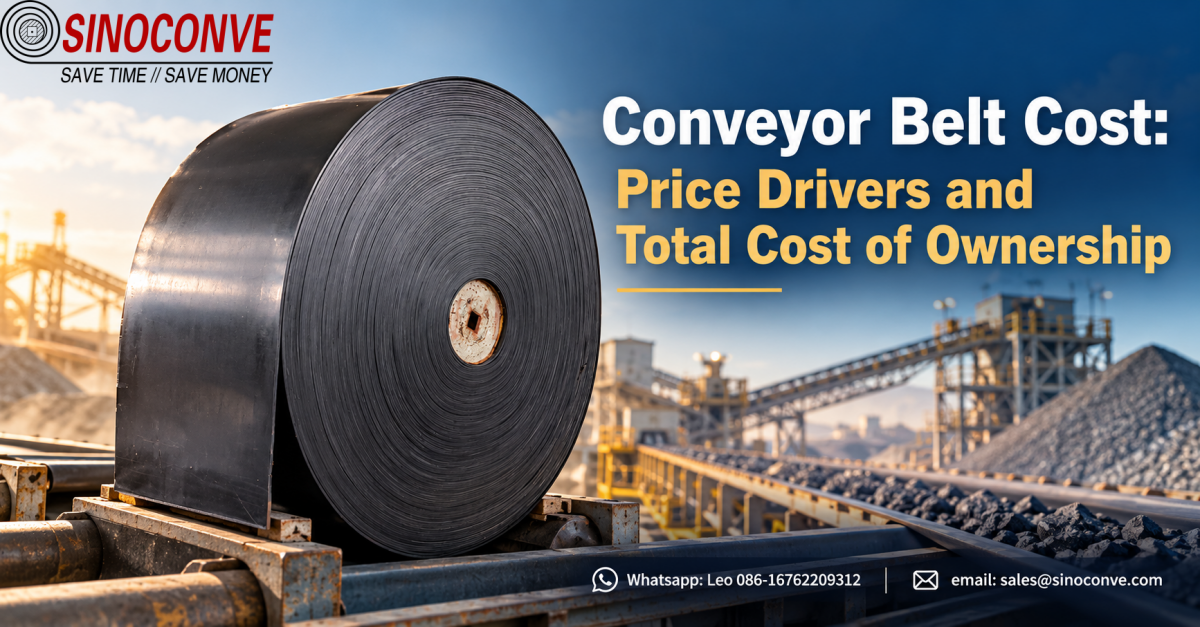
Conveyor belt cost is a structure before it is a number. We do not publish per-meter rates here, and we will not invent one, because an honest figure depends on your carcass construction, your cover compound, your width and length, your splice count and the size of your order. What this page does instead is take that price apart, show which variables move it, and hand you a three-year total cost of ownership model you can recalculate with your own unit price. Keep your last invoice beside you while you read.
01Conveyor Belt Cost Is a Structure Before It Is a Number
Two inquiries reach us looking identical on the surface. Both say EP belt, 1200 mm wide, 300 meters long, delivery in six weeks. The engineered scope behind them is not the same at all, and that gap is where most sourcing arguments begin. One buyer is moving dry aggregate at 20 C on a horizontal line. The other is moving hot clinker fines at 120 C on a 14-degree incline, with three transfer points and a loading zone that hammers the belt every forty seconds. Same headline, two different products.

Every Line on the Invoice Started as a Specification Decision
Carcass material sits at the front of the chain, and ply count follows immediately behind it. A four-ply EP 630 belt rated for a 12-degree incline and a 900 t/h design load is not interchangeable with a three-ply EP 500 belt on the same frame, even though both would be described as a 1200 mm fabric belt in a short email. Working tension per ply, troughability over the idler set and fastener pull-out strength all shift together, and the price we are able to quote shifts with them.
Cover compound is the second big branch. A DIN 53516 abrasion result of 90 mm3, 150 mm3 or 250 mm3 is not a marketing claim, it is a wear-rate input that tells you roughly how many months of 16-hour shifts the cover will survive before it reaches the wear line. Buyers who treat the cover as a cosmetic layer usually pay for that assumption in a mid-year belt change nobody budgeted for, and the second invoice is always larger than the first because it arrives with overtime attached.
02What Has to Be Settled Before Anyone Can Give You a Real Number
We cannot price a belt from a width and a length, and neither can anyone else who is being straight with you. The minimum data set is smaller than most buyers fear, but it must be complete. Center distance on the existing frame, belt width, material handled, bulk density in t/m3, maximum lump size, design capacity in t/h, incline in degrees, ambient and material temperature, and the drive power already installed at the head pulley are the usual starting point. Hand us that and the conversation turns into arithmetic instead of guesswork.
Two Belts of the Same Width Are Rarely Priced the Same
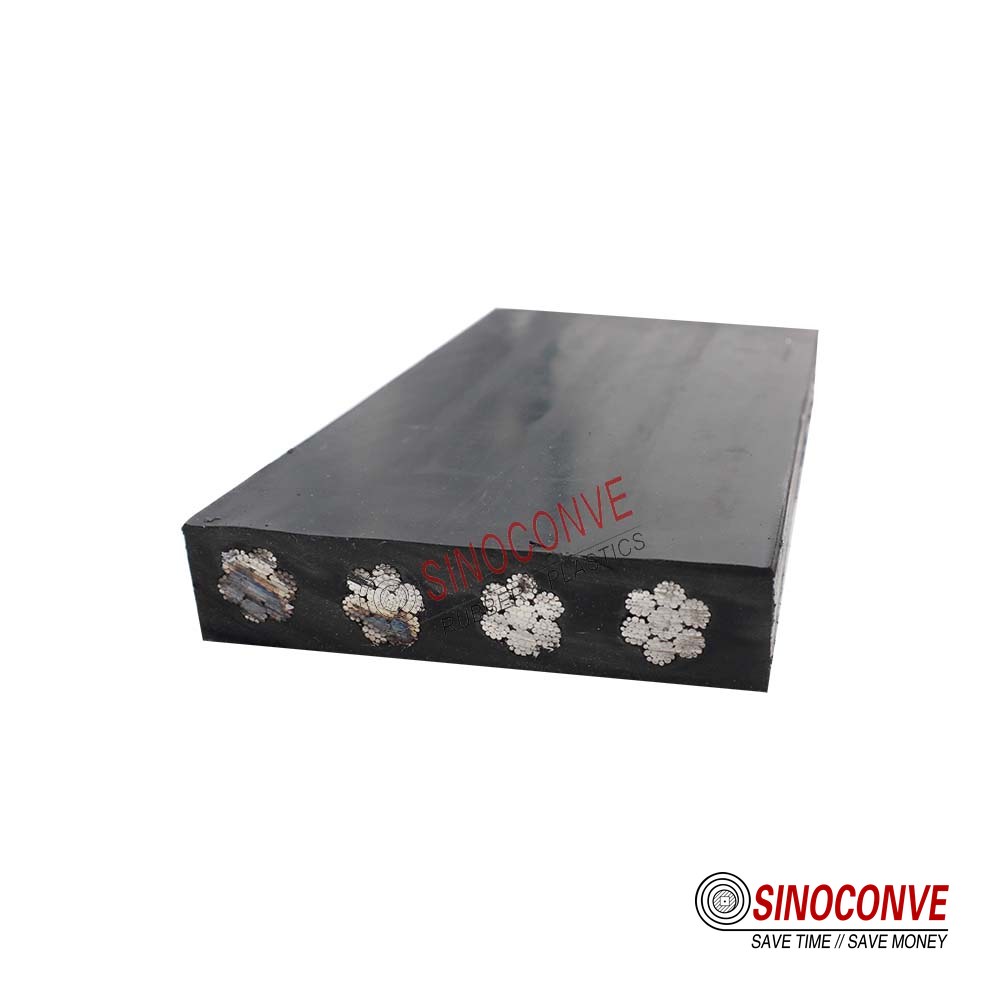
Picture two 1200 mm belts on our slitting line, side by side, both destined for a quarry. The first is an EP 500 three-ply with a 4 mm top cover and a 2 mm bottom cover. The second is an EP 800 four-ply with an 8 mm abrasion-resistant top cover, a 3 mm bottom cover and edge protection. The second belt uses roughly twice the rubber and half again the fabric, so the price difference is not a markup trick, it is material. If the application only needs the first belt, buying the second one is waste. If the application needs the second one, the first one is a scheduled failure with a calendar date on it.
This is the single most useful idea on the page. Conveyor belt cost is not good or bad in isolation, it is matched or mismatched to a duty. A belt that is correctly specified and correctly spliced will always beat a cheaper belt that is not, once you count the second purchase and the downtime around it.
03Price Driver One: Carcass Material and Ply Count
The carcass is the load-bearing skeleton, and it carries the tension, resists the impact of the loading chute and holds the splice together. Change the fabric from NN to EP and the price rises, because polyester warp and nylon weft cost more than an all-nylon weave and the EP construction holds length better over a long incline.
Where buyers get caught is assuming that more plies always means a better belt. It does not. Ply count exists to deliver the required working tension at an acceptable safety factor, usually taken from the relevant standard such as DIN 22102 or AS 1332 and confirmed by the belt rating. Beyond that point, extra plies buy you a stiffer belt that takes longer to trough, splices more slowly and adds mass the drive has to move. We regularly steer quarry customers from a four-ply belt back to a correctly rated three-ply rubber conveyor belt, and they save money on both the belt and the electricity that drives it.
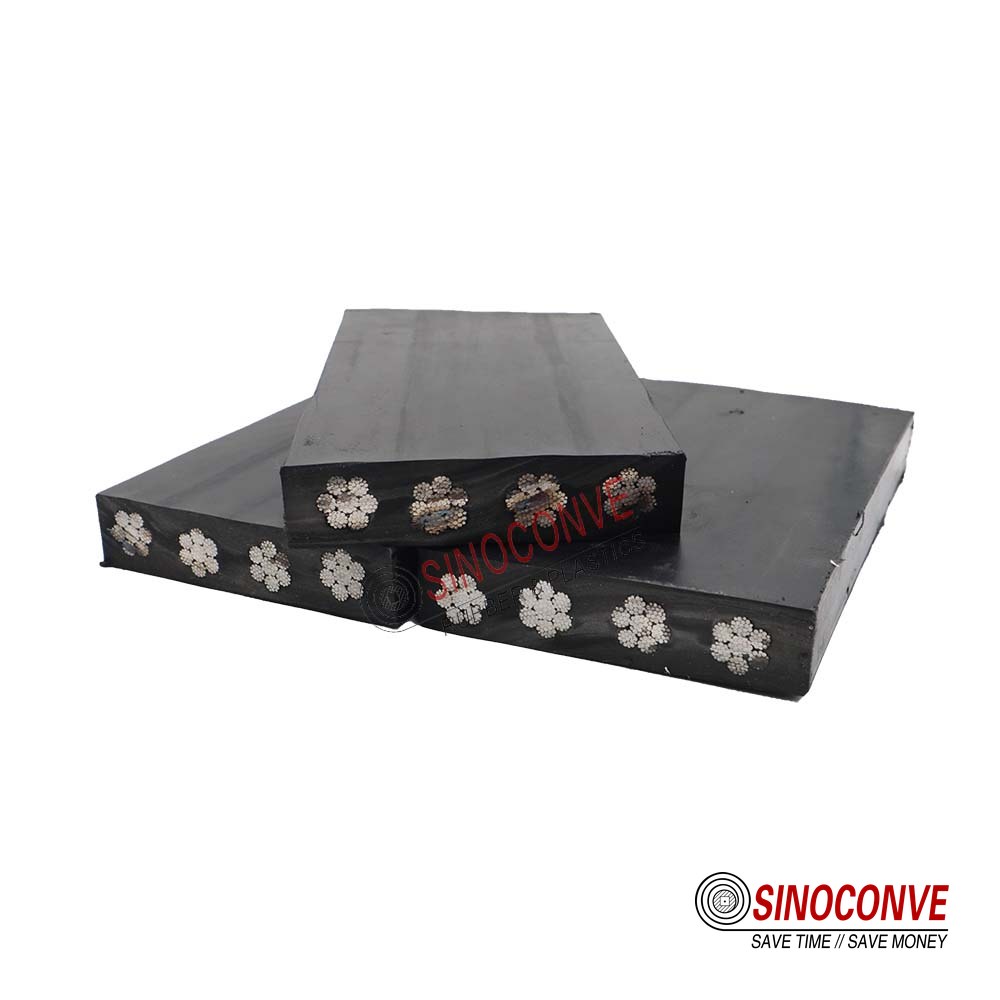
Steel cord is a different conversation. A steel cord carcass carries far higher tension in a single layer, so it wins on long overland conveyors and on high-capacity trunk lines where a fabric belt would need an impractical number of plies. It also costs more, needs larger pulleys and demands a more careful splice, and it is less forgiving of a mangled loading zone. As a conveyor belt manufacturer we build both families, and we say plainly that steel cord is the right answer on maybe one inquiry in ten. On the other nine it is an expensive way to solve a problem the drive geometry does not actually have.
| Carcass choice | What it changes on the invoice | When it is the right call |
|---|---|---|
| NN fabric, three to four plies, general purpose duty | This is the least expensive carcass family, and the price moves mainly with ply count and belt width. | Short to medium centre distances with modest tension and no strong requirement for length stability. |
| EP fabric with polyester warp and nylon weft | Roughly ten to twenty five percent above an equivalent NN build, driven by raw fabric cost and process time. | Long inclined lines and any duty where belt stretch would force repeated take-up adjustments. |
| Steel cord, single layer with high breaking strength | The highest material cost per metre, but it can replace a very high ply count on a heavy duty line. | Very long overland runs, high capacity trunk conveyors and installations with limited take-up travel. |
04Price Driver Two: Cover Grade and Cover Thickness
Rubber is sold by volume, and volume is the product of area and thickness, so cover thickness is one of the most direct cost levers on the whole belt. Moving a 1200 mm belt from a 4 mm top cover to a 6 mm top cover adds roughly half again to the cover rubber on the carrying side, and the price follows almost linearly. So does the wear life, until the application stops being abrasion-limited and starts being cut or impact-limited.
Grade matters more than thickness once you are past the minimum. Abrasion-resistant compounds are graded against standard test methods, and a belt tested to around 90 mm3 under DIN 53516 will outlast a 250 mm3 belt of identical thickness by a wide margin in a sharp, dry, abrasive duty such as granite or clinker handling. That test result is the single most under-used number in most procurement files, and it is the one we ask about first when a buyer tells us a belt wore out too fast. A heat-resistant compound is a separate family again, engineered to survive material temperatures that would destroy a standard cover long before the carcass was ever loaded.
Bottom cover thickness is where buyers trim that they later regret. The pulley side sees slip, spillage and the back of the loading chute. Skimping there to save a few percent on the purchase price is a classic case of trading a small invoice saving for a large early replacement. Our cover grade comparison walks through the standard grades side by side if you want the detail behind this section.
05Price Driver Three: Width, Length and Belt Mass
Width is the quiet multiplier. A belt is priced per metre of length, but each metre consumes fabric and rubber in proportion to its width, so a 1400 mm belt costs roughly seventeen percent more per metre than a 1200 mm belt of the identical construction. When a buyer sends us a width of 1400 mm because that is what the frame was set up for twenty years ago, we ask whether the duty still needs it. Narrowing a belt is expensive in structural terms, so the honest answer is usually to keep the width and use the money elsewhere, but the question is worth asking once rather than never.
Length is the second half of that multiplier, and the allowance you take on it decides how much belt you actually pay for. Order to the measured centre distance plus a realistic splice allowance, not to a round number that felt safe, because extra length is billed at the full per-metre rate and it adds mass the drive has to move.
Mass Is the Bridge Between Purchase Price and Running Cost
Belt mass is the one variable that appears in almost every line of a total cost model. It sets the price of the belt, the price of the freight, the size of the splice, the energy drawn by the drive and the value of the scrap when the belt finally leaves the line. A buyer who evaluates an industrial conveyor belt purely on the purchase line and ignores mass is optimising one line of a seven-line sum. We will come back to this in the model, because mass is where the two halves of the story meet.
06Price Driver Four: Splice Method and Joint Count
The splice is where a belt earns its reputation or loses it. A vulcanized splice is made on site with heat and pressure, and it aims to return the joint to a high proportion of the parent belt strength. A mechanical fastener is bolted or stapled through the belt, costs far less in labour up front, and typically delivers a lower joint efficiency along with a row of holes that will eventually become the failure site. Which one is cheaper depends entirely on how long you intend to run and how much a stoppage costs you.
Joint count multiplies everything. A 150 metre conveyor with one vulcanized joint needs one splice, one crew and one shutdown window. The same plant layout broken into three flights with five joints needs five of each, and the risk of a single weak joint compromising the whole line rises with every additional splice. When we review a quotation, we count the joints before we look at the price, because a low belt price with an under-scoped splice schedule is not a saving.
Vulcanized and Mechanical Splices Solve Different Problems
Vulcanizing is the default for permanent, long-life installations. The cost sits in the crew, the press and the time on site, and it returns a joint that runs smoothly over the pulleys and lasts as long as the belt when it is done properly. Mechanical fasteners belong where a belt must be changed fast, where the length is expected to change, or where downtime windows are short and the penalty for a long shutdown is severe. Choosing between them is a genuine engineering decision with a cost consequence on both sides, and our splice methods and cost breakdown works through the trade-offs in detail.
07Price Driver Five: Specialty Properties and Compound Families
Standard rubber covers a large share of the market, but a significant minority of belts have to do something extra, and each extra requirement carries its own cost. Heat resistance is the most common and the most misunderstood. A belt serving a cement kiln discharge or a clinker cooler is not simply a standard belt with a tougher cover, it is a belt built to survive a defined material temperature for a defined time. Flame resistance and antistatic behaviour frequently appear together on coal handling and underground applications, where they are usually tied to standards such as ISO 340, ISO 284 or MSHA 30 CFR Part 14 and must be proven by test evidence rather than asserted. Oil resistance and food-grade compliance sit at the other end, driven by contact with hydrocarbons or by hygiene requirements.
| Specialty family | What drives the extra cost | What we must see in the specification |
|---|---|---|
| Heat resistant cover for clinker, sinter and hot aggregate | Specialty polymers and curing cycles add material and press time to every metre produced. | Peak material temperature, duration of exposure and whether cooling between transfers is available. |
| Flame resistant and antistatic construction for coal and underground duty | Conductive compounds, grounding provisions and the test programme behind the certification claim. | The exact standard named by the site, plus the test reports that must accompany each delivery. |
| Oil resistant compound for recycled material and oily bulk | Nitrile based polymers cost more than general purpose rubber and are slower to process. | The oil type, the contact duration and the temperature at which the exposure actually happens. |
| Food grade belt for direct or incidental food contact | Approved materials, hygienic construction and the paperwork that proves conformity to the buyer. | The applicable food contact regulation for the destination market and the required declaration of conformity. |
The Same Logic Applies Outside Heavy Conveying
Buyers who also source drive belts ask us whether the same cost structure applies. Largely, it does. A transmission belt manufacturer faces the same carcass, compound and tooling decisions, and a drive belt price is driven by profile, cord material and the number of units per order just as a conveyor belt price is. The difference is scale rather than principle, which is why we build both and can advise on the interface when a plant is renewing a whole materials handling line at once. Buying from one V-belt manufacturer for the drives and one supplier for the conveyors rarely produces the lowest total cost, because the freight and the coordination are paid twice.
08Price Driver Six: Order Quantity, Lead Time and Batch Size
Manufacturing a belt is a batch process. A press run has a setup, a warm-up and a tail end, and those fixed costs are spread across the metres in the batch. A single 200 metre belt ordered on its own carries the full setup on its shoulders. Ten belts of similar construction scheduled together spread the same setup across ten times the output, and the per-metre figure that falls out of that is genuinely lower. This is the honest basis behind wholesale conveyor belts pricing, and it is also why a distributor who consolidates several customers into one production slot can often beat a single plant ordering alone.
Lead time carries a cost even when nobody bills it. Compressing a build window to fit a shutdown date rearranges the production schedule for every other customer in the queue, and that rearrangement resurfaces as an expediting charge or as a longer delivery the next time you order.
Match the Order Size to the Consumption Rate, Not to the Warehouse
Stocking belts you will not fit for two years is capital sitting on a shelf, and rubber does age. Storage conditions, temperature swings and light exposure all take a toll on a belt that is waiting its turn, so an excessively large order can hand back part of the saving it appeared to create. The sweet spot is generally to buy at the batch size that covers twelve to eighteen months of realistic consumption, which captures most of the setup saving without turning the store into a warehouse for aging rubber.
09Price Driver Seven: Testing, Documentation and Certification
Every belt we ship is inspected, and the depth of that inspection is a cost the buyer chooses without always realising it. Routine checks, dimensional verification, cover thickness measurement and a visual examination of the splice area are the baseline. Add abrasion testing, adhesion testing, tensile testing of the carcass or a flame and antistatic test programme and the belt spends more time in the laboratory and less time on the press, which is real time and real money.
Documentation follows the same rule. A mill test certificate, a declaration of conformity, a batch traceability record and a packing list sound like paper, and paper is not free. Producing a traceable document pack for a belt that will sit in a mine regulator's file takes administrative effort, and that effort is part of the price. It is also, in many jurisdictions, non-negotiable, so the practical question is not whether to pay for documentation but whether to agree its scope up front or discover it at the port. Our pre-order verification checklist lists the documents buyers most often forget to request until the last minute.
10Price Driver Eight: Packing, Freight, Duty and Customs
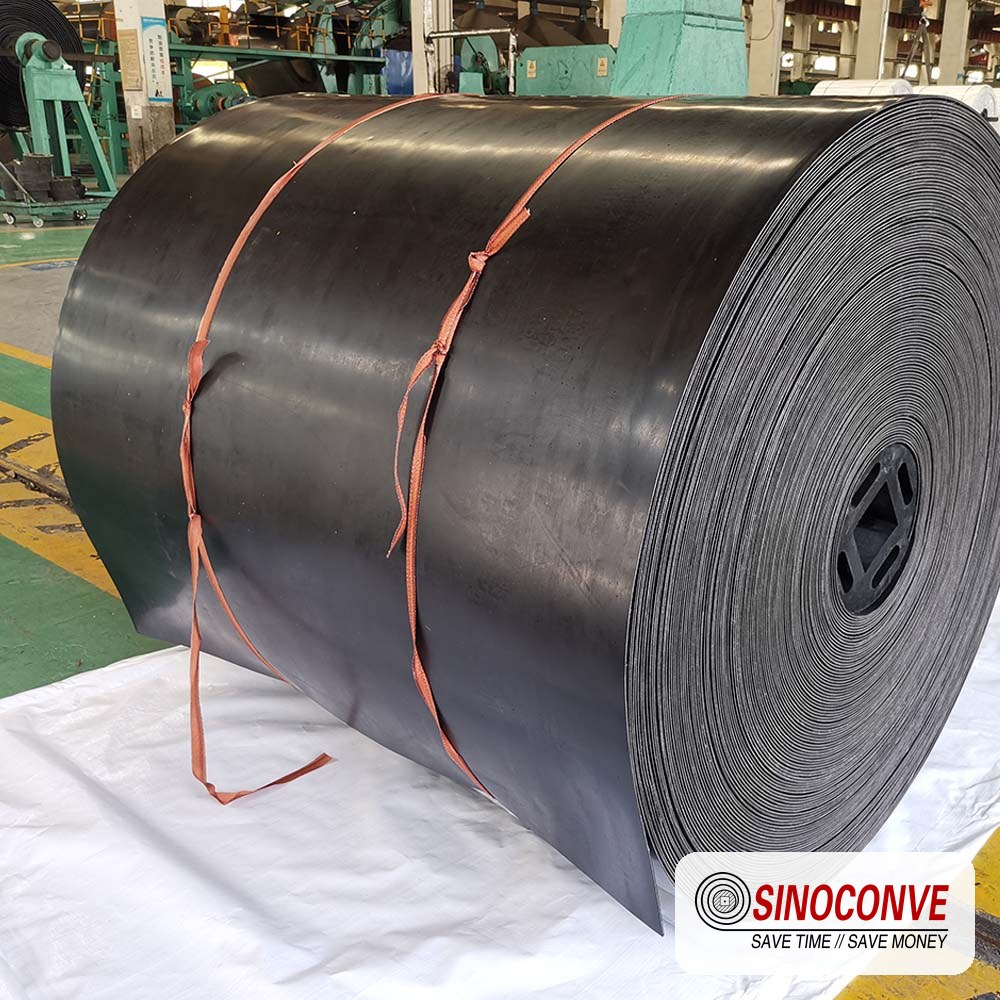
A belt has to travel before it works. Coiling, wrapping, edge protection and the steel core that holds the coil are not incidentals, and their cost scales with belt mass, length and width. A long heavy belt may need to be shipped in multiple rolls or on a flat rack rather than in a standard container, and that single decision can change the freight bill more than any negotiation over the per-metre rate. Packing is the first place where a purchase price and a landed cost part company.
Freight mode, insurance and customs formalities complete the picture. Sea freight is the economical default for most of our export business, air freight is reserved for emergencies where downtime dwarfs the shipping cost, and land freight dominates regional trade. On top of the transport itself sit import duty, value added tax, port charges and the customs broker's fee, none of which appear in a factory gate price but all of which appear on the buyer's account. Incoterms decide who pays each of those lines, and an FOB price and a DDP price for the same belt are simply not comparable numbers until the terms are aligned.
We work with both direct buyers and partners, and the arithmetic looks different for each. A conveyor belt distributor usually consolidates shipments and carries local stock, which raises their unit cost but cuts the end user's lead time and freight complexity. An end user buying direct from our conveyor belt factory may pay less per metre and more per shipment.The right channel is the one whose total landed cost and service level fit the plant, not the one with the lowest headline figure. If your EP requirement sits on a mixed order, a conveyor belt supplier who can combine carcass families in one shipment will usually trim the freight line without touching the belt price.
Convert every offer to a landed cost at your gate before you compare anything, adding transport, insurance, duty, tax where it is not recoverable, port charges and site unloading, then dividing by the metres actually usable. Two suppliers quoting the same nominal price per metre can differ by double digits once that maths is done, and the difference is rarely in the belt at all.
11The Three-Year Total Cost of Ownership Model and Its Formula
Purchase price is one of seven lines in the cost of owning a belt for three years. The other six are freight and duty, installation and splicing, lost production during the change, energy, replacement frequency, and salvage value at the end. Populate the model with your own numbers and you have an answer in minutes, without needing our price list at all, because every price term is left as a variable.
Here is the model in its base form. We count a belt that lasts S months as consuming thirty-six divided by S belt-equivalents across the three-year window, which is a fair linear view of what the maintenance budget actually absorbs. Everything else is a cost per belt event except energy, which is annual.
TCO over three years
TCO_3y = (36 / S) x (P_unit x L + F + I + D - V) + 3 x E
Annualised TCO = TCO_3y / 3 = (12 / S) x (P_unit x L + F + I + D - V) + E
What Each Variable Means and Where You Get It
Fill the table below from your own records. The only figure we cannot give you is P_unit, because that is your negotiated price per metre and it depends on every driver discussed above. Insert your actual unit price and the model runs. If you prefer to work in ratios, you can set P_unit multiplied by L to any base value such as one hundred and read the output as a relative index instead of a currency amount.
| Variable | What it represents | Where the number comes from |
|---|---|---|
| P_unit | Your negotiated price per linear metre at the quoted width and construction. | The supplier quotation you are evaluating, taken at the landed terms you agreed. |
| L | Belt length actually ordered, including splice allowance and take-up travel. | Measured centre distance doubled, plus the allowance your engineer confirms. |
| F | Freight, insurance, duty, port charges and unloading for one belt delivery. | Your forwarder invoice and customs entry for the last comparable shipment. |
| I | Installation and splicing cost for one belt change, labour and consumables together. | Your splicing contractor rate multiplied by the number of joints on the run. |
| D | Production loss caused by one unplanned or extended belt change outage. | Tons not moved multiplied by your contribution margin per ton, per event. |
| V | Salvage or reclaim credit received when the worn belt leaves the site. | Your scrap or reclaim buyer's rate applied to the belt mass in tonnes. |
| E | Energy cost of running the belt for one year at your actual duty. | Tariff per kWh multiplied by absorbed kilowatts and annual running hours. |
| S | Realistic service life in months before the cover reaches its wear limit. | Your maintenance history on this conveyor, not the catalogue expectation. |
Two habits make the model trustworthy. Use your own maintenance history for S rather than a supplier's optimistic assumption, because life has the largest effect on the answer. Then treat D as a real number rather than zero, since that single shortcut is the reason cheap belts keep winning tenders they should lose.
12Worked Example: A Better Splice Lifts Belt Life from 18 to 30 Months
Numbers make this argument easier to follow than prose, so here is a full run of the model on a typical quarry duty. We express the belt price as an index rather than a currency, with the acquisition cost of one belt set to one hundred index units, so you can substitute your own P_unit at the end without us planting a figure that belongs to a different specification.
Setting Up the Comparison on a Real Duty
The installation is a 150 metre centre distance carrying crushed granite at 300 t/h, 1200 mm wide, running sixteen hours a day. The belt is an EP 630 three-ply with a 6 mm abrasion-resistant top cover and a 2 mm bottom cover, joined by a single vulcanized splice. On paper it is a good belt, so the difference between the scenarios below is not the belt but the quality of the work done around it. In the first, the splice is made by a crew working to a tight window without a controlled press cycle and the belt is replaced every eighteen months. In the second, the same belt is spliced to procedure with correct step length and curing while a persistent tail pulley tracking fault is corrected, and life rises to thirty months.
For the index values we use the following, and you should replace each one with your own site data. The belt acquisition term P_unit multiplied by L takes the value one hundred. Freight and duty are set at eight, installation and splicing at six, the cost of one outage at fifteen, the salvage credit at four, and annual energy at ten. These are ratios chosen to keep the illustration readable, not quotations.
Running the Numbers and Reading the Result
Start with the bracket, the cost attached to each belt event. Acquisition, freight, installation and downtime, less the salvage credit, gives 100 plus 8 plus 6 plus 15 minus 4, which equals 125 index units. The eighteen-month case consumes two belt-equivalents over three years, so twelve divided by eighteen, or two thirds, multiplied by 125 is 83.3, and adding annual energy of 10 gives an annualised total of 93.3. The thirty-month case consumes 1.2 belt-equivalents, so twelve divided by thirty, or 0.4, times 125 is 50.0, and with the same energy the annualised total is 60.0. That is 33.3 index units saved each year, a 35.7 percent reduction, without spending a cent more on the belt.
Over the full three-year window the picture is starker: 280 index units against 180, which is one hundred units recovered on a single conveyor from workmanship rather than material. Scale that across a plant running a dozen belts.
| Scenario | Service life in months | Belt-equivalents over three years | Annualised total cost in index units | Three-year total in index units | What it tells you |
|---|---|---|---|---|---|
| Baseline with rushed splice and uncorrected tracking | 18 months of service before replacement | 2.0 belts consumed across the window | 93.3 units per year, including energy | 280 units over the three-year period | This is your reference case taken from the last invoice. |
| Same belt with disciplined splice and tracking correction | 30 months of service before replacement | 1.2 belts consumed across the window | 60.0 units per year, including energy | 180 units over the three-year period | A 35.7 percent lower annualised cost with no price change. |
| Cheaper belt at twenty percent below the baseline price | 12 months of service before replacement | 3.0 belts consumed across the window | 115.0 units per year, including energy | 345 units over the three-year period | Twenty-three percent worse per year despite the lower invoice. |
| Premium belt at twenty five percent above the baseline | 30 months of service before replacement | 1.2 belts consumed across the window | 70.0 units per year, including energy | 210 units over the three-year period | Paying more per metre still returns a lower annualised cost. |
Field note from our engineers: On a 42 C clinker corridor in the Middle East we once watched a plant replace the same belt three times in two years before anyone questioned the splice. The belt was never the problem. The step length was short, the press cycle was rushed to hit a shift handover, and the joint failed every time at the same point. Once the crew was retrained and the cure cycle was respected, the same belt construction ran for over two years. Nothing about the purchase price changed. Everything about the cost changed.
One more sensitivity is worth running before you close the spreadsheet. If the true cost of an outage is double our illustration, say thirty index units rather than fifteen because the line feeds a kiln that cannot be stopped cheaply, the bracket rises to 140 and the gap between the two scenarios widens to 36.1 percent. Plants with expensive downtime should weight splice quality even more heavily than this example suggests, because every avoided replacement avoids the whole bracket, not just the belt inside it.
13Engineering Levers That Lower Total Cost Without Cutting Price
Each lever below lowers total cost while leaving the belt specification intact or nearly so, and none of them requires squeezing a supplier or buying a new conveyor. They work because the model is dominated by how long the belt lasts and how much an outage costs, and both respond to discipline far more than to negotiation.
Choose the Grade the Duty Needs Rather Than the Top of the Range
Overspecifying is not a safety margin, it is a silent tax. A plant that buys a heat-resistant belt for a duty that never exceeds 60 C has paid a premium for a property it does not use, and it may also have accepted a shorter abrasion life than a properly matched standard grade would give. The reverse error is more common and more expensive, because an underspecified belt fails early and drags the whole replacement bracket with it. The objective is a match, which means writing the duty down precisely before the specification is drafted. Our page on steel cord belt durability in material handling explores how carcass choice interacts with duty on long lines.
Splice Quality, Tracking and Cleaning Carry the Best Payback
These three are the heavy hitters, and they are all maintenance-side rather than purchase-side. A splice made to procedure with the right step length, the right gum and a respected cure cycle routinely returns a joint as strong as the belt around it. Tracking correction stops the edge damage that quietly shortens life at every pass. Cleaning, including return-side scrapers and carryback control, keeps the material where it belongs and keeps the pulleys round. None of the three changes the invoice for the belt, and all three change how many times you pay it. Our guides on belt tracking faults and on cleaning methods and schedules go into the field detail.
Spares and Inspection Protect the Belt You Already Paid For
A small stock of the right idlers, a spare pulley lagging kit and a scheduled inspection routine cost a fraction of one belt replacement and prevent a surprising share of them. Wear measurement on a fixed schedule turns an unplanned failure into a planned change, and a planned change is cheaper because it avoids the overtime, the expedited freight and the production loss. Roller condition matters here too, and our conveyor roller guide covers selection and wear limits.
14Quote Fields You Must Ask For to Compare Bids
Most tender surprises come from questions nobody asked rather than answers nobody gave. If two suppliers return different numbers, the comparison is only meaningful when both were asked the same questions in the same order. Send the list below with every request, and insist that each line is answered rather than left blank. A supplier who cannot answer a line is telling you something useful about the offer.
The Minimum Data Set Every Comparable Quotation Should Carry
| Field to request | What a complete answer looks like | Why it changes the comparison |
|---|---|---|
| Carcass type, ply count and rated breaking strength | The fabric family, the number of plies and the belt rating stated together, not just the width. | Two offers can look identical on width and differ completely in load capacity. |
| Cover grade with top and bottom thickness in millimetres | The compound name, the measured abrasion figure and both cover thicknesses written out. | Cover rubber is the largest single cost variable after the carcass itself. |
| Cut length and splice allowance actually quoted | The exact ordered length and how much of it is allowance for the splice and take-up. | A metre is a metre, and any that is not needed is money spent for nothing. |
| Splice method, joint count and joint efficiency | Whether the joint is vulcanized or mechanical and who performs it on site. | Joint cost and joint risk scale with the number of splices on the run. |
| Standards applied and the test evidence provided | The named standard, for example DIN 22102 or ISO 340, plus the report that proves it. | Claims without test reports cannot be compared and cannot be defended. |
| Documents that travel with the shipment | Mill certificate, declaration of conformity, traceability record and packing list named explicitly. | Missing paperwork can stop a belt at customs after it has already been paid for. |
| Packing format, roll count and total shipment weight | How the belt is coiled, how many rolls are produced and what the shipment weighs. | Roll format and weight decide the freight bill far more than the belt price does. |
| Incoterm, port of loading and duty responsibility | The three letter term, the named place and a clear statement of who pays duty and tax. | An FOB price and a delivered price are not comparable until the terms align. |
| Lead time, expediting cost and delivery date in writing | A production lead time and a shipping lead time quoted separately rather than as one figure. | Compressed timelines carry a cost that appears on the invoice later. |
| Expected service life and wear allowance in the offer | The life the supplier expects for your duty and the cover thickness at which it is worn out. | Life expectation is the input that drives the whole total cost calculation. |
| Price basis, either per metre or per delivered belt | A stated unit of measure so that competing offers can be normalised to the same base. | Offers quoted on different bases are the most common source of false comparison. |
15Common Misconceptions About Conveyor Belt Cost
Three assumptions keep appearing in tender reviews, and each one quietly inflates the bill while looking like good commercial sense. They survive because they are easy to defend in a meeting and hard to disprove without a model, which is exactly why we built one on this page. Here they are, with the arithmetic that exposes each of them.
Three Assumptions That Look Prudent and Cost Real Money
The first is comparing unit price only. A tender that ranks suppliers by price per metre has ranked them by one of seven lines and called it a decision, ignoring freight, splicing, downtime, energy and salvage. In our worked example that shortcut pointed straight at the worst option on the table, while ranking on landed cost is barely harder.
The second is treating downtime as zero because it is hard to attribute. A belt change that runs two hours long during a peak shift costs more than the belt it replaced, and everyone in the room knows it, yet the figure never reaches the spread sheet. Put a number on it, even a rough one. A wrong number that is discussed beats a zero that is assumed, because the zero always votes for the cheapest belt regardless of what the plant actually needs.
The third is equating cheap with low total cost. They are not the same, and the difference is not a matter of opinion. A belt at twenty percent below the baseline that lasts twelve months instead of eighteen delivered an annualised cost twenty-three percent higher in our example. That is a mathematical result, not a sales argument, and it holds for any set of numbers where life falls faster than price.
A fourth appears whenever a specification is copied from an old project. Inherited requirements often carry specialty properties, documentation and test regimes the current duty does not need. Nobody defends them and everybody pays for them, so review the specification against the real duty once a year.

16Frequently Asked Questions About Conveyor Belt Cost
Do you publish a price per metre for conveyor belts?
No, and any manufacturer who does without seeing your duty is guessing. The price per metre depends on carcass, ply count, cover grade and thickness, width, length, splice scope, specialty properties, order quantity and documentation. Give us the parameters and we will give you a firm number. Give us only a width, and the most honest reply is a question.
Why do two suppliers quote very different prices for what looks like the same belt size?
Almost always because the belts are not the same belt. One offer may be a three-ply EP 500 with a 4 mm standard cover and the other a four-ply EP 800 with an 8 mm abrasion-resistant cover. Same width, same length, roughly double the material. Before you treat a price gap as markup, compare carcass, cover grade, cover thickness and the splice scope line by line.
Which single factor most changes the total cost of ownership?
Service life, without much competition. Because replacement frequency multiplies the whole bracket of freight, installation and downtime, a change in life from eighteen to thirty months moved annualised cost by 35.7 percent in our worked example. Energy and salvage matter, but they move slowly compared with how often you have to stop the line and hang a new belt.
Is a vulcanized splice always worth more than a mechanical fastener?
Not always, and the exception is worth knowing. Where a belt must be changed quickly, where its length will change, or where a long shutdown window simply does not exist, a mechanical fastener can be the lower total cost despite its lower efficiency. For a permanent installation that runs continuously, vulcanizing almost always wins over a multi-year horizon because the joint lasts as long as the belt and does not perforate the carcass.
How should I estimate the downtime cost attached to one belt change?
Start with the tons the line would have moved during the outage and multiply by your contribution margin per ton. Add the labour at overtime rates and any expedited freight the failure forced on you. If that number feels uncomfortable, it is probably closer to the truth than the zero most spreadsheets carry.
Does ordering a larger quantity always lower conveyor belt cost?
It lowers the unit price, and it does not always lower the total. Batch savings are real because press setup and warm-up costs are spread over more metres, so consolidating an order usually helps. The limit is storage life. Rubber ages on the shelf, so an order that covers more than about eighteen months of consumption starts to hand back part of the saving in shortened life for the belts that wait longest.
What service life should we assume for an EP belt on a quarry duty?
Use your own maintenance history rather than a catalogue figure, because duty dominates. An EP 630 belt with a 6 mm abrasion-resistant cover on a well-aligned conveyor handling dry granite at moderate impact can run well beyond two years. The identical belt on a misaligned line with a battered loading zone may not reach one. If you have no history, start conservative and record the first two cycles properly.
Can a more expensive belt really work out cheaper?
Yes, and the arithmetic is not delicate. In our example, paying twenty five percent more per metre for a belt that lasted thirty months instead of eighteen produced an annualised cost twenty five percent lower than the baseline. The condition is that the extra money buys something real, either more material where abrasion actually wears it away or better workmanship where the joint is the weak point. Paying more for a property the duty never uses buys nothing at all.
How often should we order replacement belts for a critical conveyor?
Order against the wear record, not against the calendar. Once you know the months a belt survives on that duty, place the order one full production lead time earlier, which protects you from expediting charges and from a rushed splice. Keeping one serviceable spare for a critical line is rarely the cheapest line on the budget and almost always the cheapest decision on the balance sheet.
Where can we get a specification reviewed before we go to tender?
Send it to us and we will read it against the duty you describe. We are a manufacturer, so we will tell you plainly where a requirement is doing work and where it is inherited habit, and we will say so whether or not it leads to an order. Our team supports projects across the mining and quarrying and port bulk handling sectors.
Related Products You May Need
- Heavy duty rubber conveyor belt for quarry and cement lines
- EP fabric conveyor belt
- Steel cord conveyor belt for long overland conveying
- Heat resistant belt
- Conveyor idler rollers and pulleys for belt support
- Browse the full product catalog
Related Blog Posts
- Cover grades explained
- Steel cord durability, efficiency and material handling performance
- Splicing guide: methods, costs and field tips
- What to verify before ordering
- EP conveyor belt tracking guide for misaligned runs and edge damage
- Cleaning schedules
- EP belt selection for stone crusher and aggregate plants
- Heavy duty rubber belts for mining efficiency