
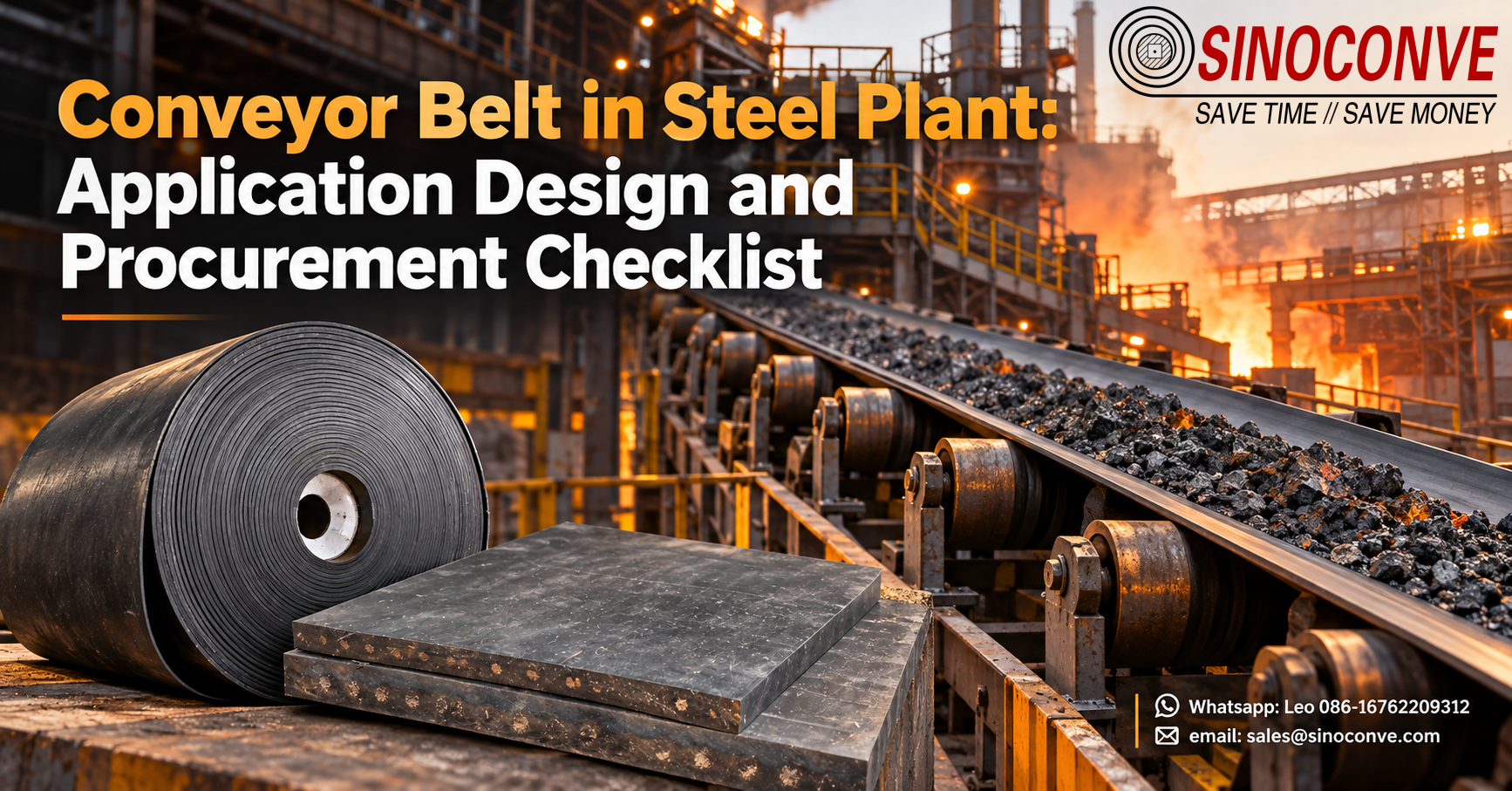
Steel plants move more material through more temperature regimes than any other bulk site we work with, and the belt that survives the sinter strand is almost never the same belt you should hang under the blast furnace stockhouse. One hard lesson from our site walks: take a single belt specification and copy it across every conveyor in the works, and you will buy premature cover failure, repeated splice cracking and stoppages that nobody budgeted for. What follows is the zone-by-zone picture — raw material yard, sinter, pellet, coke, blast furnace charging, converter additives, casting, rolling, finished goods and slag — together with the three kinds of heat a carcass actually has to survive, the component combinations that make engineering sense, and the evidence we would ask for before a steel plant order is released.

01Why a Steel Works Cannot Be Treated as One Conveyor Duty
One plant, nine different duty signatures
Walk through the gate of a large steel plant and you pass through material streams that share almost nothing except the word conveyor. Cold, wet, coarse ore reclaimed from a stockpile behaves nothing like 150 degrees Celsius sinter falling off the end of a hot strand, and neither of them behaves like the fine, sharp converter flux dropped into a charging hopper a few hundred meters away. If your maintenance history shows belt failures spread evenly across the whole plant, that is usually the signature of one cover grade and one carcass purchased for all of them. Our records say the opposite pattern is normal on the sites we support: two or three conveyors cause most of the unplanned downtime, and they are nearly always the ones sitting closest to a heat source or under a high-drop chute.
The plant you are buying for, and the parts we are not covering here
We build belts in a conveyor belt factory on the coast in Ningbo, so we spend a lot of time explaining to buyers what a steel plant actually needs from a belt and what it does not. This article stays at the level of application design and procurement, which is where most purchasing errors are made. It does not repeat the product-level grade detail you will find on a heat resistant belt data sheet, because that subject is deep enough to deserve its own page. It also says nothing about power stations; a captive power block has its own coal, ash and dust profile and should be specified separately from day one.
02The Process Map: Nine Zones and What Each One Does to a Belt
Reading the plant as a chain of transfer problems
Any steel plant can be read as a chain of transfer problems, and each link imposes a different blend of three loads on the belt: the temperature it must survive, the energy of the impact it receives, and the abrasiveness of what slides across the cover. A belt specified only by width and tensile rating ignores every one of those three. When we quote, we ask for the zone name, the material, the confirmed temperature and the drop height before we discuss carcass construction at all, because those four answers decide most of the design that follows. An industrial conveyor belt that is perfect on a cold aggregate bench can lose its cover in a single quarter once it is moved into a hot section of the same site.
Zone order matters as much as zone content. Ore and coal travel relatively cold but very abrasive routes at the front of the plant, heat concentrates in the middle around sinter, coke and the furnace itself, and the rear of the plant returns to cold material that is mixed with sharp, dense scrap. Holding that sequence in your head makes it obvious why one cover grade cannot honestly serve the whole works, and why a conveyor belt supplier who asks for the zone before quoting is worth listening to.
The nine zones at a glance
The table below is the map we use in our own application reviews. Temperatures in the third column are the belt-side conditions we ask customers to confirm with an infrared gun on a hot day, not assumptions, because the same zone can run fifteen or twenty degrees hotter on a summer afternoon than it does on the night shift.
| Plant zone | Material being carried | Belt-side temperature to confirm | Dominant risk to the belt |
|---|---|---|---|
| Raw material yard | Lump ore, fines, limestone and coal reclaimed from open stockpiles | Ambient, from 5 to 45 C depending on season | High-impact loading at the stacker and very wet, sticky carryback in the rainy season |
| Sinter plant | Hot sinter and return fines moving off the strand toward cooling | Hot contact, often above 120 C right at the strand discharge | Combined heat and abrasion, with radiant load from the hot strand housing |
| Pelletizing plant | Green balls before firing and cooled pellets afterward | Green balls near ambient, cooled pellets still warm to the touch | Sticky, alkaline carryback that builds on return idlers and inside chutes |
| Coke oven and coal handling | Wet coking coal on the front end, quenched coke on the back end | Coal cold; quenched coke warm and steam-laden near the wharf | Abrasion plus fire and dust-explosion exposure that changes the belt choice |
| Blast furnace charging | Burden mix of sinter, pellets, coke and additives from the stockhouse | Burden cold, gallery hot; radiant heat from the shell and runners | Radiant heat and hot-metal spill risk near the casthouse, plus heavy point loading |
| Converter additive handling | Lime, dolomite, fluorspar and ferroalloys fed to the steelmaking shop | Essentially cold material in small tonnages | Fine, sharp particles that cut covers and a dust regime that penalizes enclosures |
| Continuous casting | Mill scale, cut crop ends and mould powder removed from the caster | Hot short runs where crop ends can arrive at several hundred degrees | Punctures and burns from hot, irregular pieces with sharp edges |
| Rolling and finishing lines | Scale, crop scrap and short transfers of hot semi-finished stock | Intermittent heat, high for seconds then back to ambient | Thermal cycling that stiffens the cover and shortens splice life over time |
| Slag handling | Molten and granulated slag, plus cooled slag lumps for by-product sales | The hottest conveyor duty in the works, with wet granulation nearby | Everything at once: heat, impact, abrasion and steam |
Zone map used in SINOCONVE steel plant application reviews, with the temperature column left for the customer to confirm on site.
03Raw Material Yard: Impact, Water and the First Real Load Case
Where the belt meets its first and heaviest impacts
The raw material yard is where a steel plant belt first learns what impact means. Ore is dropped from stackers and reclaimers into hoppers, and the fall height at those transfer points can be two or three meters on a badly laid out chute, which is far more punishing than the gentle loading seen on a size-graded aggregate line. A 1,800 mm wide belt carrying 4,500 tonnes per hour of wet lump ore will take its worst battering in the first two meters after that chute, and no cover grade alone will save the carcass underneath it. What saves it is a proper impact zone: closely spaced cushioning idlers, a thicker top cover, and a skirt arrangement that stops material from spilling over the edges.
Water changes everything in this zone. Iron ore and coal reclaimed after rain can arrive at 8 to 12 percent moisture, which turns fines into a paste that glues itself to the return side of the belt. That paste then drops off along the entire return run and packs around the return idlers until they stop turning and start flat-spotting. A return side cleaning program is not optional equipment in a steel plant yard; it is the difference between a roller lasting two years and a roller lasting six months.
Specifying for a yard that runs all year
Yard belts in a cold climate need a cover that stays flexible at five degrees Celsius, and belts in a hot, humid climate need one that resists hydrolysis and mold growth on long storage. These are different compounds, and a purchasing team that orders one batch for a plant built across a temperature range will regret it in whichever season is the harsher one. We normally recommend an abrasion-resistant cover in the RMA Grade I to II band for ore and coal, sized with a carcass safety factor that assumes the highest seasonal moisture rather than the average. As a conveyor belt manufacturer we would rather argue about material resistance on the drawing than replace a torn belt eleven months later.
04Sinter Plant: Short Conveyors Carrying the Hottest Bulk in the Works
Why sinter duty is a heat problem before it is a wear problem
Sinter is the first place in the plant where temperature, not tonnage, drives the belt selection. Finished sinter leaving the strand is hot enough that a belt sitting directly beneath the discharge will see contact temperatures well above 120 degrees Celsius, and it will see radiant heat from the hood and the hot return strand at the same time. That combination is what destroys ordinary covers: a 70 Shore A abrasion cover that performs brilliantly in the yard will start to harden and crack within weeks when it is asked to run hot sinter and then cool down again on every revolution.
The conveyors themselves are short, often only 20 to 40 meters, which lulls buyers into thinking they are low risk. The opposite is true. Short conveyors mean many starts and stops, many splices per meter of belt, and a tight radius at the head pulley where a stiff, heat-aged cover is most likely to crack first. Our advice in this zone is to accept a lower abrasion rating in exchange for a genuine heat resistance class, and to keep the belt speed moderate so the carcass has time to shed heat between the loading point and the head.
05Pelletizing: Sticky Alkaline Material and the Return Run Trap
Heat is manageable here, chemistry is not
Pellets are less of a heat problem than sinter and more of a chemistry problem. Green balls are damp, alkaline and slightly sticky, and after induration the cooled pellets still carry a warm, dusty residue that clings to the cover. That residue migrates to the return side, hardens, and then behaves like sandpaper against every return idler it touches. On a pellet line we look first at the cleaning system and second at the belt, because a double scraper and a well-designed wash point usually eliminate more failures here than any change of cover compound. Where water is used for cleaning, the belt needs a compound that will not swell or delaminate when it is wet every shift for years.
Panel gaps and side sealing deserve a mention too, since pellet dust is fine enough to pass through the smallest opening and build up inside the structure. A belt that runs slightly misaligned through this dust will show edge wear long before its cover wears out, which is why we treat the belt tracking guide as required reading for pellet plant maintenance crews.
06Coke Oven and Coal Handling: Abrasion Plus a Fire Question
The zone where the belt choice changes category
Coking coal arrives wet and abrasive, quenched coke arrives warm and steam-laden, and both of them bring a hazard that has nothing to do with wear. Coal dust in a confined gallery can form an explosive atmosphere, and a belt that is not designed for that environment becomes the ignition path rather than the victim. In coal preparation and coke handling we move away from the yard standard and specify flame-resistant belting that satisfies the relevant test regime, typically referenced to ISO 340 and ISO 284 and, where a mine or export customer requires it, MSHA 30 CFR Part 14. Static conduction matters as much as flame spread, because a belt that cannot bleed off charge will generate sparks at the pulley.
Temperature on the coke side is real but intermittent. Coke straight off the wharf cools quickly, so the belt sees repeated short heat pulses rather than a steady soak, and repeated thermal cycling is what eventually stiffens the cover. Keeping quench water under control protects both the belt and the gallery steelwork, since a permanently wet structure corrodes fast and sheds rust onto the belt.
07Blast Furnace Charging: Burden Is Cold, the Gallery Is Not
Separating material temperature from radiant load
Buyers frequently tell us the blast furnace charging belt runs cold, and on the material side that is correct: sinter, pellets, coke and additives arrive from the stockhouse at ambient temperature. What they overlook is the gallery. A conveyor running within a few meters of the furnace shell, the hot stoves or the iron runners sits in an air stream that can be 20 or 30 degrees above the rest of the plant, and it also receives direct radiant load from any hot surface in line of sight. That radiant component is what dries a cover from the outside, and it is invisible on a data sheet that only records material temperature. When we assess this zone we ask for a surface temperature reading on the belt itself, taken after the conveyor has been running for at least two hours, because that number is what the compound has to tolerate.
Point loading, spill risk and the casthouse edge
Burden charging is also a heavy point-load duty. Coke and sinter are dropped in batches, so the loading point sees a series of impacts rather than a smooth stream, and the belt under the chute needs cushioning idlers spaced at roughly 300 to 400 mm in the impact zone to stop the carcass from being bruised. Near the casthouse there is one more consideration that has nothing to do with normal wear: a hot-metal or slag spill onto a running belt is an event that destroys the belt and can injure people. Site practice usually isolates that stretch of conveyor with a fire-resistant belt, a metal hood over the exposed section, and a fast trip that stops the drive if a spill is detected. We would treat any belt within spill range of a runner as a separate specification from the burden conveyor feeding it, and we would insist that whoever supplies it understands the difference. Working through a conveyor belt distributor who only stocks standard covers is exactly how this zone ends up under-specified.
08Converter Additive Handling: Small Tonnage, Sharp Material
The zone engineers forget to spec at all
Lime, dolomite, fluorspar and ferroalloys move in small quantities compared with ore or coke, which is why this equipment is so often specified as an afterthought. That is a mistake, because burnt lime is chemically aggressive and ferroalloy lumps are hard and angular. A belt that handles several hundred tonnes per hour of ore will handle maybe 20 to 40 tonnes per hour here, but the particles that reach the cover are far sharper, and the dust is fine enough to penetrate the smallest bearing seal. For additive handling we look for a cover with good cut and gouge resistance rather than extreme abrasion volume loss, since a single sharp ferroalloy fragment can open a cover that would shrug off years of ore polishing.
The dust regime also means cleaning equipment has to be chosen carefully. A rigid scraper blade on a belt carrying fine lime can chatter and scratch, so we prefer a segmented polyurethane scraper with controlled pressure, paired with a wash point if the plant has water available. Sealed idlers with labyrinth or contact seals pay for themselves in this zone within the first year, simply because the alternative is a seized roller every few months.
09Continuous Casting: Hot Irregular Pieces and Puncture Risk
When the threat is a hole, not a worn surface
Casting floor conveyors rarely wear out in the ordinary sense. They get punctured, burnt or torn by hot crop ends, damaged slab corners and lumps of mill scale that arrive at irregular intervals and at surface temperatures of several hundred degrees. The design response is different from anything we have discussed so far: you want a top cover thick enough to absorb a localized burn without exposing the carcass, a fabric that resists a point load well, and in some cases a steel-cord construction if the pieces are heavy. Impact idlers directly under the drop point matter even more than the belt, because a rigid roller turns a hot, sharp edge into a punch.
Because heat here comes in bursts rather than as a continuous soak, thermal fatigue of the splice is the quiet failure mode. Every hot piece heats a short length of belt, which then cools before the next piece arrives, and the splice edge works loose a little each cycle. This is why we recommend that splice quality in this zone be checked on a monthly schedule, not only after a failure.
10Rolling and Finishing Lines: Where Drive Belts Join the Picture
Behind the caster, conveyors are no longer the only belt on site. Roll tables, cooling beds, coil handling and the auxiliary machinery around them lean heavily on drive belts, and the plant maintenance team ends up buying both kinds from the same procurement desk. That is convenient, but it also means one purchase order can carry two completely different specifications.A heat-resistant carcass for hot scale is one problem; a power transmission belt feeding a cooling bed fan or a descaling pump drive is another, and a transmission belt manufacturer and a V-belt manufacturer both look at tension, pulley alignment and groove geometry rather than cover hardness.
Thermal cycling is the theme of this zone for the conveyors. Short transfers carry hot material for seconds at a time, so covers stiffen gradually and splices fatigue rather than wearing out. Keeping those conveyors short, well supported and gently loaded is more valuable than upgrading the compound, and maintaining the drive belts on the same inspection round prevents the two systems from drifting out of step in the maintenance plan.
11Finished Product and Scrap: Mixed Loads and Damaging Foreign Objects
Cold material that still finds a way to destroy the belt
By the time steel leaves the plant as coil, plate or billet, and by the time process scrap comes back for recycling, the temperature problem has largely gone. What replaces it is a foreign-object problem. Scrap streams carry wire, banding, broken tools and offcuts with edges that will slice a cover open in a single pass, and billet and slab handling brings point loads heavy enough to crush a belt running over a poorly supported section. On these lines the constraint is often belt width and tension rather than compound, and the practical answer is a robust carcass, generous pulley diameters and a magnetic or manual removal point upstream of the loading zone. A plant that buys one common specification for its finished goods and scrap conveyors tends to discover the difference the hard way, often on the same afternoon that a scrap load arrives with something unexpected embedded in it. This is a natural place to buy through a partner who keeps wholesale conveyor belts available across several widths, so a damaged section can be replaced without waiting for a new production run.
12Slag Handling: The Most Aggressive Duty in the Works
Heat, impact, abrasion and steam in the same chute
If a steel plant has one conveyor that most often ends up as a special order, it is the slag line. Molten slag is handled by other means, but granulated slag, cooled slag and the by-product that is sold on to cement makers all travel on belts, and the duty combines every difficulty we have described in one place. Granulated slag arrives wet and hot, often carrying visible steam, which means the belt is being asked to cope with heat and moisture together — a combination that attacks the fabric-to-rubber bond from the inside. Cooled slag lumps are dense and angular, so the impact at the transfer point is severe, and the resulting wear on the cover is fast.
Our field experience says the slag zone is where a compromise belt fails first and a properly specified one proves its price. We look for a compound that holds its properties in the temperature band the plant actually measures, a carcass with enough transverse strength to survive a misplaced lump, and an impact section that absorbs the drop rather than transmitting it. Where the granulation water is close to the conveyor, we ask about steam temperature as well, because a belt that is fine with 90 degree material can still be degraded by constant contact with hot vapor on the return side.
13Three Kinds of Heat: Ambient, Material and Radiant
Why one temperature number is never enough
Almost every belt failure we investigate in a steel plant traces back to a temperature conversation that was too simple. A buyer reports "the material is 60 degrees," and a compound is chosen for 60 degrees, and then the belt fails anyway because the material was only one of three heat loads acting on it. Ambient air in a steel plant gallery can sit at 35 to 55 degrees Celsius and does not switch off at night; material contact delivers heat by conduction for the seconds the belt carries the load; and radiant heat from a furnace, a hot hood or a hot slab reaches the cover without any contact at all. A compound that is excellent against contact heat may still be poor against sustained radiant exposure, because radiant energy keeps the surface hot even when the belt is empty. Getting these three separated at the specification stage prevents most of the surprises we see in the field.
What each kind of heat does to the belt
The table below is how we explain the difference to maintenance teams. Each heat load acts on a different part of the belt and on a different timescale, which is why they cannot simply be added together into a single design temperature.
| Heat load | How it reaches the belt | What it damages first | How to measure it on site |
|---|---|---|---|
| Ambient gallery heat | Warm air surrounding the whole conveyor, present even when the belt is empty | Ages the cover uniformly and softens the rubber over months of continuous exposure | Hand-held thermometer at head and tail on a hot afternoon shift |
| Material contact heat | Direct conduction from hot bulk carried on the top cover for the length of the run | Top cover hardening and cracking, then loss of grip on the pulley at the head | Infrared reading of material as it leaves the chute, plus a surface reading on the cover |
| Radiant load | Line-of-sight energy from a furnace shell, hot hood or hot product, with no contact | Surface drying and embrittlement on the side facing the heat source, often the edges | Surface probe on the belt facing the source, taken after two hours of running |
| Thermal cycling | Rapid heating on each pass followed by cooling, typical of short hot transfers | Splice edges and the bond line between cover and carcass, long before the cover wears | Log material temperature against start and stop counts for a representative week |
14Component Combination Matrix: Which Part Serves Which Zone
Treating belt, idler, scraper and enclosure as one system
A steel plant does not buy a belt in isolation; it buys a system, and the parts of that system either reinforce each other or fight each other. A heat-resistant cover paired with ordinary greased idlers will fail early, because the idlers bake and seize and then the belt slides over a locked roller. A steel-cord carcass under a poorly designed impact zone will survive tension loads it was never meant to face but still gets bruised at the chute. The matrix below is the combination logic we use when we assemble a full conveyor specification, and it is deliberately written so the purchasing team can see which parts belong together and where two good choices conflict.
| Component | Which zones it serves | When to bring it in | Where it conflicts |
|---|---|---|---|
| Heat-resistant belt | Sinter, pellet cooler discharge, coke wharf, slag by-product and any short hot transfer | Whenever measured cover temperature sits above the ordinary service band for more than a few seconds per pass | A softer, heat-tolerant compound usually wears faster, so it is a poor choice for cold, highly abrasive ore |
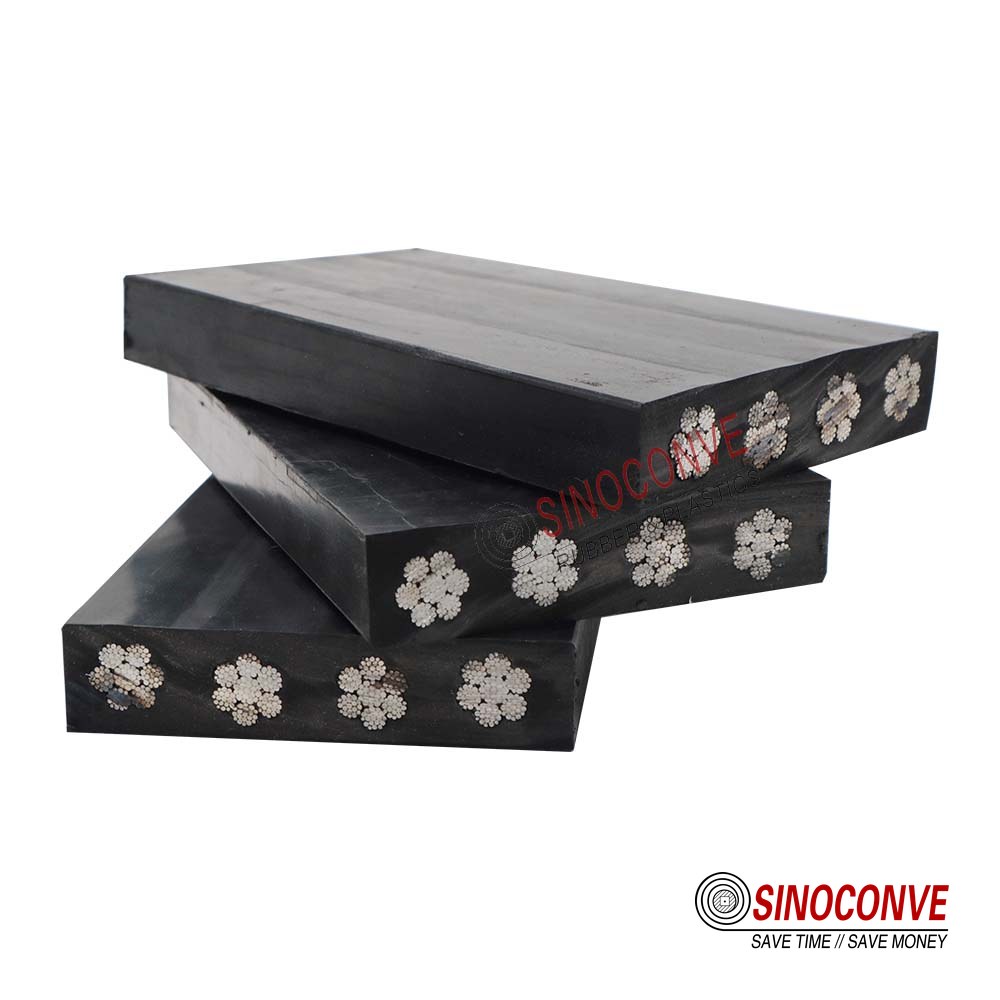
| Steel-cord carcass | Long burden runs, high-tension main lines and any transfer carrying dense slag or scrap pieces | When the tension demand outruns fabric construction or the material carries sharp, heavy fragments | Needs larger pulleys and a gentler splice, so it is wasteful on short, tight conveyors |
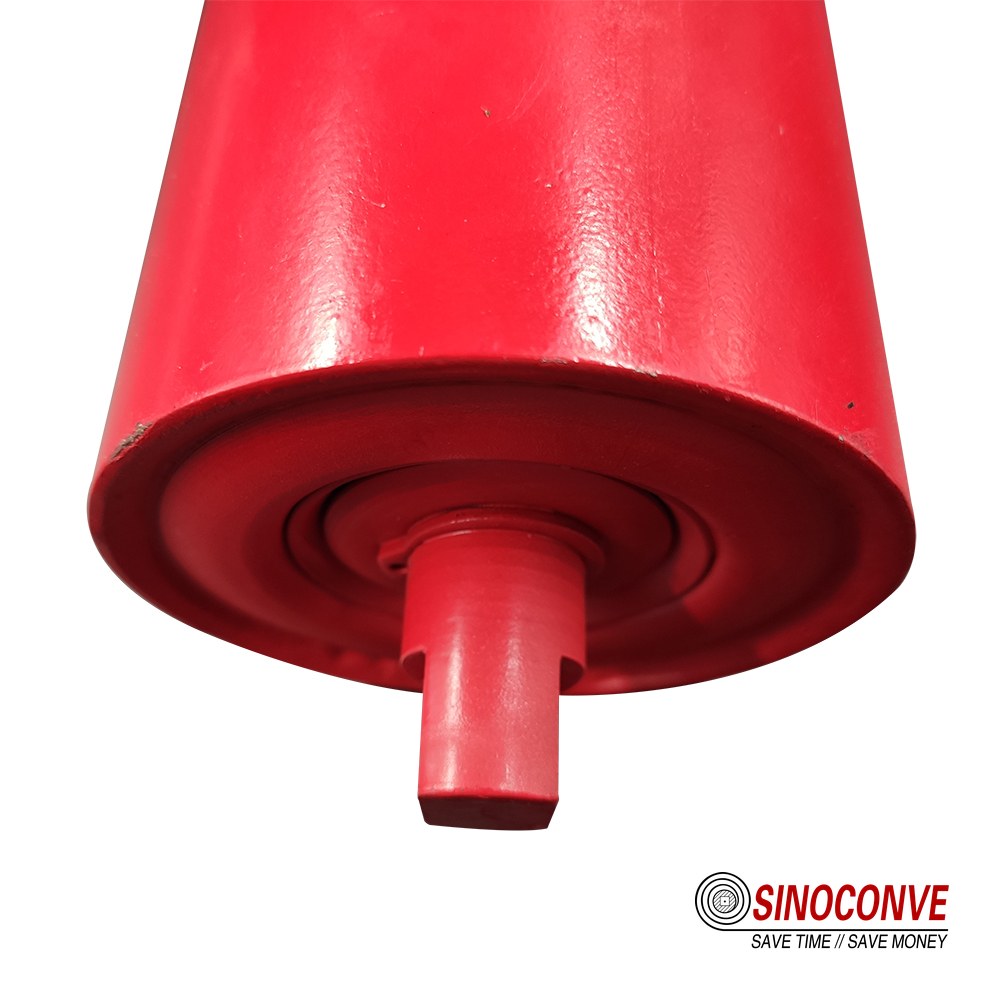
| Cushioning impact idlers | Raw material transfer towers, burden charging and the drop point of every slag conveyor | When drop height exceeds roughly one meter or lump size is large and irregular | Too many soft idlers over a long span reduce support, so they belong at the load point only |
| Heat-tolerant idlers | Sinter, caster and rolling short runs where the roller itself absorbs soak heat | When idler grease has been found hardened or bearings seized during routine inspections | Costs more than standard rollers, so it is pointless on cold ore lines |
| Cleaning scrapers and wash points | Wet ore yards, pellet lines, coal handling and every dust-heavy additive conveyor | As soon as carryback is visible on the return side or material builds around return idlers | Aggressive blades on a soft heat compound can chatter and gouge, so pressure must be set low |
| Enclosure, covers and dust control | Coal galleries, caster and rolling areas, converter additive systems and outdoor yard transfers | Where wind, rain or dust deposition would otherwise reach the belt or the structure | A closed cover traps heat, so it must not be used over a sinter or hot slag belt without ventilation |
Reading the matrix down any single row tells you why a component is needed; reading across a row tells you what to give up. That trade-off is the part most quotations ignore, which is why we encourage buyers to send the zone list with the enquiry rather than a single belt drawing and a required tonnage.
15Procurement and Acceptance Checklist for Steel Plant Belts
Turning the zone analysis into an order document
Once the zones are mapped and the components chosen, the job of the buyer is to convert all of that into a document that can be checked. A steel plant purchase specification should state the temperature class and the evidence behind it, the cover grade, the carcass type and strength, the splice method, and the traceability requirements in a way that a third party could verify. Vague language is the enemy here: a line that reads "suitable for hot material" cannot be tested, audited or rejected. Every field below should have a number, a standard reference or a named test attached to it, and the supplier should be told before the order is placed which documents will be requested at delivery. As a heat-resistant conveyor belt line, we would rather answer those questions during tendering than argue about them at the gate.
| Check area | What to demand from the supplier | Acceptance basis we would apply |
|---|---|---|
| Heat class judgement | A defined temperature range tied to the measured cover condition, not to the material alone | The declared class must cover the crest temperature with some margin for summer and start-up peaks |
| Heat ageing evidence | Retained properties after oven ageing, typically reported against ASTM D573 or the equivalent ISO method | Covers must keep enough tensile strength and elongation that the belt still tracks after ageing |
| Full-thickness tensile test | Certified breaking strength for the finished belt, reported per ASTM D378 or the agreed standard | Measured value must meet or exceed the strength written in the order, batch by batch |
| Cover abrasion and hardness | Abrasion volume loss to DIN 53516 and hardness in Shore A for both covers | Values must sit inside the range stated, since drift here signals a compound change |
| Splice vulcanization | Press temperature, pressure and cure time records for every joint made on site or in the works | Splice strength should be expected to reach roughly 90 percent of belt strength, per the governing standard |
| Batch traceability | Roll number, production date, compound batch and test report linked to the delivered belt | Each roll must be traceable to its test record so a claim can be settled without argument |
16Safety and Environment: Heat, Dust, Fumes and the Maintenance Window
The constraints that decide when the belt can actually be changed
Safety in a steel plant conveyor corridor is not only about guarding and pull cords, though those matter. The dominant hazards are specific to this environment. Hot material can travel further down a belt than anyone expects after a chute blocks and then clears, so trip devices and temperature sensing at the head end are worth more here than on a cold aggregate line. Dust from coal and converter additives is respirable and, in the coal case, potentially explosive, which places real demands on enclosure design and extraction. Fumes near the caster and the furnace make inspection harder, so the maintenance team often works in a narrow window between heats, and that window is where rushed splice work and skipped checks introduce failures that show up weeks later.
Environmental performance is now part of the same conversation. A belt that sheds carryback along the return run spreads material across the whole corridor, which raises housekeeping costs and, in a coal gallery, increases explosion risk. Our answer is usually a combination of good cleaning, sealed rollers and a properly vented enclosure, and we would point anyone planning that work at our notes on dust-resistant belt selection and at the practical scraper advice in this cleaning methods guide. When the dust is fine enough to defeat ordinary bearing seals, sealed rollers become a maintenance decision rather than a nicety, and the comparison is worth reading in this article on sealed rollers for fine dust environments.
17Common Selection Errors and What They Actually Cost
Most of the expensive mistakes in a steel plant are not exotic. They are simple specifications applied to the wrong zone, and they repeat across plants because the person writing the enquiry rarely sees the whole route. We have listed the five we meet most often, together with what each one tends to cost in downtime and replacement rather than in talk. The important thing to notice is that none of them is caused by a bad belt; each is caused by a belt that was perfectly good somewhere else. A fabric carcass chosen for a cold ore line will fail on a slag transfer, and a steel cord conveyor belt selected only because it looks stronger may be the wrong tension and pulley match for a short hot run.
| Selection error | Why it happens on steel plant projects | What it costs in service |
|---|---|---|
| One cover grade across the whole works | Central procurement consolidates the order to win a volume discount on a single line item | Hot zones fail within months while cold zones run years, so the saving is erased by early replacement |
| Material temperature taken as the design temperature | The enquiry form has one temperature field and radiant load never appears in the paperwork | Cover dries and cracks on the heat-facing side even though the belt was rated for the material alone |
| Standard idlers under a hot, high-drop chute | Idler selection is left to the conveyor builder rather than tied to the belt specification | Grease hardens, bearings seize, and the belt then grinds over locked rollers at the load point |
| Splice treated as a site detail | The order specifies the belt but nobody writes down the cure conditions for the joints | The joint becomes the weak point on every one of the short, hot, cycling conveyors in the plant |
| No enclosure on coal or additive galleries | Enclosure is deferred as a later capital item to reduce the initial project cost | Dust spreads along the corridor, housekeeping climbs and fire risk rises until covers are finally fitted |
If you recognize two or more of these rows on your own site, the fastest gain is not a new belt but a re-read of the zone list with measured temperatures beside it. That single exercise usually moves the maintenance budget to where it will do the most good.

18Frequently Asked Questions
How do we decide the heat class for a steel plant conveyor belt?
Start with a measured surface temperature on the belt itself, not the material, taken after the conveyor has run for at least two hours in the hottest shift. Add margin for summer peaks and for start-up surges, then match that number to a declared class. If the enquiry only carries a material temperature, the answer will be wrong on any conveyor that also faces radiant load.
Can one belt specification cover both the sinter plant and the raw material yard?
No, and trying to force it is the single most common cause of early cover failure we see. The yard needs abrasion resistance against cold, wet, coarse ore, while sinter duty needs heat tolerance on short conveyors that cycle hot and cold. A compound optimized for one is measurably worse at the other, so splitting the order by zone is cheaper over the life of the belts even if the unit price is slightly higher.
What heat ageing evidence should we ask for?
Ask for retained tensile strength and elongation after oven ageing, reported against ASTM D573 or the equivalent ISO practice, and ask for the test on the actual compound being supplied rather than a generic data sheet. The reason is that rubber hardens and loses elasticity with heat, and a belt that still tracks and flexes after ageing is worth more than one with a good room-temperature number. If a supplier cannot produce an ageing report, treat the heat class as a claim rather than a specification.
Do we always need a steel-cord belt in a steel plant?
Not at all. Steel cord earns its place on long, high-tension main lines and on transfers carrying dense fragments such as slag or scrap. On short hot conveyors around the caster and the rolling lines, the tension demand is usually modest and a fabric carcass is easier to splice and kinder to small pulleys. Choosing steel cord for prestige rather than for tension is an expensive habit.
How important is the splice on a hot conveyor?
On short, cycling conveyors the splice is often the first thing to fail, well before the cover wears. Thermal cycling works the joint edge a little on every pass, and a poorly cured joint will open within months. Specify the splice method and the press parameters in the order, insist on cure records, and follow the discipline set out in this splicing buyer's checklist.
Which idlers belong in the hot zones?
Heat-tolerant rollers with grease that will not harden, and cushioning impact rollers directly under the drop point. Standard greased idlers bake and seize in a sinter or caster environment, and once a roller locks it turns into a grinding wheel against the belt. The engineering behind both choices is covered in this roller selection guide and in our notes on impact rollers at loading zones.
Are standard idlers acceptable in the hot zones?
They are not, for the simple reason that the grease inside a standard roller is formulated for ordinary ambient service. In a gallery running 40 degrees or more, that grease stiffens, the bearing drags, and the roller stops turning. The failure is quiet and then sudden, and by the time it is noticed the belt has been running over a stationary, hot steel cylinder.
How do we control carryback from wet ore and pellet dust?
Layered cleaning, and no single device will do it alone. Use a primary scraper close to the head pulley, a secondary scraper behind it for the fine film, and a wash point where water is available, then keep the return run under observation for a month after commissioning. Retrofitting a wash point later almost always costs more than including it in the first design, and it is far cheaper than replacing return idlers on a rolling schedule.
What documents should arrive with the belt?
At minimum: a full-thickness tensile test report, an abrasion volume loss figure to DIN 53516, cover hardness readings, an ageing report, and a batch record linking the delivered rolls to those tests. Splice cure records belong in the same file. Without this paperwork a warranty claim becomes a discussion about memory rather than a comparison against agreed numbers.
Related Products You May Need
- Heavy carrying and conveying belts for hot zones — rubber conveyor belt
- Belting for clinker and hot bulk service — heat-resistant conveyor belt
- High-tension main lines and heavy transfers — steel cord conveyor belt
- Carrying and impact rollers for steel plant galleries — conveyor roller
- Steep incline haulage with a patterned cover — chevron conveyor belt
- Drive belts for plant auxiliaries — V belts
Related Blog Posts
- Reading the cover grade printed on a belt data sheet — rubber belt cover grades explained
- Why impact rollers matter more at the loading point than anywhere else — impact rollers at transfer points
- Rollers built for air that carries very fine dust — sealed rollers for dusty plants
- What to verify before a splicing order is released — splicing buyer's checklist
- Cleaning methods, schedules and the cases scrapers cannot fix — conveyor belt cleaning methods
- Heavy-duty belts for the mining and quarrying duty they share with ore yards — heavy-duty belts for mining