How to Choose the Right Conveyor Roller Manufacturer? An Engineering Answer
This guide answers the roller sourcing question with an evaluation order rather than a feature list. Five gates are applied in sequence: requirement match, capability verification, quality evidence, sample and pilot-batch validation, then delivery, spares and after-sales. Requirement match begins by defining the duty before any supplier is compared, and capability verification lists what a roller manufacturer has to prove, from tube forming and welding to bearing fit, sealing and balancing. Quality evidence concentrates on the documents and numbers that survive an audit, while sample and pilot-batch validation runs from first article to production release. Delivery, spares and after-sales are costed as line items between the quotation lines, with a worked total cost of ownership example a buyer can recompute. It ends with questions to ask before the RFQ, common traps, and how this guide divides work with our roller specification article.
Logistic Conveyor Belt: Hygiene, Grip and Line-Design Requirements
A logistic conveyor belt is chosen by duty, not by catalogue colour, and this guide works from the belt body outward. It defines the three duty profiles a logistics building usually runs, sortation, parcel line and incline transfer, and what each one demands from the body. Material choice is compared honestly across PVC, PU and rubber under real logistics loads, followed by surface design, texture, rough top and cleats, and the friction budget behind grip on an incline. Minimum pulley diameter, back-bending and tracking are covered with the geometry that decides them, as are impact, drop height and puncture damage at induction points. Hygiene and cleaning requirements, static and flame rating in a sealed hall, interfaces to pulleys, rollers, guide rails and sidewalls, failure modes, incoming inspection jobs and the RFQ fields that cost most when they are missed close the guide.
Synchronous Belt Factory: Technical Audit and RFQ Checklist
A synchronous belt factory audit is an evidence exercise, and this guide sets out what to ask for and how to read it. It opens with tooth profile moulds and tooling capability, then moves to cord and tensile member tension control, vulcanization temperature and pressure records, and the pitch accuracy inspection equipment behind a claimed tolerance. Batch traceability is treated as a question, what a batch number must resolve, alongside gauge and instrument calibration records. A capability boundaries section lists the questions that force honest answers, followed by a full audit checklist with item, required evidence and pass criterion. The second half covers RFQ fields that make quotations comparable, incoming inspection and acceptance criteria, six common audit mistakes that let a weak factory through, and how to turn audit notes into a sourcing decision.
Conveyor Idler Specifications: How to Read the Numbers Before Ordering
A conveyor idler specification sheet is the only document that binds a supplier, so this guide reads it field by field before an order is placed. It covers the three dimensions that stop installation when they are wrong, outer diameter, shell length and shaft extension, and why a per-end tolerance is not a total. Bearings, shafts and the lubrication line follow, including why a larger bearing number is not automatically better on a light return strand. Tube wall thickness, roundness and radial runout are tied to load, speed and duty, then sealing, protection class and coating for wet, dusty or corrosive sites. The core is an allowable deviation table a buyer can attach to the order, the document evidence to collect before a container leaves, an inbound sampling plan with instruments and ratios, and an accept, reject or concession rule. It closes with an RFQ field checklist.
Quarry Conveyor Systems: System Design and Buyer Checklist
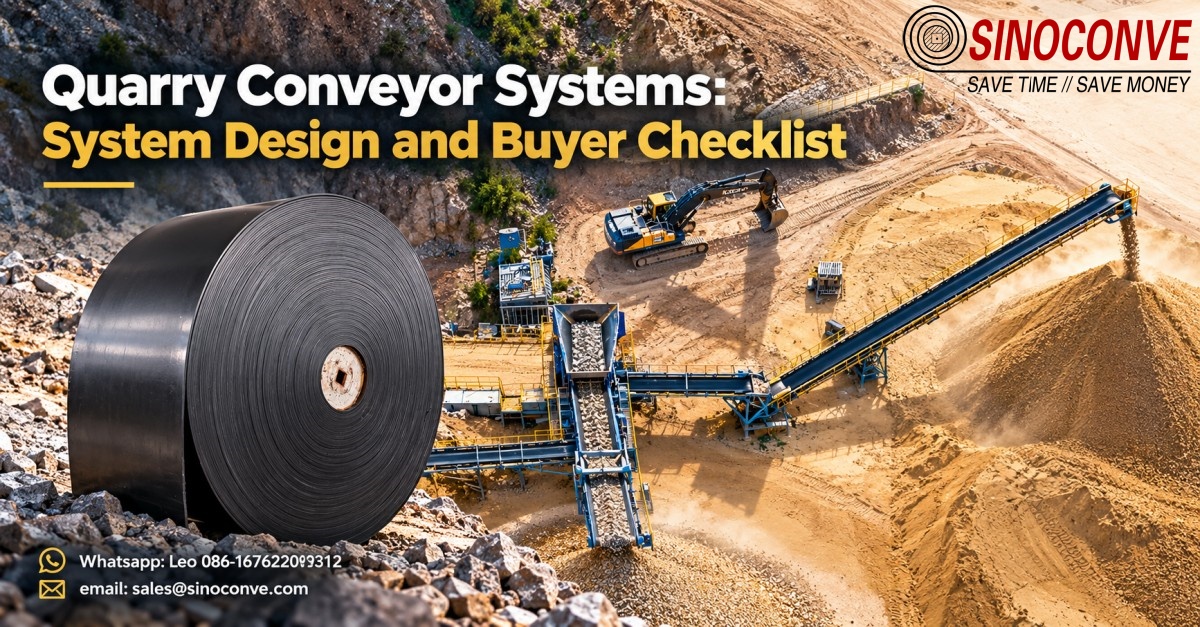
Quarry conveyor systems are settled at the interfaces long before anyone prices a belt, and this design-and-procurement guide works them in order. It sets the boundary from the primary crusher discharge lip to the last tripper or loadout chute, then identifies the two inputs that drive everything downstream, feed gradation and moisture, and how a designer reads a gradation curve for trough depth and lump clearance. Impact points get a full section on the zone that kills belts, including chute geometry and acceptable free fall heights under a crusher chute. A component matrix splits crusher, screening and stockpile sections, and a five-step conversion carries tons per hour through to belt width, with a limestone worked example where a 650 mm belt satisfies the tonnage but caps lump size at 217 mm. Idlers, pulleys, dust and enclosure, a steel cord decision framed as a system choice, maintenance and spares, a procurement checklist and buy-off checks round out the guide.
Port Conveyors: Application Design and Procurement Checklist
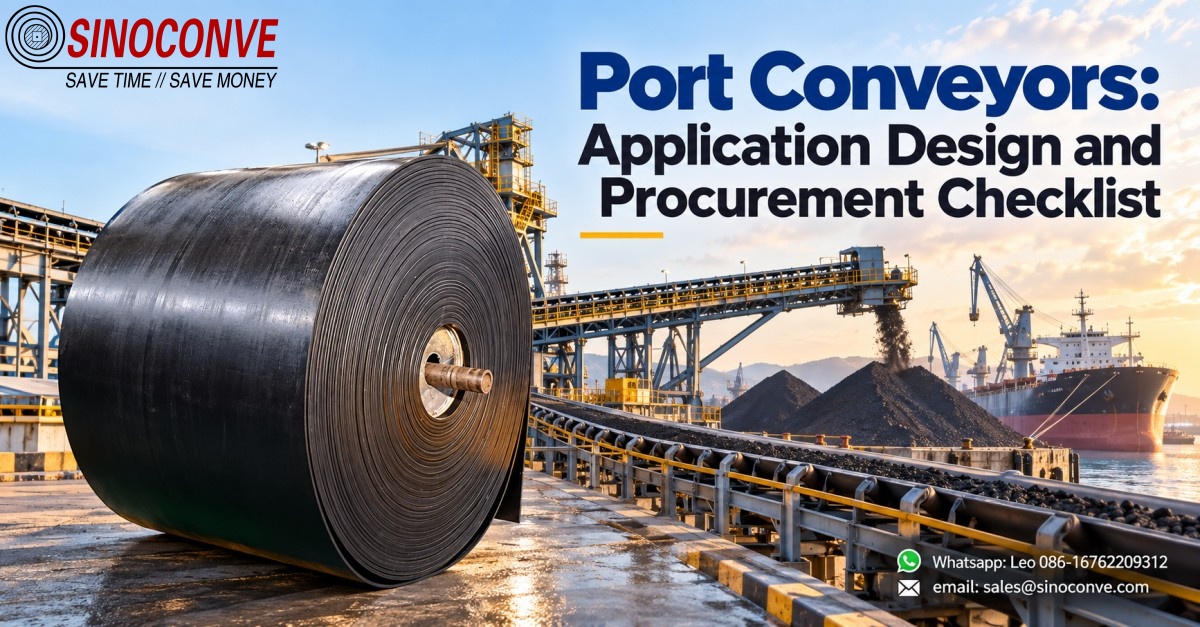
Port conveyors are not mine conveyors with a better paint system, and this application-and-procurement guide explains why. It opens with the three conditions that separate a terminal from any other conveying duty, salt-laden air that keeps attacking steel, cargo streams that change far faster than mine feed streams, and round-the-clock schedules, then walks the working zones from ship unloading and hold cleaning through stockpile handling to rail and ship loading. Corrosion control is treated by component rather than by slogan: coatings for structural steel, roller and pulley materials for a marine atmosphere, and bearing sealing and lubrication in wet salty air. Later sections cover dust and enclosure, long runs and steep inclines with a 600 m boom carcass check, impact and stream centering, uptime through redundancy and one-shift belt changes, a component matrix, an RFQ checklist, port-specific acceptance items and a single-berth total cost view.