

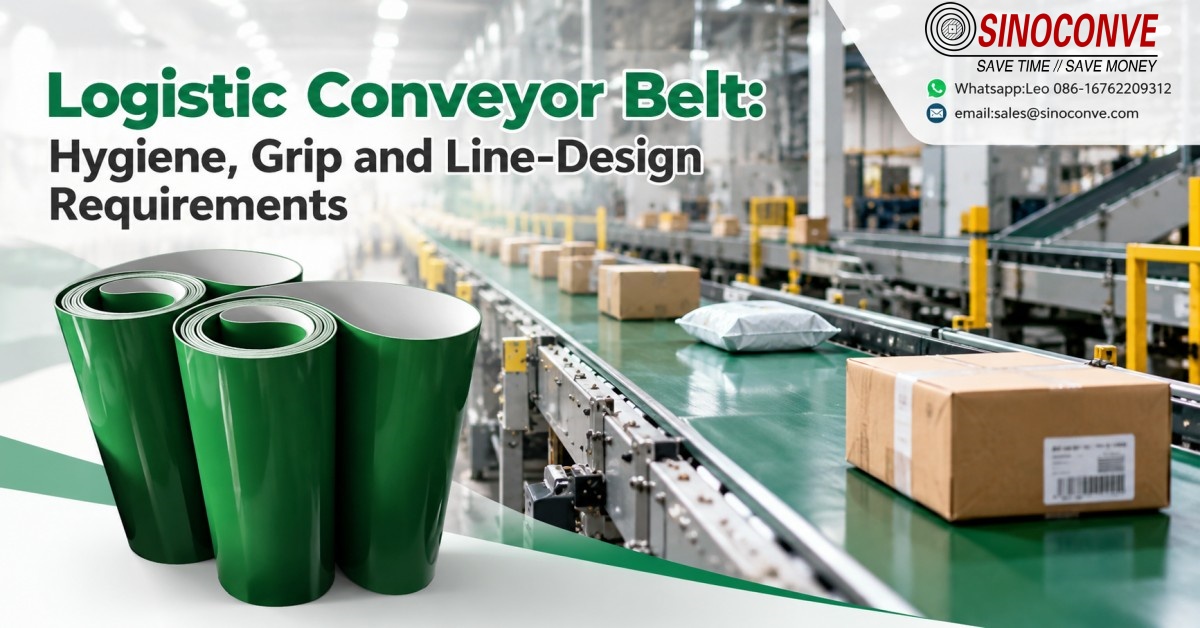
A logistic conveyor belt is chosen by its body, not by the frame it sits on. Surface grip, the smallest pulley it must wrap, resistance to punctures from strapping and loose fasteners, and a face that can be wiped down without swelling decide whether a sortation hall holds 2.4 m/s or sags to 1.6 m/s under mixed load. Everything else on the data sheet is a consequence of those four properties.
Our plant in Ningbo builds light PVC and PU belts as well as heavier fabric-carcass belt, and the questions we get from parcel hubs, third-party operators and integrators rarely arrive in that order. Buyers usually start with thickness in millimeters, move to price per meter, and only two weeks after commissioning discover that the nose transfer is chewing the belt edge or that the splice is opening over a back-bend pulley. This article works in the other direction. It starts with what the belt body has to survive inside a logistics building, then translates that into material, surface, carcass, joint and acceptance criteria you can write straight into a purchase order.
One boundary before we begin. This is a belt-body discussion. We are not going to lay out your sortation zones, size accumulation buffers or prescribe scanner and chute combinations. That system-level work belongs with your integrator. What follows sits one step inside it, at the level of the belt itself.

01What the Belt Body Has to Survive in a Logistics Building
Logistics duty is not light duty, even when every parcel weighs less than 30 kg. The belt sees a huge number of load cycles, constant start and stop, repeated wrapping over small rollers, and a stream of objects with hard corners and metal edges. A tote corner striking the same 200 mm of belt forty thousand times a week does more damage than a steady 5 t/h feed of graded aggregate, and the failure signature looks completely different.
We look at four load paths when we quote a belt for this environment. The first is flexing: how many times per hour the carcass bends around the smallest roller in the line. The second is local impact, meaning the drop height and edge geometry of whatever lands on the belt. The third is lateral, the sideways force from products that arrive off-center or from a badly aligned guide rail. The fourth is chemical and thermal, which in practice means cleaning agents, condensation and occasionally a hot item placed on the belt by mistake.
Load Cycles, Not Belt Width, Set the Wear Clock
A belt running at 1.8 m/s moves roughly 1,800 meters of itself past a fixed point every minute when you count both the carry side and the return side of a typical layout loop. If the loop includes one 63 mm nose pulley and one 80 mm tail pulley, the same centimeter of carcass passes over a tight radius about 1,200 times per hour. That is the number that governs fatigue, and it is why a belt that would last five years in a quarry transfer can fail in fourteen months on a sortation deck.
Why the Body, Not the Frame, Becomes the Bottleneck
Frames are rigid and forgiving. Belts are not. When throughput falls off in a parcel hub, the cause is usually one of three things on the belt side: a surface that has polished smooth so products slide instead of gripping, a splice that has crept and started to wander, or a carcass that has softened at the edges so the belt no longer tracks true. None of those show up in a control system alarm, and all of them are visible in the belt body weeks before they become a stoppage. For the wider context of how a EP conveyor belt tracking guide frames misalignment, the same logic applies here at a smaller scale.
02Duty Profiles: Sortation, Parcel Line and Incline Transfer
The word "logistics" covers at least three belt duty profiles, and they do not want the same body. Buying one specification for all three is the most common reason crews end up with a belt that is too stiff in one place and too soft in another. If your line mixes them, split the order.
Sortation Decks: Many Tight Wraps and a High Cycle Count
Sortation is dominated by small pulleys, frequent back-bend, and products that arrive at unpredictable angles. What matters most is flexibility of the carcass, a splice thin enough not to bump through the transfer, and a surface that keeps hold of a poly mailer that has just been thrown by a diverter. Tracking quality on these lines is really an edge and splice quality question, because a 2 mm lateral drift at a 50 mm pulley becomes a 20 mm drift by the time the belt reaches the end of a 12 m deck.
Parcel Lines and Incline Transfers: Grip Under Mixed Loads
Once the belt climbs, grip moves ahead of flexibility in priority. A carton with a glossy coated surface on a 15 degree incline needs a genuinely different friction budget than the same carton on the level. Since incline hardware is not part of this article, we keep the discussion where it belongs, at the belt face and the pulley wrap, and we point buyers to the surface families rather than to a layout.
Incoming and Outgoing Docks: Abrasion and Foreign Objects
Loading areas add sand, grit and the occasional broken pallet nail. That is an abrasion and puncture problem at the same time. A belt that is fine on the sorted side of the building can be scuffed to fabric in a single season at a dock door where the same belt is walked on and dragged over. If your building has both, the belt for the dock lane should be a different part number.
Across all three profiles, the two most useful questions for a buyer are how small the tightest pulley is and how high the tallest drop is. Answer those two and the rest of the specification narrows quickly.
03Reading the Belt Body Specification Sheet
Most logistics belt quotations are one page long, and most of the arguments in the field start because four or five of those lines were left blank. The table below is the one we use internally when we convert a customer's description into a manufacturable body. As a conveyor belt manufacturer we would rather ask these questions before the order than explain the answer after a failure.
| Specification field | What the number really controls | Range we see in logistics duty | What goes wrong when it is chosen loosely |
|---|---|---|---|
| Overall belt thickness | Sets the bending stiffness, the minimum pulley diameter and how much belt mass the drive accelerates on every start. | 2.0 to 4.5 mm on light PVC and PU bodies, and 6 to 12 mm once a full fabric carcass is used. | Too thick and the belt will not wrap a 50 mm nose pulley, while too thin wears through to fabric first. |
| Carcass ply count | Carries the tensile load and resists tearing once a cut has started at the edge or along the splice. | One or two plies are normal for logistics, and three plies appear on heavy dock lanes. | A single ply wraps easily but tears faster, and extra plies stiffen the body and raise the pulley diameter floor. |
| Rated tensile strength | Becomes the starting point for the take-up travel you must allow in the frame after installation. | Quoted in N/mm of belt width, and light logistics bodies sit low in most catalogue tables. | Under-specifying eats take-up travel early, and the splice then has to be re-made in the middle of a season. |
| Top cover compound | Governs friction against the product, hardness on the Shore A scale and how the face behaves under cleaning. | Soft compounds around 60 to 70 Shore A grip well, while harder faces survive sliding cartons better. | A glossy face looks fine on a drawing and then lets coated cartons slide back on any incline above about 8 degrees. |
| Surface pattern | Trades flatness for grip, and grip for cleanability, because every groove holds a little debris. | Smooth, fine texture, rough top and cleated faces are all standard on light belt ranges. | Rough top chosen for grip in a dusty hall can clog and then behave like a slicker belt than the original. |
| Joint method | Determines whether the belt runs as a continuous band or carries a mechanical bump on every revolution. | Vulcanized endless or stepped splice on tight-wrap decks, and fasteners only where pulleys are large. | A fastener set over a 63 mm pulley strikes the edge every pass and eventually splits the belt at the lacing holes. |
| Edge construction | Controls how much lateral rubbing against guide rails and frame corners the body will tolerate. | Sealed or encapsulated edges are the norm where rails rub, and cut edges are rarer in this duty. | An open cut edge wicks moisture into the fabric and frays within weeks on any line with a rubbing rail. |
| Friction coefficient | Sets the steepest incline before parcels creep backwards and how much drive power the wrap absorbs. | Suppliers quote a band rather than one figure, because the value moves with dust and moisture. | Buying on a single flattering number ignores that a damp plastic film can halve the grip you thought you had. |
| Antistatic and flame data | Records whether the body will bleed off static charge and how it behaves if a fire starts nearby. | Antistatic faces are tested against ISO 284, and light-belt flame behaviour is grouped under EN 12882. | An unrated belt in a dust-laden hall is a compliance problem even when it never actually sparks. |
Two Fields Buyers Consistently Leave Blank
Edge construction and joint method. Both are invisible in a photograph of a sample, both are cheap to change at the factory, and between them they cause most of the belt complaints we hear from logistics customers. Ask for them in writing on the quotation rather than in the cover email.
What a Data Sheet Cannot Tell You
A data sheet cannot tell you what a body weighs in your hand, how a cleat feels when a tote hits it, or how the surface responds to your particular cleaning chemical. Those come from a sample on your own line. We normally send a one meter length with the full ply structure and edge finish so a maintenance team can run it over their tightest pulley before the order is placed, and any serious conveyor belt supplier will do the same without being asked twice.
Field note from our engineers: At a hub in Zhejiang with a 42 degree hall temperature and plenty of cardboard dust, a maintenance team replaced a rough top belt with a smooth antistatic body on the same frames and reported that grip improved. The rough top had been packing with dust and behaving like a slick surface within two shifts. Same line, same loads, opposite of what the catalogue suggested.
04Material Choice: PVC, PU and Rubber Under Real Logistics Loads
Three families cover almost everything we ship into a distribution building: PVC, polyurethane and rubber over a fabric carcass. They are not ranked best to worst. They fail in different ways, and the right question is which failure you can live with on a given lane.
PVC is the workhorse of light conveying because it is dimensionally stable, welds into a very clean endless band, and comes in antistatic and flame-retarded versions without much drama. Its weakness is heat and some oils, and a sharp edge cuts into it rather easily. PU is tougher in almost every mechanical sense. It resists cuts, oils and fine abrasive dust better than PVC at the same thickness, and it holds up when a pallet corner drags across it. It also costs more, and not every splice shop can weld it well. Rubber over a textile carcass sits at the other end again: heavier, stronger, better at surviving a real impact, and much less pleasant to move a 1,000 mm wide roll of by hand. For logistics duty we mostly see rubber on dock lanes and on transfer belts that also handle loose bulk.
| Property | PVC belt body | PU belt body | Rubber over fabric carcass |
|---|---|---|---|
| Abrasion resistance | Adequate on clean cartons, and it wears noticeably faster once grit is present. | Best of the three at the same thickness, which is why dusty dock lanes often specify it. | Compounds are graded against DIN 53516, with limit values commonly quoted from 90 to 250 mm3. |
| Cut and puncture | Strapping edges and pallet nails will cut a PVC face if the body is thin. | High tear resistance, and our preferred body wherever nails and banding are routine. | A thick rubber cover absorbs a blow that would cut straight through a light face. |
| Oil and grease | Softens with prolonged hydrocarbon contact, so it is a poor choice near a workshop bench. | Effectively unaffected by the drips and splashes found around dock equipment. | Standard grades swell slightly, and oil resistant compounds are available when the lane needs them. |
| Temperature window | Comfortable from roughly minus 10 up to 70 degrees Celsius in ordinary warehouse conditions. | Wider than PVC, with most grades comfortable up to about 80 degrees Celsius. | Handles both cold docks and warm roof spaces, and heat resistant grades extend the top end. |
| Cleanability | A closed PVC face wipes down easily and tolerates most alkaline cleaning agents. | Clean and odour neutral, though some solvent cleaners will attack the surface. | A textured rubber cover holds dust in its own pattern and takes longer to wipe. |
| Splice behaviour | Welds or vulcanizes into a thin, nearly invisible joint that runs over small pulleys well. | Also joints well, but the number of shops that can do it competently is smaller. | Stepped vulcanized splices are standard, and they need a larger pulley to pass cleanly. |
| Typical body thickness | Usually 2 to 4 mm across the light conveying range used in parcel handling. | Usually 2 to 5 mm, with the thicker end reserved for high impact dock work. | 6 mm upward once cover and carcass are counted together on a two or three ply build. |
| Where it wins | Clean sortation decks, tight transfers and any line where a thin, quiet joint matters. | Dusty, oily or edge-hostile lanes where the surface has to survive being scraped. | Heavy dock transfers and belts shared between parcels and loose bulk material. |
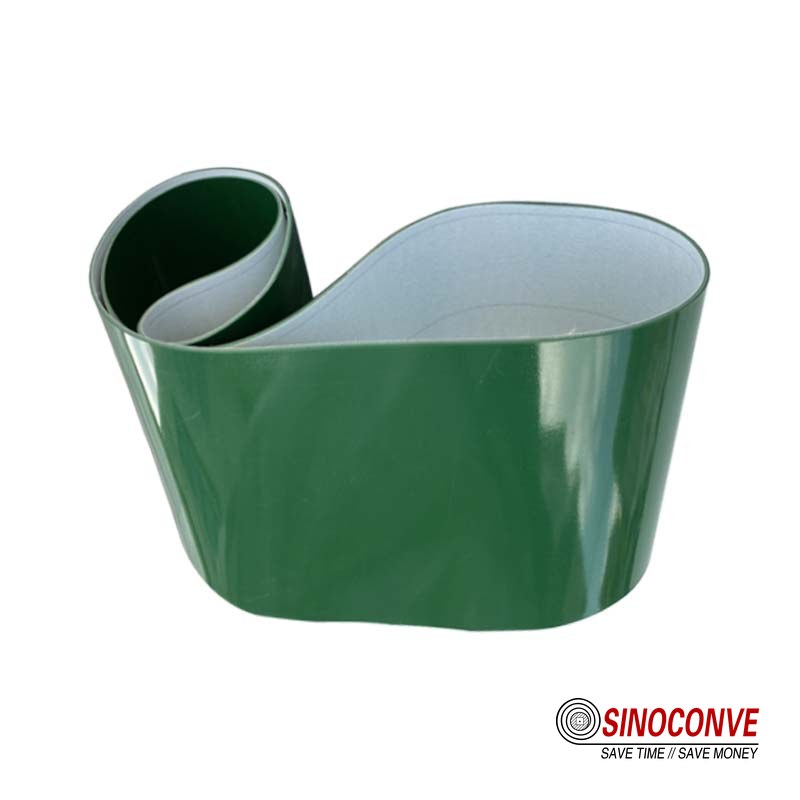
One practical note on the rubber family, since buyers sometimes assume it is always the safe answer. A heavy rubber conveyor belt that is stiff enough to shrug off a pallet blow is also stiff enough to fight a 63 mm nose pulley, and it will punish a frame that was built for light belting. The same material logic applies on the heavy side of the plant, where an industrial conveyor belt is picked for a very different set of loads. Logistics duty sits between the two, so material choice has to follow the pulley list rather than the other way round.
05Surface Design: Texture, Rough Top and Cleats
The face of the belt is where most of the argument about grip actually gets settled, and it is the part of the specification most often reduced to a single word on the drawing. In practice you have four choices, and each one changes what the belt does when it is dirty rather than when it is new.
Choosing a Face You Can Live With When It Is Dirty
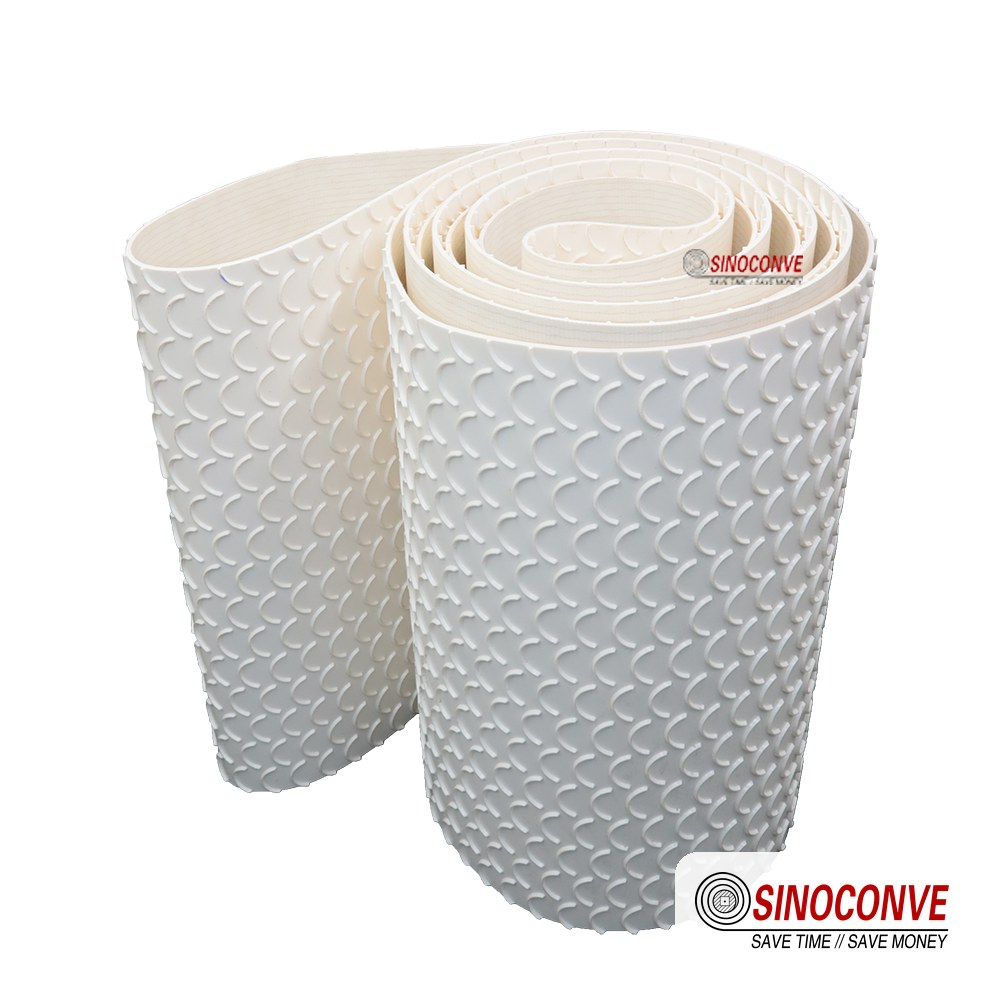
A smooth face gives the most predictable friction, the easiest cleaning and the thinnest splice, and it is what we recommend for the majority of clean parcel and tote lines. A fine micro-texture adds a little grip without giving dust anywhere to sit. Rough top, meaning a pronounced silicone or rubber pattern, is genuinely better for wet or lightly soiled cartons, but it traps fine cardboard dust and gradually behaves more like a smooth belt with a rough appearance. Cleated faces, including the angled patterns used on many steep transfers and sold through any serious conveyor belt distributor, are there to stop products rolling back rather than to raise friction under a carton.
A pattern only helps until it fills. We have measured belt faces losing most of their apparent grip advantage over a smooth body after roughly three weeks of two-shift operation in a cardboard-heavy hall. If nobody in the maintenance schedule is assigned to brush or wash the pattern, specify smooth and accept the lower initial friction number.
06Grip, Inclines and the Friction Budget
Every inclined lane has a friction budget, and it is smaller than most drawings assume once dust, moisture, product surface and belt wear have each taken their share. A belt quoted at a clean, dry friction coefficient of 0.35 can behave like 0.15 once a damp poly mailer with a printed coating sits on a dusty face.
The Friction Budget on an Incline
The working number is the tangent of the incline angle. A 10 degree lane needs about 0.18 of usable friction just to hold a stationary parcel, a 15 degree lane needs roughly 0.27, and a 20 degree lane needs about 0.36 before you allow anything for acceleration, vibration or a stopping belt. That last allowance is where projects go wrong. A belt that holds a static carton at 18 degrees will still slide that carton on the instant the drive stops and the belt relaxes, because static friction and the transient condition are not the same thing.
| Incline band | What the belt face must deliver | What we normally quote for it | What still goes wrong in service |
|---|---|---|---|
| Level to 5 degrees | Very little, which is why a smooth antistatic face is usually the most economical answer here. | Smooth or micro-textured PVC, with static-dissipative properties if electronics or fine dust are present. | Nothing dramatic, though a polished face will let light items drift sideways on a poorly tracked belt. |
| 5 to 10 degrees | Enough grip to stop a carton creeping when the line stops and restarts under partial load. | Fine texture or light rough top, and a harder compound if heavy cartons drag rather than tumble. | Grip fades at the top of the incline where dust from the discharge point settles back on the belt. |
| 10 to 18 degrees | A reliable friction band with margin for a wet or coated product surface on a dirty belt. | Pronounced rough top over a two ply carcass, often with a guide strip underneath for tracking. | Product spacing. Touching cartons push each other backwards even when the single carton test passes. |
| 18 to 25 degrees | Positive mechanical support as well as friction, because no flat face is dependable at this angle. | Angled cleats or a chevron style pattern, matched to the smallest product the lane will ever see. | Cleats sized for the average parcel let small envelopes slip between them and slide straight back down. |
| Above 25 degrees | Sidewalls or another containment method, since a flat belt alone is the wrong tool past this point. | We usually redirect buyers to a sidewall or pocket design rather than keep adding pattern depth. | Customers sometimes try to fix this with a stickier face and end up with a belt that will not track. |
Belt-to-Pulley Grip Is a Different Question
Belt-to-product friction gets all the attention, and belt-to-pulley friction decides whether the drive slips. On a logistics belt wrapped over a 63 mm pulley the wrap angle is often only 90 degrees instead of the 180 degrees you would see on a long quarry conveyor, so the available friction area shrinks and the drive has to work harder. The fix is not always a stickier belt face. More wrap, a larger drive pulley or a lagged pulley surface is usually cheaper and does not compromise the top surface.
07Minimum Pulley Diameter, Back-Bending and Tracking
The single most useful dimension on a logistics layout drawing is the diameter of the smallest pulley the belt has to wrap. If a buyer sends us only that one number plus the belt width and the product weight, we can usually tell whether the requested body will survive the line.
Minimum Pulley Diameter Is a Carcass Property
Bending stiffness comes from the carcass and the compound together, not from the total thickness alone. A 3 mm body with one ply is far more flexible than a 3 mm body with two plies and a heavy cover, even though the caliper reads the same. In practice our tables for light PVC and PU bodies start around 50 to 63 mm for a single ply and step up to about 80 mm for a two ply build, with larger values once the belt is heavy enough to need three plies. Running below the rated figure does not fail immediately. It flexes the fabric more sharply than it was designed for, the compound cracks at the bend line, and the belt fails at the fold rather than in the middle of the span.
Back-Bending at the Nose Transfer
Nose-over transfers are the hardest thing a logistics belt is asked to do, because the belt runs over a small roller with the product side facing out. That reverses the stress direction in the carcass at every pass. If the belt is back-bend rated for the pulley in question, it survives; if it is not, the top cover starts to show fine cracks along the outside of the bend within a few months. Ask your supplier whether the specific construction is released for back-bend at your nose pulley diameter, and get the answer in writing.
Tracking follows from the same geometry. A back-bend rated belt running over an under-specified nose pulley tends to creep to one side, and maintenance crews then spend months adjusting rails and snubbers instead of replacing the body. We have seen lines where two millimeters of pulley diameter increase ended a tracking argument that had already consumed a full year of maintenance hours. If you want to see how this behaves on a larger frame, our conveyor belt factory team keeps field records on exactly these cases.
08Impact, Drop Height and Puncture Damage
Logistics belts rarely die of uniform wear. They die at a point, and that point is almost always where something falls onto them or where something sharp arrives with the product. Two failure mechanisms deserve separate attention because the belt answer for each is different.
Drop Height, Edge Strikes and the Slicing Failure
A carton landing flat from 200 mm does almost nothing. The same carton landing corner-first from 800 mm concentrates the whole mass into a small area and prints a dent into the cover that becomes a crack line after a few thousand repetitions. Above roughly 1,000 mm of drop onto a light single ply body, we usually ask the buyer to add a ply, move to PU, or accept a sacrificial top cover that will be replaced long before the carcass is finished.
Puncture and slicing are the second mechanism, and they are more common in logistics than in bulk handling because of steel banding, broken pallet nails, damaged tote corners and the occasional dropped hand tool. A thin PVC face cut by a banding edge will start a tear that runs along the belt until it reaches the splice. The tear does not stop on its own. Resistance comes from two places: a carcass with enough plies to blunt the crack tip, and a top compound with genuine tear strength, which in practice means PU rather than PVC. Adding a fabric breaker layer under the cover helps further at a small weight penalty.
Most hubs also hold a spare roll, and the way that spare is bought matters more than people expect. Buying from stock in standard widths, the way most wholesale conveyor belts are supplied, gets a lane running again in a day. Buying project by project leaves a torn belt in place for a week while a special width is made. If uptime matters, keep one roll of your two most-used sizes on the rack, sealed and away from sunlight.
09Hygiene and Cleaning Requirements on the Belt Body
Cleanability is decided by the belt construction long before anyone picks up a mop. Three details control it: whether the surface is closed or open, whether the edges are sealed, and whether the compound survives the chemicals your cleaning contractor actually uses.
Closed Faces, Sealed Edges and Cleaning Agents
A closed PVC or PU face wipes down with warm water and a mild alkaline detergent, and it will tolerate routine quaternary ammonium sanitizers. It will not tolerate repeated contact with strong solvents, which soften the surface and leave it tacky. Fabric-backed edges are the hidden problem, because moisture drawn into an open edge carries cleaning residue into the carcass and starts both fraying and delamination. Sealed or encapsulated edges close that path for a modest increase in cost, and on any line that is washed rather than swept they are worth specifying.
Odour and migration matter wherever the belt shares a building with anything that ends up in contact with people or goods. Clean grades of PVC and PU are effectively odourless after a short running-in period, while a belt with plasticiser migration will leave a film on the product and on the rollers beneath it. If you are unsure, ask for a material sample to sit in a closed bag for a few days and then open it. That single test tells you more than a compliance sentence in a quotation. For the mechanics of keeping a belt genuinely clean in service, our notes on conveyor belt cleaning methods cover schedules and the cases where a scraper is the wrong tool, and the same principles apply to a small sortation deck. Return-side fouling in particular is worth reading about in our guide to return side belt cleaning, because a dirty return side deposits material on every roller it touches.
Where a line is washed in place rather than wiped, a light spray system can work provided the belt has the edge sealing to survive it, and our notes on conveyor belt spray cleaning cover that design.
10Static, Flame Rating and Dust in a Sealed Hall
Modern distribution buildings are large, dry and full of fine cardboard and plastic dust, which is a reasonable recipe for static build-up. A belt running at 2 m/s over small rollers generates charge continuously.
What an Antistatic Grade Actually Guarantees
ISO 284 sets a ceiling on surface resistance for antistatic belting, and commercially available grades are typically quoted at or below 3 x 10^8 ohms when measured under the conditions the standard specifies. That number is a test result, not a promise about your hall. Surface resistance changes with humidity, with contamination, and with wear, and a belt that passes when new may sit well above the limit after a year of daily wiping. Buyers who need static control should specify the class, ask for the test report, and include the measurement in the routine maintenance check rather than treating it as a one-time purchase decision.
Flame behaviour is handled differently for light belts. EN 12882 sorts them into categories according to how they behave in a defined test, and the category a buyer needs depends on the fire load of the space and on local rules. For heavier rubber constructions the familiar references are ISO 340 for flame propagation and DIN 22102 for the belt specification itself, with MSHA 30 CFR Part 14 appearing wherever a US mining or quarry operation is involved. A logistics hall is not a mine, but the same discipline applies: state the standard, state the category, and attach the test evidence to the order. Where dust is heavy enough to be a real ignition risk, our material on dust resistant conveyor belt construction explains which body details reduce the amount of dust a belt carries back into the structure.
11Interfaces: Pulleys, Rollers, Guide Rails and Sidewalls
A belt can be perfectly specified and still fail because the hardware around it was chosen independently. The interfaces that cause the most trouble in logistics are the drive pulley, the roller spacing under the carry side, and whatever is rubbing the belt edge.
Matching the Body to the Hardware It Touches
Drive pulleys on small conveyors are often under-sized because the frame was designed around motors rather than around belt fatigue. A lagged or crowned pulley improves grip and centralizes tracking, but crown height has to be modest on a thin body or the belt will not sit flat. Take-up travel should be enough to absorb the initial stretch of the chosen construction plus the creep you expect over the first year, and on a short logistics frame that usually means more travel than a first-time buyer allows.
Roller spacing is the other quiet failure source. A light belt that is supported too sparsely sags between rollers, the sag becomes a trap for small parcels, and the belt flexes at every roller instead of running flat. Where the load is dropped rather than placed, impact rollers under the loading point absorb the blow before it reaches the belt, and readers designing that detail will find our notes on impact roller selection for loading zones useful. In dusty halls, sealed roller designs keep grit out of the bearings and reduce the drag that a stiff belt has to overcome, a point covered in more depth in our article on sealed conveyor rollers for fine dust. For the general case, our conveyor roller guide sets out how diameter and load ratings are chosen, and the matching product range sits on our conveyor roller page.
Guide rails deserve a mention that they rarely get. Hard urethane or steel strips set with too little clearance will rub a light belt edge continuously. Give the belt 5 to 10 mm of lateral room and check that clearance whenever the belt is re-tensioned. On the drive side, small units sometimes transfer power from the motor through a short belt rather than a direct coupling, and the profile choice there follows the same rules a transmission belt manufacturer would apply to any other drive, with groove geometry matched to the belt section. We build those on the same site as our V-belt range, so a buyer sourcing both from us as a V-belt manufacturer can have the whole drive end quoted together.
12Failure Modes and What Each One Tells You
Every logistics belt failure we are asked about carries a signature. The location of the damage tells you which decision was wrong, and reading it correctly is usually faster than any test report.
Reading the Failure Signature
Look at where the problem starts, then work backwards to the specification line that allowed it. Cracks concentrated in a band across the belt, at regular intervals, point at a pulley diameter below the rated minimum. Damage that starts at the edge and migrates inward points at a rubbing rail or a tracking fault. A single tear that runs lengthwise points at a puncture event and at a carcass that was too light to stop the crack.
| What you see | Where it appears | Most likely cause on a logistics line | What we normally change |
|---|---|---|---|
| Fine cracks in the cover | In a band along the belt, spaced exactly at the pitch of one pulley. | The belt is wrapping a pulley below its rated minimum diameter somewhere in the loop. | Increase that pulley, or move to a thinner, more flexible body with the same strength. |
| Fraying or fuzz on the edge | One side only, on a line with a rubbing strip along the frame. | An open cut edge combined with continuous lateral contact from a guide rail. | Specify sealed edges, restore the rail clearance and correct the tracking fault first. |
| Splice opening or a visible bump | At the join, growing worse over a few weeks of running. | A stepped splice that was not cured fully, or a mechanical joint running over a small pulley. | Re-make it as a vulcanized endless splice, and check the joining method on the next order. |
| Lengthwise tear from a cut | Starting where something sharp landed, usually near a chute or a manual handling point. | A puncture or slice event on a carcass too light to stop the crack from running. | Add a ply or a breaker layer, or move the top face to a tougher PU compound. |
| Grip that has quietly disappeared | Across the whole face, with no visible damage and a shiny appearance. | Surface polish combined with dust packing into a rough top pattern. | Clean the face on a schedule, or move to a micro-textured compound that does not trap material. |
| Belt drifting to one side | Progressively worse along the length of the deck rather than at one spot. | Uneven tension after a re-splice, or a frame that is no longer square after a heavy impact. | Re-tension both sides evenly and check pulley alignment before blaming the belt body. |

13Incoming Inspection and Acceptance Criteria
A new belt should be checked before it goes onto the frame, not after the first complaint. The checks below take a technician about forty minutes with a tape measure, a durometer and a thickness gauge.
| Check | How to do it on site | What we accept | What to do if it misses |
|---|---|---|---|
| Cut length and width | Measure the endless loop on a flat floor with light tension, and check width at three points. | Width within the agreed tolerance, and loop length within the take-up travel left on the frame. | Do not fit it. A loop that is short will be stretched past its design tension and will fail early. |
| Thickness across the belt | Read with a gauge at several points from edge to edge, away from the splice zone. | Consistent readings within the stated tolerance, with no thin band running along one edge. | Raise it with the supplier. A thin edge band is where the first crack will appear. |
| Ply structure and cover | Peel back the cover on an offcut or the test length supplied with the order. | The ply count and cover thickness stated on the quotation, with no voids or blisters. | Reject the batch. Ply count is the single hardest thing to correct once a belt is fitted. |
| Splice quality | Run a hand along both faces at the join and bend the sample over a 50 mm former. | A flat joint with no step, no blister and no visible separation line when bent. | Ask for it to be re-made before installation rather than after the belt is on the frame. |
| Edge finish | Inspect the edge under good light and try to lift the fabric from the compound with a thumbnail. | Sealed or encapsulated edges where specified, with no exposed fibre along the running length. | Document it. Open edges are the main driver of edge fraying complaints within the first season. |
| Hardness and surface data | Check with a durometer where a figure was agreed, and file the certificate for surface resistance. | Hardness inside the agreed Shore A band, plus a test report for any antistatic claim. | Request a replacement sample. A missing report is a compliance risk even if the belt runs fine. |
14What to Put in the RFQ, and the Mistakes That Cost Most
An RFQ that names only material and thickness will always produce quotes that cannot be compared. Four extra lines fix that: the smallest pulley diameter in the loop, the steepest incline with the lightest product that will ever travel on it, the tallest drop height, and whether the belt is washed or wiped. Those four answers change the recommended body far more than a price negotiation ever will.
Three mistakes show up again and again. The first is buying one specification for a whole building that has both clean sortation decks and gritty dock lanes. The second is accepting a mechanical fastener joint because it is available today, on a line whose smallest pulley will destroy it within a year. The third is treating grip as a property of the compound alone, when it is really a property of the compound, the surface pattern, the cleaning schedule and the product arriving on it, considered together.
If you would like a second opinion on a body before you commit, send us the pulley list, the belt width and a photograph of the worst transfer on the line. We will tell you which construction we would put there and, just as often, which one we would not.

15Frequently Asked Questions
What is a logistic conveyor belt made of?
Almost all of them are a polymer face bonded to a woven fabric carcass. The face is normally PVC or polyurethane on light lines, and rubber where the belt has to absorb real impact. The carcass carries the load and decides how tightly the belt can bend.
Should I choose PVC or PU for a parcel sorting deck?
For a clean deck running cartons and totes, PVC is usually the better-value answer and it welds into a thinner, quieter splice. Choose PU when banding, nails, oils or abrasive dust are part of daily life on that lane.
What is the minimum pulley diameter for a two ply logistics belt?
Our tables for light PVC and PU bodies usually start around 80 mm for a two ply build, against roughly 50 to 63 mm for a single ply. Those figures are construction specific, so ask for the value that applies to the exact body you are being quoted. Running under the rated diameter does not fail at once, and that is exactly why it gets missed.
Can one belt handle both a nose-over transfer and a standard tail pulley?
Yes, provided the construction is released for back-bend at the nose pulley diameter you actually have. That release is a specific statement about a specific construction, not a general property of the material. Get it in writing on the quotation.
How thick should a sortation belt be?
Most parcel handling sits between 2 and 4.5 mm of total body thickness, with the lower end on tight wraps and the upper end on lanes with sharper products. Thickness is a consequence of the ply count, the cover requirement and the pulley list, not a target in itself.
Do I need an antistatic belt in a parcel hub?
If the hall is dry, dust-laden, or handles electronics and batteries, yes. ISO 284 is the reference for surface resistance on antistatic belting, and the commercial grades are typically quoted at or below 3 x 10^8 ohms. Re-measure the value during routine maintenance, because it drifts with humidity, wear and cleaning.
How do I inspect a belt body when it arrives?
Measure the loop on a flat floor, check width and thickness at several points, inspect both splice faces over a 50 mm former, and look at the edges under strong light. Peel the cover back on the test length to confirm the ply count. It takes under an hour and prevents the argument that follows a premature failure.
Why does a belt edge fray on an incline?
Usually because the belt is drifting against a guide rail rather than because the material is weak. Incline lines are more sensitive to a small tracking error, and continuous lateral contact abrades an open edge quickly. Fix the tracking and the rail clearance before ordering a different material.
How long should a logistics conveyor belt last?
On a two shift sortation deck with a properly matched pulley list, we would commonly expect three to five years from the carcass, with the top face wearing out first on an abrasive lane. Belts that fail inside eighteen months almost always have a specific, findable cause: an under-sized pulley, a fastener over a small roller, or an edge left open against a rail.
Related Products You May Need
- PVC conveyor belt for clean sortation decks and tight nose transfers.
- Rubber conveyor belt for dock lanes and heavier fabric carcass duty.
- Chevron and patterned belts when a lane climbs and products need mechanical support.
- Conveyor rollers sized to match the sag and load limits of a light belt body.
- V-belts for the drive end of small conveyors and short transfer units.
- Timing belts where a drive needs a fixed speed relationship instead of friction grip.
- Heat resistant conveyor belt for any lane that occasionally sees a hot item.
- Full product catalogue covering light and heavy belt families from one factory.
Related Blog Posts
- EP conveyor belt tracking guide: what causes a belt to drift and how to correct it without guessing.
- Conveyor belt cleaning methods: schedules, tools and the cases where a scraper makes things worse.
- Return side belt cleaning: why the dirty side of a belt deposits material on every roller it touches.
- Conveyor belt spray cleaning: designing a wash system that a belt body can actually survive.
- Conveyor belt splicing buyer checklist: twelve points to verify before you place a joint order.
- Conveyor belt splicing guide: joint methods compared, with field tips from installation crews.
- Conveyor roller ultimate guide: roller types, materials and load ratings for belt support decisions.
- Impact rollers for loading zones: protecting a belt where the product is dropped rather than placed.
- Sealed conveyor rollers for fine dust: keeping grit out of bearings in a dusty distribution hall.
- Rubber conveyor belt cover grades: how cover classes are chosen for wear, impact and heat.
- Dust resistant conveyor belt: body details that cut the amount of dust a belt carries back.
- Port conveyor belt applications: heavy transfer duty and the belt choices that suit it.