

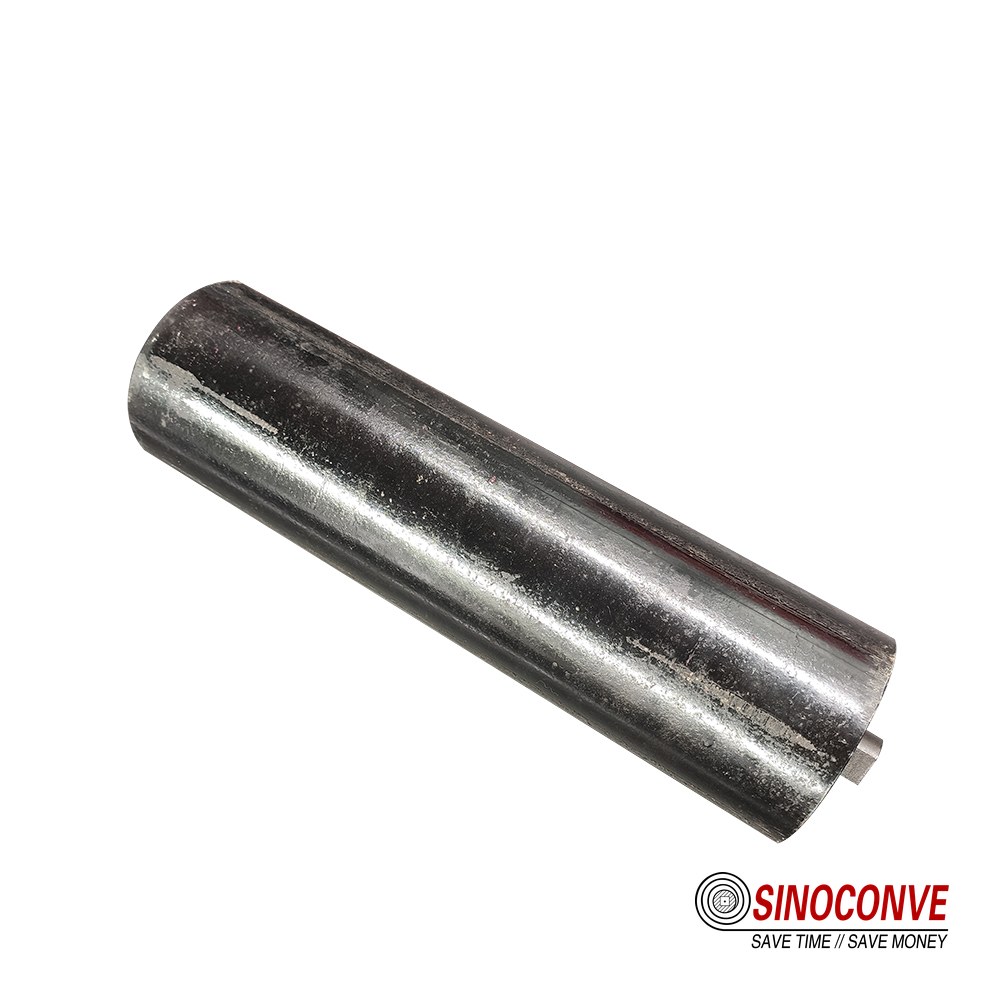
An 89 mm roller alone is not enough to raise a purchase order. A complete conveyor idler specification sheet carries at least ten independent fields, and each one decides something about the steel and the bearing that will eventually arrive at your gate, so a single wrong figure can leave a troughing set sitting on the ground while somebody measures the same bracket slot all over again. Ten fields decide everything. This page takes that sheet apart line by line, points out which values govern behavior under load, and shows how to check a delivered batch against the paper before anyone signs the receipt.

01Why the Spec Sheet Is the Only Document That Binds the Supplier
A photograph cannot be inspected, and a frozen field cannot be negotiated
A photograph proves only that somebody, somewhere, once made a roller that looked round. Bearing, wall thickness and grease grade stay invisible inside it. Real sites are far less forgiving than a product picture, and on a clinker gallery we once measured a running idler sitting 12 °C above a 42 °C ambient, simply because the whole batch had been built with a heavier wall and a poorer dynamic balance than the drawing called for.
Then the fields divide. Outer diameter, total length and shaft extension are effectively frozen, because they touch the belt or the frame, and a 1.5 mm error in any of the three can stop installation on site. Bearing brand, grease maker and paint colour stay open, provided the load rating and the protection class do not change. Treat everything as fixed and quotations stop being comparable. Leave everything open, by contrast, and two deliveries of the same part begin to disagree with each other. Lock what determines fit and loading, then allow controlled substitutions everywhere else.
One habit separates an experienced buyer from a first-timer, and it is a single master sheet per conveyor. Update it whenever a component changes, and a replacement order placed two years later still refers to the same defined part. Without it the next order gets built from a worn piece of paper or a photograph, and small changes creep in unnoticed. We have rebuilt a full specification from one surviving roller more than once, and it is slower, costlier, and never quite as precise as keeping the original numbers on file.
A wrong field costs more than a wrong price. Two rollers that looked identical on the drawing once came from our own shop at different walls, one at 3.0 mm and one at 4.0 mm, and the heavier one outlasted the lighter by more than three years on the same incline. Nobody remembers the cheaper invoice. Everybody remembers the weekend the line stopped.
Field note from our engineers: On a 1,400 mm wide export project we once rejected 620 finished pieces because the shaft extension was short by 2 mm on one end only. Nothing else was wrong with them, and they still could not be bolted into the brackets on site.
02Reading Diameter, Length and Shaft Extension Correctly
Outer diameter, total length and the lengths buyers confuse
The outer diameter printed on a sheet means the finished surface the belt actually rides on, coating included. Close is not the same as correct, and a roller quoted at 133 mm and supplied at 132.4 mm looks right while still dropping the belt crown on a tightly set trough. In our inspection bay the rule is simple. Measure across two perpendicular directions at both ends, then record the largest reading rather than the average, because the largest number is the one the belt actually feels.
Three lengths get routinely confused, and only one of them has to match your structure. Face to face across the two finished tube ends is what the sheet calls total length. Tip to tip across both protruding shafts gives shaft overall length. The span between the two bracket contact faces inside the frame is the mounting length, and that third number is the only one that must agree with the steel around it. When a client sends a sketch quoting a single "length," we ask which of the three is meant before we quote, and that one question has prevented more shipping errors than any other step in the process.
Shaft extension deserves its own gauge. Measure each protruding shaft on its own rather than trusting the overall span, because one end can sit 1 mm short while the tip-to-tip figure still looks perfect, and a bracket has no tolerance for a short stub.
| Specification field exactly as it appears on the drawing | What the printed value actually defines once the roller is built | Why this field decides whether the roller fits the frame |
|---|---|---|
| Outer diameter, measured across the finished and coated tube surface | The diameter the belt actually rides on, including every coating layer applied after the final machining pass | It sets the belt contact line and the free clearance underneath the frame brackets |
| Total length, taken face to face between the two finished tube ends | Never the tip-to-tip span across both protruding shafts | A three millimetre error stalls assembly on a welded frame |
| Shaft extension, the length protruding at each end into the bracket slot | How much shaft stands proud of the tube at each end before it enters the troughing bracket | It governs how deep the roller sits inside a standard bracket on the running line |
| Shaft diameter, as machined at the bearing seat and the bracket face | The machined diameter taken right at the bearing seat | A mismatch of four tenths of a millimetre lets the roller run loose |
| Bearing center distance between the two seats inside the tube | The span between the two bearing seat centres in the tube | It decides shaft deflection and the load each bearing carries |
03Bearings, Shafts and the Lubrication Line
A bearing code is geometry, and the grease behind it sets the interval
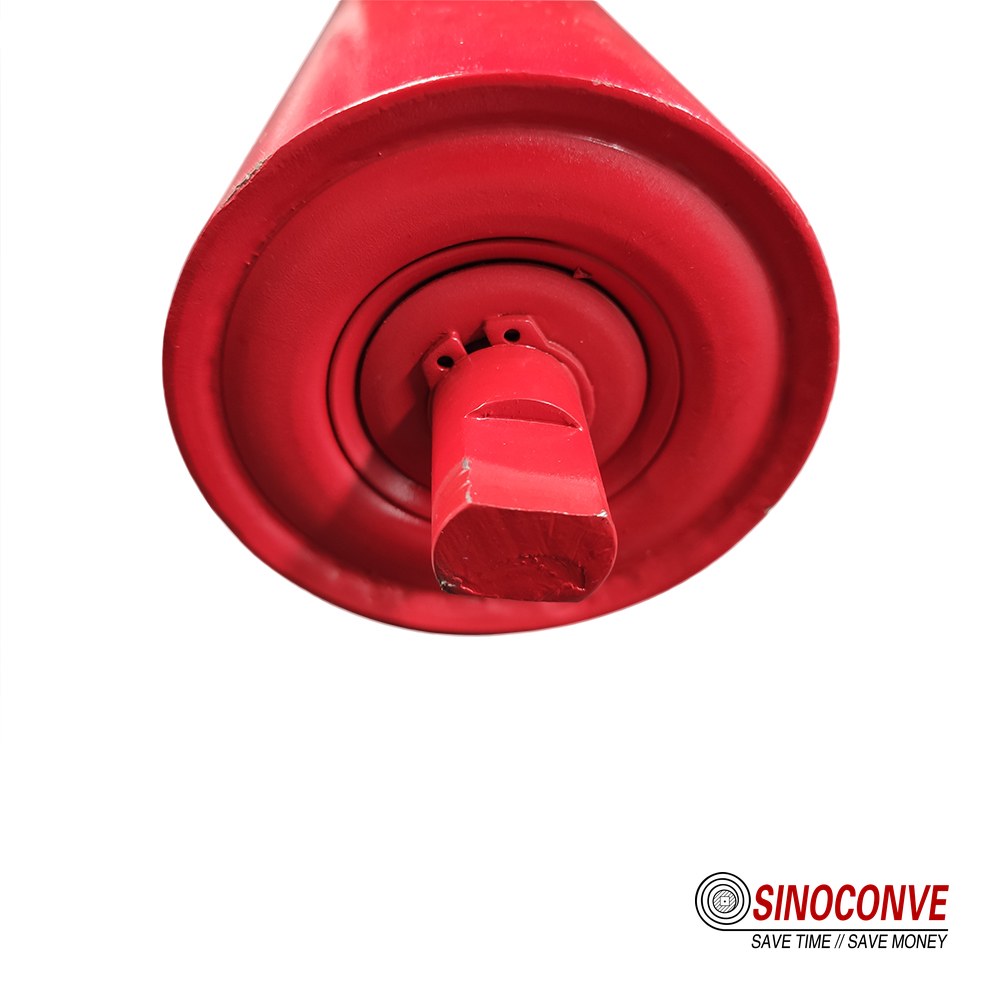
A number like 6204, 6305 or 6306 says nothing about a brand, because it describes geometry. The first digit after the basic type fixes the dimension series, so a 6305 and a 6205 share a 25 mm bore while the 63 series carries a thicker outer ring and a taller shoulder, and that extra steel is what buys radial capacity. On the full product range we publish under conveyor roller, the bearing is matched to the duty rather than to whatever happens to be cheapest that week. A light return strand putting 8 kg on a station does not need what a load zone absorbing 900 kg of drop energy needs.
Pick the seat and the code together, never the code alone. When the shaft seat measures 30 mm, the code we reach for is 6306, because that ring section is what keeps the seat stiff under a primary-crusher impact. A 25 mm seat paired with a 6305 will shrug off a shock that bruises a lighter 6205 inside a single season, and the price gap between the two is small enough that guessing wrong turns out to be the expensive choice.
Grease decides the service interval, and the brochure never mentions it. Sealed-for-life rollers arrive with the grease already pressed in, and the grade settles whether a bearing survives a 55 °C ambient or gives up at 38 °C. Lithium-based greases cover general duties, while high-temperature lines need a different base oil and a different thickener. Write the expected ambient and the expected running hours into the purchase order, because a rubber conveyor belt system on a coastal stockyard and one inside a closed cement silo pull entirely different greases from the shelf.
Shaft material sits in the same sentence as the bearing, even though it rarely reaches the quotation. A 20 mm shaft in mild steel is adequate for a light return roller, yet a carrying station under ore wants a shaft that resists bending and does not corrode where it meets the seal. Buyers seldom ask about the shaft grade. It is one of the quiet reasons two suppliers can quote a similar price for a very different product.
Ask for the bearing seat diameter in millimetres. A seat quoted as 25 mm and machined at 24.6 mm lets the inner ring creep, and creeping shows up as a polished ring on the shaft long before anything seizes.
| Bearing code together with its basic type and bore size | The shaft seat this bearing is normally paired with | Where this bearing normally belongs on a real conveyor line |
|---|---|---|
| Deep-groove ball bearing 6204, the smallest code in this table | It suits a 20 mm shaft seat and appears on light 89 mm return idlers and narrow belt lines | Best for low-load return runs where belt weight is the only real force |
| Deep-groove ball bearing 6205, the common 25 mm bore choice | It fits a 25 mm shaft on standard troughing rollers | A sensible default for most medium-duty carrying idlers |
| Deep-groove ball bearing 6305, a 25 mm bore with a heavier ring section | It shares the 25 mm bore of a 6205 but carries a thicker outer ring all round | Chosen when the station sits under a load zone or a steep incline chute |
| Deep-groove ball bearing 6306, stepping up to a 30 mm seat | It usually appears on 133 mm and 159 mm heavy rollers | It is applied to primary crushed ore and trunk conveyors |
| Deep-groove ball bearing 6308, the largest code used on standard idlers | It takes a 40 mm shaft on the biggest heavy-duty idlers and pulley-adjacent stations | Reserved for high-capacity port and mine systems where single-point load is extreme |
04Tube Wall Thickness, Roundness and Radial Runout
Wall thickness, roundness and the runout that follows
A 108 mm tube drawn at 3.2 mm wall and one drawn at 4.0 mm are indistinguishable from outside, yet the second carries noticeably more rotating mass and far more bending stiffness across the span. Put numbers to it and the difference stops being abstract. The same tube weighs about 8.3 kg per running metre at 3.2 mm wall and about 10.3 kg at 4.0 mm. Mass matters because every gram is accelerated and decelerated thousands of times a shift, and stiffness matters because a tube that flexes under load distorts the bearing seat and shortens bearing life. Industry practice on a carrying idler runs from roughly 2.5 mm wall on light 89 mm rollers to 4.5 mm or more on heavy 159 mm units, and the right value depends on load, span and belt speed together rather than on any single figure.
Check the wall where it matters. A micrometer reading taken at the tube ends says little about the middle of a long span, so we ask for three readings along the length and treat the thinnest one as the governing figure.
On the delivery paperwork, ask for the wall as a plain number in millimetres rather than a gauge range. Put the same figure on the packing list as on the drawing, because a receiving inspector who cannot find it has to stop and query the whole consignment before signing.
Roundness and coaxiality decide how smoothly a roller turns, and the values are easy to state and hard to hold in production. Both bearing seats must share one common axis within a few hundredths of a millimetre, or the shaft fights the bearings as it turns, and radial runout taken at the finished surface is the visible symptom of both faults at once. A roller running 0.8 mm of runout pushes a small constant pulse into the belt every revolution, and at 500 rpm that pulse arrives more than eight times a second. Dynamic balance sits beside runout for the same reason, since a roller balanced to G6.3 runs far more quietly at speed than one held to a looser grade, and the gap shows up most on long tube spans.
05Radial Load, Allowable Speed and the Duty Nobody Quotes
Radial load ratings are usually stated at one speed
Every bearing catalogue quotes a basic dynamic load rating, and suppliers like to repeat it as if it were a promise. It is not. The figure assumes a defined speed, a defined lubrication condition and a clean environment, none of which describes a dusty transfer tower on an industrial conveyor belt line. A 6305 rated at roughly 22 kN basic dynamic load will not deliver its full calculated life once sealing lets fines reach the raceway or the roller runs well above its design speed.
Read the load number together with the speed number, or the pair means very little. The same bearing swings from comfortable to marginal as speed climbs, and a catalogue figure quoted on its own says nothing about which side of that line your station sits on.
Allowable speed and the temperature penalty
Allowable speed for a belt idler is normally given in revolutions per minute, derived from belt speed divided by roller circumference. Run 3.5 m/s over a 133 mm roller and the shaft turns at roughly 500 rpm, comfortable for a well-sealed unit and close to the edge for a cheap one packed with heavy grease. Add a hot ambient and the grease stiffens, which raises drag and heat. On one line a roller behaved perfectly at 28 °C and then began to run hot at 55 °C, simply because nobody had matched the grease to the duty.
Ask the maker to state allowable speed in revolutions per minute rather than leaving you to convert it from belt speed, and quote it against your own duty cycle, since a figure given for intermittent operation is not the number you want on a line that runs three shifts.
A second number almost never appears on a quotation, and that is the duty cycle. Twelve hours a day, five days a week is a very different life from twenty-four hours a day, seven days a week, even on the same bearing. A conveyor belt supplier who asks about your shift pattern before quoting is doing you a favour, because the answer changes the bearing recommendation more than most buyers expect.
Here is the arithmetic we use when a client asks whether a station is overloaded. Take a 1,000 mm belt carrying 250 tonnes per hour at 3.5 m/s over troughing idlers spaced 1.2 m apart. The material resting on one station comes to roughly 24 kg, and the belt plus the roller adds a second figure on top. If the chosen bearing is rated at 22 kN dynamic but a load zone drops ore from half a metre, the momentary impact can touch 9 kN for a fraction of a second. Loading points therefore get impact rollers and heavier bearings, and that conclusion can be reached from the sheet alone.
Two figures we ask for on every RFQ are the belt speed and the heaviest load a single station will see. A station carrying 250 kg at 4.5 m/s is a very different problem from one carrying 60 kg at 2.0 m/s, and the bearing recommendation follows that pair rather than the roller diameter alone.
06Sealing Type, Protection Class and Coating
What the digits in a protection class actually promise
A protection class such as IP54, IP55 or IP65 describes two separate things, and buyers usually read only the first digit. Solid-particle ingress is rated first, so a 5 means dust cannot enter in a quantity that harms operation, while water is rated second. A labyrinth seal relies on a tortuous path that slows fines without touching the shaft. A contact lip seal presses against the shaft instead, blocking finer particles at the cost of a little friction and heat. Which one suits you depends on whether you are fighting coarse grit from a crusher discharge or airborne cement dust that behaves like flour.
Match the seal to the particle rather than to the price column. A labyrinth seal and a contact lip seal solve different problems, and swapping one for the other to save a few cents is how a bearing ends up full of fines inside a single season.
Coating is a related but separate decision. A standard painted finish protects against atmospheric moisture, while a hot-dip galvanized or polymer coating is aimed at carryback that stays wet and mildly acidic. In a port handling salt-laden ore, our engineers have found that the difference between a well-coated roller and a poorly coated one shows up as surface rust within a single rainy season. If the environment is genuinely corrosive, that is a specialty subject and we handle it in a separate note rather than pretending a standard paint will survive.
Tube material, wall finish and the coating system
Most general-purpose idler tubes are made from seamless or welded steel, and the internal wall finish matters less than the outside because the belt never touches it. What the buyer should pin down is the material standard for the tube, the surface treatment applied before coating, and the coating system itself. A two-coat paint system behaves differently from a galvanized finish when the carryback stays wet, and a polymer coating is a third option again. Ask which system is being offered rather than accepting the word paint, which on a quotation can mean almost anything.
We also ask clients to state whether the rollers will be stored outdoors before installation. A carton that sits on a wharf for six weeks before it is unpacked has already met its first corrosion test, and the answer sometimes changes the coating that a buyer should specify.
For transmission-side equipment rather than bulk handling, the same discipline applies to belt geometry, and our transmission belt manufacturer page explains how drive belt dimensions are read from a profile sheet.
07The Allowable Deviation Table Every Buyer Should Attach to the Order
Deviation limits are the part of the sheet that gets tested
A specification without tolerance columns is only a wish. Any drawing can say 108 mm, and what actually matters is how far from 108 mm a delivered piece may sit before it is a reject. When you wholesale conveyor belts together with idlers, write the tolerances into the same annexure so the acceptance inspector has a clear line to work to. The table below shows the categories we treat as standard, and the figures are typical for general-duty rollers rather than for every heavy special.
| Feature under test | Typical permitted deviation on a general-duty idler | How the value is checked before the batch is released |
|---|---|---|
| Outer diameter | Usually held within plus or minus 0.8 mm across the finished coated surface | Calipers read at both ends in two perpendicular directions and the largest figure is logged |
| Total length | Normally controlled to plus or minus 1.5 mm on the finished tube face | A steel tape or a fixed jig gauge is run across the two tube ends on a flat table |
| Shaft extension | Held to plus or minus 0.5 mm so both ends match the bracket slot depth | A depth gauge measures each protruding shaft separately because single-end shortfalls cause most install failures |
| Radial runout | Kept under 0.5 mm total indicated reading on a rotating check stand | A dial indicator is swept around the tube while the roller turns slowly in a lathe or cradle |
| Shaft straightness | Normally within 0.6 mm runout measured across the full length of the shaft | The shaft is supported on vee blocks and a dial gauge is walked along the exposed length |
| Axial end runout | About 0.4 mm total indicated reading at the end face of each tube | A dial indicator is placed against the tube end face and the roller is rotated through a full turn |
These limits are a starting point, not a universal law. A 159 mm primary-crusher roller that swallows lump ore often needs a tighter runout allowance than a 89 mm return roller on a light line, and a high-speed line punishes roundness far more than a slow one does.
08Document Evidence to Collect Before the Container Leaves
Paper that travels with a serious shipment
Numbers on a sheet matter only if there is evidence behind them, and evidence is exactly what a conveyor belt distributor should be able to forward without chasing the factory for a week. The documents we consider normal for an export batch are a steel material certificate for the tube and shaft, a rotation or load test record for the assembled unit, a coating thickness measurement summary, a dynamic balance report where the order specifies a grade, and a traceability list linking the batch number to its production date. None of these should cost the buyer anything extra, because a maker who cannot produce them is guessing as much as the buyer is.
Ask for the evidence list at the quoting stage, not after the deposit clears.
One caution is worth repeating. A material certificate proves the heat of steel, not the finished roller. We have read certificates with perfect chemistry attached to tubes that failed a simple runout check, because the certificate says nothing about drawing, welding or machining. Treat each document as one link in a chain rather than as a standalone guarantee, and read them together with the physical measurements from your own receiving bay. That combination is what actually protects an order. The same logic applies when a conveyor belt factory hands over a large project, which is why our own handover packs bundle the paperwork with the inspection record.
| Document | What it should actually contain | The warning sign that tells you to slow down |
|---|---|---|
| Steel material certificate | The heat number, grade, yield and tensile values for the tube and shaft stock | A generic certificate with no heat number cannot be tied to anything you received |
| Rotation and load test record | Measured starting torque and free-rotation behavior per sampled unit at the works | A record that only lists a pass or fail word, with no measured figures beside it |
| Coating thickness summary | Gauge readings in micrometers taken at several points across the finished surface | A single figure with no sampling points, which usually means one spot was checked |
| Dynamic balance report | The balance grade requested and the residual unbalance measured on the balancing rig | No grade stated at all, which often means static balancing was substituted |
| Batch traceability list | A table that maps each carton mark to a production date and an inspection record | Cartons that carry no mark at all, making any later complaint impossible to trace |
09Inbound Acceptance Inspection: Sampling Ratio and Instruments
How many pieces to open, and with what
A receiving bay does not need to measure every roller, and trying to do so simply means nobody measures anything. Our usual recommendation for a general-duty batch is to pull a sample based on lot size, grading from a light check on small lots up to a more demanding ratio once a single container holds several hundred pieces. A practical middle path is to inspect roughly one unit in twenty on a small lot and tighten toward one in ten when the same supplier has delivered a nonconforming batch before. Instruments stay basic: a calibrated vernier caliper for diameter, a depth or height gauge for shaft extension, and a dial indicator on a cradle for runout.
Keep the instruments calibrated and keep the records. An inspection that cannot be reproduced two weeks later is worth very little in a dispute.
A rotation check that exposes faults the calipers miss
Diameter and length measurements will not reveal a bearing that was pressed in badly or a seal fitted with its lip reversed. For that you need to spin the roller. A free-running unit should turn with light, even effort and coast to a stop without a grinding note. If it feels tight at one point in each revolution, the shaft is bent or a bearing seat is out of round. If it turns freely but rattles, the assembly clearance is too generous. Both symptoms are obvious within seconds in a quiet workshop, and both are invisible on a dimensional inspection sheet.
Sound is a useful instrument in itself. We have trained receiving staff to listen for the dry, rasping tone that signals under-greasing, and it costs nothing to do. Where an order refers to a standard such as the ISO 583 family, that standard typically addresses general idler requirements rather than acceptance sampling, so your own annexure still governs the decision to accept or reject.
10Accept, Reject or Grant Concession
Three possible outcomes, not two
Receiving inspections are usually written as if every result is either a pass or a fail, and that binary habit creates waste in both directions. A sensible system offers three routes. Full acceptance is obvious. Full rejection is equally obvious when a measured value falls outside the deviation limit by a wide margin, say a radial runout of 1.2 mm against a 0.5 mm allowance. The middle route is concession, sometimes called use-as-is, where a small and harmless excess is accepted in writing for a specific application, with the deviation recorded and a note explaining why it does not affect the duty.
Concession must be documented, time-limited and specific. An unwritten nod on the phone is not a concession; it is a future argument.
A workable threshold for a general-duty batch is to reject outright any unit that exceeds the deviation limit by more than double, and to consider concession only when the excess is small, the station is a low-load return position, and the buyer accepts the reduced life in writing. Anything rejected should be quarantined immediately and marked so it cannot drift back onto a running line by accident. We recommend a simple colored tag system, since memory is unreliable after a long shift. The standards that describe idler geometry, such as the ISO 583 family, typically set out general requirements rather than hard acceptance numbers, so the order annexure remains the document that governs.
Disposal of the rejected pieces also deserves a decision. Repair, replacement or credit all have a place, and the choice usually comes down to whether the fault is dimensional or cosmetic. A V-belt manufacturer facing the same question on a drive belt would apply the same logic, because a belt that is 3 mm short is a different problem from a belt with a scuffed label.
The paperwork that follows a rejection matters as much as the decision itself. Record the quantity, the batch mark, the measured deviation and the disposition in one place, then send a short summary to the maker within the same week. A supplier who receives a clear, measured complaint can correct the process behind it; a supplier who receives a vague phone call learns nothing and repeats the same fault on the next order.
11The RFQ Field Checklist That Makes Quotes Comparable
Fill every line or accept that the quotes will not line up
When a request for quotation arrives with half the fields blank, every maker fills the gaps with its own default, and the resulting prices describe different products. We have compared two quotations for the same conveyor that differed by nearly a third in price, purely because one assumed a 3.0 mm wall and the other a 4.0 mm wall with a heavier bearing. Fill the table below as completely as the application allows, and ask any conveyor belt manufacturer you approach to confirm each line before quoting rather than after.
| RFQ field | A concrete value the buyer should enter | What silently breaks when the line is left blank |
|---|---|---|
| Outer diameter and roller type | For example a 133 mm carrying idler rather than a 133 mm return roller | The maker quotes a standard type and the fit under your frame is never checked |
| Mounting length and shaft extension | The face-to-face span plus the shaft length entering each bracket slot | Rollers arrive that are dimensionally correct in isolation but will not bolt in |
| Shaft diameter and bearing model | State the required shaft seat size and the bearing series such as 6205 or 6306 | Light bearings get substituted into heavy stations and fail far too early |
| Tube wall thickness and material | The wall in millimeters and the steel grade for both tube and shaft | Two quotes look alike on paper while describing very different stiffness and mass |
| Sealing type and protection class | Name the seal style together with the dust and water protection class you need | Fine dust reaches the raceway and bearing life collapses without any visible damage |
| Belt speed and expected load per station | The running belt speed and a realistic carried load for the heaviest station | The allowable speed and the load rating cannot be cross-checked against the duty |
| Coating, balance grade and documents | The coating system, the dynamic balance grade and the evidence pack you expect | Corrosion protection and traceability become negotiable after the deposit is paid |
Two smaller fields are worth adding to every request even though they rarely appear on a template. The first is the expected service life, because a roller meant to last two years and one meant to last eight are not the same product even when the drawings match. The second is the storage condition before installation, since damp coastal yards punish unprotected steel far harder than a covered warehouse does.
It also helps to state whether the rollers will be split across several shipments. When a project is delivered in three batches spread over six months, the second and third batches must match the first, and the only reliable way to guarantee that is to freeze the specification and the approved sample at the outset. A maker that keeps the approved drawing on file can reproduce the batch; a maker that quotes each shipment fresh will drift away from the original numbers without ever intending to.
12Where This Page Sits Next to Our Other Roller Articles
Four existing pages, four different jobs
This page stays deliberately narrow. Rollers and idlers attract plenty of questions, and several existing articles already answer different parts of the subject, so nothing here repeats what those pages cover. Decoding a specification sheet and verifying a delivered batch is the whole job of this one. If you arrived looking for the big picture on roller construction and how the types and load ratings fit together, start with the conveyor roller overview guide and come back to the sheet afterwards.
Fine powders and aggressive chemistry each get their own treatment. For very fine dust, the dedicated article on sealed rollers for fine dust covers the choice of sealing, while salt, acid and wet carryback lead to corrosion-resistant conveyor rollers. Our short guide on the common idler and roller types is useful background too, but this article assumes you already know which type you need and simply want its numbers read correctly.
Two further pages push the same discipline into particular zones. Impact and loading-point rollers get their own note in impact rollers in loading zones, and the meeting point between rollers and pulleys on harbour systems is discussed under port conveyor roller and pulley supply. They all carry one message. Read carefully, the specification sheet is what separates a reliable line from a recurring maintenance problem.
The division of labour between these pages is deliberate. Still deciding what to buy? Begin with the overview and read it end to end. Facing an environment that attacks the roller, or a particle you cannot identify at a glance? The sealed and corrosion notes are where that question gets answered. Simply want to know whether the numbers on a quotation describe something you can install and accept? That is what this page is for, and keeping those jobs apart is what makes each page quick to use on a busy afternoon.
One more note on scope. This page will not tell you which roller to buy, because that decision belongs to the type guides. It tells you how to read the sheet for the roller you have already chosen, which keeps the article short enough to use while a quotation sits open on the desk.
13Frequently Asked Questions
What is the single most important field on an idler specification sheet?
No single field wins, and any answer naming just one is oversimplifying. If a line has to be drawn, though, we would put outer diameter and shaft extension at the top, since an error in either stops installation rather than merely shortening life.
Does a higher bearing number always mean a better roller?
Not at all, because a larger bearing adds radial capacity along with extra mass and inertia that a light return strand pays for in wasted energy, which is why we match the bearing to the station rather than to the catalogue.
Can I accept a batch that is slightly outside the deviation limits?
Sometimes, and never on a verbal nod. Concession makes sense when the excess is small, the affected station carries light load, and the buyer formally accepts a shorter service life. Draw the line at roughly half a millimetre beyond the stated limit, and apply the concession only to a low-load return position, so the exception stays small and easy to defend. What fails is an unwritten agreement that leaves no trace, because the same deviation will be argued about again at the next delivery.
Why does my supplier keep asking about belt speed and shift pattern?
Those two numbers together decide the bearing life calculation more than almost anything else on the sheet, and a 3.5 m/s line running two shifts is a very different animal from a 4.5 m/s line running continuously.
How many rollers should I measure when a container arrives?
Roughly one in twenty is a practical rule for a healthy supplier, tightened to one in ten once quality has slipped before. Spread the sample across cartons instead of lifting it from a single box. Record every figure, because a measurement nobody wrote down cannot support a claim later.
Is a material certificate enough proof of quality?
No, and treating it as proof is a common mistake. A certificate speaks for the steel heat, not for the finished roller.Certificates with perfect chemistry land beside tubes that failed a simple runout check more often than you would think. Drawing, welding and machining leave no trace on that sheet, so a clean certificate can sit beside a bent shaft or a reversed seal lip without contradiction. The certificate, the test record and the coating summary each protect part of an order, but only when they are read alongside your own physical measurements.
What does a dynamic balance grade actually change on a running line?
Vibration, and vibration is what slowly destroys bearings, seals and eventually the frame. A better balance grade matters most at higher belt speeds and on longer rollers, where even a small residual unbalance grows into a noticeable shake. On a slow, short return roller the benefit nearly vanishes. Where a grade must be written, it belongs on each application rather than copied across a whole project. When the belt itself begins to mistrack, look upstream of the roller first, and our note on conveyor belt tracking walks through the sequence we check.
Should I specify the seal type or let the maker choose?
Describe the environment and the particle, then let the maker propose while insisting on knowing which seal was chosen and why. A labyrinth seal and a contact lip seal are not interchangeable, and the answer on a mining line handling primary crushed ore differs from a fine cement dust application, as our notes for mining and quarrying operations show.
What is the difference between total indicated runout and roundness?
Runout combines the effect of the bearing seats and the shaft, while roundness describes only the tube cross-section, which is why a single runout figure is the more practical value to specify and to measure in a receiving bay.

14Reading the Sheet Is the Whole Job
A specification sheet is the machine written down before it exists, so read every field against the duty it has to serve, demand the evidence that proves the numbers, and inspect the batch against the limits you agreed. Skip that discipline and the machine arrives carrying someone else's assumptions instead.
If any line on a drawing is still unclear, send us the sheet together with the duty conditions, and we will tell you which fields we would question before a single roller is cut.
Related Products You May Need
- Bulk handling rollers — conveyor roller
- Heavy carrying idlers for mining and quarry lines — rubber conveyor belt
- Fabric-core belts for aggregate plants — EP rubber conveyor belt
- Belts for clinker and hot material service — heat-resistant conveyor belt
- Inclined conveying on a slope with a patterned cover — chevron conveyor belt
- Drive belts for the same plant — V belts
Related Blog Posts
- Roller types and how to choose the right one — roller overview guide
- Choosing sealed rollers when the air carries very fine dust — sealed rollers for fine dust
- Rollers for salt, acid and wet carryback environments — corrosion-resistant rollers
- Impact rollers at transfer points and loading zones — impact rollers
- Where rollers and pulleys meet on harbor handling systems — port roller and pulley supply
- Reading cover grade designations on a belt data sheet — rubber belt cover grades