
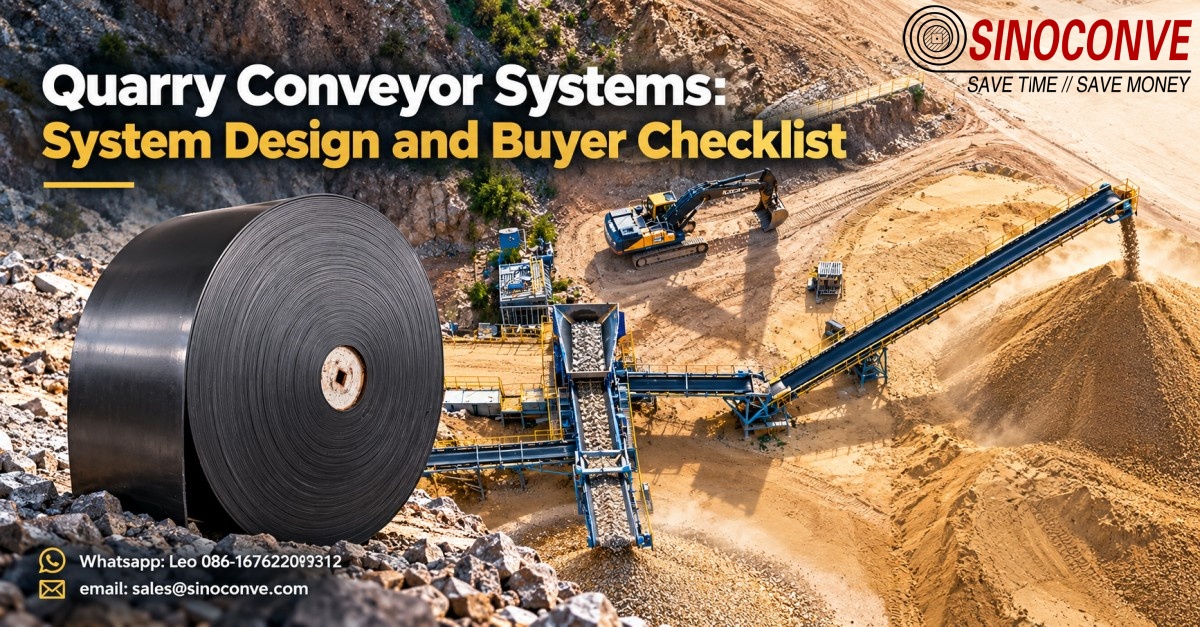
Quarry conveyor systems rarely fail because the belt was the wrong grade. When we walk a plant that cannot hold its rated tonnage, the constraint is nearly always a transfer point that has been left alone for years. One chute has dropped rock 2.4 m onto the same 3 m of belt since commissioning; at the jaw, the feed shifts off-centre every time the excavator changes bucket; and the screening deck swings the circulating load by 40 percent between the morning and afternoon shifts. This article sets out how we frame the system boundary from crusher mouth to stockpile, how we size a route against a real gradation curve, and which fields belong on the inquiry sheet before anyone is asked for a price.

01System Boundaries: Where a Quarry Route Starts and Stops
A quarry conveying route is not the same thing as a belt, and the difference shows up in the quotation. We draw the system boundary at the discharge lip of the primary crusher and close it at the last tripper or loadout chute, because everything inside that line shares one duty cycle, one feed curve and one consequence when it stops. The 1,400 mm apron feeder that meters run-of-mine rock sits outside the boundary, and so does the wheel loader pushing the toe of the stockpile. Agreeing on that line is the cheapest engineering decision in the project, and the one most often left to chance.
Inside the boundary we normally separate the route into four duty zones, and each zone gets engineered against its own worst case rather than against a plant average. Primary haulage carries the largest lumps over the longest centre distance, so impact energy and splice fatigue dominate the calculation. Recirculation loops are short, start and stop constantly, and generate most of the tracking complaints we are called out to, often 40 minutes of output a shift. Product transfer belts run lightly loaded but produce nearly all of the airborne dust, while loadout belts start repeatedly against a full pile, which is a motor and take-up problem far more than a belt problem.
Where the design margin actually belongs
Money is best spent where the consequence is highest, not where the tonnage is highest. A 12 m impact section built from denser idler spacing at 300 mm centres, heavier top cover and a properly braced skirt costs a small fraction of replacing a 900 m mainline, yet it protects the single most damage-prone stretch of the route. On the long mainline we are comfortable at 65 to 75 percent loading and let the belt live for a decade, while at the crusher discharge we design for a 250 mm slab arriving at 6 m/s and accept almost no reserve at all, because the energy has to go somewhere and the only question is whether the belt, the chute or the idler absorbs it.
The two interfaces nobody wants to own
Two documents cause more disputes than any belt specification — the measured feed gradation curve and the as-built chute drawing. If a feeder cannot hold a stable bed depth, no amount of belt engineering will repair the load profile downstream. If the chute is re-fabricated on site with a steeper lip than the design, the impact point moves, the skirt clearance closes up and the belt takes the difference in a matter of weeks. We ask for both documents before quoting, and where they do not exist we say so in writing, so the buyer knowingly keeps the interface risk.
02Feed Gradation and Moisture: the Two Inputs That Decide Everything Downstream
Every calculation on a quarry route depends on two numbers, and neither of them appears on a belt datasheet. The first is the particle size distribution of what actually leaves the crusher on a wet Tuesday, rather than what the quarry plan says the product should be. The second is the surface moisture of that material at the instant it lands on the belt. Get those two wrong and the widest, strongest, most expensive belt on the market will still spill at the skirt, track off the idlers and wear through its edges within a year.
Gradation decides trough depth and lump clearance
Lump size sets a hard geometric limit long before strength does. The accepted rule for a three-roll troughed belt is that no single lump should exceed roughly one third of the belt width on graded feed, easing to about one half of the belt width where the feed is genuinely run-of-mine and the belt is wide. On an 800 mm belt that means a 265 mm ceiling for screened product and something near 400 mm for unsized rock. A jaw crusher set at 150 mm closed side setting still produces occasional slabs between 240 mm and 280 mm when the feed is slabby, so the rule and the measured top size have to be reconciled before either the belt width or the crusher setting is frozen.
Fines punish a route for a completely different reason. Once the minus 4 mm fraction climbs past roughly 35 percent of the stream and moisture rises with it, the load stops behaving like discrete particles and starts behaving like a paste. A rubber conveyor belt that ran clean and self-clearing in July will build a sticky layer inside the skirt in October, and that layer, not the belt tracking system, is what eventually pushes the belt off centre.
Moisture moves the spill and slip thresholds
Surface moisture above about 8 percent changes the friction picture inside the loading zone, because a wet, fine-rich bed no longer transmits force through interlocking particles. We have recorded belt slip at the drive pulley on a 16 degree incline with a load the torque calculation called comfortable. Lagging condition, available take-up travel and skirt sealing all become critical once moisture enters the picture, and the cheapest fix is to stop water reaching the belt through chute covers and better drainage on the fines circuit rather than to buy cover thickness to survive the consequences.
Reading a gradation curve the way a designer reads it
Send the shift-average curve, not the best day of the month. What we want is the top size, the percentage passing 4 mm and 20 mm, and the moisture figure that goes with them, measured at the transfer rather than at the pit face. A curve that shifts 15 percent between the primary and secondary circuits tells us more about where skirt rubber and idlers will wear than any single point ever could, and it is what sizes the loading zone in the next section.
03Impact Points and Cushioning: Designing the Zone That Kills Belts
Every quarry route has one or two places where the belt is being asked to do something physically unreasonable, and they sit directly under a chute. A 250 mm lump of granite leaving a jaw at 6 m/s carries enough kinetic energy to punch through a cover, deform an idler shell or displace a frame, and it does that roughly 4,000 times a shift. Cushioning is therefore a geometric exercise rather than a materials question. When the material lands with a horizontal velocity close to belt speed and the vertical drop is short, the belt sees a rolling stone instead of a projectile.
Cutting free fall is the single most effective change on a poorly performing line. Lowering the chute lip so the drop sits between 400 mm and 600 mm, adding a rock box where the material is not sticky, and pulling the first impact idler within 150 mm of the loading point removes more damage than any cover upgrade. Where the drop cannot be reduced, as under a primary jaw where the crusher frame dictates the height, the design has to buy the energy back with idler density and belt construction.
| Free fall height at the transfer | Impact idler arrangement we specify | Protection decisions that come with the arrangement |
|---|---|---|
| Below 400 mm, which is the target for every product transfer and every screened fraction we see in the field | Standard troughing idlers at the normal 1,200 mm spacing, with no special impact section required other than a rubber-cushioned first station | Money goes into skirt sealing and dust control instead of belt cover, because the mechanical load is already harmless |
| 400 mm to 900 mm, the normal range under a secondary or tertiary crusher discharge chute | Impact idlers spaced at 300 mm to 400 mm for the first three stations, then the standard 1,200 mm pitch resumed once the bed has settled | Add a dead-bed or a curved chute lip where the material is dry, and keep skirt rubber 25 mm clear of a loaded belt |
| 900 mm to 1,800 mm, typical under a primary jaw or a gyratory feeding a mainline directly | Continuous impact idler beds at 250 mm centres for the first 4 m, mounted on a frame that is braced against the chute rather than the stringer | Heavier top cover or a cushion layer is unavoidable, and the chute geometry should be reviewed before the belt is specified |
| Above 1,800 mm, which we treat as a design fault rather than a belt selection problem | Rock box, chain curtain or shelf arrangement first, with impact idlers only as a backstop for the material that escapes the cushion | No belt on the market survives this geometry for long, so expect to revisit the chute rather than the purchase order |
Chute geometry decides where the load lands
Direction is the second variable. Rock that arrives on the belt with a velocity component close to belt speed produces very little relative movement, and relative movement is what abrades cover. A chute that discharges backwards against the belt direction is worse than one that discharges forward, and both are worse than a curved or hooded lip that resolves most of the fall into forward motion. Wherever possible we specify the discharge angle so the material is moving with the belt by the time it touches it, and we ask the fabricator to confirm the as-built angle within 2 degrees rather than assume the drawing was followed.
Field note from our engineers: at one granite quarry we spent a shift laser-tracking a discharge chute and found the material hitting the belt 180 mm left of centre, at 12 degrees to the belt axis, with a 1.1 m free fall. The plant had been buying heavier belt every 14 months. Reprofiling the chute and dropping the lip by 450 mm extended the same belt grade to 26 months, and the only hardware we added was four impact idlers.
04Component Matrix: Crusher Section, Screening Section, Stockpile Section
Once the boundary and the impact load are understood, the route resolves into a matrix of components. Read it not as a parts list but as combinations that work together, because two individually correct components can fight each other at a transfer.
We use the duty zones below as the default starting point, then adjust for moisture, clay content and whatever the as-built chute actually does. The right column records the failure we are trying to avoid.
| Duty zone on the route | Component combination we normally specify | What breaks when that combination is ignored |
|---|---|---|
| Primary haulage from crusher discharge to the first screen, where the lumps are largest and the centre distance is longest | Heavy-duty troughing idlers on a 1,200 mm pitch, an impact bed for the first 3 m, steel cord or high-tensile EP carcass, and a primary cleaner with a tungsten tip | Cover stripping at the loading point, idler shell deformation, and carryback that buries the return run within one campaign |
| Screening and recirculation, where short centres and frequent starts dominate the duty cycle | Close-pitch return idlers, a self-aligning idler one third along the return strand, secondary and tertiary cleaners, and skirt rubber sized to the actual bed depth | Belt wander on the return strand, spillage at the head, and edge wear that is always blamed on a belt defect |
| Product transfer to the finished stock, generally light, clean, dry and dust-suppressive by design | Standard troughing idlers, sealed bearing housings, covered chutes, and a single-stage cleaner that keeps the surface dust off the return side | Dust release at the transfer, bearing seizure in the finest, driest material, and product contamination on the return strand |
| Stockpile and loadout, where the belt starts repeatedly against a full pile and sees long idle periods | A slip-checked drive, a secondary cleaner that survives dry running, and a plough or tripper arrangement that can be repositioned without cutting the belt | Start-up slip that burns lagging, curly belt edges from prolonged idling, and stockpile segregation through poor trajectory |
05Capacity and Incline Checks: from Tons per Hour to a Belt Width
Capacity questions almost always arrive in the wrong units. A plant states 420 t/h and expects a belt width back, but a belt only carries volume at a speed, so tonnage on its own says nothing; the chain runs from mass flow to volumetric flow, then to the cross-section the belt must support, and only then to a standard width tier.
The five-step conversion we run on every route
Mass flow becomes volume using the loose bulk density measured on the belt rather than the density in the pit. That volume is then divided by belt speed to give the cross-section the load must occupy. A derate follows, because material on a gradient settles into a flatter profile than it does on the horizontal. The result is compared against the section each standard width and trough angle can hold. A final lump-clearance check then settles the width far more often than the tonnage does.
A worked example from a limestone plant
Take a product belt that must move 420 t/h of crushed limestone with a loose bulk density of 1.6 t/m³, on a route climbing 16 degrees, at a belt speed of 2.5 m/s chosen to keep dust generation and cover wear under control. The volumetric flow is 420 ÷ 1.6 = 262.5 m³/h, which is 0.0729 m³/s. Divided by belt speed, the required material cross-section comes out at 0.0729 ÷ 2.5 = 0.0292 m².
The climb forces one further correction. Applying a 0.90 factor for a 16 degree incline, which is the kind of derate we use between horizontal running and the 16 to 18 degree band, lifts the design cross-section to 0.0292 ÷ 0.90 = 0.0324 m². That figure is what the belt has to deliver for every hour of the shift, not the tonnage on the nameplate.
Now compare it with what standard widths actually hold. For a three-roll 35 degree trough with a 20 degree surcharge angle, usable cross-section is close to 0.0953 × b², where b is effective belt width taken as 0.9B − 0.05 m. A 650 mm belt gives b = 0.535 m and about 0.0273 m², which falls short of the 0.0324 m² we need. It could carry the load at roughly 3.0 m/s, with no room left for a wet bed or an uneven feed. An 800 mm belt gives b = 0.670 m and about 0.0428 m², so the material occupies 76 percent of the available section, which is exactly the utilisation we aim for on a mainline.
One more check then decides the answer, and it is not the tonnage. The largest slab leaving the secondary crusher measures about 250 mm. On an 800 mm belt the one-third rule allows 265 mm, so the slab clears with a little to spare. On a 650 mm belt the same rule allows 217 mm, and a 250 mm slab would bridge the trough and start the belt hunting. Tonnage alone would have justified 650 mm at higher speed; lump size removes it from the discussion, and the answer settles at 800 mm, 2.5 m/s, 35 degree trough, with the option of an EP carcass or steel cord depending on centre distance. For the selection logic behind that last choice, our own comparison of EP and steel cord carcasses for stone crusher and aggregate plants sets out the trade-offs in detail.
Incline carries a hard ceiling above the capacity calculation. For a smooth-cover troughed belt moving crushed aggregate, we treat 18 degrees as the practical limit before material begins to roll back, and most quarries run more comfortably at 15 or 16 degrees. Whichever profile you choose, it arrives either direct from the mill or through a conveyor belt distributor, and both routes work as long as the profile geometry is matched to the material and the incline.
06Idlers, Pulleys and Frames: the Hardware That Decides Belt Life
Belt life on a quarry route is often decided by forty or fifty kilograms of steel that nobody discusses in the tender. Idler selection sets the load the belt carries between supports, the shell material decides how long the roll turns freely in abrasive grit, and the bearing seal settles whether it seizes at eighteen months or survives to seven years.
Choosing troughing, impact and return idlers
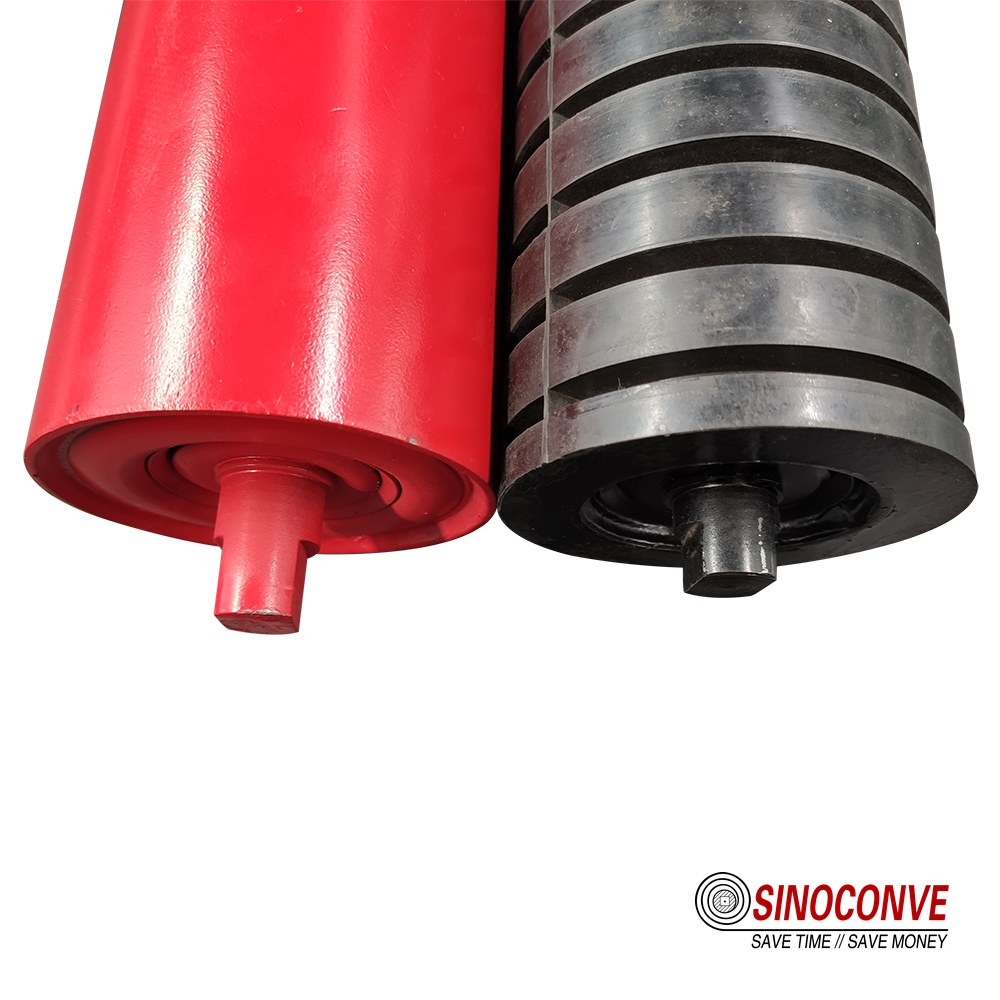
Troughing idlers on a primary haulage belt should be rated for the full lump load plus a generous dynamic allowance, on a pitch of 1,200 mm for heavy duty work and 1,000 mm to 1,100 mm where the carcass is flexible. Impact stations under a chute need a heavier shell and a pitch between 250 mm and 400 mm, as set out in the table above. Return idlers deserve closer spacing near the head pulley, where a belt just released from the trough tries to flatten and wander. Our review of conveyor roller types, materials and load ratings covers the shells and seal arrangements in more depth than we can here.
A supplier's view of loading-zone roller specification is worth reading before a chute is re-lined, because impact roller selection and chute geometry have to be settled together rather than in two separate conversations. On the frame side, stringers must be braced against the chute in the loading zone; a frame that transmits impact straight along the stringer bolts will loosen itself within a few hundred running hours and start shedding rollers onto the ground below.
Pulleys, lagging and the drive-side details
Pulley diameter is frequently dictated by the carcass rather than by torque, and a steel cord mainline needs a larger head pulley than the tonnage alone would suggest. Lagging choice then follows the environment, with rubber grooving for dry, clean drives and ceramic tiles where the belt is wet and the torque demand is high. Crowning matters more than most plants expect on long belts, and a crowned head pulley with correct lagging often removes a wander that had been blamed on the belt for two years. Where the route runs wet, the guidance in our EP belt tracking guide applies directly, because most tracking faults on aggregate belts come from the drive end rather than the load end.
As a conveyor belt manufacturer we are asked to guarantee belt life while idlers and pulleys are bought by price, and the two positions cannot both hold. When you specify an industrial conveyor belt for a crusher line, ask what roll pitch, seal type and pulley diameter the guarantee assumes.That question separates a serious quotation from a competitive one.
07Dust, Water and Enclosure: Reaching the Environmental Acceptance Line
Dust is a design output, not a housekeeping failure. If a transfer point is not enclosed, the finest fraction of the stream leaves it. Operators who handle this well begin with geometry and enclosure, add water second and treat chemical suppression as a last resort.
Sealing beats suppression in most transfer houses
Enclosing the chute, fitting skirt rubber that actually contacts the bed, and closing the head end of each belt with inspection doors takes most airborne dust out of the picture before it is generated. The money belongs in the seal line, not in the sprinkler header. Where a belts' loading zone is properly sealed and the trajectory is controlled, coarse dust levels often fall enough to meet an operating licence without any water at all, which then removes the wet-bed slip risk described earlier.
Hmm "belts'" typo. Let me fix: "Where a belt's loading zone is properly sealed". Careful with apostrophe in word counting — fine.
Fine dust behaves differently from coarse dust, and the difference matters for hardware. Sealed bearing housings and labyrinth arrangements are the standard answer on dusty return strands, because a fine, dry, free-flowing material will migrate past a simple contact seal within one season. Our note on sealed conveyor rollers in fine dust deals with that failure mode specifically.
Hmm, that's S07 using /blog/sealed-conveyor-roller-manufacturer-fine-dust — fine (whitelisted).
Water is a tool, not a default answer
Spray systems work when they are aimed at the point where dust is generated and fed at a controlled rate, and they fail when they are used as a blanket. Water added at the loading point raises moisture at the skirt, weakens the bed and pushes the cleaning system harder than it was designed for. The wider picture, including schedules and the limits of scraping hardware, sits in our review of cleaning methods, schedules and the cases where scrapers will not work.
Nearly everything covered in this section can be bought from any component catalogue, including ours, which is the point worth remembering. The wholesale conveyor belts and accessories lists that distributors circulate contain the same family of parts; what differs between good and bad outcomes is where each part is placed and against which measured load.
08Steel Cord on the Long Mainline: a System Decision, Not a Product Preference
On most quarry routes there is one place where the carcass choice genuinely changes the plant's economics, and it is the long primary haulage. Steel cord becomes the normal answer once centre distance and tonnage pass a threshold, and the reason is not strength in the abstract. A steel cord carcass stretches less under load, holds its trough shape across a wide span, and tolerates the repeated cycling of a long, heavily loaded belt without the splice creep that a fabric carcass gradually shows. Across 900 m carrying 420 t/h, that difference appears as take-up travel consumed and splice condition degrading, not as one dramatic failure.
Where it earns its place and where it does not
Below roughly 300 m of centre distance, or under about 400 t/h with a modest lift, a high-tensile EP carcass usually wins on first cost and is far easier to splice with the equipment a quarry already owns. Above that, and certainly where a route exceeds 800 m or climbs more than 200 m in total, steel cord becomes the default because the splice count falls and belt elongation stops dominating the take-up design. The real question is not which carcass is stronger. It is how many splices you want to own for the next ten years, and how much take-up travel the structure can afford to give you.
Steel cord also carries a penalty that is easy to underrate while tendering. A single splice takes longer, needs a larger press and demands drier conditions than a fabric splice, so a plant with no covered splice station and no trained crew will lose more production days to one steel cord repair than a fabric belt would ever cost it. Where maintenance capability is thin, two-ply EP on a long route is sometimes the honest recommendation. The detail behind that trade-off, including fatigue behaviour and splice preparation, sits on our steel cord conveyor belt page and in the existing review of steel cord belt durability and efficiency in material handling.
One clarification prevents confusion on the quotation. The drive train on a long mainline is a gearbox with a fluid coupling, not a belt drive, so nothing in this section applies to the screen boxes, slurry pumps and compressor sets around the plant, which run on V-belts and fail for unrelated reasons. When a quarry wants its transmission belt manufacturer supply to arrive with the conveyor order, we still keep the specifications apart, because a transmission belt is selected on power, pulley diameter and duty hours rather than tonnage and lump size.
09How This Page Divides Work with Our Two Published Selection Articles
This page deliberately stops short of cover grade and carcass selection. Two existing articles already own that ground properly, and we would rather route you to them than restate their conclusions in a weaker form. Being clear about the split saves a buyer from reading the same recommendation three times and still not knowing which document to send to the mill.
The selection article for crusher and aggregate belts
If your question is which belt grade to put on a specific crusher line, including cover class, ply count and the way abrasion resistance is tested, that belongs with our existing guide to quarry crusher conveyor belt selection. It deals with the belt itself: what the numbers on a datasheet mean, how a cover grade is proven, and how to compare two quotations that use different conventions. The present article assumes that grade discussion has already been settled and starts from the route instead.
The guide for abrasive duty and steep angles
Where the driving problem is abrasive wear on a quarry incline, the published guide to abrasion-resistant conveyor belts for quarry and steep-angle conveying covers rubber compounds, wear test methods and profile geometry. We do not repeat its conclusions here, because a recital of wear figures would pull attention away from the transfer geometry that causes most of the wear in the first place. A companion article on abrasion-resistant belts in quarry and aggregate duty is useful if you need a second opinion on compound choice.
Where the boundary sits in practice
The dividing line is simple enough to explain to a procurement team. If a decision changes when the route changes, whether that is a boundary, a load profile, an impact geometry or an acceptance test, it belongs here. If it survives a route change untouched because it is a property of the compound or carcass, it belongs in the two selection articles.
That split also matters commercially, because a buyer choosing a conveyor belt supplier on price alone will usually end up with a defensible belt and an indefensible route. What we sell as a conveyor belt factory includes the route review, the splice plan and the component matrix. Drive-side components sit outside that scope, and for screen and pump drives we quote as a V-belt manufacturer on the drive data you supply.
10Maintenance and Availability: Inspections, Wear Parts and Spares
Availability on a quarry route is built at the design stage and then defended by a routine. Plants that never suffer a long stoppage are not the ones with the best belts; they are the ones that replace a worn skirt rubber at 70 percent life instead of waiting for it to fail on a Friday night. The maintenance schedule below is the version we hand to customers who ask us to help them stop firefighting.
The inspection routine that prevents stoppages
| Inspection item | Interval we recommend | Threshold at which we act rather than watch |
|---|---|---|
| Impact zone cover thickness in the 3 m behind the chute lip | Measured weekly with a depth gauge during the first six months after any chute change | Top cover below 60 percent of nominal, or any visible carcass exposure, which means the chute geometry must be revisited |
| Idler rotation and bearing temperature along the return strand | Audited on a rolling programme so that every idler is checked within a four week cycle | A shell that is hot to touch or has stopped turning, replaced the same shift rather than at the next shutdown |
| Splice condition on any steel cord or high-tensile fabric belt | Visual check every month, with a full ultrasonic or radiographic review annually on belts over 600 m | Any cord separation, edge lifting or groove forming in the splice area, which justifies a planned recure |
| Cleaner blade wear against belt contact pressure | Checked each week, with tension re-set whenever a blade is adjusted or replaced | Carryback appearing under the head pulley, or a blade that has stopped contacting across its full width |
| Skirt rubber clearance and chute liner condition at every transfer | Inspected at each planned shutdown, and after any week with rainfall above the local seasonal average | Spillage outside the skirt line, or clearance that has closed to the point of touching a loaded belt |
Spare strategy by duty zone
Spares should be bought in proportion to consequence. Every quarry route we survey can justify a spare belt for its primary haulage, a set of impact idlers and a full set of cleaner blades, because those items stop the plant when they fail. Holding spare idlers across the whole route is usually waste, since a seized troughing roll in a product transfer can wait.
Record cover thickness at fixed markers along each belt so that wear rate rather than absolute thickness drives replacement. Our notes on rubber conveyor belt cover grades explain how the grade classes translate into wear rate expectations.
11Procurement Checklist: the Fields a Quotation Cannot Be Priced Without
Quarry conveyor enquiries arrive in every conceivable format, and the thin ones all fail in the same way. A request for 1,200 m of 800 mm belt with no route drawing, no gradation and no impact height cannot be answered honestly; it can only be answered cheaply. Filling in the fields below takes a maintenance engineer two hours and removes most of the commercial risk.
What to send with the first enquiry
| Field on the enquiry | What we need you to send | Why the answer changes the offer |
|---|---|---|
| Route profile for each belt | A marked-up general arrangement showing centre distance, lift, incline angles and every transfer point with its drop height | Incline drives the profile choice, drop height drives the impact specification, and centre distance decides whether steel cord is realistic |
| Measured gradation and moisture | Shift-average top size, percentage passing 4 mm and 20 mm, and surface moisture measured at the transfer | Gradation sets the minimum belt width through lump clearance, and moisture decides how aggressively the cleaning system must be specified |
| Duty hours and starting regime | Operating hours per shift, shifts per week, and whether the belt starts empty or against a full pile after a weekend | Starting against a loaded belt can double the effective drive demand and shortens cleaner blade life considerably |
| Existing hardware that cannot change | Pulley diameters, idler pitch, trough angle, drive power installed, and any fixed structure the new belt must work with | Minimum pulley diameter for a given carcass is a hard constraint, so a belt that ignores it will fail at the splice within months |
| Splice method and site capability | Whether the plant owns a press and trained splicers, or needs the belt shipped in roll lengths that a mechanical fastener can join | A carcass that cannot be spliced on site has to be supplied in longer rolls or joined by a specialist crew, both of which carry cost |
Two fields deserve more attention than they get. The start-up regime matters because the loading condition during the first ten seconds of every shift often determines lagging and cleaner blade life. The list of fixed hardware matters because it converts an open discussion into constraints that can be designed against.
12Acceptance: What to Verify Before the Belt Goes into Service
Acceptance is where a well-specified belt is either protected or quietly wasted. The checks that matter are not the ones on a delivery note; they are measurements that confirm the route is what the specification assumed. We have watched a correctly built belt reach the end of its life in nine months because nobody measured the skirt clearance before the first load passed under it.
Checks at the factory and on the first run
Before dispatch, confirm the cover grade and thickness against the order, check the roll lengths against the splice plan, and verify the identification marking on each roll. On a long steel cord belt it is worth witnessing splice preparation at least once, even if the actual joint is made on site, because preparation standard is where most premature splice failures begin. Documentation should travel with the belt rather than follow it by email a fortnight later. Our splicing buyer's checklist of items to verify before ordering is a useful template for that handover.
On the first run, measure skirt clearance with the belt loaded rather than empty, check the return strand for material that has escaped the loading zone, and record the belt position at the head pulley before and after the first hour. Repeat those checks after a week. A belt that has moved 20 mm sideways in its first week will keep moving.
Three mistakes account for most disputed handovers: a belt accepted without confirming the pulley diameters assumed at design stage, a transfer point never measured for drop height, and rollers bought on price with no reference to the seal class the route needs. Our overview of the conveyor roller range and the notes on mining and quarrying belt applications both help set that expectation before the order is placed.

13Total Cost of Ownership: Downtime Hours Against Belt and Spare Investment
Quarry managers rarely argue about the price of a belt once they have costed a stoppage. The arithmetic is simple enough to do on a whiteboard, and the answer usually moves the conversation from purchase price to availability within a single meeting.
Take the product line used earlier: 420 t/h of finished aggregate, on which the plant makes a contribution of about $9 per tonne after processing, haulage and royalties. One unplanned stoppage of 12 hours costs 12 × 420 × 9 = $45,360 in lost contribution before anyone has opened a toolbox. A route where the impact section and cover grade fail every four months produces three such events a year, or about $136,000 of contribution lost annually. Extending that interval to nine months reduces the count to roughly 1.33 events a year, which works out at about $60,300. The difference, close to $75,700 a year, is what a proper impact design is actually worth to that plant.
Against that figure, a realistic upgrade covering a rebuilt loading zone, denser impact idlers, a heavier cover grade on the two short belts and a spare belt set sits between $18,000 and $22,000 installed. The payback runs from about 2.9 months to 3.5 months, after which the saving keeps compounding. Numbers like these are illustrative and shift with local prices and product values.
| Cost line in the calculation | Basis used in the illustrative example | Effect on the five-year position |
|---|---|---|
| Lost contribution per stoppage event | 12 hours of a 420 t/h line at $9 of contribution per tonne, giving $45,360 per event | Dominates every other line in the table, and is the reason belt price is rarely the deciding number |
| Failure frequency before the upgrade | One event every four months, which is three events a year and about $136,000 of lost contribution | Sets the baseline against which any improvement is measured, and is usually understated in plant records |
| Failure frequency after the upgrade | One event every nine months, which is about 1.33 events a year and roughly $60,300 of lost contribution | Delivers about $75,700 a year of avoided loss, before counting the reduction in emergency labour and freight |
| Installed cost of the improvement package | Loading zone rebuild, impact idlers, heavier cover on two belts and one spare belt set at $18,000 to $22,000 | Produces a payback between 2.9 and 3.5 months, with the benefit continuing for the life of the route |
What makes the calculation honest is using the plant's own downtime history rather than an assumed failure rate. Two years of maintenance records, even badly kept ones, beat any generic assumption.
14Frequently Asked Questions About Quarry Conveyor Systems
What does a quarry conveyor system include, and where should the boundary sit?
Our boundary runs from the discharge lip of the primary crusher to the last tripper or loadout chute, and everything inside it shares one duty cycle and one consequence when it stops. Feeders, excavators and the pit sit outside it, which is why the four duty zones get specified separately.
Is our bottleneck the belt grade or the transfer point?
Look at the transfer point first, every time. If the drop height exceeds 900 mm, if material lands more than 50 mm off the centreline, or if the skirt has been trimmed on site since commissioning, correcting those three items will usually recover throughput before any belt change does.
Does an entire quarry route need steel cord belting?
No. Steel cord usually belongs on the long primary haulage, where centre distance makes splice count and elongation the dominant running costs. Short recirculation belts start and stop too often to benefit from a carcass that is slower to repair, and product transfer belts are well served by a high-tensile EP construction.
What free fall height is acceptable under a crusher chute?
Between 400 mm and 600 mm wherever the structure allows it, which is where we aim on every new transfer. Above 900 mm we would rather rebuild the chute lip than select a heavier belt, and above 1,800 mm we treat the geometry itself as a design fault, because no belt survives that loading indefinitely.
How much moisture is too much for a quarry belt?
It depends on the fines content far more than on the moisture number by itself. Once the minus 4 mm fraction passes roughly 35 percent of the stream, moisture above about 8 percent normally starts building a sticky layer inside the skirt, and the belt responds by running off centre at the next idler.
Can we raise capacity by increasing belt speed rather than belt width?
Sometimes, but it is rarely the cheap option it appears to be. In the worked example above, the 650 mm belt could have carried the load at 3.0 m/s and the tonnage would have been satisfied. Lump clearance would not have been, because it caps top size at 217 mm on that width. Higher speed also raises dust and wear, so speed is the last variable we adjust.
What has to be on the enquiry before a supplier can price a route?
A route profile with drop heights at every transfer is the first item, followed by measured gradation and moisture. Duty hours and the start-up regime come next, along with fixed hardware such as pulley diameters and idler pitch. Finally, tell us how the belt will be spliced on site, because that can remove certain carcass options entirely.
Above 18 degrees, is a chevron belt the only option?
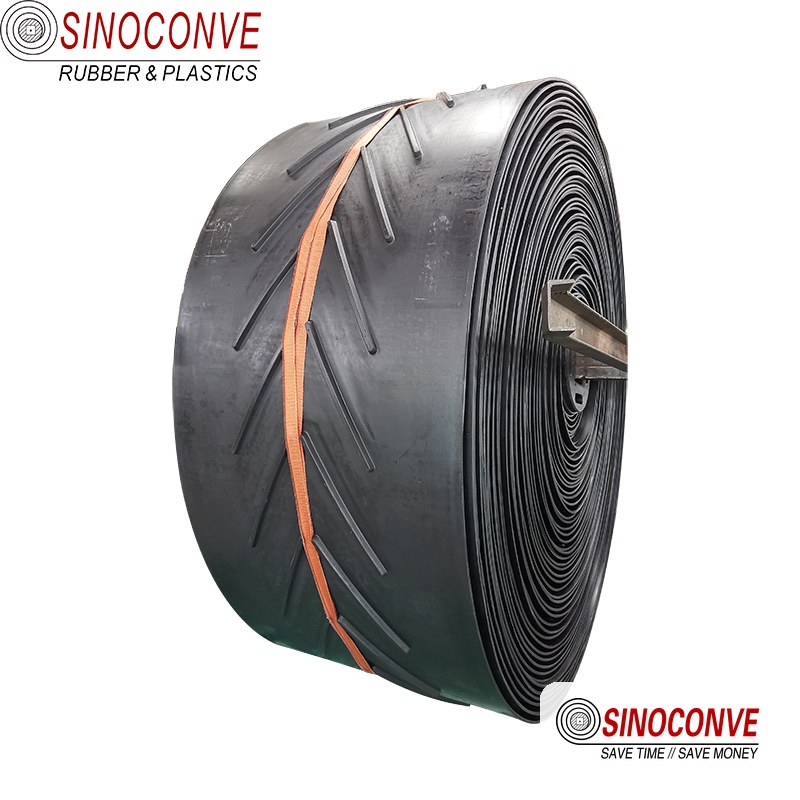
Not the only one, but on crushed aggregate it is usually the practical one. Once a route passes 18 to 20 degrees we would look at chevron profiles or a cleated arrangement with sidewalls before accepting a steeper smooth belt, because a smooth cover loses usable capacity as material slides back down the incline.
How do we accept a new belt properly before it goes into service?
Measure skirt clearance with the belt loaded rather than empty, since an empty belt always looks generous. Record the belt position at the head pulley during the first hour and again after a week, and confirm on site that the pulley diameters match what the specification assumed. Those three checks catch most of the faults that otherwise surface as warranty claims six months later.
Related Products You May Need
- Steel cord conveyor belt for long primary haulage on quarry mainlines
- EP rubber conveyor belt for crusher discharge, screening and recirculation duty
- Conveyor rollers and impact idlers for loading zones and return strands
- Chevron conveyor belt for inclined stockpile and loadout runs
- V-belt drives for screen boxes, pumps and compressor sets around the plant
Related Blog Posts
- Quarry crusher conveyor belt selection: how to compare grades and offers
- Abrasion resistant conveyor belt guide for quarry and steep angle conveying
- EP conveyor belt selection for stone crusher and aggregate plants
- Impact rollers in loading zones: what to specify and why it matters
- Conveyor roller guide: types, materials and load ratings explained
- Steel cord rubber conveyor belt durability and efficiency in material handling
- Conveyor belt cleaning methods, schedules and when scrapers will not work
- Dust resistant conveyor belts for dusty bulk handling environments