
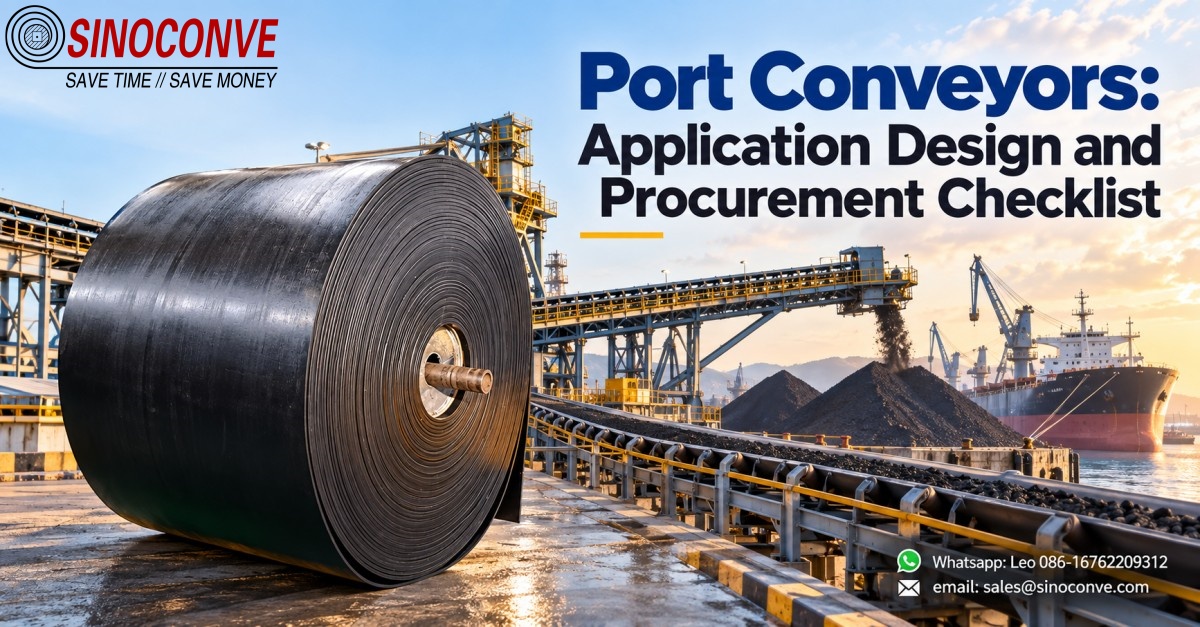
Port conveyors live in a harsher environment than almost any other bulk handling system we service, and the breakdowns we get called out to fix seldom begin with the belt carcass. Salt-laden air attacks steelwork, bearings, and paint long before a cover compound wears through, while fine cargo packs into transfer points and quietly hides seized rollers. A terminal paid by the ton cannot absorb unplanned stops the way a quarry can, so availability becomes a design driver rather than a bonus feature. This page sets out how we approach a port conveyor system, where the duty diverges from mine and quarry work, and what a buyer should put into an RFQ before comparing prices.

01The Three Conditions That Separate a Port Terminal From Any Other Conveying Duty
We have walked coal, iron ore, and fertilizer terminals in Ningbo, Rizhao, and along the Gulf coast over the past two decades, and the same three conditions show up on every one of them. Chloride in the air, abrasive dust that refuses to settle, and a berth schedule that treats a stopped shiploader as a commercial event rather than a maintenance nuisance.
Why Salt Never Stops Attacking Steel Structures in a Port
A mine site is dry for most of the year. A port is wet with salt spray almost every day, and airborne chloride settles on every horizontal surface, including the top of a roller shell and the shaft step under a bearing housing. We have pulled bearing housings off a stacker-reclaimer after fourteen months that looked as though they had spent a decade outdoors. The grease had emulsified, the seal lip had hardened, and the outer race was pitted across roughly a third of its circumference. None of that damage had anything to do with belt tension or throughput, which is the part most specifications miss.
Protection therefore has to be designed as a package: coating systems on the structure, sealed or regreasable bearings chosen for the duty, and shaft materials that will not flash-rust while a machine stands idle over a weekend.
Why Port Cargo Streams Change Faster Than Mine Feed Streams
A quarry sends the same granite to the same crusher for years, so a belt specified on day one stays matched to the duty. A port terminal may handle iron ore fines on Monday, urea on Wednesday, and wood chips the following week, each with a different bulk density, angle of repose, and moisture level. That variety is why we design conveying systems around the worst material named in the berth contract instead of the average, and why transfer geometry gets more engineering attention than it would on a fixed-feed plant.
Field note from our engineers: At a 42 °C summer shift on a Gulf Coast ore berth we logged 71% relative humidity at midnight and a visible salt film on the gantry handrails by 05:00. That terminal had bought a good belt and a poor corrosion package. Two years later the belt was still serviceable and the idler frames were being replaced in whole sections.
02Process Zones: From Ship Unloading and Hold Cleaning to Stockpile Handling
A terminal is not one conveyor duty. It is four or five different duties chained together, and the belt that survives the quay may be the wrong belt for the boom. Mapping the line zone by zone is the first thing we do on a site survey, because every later decision about materials, enclosure, and spares follows from it.
| Terminal process zone in the layout | Duty conditions we actually see in service | Components that carry the highest risk | Failure pattern worth designing against here |
|---|---|---|---|
| Ship unloading and hold cleaning on the quay | Continuous and highly variable load, because grab or continuous unloader discharge lands off center and the belt takes short heavy surges instead of a steady feed. | Hopper liners, impact cradles, skirt rubber, and one or two very heavy belts that must never be swapped mid-berth. | Edge damage and torn covers from off-center lumps, plus seized impact rollers under the hopper after a wet cargo campaign. |
| Stockpile stacking and reclaiming across the yard | Long travel distances with frequent slewing and luffing, so a belt runs partly empty and partly choked within a single pass. | Tracking hardware, self-aligning idlers on the long straight runs, and pulley lagging on the boom. | Belt drift and edge wear caused by structure movement rather than by material, since alignment changes with every boom position. |
| In-plant transfer towers inside the yard | Short, fast belts in cascades with several transfers inside one tower, and the highest dust concentration in the whole terminal. | Chute liners, secondary cleaners, sealed idlers, and the enclosures around each drop point. | Carryback and spillage that builds a layer on the walkway within one shift and then conceals a failed roller. |
| Shiploader boom and rail wagon loading | Steep inclines, long boom reaches, and a much stronger wind profile once the boom is raised above the dockside structures. | Higher-tension belt construction, patterned covers on the incline, and wind covers along the boom. | Material rollback on the incline and wind-blown cargo at the boom tip, both of which surface as environmental complaints. |
Where the Duty Is Hardest Inside the Berth Area
A single quay line contains a receiving hopper, a short inclined belt, a transfer tower, and a stockpile boom inside about a hundred meters. Dust load peaks at the tower, corrosion exposure peaks at the boom tip because it faces open sea air with no shelter, and impact load peaks at the hopper. We treat the quay line as three separate specifications bolted together, and we tag each conveyor with the zone it belongs to so a spare roller pulled from the store is the correct roller for that position. That labeling habit has reduced wrong-part installations on our service contracts more than any tooling change we have made.
Why Stockpile and Rail Loading Zones Need a Different Specification
Once material leaves the berth, the duty shifts toward distance and incline. A stacking boom may run at 4.0 to 4.5 m/s over several hundred meters, and the belt feeding a rail wagon often climbs between 15 and 18 degrees. What we recommend there is a steel cord carcass rather than a fabric one, and not because EP or NN belts fail in that service. The reason is take-up travel: a long fabric line needs so much elongation allowance that the counterweight tower costs more steel and more dockside footprint than the belt saving is worth.
Zone mapping also drives the spares list. A terminal that stocks identical rollers for every position ends up overstocked in the easy zones and short in the hard ones, which is exactly backwards when a berth clock is running.
03Salt-Laden Air: How We Control Corrosion on Steel, Rollers, Pulleys, and Bearings
Corrosion is the cost line that separates a port project from an inland one. We have watched terminals save 8% on frame procurement and pay it back several times over in replacement labor by year four. Protection has to be specified by component group, because steel, rollers, lagging, and bearings fail from the same salt for different reasons.
Coating Systems for Structural Steel and Frames
We work from a written coating schedule rather than a color sample. Blast the steel to a recognized surface profile, apply a zinc-rich primer, then build intermediate and top coats to a stated dry film thickness, and hold the applicator to that number with gauge readings at inspection. For anything within a few hundred meters of open water we ask for a system matched to a severe marine corrosivity category, which is a step beyond what most inland plants ever write into a specification.
Bolted connections, handrail bases, and drain paths are the details that fail first, so they deserve the same attention as the main members. As a conveyor belt manufacturer we do not supply steelwork, but we do ask to see the coating schedule before we will stand behind a belt warranty on a quay line, because a structure that sheds rust onto the return strand destroys covers from the inside.
| Component group and where it sits | Exposure to marine salt and spray | What we write into the specification |
|---|---|---|
| Structural steel members and access walkways | A continuous chloride film, standing water at the low points, and abrasive ore underfoot that strips any coating it rubs against. | Multi-coat system over a blasted profile with a zinc-rich primer, plus a stated dry film thickness that the applicator is held to at inspection. |
| Idler frames and their support brackets | Splash zone at the quay face, plus material build-up that traps moisture against bare metal for weeks at a time. | Hot-dip galvanized frames for general positions and stainless or polymer frames in the splash zone, where galvanizing alone is consumed within a few years. |
| Pulley shells with their rubber lagging | Wet fines riding the return strand, so the shell stays damp for most of the shift and the drive face is never really dry. | Ceramic or grooved rubber lagging over a corrosion-resistant shell coating, because a polished steel shell loses grip as soon as it is wet with slurry. |
| Bearings and the housings around them | Moisture drawn in during washdown and then pushed in again by the day to night thermal cycle. | Sealed units with a contacting lip plus a labyrinth path, or regreasable housings charged with a high water-resistance grease on a purge schedule. |
| Fasteners and small items of hardware | The first items to fail and the last items anyone remembers to include in the paint or coating scope. | Grade 316 stainless for exposed bolts in the splash zone, listed explicitly on the bill of materials instead of being left to site supply. |
Roller and Pulley Materials That Survive a Marine Atmosphere
Roller selection in a port is a corrosion decision before it is a load decision, and that order matters most when the budget is tight.
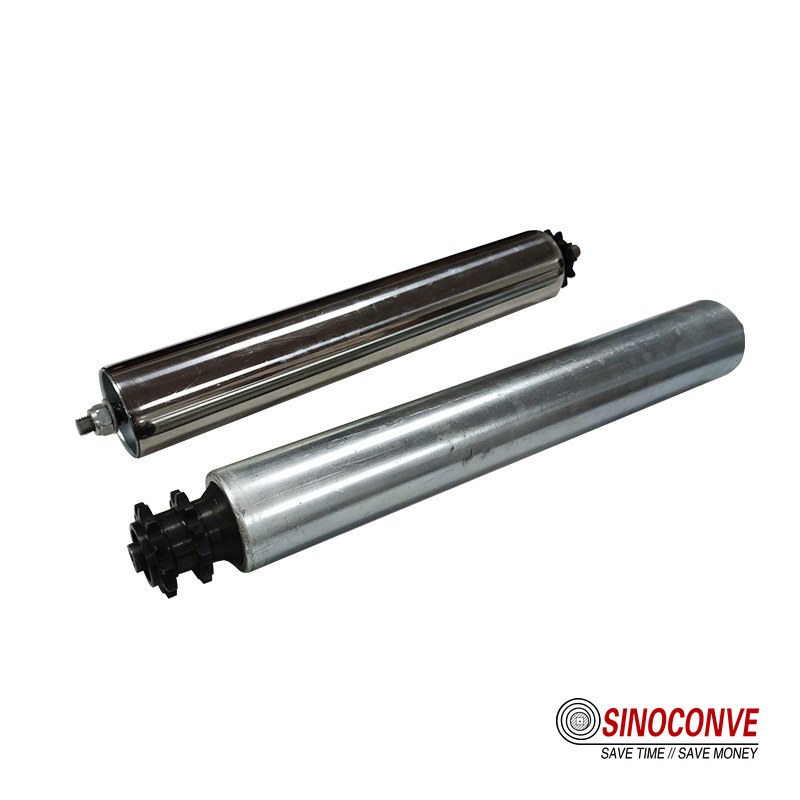
A standard painted shell with a pressed steel end cap gives several years of service inland. On a quay it may not survive two. We move to polymer or stainless shells in the splash zone, keep the bearing seat machined rather than pressed wherever the budget allows, and specify a dynamic load rating with real margin over the calculated radial load, because a corroded or fretted seat lowers the usable rating long before the roller itself is worn out.
Where a terminal prefers one interchangeable roller across the whole line we accept that compromise and shorten the inspection interval rather than pretending the specification is equal everywhere. Under that loading a properly specified rubber conveyor belt will outlast two sets of frames, which is the reverse of the usual inland experience where frames outlive several belts.
Bearing Sealing and Lubrication in Wet, Salty Air
Grease choice matters more here than most maintenance teams expect. A lithium complex grease with strong water washout resistance holds up far better than a general-purpose product, and we would rather see four purge points a year than one annual refill, because the purge is what physically pushes contaminated grease out of the housing. In splash-zone positions we have had good results with sealed-for-life units and simply treat the roller as a consumable on a five-year cycle.
Field note from our engineers: On a coastal ore berth we measured about 0.6 mm of coating loss on idler frames facing the sea within 26 months, against almost no measurable loss on the sheltered side of the same frame. Corrosion in a port is directional. That is why we rotate replacement idlers through a line instead of replacing whole frame sets at once.
04Dust and Enclosure: Transfer Towers, Wind, and Environmental Acceptance
Dust is the visible half of a port spillage problem and the carryback that feeds it is the invisible half. We have sampled fine ore dust settling on plant 200 m downwind of a transfer tower, which is a useful reminder that a lip seal and a good intention are not an enclosure strategy.
Sealing the Transfer Point Without Choking the Belt
The rule we work to is simple to state. Control the material at the point where it is moving fastest and the particles are closest together, then give the air somewhere to slow down before it escapes the enclosure. In practice that means a hood that follows the belt trajectory, a skirtboard long enough to be useful, and enough free volume under the cover that internal pressure does not force dust out through every gap. Where a terminal has been fighting spillage for years the fix is usually not more rubber. It is a longer, gentler chute that delivers the stream aligned with the belt center line instead of slamming it sideways into a skirt wall.
For very fine, dry cargo we add a dust curtain or a small fogging system at the discharge lip. For sticky ore the same hardware simply creates mud, so the choice follows the material rather than the environmental target.
Wind, Water Spray, and What an Environmental Inspector Actually Checks
Open stockpiles and raised boom conveyors are the two positions where wind does the damage. We specify covers or partial cladding on elevated boom belts and try to hold free-fall height at the discharge below roughly 1.0 m, because that single change can cut visible dust dramatically without adding one spray nozzle. Water spray works well on coal and mineral dust, but it is never free: every liter added to the cargo is a liter pumped, treated, and in some cases paid for again as a moisture penalty at the receiving port. Terminals that manage this well meter the spray from a measured dust reading rather than running it flat out.
The two hardware groups that decide the outcome are the belt itself and the enclosure around it. A conveyor belt supplier can offer a cover with the surface finish that suits sticky cargo, and a conveyor belt factory running its own forming line can hold that finish across repeat orders instead of drifting between production lots.
05Long Runs and Steep Inclines: Drive, Tension, and Material Flow Checks
Two things go wrong on long port lines. Either the drive runs out of tension margin at the tail, or the material starts sliding back on the incline. Both are calculable before a tonne of steel is ordered. Whether the line carries a fabric or a steel cord industrial conveyor belt, the check sequence stays the same and we run it on every project rather than trusting a catalog rating.
Sizing the Carcass on a 600 m Boom Run
Start with the material load. At 2,500 t/h and 4.0 m/s the line is moving 694 kg of cargo every second, which over one metre of travel is about 174 kg per metre of belt. That single figure tells you how much belt mass and how much idler drag the drive has to pull before any friction loss is added. For a 600 m center-to-center boom run at the same speed, our friction calculation lands somewhere in the 90 to 110 kN band for effective tension, depending on how conservative we are with the idler friction factor and whether the return strand is carrying material.
Multiply by a design factor of 1.3, apply the safety factor the project standard demands, and the resulting cord rating sits above anything a fabric carcass can offer at that width. Elongation gives the second reason. A steel cord carcass stretches around 0.2% at working tension while an EP belt of comparable strength may reach 1.5%. Over 600 m that gap is 7.8 m of extra take-up travel that has to exist somewhere, and a counterweight tower of that height is expensive at the waterside.
Inclines Where a Standard Cover Stops Working
Inclines above roughly 16 degrees carrying fine wet ore are where smooth covers give up. We have seen a 17 degree shiploader incline lose material in a slow continuous slide rather than in visible slips. The options are a chevron cover, a sidewall and cleat arrangement, or adding a transfer stage to reduce the angle. We price all three before recommending one.
One check we never skip is what happens with an empty boom. A long line starting with an empty belt needs enough take-up travel to absorb elastic recovery without tripping the zero-speed sensor, and that small detail has embarrassed more than one commissioning team on handover day.
06Transfer Points and Impact: Cushioning, Stream Centering, and Spillage Control
The loading point is where a port conveyor takes most of its structural punishment, and it is also where a small geometry error turns into a monthly maintenance routine. Impact energy rises with the square of the drop velocity, so trimming 0.2 m from a fall height does more for belt life than moving up a cover grade. We start every transfer review there.
How We Set Up an Impact Zone That Survives More Than One Campaign
We size the cushioning on the energy of the largest lump the berth contract names, not on the average particle. For ore with a 300 mm top size leaving a chute, impact rolls go in at 300 to 500 mm centers beneath the loading point, carried on a frame rigid enough that the belt cannot sag into the gap between rolls. The skirt is then set to the running belt with a clearance measured in millimeters and checked again after the first week, since new rubber beds down.
Chute alignment matters just as much: we want the stream landing on the belt center line with the velocity component along the belt, not across it. Our field notes on impact roller selection for loading zones go into the spacing detail if you need to argue the case with a contractor.
Spillage appearing behind the loading point in the first month almost always means the stream is striking the skirt wall rather than the belt, which is a chute problem disguised as a belt problem.
07Uptime and Availability: Redundancy, Quick Belt Change, and Spare Strategy
A berth earns nothing while a belt is being replaced, so availability has to be designed rather than hoped for. That changes what a terminal buys, in ways that look expensive on a single line and obvious across a whole ship loader.
Designing for a Belt Change Inside One Shift
The most useful thing a designer can do for a port is to make the belt replaceable quickly. On a boom line that means enough maintenance access at the head and tail, a take-up with travel to spare rather than travel that just fits, and a splice method the terminal's own crew can execute without waiting for a specialist visit.
We generally recommend a vulcanized splice on mainline belts above roughly 800 mm width, and a mechanical fastener only where a temporary repair has to get the berth running before the next tide. The drive train deserves the same scrutiny, because motors, gearboxes, and the belts that connect them sit in exactly the same salty air as everything else. For drives standing near open water we look for a wrapped construction that resists moisture working into the tensile cord, and we would rather buy from a V-belt manufacturer who will quote a matched set than mix belts from three brands on one sheave set. The same thinking applies to the auxiliary drives, where a transmission belt manufacturer can confirm the profile and length match the pulleys actually installed.
Spares That Cover the Failure Modes You Actually Have
A spares list copied from a tender template is usually wrong in both directions. It overstocks cheap items in easy zones and leaves nothing on the shelf for the roller position that fails twice a year. We build the list from the maintenance history of the line or, on a new terminal, from the zones we identified in the survey. If the boom tip has been the problem position, the store holds boom tip rollers, not a generic set of two hundred.
Two or three critical belts in stock beat a warehouse of hardware. Which belts those are depends on lead time from the mill and on how long the terminal can run a damaged line before the splice fails.
08Port Duty Versus Mine and Quarry Duty: Where the Requirements Diverge
Most of the hardware looks identical on both sites, which is exactly why the differences get missed. A conveyor frame that performs well for a decade at an inland pit may be scrapped in three years at a berth, and the reason is never the belt alone. We keep a comparison table in front of us during any tender that involves both environments.
| Design dimension across the two sites | Typical conditions at a port terminal | Typical conditions at a mine or quarry | What we change in the design |
|---|---|---|---|
| Atmospheric exposure to salt and spray | Chloride-bearing air and spray, wet most of the year, with open water within a few hundred meters of most structures. | Usually inland and dry for long stretches, with abrasive dust as the dominant attacker rather than salt. | Corrosion protection becomes a first-order cost line in a port and a secondary line at most mines. |
| Operating schedule driven by the berth | Berth-driven, often around the clock at high utilization, with no tolerance for a stop that extends a vessel stay. | Shift-based, frequently able to absorb a few hours inside a weekly production target without commercial consequence. | Redundancy and fast belt change move to the top of the specification for a port line. |
| Material variability across the cargo list | Cargo changes with the vessel: ore fines, pellets, coal, fertilizer, and wood chips may share one line in the same month. | Feed normally comes from one orebody or one aggregate source, stable in density, size, and moisture. | Port systems are sized around the worst material in the contract, not the average of the last year. |
| Environmental scrutiny from the local area | Dust, noise, and runoff are monitored, and complaints from a nearby town can halt a berth within a day. | Limits exist but are usually enforced against a wider margin and a much smaller nearby population. | Enclosure and dust control hardware is a permit item in a port rather than an optional upgrade. |
| Acceptance testing and the handover pack | Terminals expect an availability figure, a documented spares package, and often a witnessed performance trial. | Acceptance is more often a throughput test followed by a short handover and a parts list. | Documentation quality separates suppliers in port tenders more than a few percent of price. |
Where the Two Duties Actually Overlap
Belt construction is the obvious overlap, and so is the geometry of a well designed transfer. Abrasion, loading impact, and carcass strength all follow the same engineering whether the plant sits beside a river or a quay. A quarry belt chosen on abrasion resistance and a port belt chosen on tension usually converge on similar cover grades and similar carcass classes. The moment the two part company is everything bolted to the ground: structure, idlers, bearings, and the maintenance philosophy wrapped around them.
09Component Combination Matrix for a Port Conveyor Line
Individually good components can still make a poor line, because most port failures come from interfaces rather than from single parts. We work from a matrix that pairs each component group with the base specification and the specific conditions that justify an upgrade, so nothing gets bought twice and nothing gets left out.
| Component group within the conveyor line | Base specification we start from today | Condition on site that justifies an upgrade | What the upgrade actually protects in service |
|---|---|---|---|
| Idlers and rollers along the line | Sealed units with a machined bearing seat and a dynamic rating comfortably above the calculated radial load. | Splash-zone positions, boom tips, and any point where replacements fall under a twelve-month interval. | Bearing life and the labor hours a quay-side roller change consumes from a berth crew. |
| Belt cleaners at the head end | A primary scraper sized for the belt speed, plus one secondary unit mounted at the head pulley. | Wet or sticky cargo that coats the return strand, or a line where spray hardware already exists. | Carryback volume, which sits behind most walkway spillage and most cleaning labor on a port line. |
| Enclosure of transfer points and dust control | A hood that follows the belt trajectory, skirt rubber, and a lined chute at every drop point. | Any transfer within sight of a residential area, or any cargo that shows visible dust in wind. | Environmental complaints and the operating conditions attached to the terminal permit. |
| Drive units, take-up travel, and guarding | Enough take-up travel for the calculated elongation, plus accessible grease points and a readable tension reference. | Long boom runs where a belt change needs a crane window rather than a normal shift. | Commissioning time and the nuisance trips that stretch a start-up into a second week. |
| Belt construction and the cover grade | A carcass chosen on the worst material and the tightest radius in the line, with a cover grade matched to abrasion and moisture. | Lines carrying more than one cargo class, where a mid-range cover reduces the number of part numbers held. | The largest single replacement cost in the terminal and the downtime that comes with it. |
None of those choices can be made from a catalog alone, which is why buyers running several berths tend to standardize part numbers across the whole site. Working with a supplier who can quote wholesale conveyor belts against one specification sheet keeps the roller count in the store low and makes the annual spares budget something you can forecast instead of discover.
10Installation and Commissioning: Site Conditions, Wind and Tide, and Maintenance Access
Everything specified on paper has to survive a construction site that is frequently wet, windy, and shared with marine traffic. Two of the least glamorous items on our punch lists, access and alignment, account for most of the first-year problems we are later asked to solve. Both are far cheaper to settle on a layout drawing than on a finished gantry.
Access and Clearance Decisions That Are Cheap Now and Expensive Later
Designing maintenance access on a berth differs from designing it in a plant yard, because the space around the structure is often water. A roller change should be possible from a walkway or a fixed platform without hiring a crane, so we mark every position that will need lifting equipment on the layout drawing and challenge each one. A 600 mm maintenance clearance along the return strand sounds generous until the first seized roller needs a puller and a hammer. Alignment is the second item. We ask for the structure survey and the belt line survey before the pulleys are grouted in, because correcting a 30 mm offset with shims after the grout has cured is a week of unplanned work that costs many times more than measuring twice.
Our team wrote a separate guide on sealed roller construction for dusty terminals, which covers the component detail behind that argument and the positions where a puller cannot reach.
Wind and tide add two constraints inland crews never meet. Raised boom sections have to be parked in a defined position before a weather front arrives, and any work below the quay line has to fit a tidal window that may be only a few hours long.
We also photograph the as-built pull direction and the splice position on every line we commission. The next crew that has to change a belt will not have the drawings to hand, but they will have a phone. For background on how port bulk terminals are organized, our industry note on port bulk material handling sets out the wider layout these decisions sit inside.
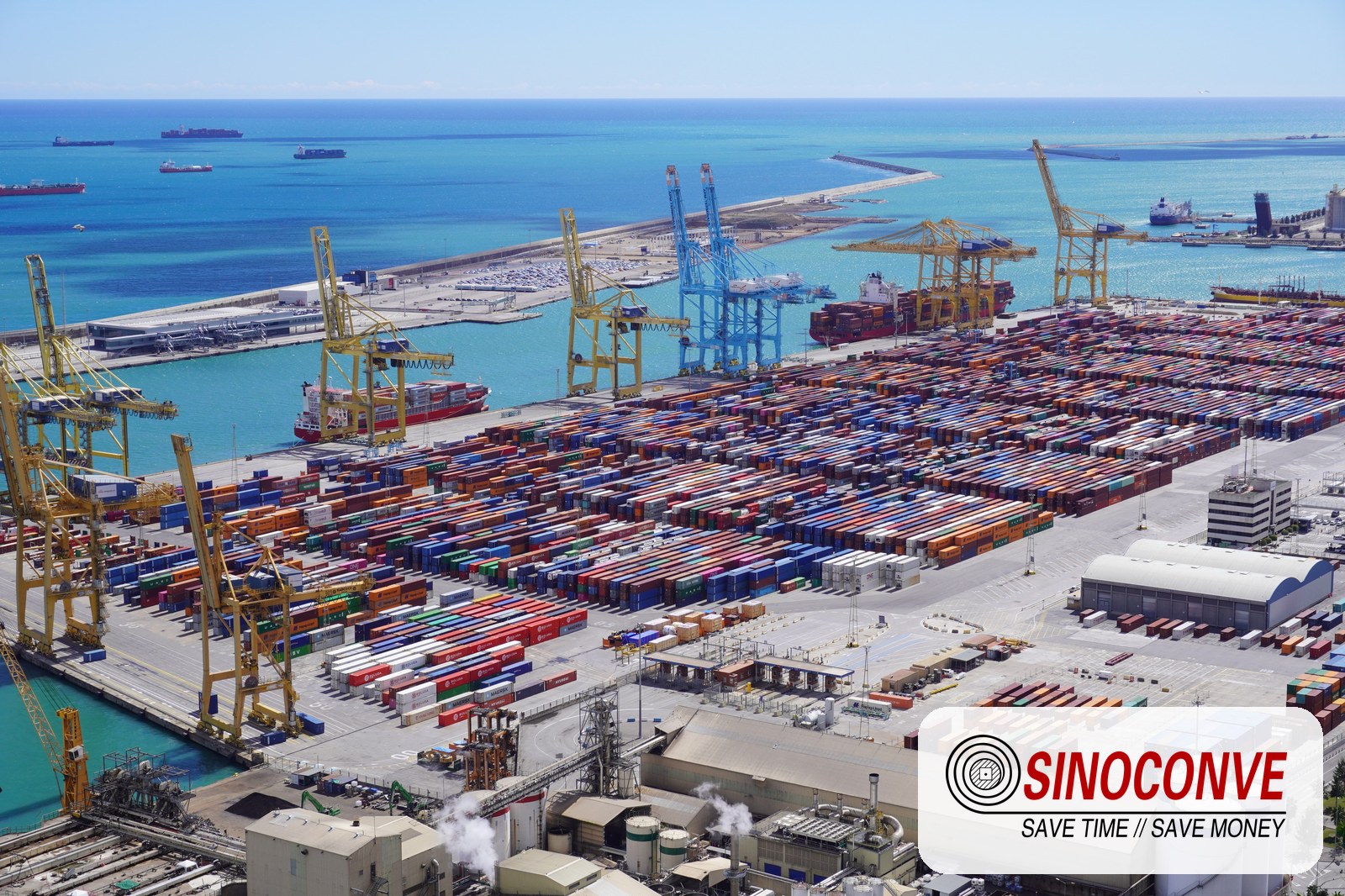
11Procurement Checklist: What Every Port RFQ Should Ask For
We regularly see tenders where six suppliers quote the same belt and none of them are quoting the same thing. The cure is a field list that forces comparability, including several items a port terminal cares about that an inland buyer may never think to mention.
| Field to specify in the RFQ | Why it changes the quoted price | Representative value for a port line |
|---|---|---|
| Belt width, speed, and throughput, stated together | Together they set the cargo load per metre and therefore the carcass class, so quoting them separately invites a price for the wrong construction. | A bulk berth line commonly runs 1,400 to 2,000 mm wide at 3.5 to 4.5 m/s carrying 1,500 to 3,000 t/h. |
| Cargo list with density and moisture range | The heaviest cargo in the contract sets tension and wear, while the wettest cargo sets the whole cleaning and enclosure requirement. | A terminal handling ore at 2.5 t/m3 beside fertilizer at 0.9 t/m3 must be sized on the higher figure. |
| Corrosion class for structures and components | It drives steel finish, idler shell material, fastener grade, and grease selection, and can move the total price by double digits. | Structures within a few hundred meters of open water are normally specified to a severe marine category. |
| Operating hours and the required availability | This decides whether the terminal needs redundant components, a second belt in store, or both at once. | Round-the-clock berth operation usually justifies one spare belt for every critical line on site. |
| Splice method and who executes it | A vulcanized splice changes field support, tooling, and lead time, and it is often misquoted as a mechanical joint by an unfamiliar bidder. | Mainline belts above roughly 800 mm width are usually specified as vulcanized and documented as such. |
| Spares package and the delivery basis | It defines first-year stocking levels and the sea freight plan, which is a genuine cost line on any coastal project. | A first-year package typically covers three to five percent of the component count on the line. |
| Condition of the receiving steel structure | On brownfield berths the existing frame alignment and foundation condition decide whether a new belt can be tracked at all. | Aged structures often carry more distortion than a new belt tolerance will accept. |
Terminals that buy through a local agent rather than direct should run the same field list through that conveyor belt distributor and ask for the answers to be passed back to the mill unchanged. An agent who rewrites the technical fields to suit the stock on the floor is the most common reason a port belt arrives with a cover grade nobody ordered. Our product catalog lists the constructions and cover grades most berths end up choosing between.
12Acceptance Criteria: What We Verify Before Handover
A standard belt acceptance covers dimensions, cover thickness, and splice strength, and that is where many contracts stop. A port project needs a second list that tests the parts nobody photographs for the brochure.
Port-Specific Items That Rarely Appear on a Standard Checklist
We gauge coating thickness on the frames facing the water rather than on a sample pulled from the yard, and we check that every splash-zone fastener is the correct grade by looking at the heads rather than at the delivery note. Sealing on each idler has to match the component schedule, not whatever left the supplier's warehouse that week. Tracking gets witnessed at full load with the boom in the position it will actually work in, because a line that tracks beautifully at the stowed angle tells you almost nothing.
We also insist on a run with the belt empty followed by a run at design tonnage. A line that tracks when empty and walks sideways when loaded has a feeding problem, and it is much easier to correct while the contractor is still on site than three months later.
For the belt and roller scope itself, we point buyers to our separate notes on port conveyor belt supply and on roller and pulley supply for port systems, since those pages deal with the commercial detail that this system-level guide deliberately leaves alone.
Documents close the job. No terminal should sign off without the as-built belt data sheet, the component schedule with part numbers, the witnessed tracking record, and a written spares list that matches what is physically on the shelf. A handover folder assembled after the fact is worth very little. The same discipline applies to the joint itself, and our guide to conveyor belt splicing methods and costs explains what a documented splice looks like in practice.
13A Total Cost View: Downtime Hours Against Spare-Part Spend
Capital cost arguments rarely settle a port decision, and they should not. What settles them is the value of one berth hour, and most terminals know that number to three significant figures because their commercial team uses it every day.
Working the Number for a Single Berth
Take a berth moving 2,500 t/h of ore with a cargo value of $120 per tonne and a terminal margin near 12%. One stopped hour costs about 2,500 x 120 x 0.12, which is $36,000 in lost margin before demurrage is considered. Now suppose a $9,000 upgrade to sealed idlers and better lagging across one boom line removes a single three-hour unplanned stop each quarter.The recovery is 3 x 36,000, or $108,000 per quarter, against a first cost of $9,000. Even if you halve the assumed margin and double the upgrade cost, the case does not become close.This is why we push corrosion and sealing items hard in port budgets and stay quiet about them in quarry budgets.
Spare parts follow the same arithmetic. A component that costs $200 and takes four hours to replace is really a $144,200 component if its failure stops the berth, which is a useful way to justify stocking the version that lasts twice as long for 30% more money.
14Mistakes We See Repeatedly in Port Conveyor Projects
The first mistake is buying a mine specification with a marine coating added at the end. Corrosion, access, and spare parts are structural decisions, and by the time they reach the paint shop it is too late to change any of them.
The second is treating tracking as a belt problem. On long boom lines the belt is usually innocent, and the fault sits in the structure, the loading point, or an idler frame that has been knocked out of line by a crane lift. Our EP conveyor belt tracking guide walks through the diagnostic order we use before anyone touches a tensioner. Misdiagnosed tracking leads to over-tensioning, and over-tensioning shortens the life of everything in the line.
The third is optimizing the belt while ignoring the environment it runs in. A premium carcass on corroded idlers and a leaking skirt will fail on schedule anyway. Buying corrosion-resistant conveyor rollers for the splash zone is a smaller line item than a belt upgrade and removes more failures. Finally, terminals that compare themselves only against other ports miss the useful lessons from other bulk industries, and our notes on heavy duty rubber belt in mining operations and on the mining and quarrying industry set out where those lessons transfer and where they do not.

15Frequently Asked Questions About Port Conveyor Systems
What really separates a port conveyor from a quarry conveyor?
Corrosion exposure, continuous operating schedule, and cargo variability, in that order. Belt construction often ends up broadly similar on both sites. The structure, idlers, bearings, and spares strategy diverge sharply. When a specification is copied from a pit and only the coating system is changed, the terminal feels the difference within two years. Corrosion appears on the frames and bearing seats long before anyone notices cover wear.
Do we need a steel cord belt on every port line?
No. Use a steel cord carcass where elongation dictates the size of the take-up tower, and a fabric carcass on short transfers where flexibility and easier splicing matter more; our comparison of steel cord belt construction and durability shows where the crossover normally falls.
How much corrosion allowance should an idler frame carry?
Less than most drawings assume, and always in the right place, because extra millimeters of painted steel buy far fewer years than a change of material does. We accept a sacrificial frame on sheltered faces and specify stainless or polymer in the splash zone.
Which belt cleaners work on wet, sticky ore?
Polyurethane blades generally hold up better than tungsten carbide on sticky cargo, although they wear faster against sharp ore. Mounting stiffness and blade angle often matter more than the blade material. A well set secondary cleaner at the head pulley delivers more benefit than a heavier primary unit. Our notes on cleaning methods and scraper limits go further into the scheduling side.
Can one spare belt cover the whole terminal?
It can, but not on a quay line where two or three different belt constructions share the same structure. We usually recommend one spare per critical line, plus a splice kit that matches it. A spare belt you cannot join on site is just inventory sitting on a shelf. For low-utilization transfer belts, one spare shared across two similar positions is a reasonable compromise.
How do we specify dust control so it passes environmental inspection?
Start from a measured dust reading rather than from a nozzle count. Enclosure comes first, free-fall height second, and water last, because added water changes the cargo and can create a moisture penalty at the receiving end. Where the cargo is fine and dry, a cover compounded for dust resistance helps as much as the hardware around it, which is the argument in our note on dust resistant conveyor belt supply.
What availability figure should a port conveyor line achieve?
Well-maintained mainline systems commonly reach 95 to 98% mechanical availability over a year, with the shortfall concentrated in belt and splice work rather than in individual components, so anything below 93% normally points to one neglected zone.
Where do we start if a berth is losing three hours a week to unplanned stops?
Build the failure list by zone for one month before buying anything. The top two entries usually sit at the loading point and at one or two roller positions. Correcting those returns most of the lost hours. Purchases made before that list exists tend to be the wrong ones, and the store ends up holding parts for failures that never happen.
What documents should be handed over at the end of a port project?
At minimum the as-built belt data sheets, the component schedule with part numbers and protection class, the witnessed tracking record, the splice procedure with its test result, and a spares list matched to what is physically on site. Ask for them as a contractual deliverable rather than a favor after commissioning. Documents assembled months later rarely match the machine you bought. A two-page pack that mirrors the installation beats a folder of generic certificates.
16Related Products You May Need
- Rubber Conveyor Belt — heavy duty covers for ore, coal, and fertilizer berths.
- EP Rubber Conveyor Belt — fabric carcass for transfer towers and short port lines.
- Chevron Conveyor Belt — patterned covers for boom inclines where smooth belts slip.
- Conveyor Rollers — sealed and corrosion-resistant rolls for splash-zone positions.
- V-Belt — drive belts for motors and gearboxes standing in salt air.
- Product Catalog — the full belt, roller, and drive range in one place.
17Related Blog Posts
- Port Conveyor Belt Supplier: What Terminals Should Check
- Roller and Pulley Supply for Port Systems
- Corrosion-Resistant Conveyor Rollers for Coastal Plants
- Dust Resistant Conveyor Belt Supply
- Impact Rollers for Loading Zones
- EP Conveyor Belt Tracking Guide
- Steel Cord Rubber Conveyor Belt Durability and Efficiency
- Conveyor Belt Splicing: Methods, Costs, and Field Tips