Engineered belt solutions for demanding industries worldwide

Blog

Blog

Home/Blog
Recent Posts
Industrial V Belt Drive: Profile, Drive Behavior and Application Limits

Industrial V Belt Drive: Profile, Drive Behavior and Application Limits

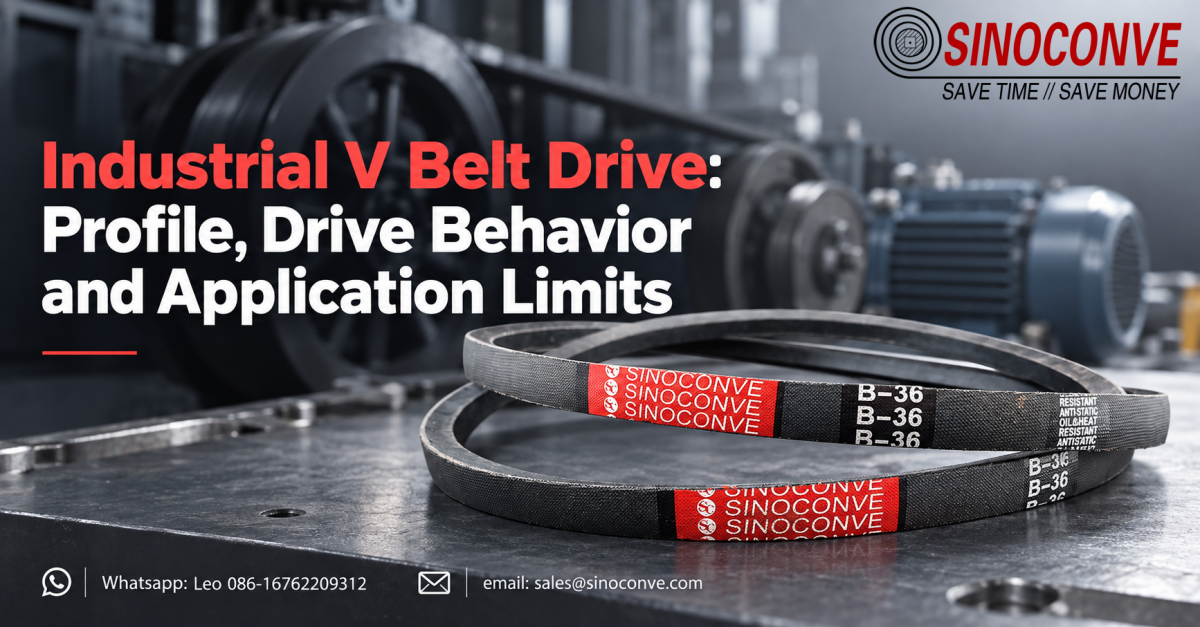
An industrial V belt drive turns torque into grip through wedge action, and this guide follows that physics into purchasing decisions. It sets out the section profile family, A, B, C and D plus the SPZ to SPC metric range, then explains how wedge angle and effective diameter produce the speed ratio, and why arc of contact, elastic creep and true slip must be kept apart when a drive underperforms. Tension gets a practical section on how much to set and how often to recheck, together with the equal-length rule for matched sets and the alignment and offset problems that quietly cause most premature failures. A worked example sizes a drive from power, torque and speed, and application limits state honestly when a V belt is the wrong answer. Failure modes and prevention, procurement and acceptance fields, and a comparison with timing belts and banded sets complete the article.

Conveying Solutions for Mining: System Design and Buyer Checklist

Conveying Solutions for Mining: System Design and Buyer Checklist

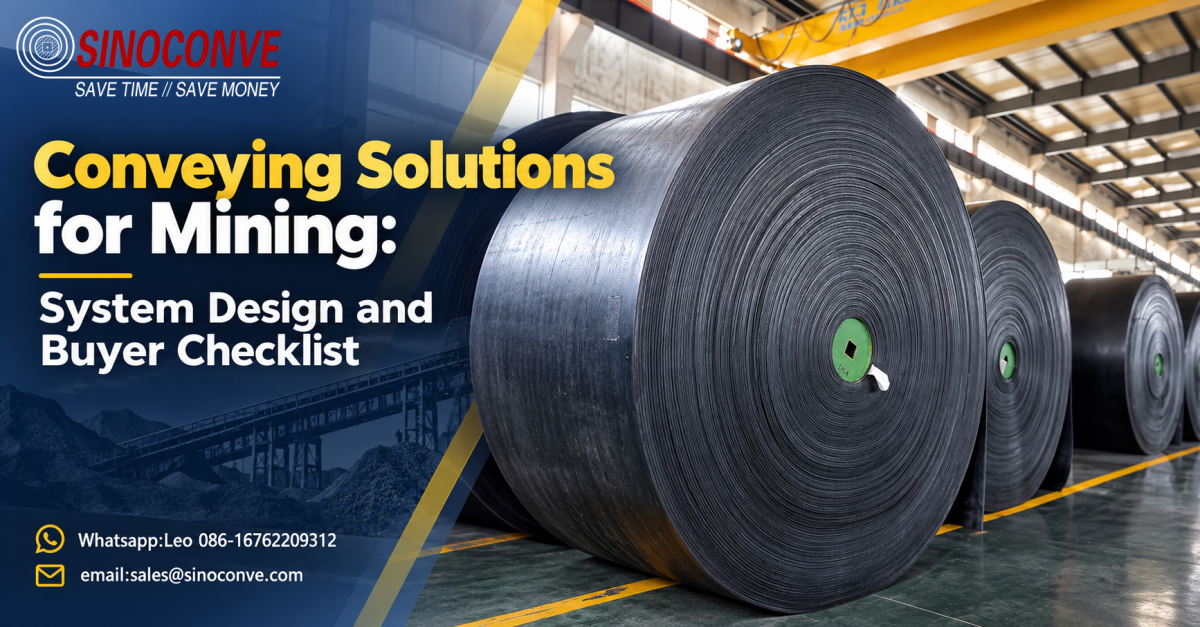
Conveying solutions for mining are decided at the system boundary, long before a belt is priced, and this guide works from that boundary inward. It sets where a mining conveying design starts and stops, then covers route selection and transfer points across a mine site, capacity and incline checks that close the numbers before purchase, and drive, tension and starting behaviour for long or loaded starts. A component combination matrix maps which part serves which segment, so nothing is over-specified or left out, followed by the effect of environment, dust and climate on the design. The underground to surface transition, long flights, stockyards and loading interfaces each get a section, with a purchasing checklist and acceptance criteria for a mining conveying solution, the common design errors that surface late, and how this design view divides work with our service article and systems page.
Concrete Conveyors for Industrial Floors: Application Design and Procurement Checklist

Concrete Conveyors for Industrial Floors: Application Design and Procurement Checklist

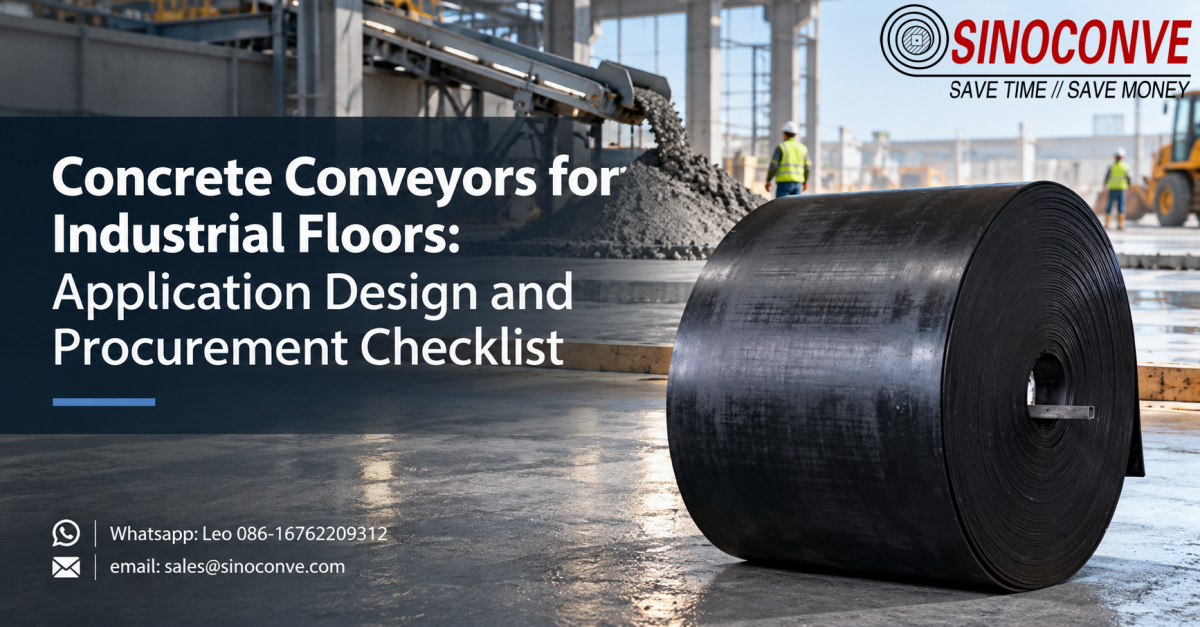
Concrete conveyors for industrial floors serve two duties that should never share one specification, and this guide separates them before it specifies anything. It zones a floor pour from discharge to clean-up, then shows how slump and aggregate size choose the conveying method rather than the other way round. Belt construction for concrete placement duty is covered in terms of cover compound, carcass, jointing and cleaning, followed by the equipment combinations and the interfaces between them. A capacity check converts cubic metres per hour into belt width and speed, and cold joints are treated as a supply discipline problem with the practices that prevent them. Field risks on a floor pour, traffic, curing lifts and temporary crossings, the design mistakes we keep finding on slabs, a procurement checklist, acceptance criteria, documentation evidence and the differences from our other concrete articles close the page.

Conveyor Carryback Solutions: System Design and Buyer Checklist

Conveyor Carryback Solutions: System Design and Buyer Checklist

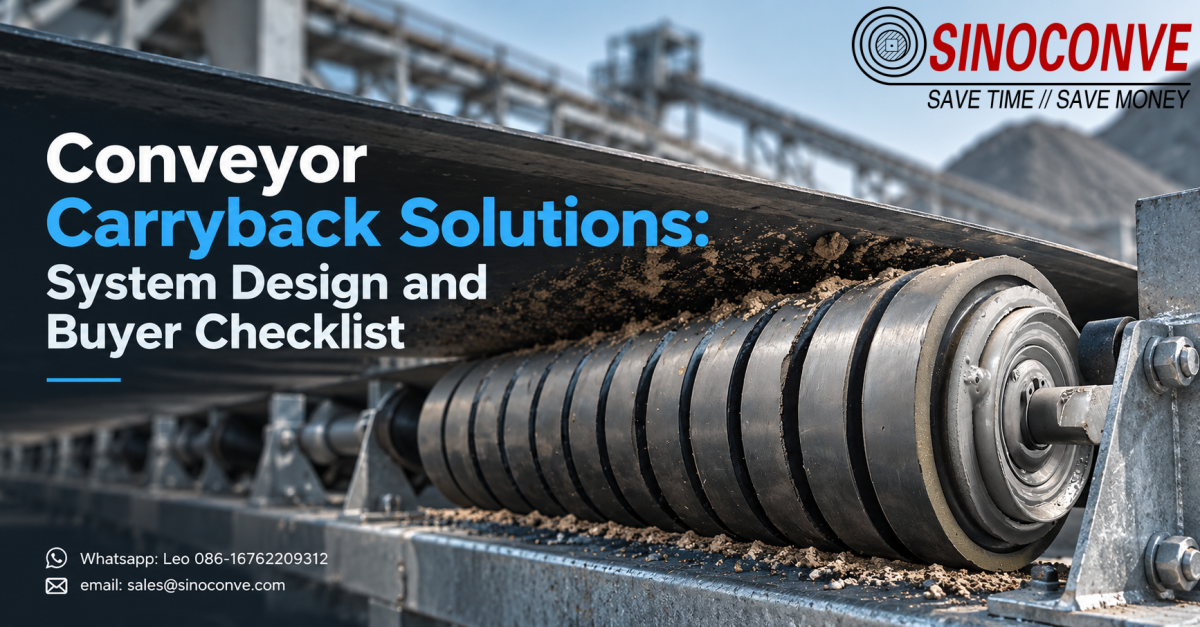
Conveyor carryback solutions are a business case before they are a purchase, and this guide puts a number on the problem first. It gives the annual loss formula, then converts tonnes into money across material, labour, downtime and compliance cost, so a proposal can be judged on payback instead of on impressions. Four intervention families are then compared as one portfolio: structural work on chutes, skirts and pulley geometry, component work on rollers, idlers and tracking hardware, operational changes to speed, throughput and maintenance windows, and material interventions on moisture, fines, binder and temperature. A worked investment-return example is followed by an honest reading of the payback result, the assumptions that break it, and a ninety-day remediation roadmap that moves from fix to standard in months four to twelve. Procurement and acceptance criteria close it.
Parcel Conveyor Systems: System Design and Buyer Checklist

Parcel Conveyor Systems: System Design and Buyer Checklist

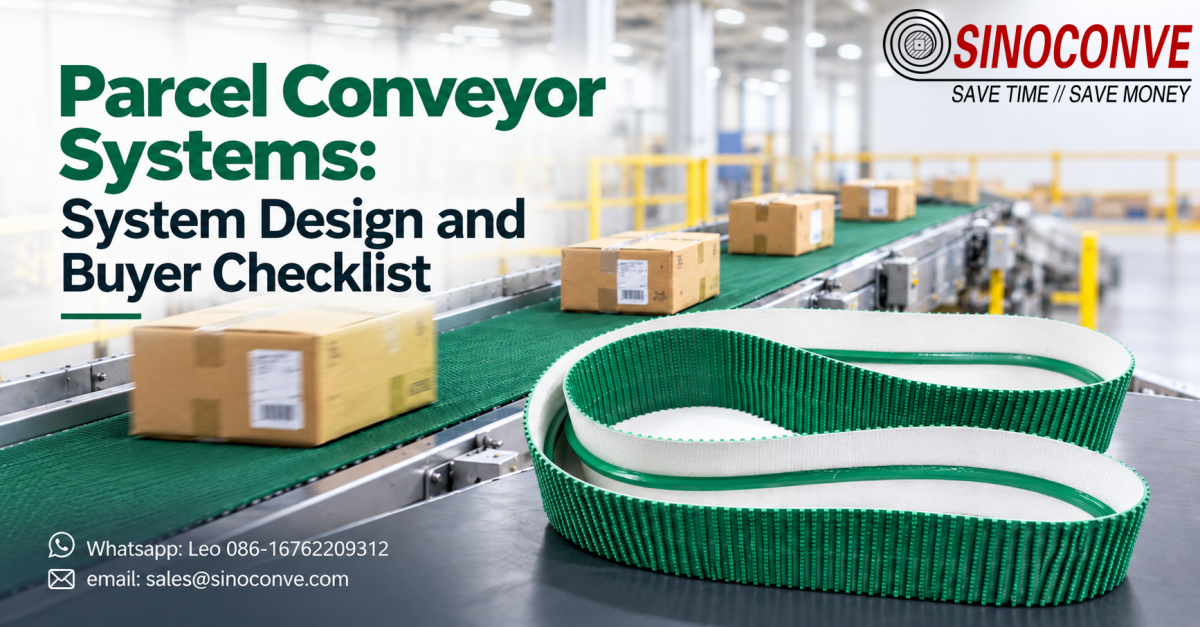
Parcel conveyor systems are drawn from trailer to trailer, and this guide keeps that boundary in view throughout. It works zone by zone, from induction and infeed through sortation, chutes and accumulation to the outfeed that loads the next vehicle, and states what each section actually has to do. An equipment combination matrix then matches hardware to each zone without over-specifying, followed by a capacity check that converts pieces per hour into belt width and speed. Peak factor, port count and the real price of recirculation are treated as design variables rather than assumptions, and buffer and accumulation sizing is worked from arrival patterns. Environment and working conditions, clearance, headroom and building interfaces, fire safety, egress and personnel protection, control interfaces for scan, weigh and sort signals, start-stop coordination between segments, procurement and acceptance checks, and common design errors complete the guide.

Conveyor Belt Cost: Price Drivers and Total Cost of Ownership

Conveyor Belt Cost: Price Drivers and Total Cost of Ownership

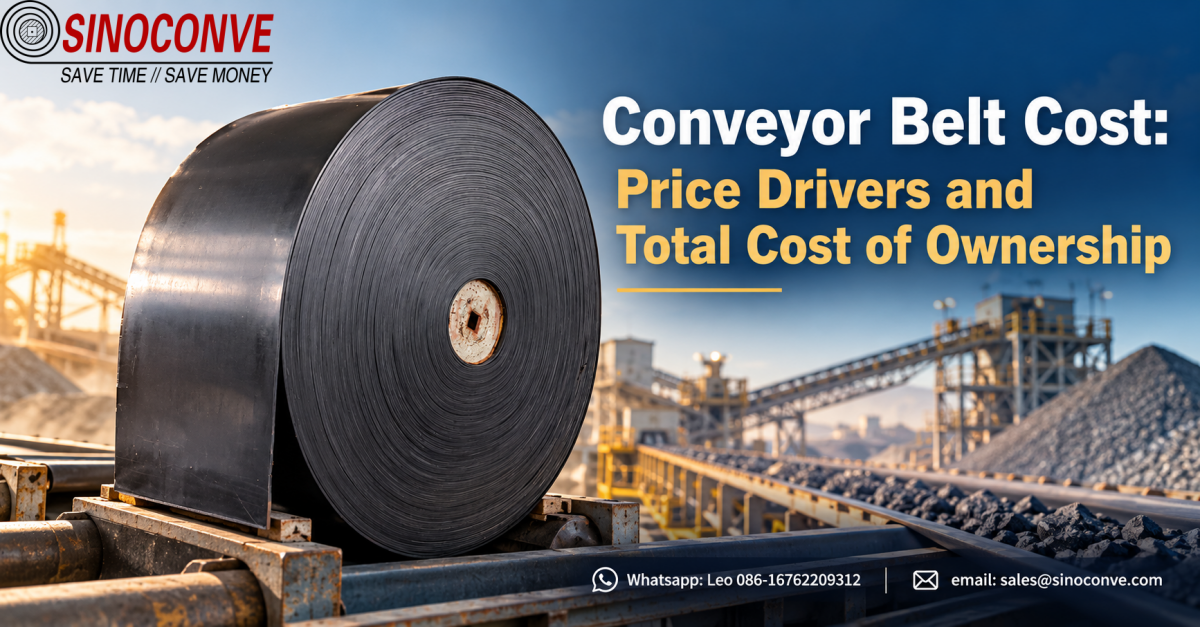
Conveyor belt cost is a structure before it is a number, and this guide builds that structure line by line. It sets out what has to be settled before anyone can quote honestly, then walks eight price drivers: carcass material and ply count, cover grade and thickness, width, length and belt mass, splice method and joint count, specialty properties and compound families, order quantity, lead time and batch size, testing, documentation and certification, and packing, freight, duty and customs. The second half turns price into ownership with a three-year total cost model and its formula, a worked example where a better splice lifts belt life from eighteen to thirty months, and the engineering levers that lower total cost without cutting price. Quote fields to request, and the misconceptions that keep buyers comparing lists instead of lifetimes, complete the guide.


Industrial V Belt Drive: Profile, Drive Behavior and Application Limits

Industrial V Belt Drive: Profile, Drive Behavior and Application Limits

An industrial V belt drive turns torque into grip through wedge action, and this guide follows that physics into purchasing decisions. It sets out the section profile family, A, B, C and D plus the SPZ to SPC metric range, then explains how wedge angle and effective diameter produce the speed ratio, and why arc of contact, elastic creep and true slip must be kept apart when a drive underperforms. Tension gets a practical section on how much to set and how often to recheck, together with the equal-length rule for matched sets and the alignment and offset problems that quietly cause most premature failures. A worked example sizes a drive from power, torque and speed, and application limits state honestly when a V belt is the wrong answer. Failure modes and prevention, procurement and acceptance fields, and a comparison with timing belts and banded sets complete the article.

Conveying Solutions for Mining: System Design and Buyer Checklist

Conveying Solutions for Mining: System Design and Buyer Checklist

Conveying solutions for mining are decided at the system boundary, long before a belt is priced, and this guide works from that boundary inward. It sets where a mining conveying design starts and stops, then covers route selection and transfer points across a mine site, capacity and incline checks that close the numbers before purchase, and drive, tension and starting behaviour for long or loaded starts. A component combination matrix maps which part serves which segment, so nothing is over-specified or left out, followed by the effect of environment, dust and climate on the design. The underground to surface transition, long flights, stockyards and loading interfaces each get a section, with a purchasing checklist and acceptance criteria for a mining conveying solution, the common design errors that surface late, and how this design view divides work with our service article and systems page.

Concrete Conveyors for Industrial Floors: Application Design and Procurement Checklist

Concrete Conveyors for Industrial Floors: Application Design and Procurement Checklist

Concrete conveyors for industrial floors serve two duties that should never share one specification, and this guide separates them before it specifies anything. It zones a floor pour from discharge to clean-up, then shows how slump and aggregate size choose the conveying method rather than the other way round. Belt construction for concrete placement duty is covered in terms of cover compound, carcass, jointing and cleaning, followed by the equipment combinations and the interfaces between them. A capacity check converts cubic metres per hour into belt width and speed, and cold joints are treated as a supply discipline problem with the practices that prevent them. Field risks on a floor pour, traffic, curing lifts and temporary crossings, the design mistakes we keep finding on slabs, a procurement checklist, acceptance criteria, documentation evidence and the differences from our other concrete articles close the page.

Conveyor Carryback Solutions: System Design and Buyer Checklist

Conveyor Carryback Solutions: System Design and Buyer Checklist

Conveyor carryback solutions are a business case before they are a purchase, and this guide puts a number on the problem first. It gives the annual loss formula, then converts tonnes into money across material, labour, downtime and compliance cost, so a proposal can be judged on payback instead of on impressions. Four intervention families are then compared as one portfolio: structural work on chutes, skirts and pulley geometry, component work on rollers, idlers and tracking hardware, operational changes to speed, throughput and maintenance windows, and material interventions on moisture, fines, binder and temperature. A worked investment-return example is followed by an honest reading of the payback result, the assumptions that break it, and a ninety-day remediation roadmap that moves from fix to standard in months four to twelve. Procurement and acceptance criteria close it.

Parcel Conveyor Systems: System Design and Buyer Checklist

Parcel Conveyor Systems: System Design and Buyer Checklist

Parcel conveyor systems are drawn from trailer to trailer, and this guide keeps that boundary in view throughout. It works zone by zone, from induction and infeed through sortation, chutes and accumulation to the outfeed that loads the next vehicle, and states what each section actually has to do. An equipment combination matrix then matches hardware to each zone without over-specifying, followed by a capacity check that converts pieces per hour into belt width and speed. Peak factor, port count and the real price of recirculation are treated as design variables rather than assumptions, and buffer and accumulation sizing is worked from arrival patterns. Environment and working conditions, clearance, headroom and building interfaces, fire safety, egress and personnel protection, control interfaces for scan, weigh and sort signals, start-stop coordination between segments, procurement and acceptance checks, and common design errors complete the guide.

Conveyor Belt Cost: Price Drivers and Total Cost of Ownership

Conveyor Belt Cost: Price Drivers and Total Cost of Ownership

Conveyor belt cost is a structure before it is a number, and this guide builds that structure line by line. It sets out what has to be settled before anyone can quote honestly, then walks eight price drivers: carcass material and ply count, cover grade and thickness, width, length and belt mass, splice method and joint count, specialty properties and compound families, order quantity, lead time and batch size, testing, documentation and certification, and packing, freight, duty and customs. The second half turns price into ownership with a three-year total cost model and its formula, a worked example where a better splice lifts belt life from eighteen to thirty months, and the engineering levers that lower total cost without cutting price. Quote fields to request, and the misconceptions that keep buyers comparing lists instead of lifetimes, complete the guide.
Explore more

We are committed to providing you with better products and services. Welcome to browse more content for details