
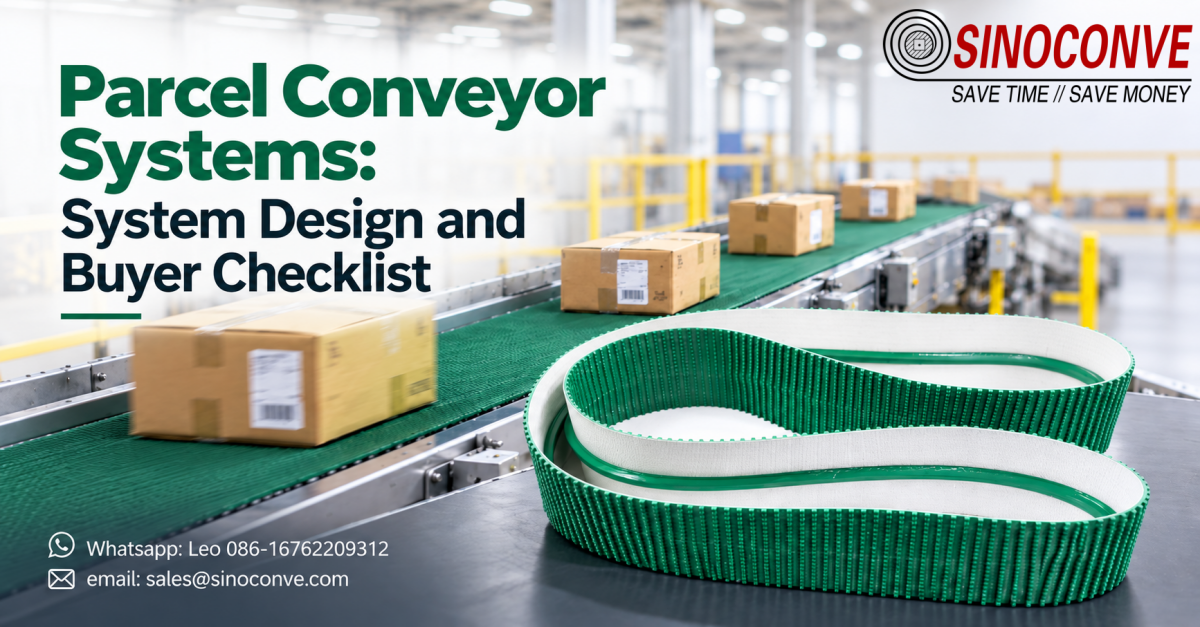
A parcel conveyor system is a chain of zones rather than one machine, and it is sized backwards from demand: pieces per hour, average piece weight, sortation port count, and the peak factor your busiest hour actually delivers. Get the zone boundaries and the interfaces right, and the equipment list falls into place on its own.
Our engineering team in Ningbo builds the belting, rollers and drive elements that end up inside these lines, and we are pulled into parcel and distribution projects at the point where the integrator's drawing meets the procurement list. The pattern repeats. A hub is planned around a headline figure such as 8,000 parcels per hour, then re-planned twice during commissioning because the induction buffer was a few meters too short, the sorter ports could not clear at the rate the spreadsheet assumed, or an incline transfer was asked to lift cartons its geometry never really allowed. Every one of those is a system decision. None of them is fixed by buying a different belt.
What follows stays at the system level: the boundary from trailer to trailer, the way equipment families combine zone by zone, a capacity calculation you can reproduce with your own numbers, and the environment constraints, control interfaces, procurement list and design errors that decide whether the line hits its target.

01Drawing the System Boundary from Trailer to Trailer
The boundary of a parcel conveyor system runs from the moment a trailer door opens to the moment the last outbound parcel sits inside a departing trailer. Drawing it anywhere else creates gaps that nobody owns, and those gaps are where throughput quietly disappears. The most common mistake is to draw the boundary at the sorter, because the sorter is the most expensive single machine in the building and therefore collects all of the attention.
The Handoffs That Decide Real Throughput
A line only runs as fast as its weakest handoff. Between the dock and the sorter there are at least four of them: trailer to unload conveyor, unload conveyor to induction, induction to the singulation or metering section, and meter to sorter infeed. Downstream there are two more, from sorter to chute and from chute to the outbound build station. If any one of these is undersized by even a small margin, the shortfall refuses to stay local. It travels upstream as jams and downstream as gaps, and the sorter idles at 60 percent of its rated rate while everybody blames the sorter.
What Belongs Inside the Boundary
Inside, we count every powered and gravity element that moves a parcel between those two trailers, together with the controls, sensors and accumulation zones that let the line absorb daily variation. Outside, we place trailer loading practice, yard scheduling and the storage plan, all of which change performance but are managed by other teams.
Being explicit about that line matters at contract stage, because it decides who pays when the unload conveyor and the induction lane were specified by two vendors against two different rate assumptions. We have watched a project stall for eleven days over exactly that question, with two trucks waiting and neither supplier obliged to run the numbers again.
02Zone by Zone: What Each Section Actually Has to Do
Every parcel line, however large, decomposes into a small number of functional zones. The names differ between integrators, but the physics does not. Naming the zones precisely is what allows two vendors to quote against the same duty without inventing their own assumptions about where the parcel is singulated, where it is metered, and where it is allowed to queue.
Receiving and Induction Zones
Receiving is where the line stops being a bulk operation and starts being a single-file one. The job of this zone is to convert a loose, irregular stream of parcels into a controlled sequence with predictable gaps. Telescopic or extendable conveyors carry freight out of the trailer, elevator or spiral sections raise it to the sortation deck, and a merge combiner folds two or three inbound lanes into one metering lane without letting parcels touch. Induction is the most lightly engineered zone on most drawings and the one that most often limits the whole system.
Sortation and Its Downstream Side
Sortation is the zone everyone designs first and the one least likely to be the real bottleneck. Whether the mechanism is a cross-belt, a tilt-tray, a pop-up wheel diverter or a sliding shoe, its rated capacity is a clean number quoted under ideal singulation and ideal spacing. In service it receives neither. The zone immediately after sortation is where most functional problems surface, because that is where gravity takes over and where a chute that is two degrees too shallow turns into a daily jam.
Merge, Divert and Dispatch
Merge, divert and dispatch exist to recombine and re-separate the stream before it leaves the building. Their duty is intermittent and uneven, which makes them easy to under-size on paper. An outbound build station that must handle a full trailer build every eighteen minutes has to receive parcels in a burst, and the conveyor feeding it has to hold a buffer, not just transport. A well-designed system treats dispatch as a demand spike, not as a steady flow.
03The Equipment Combination Matrix
Choosing equipment is not a matter of picking the best family. It is a matter of picking the family whose failure mode you can tolerate at a given zone, and then specifying the interface to the neighbouring zone so tightly that the two agree on product pitch, elevation and speed. The matrix below is the one we use when a project arrives as a process drawing with no equipment list attached.
| Zone | Equipment families that fit the duty | Interface it must agree with the next zone | What fails first when the interface is loose |
|---|---|---|---|
| Trailer receiving | Telescopic belt loader, extendable roller bed, or a rigid belt running to a fixed dock edge. | Discharge elevation and takeaway speed, so parcels leaving the loader are not dropped onto a faster belt. | Parcels pile up at the trailer mouth whenever the fixed belt runs faster than the loader can feed it. |
| Induction and metering | Flat belt with a metering gate, merge combiner, or a singulator feeding a single metering lane. | Declared parcel pitch and a rate the sorter infeed can accept without recirculating. | Double feeds and side-by-side parcels, which the sorter then reads as one item or rejects entirely. |
| Primary sortation | Cross-belt, tilt-tray, pop-up wheel diverter or sliding shoe, chosen by rate and product mix. | Infeed and outfeed elevation, chute entry angle, and a chute count matched to the port rate. | Recirculation climbs because assigned chutes are full and no exception path was provided. |
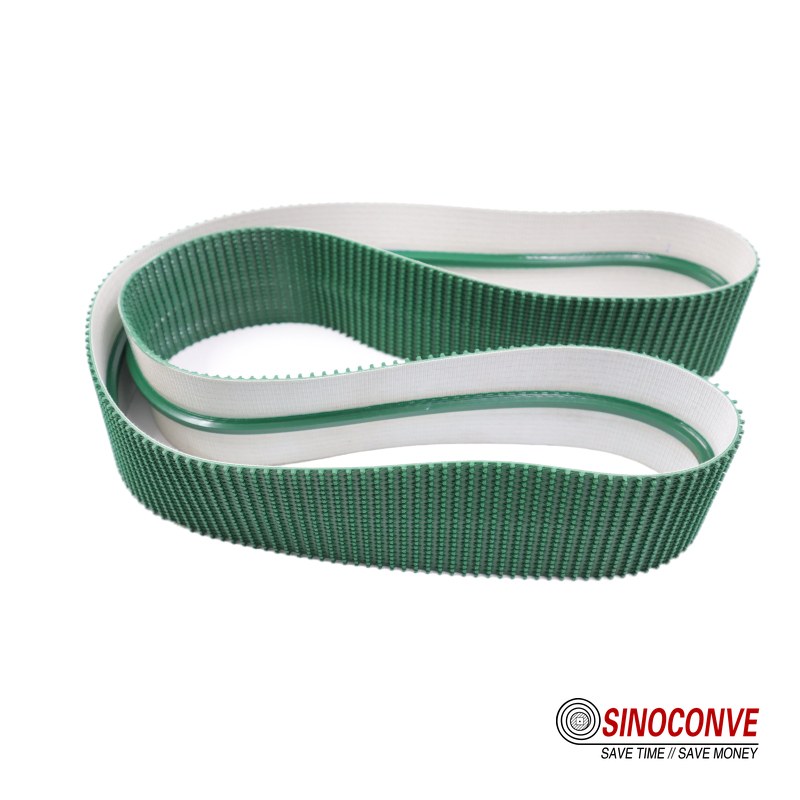
| Incline transfer | Cleated or patterned belt, sidewall belt, or a spiral elevator where footprint is tight. | Entry and exit speed matched to the horizontal sections, with no acceleration step at the change. | Cartons slide or rotate on the slope and arrive jammed sideways at the top transition. |
| Curves and corners | Powered curve roller module, tapered roller curve, or a belt curve unit on tight layouts. | Inner and outer speed difference, and a transfer gap the smallest parcel cannot fall through. | Parcels ride the outer rail, spin, and re-enter the straight section out of alignment. |
| Chutes and gravity lines | Powered or gravity chute, spiral chute, or a roller accumulation lane into the build station. | Slide angle consistent with the lightest and the heaviest parcel, and a clear discharge mouth. | Light poly mailers stall on a shallow chute while heavy cartons overshoot and block the mouth. |
| Accumulation buffer | Zero-pressure roller accumulation, minimum-pressure zones, or belt accumulation on short lines. | Release rate and zone length, so the buffer discharges at the rate the next zone can absorb. | A buffer that discharges faster than the downstream zone can take, which pushes the jam one zone along. |
| Outbound dispatch | Telescopic loader, extendable roller bed, or a powered belt into the trailer nose. | Burst intake rate and a staging buffer sized to one trailer build cycle, not to a steady average. | The build station starves during the second half of each trailer, and the loader sits half empty. |
Read across any row and the pattern is clear: the equipment family is the easy half of the decision, and the interface is the half that gets left to the installation crew. That habit works until the first busy Monday, when an interface nobody owned turns into an hourly stoppage.
04Matching Hardware to Each Zone Without Over-Specifying
Once the families are chosen, the second-level decisions are about hardware that touches the parcel and hardware that touches the belt. Both matter, and both are usually decided far too late in a project to be changed cheaply. This is the level at which a parcel line is either smooth for ten years or noisy for two.
Transitions Between Belt and Roller Sections
The join between a belt section and a roller section is where small parcels get lost and thin items get caught. Any transfer gap wider than roughly one third of the shortest parcel dimension becomes a trap, and any height step above about 3 mm becomes a catching edge for a soft mailer. Where a belt hands over to rollers, a driven transition roller or a short nose bar closes the gap far more reliably than simply bolting two frames together. On curve modules, the same logic applies to the inner corner, and a proper conveyor roller selection at the transition is what keeps a 150 mm parcel from dropping through.
Roller Spacing and Small-Parcel Handling
Roller pitch sets the smallest parcel the line can move without it tilting, sagging or falling through, and it is normally fixed by the largest item in the mix rather than the smallest. The people who suffer are the returns and the document envelopes, which arrive in every real parcel operation. A spacing above about 60 mm on a carry deck is already marginal for a small flat mailer, and spacing above 90 mm will simply swallow it. If the product mix genuinely spans 20 mm to 900 mm, the honest answer is a dedicated small-parcel lane rather than one deck trying to serve both ends. Readers sizing the support side will find the load and diameter logic in our guide to conveyor roller types, materials and load ratings, and the matching range sits on the same roller product page.
Where parcels are dropped rather than placed, the loading point deserves impact rollers or a short impact bed so the blow is absorbed by hardware instead of by the belt. Our notes on impact rollers for loading zones cover the spacing and the spring rates that make that work, and in dusty halls the bearing protection detail is set out in our article on sealed conveyor rollers for fine dust.
05Capacity Check: From Pieces per Hour to Belt Width and Speed
Capacity is not a single number, and treating it as one is the root of most commissioning surprises. A parcel line has to satisfy three separate capacity conditions at once: the rate condition, the mass condition and the geometry condition. A configuration that passes one and fails another will look fine in the tender document and fail on the second shift.
The Four Inputs You Need Before Any Calculation
Four inputs drive everything else: the nominal parcels per hour, the peak factor, the average parcel footprint along the direction of travel, and the average piece weight. Add the heaviest single item in the mix and the number of destination groups, and the outline design is essentially determined. Note the order. Rate and weight come first; belt width and belt speed are outputs, not inputs. When a supplier asks you for belt width before establishing the rate, the conversation has already gone backwards.
Working the Numbers for a Nominal 8,000 Parcels per Hour
Take a hub with a nominal design rate of 8,000 parcels per hour and a peak factor of 1.15 measured over its busiest fifteen minutes. The design rate for the conveyor spine is therefore 8,000 times 1.15, or 9,200 parcels per hour. Assume an average parcel length of 380 mm along the direction of travel and allow a 120 mm gap for reliable singulation, which gives a target pitch of 0.50 m. Required line speed is then 9,200 parcels per hour multiplied by 0.50 m and divided by 3,600 seconds, which equals 1.28 m per second, so we would round up to 1.4 m per second for margin.
| Step | Basis or formula | Value in this worked example | What to re-check before you commit |
|---|---|---|---|
| Nominal design rate | Parcels per hour the business plans around, before any peak allowance is applied. | 8,000 parcels per hour over a full operating shift. | That the number is a sustained rate, not a marketing peak achieved for ten minutes. |
| Peak rate | Nominal rate multiplied by the measured peak factor, never by a guessed one. | 8,000 x 1.15 = 9,200 parcels per hour. | The peak factor against your own scanner data, because 1.15 and 1.40 lead to very different lines. |
| Parcel pitch | Average parcel length along travel plus the smallest reliable singulation gap. | 380 mm plus 120 mm gap = 0.50 m centre to centre. | That the gap survives the merge, because a 60 mm gap will not. |
| Line speed | Peak rate multiplied by pitch, divided by 3,600 seconds, then rounded up. | 9,200 x 0.50 / 3,600 = 1.28 m/s, specified as 1.4 m/s. | That the chosen speed still suits the slowest and lightest items in the mix. |
| Belt width | Widest parcel plus tracking and guide-rail allowance on both sides. | 600 mm widest parcel plus 2 x 100 mm = 800 mm belt. | That no diagonal or overhanging item exceeds the working width in real operation. |
| Mass flow condition | Peak rate multiplied by average piece weight, checked against the heaviest item. | 9,200 x 2.4 kg = 22,080 kg/h, about 22 t/h. | That a single 30 kg item at 1.4 m/s does not exceed the local roller load rating. |
| Sortation port count | Peak rate divided by the practical per-port rate, then lifted for recirculation. | 9,200 / 1,150 = 8.0, and 12 percent recirculation takes it to 9 active ports. | That the per-port figure came from your own divert cycle time, not a catalogue ceiling. |
| Buffer length | Surge volume multiplied by pitch, divided across the available accumulation lanes. | 60 s of surge = 153 parcels = about 77 m of single-file accumulation. | That the surge is covered across three or four lanes rather than one very long one. |
The three conditions rarely agree on the same answer. A line running at 1.4 m per second through an 800 mm belt may satisfy the rate and the geometry and still overload a local roller at a loading point where 30 kg items land corner-first. That is why we check mass at the same time as rate, and why we ask for the heaviest single item as well as the average. As a conveyor belt manufacturer we would rather spend an extra hour on that check than explain a bent roller six months into operation.
Field note from our engineers: On a hub near Ningbo we measured the incoming stream for a full week before the sorter was ordered. The nominal rate was 8,000 parcels an hour, but the fifteen-minute peak hit 1.35 times that, and the afternoon shift carried almost all of it. The original layout had been sized at nominal with a 1.1 peak assumption, which quietly removed two of the nine ports the line actually needed. Adding the two ports before commissioning cost a fraction of what it would have cost to retrofit them around a live sorter.
06Peak Factor, Port Count and the Price of Recirculation
Two numbers quietly decide how much steel and how many chutes a parcel line carries, and neither of them appears on the sorter's specification sheet.The first is the peak factor, and the second is the recirculation rate that appears whenever a parcel is not sorted on its first pass.
Peak Factor Is a Local Measurement
Peak factor is the ratio between your busiest short interval and your sustained rate, and there is no honest industry default for it. A hub that serves a single large e-commerce client may run nearly flat, while a hub handling mixed business-to-business freight can spike well above its average every afternoon. The only defensible way to set the number is to measure it from your own scan data over at least a full week, ideally a full month that includes the seasonal peak. Buying a line sized on someone else's peak factor is how a building ends up with a sorter it can never fully use.
How Many Sortation Ports Do You Really Need
Port count follows directly from the peak rate and the practical cycle time of the divert mechanism, not from the number of destinations. A port that takes 1.4 seconds to complete a divert and reset, including the minimum gap between consecutive parcels, clears about 2,500 items an hour in theory. In practice we derate that heavily for mis-reads, full chutes, awkward items and operator intervention, and a planning figure near 1,150 per hour is realistic for a wheel diverter in mixed freight. Recirculation adds on top, because every parcel that is not routed on its first pass loads the sorter a second time. On a line with 12 percent recirculation the effective rate is not the peak rate but the peak rate multiplied by 1.12, and if that pushes you past a whole port the honest answer is to add the port.
07Buffer and Accumulation Sizing
Accumulation is the part of a parcel conveyor system that buys forgiveness. It absorbs the difference between an irregular inbound stream and a sortation process that wants parcels evenly spaced. Almost every under-performing line we inspect is short of it.
What Accumulation Is Actually For
A buffer does three jobs at once. It decouples an unload station from an induction lane so a slower trailer does not stall the line, it holds a slug of parcels so the sorter receives a continuous feed rather than a burst followed by a gap, and it gives maintenance a place to park product when a zone needs clearing. A line with no buffer has to run perfectly all shift. A line with 60 seconds of buffer can survive a jam at the induction point without the sorter ever seeing it.
A second, less obvious job is to protect the sortation ports during the outbound build cycle. When a full trailer rolls out and a new one rolls in, the build station stops taking parcels for a few minutes while the chute mouths are cleared, and without accumulation that pause backs up into the sorter and lifts the recirculation rate for the rest of the hour.
Sizing the Buffer from a Surge, Not from a Feeling
Size the buffer from the measured surge duration and its rate. If your inbound stream runs 10 percent above design for 90 seconds during a trailer change, the buffer has to hold that excess. On our worked example, a 90 second surge at 2.55 parcels per second is about 230 parcels, which at a 0.50 m pitch is roughly 115 m of single-file accumulation. Spread across four parallel lanes that becomes about 29 m per lane, which is buildable. Forcing the same volume into one lane gives a 115 m monster that no building will host, so accumulation is best designed as several shorter lanes rather than one long one. Our conveyor roller range covers the zero-pressure and minimum-pressure modules used for this, and the heavier transfer duty versions are covered in our notes on conveyor rollers and pulleys for port systems.
08Environment and Working Conditions
A parcel line does not sit in a laboratory. It sits in a building with a hot roof, a cold dock door, cardboard dust in the air and a fire code that has opinions about anything crossing a compartment wall. Each of those conditions lands on a different part of the system, and each has a design response that is far cheaper at drawing stage than at retrofit.
| Condition | Where it bites hardest | Design response we normally specify | Evidence to ask for at handover |
|---|---|---|---|
| Temperature swing | Dock doors that open all winter, and roof-level lines that bake every summer afternoon. | Components rated across the full building range, not just the design ambient at the desk. | A rated temperature band for every belt, roller bearing and sensor in the delivery. |
| Dust from cartons | Photoelectric sensors, bearing housings and the gaps around guide rails. | Sealed bearings, protected sensor optics and a cleaning schedule written into the contract. | Sealing class and cleaning access confirmed on the as-built drawing. |
| Humidity and condensation | Cold metal frames and control cabinets in a warm, humid hall. | Enclosure heating or ventilation, plus corrosion-resistant hardware near wash-down areas. | IP rating of each enclosure and the material grade of exposed fasteners. |
| Noise at operator positions | Divert mechanisms, chute entries and any transfer with a height step. | Transitions designed flat, chute liners specified for quiet running, and a target near 75 dB(A). | A sound-level reading at the build stations during a full-rate test. |
| Static in a dry hall | Fast-moving light items on polymer surfaces, and the electronics that read them. | Conductive or antistatic belt grades and proper earthing of every conveyor frame. | A surface-resistance test report plus a continuity check on each bonded frame. |
| Vibration from bad transfers | Chute brackets, sensor mounts and any joint with a visible height step. | Rigid bracketry, correct gaps and a commissioning check for loose or resonating parts. | A commissioning report that records every transfer step and its correction. |
Temperature, Dust and the Parts They Touch
Temperature and dust reach different parts of the line. A cold dock door barely affects the sorter in the middle of the building, but it changes how a light belt behaves on a loader that sits in the doorway all night. Dust behaves in the opposite way: it travels everywhere but only causes trouble where there is a small gap or an optical surface to blind. Both are cheap to design for and expensive to chase, so we set the rated range for every component in the delivery rather than for the building average.
Noise Is a Design Output, Not an Afterthought
Noise complaints in parcel buildings almost always trace back to the same three sources: a transfer with a height step, a steel chute that rings under impact, and an unlined divert mechanism firing several thousand times an hour. None of those is hard to fix, provided somebody owns the target before the line is built. A parcel line at 78 dB(A) at the build station is a maintenance grumble; the same line at 88 dB(A) becomes a compliance problem and a reason for hearing protection zones. Fixing the step and lining the chute typically recovers 6 to 8 dB(A) on their own.
09Clearance, Headroom and Building Interfaces
The building is a constraint on the conveyor, not the other way round, and the constraints that hurt are the ones nobody draws. Headroom, walkway width, structural capacity and the position of the sprinkler pipework all limit what the line can be, and all of them are far easier to respect during layout than after the steel is ordered.
Vertical Clearance and Maintenance Access
Every conveyor needs clearance above it for the tallest parcel plus a margin for a jam, and clearance beside or below it for a person to reach the drive, the bearings and the sensors. A line tucked 1.9 m under a sprinkler pipe and 200 mm from a wall may look efficient on the plan and be impossible to maintain in practice, so we ask for the true headroom under every obstruction and a maintenance access path on at least one side of each drive and divert.
Structural Loads and Floor Interfaces
A parcel line concentrates load at its support points, and those points are usually well defined before the building's floor is poured. Live loads from accumulation are the ones that surprise structural engineers, because a properly buffered lane holds far more mass per metre than a running line ever does. We hand over the loaded-worst-case weight per support, not the empty frame weight, and we mark the anchor positions on the drawing so nobody has to guess later. Where a line crosses an expansion joint or a mezzanine edge, that interface deserves its own detail rather than a standard bracket.
10Fire Safety, Egress and Personnel Protection
Fire and safety requirements reshape a parcel conveyor system more than any other constraint, because they are non-negotiable and they are checked at handover. Three of them catch out first-time projects more than the rest.
Compartment Walls and Sprinkler Clearance
Where a conveyor crosses a fire compartment wall, the penetration has to be protected, and the detail is usually a rated shutter with a closing sequence that the conveyor controls must respect. The second requirement is sprinkler clearance: heads need an unobstructed discharge path, which sets a hard ceiling on how high a belt or a chute can sit beneath them. A layout that fills that space with a gravity chute will fail inspection, and moving it afterwards means re-engineering the line. When we supply belting into a compartment-crossing line we ask early which sections are inside the rated envelope, because the answer changes the extent of belt that has to carry a flame-retardant rating and be supported by test evidence.
E-Stops, Guarding and Walkways
Emergency stops have to be reachable from every position an operator can occupy, and on a long accumulation lane that means more of them than most budgets allow for at first pass. Guarding covers exposed drives, nip points and the return side of belts, and walkways across the line are needed wherever a person has to cross during normal work. On a line handling heavy cartons, a guarded cross-over is safer than an open gap, and its cost is trivial next to an injury. The principle is constant: if a person can reach it, they must be able to stop it.
11Control Interfaces: Scan, Weigh and Sort Signals
The conveyor is the muscle of a parcel system and the controls are its nervous system, and the two only work together when the interfaces between them are specified as carefully as the steel. A scan tunnel that mis-reads a label, a weighing section that reports weight 200 mm after the parcel has already left it, and a divert command that arrives a fraction late all produce the same visible outcome: a parcel in the wrong chute and a recirculation count that climbs.
Where the Sensors Sit and Why Position Matters
Every sensor on the line answers a timing question, so its position is a design decision rather than an installation convenience. A barcode tunnel needs a clear run of flat belt on both sides so the label faces the camera at a stable speed, and it needs the parcel centred rather than against a rail. Place a photocell one metre before a divert at 1.4 m per second and the controller has only 0.7 seconds, often less than the mechanism needs to fire and reset. Read the tracking behaviour that keeps labels facing the reader in our guide to EP conveyor belt tracking, because a belt that wanders sideways is a scan problem long before it is a belt problem.
Weighing in motion adds its own tolerance question. A dynamic scale on a parcel line typically holds an accuracy band of a few tens of grams at moderate speed, and that band widens with belt speed, vibration and any gap in the support under the weighing section. If the weight is used only to route items into a heavy or light lane, a loose band is acceptable. If it is used for billing or compliance, the section has to be isolated from the surrounding frame and the speed held steady, and the scale has to be certified for the duty the building actually performs. The mistake is to buy one weighing solution for a job that needs two different accuracies.
The drive side of the interface is quieter but equally important, because the sorter, the metering belt and the accumulation lanes all have their own motors and their own starting behaviour. Where a parcel unit transfers power through a belt drive rather than a direct coupling, the profile and groove geometry follow exactly the rules a transmission belt manufacturer applies to any industrial drive, and matching that drive to the load avoids both slip and over-tensioning. Because we build those drives on the same site as our belting, a buyer sourcing the whole package from us as a V-belt manufacturer can have the conveyor belt and the transfer drive quoted together against one duty.
12Start-Stop Coordination Between Conveyor Segments
A parcel line with fifty motors is really a set of short chains, and the rules that govern how one chain hands work to the next decide whether the line runs smoothly or ripples with stop-start surges. The control philosophy matters as much as the hardware, because the same components behave very differently depending on how their zones are released.
The classic choice is between zone control, where each short segment runs only when the segment ahead has room, and line control, where longer stretches run as a unit and stop together. Zone control is gentler on the product and uses less energy, but it needs reliable accumulation sensors and it introduces a small delay at every handover. Line control is simpler and cheaper but it stops more mass at once, which puts more stress on the belt and the drive on every restart. On heavy carton lines we lean toward zone control with generous accumulation, and on short light lanes with few sensors the simpler approach is usually the right call.
Whatever philosophy is chosen, the rule that matters most is that no downstream zone is ever allowed to accept product faster than it can pass it on. Running a discharge belt faster than the zone it feeds is the most common cause of pile-ups at transfer points, and it is a controls decision rather than a hardware one.
13Procurement Checklist and Acceptance Criteria
An order for a parcel conveyor system should read as a performance specification, not as a parts list. The checklist below is the one we walk through with a buyer before the belt and roller volumes are fixed, and it is deliberately written in terms of what has to be true at handover rather than what is being bought. A line that satisfies every row here is a line that will run to its stated rate.
| Item to specify | What a complete specification contains | Acceptance judgement at handover |
|---|---|---|
| Duty definition | Nominal rate, peak factor and its source data, average and maximum piece weight, and the smallest and largest parcel dimensions. | The line holds the peak rate for the full surge duration, not for a single test minute. |
| Zone boundaries | A marked-up drawing that names where receiving ends, where induction begins, and where each handoff sits. | Every handoff on the drawing has one named owner and one stated rate. |
| Speed and width per zone | Belt width, line speed and pitch declared for each section, with the calculation shown. | Measured speed within tolerance and parcels passing at the nominated pitch during a full-rate run. |
| Sortation capacity | Port count, per-port cycle time, recirculation allowance and the size of the exception path. | Recirculation at or below the agreed figure during a peak hour, with no chute flooding. |
| Buffer volume | Accumulation length per lane, the surge it covers, and the release logic in case of a downstream stop. | A staged stop downstream is absorbed without the sorter needing to slow or pause. |
| Transfers and gaps | Every transition drawn with its gap and step dimension, and the smallest parcel that will cross it. | No gap exceeds one third of the smallest parcel dimension, and no step exceeds 3 mm. |
| Components and ratings | Roller load ratings, bearing sealing class, belt fire and static ratings, and enclosure IP ratings. | A test report behind every rating claim, filed and traceable to the delivered batch. |
| Safety and compliance | E-stop locations, guarding of drives and nip points, and the fire-compartment crossing detail. | Independent sign-off before the line is released for live product. |
| Spares and documentation | A recommended spare list for the critical path, plus as-built drawings and control documentation. | Critical spares on site and the drawings matching what was actually installed. |
A serious conveyor belt supplier will welcome a checklist of this kind, because it turns a vague enquiry into a duty that can be quoted accurately and delivered against. Where a patterned surface is needed on a slope, the range sits with our conveyor belt distributor catalogue, and the standard light and heavy bodies that cover the rest of the line are listed in our rubber conveyor belt range.
14Common Design Errors and How They Surface
Almost every avoidable failure on a parcel line traces back to one of a handful of design decisions made before the steel was ordered. They are worth listing together, because in our experience the same five or six mistakes cause the bulk of the commissioning pain on new systems.
| Design error | How it shows up in service | Root cause | Correction we would make |
|---|---|---|---|
| Insufficient accumulation | The sorter pauses whenever one build station stops, and recirculation climbs across the whole hall. | Buffer sized from an average rather than from a measured surge and its duration. | Add parallel accumulation lanes sized to the surge, not one long single-file lane. |
| Under-sized peak factor | The line hits its target on a quiet day and misses it on every busy afternoon. | A peak assumption borrowed from another site instead of measured from the site's own scan data. | Re-measure the peak, then resize ports, speed and buffer against the real number. |
| Chute angle too shallow | Light mailers stall on the slope while heavy cartons overshoot and block the chute mouth. | One chute angle chosen for an average parcel that does not exist in the real mix. | Set the angle from the lightest parcel, and add a dedicated lane for the extremes. |
| Transfer gap too wide | Small parcels drop between sections, or a soft item catches on a step and spins out of alignment. | Transitions detailed by the installation crew after the frames were already fixed. | Draw every transition with a gap and step dimension, and check it against the smallest parcel. |
| Discharge faster than the next zone | Parcels pile up at one transfer point all shift, while the rest of the line runs half empty. | Segment speeds set individually rather than released by the capacity of the zone downstream. | Slave each release rate to measured zone capacity and let the sensors meter the flow. |
| Incline asked to do too much | Cartons slide, rotate or creep back on the slope and arrive jammed at the top transition. | An incline angle chosen for footprint reasons, with no regard for the product that has to climb it. | Re-cut the incline to a workable angle, or move the rise to a spiral or sidewall section. |
| No exception path | Unreadable or unassigned parcels loop the sorter indefinitely and drag the whole rate down. | Recirculation treated as an operational detail rather than a sized part of the design. | Provide a dedicated exception chute and count its volume in the port calculation. |
Field note from our engineers: A terminal we worked with rebuilt one transfer three times before anyone measured it. The step between the metering belt and the sorter infeed was four millimetres, small enough to look flat on the drawing and large enough to flip a flat mailer end over end. Leveling that one joint and adding a transition roller removed a daily stoppage that had been blamed on the scanner for two months. The scanner was working perfectly the whole time.
None of those errors is exotic, and every one is decided in the layout rather than on the shop floor. When we review a system we start with the duty definition and the transfer list, because that is where the money is either saved or lost. Running both light parcel belting and heavy duty conveyors under one roof is why we keep an industrial conveyor belt range and a parcel-duty range under the same roof. If you are comparing volumes across a whole facility, the stock sizes that cover most lines are listed in our wholesale conveyor belts catalogue, and the people who build them sit in one conveyor belt factory in Ningbo.

15Frequently Asked Questions
What is a parcel conveyor system?
It is the complete conveyor spine that moves parcels from an inbound trailer to an outbound trailer, covering receiving, induction, sortation, merge and divert, accumulation and dispatch. It is defined by its boundaries and the handoffs between zones, not by a single machine. The sortation unit is only one part of it.
How do I calculate the belt speed for a parcel line?
Multiply the peak parcels per hour by the parcel pitch in metres, then divide by 3,600 seconds. For 9,200 parcels an hour at a 0.50 m pitch that gives 1.28 m per second, which we would specify as 1.4 m per second to leave margin. Speed is an output of the rate and the pitch, never an input chosen first.
How many sortation ports do I need?
Divide the peak rate by the practical per-port rate, then add the recirculation allowance. A realistic per-port planning figure for a wheel diverter in mixed freight is around 1,150 parcels an hour, well below the theoretical cycle-time number. Round up, and always add a dedicated exception port.
Why does my line keep recirculating parcels?
Almost always because a chute was full, a label could not be read, or no exception path was provided. Recirculation is a sizing question rather than a software one. If the recirculation rate sits above the figure the line was designed for, the port count or the chute capacity is short, not the control logic.
How much accumulation buffer should a parcel system have?
Enough to cover your measured surge. If the inbound stream runs above design for 90 seconds, the buffer has to hold that excess, which on our example is about 230 parcels or roughly 115 m of single-file accumulation. Spread that across several lanes, because one 115 m lane is rarely buildable inside a real building.
What clearance does a conveyor need in a distribution center?
Enough headroom for the tallest parcel plus a margin for a jam, and enough space beside every drive and divert for a person to work on it. Sprinkler heads need an unobstructed discharge path, which sets a firm ceiling on how high a belt or chute can sit beneath them. All of these belong on the layout drawing, not in a verbal note.
Do I need a separate lane for small parcels?
If your mix genuinely spans from 20 mm envelopes up to 900 mm cartons, yes. A roller spacing that handles the cartons will swallow the envelopes, and a spacing tight enough for the envelopes will not carry the cartons. One deck serving both ends usually means both ends suffer.
Where do most parcel conveyor design errors come from?
From the layout, not the components. Insufficient accumulation, an under-sized peak factor, a shallow chute, a wide transfer gap and a discharge rate faster than the next zone are the recurring five. Each is decided long before the steel is cut, which is why they are cheap to prevent and expensive to correct.
Can one supplier cover the whole conveyor package?
For the belting, rollers and drive elements, often yes, and buying them together keeps the duty assumptions consistent. A supplier who makes both light parcel belting and heavier industrial belting can also tell you which end of the range your duty really belongs to. What a belt and roller supplier cannot do is replace your integrator's layout work, and it should not try.
Related Products You May Need
- PVC conveyor belt for light induction and sortation decks where a thin, quiet section suits the duty.
- Conveyor rollers for the accumulation lanes and the transitions between belt and roller sections.
- Chevron and patterned belts for any incline transfer where parcels need positive grip on the climb.
- V-belts for the transfer drives on metering belts and short unit conveyors across the hall.
- Rubber conveyor belt for dock lanes and heavier fabric-carcass duty on the receiving side.
- Timing belts wherever a drive needs a fixed speed relationship instead of friction grip.
- Heat resistant conveyor belts for any lane that occasionally sees a hot or warm item.
- Full product catalogue covering light parcel belting and heavy conveyor ranges from one factory.
Related Blog Posts
- Conveyor roller ultimate guide: roller types, materials and load ratings for conveyor support sizing.
- Impact rollers for loading zones: how to protect a belt where parcels are dropped rather than placed.
- Sealed conveyor rollers for fine dust: keeping cardboard grit out of bearings in a dusty hall.
- Conveyor rollers and pulleys for port systems: heavy transfer duty and the hardware that carries it.
- EP conveyor belt tracking guide: why a belt drifts and how that becomes a scan and divert problem.
- Conveyor belt cleaning methods: schedules, tools and the cases where a scraper makes things worse.
- Return side belt cleaning: why the dirty side of a belt deposits material on every roller it touches.
- Dust resistant conveyor belt: construction details that cut the dust a belt carries back into the frame.
- Conveyor belt splicing buyer checklist: twelve points to verify before you place a joint order.
- Conveyor belt splicing guide: joint methods compared, with tips from installation crews.
- Port conveyor belt applications: heavy transfer duty and the belt choices that suit it.
- Quarry and crusher belt selection: sizing belts for the heavy end of bulk handling.