Engineered belt solutions for demanding industries worldwide

Blog

Blog

Home/Blog
Recent Posts
Timing Belt Buyer's Checklist: 12 Things to Verify Before You Order

Timing Belt Buyer's Checklist: 12 Things to Verify Before You Order

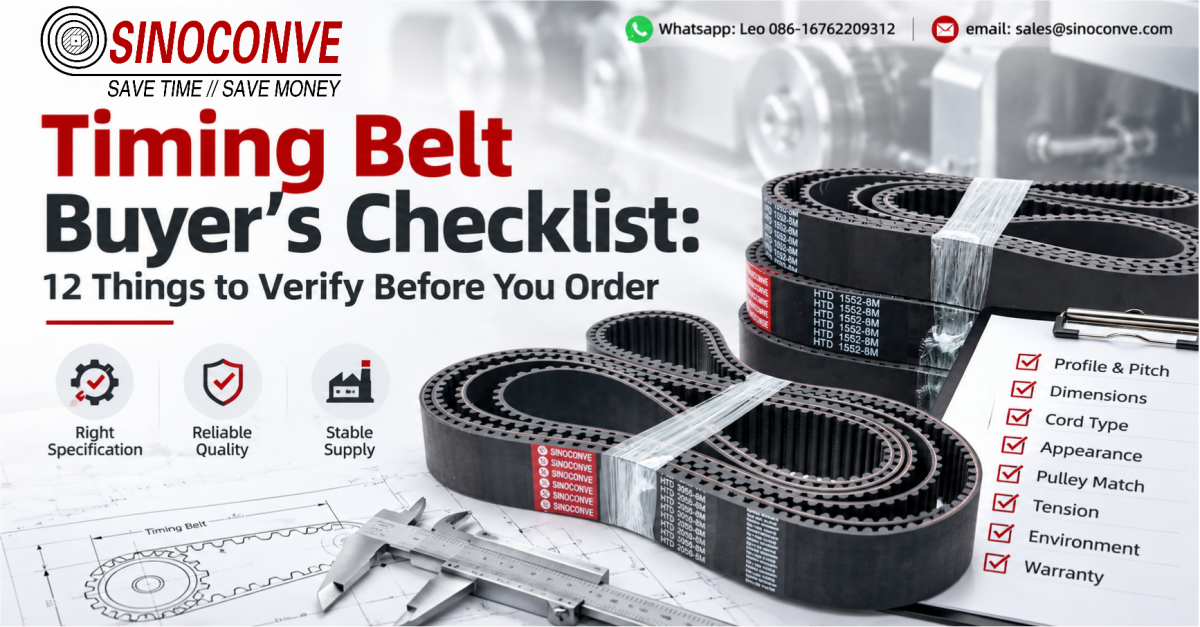
A timing belt order fails in a narrow window, between confirming the profile and fitting the belt, and each stage needs its own checks. This checklist splits twelve verifications into three groups of four. Before ordering it covers confirming the tooth profile and pitch from a sample or drawing, establishing whether pitch length or tooth count is the controlling dimension, fixing the width and the back treatment, and naming the cord type on the order with the evidence that goes with it. On arrival the checks turn into measurements: three dimensions to take, what delamination and core exposure look like, how a joined belt differs from an endless one, and the marking and ageing details worth reading before the belt goes on the shelf. Before fitting, the last four checks cover pulley and groove compatibility, minimum teeth in mesh, tension travel against centre distance, environment and the warranty conditions that a claim depends on.
V-Belt Size and Profile Chart: What the Numbers Actually Mean

V-Belt Size and Profile Chart: What the Numbers Actually Mean

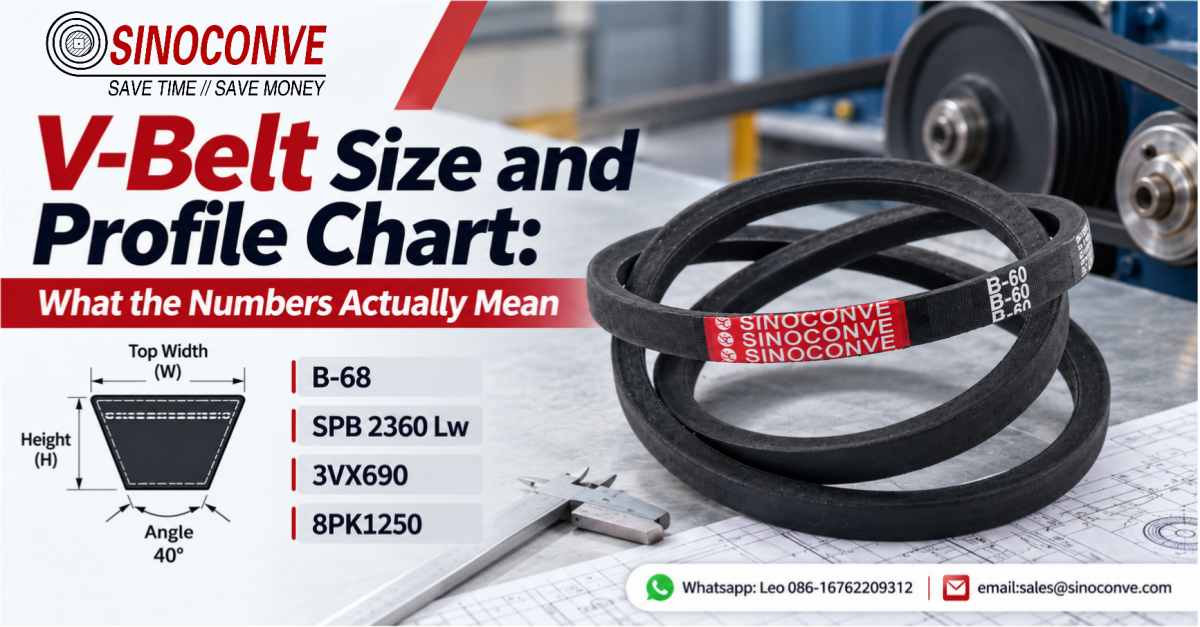
A V-belt code is a set of measurements with the units left out, and that is why ordering goes wrong. This guide takes real markings apart, SPB 2360 Lw, B-68, 3VX690 and 8PK1250, and says what each position measures and which line on the belt it refers to. The three length conventions get their own section because they cause most of the trouble: datum length Lw, inside length Li and effective length Ld are compared side by side with the offsets between them. Section dimensions come next, top width, belt height and the nominal forty degree wedge angle, including why the angle is nominal and what happens as a belt wears. Cross-reference tables map classical A to D against narrow section SPZ to SPC and the imperial 3V, 5V and 8V families, with the combinations that must never be substituted. Banded belts are covered as an ordering discipline, rib count, matched sets and what a matched set actually guarantees, and the guide closes with a twelve point ordering checklist.
PVC Conveyor Belt vs Rubber Conveyor Belt: Which One Fits Your Line

PVC Conveyor Belt vs Rubber Conveyor Belt: Which One Fits Your Line

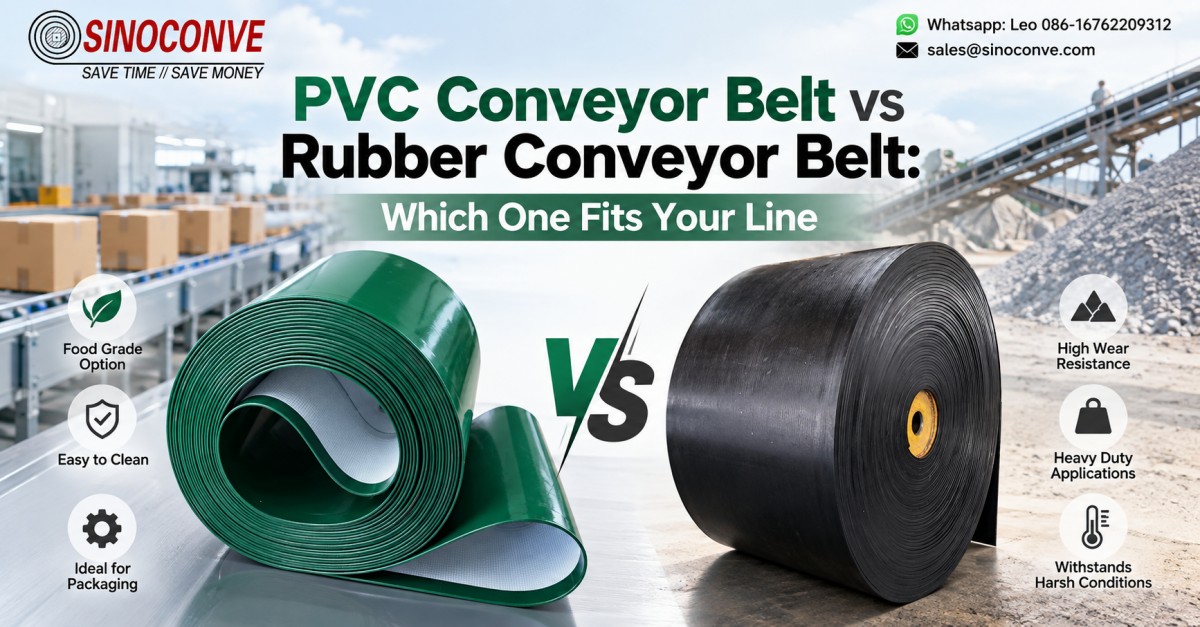
This comparison is written the way a packaging engineer buys, from the line backwards rather than from the material datasheet forwards. It opens with the constraints that actually decide the belt on a packaging line, the small pulleys, knife edge transfers, short centres and accumulation zones, then does the same for a food room and a parcel hub. Only after those three settings are on the table does it compare PVC and rubber against them: hygiene and cleanability, cover hardness and grip, impact and tear resistance, behaviour over small pulleys, temperature range, splice options and cost per metre against cost per year. Food contact documentation is treated as a paperwork path rather than a slogan, with the difference between food grade, washdown and anti-microbial spelled out. A decision matrix covers application, material, temperature and cleaning regime, and the closing sections list seven mis-selections and what to check on arrival.
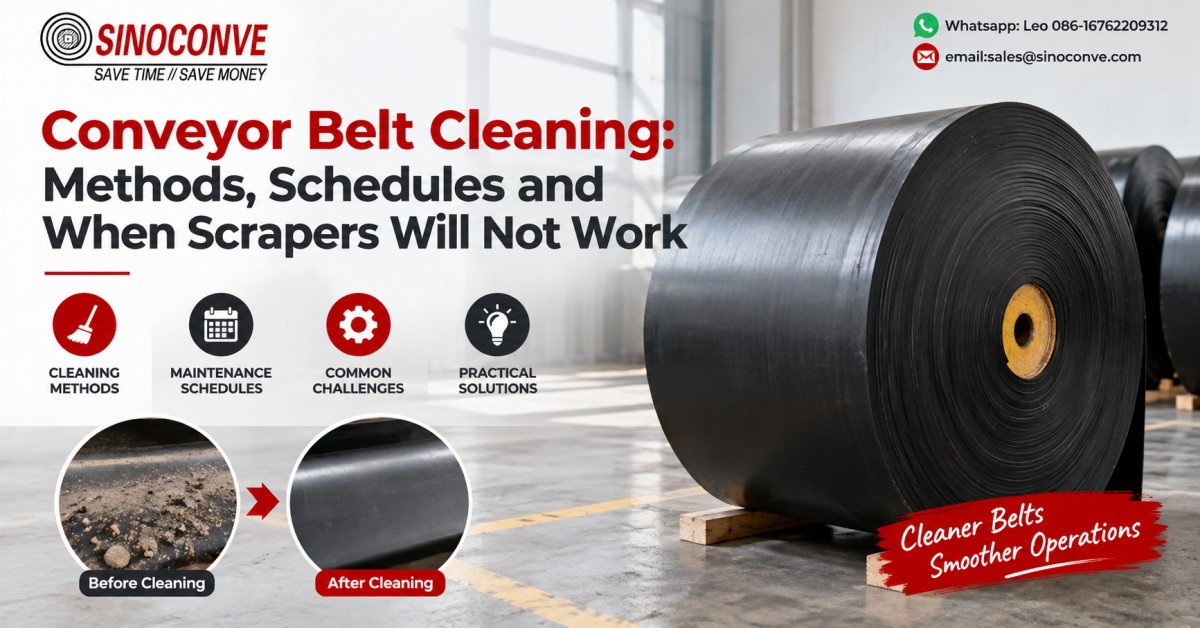
Conveyor Belt Cleaning: Methods, Schedules and When Scrapers Will Not Work

Conveyor Belt Cleaning: Methods, Schedules and When Scrapers Will Not Work

Carryback is usually treated as a housekeeping problem, which is why it keeps coming back. This guide reads it as a cost line instead: what the returned material is worth, what the extra cleaning hours and worn rollers add up to, and what the same tonnage does to belt life. It then works through the methods in the order of what they can actually remove, mechanical scrapers, rotary brushes, wash boxes, air knives, ploughs, and the return-side spiral and disc rollers that clean by geometry rather than by a blade edge. The central section covers the five cases where a scraper simply will not work, chevron and patterned belts, cleated and sidewall belts, mechanical fastener joints, high-moisture clay and belts whose cover is already worn through, and gives an alternative route for each one. Material matrices, wear inspection intervals, six failure modes, alignment and joint constraints, a cost comparison and twelve field mistakes close the guide.
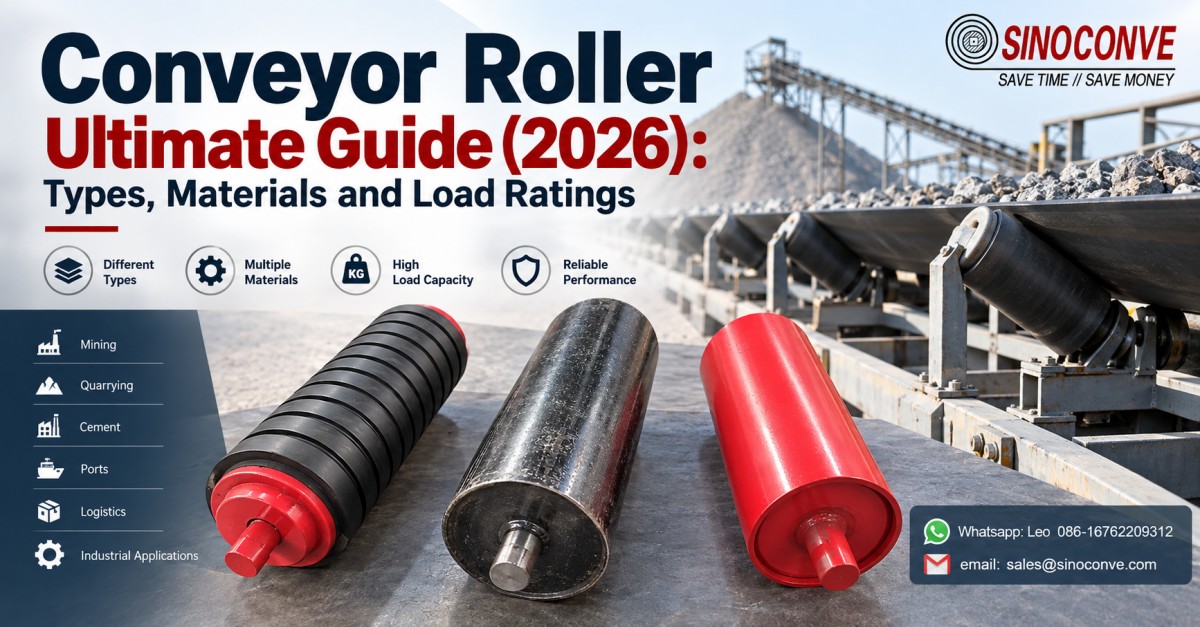
Conveyor Roller Ultimate Guide (2026): Types, Materials and Load Ratings

Conveyor Roller Ultimate Guide (2026): Types, Materials and Load Ratings

A conveyor roller looks like the simplest component on the line and carries the most expensive mistakes. This guide separates the two questions buyers mix up: where a roller sits, which decides its duty, and what it is built to do, which decides its shape. It walks through the six position-based types from carrying and return through impact and transition, then the function-based families, tracking, spiral and rubber-disc cleaning rollers, and what each one is actually for. Shell material gets its own treatment, carbon steel against stainless, polymer and ceramic, followed by the part that cheap rollers cut first: bearings, seal arrangement and grease. Load rating is worked through with the equation and a full example, because roller pitch and trough angle decide the load long before the shell diameter does. The closing sections cover shell diameter against rotational speed, bearing life, installation and alignment, and the four ways rollers fail.

Conveyor Belt Splice vs Mechanical Fastener Joint: Which One Fits Your Line

Conveyor Belt Splice vs Mechanical Fastener Joint: Which One Fits Your Line

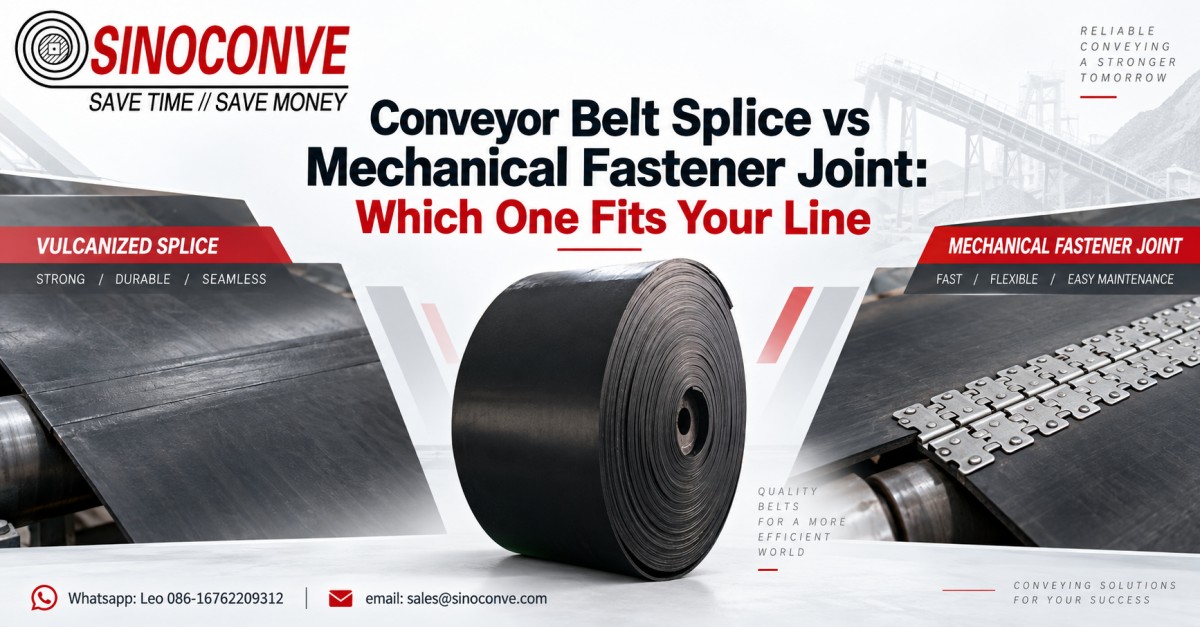
The argument between a hot vulcanized splice and a mechanical fastener joint is usually settled by whoever has the belt stopped in front of them, and that is the wrong way round. This comparison puts the two methods side by side on the only terms that matter when you are choosing: how much of the belt's own strength the joint keeps, how long the line is down, what the joint costs over three years, and whether the site can actually cure a splice. It works through the eight-row comparison matrix, a three-year life cycle cost example on a 1,200 mm five-ply belt, and a decision tree that runs from ply count and belt width through power availability, humidity and material temperature. It also covers the cases where a fastener is the better answer rather than a compromise, and the five ways mechanical joints fail in service when they are used outside their limits.


Timing Belt Buyer's Checklist: 12 Things to Verify Before You Order

Timing Belt Buyer's Checklist: 12 Things to Verify Before You Order

A timing belt order fails in a narrow window, between confirming the profile and fitting the belt, and each stage needs its own checks. This checklist splits twelve verifications into three groups of four. Before ordering it covers confirming the tooth profile and pitch from a sample or drawing, establishing whether pitch length or tooth count is the controlling dimension, fixing the width and the back treatment, and naming the cord type on the order with the evidence that goes with it. On arrival the checks turn into measurements: three dimensions to take, what delamination and core exposure look like, how a joined belt differs from an endless one, and the marking and ageing details worth reading before the belt goes on the shelf. Before fitting, the last four checks cover pulley and groove compatibility, minimum teeth in mesh, tension travel against centre distance, environment and the warranty conditions that a claim depends on.

V-Belt Size and Profile Chart: What the Numbers Actually Mean

V-Belt Size and Profile Chart: What the Numbers Actually Mean

A V-belt code is a set of measurements with the units left out, and that is why ordering goes wrong. This guide takes real markings apart, SPB 2360 Lw, B-68, 3VX690 and 8PK1250, and says what each position measures and which line on the belt it refers to. The three length conventions get their own section because they cause most of the trouble: datum length Lw, inside length Li and effective length Ld are compared side by side with the offsets between them. Section dimensions come next, top width, belt height and the nominal forty degree wedge angle, including why the angle is nominal and what happens as a belt wears. Cross-reference tables map classical A to D against narrow section SPZ to SPC and the imperial 3V, 5V and 8V families, with the combinations that must never be substituted. Banded belts are covered as an ordering discipline, rib count, matched sets and what a matched set actually guarantees, and the guide closes with a twelve point ordering checklist.

PVC Conveyor Belt vs Rubber Conveyor Belt: Which One Fits Your Line

PVC Conveyor Belt vs Rubber Conveyor Belt: Which One Fits Your Line

This comparison is written the way a packaging engineer buys, from the line backwards rather than from the material datasheet forwards. It opens with the constraints that actually decide the belt on a packaging line, the small pulleys, knife edge transfers, short centres and accumulation zones, then does the same for a food room and a parcel hub. Only after those three settings are on the table does it compare PVC and rubber against them: hygiene and cleanability, cover hardness and grip, impact and tear resistance, behaviour over small pulleys, temperature range, splice options and cost per metre against cost per year. Food contact documentation is treated as a paperwork path rather than a slogan, with the difference between food grade, washdown and anti-microbial spelled out. A decision matrix covers application, material, temperature and cleaning regime, and the closing sections list seven mis-selections and what to check on arrival.

Conveyor Belt Cleaning: Methods, Schedules and When Scrapers Will Not Work

Conveyor Belt Cleaning: Methods, Schedules and When Scrapers Will Not Work

Carryback is usually treated as a housekeeping problem, which is why it keeps coming back. This guide reads it as a cost line instead: what the returned material is worth, what the extra cleaning hours and worn rollers add up to, and what the same tonnage does to belt life. It then works through the methods in the order of what they can actually remove, mechanical scrapers, rotary brushes, wash boxes, air knives, ploughs, and the return-side spiral and disc rollers that clean by geometry rather than by a blade edge. The central section covers the five cases where a scraper simply will not work, chevron and patterned belts, cleated and sidewall belts, mechanical fastener joints, high-moisture clay and belts whose cover is already worn through, and gives an alternative route for each one. Material matrices, wear inspection intervals, six failure modes, alignment and joint constraints, a cost comparison and twelve field mistakes close the guide.

Conveyor Roller Ultimate Guide (2026): Types, Materials and Load Ratings
SINOCONVE
Sep 21, 2026

Conveyor Roller Ultimate Guide (2026): Types, Materials and Load Ratings

A conveyor roller looks like the simplest component on the line and carries the most expensive mistakes. This guide separates the two questions buyers mix up: where a roller sits, which decides its duty, and what it is built to do, which decides its shape. It walks through the six position-based types from carrying and return through impact and transition, then the function-based families, tracking, spiral and rubber-disc cleaning rollers, and what each one is actually for. Shell material gets its own treatment, carbon steel against stainless, polymer and ceramic, followed by the part that cheap rollers cut first: bearings, seal arrangement and grease. Load rating is worked through with the equation and a full example, because roller pitch and trough angle decide the load long before the shell diameter does. The closing sections cover shell diameter against rotational speed, bearing life, installation and alignment, and the four ways rollers fail.

Conveyor Belt Splice vs Mechanical Fastener Joint: Which One Fits Your Line

Conveyor Belt Splice vs Mechanical Fastener Joint: Which One Fits Your Line

The argument between a hot vulcanized splice and a mechanical fastener joint is usually settled by whoever has the belt stopped in front of them, and that is the wrong way round. This comparison puts the two methods side by side on the only terms that matter when you are choosing: how much of the belt's own strength the joint keeps, how long the line is down, what the joint costs over three years, and whether the site can actually cure a splice. It works through the eight-row comparison matrix, a three-year life cycle cost example on a 1,200 mm five-ply belt, and a decision tree that runs from ply count and belt width through power availability, humidity and material temperature. It also covers the cases where a fastener is the better answer rather than a compromise, and the five ways mechanical joints fail in service when they are used outside their limits.
Explore more

We are committed to providing you with better products and services. Welcome to browse more content for details