
Two quotations for a rubber conveyor belt can land on your desk on the same morning, both at roughly the same price per meter, and one of them will still be running on a granite primary discharge four years from now while the other is cut off the structure in fourteen months. The gap is not the brand on the sidewall. The gap is four millimeters of top cover, one ply of EP fabric, thirty points of abrasion loss, and whether anybody on the buying side asked how far the take-up carriage can actually travel.
We build belting for a living. SINOCONVE has been manufacturing in Ningbo since 1988, we run eight fabric-carcass lines and two steel cord lines, and a large part of every week goes into answering the same handful of questions from quarry managers, cement plant maintenance engineers, port terminal superintendents, EPC procurement teams and distributors: what does EP200 mean, is DIN W really better than RMA Grade I, how many plies do I need for 800 t/h of crushed basalt, why did last year's belt split at the splice instead of wearing out, and what is the minimum order quantity if I only need 180 meters.
This page collects our answers in one place. It is the pillar for everything we publish on rubber and EP fabric belting, so it is long on purpose. Read it end to end if you are specifying a new conveyor, or jump to the table you need if you are already halfway through a tender.

01What a Rubber Conveyor Belt Is, and Where It Actually Runs
A rubber conveyor belt is a moving load-bearing surface built from three functional layers: a tension-carrying carcass, a top cover that takes the abrasion and the impact, and a bottom cover that rides the return idlers. Everything else on the belt, the edge rubber, the breaker fabric, the splice, exists to protect those three. Get the carcass wrong and the belt stretches until the take-up bottoms out. Get the cover wrong and the belt wears through in a single season. Get both right and the belt usually dies of something else entirely — a seized idler, a misaligned chute, or a splice that was never going to hold.
When buyers say they need “a rubber belt”, what they usually mean is a heavy-duty fabric-carcass belt, almost always EP, running on a troughing idler set at a bulk handling site. That is the center of gravity for this guide, but the family is wider than that, and picking the wrong family is a more expensive mistake than picking the wrong grade inside the right family.
The five families you will be quoted
EP fabric belts — polyester warp, polyamide weft. The default for 80% of bulk conveying duty: stone crushers, aggregate plants, cement, ports, fertilizer, biomass, recycling. Belt strength classes commonly run from EP100 up to EP500 per ply, with two to six plies.
NN fabric belts — nylon warp, nylon weft. Higher elongation, higher resistance to impact and fatigue. Common in mobile crushing spreads, short conveyors with violent loading, and drives where shock loading is routine.
Steel cord belts — a single layer of brass-plated steel cables instead of plies. Used for long overland lines, high tonnage and center distances where fabric elongation becomes unmanageable. Strength classes typically ST630 to ST5400 N/mm and beyond.
Specialty rubber belts — chevron and cleated profiles for inclines, corrugated sidewall belts for steep or space-constrained transfer, heat, oil, cold, acid and flame-resistant compounds, and endless belts vulcanized to a fixed length for feeders and sorters.
PVC and PU light belts — not rubber at all, but they compete for the same budget line. We cover the boundary in section 08, and we compare them properly in our article on rubber conveyor belt vs PVC conveyor belt.
Where they run, and what actually kills them there
Mining and quarrying. Primary and secondary crusher discharge, conveyors with large lump sizes, high impact at the loading point, water and fines. The dominant failure mode is top cover wear and impact damage at the chute, not carcass failure. Typical belt speeds 2.0–5.0 m/s. As a general rule a rubber conveyor belt on unsized rock wants a belt width of at least three times the largest lump, and twice the largest lump where the material is screened first. Confirm that against your actual size distribution before ordering.
Cement. Limestone, clinker, gypsum, additives. The killer here is temperature at the clinker discharge and fine abrasive dust everywhere. Heat grades matter more than pure abrasion grades on the clinker line; on raw material lines it is the other way round.
Ports and bulk terminals. High tonnage, long center distances, salt air, 24-hour operation with minimal maintenance windows. Storage and handling quality decides belt life as much as the belt itself; we have written separately about conveyor belt stock planning for that duty.
Agriculture and food. Grain, fertilizer, potatoes, sugar beet, feed. Lower speed, lower impact, but aggressive chemical exposure from fertilizer and a real need for cleanable, non-marking surfaces. Hygienic lines usually leave rubber behind and go to PVC or PU.
Recycling and waste. The worst environment for belt edges. Wire, glass, sharp plastics and tramp metal cut edges and cause longitudinal rips. Edge rubber quality and a properly set skirt system matter as much as the cover grade.
Whatever the duty, the same three numbers decide whether the belt survives: the carcass strength class, the cover grade, and the cover thickness. Sections 03 to 06 walk through each of them. If you are tendering right now and want a sanity check on a specification before it goes out, we are happy to review it — the fastest route is through our contact page, and our conveyor belt manufacturer overview lists the current construction range.
02Inside the Belt: Carcass, Covers, Edge and Breaker
Every specification argument is easier once both sides draw the same cross section. A standard multi-ply rubber conveyor belt has four zones, and each one has a job. When a belt fails early, it is almost always because one zone was designed for a different job than the one it got.
Top cover (carrying side)
The top cover takes abrasion from the material, impact at the loading point, and chemical attack from whatever is wet in the load. It sets the belt's service life in most abrasive duties. Its two design variables are compound grade and thickness, and they are independent. A premium abrasion-resistant compound applied at 4 mm will still disappear under 300 mm granite lumps; an ordinary general-purpose compound applied at 8 mm will survive the impact and then wear from the surface. You need to decide which of the two is your dominant wear mechanism before you choose.
Cover compounds are made from natural rubber and SBR blends, or EPDM and nitrile for heat and oil duty. The compound determines abrasion resistance, aging, ozone and UV resistance, and the temperature window. Thickness determines how much material you have to sacrifice before the carcass is exposed.
Carcass (the plies)
The carcass is a stack of fabric plies bonded with skim rubber. The warp threads run longitudinally and carry the tension; the weft threads keep the warp aligned, give transverse rigidity and resist tearing and fastener pull-out. Ply count multiplied by the nominal fabric strength per ply gives the belt's nominal breaking strength. Carcass design is where the belt's elongation, troughability, fastener retention and splice efficiency are all decided.
Two terms are worth remembering. Troughability means the belt can form a 30° or 35° or 45° trough without fighting the idlers; too many plies at too narrow a width gives you a belt that sits flat and spills. Load support means the belt does not sag between idlers on a wide spacing; too few plies gives you edge buckling and premature ply separation.
Bottom cover (return side)
The bottom cover is thinner than the top cover on most bulk belts, usually half to two thirds of the top thickness, because it only meets idler rolls and pulley lagging. It is not decorative. On return runs with poor tracking, the bottom cover wears as fast as the top. On belts that run over many return rolls in wet, gritty conditions, an undersized bottom cover exposes the carcass and lets water into the plies, which is how edge and ply separation usually start.
Edge and breaker
The edge zone is the belt's weakest structural point. A cut-edge belt has the fabric plies exposed at the sides unless the maker seals them with edge rubber. A moulded-edge belt wraps cover rubber around the plies for extra protection, at a small cost in width accuracy and price. On conveyors where the belt rubs structure, mistracks, or handles sharp material, moulded edges and a wider edge rubber strip pay for themselves many times over.
A breaker fabric is a single ply of coarse fabric placed directly under the top cover. Its job is to spread impact from a large lump over a wider area of carcass and to stop a cut in the top cover from running straight into the first ply. Below about 150 mm lump size and moderate drop height, most belts do not need one. On a primary crusher discharge with 1.5 m of drop, a breaker ply is cheap insurance.
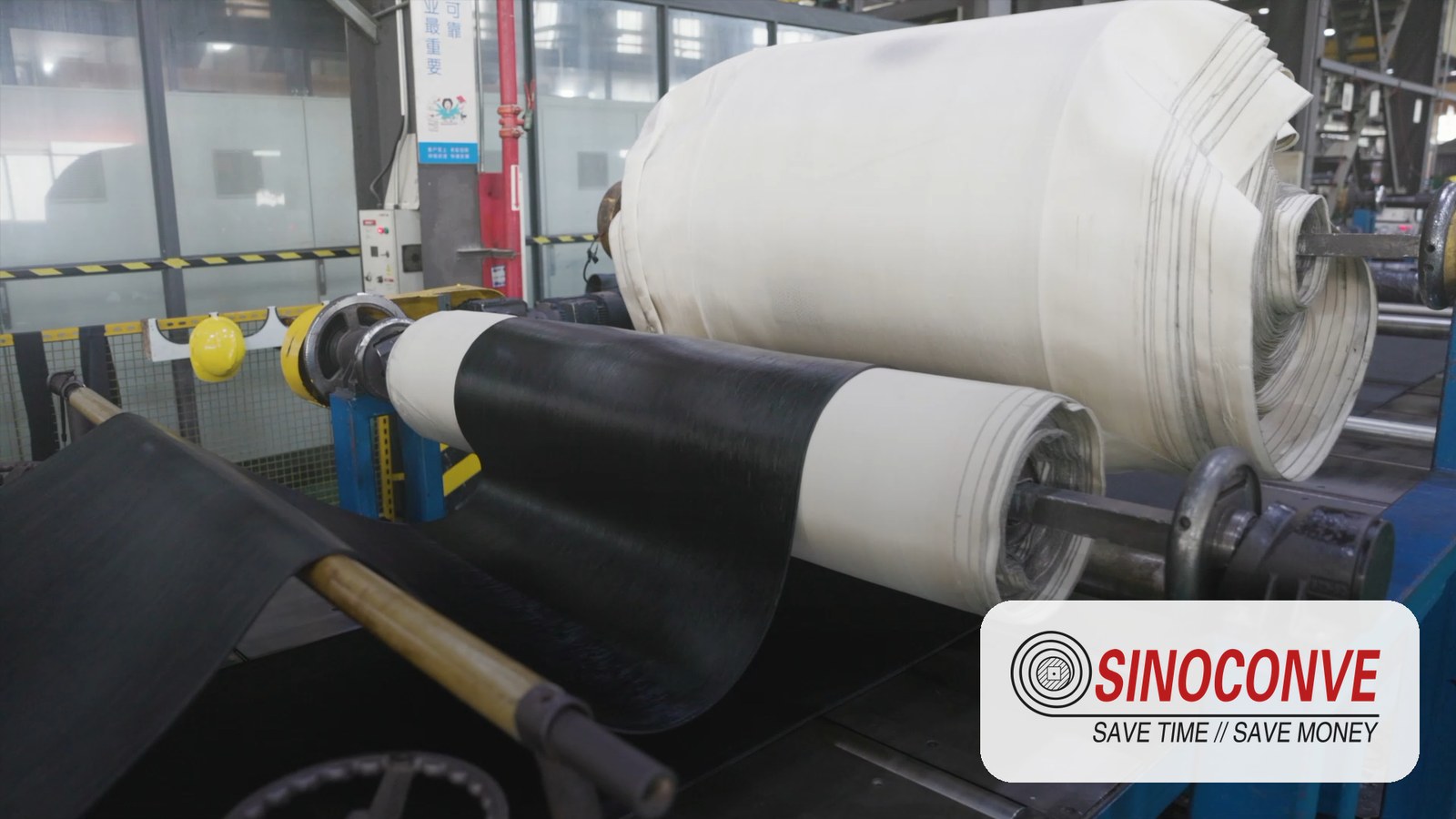
Carcass plies carry the tension; the covers only protect them. Everything else is a trade-off between cost, weight and troughability.
How the layers are actually made
The carcass fabric arrives as roll goods and is inspected on receipt, on width, weave, mass per square meter and tensile strength. The rubber compound is mixed and its cure behavior checked on a rheometer before it goes anywhere near the line. The plies are then calendered with skim compound and built up under controlled tension on a four-roll calender, because uneven tension between plies is one of the quiet causes of a belt that tracks badly from day one and never settles. After building, the belt is vulcanized under pressure, trimmed, inspected for dimensional and visual defects, and sampled for laboratory testing.
Our own incoming, in-process and finished-goods checks are described on the quality assurance page. The reason we put that much into process control is simple: cover grade and ply count are printed on the test certificate, but ply tension and skim adhesion are not, and they decide whether the belt is still running in year three.
03Carcass Types Compared: EP Fabric vs NN Fabric vs Steel Cord
This is the first decision, and it matters more than the cover grade. The carcass sets how much the belt stretches, and stretch decides three things at once: how much take-up travel the conveyor needs, how the belt behaves under the chute, and how hard the splice is going to be. Swap a carcass type on an existing conveyor and you are not doing a like-for-like replacement. We've watched a plant spend four consecutive weekends re-tensioning after exactly that swap.
What EP and NN actually stand for
EP is polyester warp, polyamide weft. First letter for the longitudinal threads, second for the cross threads. NN is nylon in both directions. Polyester barely stretches; polyamide stretches a lot and takes a beating without letting go. Combine them the way EP does and you get the compromise the belting trade settled on a long time ago — a belt that hardly moves in the direction of travel, yet still fights a rip across its width. That's the whole point of the construction.
Steel cord throws the fabric out completely. One layer of steel cables carries the tension, with transverse cords above and below to hold the belt's shape. No plies means no ply separation, and elongation at working tension is close to nil. It sounds like the perfect belt. It isn't. Bigger pulleys, stricter splice work and a rip detection plan all come with it, and we'll come back to those.
The comparison table
Everything in the table below is the range we work with when we quote, and it follows standard mill practice under DIN 22102, ISO 14890 and ISO 15236. Treat it as orientation, not as a promise about your conveyor. Your own duty calculation, and the mill's load-elongation curve for the actual fabric, both outrank anything on this page.
| Property | EP (polyester warp / nylon weft) | NN (nylon warp / nylon weft) | Steel cord |
|---|---|---|---|
| Nominal strength | 100–500 N/mm per ply; belt class 2–6 plies | 100–300 N/mm per ply; belt class 2–6 plies | ST630–ST5400+ N/mm as a single-unit rating |
| Elongation at break (warp) | Roughly 12–15% | Roughly 18–22% | Well under 1% |
| Elongation at working tension | Low; the reason EP dominates long fabric lines | Noticeably higher | Minimal |
| Permanent stretch after break-in | Small; modest take-up travel | Larger; needs generous take-up travel | Almost none; very short take-up travel |
| Impact and puncture resistance | Good | Best of the three; fabric absorbs shock | Poor at the surface; a cut can reach cables fast, so it is used with heavy covers and impact beds |
| Tear and rip propagation | Contained by the nylon weft | Very good | Longitudinal rips travel easily along the cables |
| Troughability at 35° | Good within sensible ply counts | Good | Good at high strength, but transverse stiffness must be designed in |
| Minimum pulley diameter demand | Moderate; roughly 100–125 mm per ply as a rule of thumb | Similar or slightly smaller | Largest; pulley diameter is a hard design constraint |
| Splice method | Hot or cold vulcanized stepped splice; mechanical fasteners possible as a stopgap | Same | Vulcanized only, with dedicated splice materials and tight process control |
| Relative belt mass for equal strength | Moderate | Moderate | Lowest |
| Typical sweet spot | Most bulk handling duty, center distances from a few dozen meters to well over a kilometer | Mobile crushers, short conveyors, violent loading, shock loads | Long overland lines, high tension, high tonnage, uphill transport |
| Main weakness to design around | Impact at the loading point has to be managed | Take-up travel and tracking during break-in | Cost, splice complexity, rip risk, pulley sizing |
One caveat about reading a table like that. It makes the three carcasses look evenly matched, and in the field they are not. The large majority of belts we ship are EP; NN is a small slice; steel cord turns up mainly when tonnage or center distance leaves no choice. So the useful question is not which one is best. It is which one is still running in year five on this conveyor.
How we choose in practice
On a fixed plant conveyor with a normal take-up, EP wins on nearly every count. It holds its length, it tracks predictably and it splices well. It's also the most widely stocked carcass in the world, which matters when you need 200 m this month rather than a fresh production run — the kind of order that comes off a wholesale conveyor belts stock program instead of a drawing board.
NN shows up when the loading point is brutal and the conveyor is short. Picture a mobile jaw crusher dropping 500 mm rock through a 2 m fall: fabric elongation is doing useful work there, soaking up the impact rather than passing it into the splice. That said, NN is not a free upgrade, and it is not a cure for a bad chute. We changed out an NN belt on a quarry line last year and it delaminated across a 400 mm impact zone about 11 months later, right under the loading point. The carcass was not the problem. The drop height was, and it had been that way since the plant was commissioned.
Steel cord comes out when tension is high enough that fabric would need so many plies the belt stops being practical. Past roughly ST1600-equivalent tension, on a long center distance, steel cord is usually cheaper per tonne conveyed and far lighter per meter. Here's the catch: the belt mass you save, you can easily spend twice over on pulleys, splice labor and rip detection. Skip those and steel cord fails faster, and far more expensively, than fabric ever would.
We build all three. Before we quote a carcass change we ask for one thing: the take-up data. Type of take-up, total travel available, and the measured elongation of the belt that is on the conveyor now. A conveyor belt distributor working with us gets that question in writing before we release a drawing. Which is why we are stubborn about it — a carcass swap without those numbers is how a plant ends up re-tensioning every week and blaming the belt.
If you want the fabric comparison in more depth, our dedicated piece on EP vs NN conveyor belt goes further into the numbers, and the fabric-versus-steel decision has its own write-up in fabric vs steel cord conveyor belt.
04How to Read EP Grades: EP100, EP200, EP400 and Ply Notation
Half of the specification arguments we see start the same way: somebody reads an EP designation as a belt strength when it is really a fabric strength.Get that wrong by a factor of two and you have chosen between a belt that lasts and a belt that tears out of its splice. It's worth getting exactly right.
What the number after EP means
The number is the nominal breaking strength of the fabric, in newtons per millimeter of belt width, measured per ply. The per-ply part is the one people drop. Here are the grades you will actually be quoted, and where each one usually lands:
| Fabric grade | Nominal strength per ply | Plies normally quoted | Where it usually lands |
|---|---|---|---|
| EP100 | 100 N/mm | 2–3 | Light duty, short conveyors, low tonnage; often sized by impact or stiffness rather than by tension |
| EP160 | 160 N/mm | 3–4 | The grade that quietly covers most 630-class tenders; see the 630/4 walk-through below |
| EP200 | 200 N/mm | 3–5 | The workhorse: aggregate plants, cement raw mills, general bulk conveyors |
| EP315 | 315 N/mm | 4–5 | Long center distances where a 4-ply EP200 is running out of margin |
| EP400 | 400 N/mm | 4–6 | Heavy duty, high tension, high tonnage, usually with a thicker top cover and a bigger pulley set |
Between those you will also meet EP125, EP150, EP250, EP300 and EP500. They're not arbitrary. A belt gets designed against a tension figure and then rounded to the nearest fabric grade a mill actually stocks, which is why specifying EP400 where EP315 would do is a real cost with no measurable return. We see it most often on tenders where nobody wanted to redo the calculation.
The ply suffix: EP200/4 is not the same belt as EP200/3
The suffix is the ply count, and the belt's nominal strength is fabric grade multiplied by plies — not the grade on its own. Run the arithmetic on three combinations you meet every week. EP200/3 gives 200 × 3, so 600 N/mm across the belt. EP200/4 gives 200 × 4, or 800 N/mm: a third more belt, same fabric, same cover. Then EP400/3 comes out at 400 × 3, or 1,200 N/mm, which is a different animal altogether. Which is why a quotation that says only “EP200” is not a specification. Ask for the ply count.
The second notation system you will meet: 630/4 and 400/3
DIN-style designations sometimes run the other way round: a belt strength class first, then the ply count. The numbers look familiar, and that is exactly what makes them dangerous. Here is how we read two of them that turn up in tender packages constantly.
630/4. The 630 is the nominal breaking strength class of the whole belt in N/mm, and the 4 is the ply count. To find the fabric that can deliver it, divide: 630 / 4 = 157.5 N/mm per ply. No mill stocks a 157.5 fabric, so you round up, and the nearest standard grade is EP160. Four plies at 160 gives 640 N/mm, which covers the 630 class with a little margin — and that is how the belt normally gets built. EP150 would give 600 N/mm and fall short. So when a drawing says 630/4, the belt you should receive is an EP160/4, and the test certificate should show a nominal strength at or above 630 N/mm.
400/3. Same logic on a smaller belt: 400 / 3 = 133 N/mm per ply. The neighbours on the grade ladder are EP125 (3 × 125 = 375 N/mm) and EP150 (3 × 150 = 450 N/mm). EP150/3 is the belt that comfortably clears a 400 class, and it is what we would quote unless the customer's own drawing names the fabric. If a supplier offers a 400/3 built on EP125, the arithmetic doesn't close — the belt is 6% under its own nameplate before you apply a single safety factor.
That's not to say one notation is right and the other is wrong. Both are legitimate, and both are in daily use. The point is that you should be able to rebuild the arithmetic on the back of an envelope. If a supplier can't, you have your answer.
From nominal strength to a working belt
Nominal breaking strength is not a tension you can run at. Divide it by a safety factor and you get the design tension, and the factor comes from your standard and from the splice. In DIN 22101 and ISO 5048 practice, fabric belts on long, well-maintained conveyors with vulcanized splices generally sit between 8 and 10. Steel cord usually sits lower, somewhere around 6.7 to 8, because splice efficiency and tension distribution behave differently. Short belts, reversing conveyors, hard impact at the loading point and mechanical fasteners all push the number up. Take it from your own calculation. A factor copied off a forum post is not a design input.
One number matters more than the safety factor once the belt is running, and it's the one nobody asks for: elongation at working tension. That figure tells you how much take-up travel the conveyor needs. Ask any conveyor belt supplier for the load-elongation curve at 10% of nominal strength, and treat a refusal as a technical warning rather than a commercial detail. We've seen more than one “minor” take-up problem turn out to be a belt that stretches further than the original drawing assumed.
If you are sizing for a crusher discharge, our worked selection example on the industrial conveyor belt range shows how the arithmetic lands on a real specification, using the same method we use in-house.
Minimum pulley diameter and ply count
More plies means more bending stiffness, and bending stiffness means bigger pulleys. A widely used starting point for fabric carcasses is roughly 100 to 125 mm of pulley diameter per ply, so a 4-ply belt wants something in the 400 to 500 mm range at the drive while a 3-ply belt can work on a smaller head pulley. Steel cord is a separate calculation set entirely and usually starts well above 600 mm at the drive. Go under the carcass maker's minimum diameter and the fabric is bent too tightly on every revolution: the warp fatigues, threads break from the inside, and months later you are looking at a belt that failed on a straight run for no visible reason. Pull the D/d table from the actual carcass supplier before you freeze pulley sizes. This is a design decision, not a purchasing afterthought.
Our conveyor belt factory runs eight fabric lines and two steel cord lines, so we can quote a carcass and cover combination rather than forcing you into a catalogue page. If your duty needs a drive component as well, we build that too: as a transmission belt manufacturer we supply wrapped and cogged V-belts, banded sets and timing belts to many of the same plants that buy our belting.
05Cover Rubber Grades: DIN 22102 W/X/Y/Z and RMA Grade I/II
The carcass carries the load; the cover takes the punishment. Cover grade is the single most argued-about line in most belt tenders, and it is also the line most often copied from a previous project without anyone checking whether the duty is the same. Two buyers can both be running crushed stone, and one of them needs a premium abrasion compound while the other is destroying general-purpose covers because the rock is wet and sharp. The grade you need depends on which mechanism is actually eating the belt.
Two grading systems dominate international procurement: DIN 22102 with its letter grades W, X, Y and Z, and the RMA system with Grade I and Grade II. Suppliers in Europe, the Middle East, Africa and much of Asia quote the DIN letters. North American buyers usually quote RMA. Australian projects frequently reference AS 1332 with its M and N grades. They are not formally interchangeable, but they correlate, and the correlation is what you need in a tender evaluation.
The DIN 22102 cover grades
Here is how we read the four letter grades as they are commonly specified. The numeric values are the nominal published figures associated with each grade; they are properties of the compound, not of any particular shipment, and the mill's actual test report is what governs acceptance.
| DIN grade | Tensile strength (min) | Elongation at break (min) | Max abrasion loss | Where it earns its money |
|---|---|---|---|---|
| W — abrasion resistant | about 18 MPa | about 400% | about 90 mm³ | Crushed granite and basalt, sinter, coke, sharp wet aggregate, primary and secondary crusher discharge. The most expensive cover per kilogram and usually the cheapest per tonne conveyed. |
| X — general purpose | about 15 MPa | about 350% | about 150 mm³ | Fines, sand, gravel, grain, cement raw materials, bagged goods, most in-plant conveying where abrasion is moderate and the drop heights are controlled. |
| Y — heat resistant, abrasion capable | about 20 MPa | about 400% | about 150 mm³ | Cement clinker after the cooler, hot sinter, foundry sand, asphalt plant feed, fertilizer after drying. Handles elevated material temperature while still resisting abrasion, which grade Z does not do as well. |
| Z — heat resistant | about 18 MPa | about 400% | about 250 mm³ | The hottest duties: clinker right at the kiln discharge, coke, hot briquettes, materials where the compound has to survive continuous elevated temperature and abrasion resistance is secondary. |
Notice what happened to abrasion resistance as we moved from W to Z. It got worse. Heat resistance and abrasion resistance pull in opposite directions in a rubber compound, because the plasticizers and the polymer system that survive high temperature are not the same ones that give the toughest surface at ambient. That is why a plant that specifies grade Z everywhere because “Z is the last letter” ends up replacing belts twice as often as the plant next door that specified W on the cold lines and Z only where the clinker actually is.
The RMA grades, and how they line up with DIN
RMA Grade I and Grade II are abrasion classifications. Grade I is the premium abrasion-resistant cover and Grade II is the standard general-purpose cover. Both are specified with a minimum tensile strength and elongation, and they differ in the maximum abrasion loss permitted under the rotating-drum test. RMA Grade I is the tighter number by a factor of two against Grade II, which is why it costs more.
| Duty you are specifying for | DIN 22102 | RMA | AS 1332 | What to ask for as evidence |
|---|---|---|---|---|
| Premium abrasion resistance | W | Grade I | M | Abrasion loss figure with the test method and the lab named; usually ISO 4649 or ASTM D5963. |
| General purpose | X | Grade II | N | Same, plus minimum tensile and elongation figures. |
| Heat plus abrasion | Y | No direct equivalent; specify a heat grade with an abrasion figure attached | No direct equivalent | Compound formulation, continuous and peak temperature rating, aging data after heat exposure. |
| High temperature | Z | No direct equivalent | No direct equivalent | Same, plus a temperature survey at the loading point, not just an average. |
One warning that saves money: do not treat W equals Grade I and X equals Grade II as a legal equivalence. The test methods differ, the specimen geometry differs and the abrasion indices are not on the same scale. Treat the table as a translation guide for evaluating offers, and make the actual acceptance criterion the test report from the mill, quoting the method.
The four cover dimensions you actually need to specify
Abrasion. Specified either by DIN letter, RMA grade or a direct maximum abrasion loss figure. Ask which method, because ISO 4649 and ASTM D5963 give different numbers for the same compound. If the tender says only “abrasion resistant”, you have not specified anything.
Heat. There is no single universal heat grade. What you need to give the mill is the material temperature at the loading point, the maximum lump temperature on the hottest day of the year, and whether the belt sees that temperature continuously or in pulses. A belt rated for 90 °C continuous can usually take short excursions higher than that, but the number of excursions and their duration are what decide whether the cover hardens and crazes in eight months or in three years. This is exactly the kind of detail that separates a good heat-resistant belt from a cheap one, and we wrote a separate buyer's checklist for heat resistant conveyor belt selection if that is your main constraint.
Oil and chemical resistance. Nitrile-based compounds are the standard answer for oils, greases and many hydrocarbons. The evidence is a volume swell figure after immersion under a named standard, plus the immersion medium, the temperature and the duration. For acids, alkalis and fertilizer salts, the requirement is usually expressed as a resistance class rather than a number, and the honest answer from a mill is a set of test results plus a field reference on similar exposure. Our oil resistant conveyor belt range is built around nitrile compounds; for aggressive salts and acids there is a separate acid and alkali resistant line.
Flame resistance. Specified by standard: ISO 340 for flame propagation, ISO 284 for electrical surface resistance where anti-static behavior is required, and national schemes such as AS 4606 in Australia, EN 12882 classes in Europe and MSHA acceptance in the United States. Underground coal, grain handling, biomass storage and any enclosed space with a dust explosion risk bring their own fire rules that override your cover grade preference. Never assume a standard rubber belt is acceptable in a fire-risk zone because it is thick.
Any conveyor handling flammable dust or in an underground application should also carry proper anti-static properties; the topic is big enough that we keep a separate note on flame resistant conveyor belt standards and test evidence.
06Cover Thickness, Belt Width and Edge Rubber
Once the grade is chosen, thickness decides how long it lasts. This is the cheapest upgrade available on a rubber conveyor belt and the most commonly skipped, because it is buried one line down in the quotation and it is the easiest place for a low bid to hide. Doubling the top cover thickness does not double the belt price, but it can double the interval between cover replacements.
How we bracket top and bottom cover thickness
Cover thickness is driven by lump size, drop height and throughput. Stepping up a size is usually cheaper than stepping down a belt's service interval. The bands below are the starting points we use in quotation; impact bed design, chute geometry and the actual drop height move them up or down, and the final figure belongs on your drawing.
| Max lump size | Typical top cover | Typical bottom cover | Typical duty |
|---|---|---|---|
| up to about 50 mm | 3–4 mm | 1.5–2 mm | Cement raw meal, grain, fertilizer granules, fine sand, bagged product lines. |
| 50–100 mm | 4–5 mm | 2 mm | Aggregate transfer, screened stone, coal, general plant conveying. |
| 100–200 mm | 6 mm | 2–3 mm | Secondary crusher feed and discharge, run-of-mine coal, recycled demolition material. |
| 200–400 mm | 8 mm | 3 mm | Primary crusher discharge on granite, basalt, hard limestone; high drop heights. |
| over 400 mm | 10 mm and up | 3–4 mm | Run-of-mine ore, boulders, very high impact loading points; pair with impact idlers or an impact bed. |
Two clarifications on that table. First, the bottom cover is not simply “smaller than the top”. On a reversing conveyor or a line with many return idlers in gritty conditions, the bottom cover wears at the top cover's rate, and we have seen belts where the first failure was on the return side. Second, thickness and grade are separate levers. Grade W at 6 mm outperforms grade X at 8 mm on sharp dry granite, but grade X at 8 mm outperforms grade W at 4 mm on large lumps, because the failure mechanism is impact rather than sliding abrasion. Diagnosis first, then specification.
Belt width
Standard rubber conveyor belt widths run from roughly 400 mm to 2,200 mm, with 500, 650, 800, 1,000, 1,200, 1,400, 1,600 and 1,800 mm covering the great majority of bulk handling duty. Width is set by throughput, lump size and troughability together.
The lump size rule is the one to check first, because it is a hard constraint rather than a preference. For unsized material, belt width should be at least three times the largest lump. For screened material it can come down to about twice. A 900 mm lump on a 1,200 mm belt will not convey reliably no matter how strong the carcass is; it will roll, jam the skirt, and eventually tear through the edge. If you cannot change the width, the answer is a grizzly or a rock box at the loading point, not a heavier belt.
Throughput then sets the width and speed combination. Wider and slower is generally kinder to the belt than narrower and faster for the same tonnes per hour, because impact energy scales with the square of speed, and a faster belt wears the skirt rubber and the loading zone harder. Belt speed for bulk duty typically sits between 1.0 m/s and 5.0 m/s, with fine free-flowing materials on the fast end and large lumpy material on the slow end. Where a plant can accept a wider structure, it usually gets a longer belt life for the same capital outlay.
Edge rubber: the cheapest insurance on the belt
Edge rubber is the strip of compound that seals the sides of the carcass. On a cut-edge belt the plies are exposed at the sides unless they are sealed, and an exposed ply edge wicks water into the carcass. Once moisture is inside, ply separation follows, usually starting at the edge and running inward. On a moulded-edge belt the cover rubber is wrapped around the plies, which protects the edge against rubbing and light impact but slightly reduces the usable width for the same nominal size.
Nominal edge width typically scales with belt width, running from around 20 mm on a narrow belt up to 40–50 mm on a wide one. What matters in the field is that the edge rubber is genuinely present, correctly cured and not thin enough to disappear after a few months of mistracking. If the conveyor structure lets the belt rub, the edge is where you will see it first. Fixing the structure is the right answer; a wider edge strip buys you time but not indefinitely.
Where a belt conveys very sharp material, such as recycled glass, scrap, or demolition debris, we usually recommend both a moulded edge and a premium abrasion compound on the edge strip, because the edge sees sliding contact as well as impact. For inclined and steep-angle duty the profile changes the calculus entirely, which is why chevron and cleated belts are specified separately; our sidewall conveyor belt range and the standard chevron range are built to different edge and base-belt rules than a flat belt.
Compounding and edge building are the same discipline whether the product runs flat or on a drive. As a V-belt manufacturer we apply the same incoming-material checks and the same cure control to wrapped, cogged and banded drive belts that we apply to belt covers, because a plant that buys both from one source does not want two different quality standards in the same store room.
07Application Selection Matrix: What to Choose Where
Most of the belts we ship go into a handful of recognisable duties. If you know which one you are in, you can skip most of the theory and go straight to the row. The matrix below reflects what we quote for each duty after asking about lump size, temperature, moisture and tonnage. Treat it as a starting specification to argue with, not a substitute for a duty calculation.
| Duty | Carcass | Strength class | Cover | Covers top / bottom | Notes |
|---|---|---|---|---|---|
| Hard rock quarry, primary and secondary crush | EP, or NN on short mobile units | EP200/4 to EP400/4 | W | 8 / 3 mm | Breaker ply under the top cover; impact idlers or an impact bed at the loading point; moulded edges. |
| Sand, gravel and screened aggregate | EP | EP160/3 to EP250/4 | W or X | 5–6 / 2 mm | Grade W pays back quickly on wet, sharp sand and gravel. Watch the wash plant water on the return side. |
| Cement, limestone and raw feed | EP | EP160/4 to EP315/4 | X or W | 6 / 2 mm | Most cement plant wear is abrasion from limestone dust, so premium abrasion grades are worth considering on the busy lines. |
| Cement clinker and hot product | EP | EP250/4 to EP400/5 | Y, and Z near the kiln | 6–8 / 2–3 mm | Take a temperature survey at the loading point before you choose. Grade Y survives abrasion that grade Z gives up on; grade Z survives heat that grade Y cannot. |
| Coal handling and power plants | EP | EP200/4 to EP400/5 | W plus flame-resistant and anti-static construction | 6–8 / 2–3 mm | Fire rules override everything else. Underground and enclosed duties need the flame and surface-resistance evidence on file, not a verbal assurance. |
| Port bulk terminal | EP on medium lines, steel cord on long high-tonnage runs | EP315/4 up to EP500/5, or ST1250 and above | W, or X where the material is fine and dry | 6–8 / 3 mm | Long center distances and continuous duty reward the low elongation of EP or steel cord. Stock planning matters more here than anywhere. |
| Fertilizer and chemical plants | EP | EP200/3 to EP315/4 | Oil and chemical resistant compound as the primary requirement | 4–6 / 2 mm | Abrasion is the secondary threat here; chemical swell and hardening are the primary one. Specify the medium, the concentration and the temperature. |
| Agriculture, grain and feed | EP, or NN where impact dominates | EP100/2 to EP200/4 | X, food-contact compliant where required | 3–5 / 2 mm | Fire rules may still apply inside grain silos and enclosed galleries. Hygiene requirements often push the line to PVC or PU instead of rubber. |
| Recycling and waste sorting | EP with a rip-resistant construction | EP200/3 to EP315/4 | W, with a protected edge | 6 / 2 mm | Sharp, unpredictable material. Edge damage and longitudinal rips dominate, so edge protection and chute design matter as much as the cover. |
| Steel works, slag and hot sinter | EP or steel cord depending on tension | EP315/4 and up | Z or Y | 8–10 / 3 mm | Heat plus heavy impact plus possible mechanical damage. Expect to replace covers on a planned cycle rather than get long life from one belt. |
Reading the matrix correctly
The row gives you the belt. It does not give you the conveyor. Three of the four failure case studies we get called about every month are not belt specification problems at all, they are loading point, tracking or transfer chute problems that a heavier belt only postpones. If you are in one of the duties above and want the industry-specific detail, we keep separate pages for mining and quarrying, cement plants, port bulk material handling, agriculture and recycling.
If your conveyor runs at a steep angle, none of the rows above apply unchanged. The profile, the base belt and the edge design all change once you ask the belt to hold material on an incline. Those tasks need a different page of the catalogue, and a different conversation.
08Where Rubber Stops Making Sense: Steel Cord, PVC and PU
Rubber fabric belting is the right answer for a very large part of the world's conveying, but it is not the only answer and it is not always the best one. Knowing where the boundary sits saves money in both directions: you stop paying for a steel cord splice on a line that does not need one, and you stop replacing PVC every eighteen months on a duty that wanted rubber from the start.
Rubber fabric against the alternatives
| Option | Strengths | Limits | Choose it when |
|---|---|---|---|
| EP / NN fabric rubber | Tough, repairable, spliceable on site, wide range of covers, tolerant of impact and misalignment | Higher elongation than steel cord; heavier than steel cord for equal strength; needs a real vulcanizing setup for good splices | Most bulk duties, any line where impact and abrasion dominate, and any site that needs a field-repairable belt |
| Steel cord rubber | Very high tension capacity, minimal stretch, light per meter, best for long center distances | Large pulley diameters, vulcanized splice only, poor rip resistance, higher splash cost, less forgiving of a bad loading point | Long overland conveyors, high tonnage, uphill transport, and any line where take-up travel is the limiting factor |
| PVC light belt | Cheap, light, easy to clean, easy to splice with mechanical fasteners, hygienic, wide range of colors and surface textures | Poor abrasion and impact resistance, hardens and cracks in cold, swells with oils, low tension capacity, cut easily | Packaging, food contact, small parts, sorting lines, in-plant light duty where tonnage and lump size are low |
| PU light belt | Better abrasion and cut resistance than PVC, good oil resistance, food-contact grades available, holds up in wet conditions | Costs more than PVC, still a light belt in tension terms, needs correct pulley diameters to avoid tracking trouble | Food processing, wet or oily light duty, sharp small parts, anywhere PVC wears out too fast |
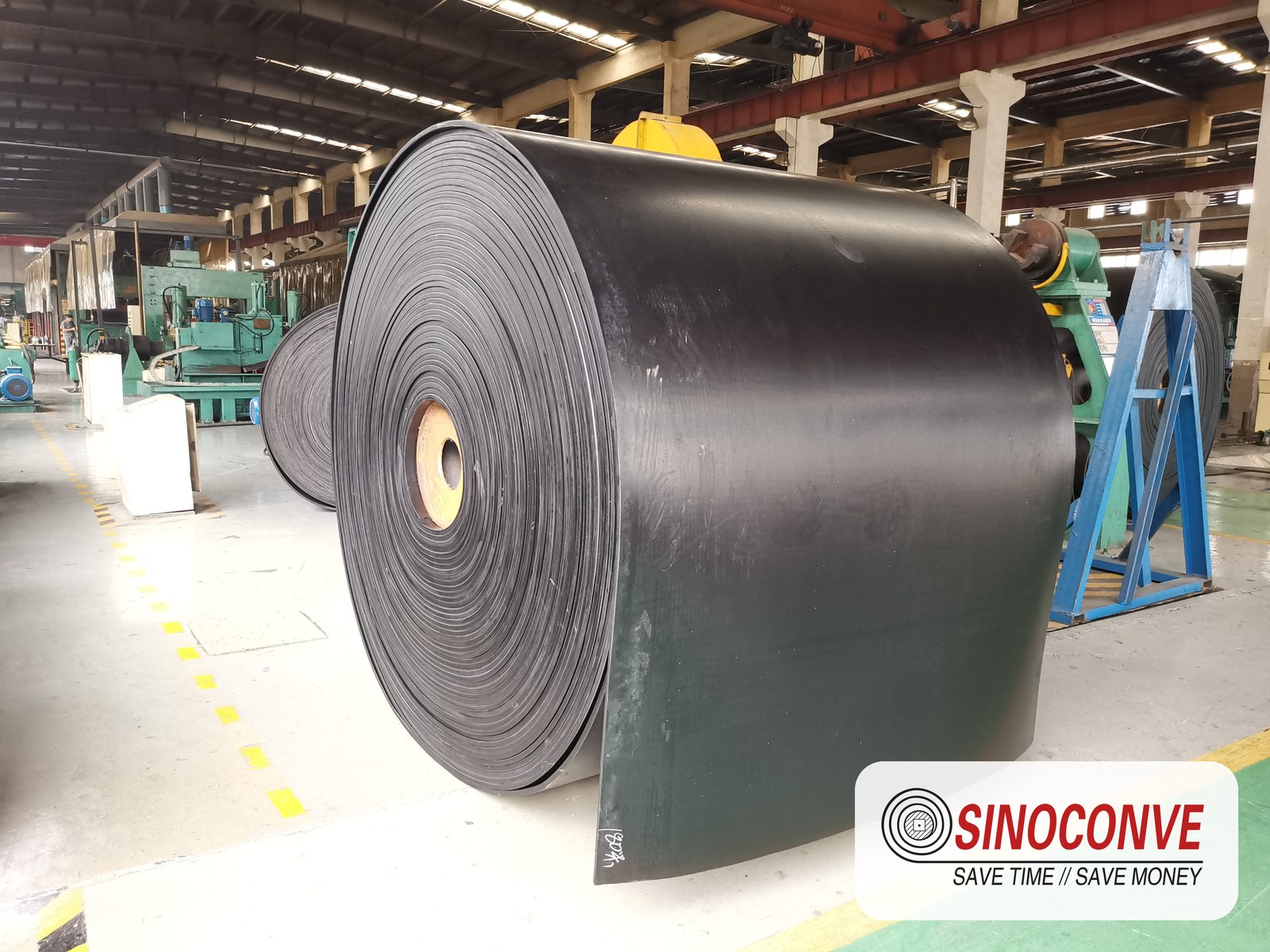
A finished rubber conveyor belt roll before packing. Width, ply count and cover thickness are fixed at this point; nothing downstream can correct a wrong specification.
The two boundaries that matter most
The first boundary is tension. As long as a fabric belt can carry the tension at a sensible ply count, fabric wins, because it is repairable, it tolerates a loading point that is not perfect, and you can vulcanize a new splice on site with a crew and a press. Once the tension forces you past roughly six plies or past the equivalent of high ST classes, the belt becomes stiff, heavy, hard to trough and hard to splice, and steel cord starts to look better on both mass and cost per tonne conveyed.
The second boundary is hygiene and surface finish. Rubber is a poor choice for a line that has to be washed down daily, must not shed black particles onto a product, or needs to be visibly clean for an auditor. That is a PVC or PU job, and the decision is driven by the product, not by the material cost. Our PVC conveyor belt range exists precisely for those lines, and the boundary between the two families is the subject of a separate article.
There is a third consideration that is not technical at all: what the site can maintain. A plant with a vulcanizing press, a trained splicing crew and a stock of cover repair material will get excellent life out of a rubber belt. A plant with neither should think hard before buying a steel cord belt, because the failure mode of a badly spliced steel cord belt is a sudden, complete, expensive one.
09What to Verify Before You Buy
This is the section we would put in front of any purchasing team before a belt order is released. None of it requires a laboratory of your own. All of it requires somebody to read three documents and ask four questions.
The verification checklist
| Check | What you ask for | Why it matters |
|---|---|---|
| Full designation on the drawing | Carcass type, fabric grade, ply count, cover grade, top and bottom thickness, width, and the standard being worked to | A line that says “EP200 rubber belt, 1,200 mm” cannot be inspected against anything. Half of all disputes start with an incomplete designation. |
| Cover compound test report | Tensile strength, elongation at break and abrasion loss, each with the test method and the laboratory named | This is the only way to confirm a grade claim. A number without a method is not evidence. |
| Adhesion values | Cover-to-carcass peel strength and ply-to-ply peel strength, tested to the relevant standard | Adhesion is what stops a belt delaminating at the splice or at the edge. It is invisible on the invoice and decisive in service. |
| Load-elongation curve | The elongation figure at a stated fraction of nominal strength, plus the permanent elongation after break-in | This is the data that tells you whether the take-up on your existing conveyor can absorb the new belt. Get it before you order, not after you install. |
| Dimensional tolerances | Measured width, total thickness and cover thickness at several points along the roll, with the tolerance standard quoted | Thin covers and short widths are the classic way a low bid recovers its margin. Measure on receipt. |
| Batch traceability | A batch or roll number marked on the belt that links back to the production record and the test report | If a single roll fails, traceability is the difference between an investigation and an argument. |
| Splice materials | Splice rubber and cement from the belt maker, matched to the compound, with the splice procedure supplied | A splice is only as good as the material compatibility between the belt and the splice kit. Mixing brands is a common root cause of early splice failure. |
| Standard edition | Which edition of DIN 22102, ISO 14890, ISO 15236 or AS 1332 the belt is made to | Grade values have moved between editions. Two suppliers quoting “grade W” to different editions are not quoting the same belt. |
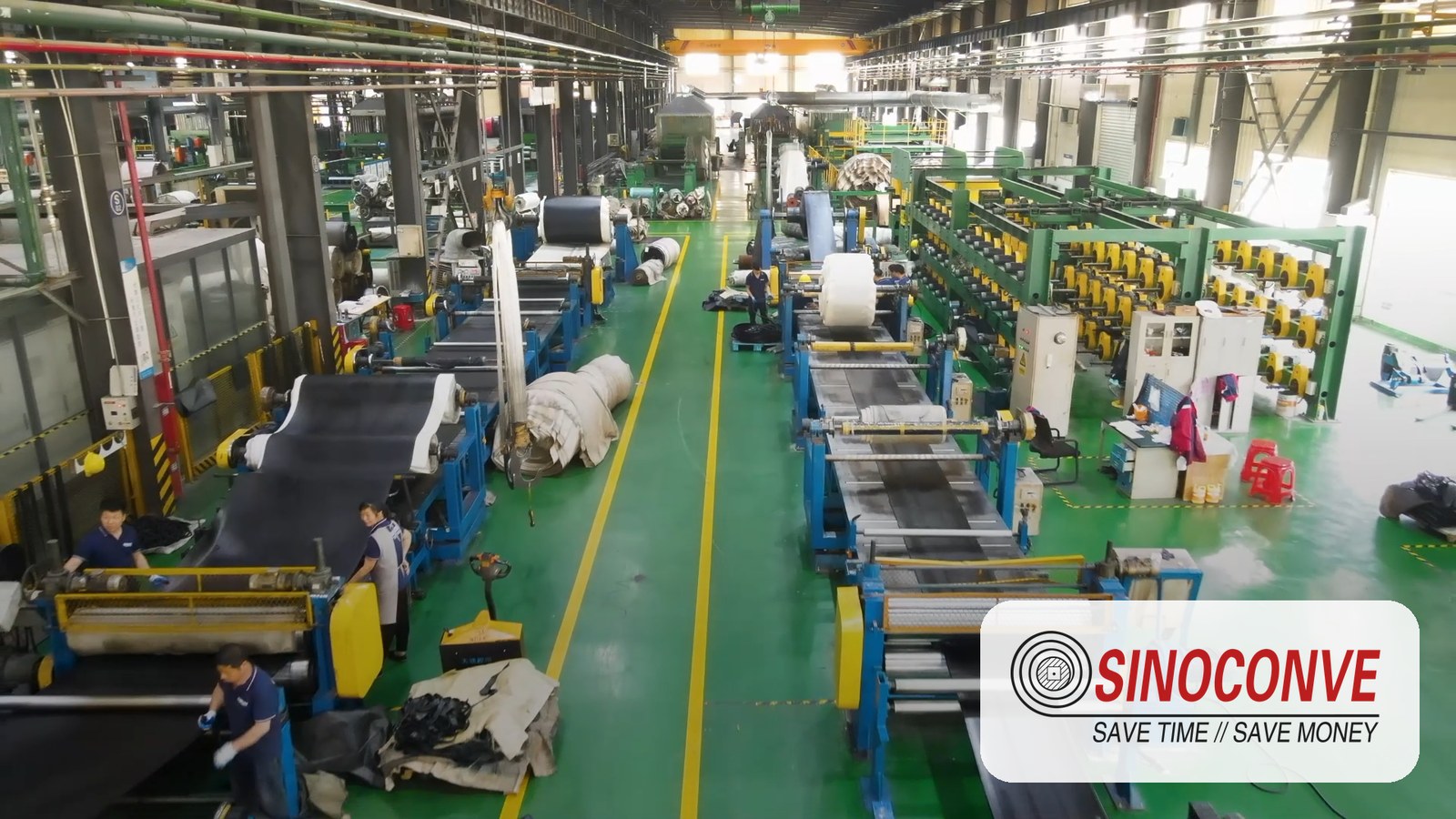
Rubber conveyor belt production lines. Process control between the calender and the press decides ply tension and skim adhesion, which no certificate will show you.
Batch consistency is the check nobody does
A single sample belt can pass any test. The question that matters for a plant buying 400 m now and 400 m next year is whether the second batch behaves like the first. Ask what the mill does to hold compound formulation stable between batches, how incoming rubber and fabric are inspected, and whether the process parameters are recorded per run. If the answer is vague, expect the 2027 belt to track differently from the 2026 belt, and expect your splicing crew to notice before your procurement team does.
If a supplier cannot answer these questions, that is useful information in itself, and it is worth more than a discount. There is a broader write-up of what separates a verifiable mill from a trading company in our article on rubber conveyor belt manufacturers.
The RFQ information that gets you a usable offer first time
Nine times out of ten, a quotation that comes back as a vague price per meter is a response to a vague enquiry. Send these items and the offer you get back will be comparable with the next one:
- Material conveyed, bulk density, and maximum lump size.
- Required capacity in tonnes per hour, and belt speed if it is fixed.
- Conveyor length, lift or drop, and the number and type of pulleys.
- Troughing angle and idler spacing.
- Take-up type and total available travel.
- Loading point detail: drop height, chute type, whether there is an impact bed.
- Material temperature at the loading point, continuous and peak.
- Ambient conditions: rain, freezing, salt air, dust, humidity.
- Any fire, anti-static, hygiene or food-contact requirement.
- Required length, whether the belt is to be supplied as an open length or endless, and the splice method.
With those ten items we can quote a construction rather than a price. Without them, any honest mill is guessing, and a dishonest one is quoting the cheapest construction that will pass a visual inspection. Our guide to comparing conveyor belt test reports goes through the document set line by line if you want to take that further.
10Common Selection Mistakes and Why Belts Fail Early
We see the same handful of failures across very different industries, which is a good sign that they are specification and installation problems rather than bad luck. Here is the table we run through with maintenance teams.
| What you see | Likely cause | Correct response |
|---|---|---|
| Top cover worn through in a straight run, evenly across the width | Grade too soft for the material, or cover too thin for the lump size and throughput | Move to a premium abrasion grade and increase top cover thickness. Check belt speed and skirt rubber pressure as well. |
| Localised cover damage under the chute only | Impact, not abrasion. Excessive drop height, chute geometry, missing impact idlers | Fix the loading point first, then consider a breaker ply and a thicker top cover. A stronger cover alone will not fix a 3 m drop. |
| Cover cracked, hard and crazed after months in service | Heat exposure beyond the compound's rating, or ozone and sunlight aging on an outdoor belt | Measure the actual material temperature at the loading point. Move to Y or Z as appropriate, or an EPDM-based compound for sustained high temperature. |
| Ply separation starting from the edges | Moisture ingress through unsealed or damaged edges, or edge rubber worn away by structure contact | Repair the tracking problem, seal or replace with a moulded-edge construction and a wider edge strip. |
| Splice opens or pulls apart long before the cover wears | Under-strength carcass, wrong splice geometry, mismatched splice material, or splice made under poor conditions | Recheck the tension calculation and the safety factor, then review the splice procedure and the materials with the belt maker. |
| Longitudinal rip running the length of the conveyor | Tramp metal or a sharp object wedged in a chute or skirt, sometimes aided by poor loading alignment | Add or repair metal detection or a belt rip detection system, inspect the chute, and consider a rip-resistant carcass construction. |
| Take-up bottoms out within weeks of a new belt | Wrong carcass type for the duty, or a ply count too low for the tension, or a substitution made without checking elongation | Compare the load-elongation data against the old belt. A carcass change is an engineering change, not a like-for-like replacement. |
| Belt will not train, tracks one way under load and the other way empty | Uneven ply tension from manufacture, damaged edge, misaligned idlers, or a structure problem | Check the structure and idler alignment first. If the belt is genuinely asymmetric, that is a manufacturing defect and should be raised as one. |
The specification mistakes behind most of them
Buying on price per meter without the class. Two belts at the same price can differ by a whole ply count if one quotation quietly assumes a cheaper fabric. Compare the full designation, then compare price.
Copying the last project's specification. The previous belt may have been over-specified because that plant had a different loading point, or under-specified because nobody ever audited it. Start from the duty, not from the drawing you happen to have.
Treating cover grade as a quality ladder. Grade Z is not “better” than grade W. They are different tools, and using the wrong one costs money in both directions.
Ignoring the take-up. This is the most expensive mistake on the list because it does not show up until commissioning. Before you change carcass type or reduce ply count, get the load-elongation data and check it against the take-up travel you actually have.
Specifying a belt but not the loading point. If the chute is going to drop material two meters onto the belt from a height, the belt specification is only half the job. Fix the drop with a rock box or a chain curtain, and the same belt lasts twice as long.

11FAQ: Rubber Conveyor Belt Questions We Answer Every Week
What does EP200 mean on a rubber conveyor belt?
EP200 describes the fabric, not the whole belt. EP means a polyester warp with a polyamide weft, and 200 is the fabric's nominal breaking strength in newtons per millimeter of width, per ply. An EP200/4 belt therefore has a nominal belt strength of 200 × 4 = 800 N/mm, while an EP200/3 belt of the same width and cover grade has a nominal strength of 600 N/mm. If a quotation gives you the fabric grade without the ply count, you cannot compare it with anything, so always ask for the full designation.
Is DIN grade W the same as RMA Grade I?
They serve the same purpose, a premium abrasion-resistant cover, and they are the grades most often quoted against each other. They are not formally equivalent, because DIN 22102 W and RMA Grade I are verified under different test methods with different specimen preparation, so the abrasion figures are not directly comparable. For tender evaluation it is reasonable to treat grade W and Grade I as the same class of cover. For acceptance, insist on the actual test report with the method named, and compare like with like. The same caution applies to AS 1332 grade M.
Can I replace a 4-ply belt with a 3-ply belt of a higher fabric grade?
Sometimes, and only after checking two things. First, the nominal belt strength has to be preserved: a 4-ply belt on EP200 fabric is 800 N/mm, so a 3-ply replacement needs a fabric grade of at least EP300 to reach 900 N/mm, or EP315 for 945 N/mm. Second, and more often forgotten, fewer plies changes the belt's stiffness and its load support between idlers. A 3-ply belt sags more on the same idler spacing and troughs differently, which can change tracking and spillage. It also needs a different minimum pulley diameter. We treat this as an engineering change and ask for the take-up data and the idler spacing before we confirm it.
What is the minimum order quantity and typical lead time?
For belts we normally work from about 50 m per specification, because that is what a production run needs to be set up economically. For V-belts the starting point is generally 30 to 50 pieces. Standard lead time is around 30 days from order confirmation, and we keep a fast lane for genuine emergencies that generally lands in the 15 to 20 day region. Samples can usually be arranged in 2 to 5 days. Payment terms are typically 30% deposit with the balance before shipment by T/T, or a letter of credit. If your project is tight, tell us the installation date at the enquiry stage rather than at the order stage; it changes how we schedule the run.
Should the belt be supplied endless or as an open length?
It depends on the conveyor. Short conveyors with a fixed take-up, feeders, and any application where belt length is critical are usually better supplied endless, vulcanized to the exact center distance at the works. Long conveyors are almost always supplied as an open roll and spliced on site, because the center distance is measured after installation and the belt needs to be threaded through the structure. If you are ordering an open belt, decide the splice method before the order, not after. A vulcanized splice and a mechanical fastener need different edge preparation and sometimes a different edge construction.
How do I know whether I need a heat-resistant belt?
Measure, do not guess. What matters is the material temperature at the loading point, the hottest lump in the stream, and how long the hot material sits on the belt. If the material is above roughly 60 °C at the loading point on a continuous basis, a standard general-purpose cover will harden and crack long before it wears out, and you should be discussing grade Y, grade Z or an EPDM-based compound. If the temperature is above that only in short pulses, the duration and frequency of those pulses decide the specification. Bring us a temperature survey and we can be specific; bring us the phrase “hot material” and all we can do is quote a conservative worst case.
Can I use a standard rubber conveyor belt in an underground coal mine?
No. Underground coal, and any enclosed handling of combustible dust, brings mandatory fire-performance requirements that override your cover grade. The belt has to meet the applicable flame propagation standard and carry anti-static properties that meet the relevant electrical surface resistance limit, and the evidence has to be documented for inspection. Regions operate different schemes, and the requirement in your jurisdiction is the one that applies. This is a case where we will not ship a belt without seeing the required specification in writing, and we would rather lose the order than have a plant discover the problem during an incident investigation.
How do I verify a supplier's grade claim?
Ask for three documents for the specific belt you are buying: a cover compound test report with the abrasion, tensile and elongation values and the test method named; adhesion values for cover-to-carcass and ply-to-ply; and the dimensional record for the roll. Then compare them with the standard edition written on your drawing. A supplier who can produce those three for the batch in question is a supplier you can hold to a claim. A supplier who sends a generic certificate with no batch reference is not. The full methodology is set out in our article on RMA Grade I vs Grade II procurement.
What should we send with an enquiry?
The ten items listed in section 09. If you have them, send them. If you do not, send what you have and the drawing, and tell us what is uncertain. We would rather spend twenty minutes on a call before quoting than have a plant discover at commissioning that the new belt is a different construction from the one it replaced. You can reach us through the contact page or by email at sales@sinoconve.com.
Related Products You May Need
| Rubber Conveyor Belt The full heavy-duty range: EP and NN fabric carcasses, DIN and RMA cover grades, widths from 400 mm to 2,200 mm. |
EP Rubber Conveyor Belt Polyester-nylon fabric belting from EP100 to EP500 per ply, in 2 to 6 plies, built to DIN 22102 and ISO 14890 conventions. |
Steel Cord Conveyor Belt Single-layer steel cable carcass for long overland lines, high tension and high tonnage where take-up travel is limited. |
| Chevron Conveyor Belt Profiled belts for inclined conveying where a flat belt would let the load slide back down. |
V-Belt Wrapped, cogged and banded drive belts, plus timing and multi-rib belts, for crusher and mill drives on the same sites. |
Full Product Catalog Conveyor belts, light PVC and PU belting, transmission belts, rollers and idlers in one place. |
Not sure which row fits your conveyor? Send us the duty data and we will confirm the construction in writing. Email sales@sinoconve.com or use the contact form.
Related Blog Posts
- Rubber Conveyor Belt Manufacturers — how to tell a mill from a trading company and what to ask before you commit.
- Rubber Conveyor Belt vs PVC Conveyor Belt — where each material wins, and what the sustainable choice actually means in practice.
- EP vs NN Conveyor Belt — the carcass decision in detail, with elongation and take-up consequences.
- Rubber Conveyor Belt Cover Grades — compound selection, abrasion and heat, line by line.
- Conveyor Belt 4 Fabric Plies Guide — when four plies is the right answer and when it is over-specified.
- Verify DIN 22102 Grade Claims — the document set that proves a grade claim, and the gaps that do not.