
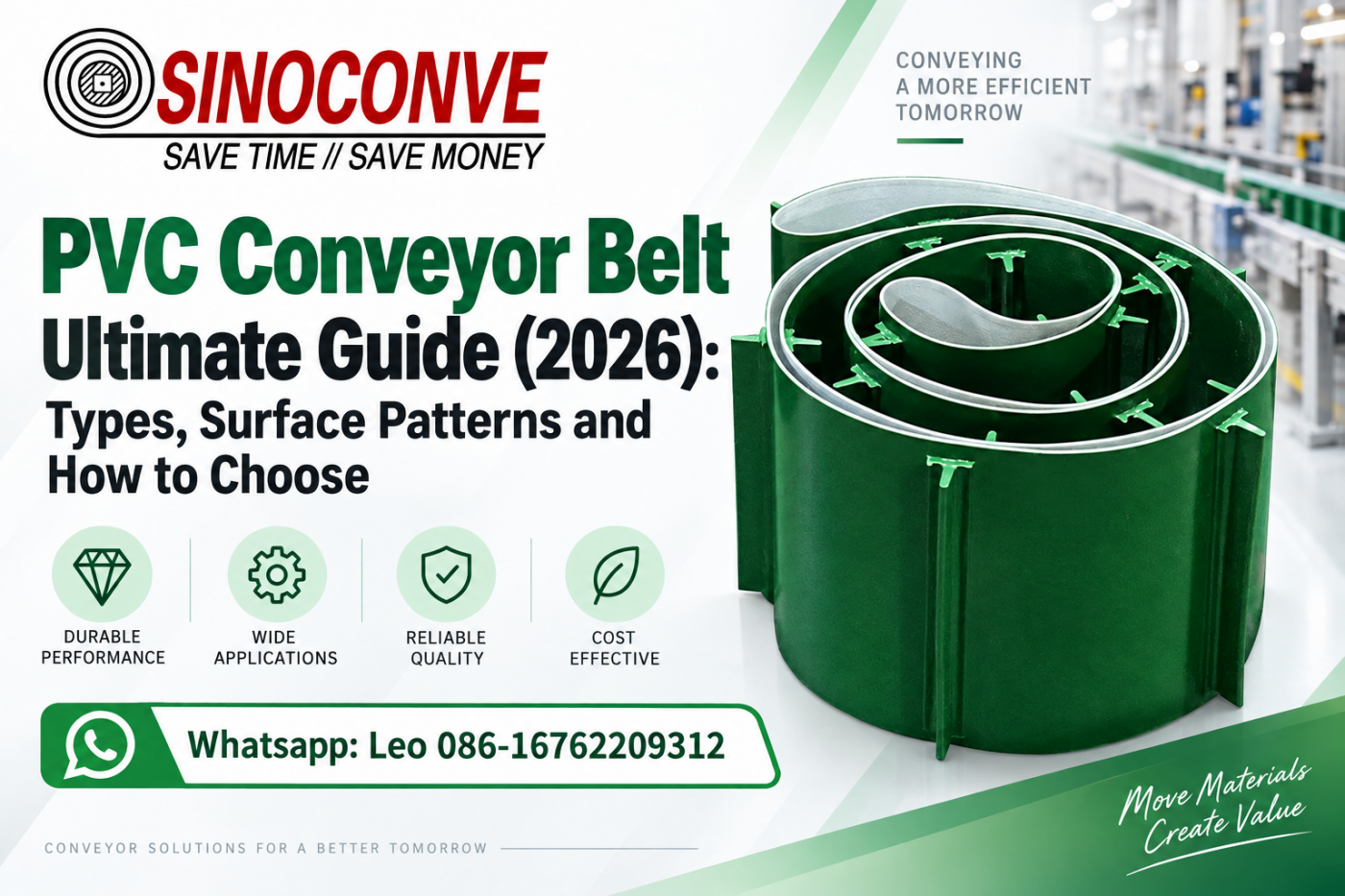
Walk into the packaging hall of almost any food plant and you will find the same belt doing the same job. A white or pale green PVC belt, running flat, moving trays and pouches and wrapped product from one machine to the next. It is the cheapest item on the line. It is also the fastest to replace, and usually the last thing anyone thinks about until it starts mistracking at three in the morning. We have been building these belts since 1988. The questions that land in our inbox have barely changed. Which pattern will hold this incline? Is this belt actually food safe? And why did the splice open again after four months, when the last one lasted two years?
This guide is the long answer, written for the people who specify and maintain light duty conveyors in food, packaging and logistics. Five things decide most of it. Which polymer you pick. How the belt is built. Which surface pattern the duty demands. How the joint is made. How the line gets cleaned. Material choice sets the ceiling. Construction decides how long the belt holds up. Food contact compliance is a paper trail, not a colour. As a conveyor belt manufacturer, we quote this family every working day, and we rarely quote it from a catalogue page alone. Typical light duty PVC belting runs 1 to 8 mm thick, 300 to 2000 mm wide, with working tensions around 10 to 25 N/mm depending on ply count and fabric. Anything outside those bands gets checked against your drawing. Not against a stock list.

01Material Map: PVC, PU, Silicone and Where Each One Stops Working
Four polymer families do nearly all of the work in light duty conveying. PVC, PU, silicone and PE. The choice between them comes down to four variables, and only four. Temperature. Fats and oils. Cleaning chemicals. Budget. Everything else is detail. Get those four right and the belt behaves. Get one wrong and no amount of clever engineering rescues it.
What a PVC belt actually is
A PVC belt is a fabric carcass with a PVC coating. It is not a sheet of plastic, though plenty of buyers assume it is. The carcass carries the tension and stops the belt stretching. Ours is normally woven with polyester in the warp and a polyester or polyamide weft, then dipped and coated on one or both faces. Cover thickness for light duty belting lands between 0.8 mm and 3 mm per face. Total thickness runs between 1 mm and 8 mm. Where it lands inside that band depends on two things: how much abuse the top surface takes, and how tight the smallest pulley on the line is.
Temperature is the first hard limit. Standard PVC covers are comfortable from about minus 10 °C to plus 80 °C in continuous contact with product. A short excursion above that is survivable. Stay there and the plasticiser begins migrating out of the compound, and the cover hardens, cracks and sheds. Some grades can be built to run hotter. We confirm that against the actual grade, never as a promise for the whole family. Below minus 10 °C plain PVC stiffens and cracks at the splice. That is why freezer lines move to a different polymer instead of ordering a thicker PVC.
The second thing to know about PVC is the plasticiser. It keeps the compound soft. It is also the part that migrates into product and into cleaning agents. Water leaves PVC alone, and so do most dilute acids, alkalis, alcohol and salt solutions. Animal fats are a different story. So are hot cooking oil and aggressive solvents, where PVC is simply the wrong answer for direct contact. On a wash-down line, ask for a cover formulated for the chemicals you actually use. A generic top surface will not survive them, and we have seen covers go tacky inside eight months on the wrong detergent.
Where PU earns its higher price
Polyurethane belting carries the same style of fabric carcass, with a PU coating instead of PVC. On a food line the practical differences show up in three places, and they rarely show up on a price sheet. Cut and tear resistance is much higher, typically two to three times the figure for a comparable PVC cover. Put that next to a trimming knife or a sharp metal closure and the belt lasts far longer. Oil and fat resistance is genuinely good, not merely acceptable. On meat, cheese and snack lines that is the difference between a cover that lasts years and one that degrades over months. PU also runs over a wider band. Roughly minus 20 °C to plus 90 °C, against minus 10 to plus 80 for standard PVC.
The catch is hydrolysis. In a hot, humid wash-down environment an ester-based PU breaks down at the surface, going tacky first and then crumbling. Ether-based PU survives those conditions. The difference never shows on a price sheet unless you ask which chemistry you have been quoted. Ask. Expect to pay roughly 1.3 to 1.8 times the PVC price per square metre. On a line running 16 hours a day with knife exposure, that pays back inside a year. On an ambient carton transfer it usually does not, and PVC is the better buy.
Silicone, PE and the two edge cases
Silicone belting holds roughly minus 40 °C to plus 200 °C. It also releases sticky product better than anything else in the family. This is the belt you see coming out of a bakery oven, or running under a hot-fill head, or carrying caramel that would glue itself to PVC. Its weaknesses are mechanical. Low tear strength. Poor cut resistance. A price that makes buyers wince, often four to seven times PVC per square metre. Do not specify silicone because the room is hot. Specify it because the belt surface itself is hot, or because the product sticks to everything else you have tried.
At the cold end, PE belting runs down to about minus 40 °C and stays flexible long after PVC has gone brittle. Freezer tunnels are its natural home. So are blast freezers, ice-pack lines, and any chilled transfer where a PVC splice would crack on the first cold start. Between those two extremes, PVC and PU handle almost all ambient food, packaging and parcel handling. Most of this guide deals with those two.
| Property | PVC | PU | Silicone | PE |
|---|---|---|---|---|
| Typical working temperature | -10 to +80 °C | -20 to +90 °C | -40 to +200 °C | -40 to +70 °C |
| Cut and tear resistance | Moderate | High, 2-3x PVC | Low | Moderate |
| Oil and animal fat | Fair, degrades slowly | Good | Good | Fair |
| Hot wash-down chemicals | Grade dependent | Ether-based PU only | Good | Fair |
| Relative cost per m² | 1.0 baseline | 1.3 to 1.8x | 4 to 7x | 1.1 to 1.4x |
| Splice method | Hot-pressed finger or step | Hot-pressed finger | Finger or mechanical | Mechanical clip |
| Best fit | Ambient dry lines, cartons, parcels | Meat, cheese, bakery, oily product | Hot product, sticky product | Freezer tunnels |
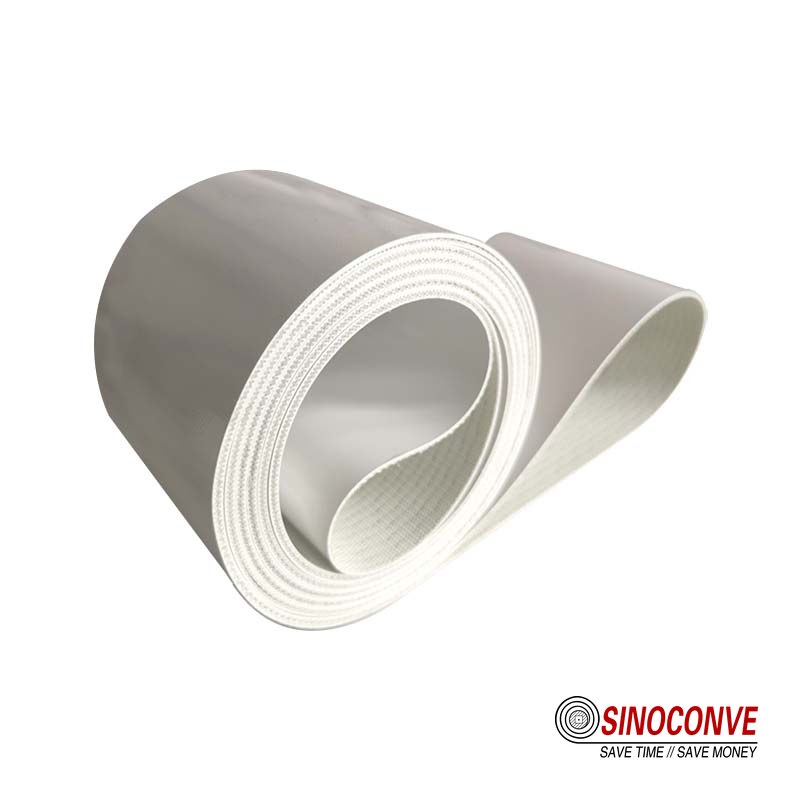
White food-grade PVC belting off the line. Colour, cover compound and cover thickness are specified per order, not per catalogue page.
Two smaller material decisions get made at the same time, and both are easy to get wrong. Colour is the first. White and pale blue are the usual choices for direct food contact, because both show soil immediately, and many plants use colour to separate allergen zones. Colour is a compound additive, so it has to be chosen together with the food-contact grade, not added afterwards.
Static is the second. On lines handling film, dust or dry powder, a static build-up makes product jump and blocks jam at the infeed. Antistatic grades exist in PVC. The surface resistance target belongs in the specification, because you cannot check it visually once the belt is running. One more note on grades. Whether a belt is suitable for food contact depends on the compound behind the colour, not on the colour itself, so if your audit references FDA, EU 10/2011, REACH or a national recommendation, say so at enquiry stage and we confirm the option against the grade you would actually receive.
02Belt Construction: Plies, Covers, Cleats, Sidewalls and Guides
Material is only half the specification. The rest is the build. How many fabric plies carry the load. How thick the covers are. Which profiles get welded or moulded onto the surface, so the belt can lift a product, contain it, or simply keep it on the centre line.
One ply or two — and why it is not about strength alone
Single ply belting is lighter, thinner and cheaper. It also tracks well around small pulleys, because it bends easily. Two ply belting adds a second fabric layer under the top cover. That raises the tension rating. More importantly, it improves fastener holding and the belt's resistance to impact and edge damage. On a short transfer with a knife-edge nose bar, single ply is usually right. On a longer line with a loaded loading point, two ply outlives it comfortably. We quote a lot of single ply for belts under about 3 m, and almost nothing but two ply once a line passes 10 m.
Cover thickness is the number that decides how long the top surface lasts. A belt moving cartons at 30 m/min will run for years on a 1 mm top cover. Put that same belt under a metal detector rejection flap, where product drops onto it all shift, and the verdict changes. So does a line where trays get dragged across the surface. There, 2 to 3 mm is money well spent. Under 1 mm, fabric texture prints through the cover and the edges wear through first, long before the top surface is finished.
Working tension has to match the take-up and the drive, not just the load. A typical two-ply PVC belt with polyester fabric carries a working tension in the region of 10 to 25 N/mm. Where it lands inside that band depends on fabric, ply count and splice method. Before we quote a construction we ask for three numbers: belt width, load per metre, and drive pulley diameter. Quote on width and pattern alone and the belt comes back as a warranty claim. Lines outside the light duty family run far higher tensions, and the same engineering applies to rubber conveyor belt constructions and heavier carcasses.
Cleats: what goes up an incline
Once the angle passes roughly 20 degrees, a flat belt stops carrying loose product. Cleats solve that. Three profiles cover most of the work. A T-cleat runs across the belt and gives a straight pushing face. A C-cleat has a curved profile that holds small product without trapping it. A lug or stud pattern grips in both directions, which suits diverters and bi-directional transfers. Standard cleat heights run from 10 mm up to about 50 mm. Our rule is simple. The cleat has to be tall enough to hold the product at the steepest angle on the line, and no taller. Over-tall cleats fold over at the smallest pulley and tear at the base.
Cleat pitch is the parameter everyone ignores until product starts rolling back down the incline. Space the cleats too far apart and product rolls between them. Space them too close and the cost per metre jumps for no benefit at all. For a product of known length, a pitch of roughly one and a half times that length is a sensible start, and then it gets checked against the smallest pulley. We weld cleats in the same PVC or PU as the cover, so they flex with the belt instead of cracking off at the root.
Sidewalls, guide strips and tracking profiles
Corrugated sidewalls are welded to both edges to form a trough, so loose material stays on the belt. Heights usually run 30 mm to 60 mm. They raise the conveying angle far past what a flat belt can hold, which is why they turn up on granules, powders and small parts. The trade-off is cleaning. A corrugated wall creates a base joint and a fold line where product lodges. On a hygiene-critical line, that has to be justified by the incline.
Guide strips are the quiet workhorse of light duty conveying. A V-guide, typically 8 x 6 mm or 13 x 8 mm, is welded to the underside and runs in a grooved pulley or a set of guide rollers. It holds the belt on track through long lines, through end transfers, and through any section where the belt would otherwise wander. Wherever a line runs longer than about 10 m, we specify a continuous V-guide rather than short sections. Intermittent guides let the belt walk in the gaps.
For lines with heavy lateral pull, a pair of edge guides or a centre guide works better. The choice comes down to the pulley groove geometry already on your frame. One practical note on ordering. Most builds here carry a minimum of about 50 m per specification, samples take 2 to 5 days, and normal production runs roughly 30 days from confirmation of drawing and grade. If a line is down, an urgent replacement can usually move in 15 to 20 days.
03Surface Patterns: The Full Spectrum, and What Each One Is For
This is where most selections go wrong. Pattern gets chosen from a photograph, not from the duty. Cover compound decides how the belt survives. The pattern decides whether it can carry the product at all. Before we name a pattern, we ask three questions. What is the product? What is the steepest angle on the line? How tight is the smallest change of direction? A coarse rough-top surface will grip a sack of flour at 30 degrees. It will also fight you through a 40 mm nose bar, and trap dust that no wash-down will ever remove.
Smooth and matte tops: the default for flat food lines
A smooth gloss cover is the baseline for horizontal food transfer, inspection tables and metal detector belts. It cleans easily. It drains quickly. It also gives the most consistent surface for photocell and vision systems, because there is no shadow pattern for the sensor to read. Its limit is grip. On a level run, friction barely matters. Once the incline passes roughly 8 to 10 degrees, smooth PVC will let a pouch or a tray slide. The first symptom is rarely an obvious slip. Product simply bunches at the top of the ramp.
Matte, lightly sanded tops sit one step up. Slightly more friction, still easy to clean, and still suitable for direct food contact in the right compound.
Ribbed, herringbone and self-tracking surfaces
Fine longitudinal ribs run the length of the belt. They cut the contact area against the product, which stops sticky dough and hot product grabbing the surface. They also let air and moisture escape, so wet produce does not skate on a film of water. A herringbone or diagonal rib does a second job. The angled grooves squeeze product toward the centre line as the belt moves, so light items self-centre along a long run. Both are harder to clean than a flat top. Justify them by the product, not by habit.
Diamond, waffle and the parcel-handling family
Cross-hatched diamond, waffle, honeycomb and stud patterns raise friction against a flexible or irregular load. They are standard on parcel sorters and bag handling lines, and on carton diverters. Any incline between roughly 15 and 30 degrees carrying boxes or sacks usually wants one of them. Depth matters as much as shape. A 1 mm embossed diamond is decorative. The same pattern cut 2.5 to 3 mm deep will hold a poly bag on a 25 degree incline, which is a different belt altogether. The cost is cleaning. Every groove collects dust, cardboard fibre and food debris. This family suits the last 50 m of a parcel hub. It does not suit a direct-contact food line.
Rough top, crescent and nub: the heavy-grip end
Rough top belting carries a pebbled, crumb-like surface that grips almost anything. That makes it the belt of choice for inclined transfers of loose or heavy items. Bagged goods, boxes, potatoes. Anything that arrives with no packaging at all. The same logic applies wherever a light belt is asked to do a heavy job, and it is the family that an industrial conveyor belt shares at its most aggressive end. Crescent or chevron patterns sit slightly below rough top on grip, but they clean far better. That is why so many biscuit, cracker and dough lines run one. It centres the product, resists sliding on the cooling incline, and can still be washed at the end of the shift.
Special surfaces: perforated, non-stick and grip-coated
Three surfaces sit outside the main families. Perforated belting with 4 to 10 mm holes is used where the belt is also part of the process. It drains washed produce, or passes air through a dryer, or lets crumbs drop through to a tray below. Non-stick coatings help with caramel, cheese and confectionery, where a standard cover would hold on to the product. Grip-coated tops give incline capability close to rough top at a much lower profile. That is the answer when a line has both a steep incline and a tight nose bar, a combination that catches people out.
| Surface pattern | Appearance | Grip on incline | Cleanability | Typical duty |
|---|---|---|---|---|
| Smooth gloss | Flat, reflective | Level only, to about 8° | Best | Inspection tables, metal detectors, carton transfer |
| Matte or sanded | Low sheen, fine grain | Level to 10-12° | Very good | Food contact lines, small inclines |
| Longitudinal fine rib | Parallel lengthwise lines | Level to 10° | Good | Dough, sticky product, wet produce |
| Herringbone or diagonal rib | Angled chevrons, self-centring | Level to 15° | Good | Positioning of light items, long runs |
| Diamond or waffle | Cross-hatched cells, 1-3 mm deep | 15-30° | Fair | Parcels, bags, carton inclines |
| Crescent or chevron | Curved crescent ridges | 20-30° | Good | Biscuit, cracker and dough cooling |
| Rough top (pebbled) | Crumb-like irregular texture | 30° and above | Poor | Sacks, bagged goods, unpacked produce |
| Nub or stud | Raised dots in a grid | 15-25° | Fair to good | Small parts, dual-direction transfers |
| Grip-coated | Fine high-friction layer | Up to 25° | Good | Steep inclines with tight nose bars |
| Perforated | Holes 4-10 mm | Level | Good, self-draining | Washing, dewatering, crumb drop-through |
One pattern note that comes up in almost every food enquiry. A deep, open pattern is not automatically the food-safe choice, because embossing gives bacteria and debris a place to sit. On wash-down lines we usually push back toward a matte or fine-ribbed top and solve the incline with cleats or a PU compound instead of a coarse surface.
04Food-Contact Compliance: What the Documents Should Say
Food-grade is a claim with a paper trail, not a colour. The three references you will see on belt documentation are FDA 21 CFR 177.2600 in the United States, EU Regulation 10/2011 with the framework Regulation EC 1935/2004 in Europe, and REACH for restricted substances. Germany adds BfR recommendations, and DIN standards cover belt construction and testing rather than food contact itself.
What to ask for, and what not to accept
Ask for a declaration of compliance naming the regulation, the material grade and the intended contact conditions — dry, fatty, contact time and temperature. A full pack should also carry a migration test report from an accredited laboratory, covering overall migration and specific migration where the application demands it. We supply material options that can be built to meet FDA and EU 10/2011 requirements, and the grade has to be confirmed against the belt you are actually buying, because two white PVC belts from the same family can carry different compounds. Do not accept a verbal assurance, or a certificate covering a different colour or a different raw material.
Colour, metal detection and zone control
Colour coding is the cheapest hygiene control on the line. White and light blue are the standard food-contact colours, and blue dominates in plants with bakery and cereal dust because it is the one colour no food product matches. Where a risk assessment calls for it, belts can be supplied in grades that carry a metal-detectable additive. Detection thresholds depend on the fragment size the detector can resolve, so that is a conversation with the detector supplier as much as the belt supplier — a metal-detectable belt only helps if the detector is set to find it.
The details that decide a hygiene audit
Three features separate a belt that audits well from one that does not. The splice is the first: a finger splice with an open groove or a lifted edge is a debris trap, so a clean, well-pressed joint matters as much as a clean cover. The second is edge condition, because a frayed or delaminated edge wicks water under the cover and grows micro-organisms no spray cycle reaches. The third is drainage: holes and open patterns help on a wash-down line, while a smooth cover that leaves water standing is the wrong answer there. For a broader view of how these decisions map onto a complete food plant, our food and packaging industry page covers the conveying side in more detail.
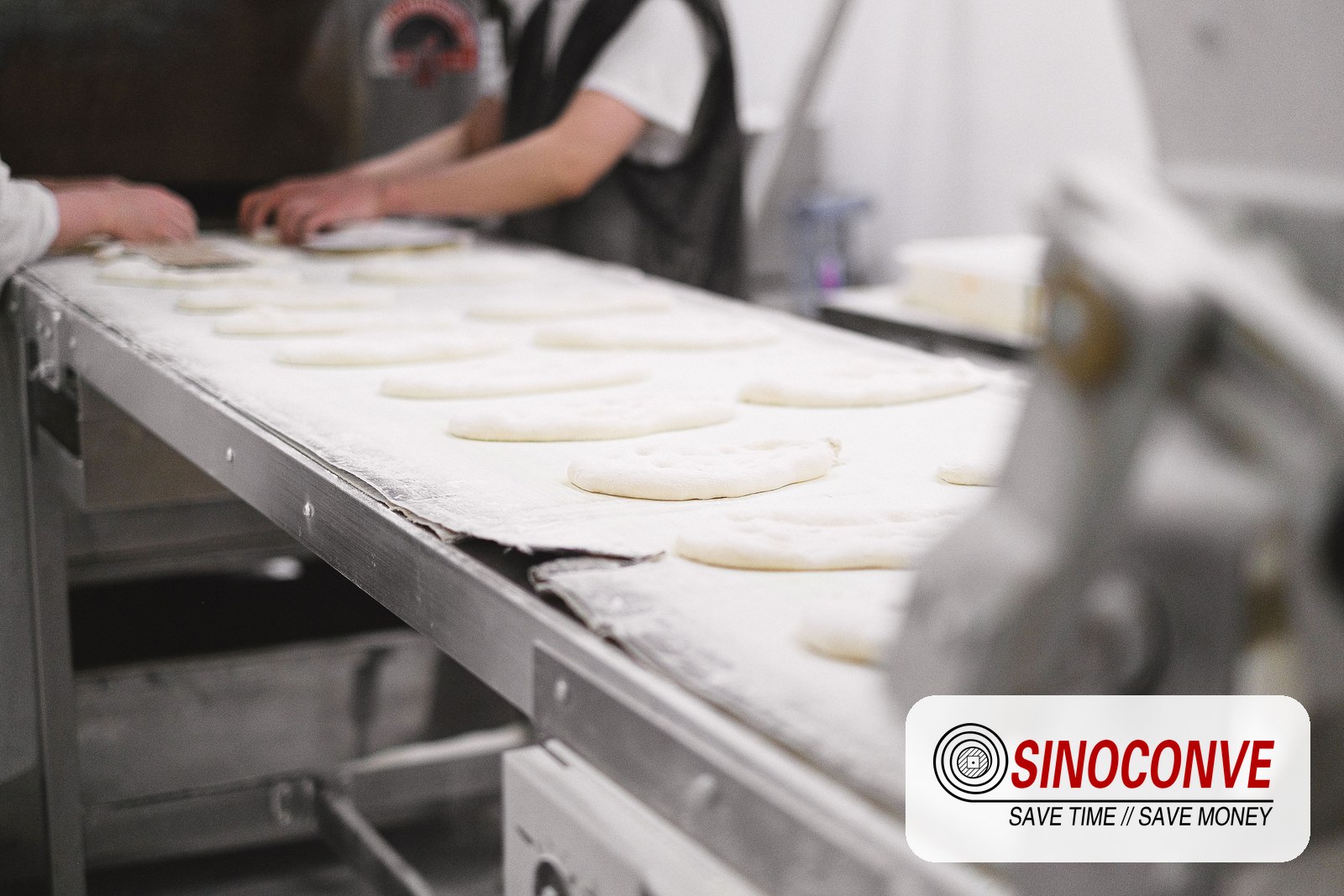
White belting on a food line. Cover compound, colour and documentation are specified together, not after the fact.
05Jointing: How the Belt Is Made Endless, and Why Joints Fail
Almost every belt failure conversation we have starts at the joint. The belt itself is a continuous extrusion of coated fabric; the joint is where it becomes a loop, and it never quite reaches the strength of the parent belt.
Finger splice, step splice and mechanical fasteners
The standard answer for PVC and PU light duty belting is a finger splice, sometimes called a finger-over-finger joint. The two ends are cut into interlocking fingers, laid into each other, and pressed hot under controlled temperature, pressure and time so the covers fuse and the fabric fingers key together. Done properly it reaches roughly 40 to 70 percent of the belt's own tensile strength, and it runs smoothest over small pulleys because the thickness stays constant through the joint.
A step splice uses overlapping steps instead of fingers and is quicker to prepare. It suits wide slow belts and is less happy on narrow high-speed ones, where the step lifts cleats and disturbs tracking. Mechanical fasteners — metal clips, spiral lacing, pin joints — can be fitted on site in an hour with hand tools, which is why they turn up on breakdown repairs. The trade-off is the hooks and the open gap, a hygiene problem on food contact lines and a wear point on the pulleys.
Endless, open-ended and field-made joints
If the frame can be dismantled, the strongest answer is an endless belt made and jointed in our plant, tested before it ships, with the joint marked on the edge. If the frame cannot be opened, the belt ships open-ended and the joint is made on site with a portable press. A field-made joint is only as good as the conditions, and the causes of early failure are consistent: moisture in the fabric, uneven pressure from a worn press platen, and fingers cut freehand instead of against a template.
Two habits in our plant are worth copying. We cut and press every joint with a template jig and log the press parameters for the order, so a repeat belt is genuinely the same belt. And we mark the direction of travel on the belt edge, because a finger splice is designed to run one way, and a belt installed backwards will have the finger tips lifting at every pulley. If you are replacing a belt yourself, photograph the old edge marking before you cut it off.
06Cleaning, Tracking and Service Life
A belt that is specified correctly and then maintained carelessly still fails early. Three habits do most of the damage: cleaning chemicals chosen for the stainless steel rather than for the belt, tracking corrected by moving the belt instead of the pulley, and service life assumed from a catalogue rather than measured.
Cleaning a PVC or PU belt without wrecking the cover
Match the chemistry to the compound. Dilute alkaline detergents at the concentration your hygiene plan specifies are fine on a properly formulated food grade PVC or PU cover. Concentrated chlorine, strong solvents, hot caustic and acid sanitisers left to dwell attack the plasticiser or the coating, and the damage shows up as a dull, tacky surface that then holds soil. Keep wash water inside the range the compound was built for — on standard PVC that means well under the 80 °C limit, not a steam lance at close range.
Mechanically, use soft brushes or a low-pressure spray. A hard scraper on a smooth food-grade cover leaves scratches that never clean out. On a multi-belt line, check that the cleaning regime suits the weakest belt, because an agent that is acceptable on PU can be aggressive on PVC. If a belt is replaced far more often than cover wear suggests, the cleaning chemicals are usually the reason, and it is one reason we ask new conveyor belt supplier customers for a chemical list alongside the drawing.
Tracking, tension and the small adjustments that matter
Light duty belts go off track for a short list of reasons: uneven tension across the width at the splice, a pulley that is out of square with the belt centre line, a drum that is not level, product loading off centre, or a belt that has taken a set from being stored folded. Correct the cause, not the symptom. Adjusting a snub roller to pull a belt back on line while the frame is out of square simply moves the wear to the belt edge, and the edge then frays and delaminates.
Tension is checked by pressing the belt at mid span and looking for a deflection of roughly 10 to 15 mm for every 1,000 mm of span, then taking up the slack at the frame adjusters. Over-tension does more damage than under-tension here, because it loads the splice and the pulley bearings and rounds off the belt edges. If the line has a V-guide, check the groove width in the pulley at the same time; a worn groove lets the guide wander and the belt mistracks in a slow oscillation rather than running off.
What a realistic service life looks like
On an ambient packaging or logistics line, a well-specified PVC belt with a 2 mm cover routinely runs for several years. On a food line with daily wash-down and knife contact, the cover reaches end of life sooner, and the joint is usually the first thing to need attention. Abrasive scraping loads — trays dragged across the surface, granular product at a transfer point — shorten life more than any other single factor, and cover thickness is almost always the cheapest way to buy the time back.
Replace on condition, not on a calendar. The signals are consistent: visible fabric texture printing through the cover, a cover worn through at the edges, a splice lifting at a corner, perished or gapping edges, and repeated mistracking that survives a proper alignment check. Log cover thickness with a simple gauge at three points across the belt every quarter; that gives you a wear rate, and the wear rate tells you when to order. Where the whole plant runs a mix of PVC and PU belting, the same logic applies as with PVC conveyor belt stock generally: keep the two or three most common sizes on the shelf rather than the whole range, because a stored belt ages even when it is not running.
07How the Specification Changes by Industry
The same product family is specified completely differently depending on what is on the belt. Here is how the four big application groups actually differ, based on the enquiries we handle.
Food processing: meat, dairy, bakery and produce
Meat, poultry and ready-meal lines want PU rather than PVC, in blue or white, with a smooth or lightly matte top. Knife and bone exposure makes cut resistance the deciding property, and wash-down chemistry decides the PU chemistry. Dairy and cheese follow the same pattern with a tighter focus on fat contact. Bakery splits in two: dough and biscuit lines use crescent or fine-ribbed surfaces to stop sticking and centre product on cooling inclines, while oven exits and hot product move to silicone. Produce lines want perforated belting with good drainage and a compound that tolerates chlorine-based wash water. Frozen and chilled lines move away from PVC to PE or a low-temperature PU below about minus 15 °C.
Packaging and carton handling
Packaging machines are the biggest single user of light duty PVC belting, and the specification is driven by the machine rather than by the product. Smooth or matte tops dominate because photocells, vision systems and printers need a predictable surface. Diamond tops appear at the incline between a case erector and a palletiser, and grip-coated surfaces solve the tight nose bars that come with small transfer pulleys. Two details decide success here: static control on lines handling film and dry powder, and a joint that is thin enough not to disturb the gap under a guide rail. On high-speed lines we routinely specify a hot-pressed finger splice and mark the running direction, because a folded-back finger tip on a packaging machine lifts product out of register.
Logistics, warehousing and parcel handling
Parcel conveyors run wide, long and hard, and they tolerate a coarser surface than any food line. Rough top and deep diamond patterns hold bags and irregular cartons on sortation inclines, while telescopic and flexible conveyors need a thin, high-tension belt that rolls tightly and tracks true. Long runs get a continuous V-guide. The wear point is almost always the loading end where parcels drop onto the belt, and thickening the top cover there is cheaper than replacing the full run early. If that is the part of your plant you are specifying, our logistics and warehousing industry page covers the layout side in more detail.
Parcel hubs also buy differently. Contractors and integrators often buy wholesale conveyor belts by size range and hold stock across several sites, which changes the conversation from a single belt to a repeatable specification with a documented joint procedure. That is where a conveyor belt distributor earns its margin: not by holding every size, but by knowing which two dozen sizes cover most of the installed base in the region.
Aggregate, recycling and the point where light duty ends
Plant engineers often ask us to solve a heavier problem with a light duty belt, and it is worth knowing where that stops working. Once the material is lumpy, hot, sharp or heavy, the answer moves to a multi-ply EP carcass with a proper cover grade and a vulcanised splice, and the pattern moves to a chevron or a raised cleat profile that lifts the load rather than just gripping it. Teams running both kinds of belt on one site usually find it simpler to consolidate with one rubber conveyor belt and light duty supplier than to split the order. The drive side belongs in the same conversation, since a sorting line's pulleys and drives often come from the same transmission belt manufacturer as the conveying side, and a second V-belt manufacturer on the vendor list rarely adds value. Our own conveyor belt factory runs both families under one roof, so a mixed shipment can go out on a single schedule.
| Industry | Material | Surface | Cover | Watch out for |
|---|---|---|---|---|
| Meat, poultry, ready meals | PU, blue or white | Smooth or matte, cleats on inclines | 2-3 mm | Hydrolysis in hot wash-down, knife cuts |
| Bakery and confectionery | PVC or silicone | Crescent, fine rib, non-stick | 1-2 mm | Product temperature at the oven exit |
| Dairy and cheese | PU, white | Smooth, easy to clean | 2 mm | Fat contact, daily CIP chemistry |
| Produce and salad | PVC or PU, white | Perforated, fine rib | 2 mm | Standing water, green debris in holes |
| Frozen and chilled | PE or low-temp PU | Smooth, low friction | 1.5-2 mm | Brittleness below -15 °C, ice build-up |
| Packaging machines | PVC, antistatic option | Smooth, matte, grip-coated | 1-2 mm | Joint thickness under guide rails, static |
| Parcels and logistics | PVC | Rough top, diamond | 2-3 mm | Impact at the loading point, edge damage |
| Aggregate, recycling, bulk | Multi-ply EP or rubber | Chevron, cleated | 4-8 mm | Impact, abrasion, splice strength |
08How We Build, Check and Ship a Light Duty Belt
Understanding the production sequence helps when you compare quotations, because two belts that look identical on a specification sheet can leave the plant very differently. Coating and calendering come first, then cutting to width and length, then cleats, sidewalls or guide strips are welded on, then jointing, then inspection and packing.
Checks that run through the process
Incoming compound and fabric are checked against the grade and the batch record. Thickness is measured across the full width, not only at the centre, because a belt 0.2 mm thin at one edge wears through there first. Width is held to plus or minus 2 mm on cut belts. Carcass tensile strength and cover adhesion are checked against the drawing, and every finished splice gets a visual and a pull check before coiling. Length is cut to the supplied drawing, so a replacement arrives at the dimension the frame needs rather than a nominal length that has to be taken up on the tensioner.
Every order ships with a packing list and an inspection record, and on food-contact grades with the material declaration for the compound used. If you need pre-shipment inspection by a third party, tell us at the order stage rather than a week before the vessel sails, because that date has to go into the schedule.
| Item | Our normal position | Notes |
|---|---|---|
| Minimum order quantity | About 50 m per specification | Mixed sizes and patterns can share one order |
| Sample lead time | 2 to 5 days | Sample length is usually 1 to 2 m of the specified build |
| Production lead time | About 30 days | From confirmation of drawing, grade and splice type |
| Urgent replacement | 15 to 20 days | Say the line is down when you enquire |
| Payment terms | T/T 30 percent deposit, balance before shipment, or L/C | OEM, ODM and private label available |
| Packing | Coiled on a mandrel, strapped, wrapped with edge protection | Belts leave round, never folded |
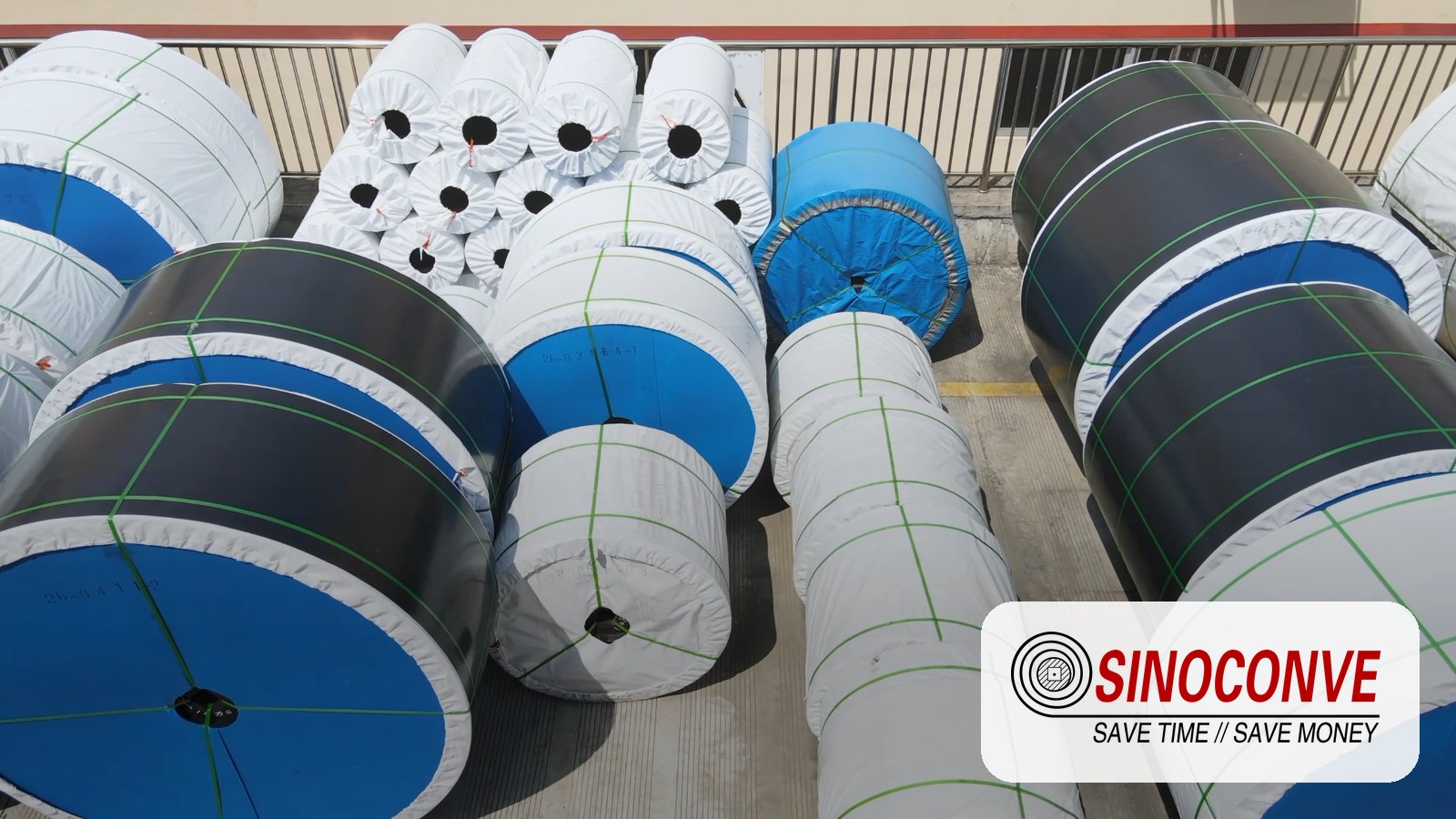
Finished rolls in the workshop. Each coil is tagged with specification, length and running direction.
09The Specification Sheet We Need From You
Send these ten items and we can normally name the construction, the pattern and the splice in one reply. Miss half of them and the quotation turns into a series of questions, which is how a two-day exercise becomes a two-week one.
- Line function — straight run, incline or transfer with a nose bar, and the steepest angle in degrees rather than "slight".
- Product — item size, weight per item, and whether the surface is loose, sticky, wet or hot.
- Belt width and length — measured on the frame, including the joint allowance if the belt is endless.
- Smallest pulley or roller diameter — this limits belt thickness and splice type, and it is the number people most often leave out.
- Load per metre and belt speed — enough for us to check the tension rating with margin.
- Temperature — normal operating temperature and the peak the belt actually sees.
- Chemical exposure — wash-down agents, oil, fat, salt, or cleaning in place.
- Food contact and colour — direct or indirect contact, which regulation applies, and any colour coding your hygiene plan uses.
- Cleats, sidewalls or guides — profile, height, pitch, and the frame detail they have to clear.
- Splice preference and frame access — whether the frame can be opened for an endless belt, or whether the joint has to be made on site.
A photograph of the old belt edge, with any printed marking visible, saves a round of questions on its own. So does a note of what failed last time, because the failure says more about the duty than the specification does.

10Frequently Asked Questions
What is the difference between PVC and PU conveyor belting?
Both use a fabric carcass; the coating differs. PU resists cuts, tears, oils and animal fats far better and runs over a wider band, roughly minus 20 °C to plus 90 °C. PVC costs less and cleans well on dry and ambient duties. On meat and bakery lines with knife exposure, PU usually pays for itself; on carton transfer, it rarely does.
Which surface pattern should I choose for an incline?
Start with the angle and the product. A smooth top holds to about 8 degrees, matte to about 12, diamond or waffle covers 15 to 30, and rough top goes beyond 30. A sealed pouch or carton is normally fine on diamond. If the product is loose, wet or unpacked, look at rough top or cleats, and send us the incline angle plus the minimum pulley diameter so we can confirm both.
Is PVC conveyor belting food safe?
It can be, provided the specific compound and colour carry the right declaration. We supply materials that can be built to meet FDA 21 CFR 177.2600 and EU 10/2011 requirements, and the grade, colour and cover thickness have to be confirmed for the belt you are ordering. Ask for a declaration of compliance naming the regulation and the intended contact conditions, not a general statement about the product family.
Can I use a PVC belt in a freezer?
Not comfortably. Standard PVC stiffens below about minus 10 °C and cracks at the splice, usually within the first weeks of running. Freezer tunnels, blast freezers and chilled lines below minus 15 °C are better served by a PE belt or a low-temperature PU compound, which stay flexible there. Give us the actual air and product temperature rather than the room name, because a chiller at 2 °C is a different duty from a blast freezer at minus 35 °C.
How long should a PVC conveyor belt last?
On an ambient packaging or parcel line, a belt with a 2 mm cover commonly runs several years. On a food line with daily wash-down, knife contact or heavy scraping, the cover and then the splice reach end of life sooner. Track cover thickness at three points across the belt every quarter: that wear rate is a far better replacement trigger than a calendar date.
How is a PVC belt joined, and can it be done on site?
In our plant we press an endless finger splice, which reaches roughly 40 to 70 percent of the belt's own tensile strength and runs smoothly over small pulleys. If the frame cannot be opened, the belt ships open-ended with a template-cut kit and the splice is pressed on site using a portable press. Field joints fail early for three reasons: moisture in the fabric, uneven press pressure, and fingers cut freehand.
What are your minimum order, lead times and sample policy?
Our normal minimum is around 50 m per specification. Samples ship in 2 to 5 days, regular production takes about 30 days from confirmation of the drawing and grade, and an urgent replacement can move in 15 to 20 days if you tell us the line is down. Payment is T/T with 30 percent deposit and the balance before shipment, or L/C, and OEM, ODM and private label work are all available.
Can you supply light duty belting and heavy duty belts on the same order?
We can. Light duty PVC and PU belting, multi-ply EP and rubber belting, chevron and cleated profiles and the V-belt range all come out of the same plant, so a mixed shipment can be quoted and scheduled together, which removes a supplier audit and a delivery window from your store room. Send sizes, quantities and destination port with the enquiry.
11Related Products You May Need
| Rubber conveyor belt Multi-ply constructions for bulk material, aggregate and recycling duty. |
EP rubber conveyor belt Higher tension ratings for long runs and heavier loads. |
PVC conveyor belt The light duty family covered in this guide, in white, blue and green. |
| Timing belt drives Tooth-profile belts for the packaging, labelling and indexing stations that sit next to a PVC line. |
Full product catalog Every belt family we build, with specifications and ordering data. |
Talk to our engineers Send the twelve-point specification and we will come back with a build. |
If you are mid-project and the line is already built, the fastest route is a photograph of the old belt edge plus the incline angle and the smallest pulley diameter. Send those three things to our sales team and we can usually confirm the material, pattern and splice in one reply.
Related Blog Posts
- PVC conveyor belt types and selection guide — the four structural families and how the joint method changes with each one.
- Food grade PVC conveyor belt: a buyer's check — the declarations and documents to request before you place an order.
- PU conveyor belts for food handling and hygienic lines — where PU beats PVC on meat, dairy and wash-down duty.
- Cleat PVC conveyor belt guide — cleat profiles, heights and pitch for inclined light duty lines.
- Food conveyor belt wholesale guide — how stocking dealers and integrators structure repeat orders.
- Rubber vs PVC conveyor belts — where the light duty family stops and the heavy duty range starts.