
V-belt vs Timing Belt: Which One Fits Your Line
Most drive failures we get called about are not belt failures. They are specification decisions made years earlier, and the belt is simply the part that finally admits it. A timing belt asked to survive a jaw crusher's shock load will shear teeth off the backing. A wrapped V-belt asked to hold a 1:1 phase relationship on a packaging indexer will creep a few degrees out of position every shift until the registration mark is 20 mm off and the operator starts blaming the servo. Both belts were installed correctly. Both belonged to the wrong drive family for the job they were given.
We are SINOCONVE, a belt operation in Ningbo that builds friction drives and synchronous drives on the same floor. As a V-belt manufacturer and a transmission belt manufacturer, we quote the same shaft speed with either answer, and the recommendation changes with the machine in front of us — how it starts, how it is loaded, how often somebody adjusts it, and who maintains it on a Sunday night. This page is the comparison we walk through with plant equipment engineers and maintenance supervisors before a quotation gets written. It is not a product listing. It is the reasoning behind the recommendation.

01Start With the Job, Not the Belt
When a distributor sends us a drive for quotation, the first mail usually contains a belt number and nothing else. We send it back. A part number tells us what somebody installed; it does not tell us what the machine needs. Two drives can look identical on a drawing — same center distance, same pulley diameters, same 15 kW motor — and still need different families, because one starts against a locked rotor and the other ramps up under a variable frequency drive.
So we collect three numbers before anything else. Getting these three right has saved more retrofit budget for our customers than any belt compound we have ever formulated.
Three Numbers Before Any Profile
Number one: starting torque, not running torque. A conveyor that draws 11 kW at steady state can ask for 250 percent of that for two seconds on a loaded start. V-belts slip in that window and survive; the slip acts as a mechanical fuse and the shock never reaches the gearbox. A timing belt rated for 11 kW continuous will see 27 kW of tooth load and either ratchet a tooth or break cords at the tooth root. Ask the question in amps: what does the motor draw in the first two seconds at locked rotor? That single figure reshapes the whole recommendation.
Number two: how exact the ratio must be. A friction drive gives back 1 to 3 percent as slip and creep, and it drifts with load. That is invisible on a fan, a blower, or a screw conveyor. It is fatal on a rotary cutter that must stay in register with a printing cylinder, on a transfer that feeds a robot cell, or on any drive where two shafts must hold phase for millions of cycles. If the process cares about position, not just speed, the decision is already made for you.
Number three: can the center distance move? This is the question we ask before we recommend, and it decides more installs than belt chemistry ever will. A V-belt can be installed by rolling it over a pulley groove and then tensioned with a take-up — that is why V-belt drives tolerate crude adjusters, slots, and even the occasional shim washer. A timing belt needs either an adjustable center distance or a proper idler, because it has to be tensioned to a real value and it has no slip to absorb a slack installation. If the frame is welded and the centers are fixed, you are either adding an idler or staying with friction.
02Friction vs Engagement: The Principle Behind Every Drive
Strip away the marketing and there are only two ways to move torque from one shaft to another with a flexible belt. You can rub, or you can interlock. Every V-belt, from a 6 mm fractional belt on a bench grinder to a 22 mm SPC belt on a mine fan, transmits torque by friction generated in a wedge. Every timing belt, from a 3M GT on a 3D printer to a 14M HTD on a stone crusher, transmits torque by the mechanical interference of teeth in grooves. The consequences of that difference run through everything else on this page.
How a V-belt Actually Grips
A V-belt does not sit in the bottom of the groove. It wedges against the two angled flanks, and that wedge multiplies the normal force far beyond the tension in the belt. With a 38-degree included groove angle, the normal force on the flanks is roughly three times the radial force the belt would apply if it simply lay on a flat pulley. That multiplication is the entire reason a 17 mm B-section belt can carry 15 kW at 1,450 rpm on a 125 mm pulley without a chain.
The grip is real, but it is not absolute. Between 1 and 2 percent of the driven speed disappears as creep — the belt stretches slightly on the tight side and contracts on the slack side, and each element of the belt leaves the driver slightly earlier than it arrived. Add slip under transient overload and you get the 1 to 3 percent total figure we quote to customers. On a 1,470 rpm motor that is 15 to 45 rpm at the output. Acceptable almost everywhere. Unacceptable on an indexing drive.
How a Timing Belt Holds the Ratio
A timing belt has tensile cords of glass fiber, aramid, or steel running through the pitch line, and molded teeth that drop into matching grooves. Torque is carried by the cords; the teeth only have to keep the belt from sliding around the pulley. Slip is zero in normal operation, ratio error is measured in arc-minutes rather than percent, and the drive runs at 96 to 98 percent efficiency because there is no wedge loss. No re-tensioning every few hundred hours, no belt dust in a food area, no dressing sprays.
Comparison Table: The Two Transmission Principles
| Design point | V-belt (raw edge or wrapped) | Timing belt (synchronous) |
|---|---|---|
| How torque crosses the gap | Friction wedge on angled flanks, normal force about 3x radial force at 38 degrees | Mechanical engagement of teeth in grooves, load carried by tensile cords at the pitch line |
| Slip and ratio accuracy | 1 to 3 percent creep and slip, varies with load | Zero slip in normal operation, ratio held to arc-minute accuracy |
| Peak efficiency | 90 to 94 percent wrapped, 95 to 98 percent raw edge with treated flanks | 96 to 98 percent across the useful speed range |
| Behavior at 200 percent overload | Belt slips, drive survives, gearbox protected, belt life shortened | Teeth shear or belt ratchets and jumps pitch; drive stops |
| Typical belt speed limit | 25 to 30 m/s classical, 35 to 42 m/s narrow section | 20 to 35 m/s depending on pitch and pulley tooth count |
| Sensitivity to dust, water, oil | Grip drops with oil; dust and grit mostly tolerable; EPDM and CR compounds handle heat | Debris packed into grooves causes tooth skip and rapid wear |
| Tensioning method | Deflection rule of thumb, about 10 mm per meter of span; matched sets on multi-belt drives | Sonic tension meter, target frequency in Hz from belt mass per unit length |
| Center distance flexibility | Wide; belt can be rolled on, take-up range is generous | Narrow; needs adjustable centers or an idler to tension |
| Best fit in one line | Shock loads, dirty plants, forgiving maintenance, cheap pulleys | Exact ratio, clean rooms, compact envelopes, low noise |
03Classical V-belt Sections A, B, C, D: Still the Right Tool on Old Frames
The classical V-belt family — A, B, C, and D sections under DIN 2215 and ISO 4184, or the RMA letters with inch dimensions in North America — is the oldest standardized friction drive still in daily production use. People treat it as obsolete. It is not. It is the section range that matches the pulleys already bolted to a 1990s mixer, the grooves on a quarry screen gearbox, and the cast-iron sheaves sitting in a warehouse in Nigeria that a maintenance team has to keep running next week.
Classical Section Dimensions We Work To
| Section | Top width | Height | Typical minimum datum diameter | Typical power per belt |
|---|---|---|---|---|
| A (13A / 4L range) | 13 mm (0.50 in) | 8 mm | 75 to 90 mm | 1 to 7 kW |
| B (17B / 5L range) | 17 mm (0.66 in) | 11 mm | 112 to 140 mm | 2 to 15 kW |
| C (22C) | 22 mm (0.87 in) | 14 mm | 180 to 224 mm | 5 to 40 kW |
| D (32D) | 32 mm (1.25 in) | 19 mm | 315 to 355 mm | 10 to 75 kW |
Power figures above are typical ranges for a single belt at motor speeds between 960 and 1,450 rpm with a reasonable speed ratio. Real capacity depends on the datum diameter of the small pulley, the arc of contact, the number of shifts, and the ambient temperature, so treat them as a starting point for sizing and confirm against the actual duty and drawing. A 200 mm C-section pulley running at 1,450 rpm behaves very differently from a 180 mm one at 900 rpm, and the difference is not linear.
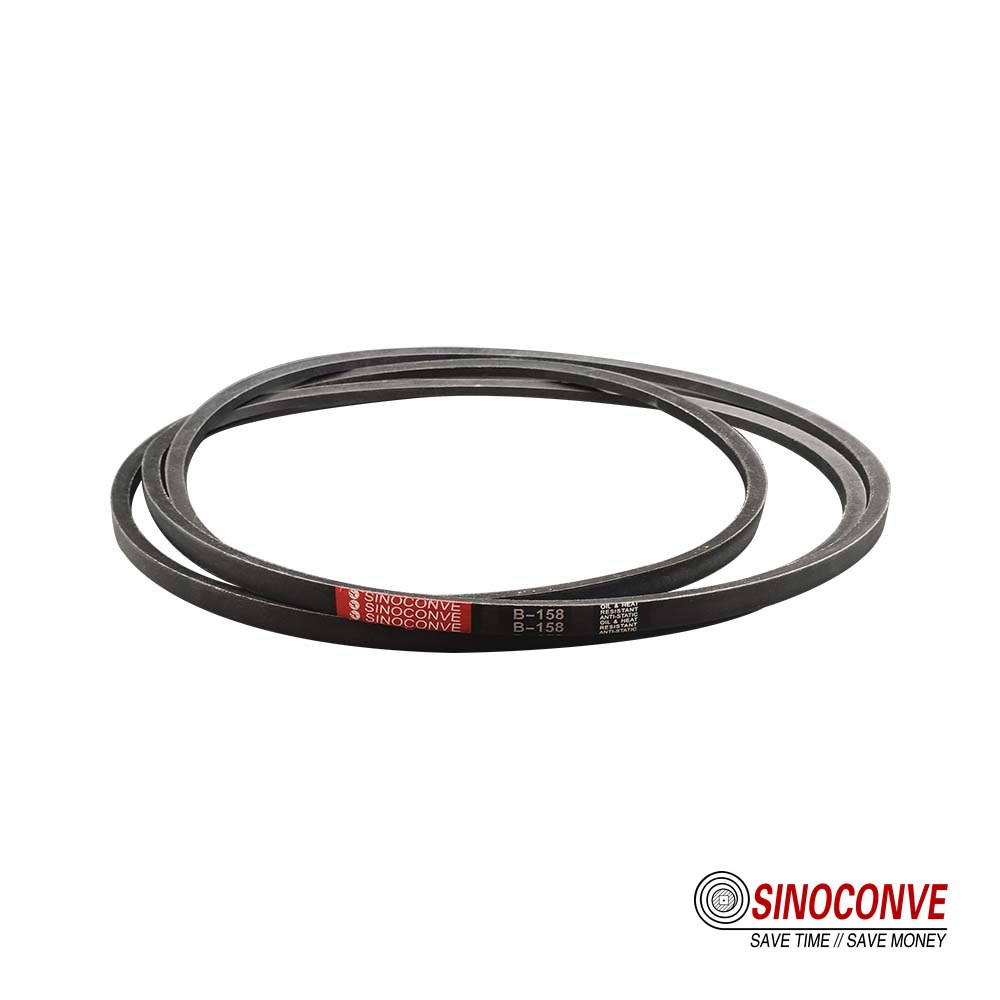
Length is the other trap. Classical belts are described on three different datum systems: outside length (La), datum length (Ld), and inside length (Li). A belt sold as "B-75" in one market and "B 1900" in another may be the same belt, or may be 25 mm apart. When a customer sends us a burned belt with a partially readable stamp, we measure pitch length on three belts from the same drive before quoting, because a mismatch of one size class will burn out a new set in a week.
04Narrow Sections SPZ, SPA, SPB, SPC: More Power in Less Space
DIN 7753 introduced the narrow section family — SPZ, SPA, SPB, and SPC — to carry more power in a smaller envelope than classical belts of the same height. The trick is geometry. A narrow belt is taller relative to its top width, so it sits deeper in the groove and wedges harder, and a higher-strength cord carries more tension per millimeter of width. The practical result is that an SPB drive often replaces a C-section drive with pulleys roughly 25 to 40 percent smaller in diameter and a much shorter center distance.
Narrow Section Reference Data
| Section | Top width | Pitch width | Typical power per belt | Where we see it most |
|---|---|---|---|---|
| SPZ | 9.7 mm | 8.5 mm | 0.5 to 6 kW | Small pumps, fans, machine tools, packaging feeders |
| SPA | 12.7 mm | 11 mm | 1 to 12 kW | Compressors, mixers, conveyors, agricultural implements |
| SPB | 16.3 mm | 14 mm | 3 to 35 kW | Crushers, screens, large fans, screw conveyors |
| SPC | 22 mm | 19 mm | 10 to 75 kW | Jaw and cone crushers, mine ventilation, mills, dredge pumps |
Note the gap between SPZ and SPA, and between SPB and SPC. A drive that needs 40 kW on a 160 mm pulley is not an SPB problem at all — it is an SPC problem with a wider face, or a multi-belt SPB set with four or five grooves. Because SPB and SPC share groove angles but not depth, you cannot mix them on one sheave, and we have seen more than one customer destroy a set of SPC belts by dropping them into SPB grooves that "looked the same" on the shelf.
Groove Angle Is a Moving Target
Pulley grooves are not all 38 degrees. A belt entering a small pulley has to bend more, so its cross section deforms and the effective wedge angle changes; that is why groove angles run from about 34 degrees on the smallest pulleys through 36 degrees in the mid range up to 38 degrees on large ones. Put a belt designed for a 38-degree groove into a 34-degree sheave and it bottoms out, loses grip, and slips — usually while the maintenance team reports that "the new belts are no good." We check groove angle with a profile gauge whenever a drive keeps eating belts, and it is surprising how often a worn or wrong-angle sheave, not the belt, is the root cause.
For buyers running a mixed plant, we keep SPA, SPB, and SPC inventory in the common lengths so that a conveyor belt distributor can consolidate a maintenance order in one shipment instead of splitting it across three suppliers and three freight bills.
05Raw Edge V-belt: What the Cut Edge Actually Buys You
Almost every V-belt is built as a sleeve: rubber, cords, and fabric are laid into a mold and cured as a ring. The difference between a wrapped and a raw edge belt is what happens next. A wrapped belt gets a fabric jacket that wraps the whole cross section, including the flanks. A raw edge V-belt has its flanks cut directly from the cured slab, so the angled sidewalls are exposed rubber compound with a precisely machined profile.
Why does that matter? Fabric on the flank is a friction reducer. It protects the belt in abrasive dirt and it survives badly worn sheaves better than bare rubber, but it also lets the belt slide a little more than it should. Cutting the flanks exposes a compound with a higher coefficient of friction, which lets the belt carry more torque at the same tension, run at a slightly higher belt speed, and bend around smaller pulleys without the jacket cracking. The typical gain in transmitted power for the same top width is in the range of 15 to 25 percent, and efficiency climbs to the 95 to 98 percent band instead of the 90 to 94 percent band.
Where a Raw Edge V-belt Is the Right Call
We recommend raw edge construction when the drive is compact, when belt speed is high, and when the pulleys are small. Think of a 5.5 kW gearmotor driving a 90 mm SPZ pulley at 2,900 rpm, or a woodworking spindle that has to spin at 6,000 rpm without a vibration signature, or a retrofit where the frame cannot be enlarged but the motor was upsized from 7.5 to 11 kW.In those cases the raw edge belt gives extra capacity from the same groove.
We also recommend it for reversing drives, because the machined flank wears more evenly in both directions, and for drives where the operator complains about belt dust or a squeal at start-up. A squeal on start is a friction event, and friction events come from the flanks.
The counter-case is just as clear. In an environment with heavy abrasive dust, or on a pulley that has visible grooves worn into the flanks, a wrapped belt lasts longer. There is a real cost in abrasive service for the extra grip. On a stone crusher with plenty of airborne grit, a wrapped or cogged belt is often the more economical answer even though the raw edge version would technically transmit more power. Construction has to match the plant, not just the calculation.
06Timing Belt Pitches in Practice: 3M, 5M, 8M, 14M, T5, T10
Pitch is the distance from one tooth center to the next, and it settles how much torque a belt can carry before the teeth shear off the backing. It comes from the profile, not from the length. Pick the pitch badly and no amount of extra belt width rescues the drive.
The profiles you actually meet in a plant fall into three families. There is the imperial range — MXL, XL, L, H and XH — which arrives with North American machinery and the aftermarket that supports it. There is the metric trapezoidal strand, T2.5, T5 and T10, which is what most European-built equipment carries. Then there is the curvilinear HTD and GT line in 3M, 5M, 8M and 14M, which is where nearly all new design work now lands. ISO 5296 describes the tooth form and the pitch codes.
Put two drives side by side and the point becomes obvious. A labeling head transmitting half a kilowatt through a 20 mm belt at high speed, and a mill drive transmitting 55 kW through a 115 mm belt at low speed, are not two settings of one answer. They are different worlds. Ask a 3M belt to work a 14M job and you will be counting missing teeth before the shift ends.
Pitch Selection Guide
| Pitch | Pitch size | Typical power range | Typical duty |
|---|---|---|---|
| 3M / T5 | 3 mm / 5 mm | 0.05 to 2 kW | Instrumentation, small pumps, labeling, office machines |
| 5M | 5 mm | 0.2 to 6 kW | Packaging indexers, small conveyors, blowers |
| 8M | 8 mm | 1 to 60 kW | Main plant drives, machine tools, textile machinery, agitators |
| 14M | 14 mm | 5 to 300 kW | Heavy process drives where ratio accuracy and low speed matter |
| T10 | 10 mm | 0.5 to 40 kW | European-built machines, pumps, compressors, food equipment |
| XL / L / H | 0.2 in / 0.375 in / 0.5 in | 0.1 to 30 kW | North American legacy equipment and aftermarket replacements |
One more factor catches people out, and it has nothing to do with pitch: the tooth count on the small pulley. Run a timing belt around a toothed pulley with fewer than 14 to 16 teeth in mesh and the whole load lands on two or three teeth. Life falls off a cliff. On our own drawings the working minimum is 28 teeth on the small pulley for a 14M drive and 22 for an 8M. This is exactly where a tight envelope starts to favour the friction family, because a V-belt has no minimum tooth count at all. A 90 mm SPZ sheave is an ordinary design choice. A 90 mm 14M pulley is a mistake with a part number.
07V-belt for Crusher Drives: Shock Load Is the Whole Story
If one application settles the argument in favour of friction, it is crushing. A jaw crusher swallows irregular lumps of rock, stalls for a beat, recovers, and repeats that cycle tens of thousands of times in a shift. The torque trace on the drive shaft does not look like a curve. It looks like a comb. Peaks at 200 percent of rated torque are routine, and a jam that stops the flywheel can push the transient far higher in the two seconds before the motor protection trips.
We have stood beside enough of these machines to recognize the sound. The belt squeals. The flywheel keeps turning on stored energy. Nothing downstream sees the peak. That squeal is the drive doing its job.
Our standard answer for a crusher is a multi-belt SPC set or a banded 8V set running from a 75 kW to 250 kW motor onto a large flywheel pulley. When the machine stalls, the belts slip. The shock never reaches the gearbox input shaft. Slip here is not a defect. It is a torque limiter that costs a handful of belts instead of a gearbox, and a gearbox for a machine that size is not a two-week repair. We have been through the arithmetic with maintenance managers who wanted to convert a crusher to a synchronous drive so they could stop changing belts. The conversation usually ends when we price the belts against a gearbox rebuild.
How We Specify a Crusher Drive
Three decisions dominate, and they are not equally weighted. Belt count and section come first. We size for the running power, then keep adding belts until the transient case is covered by slip rather than by belt failure. In practice that means one or two belts more than a clean running-power calculation suggests, and the extra belts cost less than the alternative.
Banded construction comes second. It starts to matter once a drive carries more than four belts and any pulsation at all. Loose belts roll over in the groove. Once a belt turns over it whips, and a whipping belt in a crusher house is a safety problem as much as a maintenance one. A banded set ties the belts together under a common top cover, so they behave as one unit, hold the same length, and cannot turn over.
Third, matched lengths. Mixed lengths in a multi-belt drive mean the longest belt carries most of the load and fails first. Then the customer buys a full set again. We group matched sets by length inside the tolerance the standard allows and stamp the set number on every belt in the package, so a partial replacement is at least a conscious decision rather than an accident.
Crushing circuits rarely stop at the crusher. The discharge lands on an industrial conveyor belt that has to survive the same rock and the same dust, and most plants prefer to buy both kinds of belt from one source so that spares and paperwork stay simple. That is one reason our customers often put drive belts and carrying belts on a single purchase order, and why we hold both quarry and mining belt lines in stock.
08Agricultural V-belt: Dust, Slip, and Seasonal Restart
Agricultural drives live under conditions that would shut a factory down inside a week. They stand outdoors in the weather. They run twelve hours a day for six weeks, then sit idle for six months and get restarted in the rain by somebody with no time and no patience. Belts on combine harvesters, round balers, grain augers and threshing drums are expected to run on dusty, rusty, slightly misaligned pulleys, and the maintenance budget is measured in minutes rather than hours.
That is why an agricultural belt is its own product family with its own sections and its own compounds. Dropping an ordinary industrial B-section onto a baler and expecting a season out of it is a common mistake, and an expensive one at harvest.
What Distinguishes an Agricultural V-belt
The agricultural sections in the RMA and ASABE world carry designations such as HA, HB, HC and HD. They are dimensioned around the pulley grooves that are already on the machine, but the top-to-height ratio is higher than the industrial equivalent of the same width and the cord package is heavier. Many of them are built around minimum pulley diameters that look absurd to an industrial engineer, because a harvesting machine has to fold itself around a crop row. Belt speeds are low and torques are high, which is the opposite of a machine tool drive.
Construction follows the duty rather than the catalog. Covers resist water and ultraviolet light instead of oil. Compounds stay flexible down to temperatures where an industrial belt has already gone glassy, so a belt that sat through a hard winter does not crack open on the first cold morning. Some drives use double-sided or hexagonal belts that drive from both faces around a run of backside idlers — a geometry that would be unthinkable on a machine tool and is completely normal on a combine.
Variable Speed and Slip Clutch Behavior
Harvesting machines commonly use variable-speed pulleys that open and close to change ratio while the machine is moving, with the belt running at a controlled slip for hours on end. That slip is deliberate, not a fault. It also means the compound has to tolerate continuous sliding at moderate load without glazing over. A belt that behaves perfectly on a fixed-ratio industrial drive will polish its flanks and lose grip on a variable-speed threshing drive inside one season. If you are sourcing an agricultural V-belt, say at the start that the drive is variable speed. The recommendation changes, and a supplier who does not ask that question is guessing.
09Selection Matrix: Match the Condition to the Drive
Textbooks present drive selection as a formula problem. On a plant floor it is a conditions problem. What usually decides the answer is not the belt data at all. It is the duty cycle, the state of the frame, and who is going to maintain the thing. The table below is the working version we use in customer meetings. Find the row that matches your machine, then read across.
| Operating condition | Recommended drive | Why | Watch out for |
|---|---|---|---|
| Frequent shock or stall loads (crushers, mixers, chippers) | V-belt, banded or multi-belt set, SPB/SPC or 8V | Slip absorbs the transient and protects the gearbox | Purchase as a matched set; check sheave wear |
| Position or phase must repeat exactly (indexers, printing, robotics) | Timing belt, 5M or 8M | Zero slip, ratio held to arc-minutes | Needs adjustable centers or an idler |
| Fixed, welded center distance with no idler | V-belt, raw edge or wrapped | Rolls over the sheave, tolerates rough adjustment | Do not overtension to compensate for wear |
| Very small driven pulley (under 80 mm) | V-belt, cogged raw edge | No minimum tooth count; cogs reduce bend stress | Watch heat build-up at high speed |
| Heavy dust, grit, or slurry | Wrapped or cogged V-belt | Fabric jacket resists abrasion; grooves cannot clog | Accept some slip; inspect more often |
| Oil mist, coolant spray, washdown | Timing belt with oil-resistant cover, or shielded V-belt | Toothed drive keeps working when flanks lose grip | Contamination degrades rubber either way; add a guard |
| High belt speed above 30 m/s | Narrow section V-belt (SPZ, SPA, SPB) | Narrow sections are rated to roughly 35 to 42 m/s | Balance the pulleys; vibration kills bearings first |
| Energy is the dominant lifetime cost | Timing belt | 96 to 98 percent efficiency, no slip loss, no dressing | Pulley cost is higher; alignment must be right |
| Operator-level maintenance, minimal tools | V-belt | Changeable in fifteen minutes with a pry bar and a rule | Training matters more than the belt brand |
| Outdoor seasonal machine, restart after storage | Agricultural V-belt | Low-temperature flexibility, UV and water resistance | Variable-speed drives need a slip-tolerant compound |
| Reduction ratio over 5:1 in one stage | Timing belt with a large driven pulley, or two-stage V-belt | Toothed drives handle high ratios with fewer grooves | Check arc of contact on the small pulley, keep above 120 degrees |
Two rows in that table earn a comment. The oil-mist row is the one people get wrong most often. A toothed belt running in oil mist fails just as surely as a V-belt does, only more expensively, because you lose the belt and usually a set of pulleys with it. The cure is a guard and a drain, not a different belt family. The efficiency row is the one that flips a decision when electricity is dear. A 37 kW drive running 6,000 hours a year at three percent lower efficiency throws away roughly 6,600 kWh a year. Over three or four years that pays for the pulleys a timing belt conversion needs, and every year after that the saving is free.
10Cost and Life: The Twenty-Four Month View
Purchase price is the smallest number in this whole comparison, and it is the one most often used to decide it. A wrapped B-section belt costs less than an 8M timing belt of similar length. Both are trivial next to the pulleys, the downtime and the electricity. When a maintenance manager asks us which is cheaper, we ask about the shift pattern first, because the honest answer moves with how many hours the drive runs and what an hour of stopped production costs. On a single-shift plant the arithmetic leans one way. On a three-shift plant running 6,000 hours a year it often leans the other way.
| Cost or life factor | V-belt drive | Timing belt drive |
|---|---|---|
| Belt purchase price at equal power | Baseline, usually the lowest cost per kW transmitted | Typically 1.5 to 3 times the V-belt price for the same duty |
| Pulley and sheave cost | Low; standard grooved sheaves are commodity items | Higher; toothed pulleys need hobbing or shaping and often a taper-lock bore |
| Energy cost over 6,000 h/year at 37 kW | Roughly 3 percent slip and wedge loss above a perfect drive | Lowest operating loss of any flexible drive |
| Typical service life, single shift, clean plant | 10,000 to 25,000 hours for a correctly tensioned raw edge belt | 15,000 to 30,000 hours in a clean, aligned, well-tensioned drive |
| Life in dusty or shock-loaded duty | Degrades gradually as flanks wear; replacement is predictable | Can fail suddenly by tooth shear with little warning |
| Maintenance labor per year | Re-tension at 100 h, check monthly, matched sets on multi-belt drives | Check tension at 100 h then about every 1,000 to 2,000 h |
| Cost of a failure event | Usually one belt set and two hours of labor | Belt plus possible pulley damage and a stopped production line |
| Spares holding | Shelf-friendly, long storage life, wide temperature tolerance | Keep flat or on a large-diameter hanger, avoid tight coils |
| Payback signal | Wins when downtime is cheap and load is rough | Wins when energy is dear, uptime is critical, or ratio accuracy is a spec |
Treat these numbers as planning ranges, not guarantees. Service life swings a long way with pulley alignment, ambient temperature, duty cycle and who did the installation. A raw edge belt that was re-tensioned at thirty minutes and again at one hundred hours will outlast the identical belt that was installed and forgotten. The only honest way to predict life on a specific line is to work from the actual duty and the drawing, and we would rather send a customer a sizing sheet than a promise.
11Installation, Tension, and Maintenance: Where the Two Families Diverge
Installation is where a correct specification either becomes a good drive or does not. The two families ask for different skills and different tools, and a team that is excellent with one will sometimes struggle with the other. That is not a reason to avoid either family. It is a reason to think about who will be standing at the machine at two in the morning.
V-belt Installation and Tension
The method is simple. Loosen the motor, push it in, roll the belt over the sheave without levering it with a screwdriver, pull the motor back, and set tension by deflection. The working rule is about 10 mm of deflection for every meter of span under moderate thumb pressure at the middle of the span. Run the drive for thirty minutes, then re-tension, because a new belt settles into the groove and gives up tension in the first hour.
On a multi-belt drive, replace the whole set. A new belt sitting next to three worn ones runs at a different diameter and ends up carrying the entire load. That is the whole story behind the most common sentence in belt maintenance: "we only replaced the broken one."
The inspection routine is cheap and visual, which is why we push it. Look for glazing on the flanks, cracks at the base of the belt, and whether the belt is riding high or low in the groove. A belt sitting on the groove bottom is not transmitting torque at all. It has worn thin, or the sheave has worn wide, and the cure is a new belt or a new sheave rather than more tension.
Timing Belt Installation and Tension
Never roll a timing belt over a flange. Remove the pulley or release the tensioner, slide the belt on, and set tension with a sonic meter reading span frequency in hertz. The target frequency comes from the belt mass per unit length, the span length and the required static tension, and it is different for every drive. Then turn the drive through two full revolutions by hand and check again, because the belt only seats into the grooves on the first pass. A timing belt that walks off the side of a pulley is nearly always a misalignment problem rather than a belt problem. No amount of tension will bring it back.
12From Enquiry to Delivery: What We Need and What We Ship
A useful enquiry has a handful of numbers in it. For a V-belt drive we want motor power and speed, the driven shaft speed or the existing pulley diameters, the center distance, the number of grooves, the section if it is still legible on the belt, the ambient conditions, and how many hours a day the drive runs. For a timing belt, add the pitch, the pulley tooth counts and whether the center distance is adjustable. A phone photo of a sketch on a notepad is fine. Accuracy matters here; formality does not.
Lead Times, MOQ, and Samples
Standard production runs 30 days from a confirmed order and drawing. On a genuine breakdown, where a line is down and money is leaving the plant every hour, we can compress that to 15 to 20 days. For V-belts, minimum order quantities start at 30 to 50 belts per section and length. That suits a distributor building a regional range and is awkward for a plant that needs four belts, so we will mix sections and lengths to reach a workable total. Samples ship in 2 to 5 days. A new timing belt profile that needs a mould adds tooling time at the front of the schedule, and we would expect you to approve a sample before mass production starts.
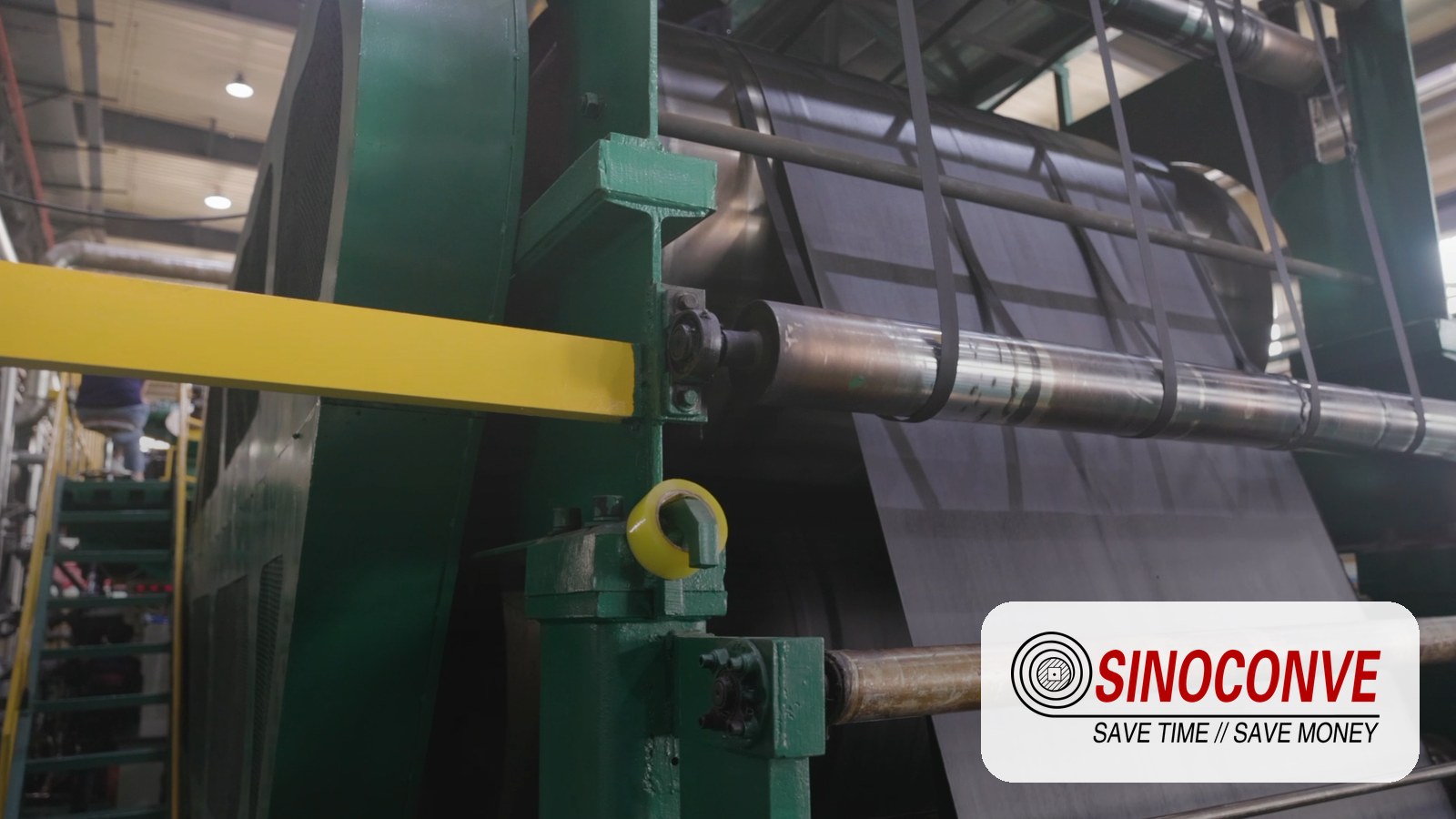
We are a belt factory rather than a trading desk, which means the person answering your technical question can walk out to the line and check. That sounds like a small thing until the day you need it. When a customer asks whether a raw edge profile can be built in an oil-resistant compound for a 42 degree ambient, the answer should come out of the compound room and not off a catalog page. You can see how we work and where the belts are made on our conveyor belt factory overview page.
Distributors and OEMs usually buy in mixed containers, and that shapes how we quote. A conveyor belt manufacturer and a drive belt maker inside one supply chain is convenient for a conveyor belt supplier relationship, because it means one set of documents, one inspection and one shipment covering drive belts, rubber conveyor belt roll goods, and the fittings a maintenance store normally chases from three different vendors. If you would rather order against a full list, our wholesale conveyor belts catalog section carries the standard ranges side by side, and you can mix V-belts, timing belts, PK belts and carrying belts in a single container without splitting the paperwork.
13Decision Rules: Choose A or Choose B
After enough retrofit conversations the decision collapses into a short list of rules. They are no substitute for a sizing calculation. They will get you into the right family before you spend money on pulleys.
Choose a V-belt when
Start with how the machine starts. If the motor has to break the load away from rest, the starting torque sits far above the running torque, and that is friction territory. A 45 kW hammer mill pulling two and a half times its running current at locked rotor does not get a synchronous belt from us. It gets a banded SPB set and a slip that works as a fuse.
Then look at the load itself. A drive that pulsates, or that can stall and recover, punishes teeth. Friction absorbs the punishment and keeps running. We saw the same pattern at a gold plant where a primary crusher cycled hard enough to shake the handrails. Those belts had been slipping for years. Nobody had ever opened the gearbox.
Look at the frame next, because it decides more installations than any calculation. A welded frame with fixed centers and no idler is not a timing belt installation waiting to happen. It is a V-belt installation, full stop. Friction belts roll over a sheave and tension up on a slotted motor plate. If somebody has to fabricate an idler onto that frame to make a synchronous drive fit, the conversion has quietly turned into a welding job.
Environment counts for more than the calculation sheet admits. Dust, grit and washdown are ordinary in a quarry or a foundry. Fabric-jacketed and cogged friction belts live with that. Grooves packed with grit are a different problem entirely, and they shorten pulley life along with belt life.
Size decides things at the small end. If the fastest pulley on the drive is 80 mm or under, take the friction answer. There is no minimum tooth count to respect, and a cogged raw edge belt bends around that diameter all day without splitting.
Finally, ask who maintains it. A crew with a pry bar, a steel rule and twenty spare minutes can change a V-belt set. On a remote site that is a real advantage, and it is no criticism of anybody's technicians.
Where all of that lines up, a raw edge belt in SPZ, SPA, SPB or SPC gives the most capacity per millimetre of pulley width, and a wrapped or banded classical belt gives the most abuse tolerance for the money.
Choose a timing belt when
Start with position rather than speed. If the process cares where the shaft is, not merely how fast it turns, the decision is already made. Registration, indexing, cut-to-length, transfer into a robot cell — every one of those needs a drive with no slip to give away.
Tight envelopes push the same way. A synchronous drive holds a high ratio in a single stage and needs fewer grooves than the friction alternative. Once you pass about 5:1 in one stage, teeth are usually easier to build with than a wedge.
Long hours change the arithmetic. A drive running 6,000 or 7,000 hours a year cannot afford to give away two to four points of efficiency to slip and wedge loss. On a 37 kW motor that is real money, and it comes back every year on the same bill.
Cleanliness is a requirement in some plants and a preference in others. In a food or pharmaceutical area, belt dust is not a preference. It is an audit finding. A synchronous drive does not shed flanks, and that single fact ends the discussion on those lines.
Smoothness matters too. Where the motor sits behind a variable frequency drive with a proper soft start, most of the shock that would otherwise attack the teeth has already been engineered out of the system. That is the case where converting a high-power drive to a timing belt is reasonable rather than reckless.
And when the honest answer is "both"
Most plants are not making one decision for a whole factory, and they should not try. A packaging line can run friction drives on the main transport and synchronous drives on the registration and cutting sections. That is good design, not a compromise.
What matters is that each shaft was decided on purpose, and that the decision survives in writing. A belt store that mixes sections without labels, or keeps one belt size for four different drives, will produce failures that look random and are, in fact, scheduled. Somebody will fit the wrong belt one night; it will run just long enough to look like it worked.
We would rather sell the right family once than the wrong one three times over. Send the drive details and a photo of the nameplate, and what comes back is the family we would use, the section or pitch, how many belts we would hang on that drive, and a straight note about anything that cannot be confirmed without the drawing.

14Frequently Asked Questions
Can I replace a V-belt with a timing belt to stop re-tensioning?
A maintenance supervisor asked us this last month over a photo of a crusher drive, and the honest answer is that the re-tensioning would not stop — it would only get harder. A timing belt still wants a tension check at around 100 hours and periodic checks after that, and on a crowded drive those checks mean a sonic reading in a gap where you can barely fit two fingers, against a thumb deflection on a V-belt you can take from the walkway. What actually justifies the conversion is ratio accuracy, and that is a different question from maintenance hours. On a registration shaft or an indexing shaft the swap earns its keep. On the shock-loaded drives we get asked about most, our answer is no, because you would be trading a belt set for a gearbox rebuild, and we have watched that trade go wrong more than once.
What is the difference between a raw edge V-belt and a wrapped V-belt?
Between 15 and 25 percent — that is the usual power gap between a raw edge and a wrapped belt of the same top width, and it is nothing more complicated than what touches the sheave. Cut those angled sidewalls straight out of the cured rubber slab and bare compound grips harder, which also lets the belt bend around a small pulley without the jacket splitting. Wrap the whole cross section in fabric instead, flanks included, and you give up some grip in exchange for a surface that shrugs off abrasive dust and tolerates a worn groove far better. In a quarry we usually specify wrapped and accept the lower figure, because a belt that survives the grit outlasts one that transmits 20 percent more power for three weeks.
Which classical section should I use, A, B, C, or D?
13, 17, 22 and 32 mm across the top — those are A, B, C and D under DIN 2215 and ISO 4184, and no section will seat properly in another one's groove, so the sheave already bolted to the frame normally settles the argument before any calculation starts. Working from a bare drawing is a different exercise: A covers roughly 1 to 7 kW per belt, B about 2 to 15 kW, C about 5 to 40 kW and D about 10 to 75 kW at motor speeds between 960 and 1,450 rpm. Then check that figure against the small pulley diameter and the daily hours, which move the answer more than most people expect.
What does SPZ, SPA, SPB, and SPC mean, and can I swap them?
We have watched a full set of SPC belts destroyed in a single shift by an SPB sheave that looked identical on the shelf, which is the quickest way to explain why DIN 7753 keeps these belts at 9.7, 12.7, 16.3 and 22 mm across the top and never mixes them. Each section sits at a different depth in its groove. What the family buys you is power density — more load than a classical belt of the same height, inside a smaller pulley envelope — with speed ratings running to roughly 35 to 42 m/s, and an SPC belt forced into an SPB groove damages the belt and the pulley at the same time.
Is an agricultural V-belt just a regular V-belt with a different label?
Not by a wide margin, and the gap shows up in the second season. Agricultural sections such as HA, HB, HC and HD are dimensioned around the small pulleys and the high torque of farm machinery, and the compounds are built for water, ultraviolet light, low-temperature flexibility and the continuous sliding that goes on inside a variable-speed harvesting drive. An industrial belt of the same nominal width may drop into the same groove and run perfectly well — it will usually be finished before the harvest is.
Why does my multi-belt drive keep breaking the same belt?
This pattern comes from the store rather than the drive: two lengths of the same section on the shelf, or a fitter who replaced one belt instead of the whole set. If the lengths differ even slightly, the shortest belt carries most of the load and dies first, then the next shortest takes over — so replace the whole set with matched lengths, check the sheave grooves for wear, and put a straightedge or a laser across the pulley faces before you push the start button.
How do I tension a V-belt without a tension gauge?
About 10 mm of deflection for every meter of span, measured with firm thumb pressure at the middle of the longest run — that is the whole method, it is close enough for most drives up to about 30 kW, and above that figure, or on any timing belt at all, you should stop guessing and reach for a gauge or a sonic meter.
What is the minimum order quantity and lead time for a custom belt?
30 to 50 belts per section and length is where a V-belt order normally starts, though we will mix sections and lengths to reach a workable total for a plant that only needs four. Standard production runs 30 days from a confirmed order and drawing. When a line is down and money is leaving the plant every hour, that can be compressed to 15 to 20 days. Samples ship in 2 to 5 days, and a new timing belt profile that needs a mould adds tooling time at the front of the schedule, so plan on approving a sample before we run the batch.
Can a belt slip be a good thing?
What actually breaks when a jaw crusher stalls — the gearbox, or the belts? On a shock-loaded drive the belt slips and the torque peak stops right there, so the gearbox, the coupling and the motor are all spared a load the drive train was never sized to carry. The price of that protection is a set of belts, and against a gearbox rebuild it is a bargain.
How should I store spare belts?
The belts that come apart first are usually the ones that spent three years hanging behind a hot motor, so start with the shelf rather than the belt. Cool, dark and dry is the rule, away from electric motors, transformers and anything that throws ozone or direct sunlight.Hang V-belts on a large-diameter peg, or lay them flat in a carton, and never coil a timing belt tightly or fold one — a crease damages the cords permanently, and that is exactly where it will break. Rotate stock so the oldest belts leave first, and write the receipt date on the box. Rubber ages on the shelf whether or not anybody runs it.
15Related Products You May Need
Most of the enquiries that reach us are not for one belt but for a whole maintenance programme — a V-belt set for the crusher, a timing belt for the indexer, and the carrying belts for the same discharge line. What follows is what those customers actually order from us, listed in roughly the order their questions arrive. If you already have the drive data, a quotation is one message away; if you are still deciding between families, the last column is the fastest way to see whether we build the section or pitch you need.
| Product line | What it covers | Where to look |
|---|---|---|
| V-Belt | This is where we send a shock-loaded crusher, a mixer that stalls on a cold morning, or any drive whose frame is welded solid with no room for an idler. Classical A B C D, narrow SPZ SPA SPB SPC, raw edge, cogged, banded and agricultural sections all sit in this one line. | V-belt range |
| Timing Belt | Standard production is 30 days from a confirmed order and drawing, a genuine breakdown can be pushed through in 15 to 20 days, and a profile that needs a new mould adds tooling time at the front of the schedule. Covers HTD 3M 5M 8M 14M, T5 and T10, plus imperial XL L H replacements. | Timing belt range |
| PK Belt | Only worth a look when the envelope leaves you almost no pulley width to work with — but on that drive a serpentine rib set is often the neatest answer, and it is the family that takes over exactly where the single and multi-belt friction drives in sections 04 and 05 run out of room. | Poly-V belt range |
| Rubber Conveyor Belt | Choose the cover before the carcass: abrasion-resistant where the rock is sharp and the drop is high, heat-resistant where the material arrives warm, and a chevron profile once the belt has to climb rather than run flat. EP and NN carcasses cover most of what a quarry or a bulk terminal asks for. | Conveyor belt range |
| Full Catalog | If your order carries drive belts and carrying belts together, this is the page that keeps it to one set of documents, one inspection and one shipment — which is the whole reason a maintenance store stops chasing three vendor accounts. | Product catalog |
| Contact | Send the motor power, the shaft speeds or the existing pulley diameters, the center distance and the groove count, plus a photo of the nameplate. A sketch on a notepad is fine, formal drawings are not needed for a first recommendation, and the answer usually comes back the same day. | Talk to our engineers |
16Related Blog Posts
This page answers the comparison question and not much else, and we would rather point you at the guide that fills the gap than pad this one out. The pieces below are the ones we send most often to engineers who are still narrowing down profiles, or who have inherited a drive nobody can identify. Read them top to bottom if the subject is new to you, or jump straight to the banded and raw edge titles if you already know which family you want.
- V-belt buying guide: profiles and sizes — the place to start if your only question is which section or pitch to write on a purchase order, including the size codes that different markets print differently.
- Classic V-belts vs cogged V-belts — is a cogged belt always the upgrade? Worth reading before you assume it, because pulley diameter and belt speed decide the answer.
- PU timing belt vs rubber timing belt — two materials for the same drive, and the difference in service temperature and chemical tolerance decides the choice more often than the price does.
- Cogged V-belt manufacturer vs wrapped supplier — we wrote this for buyers who keep getting two quotations for one drive and want to know why the specifications never line up.
- Raw edge cogged V-belt: when to choose it for industrial drives — aimed at the drives where a wrapped belt is acceptable but not ideal: small pulleys, high belt speeds, and retrofits where the motor was upsized but the frame was not.
- Banded V-belt drive system selection — if a belt on your multi-belt drive has turned over even once, read this before you buy the next set.
- Transmission belt guide: choosing and maintaining a V-belt — the long version, covering tension, alignment and shelf storage for the maintenance teams who have to keep a mixed fleet of drives running.