
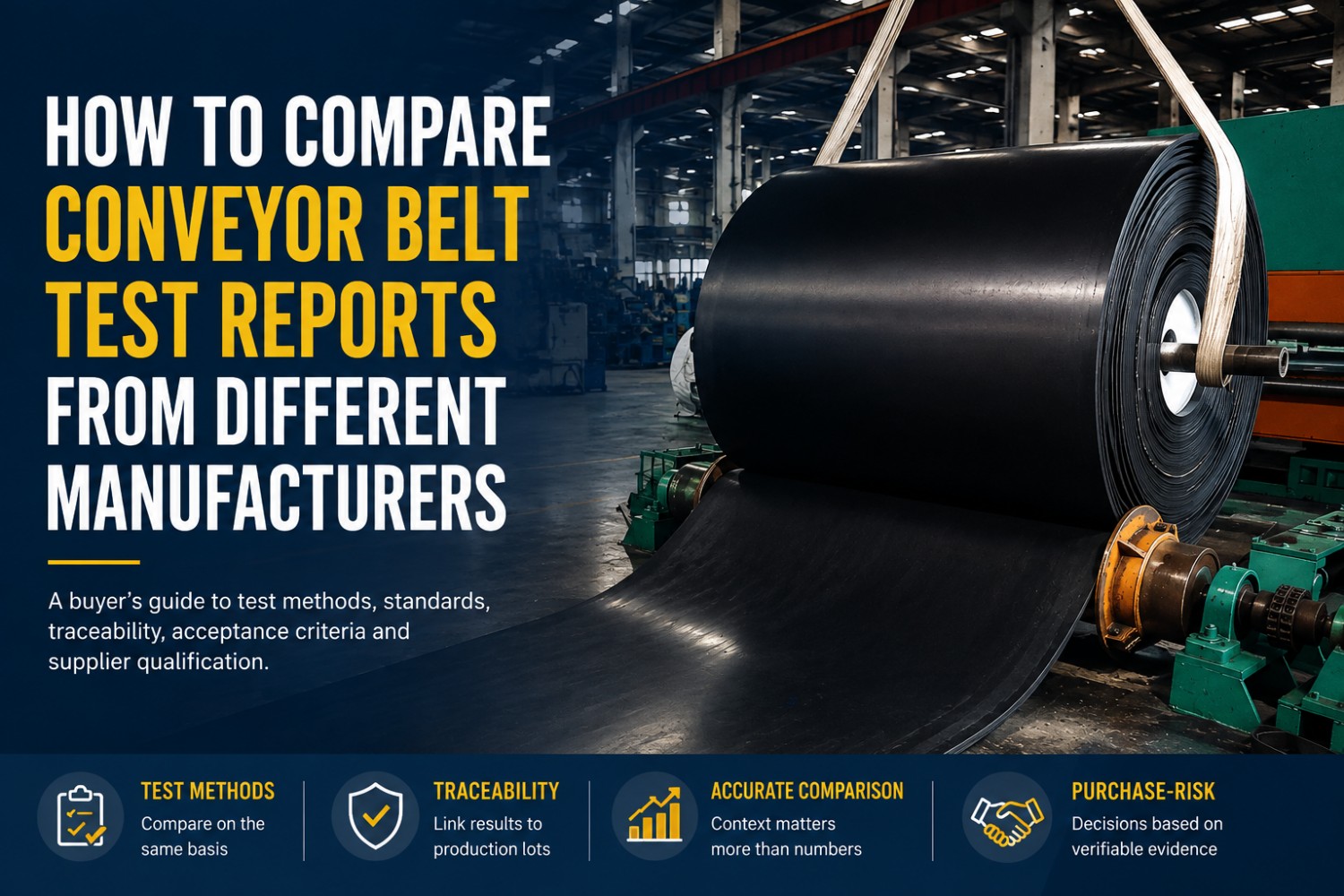
How to Compare Conveyor Belt Test Reports from Different Manufacturers
A procurement team may receive three quotations for the same EP conveyor belt and see three very different test reports. One supplier lists tensile strength and elongation. Another adds abrasion and adhesion results. A third sends a certificate carrying an ISO reference but gives little information about the tested sample. Comparing the numbers line by line can create a false sense of certainty.
A useful conveyor belt test report must answer more than “did the sample pass?” It should show what was tested, which belt or batch the sample represents, which method was used, what requirement applied, and whether the result can be traced to the material being purchased. For Quality and Procurement teams qualifying a rubber belt factory, those details often matter more than the number of tests printed on the page.
Do not rank conveyor belt manufacturers by whichever report contains the highest numbers or the longest list of tests. First normalize the specification, standard edition, test method, units, sample identity and acceptance criteria. Then compare the actual results. A report without traceability may describe a good laboratory sample without proving that the production belt you are buying has the same construction.
1. Why Conveyor Belt Test Reports Are Often Difficult to Compare
Test reports become misleading when buyers assume that identical property names mean identical tests. They do not necessarily.
“Tensile strength,” for example, could refer to the full-thickness strength of a textile conveyor belt or a property of the cover rubber. An abrasion result depends on the stated method and reporting basis. Adhesion results are meaningful only when the interface, test method and units are clear. A report may also quote a standard without identifying its edition or explaining which requirements apply to the ordered belt.
This is particularly important with an EP conveyor belt, where the buyer needs to distinguish between carcass-related properties, cover-rubber properties, adhesion, dimensions and any application-specific requirements.
Before comparing Manufacturer A with Manufacturer B, ask a more basic question: are the two reports actually describing the same product requirement?
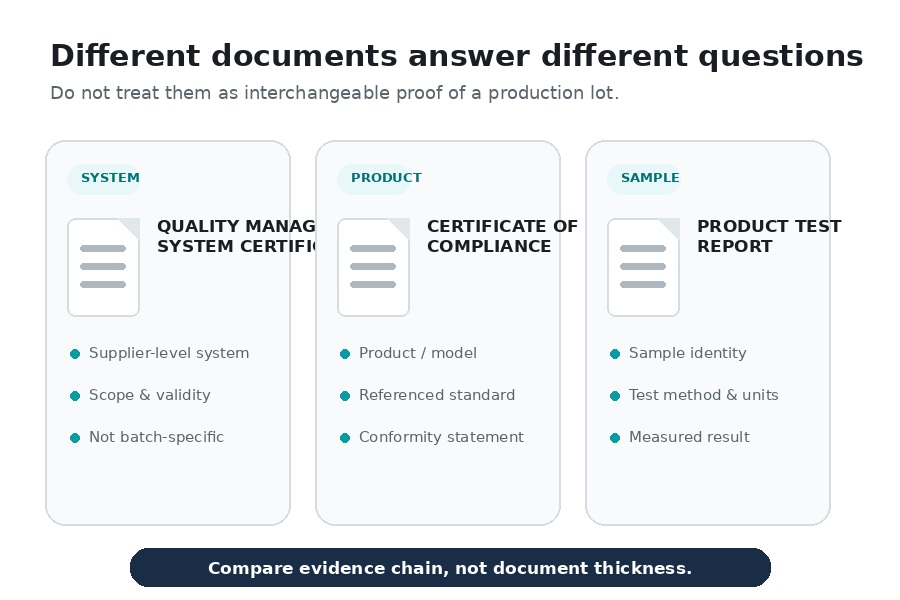
A test report, technical data sheet, certificate of conformity and quality-management certificate are different documents. Do not treat them as interchangeable proof that a particular production lot meets your purchase specification.
2. Start with the Purchase Specification, Not the Test Result
The strongest comparison begins before the reports arrive. Procurement should issue the same technical requirement to every candidate manufacturer.
For a heavy duty conveyor belt, that requirement may include belt type, carcass construction, nominal strength, width, cover thickness, cover grade, applicable standard and any special performance requirement. Application information such as conveyed material, loading conditions, temperature, oil exposure or fire-safety requirements should be included when it affects the belt specification.

Without this common baseline, a buyer may compare two technically different products as if they were substitutes. A lower quotation may simply reflect a different construction or test scope.
| Comparison Item | What Procurement Should Verify | Why It Matters |
|---|---|---|
| Belt construction | Textile or steel cord, carcass rating, ply/cord construction and covers | Results from different constructions should not be compared as though they represent the same belt. |
| Standard | Exact standard and required edition | Standards are revised. A standard number without an edition can leave the acceptance basis unclear. |
| Test method | Method used for each reported property | Similar property names can be measured or reported differently. |
| Acceptance value | Contract requirement, not merely the measured value | A result cannot be judged as conforming unless the requirement is defined. |
| Sample identity | Product, batch, roll or other traceable identifier | Shows whether the result can be connected to the supplied goods. |
3. Check Whether the Report Is Traceable to the Belt You Are Buying
This is one of the most important supplier-qualification checks and one of the easiest to overlook.
A technically impressive report has limited purchasing value if it cannot be connected to the ordered product. Look for information that identifies the manufacturer, product description, specification, sample, production batch or roll where applicable, test date and report number.
Then compare those identifiers with the quotation, purchase specification and packing or production records.
Suppose a supplier offers an EP belt against your approved specification but submits an old laboratory report carrying only a generic product name. The reported properties may be genuine, yet the document does not establish that the quoted construction or future production lot was represented by that sample.
For repeat orders, traceability becomes even more useful. It allows Quality teams to compare batches, investigate deviations and determine whether a later shipment was produced against the same approved specification.
4. Separate Carcass Tests, Cover Tests and Complete-Belt Tests
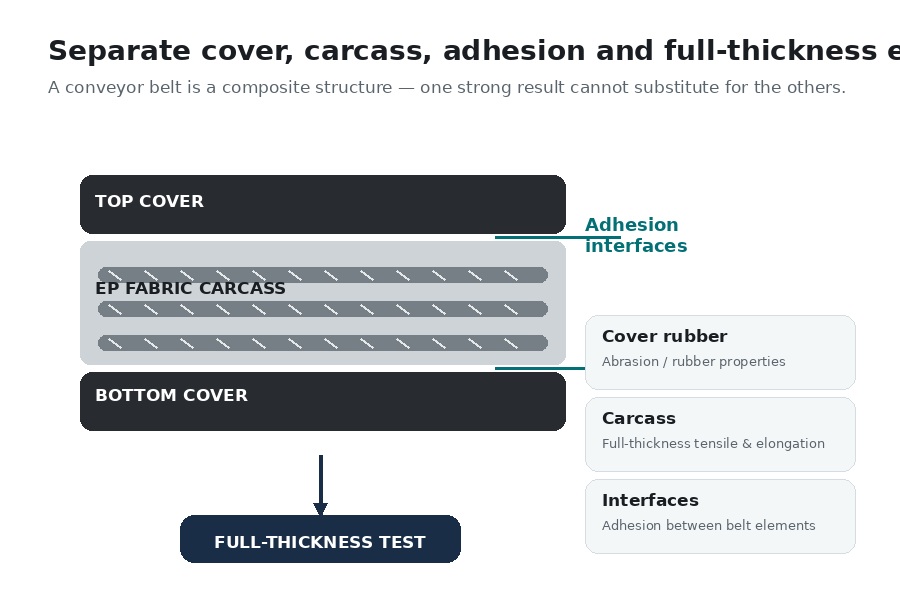
A conveyor belt is a composite structure. The carcass carries tension, the covers protect the structure and interact with the conveyed material, while adhesion helps the constituent layers remain integrated. One strong result cannot substitute for the others.
4.1 Full-thickness tensile strength and elongation
For textile conveyor belts, ISO 283:2023 specifies a method for determining full-thickness tensile strength in the longitudinal direction together with elongation at the reference force and at break. Depending on the purchasing requirement, these results can help verify the mechanical behavior of the textile belt carcass.
When comparing reports, check the direction of testing, units, test method and the exact belt construction represented by the specimen. Do not compare a carcass-related full-thickness result with the tensile strength of cover rubber.
4.2 Adhesion between belt elements
Adhesion matters because a conveyor belt does not work as independent pieces of fabric and rubber. ISO 252:2023 provides test methods for adhesion between constituent elements, including between plies and between covers and the carcass, within the standard's stated scope.
For procurement comparison, identify which interface was tested. A single value labelled only “adhesion” is incomplete if the report does not make the test location and method clear.
4.3 Abrasion resistance
Abrasion data is frequently emphasized for mining, quarrying and other abrasive bulk-material applications. ISO 4649:2024 describes rotating cylindrical drum methods for determining rubber abrasion resistance.
There is an important limitation: a laboratory abrasion test is useful for comparative testing, quality control and specification verification, but it should not be converted directly into a promised field service life. Real belt wear also depends on material characteristics, transfer height, impact, loading geometry, belt speed, cleaning systems, alignment and other operating conditions.
If Supplier A reports a better abrasion value than Supplier B, first confirm that both used the same method and reporting basis. Then treat the result as one piece of qualification evidence—not as proof that Supplier A's belt will last a specific percentage longer in your conveyor.
5. Verify the Standard and Its Edition
Writing “ISO standard” on an RFQ is not precise enough.
ISO 14890:2026 is the current international specification for rubber- or plastics-covered conveyor belting of textile construction for general surface use on flat or troughed idlers. It replaced the 2013 edition. This is a useful example of why buyers should record the edition instead of copying a standard number from an old specification indefinitely.
Test methods also have their own standards and revision cycles. For example, ISO 283:2023 addresses full-thickness tensile strength and elongation of textile conveyor belts, while ISO 252:2023 addresses adhesion between constituent elements within its applicable scope.
Special-service belts require additional attention. A flame-resistance requirement, electrical-conductivity requirement or heat-resistant cover requirement should appear because the operating environment requires it—not because adding more standards makes a quotation look more technical.
For example, ISO 340:2022 covers a laboratory-scale method for assessing a conveyor belt's reaction to an ignition flame source. Such a result answers a defined fire-test question; it does not by itself verify every other mechanical, operational or regulatory requirement for a conveyor installation.
6. Compare the Test Method Before Comparing the Numbers
Once the reports are traceable and the specification is aligned, Procurement can start comparing measured values. Keep the method beside the result.
| Property | What to Compare | Common Procurement Mistake |
|---|---|---|
| Full-thickness tensile / elongation | Test method, direction, units, specimen identity and requirement | Comparing values from different belt constructions or confusing belt strength with cover-rubber tensile data |
| Abrasion | Method, reporting basis, units and cover compound represented | Assuming a laboratory abrasion result predicts exact belt life |
| Adhesion | Interface tested, method, units and acceptance requirement | Accepting a generic “adhesion” number without knowing what was separated |
| Dimensions | Width, length, total thickness, covers and specified tolerances | Checking nominal dimensions but not the agreed tolerance |
| Special performance | Applicable test method, requirement and sample identity | Requesting fire, heat, oil or electrical properties without linking them to the actual application |
7. Do Not Confuse “Higher” with “Better”
Procurement spreadsheets naturally encourage ranking. Conveyor belt engineering does not always work that way.
If a manufacturer reports a property above the specified minimum, the first question is whether it complies—not whether it has the largest number among all bidders. A higher numerical value may be useful for some properties, irrelevant beyond the requirement for others, or potentially misleading if the methods differ.
The same logic applies to belt construction. A higher-strength carcass is not automatically the better purchase. Conveyor length, operating tension, take-up arrangement, pulley diameters, loading and splice design all influence the appropriate construction. Buying a heavier belt simply because it appears more robust can add cost without solving the actual operating problem.
For buyers still defining the correct carcass range, the EP100 to EP400 rubber conveyor belt guide explains why fabric strength should be matched to real conveyor conditions rather than selected by rating alone.
8. Distinguish Factory Reports from Independent Third-Party Reports
Factory and third-party reports can both have a place in supplier qualification, but they answer different commercial questions.
A factory laboratory is valuable for routine process control, production testing and ongoing batch verification. An independent inspection or laboratory can add another level of verification when the buyer requires external evidence for a critical order, new supplier, contractual requirement or disputed result.
Third-party testing does not remove the need for traceability. An independent laboratory result is only as relevant as the sample submitted to it. Procurement should define who selects the sample, how it is identified, whether testing is witnessed, which methods apply and how results will be handled if they fail.
SINOCONVE's documented quality-control process includes incoming raw-material inspection, in-process monitoring, finished-belt inspection and performance testing before shipment. The company can provide product test reports, while third-party testing can be arranged where a customer's specification requires it. More detail about the factory's manufacturing and quality framework is available on the SINOCONVE conveyor belt manufacturer profile.
9. Use Test Reports to Audit the Factory's Quality System
A test report should not be evaluated in isolation from the factory that produced it.
During a factory audit, ask how raw materials are approved, where test specimens are taken, how instruments are controlled, who reviews results, how nonconforming results are handled and how records are linked to production. Then follow one completed order from raw material to finished roll and supporting documentation.
SINOCONVE's confirmed conveyor belt operation includes eight fabric conveyor belt production lines, two steel cord conveyor belt production lines, a laboratory and 15 quality-control personnel. Its quality process includes incoming material checks, production inspection and final testing and inspection before shipment.
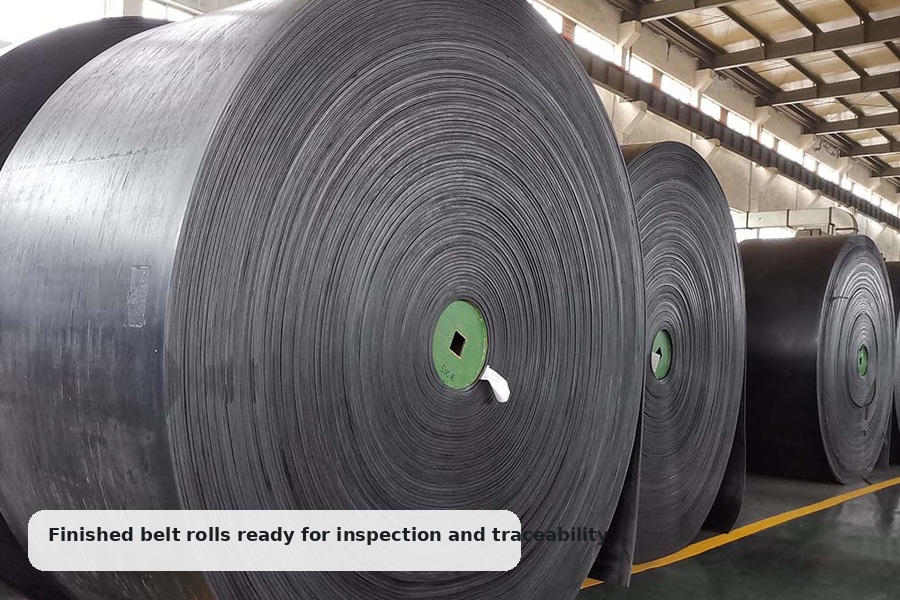
Those capabilities are relevant to supplier qualification, but the buyer should still define the inspection and documentation requirements for the specific purchase order. Factory capability and order-specific conformity are related; they are not the same proof.
For a broader supplier-audit framework, see how to evaluate a rubber conveyor belt manufacturer.
10. Build a Side-by-Side Supplier Qualification Matrix
Once technical scope has been normalized, Procurement can compare manufacturers in a structured way. Avoid reducing the decision to price plus a single “Pass/Fail” test column.
| Qualification Area | Evidence to Request | Warning Sign |
|---|---|---|
| Specification match | Quoted construction mapped to each required specification item | Quotation uses only a generic belt description |
| Test methods | Method and edition identified beside relevant results | Results provided without methods or units |
| Traceability | Report/sample identifier linked to production records or supplied lot | Generic report with no identifiable connection to the order |
| Acceptance criteria | Agreed limits stated in specification or inspection plan | Supplier submits numbers but no basis for Pass/Fail |
| Factory QC | Incoming, in-process and final inspection controls | Quality claim depends only on final visual inspection |
| Third-party verification | Defined scope, sampling responsibility and test requirements where needed | Old third-party certificate presented as proof for every future order |
| Repeat-order control | Approved specification, revision control and retained production records | Specification must be reconstructed from sales emails for each order |
11. What to Put in the RFQ Before Asking for a Test Report
The best time to resolve test-report differences is before production, not when the container is ready to ship.
Your RFQ should identify the required belt construction and operating duty, then state what evidence must accompany the order. For replacement belts, attach the existing specification, belt marking, drawing or available previous report. For a new conveyor, provide the engineering data needed to review the proposed belt.
- Product definition: belt type, width, length, carcass or strength requirement and cover construction.
- Application: conveyed material and the operating conditions that affect belt selection.
- Governing requirement: applicable standard, edition and project-specific specification.
- Inspection scope: dimensions and performance properties that must be verified.
- Test documentation: required report format, sample or lot identification and acceptance limits.
- Independent verification: whether third-party inspection, witnessing or testing is required and who controls sampling.
- Commercial traceability: quantity, roll identification, packing and documents that must match the purchase order.
The conveyor belt sourcing guide provides a wider procurement framework for connecting specification, inspection, testing and supplier documentation before a purchase is released.
12. Frequently Asked Questions
Is a conveyor belt test report enough to approve a manufacturer?
No. It verifies only the properties, samples and scope identified in that report. Supplier approval should also examine manufacturing capability, quality control, specification management, traceability and repeat-order consistency.
Should I choose the manufacturer with the best test values?
Not automatically. First verify that the suppliers tested equivalent belt constructions using comparable methods and units. The correct purchasing target is conformity with the engineered requirement plus reliable production control, not the largest number in every column.
What should an EP conveyor belt test report include?
The exact scope depends on the purchase specification. For a textile belt, relevant evidence may cover dimensions, full-thickness tensile and elongation behavior, adhesion and applicable cover-rubber properties. Special tests should be added only when required by the application or contract.
Can an old test report be used for a new order?
It may help demonstrate historical capability, but it should not automatically be treated as batch-specific evidence for new production. Ask what the old report represents and what inspection or test documentation will be generated for the new order.
Does ISO 9001 prove that a conveyor belt meets the product specification?
No. A quality-management-system certificate and a product-specific test report answer different questions. Procurement should verify both the supplier's quality framework and the evidence associated with the belt being purchased.
When should I request third-party testing?
Consider it when independent verification is required by the contract, when qualifying a new supplier for a critical application, when the order has unusual technical requirements, or when the commercial risk justifies additional verification. Agree the test scope and sample-selection process before production.
Can abrasion test results predict conveyor belt service life?
Not by themselves. Laboratory abrasion testing is useful for comparison and quality control, but field wear is also influenced by conveyed material, loading and transfer conditions, impact, belt speed, alignment, cleaning and other system factors.
13. Compare Evidence, Not Just Documents
A thick test-report package is not necessarily stronger evidence. For procurement, the useful chain is straightforward: approved specification → identifiable production → appropriate test method → traceable result → defined acceptance decision.
If one link is missing, ask the manufacturer to clarify it before the purchase order is released.
For conveyor belt sourcing, SINOCONVE can review the required belt specification, testing scope and documentation before production. Buyers can send the existing belt specification or drawing, required standard and edition, relevant operating conditions, quantity, and any project-specific inspection or third-party testing requirements to sales@sinoconve.com. For a formal quotation or technical review, use the SINOCONVE contact and RFQ page.

Related SINOCONVE Products
- EP Rubber Conveyor Belt — browse SINOCONVE's textile-reinforced rubber conveyor belt category.
- Industrial Conveyor Belt Products — review rubber conveyor belt categories for different operating conditions.