

Engineered belt solutions for demanding industries worldwide

Recent Posts
V-belt vs Timing Belt: Which One Fits Your Line

V-belt vs Timing Belt: Which One Fits Your Line

The choice between a friction drive and a synchronous drive is usually made on the drawing, and often for the wrong reason. This comparison starts with the job rather than the belt: what the driven machine needs from the shaft, not just how fast it turns. It sets out the principle behind each family, then works through the practical detail on both sides. On the V-belt side you get classical A, B, C and D sections with their top widths and power bands, narrow sections SPZ, SPA, SPB and SPC under DIN 7753, and an explanation of what a raw edge belt actually buys you in grip and pulley size. On the other side, timing belt pitches from 3M through 14M and T5 to T10 are put in context, with a note on crusher drives where shock load decides everything and agricultural drives where dust and seasonal restart dominate. A selection matrix matches the condition to the drive, a twenty-four month cost and life view shows where the money goes, and the closing rules tell you plainly when to choose A, when to choose B, and when the answer is both.
Chevron Conveyor Belt vs Flat Conveyor Belt: Which One Fits Your Line

Chevron Conveyor Belt vs Flat Conveyor Belt: Which One Fits Your Line

Almost every wrong chevron belt decision traces back to one skipped step: nobody measured the real incline, the angle left after the chute and the skirt boards have taken their share. This guide starts there and then walks through the decision in order. It explains what actually sets a flat belt's incline limit, which is the material's internal friction and angle of repose rather than the drawing, and how surface condition, moisture, particle size and impact at the loading point move it. A decision table then maps incline against material and belt type, from flat through shallow and deep chevron to corrugated sidewall, with the honest caveat that these are engineering ranges and not guarantees. Profiled belt cleat height and pitch get their own section, as does the point where chevron is no longer enough and a sidewall belt is the only answer. You also get the six things to check before converting a flat conveyor, a cost and service life comparison, and how to align the profile when splicing so the cleats meet correctly.
Heat Resistant Conveyor Belt vs Standard Rubber Belt: Which One Fits Your Line

Heat Resistant Conveyor Belt vs Standard Rubber Belt: Which One Fits Your Line

The question is not whether your plant is hot. It is whether the belt surface is hot, and for how long. This guide sets out the decision in the order it should be made: establish the peak material temperature rather than the ambient temperature, find out where the standard belt actually gives up, then match the duty to a grade. You get a temperature band matrix covering clinker, cement raw meal, sinter, foundry sand, coke and fertiliser prills, each with its peak range and the grade that survives it, plus a plain comparison of standard versus heat resistant construction. The four technical routes to heat resistance are explained by what problem each one solves and what it costs you elsewhere. There is a three-year cost model showing where the price difference sits, a note on how heat arrives together with oil, chemical attack and abrasion, and the four field mistakes that kill heat resistant belts early, including what to do when no belt grade will hold.
Rubber Conveyor Belt Ultimate Guide (2026): Types, Grades and How to Choose

Rubber Conveyor Belt Ultimate Guide (2026): Types, Grades and How to Choose

Most rubber conveyor belt problems start before the belt is even made, because the carcass and the cover are chosen separately and nobody checks that the two decisions agree. This guide works through both. It explains what a rubber conveyor belt actually is, then opens it up: carcass, top and bottom cover, edge rubber and breaker. From there it compares the three carcass families you will be quoted against each other, EP polyester fabric, NN nylon fabric and steel cord, with the trade-offs that matter in service rather than on a datasheet. The EP grade notation gets its own treatment, because EP100, EP200 and EP400 are widely misread: you get the ply notation explained and two worked examples, 630/4 and 400/3, showing which stock grade actually satisfies the number on the drawing. Cover grades follow, with the DIN 22102 W/X/Y/Z scale set against the RMA grades many buyers see instead, plus a selection matrix by industry and the checks to run before you place an order.
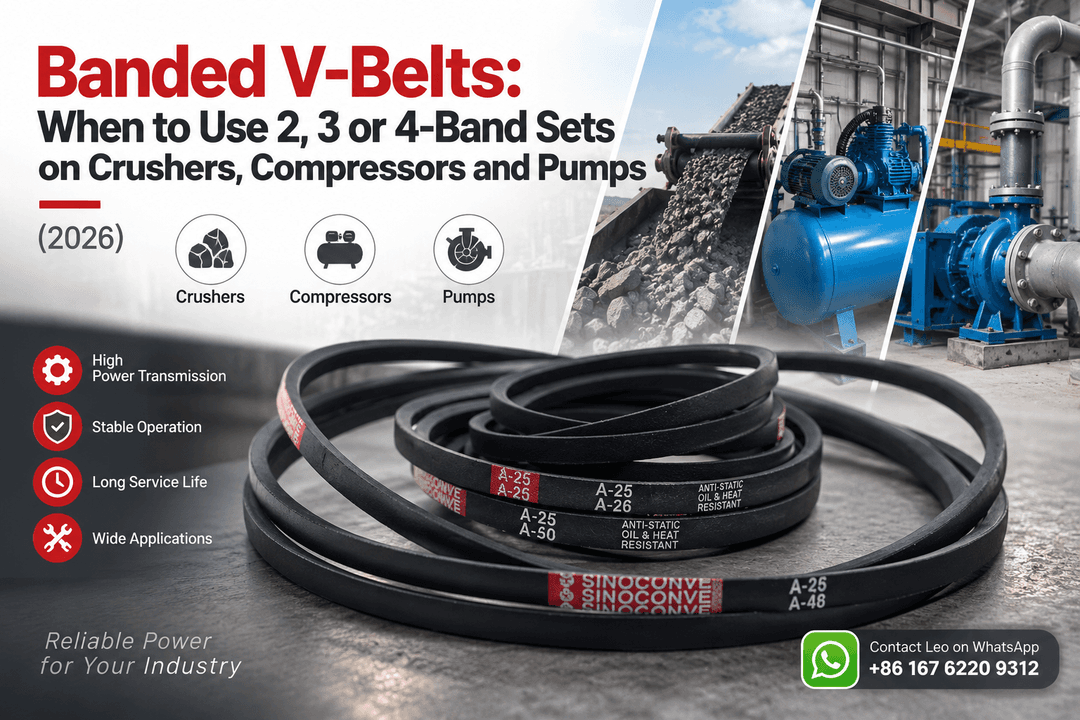
Banded V-Belts: When to Use 2, 3 or 4-Band Sets on Crushers, Compressors and Pumps (2026)

Banded V-Belts: When to Use 2, 3 or 4-Band Sets on Crushers, Compressors and Pumps (2026)

On any drive with more than two grooves, mixing individual belts is how a set fails early. This guide explains why: belts of different length or wear share load unequally, the shortest one carries more than its share, and the whole set goes down together. It then covers how banded V-belts are actually specified — profile, number of bands and datum length — and how to write that on an enquiry so the quote comes back comparable. A table sets out when a two, three or four band set is the right answer against load, groove count and equipment type, from jaw and cone crushers through screw compressors, centrifugal pumps, fans and mixers. Installation and tensioning get their own section, including the deflection method step by step, run-in and the re-tension most sites never do, and why half a degree of misalignment rolls ribs out of a groove. Failure modes are mapped to causes, and a worked example takes a 22 kW drive through service factor, section, datum length and band count. Two, three or four bands. The set is the unit.
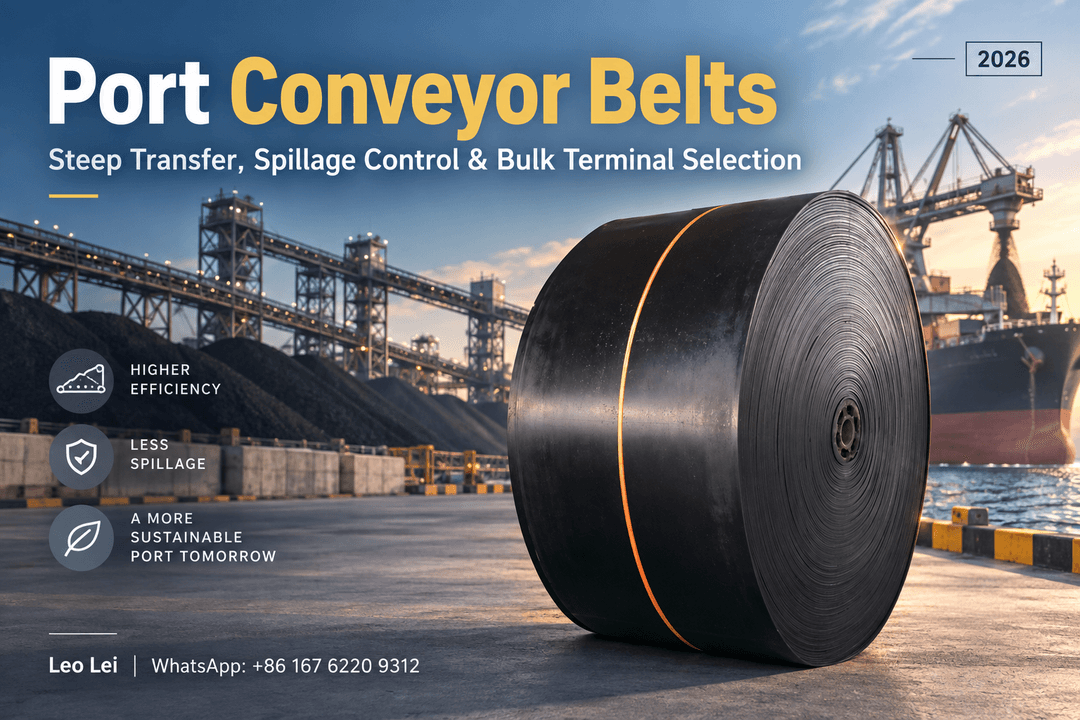
Port Conveyor Belts: Steep Transfer, Spillage Control and Bulk Terminal Selection (2026)

Port Conveyor Belts: Steep Transfer, Spillage Control and Bulk Terminal Selection (2026)

Port conveyors do not fail for the same reasons as plant conveyors. This guide works through four bulk terminal duties in order — stockyard to quay, ship unloader lift sections, tripper and transfer house, and stacker or reclaimer booms — and shows what each one demands in terms of belt type, carcass and inclination. You get an incline to belt type matrix covering chevron cleat heights and corrugated sidewall heights, with the honest caveat that these are engineering ranges rather than guarantees. Spillage and carryback get a separate treatment: skirt rubber, impact beds, primary and secondary cleaners, return-side cleaning and drop height control. Because ports run in salt air, there is a section on carcass, splice and cover selection for humid and chloride-rich environments, plus the splice strength that ship-unloader lift sections need under repeated starting. A worked 900 t/h capacity check shows how a nominal figure collapses once inclination is applied. We finish with the specification details we ask for before quoting.

V-belt vs Timing Belt: Which One Fits Your Line

V-belt vs Timing Belt: Which One Fits Your Line

The choice between a friction drive and a synchronous drive is usually made on the drawing, and often for the wrong reason. This comparison starts with the job rather than the belt: what the driven machine needs from the shaft, not just how fast it turns. It sets out the principle behind each family, then works through the practical detail on both sides. On the V-belt side you get classical A, B, C and D sections with their top widths and power bands, narrow sections SPZ, SPA, SPB and SPC under DIN 7753, and an explanation of what a raw edge belt actually buys you in grip and pulley size. On the other side, timing belt pitches from 3M through 14M and T5 to T10 are put in context, with a note on crusher drives where shock load decides everything and agricultural drives where dust and seasonal restart dominate. A selection matrix matches the condition to the drive, a twenty-four month cost and life view shows where the money goes, and the closing rules tell you plainly when to choose A, when to choose B, and when the answer is both.

Read More
Chevron Conveyor Belt vs Flat Conveyor Belt: Which One Fits Your Line

Chevron Conveyor Belt vs Flat Conveyor Belt: Which One Fits Your Line

Almost every wrong chevron belt decision traces back to one skipped step: nobody measured the real incline, the angle left after the chute and the skirt boards have taken their share. This guide starts there and then walks through the decision in order. It explains what actually sets a flat belt's incline limit, which is the material's internal friction and angle of repose rather than the drawing, and how surface condition, moisture, particle size and impact at the loading point move it. A decision table then maps incline against material and belt type, from flat through shallow and deep chevron to corrugated sidewall, with the honest caveat that these are engineering ranges and not guarantees. Profiled belt cleat height and pitch get their own section, as does the point where chevron is no longer enough and a sidewall belt is the only answer. You also get the six things to check before converting a flat conveyor, a cost and service life comparison, and how to align the profile when splicing so the cleats meet correctly.

Read More
Heat Resistant Conveyor Belt vs Standard Rubber Belt: Which One Fits Your Line

Heat Resistant Conveyor Belt vs Standard Rubber Belt: Which One Fits Your Line

The question is not whether your plant is hot. It is whether the belt surface is hot, and for how long. This guide sets out the decision in the order it should be made: establish the peak material temperature rather than the ambient temperature, find out where the standard belt actually gives up, then match the duty to a grade. You get a temperature band matrix covering clinker, cement raw meal, sinter, foundry sand, coke and fertiliser prills, each with its peak range and the grade that survives it, plus a plain comparison of standard versus heat resistant construction. The four technical routes to heat resistance are explained by what problem each one solves and what it costs you elsewhere. There is a three-year cost model showing where the price difference sits, a note on how heat arrives together with oil, chemical attack and abrasion, and the four field mistakes that kill heat resistant belts early, including what to do when no belt grade will hold.

Read More
Rubber Conveyor Belt Ultimate Guide (2026): Types, Grades and How to Choose

Rubber Conveyor Belt Ultimate Guide (2026): Types, Grades and How to Choose

Most rubber conveyor belt problems start before the belt is even made, because the carcass and the cover are chosen separately and nobody checks that the two decisions agree. This guide works through both. It explains what a rubber conveyor belt actually is, then opens it up: carcass, top and bottom cover, edge rubber and breaker. From there it compares the three carcass families you will be quoted against each other, EP polyester fabric, NN nylon fabric and steel cord, with the trade-offs that matter in service rather than on a datasheet. The EP grade notation gets its own treatment, because EP100, EP200 and EP400 are widely misread: you get the ply notation explained and two worked examples, 630/4 and 400/3, showing which stock grade actually satisfies the number on the drawing. Cover grades follow, with the DIN 22102 W/X/Y/Z scale set against the RMA grades many buyers see instead, plus a selection matrix by industry and the checks to run before you place an order.

Read More
Banded V-Belts: When to Use 2, 3 or 4-Band Sets on Crushers, Compressors and Pumps (2026)

Banded V-Belts: When to Use 2, 3 or 4-Band Sets on Crushers, Compressors and Pumps (2026)

On any drive with more than two grooves, mixing individual belts is how a set fails early. This guide explains why: belts of different length or wear share load unequally, the shortest one carries more than its share, and the whole set goes down together. It then covers how banded V-belts are actually specified — profile, number of bands and datum length — and how to write that on an enquiry so the quote comes back comparable. A table sets out when a two, three or four band set is the right answer against load, groove count and equipment type, from jaw and cone crushers through screw compressors, centrifugal pumps, fans and mixers. Installation and tensioning get their own section, including the deflection method step by step, run-in and the re-tension most sites never do, and why half a degree of misalignment rolls ribs out of a groove. Failure modes are mapped to causes, and a worked example takes a 22 kW drive through service factor, section, datum length and band count. Two, three or four bands. The set is the unit.

Read More
Port Conveyor Belts: Steep Transfer, Spillage Control and Bulk Terminal Selection (2026)

Port Conveyor Belts: Steep Transfer, Spillage Control and Bulk Terminal Selection (2026)

Port conveyors do not fail for the same reasons as plant conveyors. This guide works through four bulk terminal duties in order — stockyard to quay, ship unloader lift sections, tripper and transfer house, and stacker or reclaimer booms — and shows what each one demands in terms of belt type, carcass and inclination. You get an incline to belt type matrix covering chevron cleat heights and corrugated sidewall heights, with the honest caveat that these are engineering ranges rather than guarantees. Spillage and carryback get a separate treatment: skirt rubber, impact beds, primary and secondary cleaners, return-side cleaning and drop height control. Because ports run in salt air, there is a section on carcass, splice and cover selection for humid and chloride-rich environments, plus the splice strength that ship-unloader lift sections need under repeated starting. A worked 900 t/h capacity check shows how a nominal figure collapses once inclination is applied. We finish with the specification details we ask for before quoting.

Read More

Explore more

We are committed to providing you with better products and services. Welcome to browse more content for details