

Engineered belt solutions for demanding industries worldwide

Recent Posts
Heat Resistant Conveyor Belt Failure Modes: Root Causes and Field Fixes

Heat Resistant Conveyor Belt Failure Modes: Root Causes and Field Fixes

Heat is rarely the only thing killing a heat resistant belt, and treating it that way is why some conveyors eat a belt every nine months. This is a diagnostic manual rather than a selection guide. It sets out nine failure modes we see in cement, clinker, coke, sinter and foundry duty, each with the symptoms visible on site, the measurement that confirms the cause, and the fix that stops it coming back. Heat aging is separated from burn-through because the two demand opposite responses, and cover hardening is quantified rather than described. Ply separation, edge cracking, blistering, carcass degradation and premature splice failure each get their own treatment with thresholds you can measure using a durometer, a thermometer and a tape. One section deals with the mistake that costs buyers most: EPDM is an excellent heat performer and a poor oil performer, and plants that run both heat and oil on one belt find out the expensive way. Anti-static, flame resistance and MSHA requirements are separated from temperature rating, because flame retardant does not mean heat resistant. The closing sections cover material temperature measurement and prevention.
Rubber Conveyor Belt Buyer's Checklist: 12 Things to Verify Before You Order

Rubber Conveyor Belt Buyer's Checklist: 12 Things to Verify Before You Order

Most rubber conveyor belt disputes start with a purchase order that never specified anything measurable. This checklist is the twelve points we work through before we sign off a belt order, written so a buyer can use it against any supplier. It opens with the four documents that must exist before price is discussed, then works through the choices that decide service life: EP versus NN carcass behaviour, why four plies is not automatically stronger than three, and how to back-calculate ply count from the tensile rating your conveyor actually needs. Cover grade and abrasion limits get a measured treatment, along with top and bottom cover thickness and the tolerances that let a supplier shave millimetres without breaking the specification. Cut length, splicing allowance, ply adhesion, edge protection and the joint method each have their own acceptance check. From there the checklist moves to the commercial side: what a factory test report proves and what it does not, how packing and roll direction cause damage in transit, where warranty starts and stops, and how to close the loop by converting twelve line items into a cost per tonne figure.
TOP 10 Conveyor Belt Manufacturers in China (2026): 10 Factories Compared for Buyers

TOP 10 Conveyor Belt Manufacturers in China (2026): 10 Factories Compared for Buyers

China supplies a large share of the world's conveyor belting, but a list of famous factory names does not tell a buyer which one fits a specific conveyor, risk level and order shape. This article compares ten Chinese conveyor belt manufacturers on the things that actually change a purchasing decision: what the factory is set up to make, whether it belongs in the heavy-duty or light-duty group, which industries it serves, and what kind of buyer it suits. It opens with a comparison table covering all ten, then explains the heavy-duty versus light-duty split that should be settled before any shortlist is built. Each factory then gets its own profile with the same information skeleton, so the entries can be compared side by side rather than read as advertising. A short six-step framework shows how to convert the table into a defensible shortlist and where to go deeper on sourcing, quality control and pricing. Third-party details are hedged to publicly stated information, and the article discloses that SINOCONVE publishes it and also appears in the list.
Conveyor Belt Splicing Ultimate Guide (2026): Methods, Costs and Field Tips

Conveyor Belt Splicing Ultimate Guide (2026): Methods, Costs and Field Tips

Most splice failures are decided long before the crew arrives, because the joint method is picked out of habit rather than from the duty the belt actually runs. This guide treats splicing as a business decision first and a workshop task second. It sets out the three joint families, hot vulcanized, cold bonded and mechanical, and what each one is genuinely good at rather than what the catalogue claims. A decision matrix matches the joint to the duty, and a separate section prices the wrong choice in lost tonnage and repeat labour. The real cost structure of a splice is broken out line by line, with benchmark ranges you can hold a quotation against, and an explanation of why a vulcanized joint never reaches the strength of the parent belt. Field execution gets a practical treatment: the twelve hours that decide the joint, seven failures we see again and again, and the site conditions that quietly break joints, from drop height to take-up travel and troughing. Acceptance criteria, inspection records and splice retirement rules close the loop, followed by the data package we need before quoting.
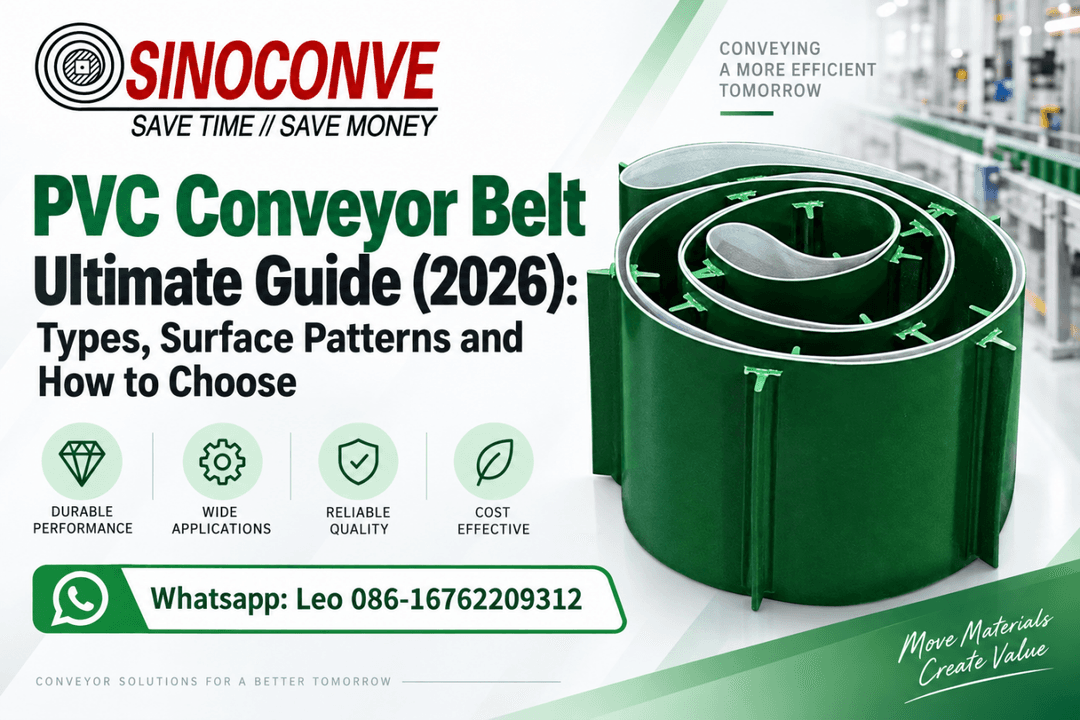
PVC Conveyor Belt Ultimate Guide (2026): Types, Surface Patterns and How to Choose

PVC Conveyor Belt Ultimate Guide (2026): Types, Surface Patterns and How to Choose

Light duty belting is where most plants overspend without noticing, because PVC, PU and silicone are quoted as if they were interchangeable. This guide maps where each material stops working and gives you the language to specify the right one. It starts with the material map, then opens up belt construction: plies, covers, cleats, sidewalls and guides, and what each layer is doing. The surface pattern section covers the full spectrum from smooth and matte through diamond, waffle, rough top, grip top, longitudinal rib and special profiles, with the application each pattern was designed for rather than a generic list. Food contact documentation gets its own section, covering which declarations to request and how to read them. Jointing, cleaning, tracking and service life are handled together, because that is how they fail in practice. You also get how the specification changes by industry, how we build, check and ship a light duty belt, and the specification sheet we need from you to quote without guessing.
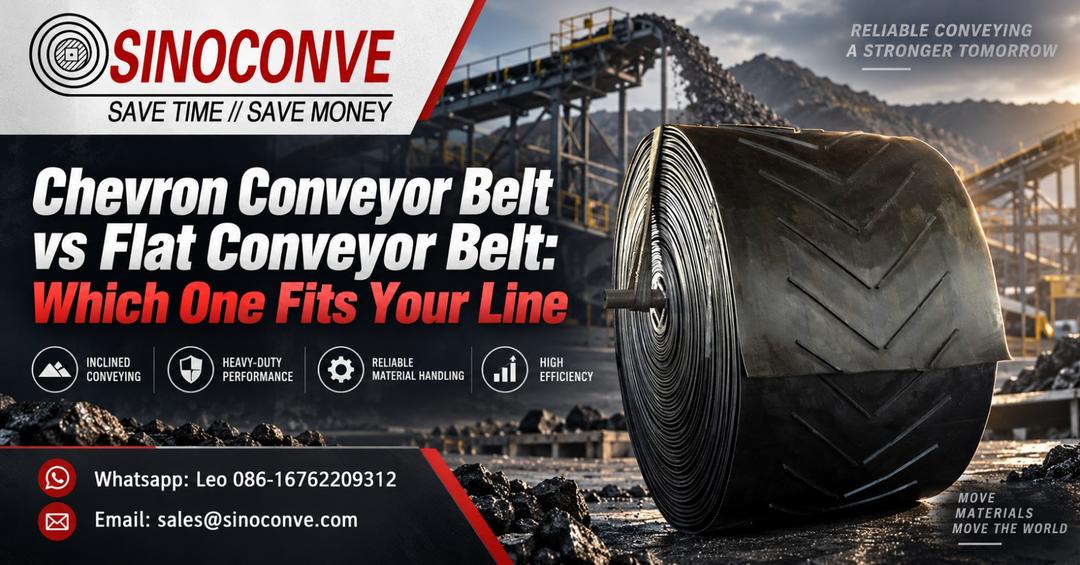
Chevron Conveyor Belt vs Flat Conveyor Belt: Which One Fits Your Line

Chevron Conveyor Belt vs Flat Conveyor Belt: Which One Fits Your Line

Almost every wrong chevron belt decision traces back to one skipped step: nobody measured the real incline, the angle left after the chute and the skirt boards have taken their share. This guide starts there and then walks through the decision in order. It explains what actually sets a flat belt's incline limit, which is the material's internal friction and angle of repose rather than the drawing, and how surface condition, moisture, particle size and impact at the loading point move it. A decision table then maps incline against material and belt type, from flat through shallow and deep chevron to corrugated sidewall, with the honest caveat that these are engineering ranges and not guarantees. Profiled belt cleat height and pitch get their own section, as does the point where chevron is no longer enough and a sidewall belt is the only answer. You also get the six things to check before converting a flat conveyor, a cost and service life comparison, and how to align the profile when splicing so the cleats meet correctly.

Heat Resistant Conveyor Belt Failure Modes: Root Causes and Field Fixes

Heat Resistant Conveyor Belt Failure Modes: Root Causes and Field Fixes

Heat is rarely the only thing killing a heat resistant belt, and treating it that way is why some conveyors eat a belt every nine months. This is a diagnostic manual rather than a selection guide. It sets out nine failure modes we see in cement, clinker, coke, sinter and foundry duty, each with the symptoms visible on site, the measurement that confirms the cause, and the fix that stops it coming back. Heat aging is separated from burn-through because the two demand opposite responses, and cover hardening is quantified rather than described. Ply separation, edge cracking, blistering, carcass degradation and premature splice failure each get their own treatment with thresholds you can measure using a durometer, a thermometer and a tape. One section deals with the mistake that costs buyers most: EPDM is an excellent heat performer and a poor oil performer, and plants that run both heat and oil on one belt find out the expensive way. Anti-static, flame resistance and MSHA requirements are separated from temperature rating, because flame retardant does not mean heat resistant. The closing sections cover material temperature measurement and prevention.

Read More
Rubber Conveyor Belt Buyer's Checklist: 12 Things to Verify Before You Order

Rubber Conveyor Belt Buyer's Checklist: 12 Things to Verify Before You Order

Most rubber conveyor belt disputes start with a purchase order that never specified anything measurable. This checklist is the twelve points we work through before we sign off a belt order, written so a buyer can use it against any supplier. It opens with the four documents that must exist before price is discussed, then works through the choices that decide service life: EP versus NN carcass behaviour, why four plies is not automatically stronger than three, and how to back-calculate ply count from the tensile rating your conveyor actually needs. Cover grade and abrasion limits get a measured treatment, along with top and bottom cover thickness and the tolerances that let a supplier shave millimetres without breaking the specification. Cut length, splicing allowance, ply adhesion, edge protection and the joint method each have their own acceptance check. From there the checklist moves to the commercial side: what a factory test report proves and what it does not, how packing and roll direction cause damage in transit, where warranty starts and stops, and how to close the loop by converting twelve line items into a cost per tonne figure.

Read More
TOP 10 Conveyor Belt Manufacturers in China (2026): 10 Factories Compared for Buyers

TOP 10 Conveyor Belt Manufacturers in China (2026): 10 Factories Compared for Buyers

China supplies a large share of the world's conveyor belting, but a list of famous factory names does not tell a buyer which one fits a specific conveyor, risk level and order shape. This article compares ten Chinese conveyor belt manufacturers on the things that actually change a purchasing decision: what the factory is set up to make, whether it belongs in the heavy-duty or light-duty group, which industries it serves, and what kind of buyer it suits. It opens with a comparison table covering all ten, then explains the heavy-duty versus light-duty split that should be settled before any shortlist is built. Each factory then gets its own profile with the same information skeleton, so the entries can be compared side by side rather than read as advertising. A short six-step framework shows how to convert the table into a defensible shortlist and where to go deeper on sourcing, quality control and pricing. Third-party details are hedged to publicly stated information, and the article discloses that SINOCONVE publishes it and also appears in the list.

Read More
Conveyor Belt Splicing Ultimate Guide (2026): Methods, Costs and Field Tips

Conveyor Belt Splicing Ultimate Guide (2026): Methods, Costs and Field Tips

Most splice failures are decided long before the crew arrives, because the joint method is picked out of habit rather than from the duty the belt actually runs. This guide treats splicing as a business decision first and a workshop task second. It sets out the three joint families, hot vulcanized, cold bonded and mechanical, and what each one is genuinely good at rather than what the catalogue claims. A decision matrix matches the joint to the duty, and a separate section prices the wrong choice in lost tonnage and repeat labour. The real cost structure of a splice is broken out line by line, with benchmark ranges you can hold a quotation against, and an explanation of why a vulcanized joint never reaches the strength of the parent belt. Field execution gets a practical treatment: the twelve hours that decide the joint, seven failures we see again and again, and the site conditions that quietly break joints, from drop height to take-up travel and troughing. Acceptance criteria, inspection records and splice retirement rules close the loop, followed by the data package we need before quoting.

Read More
PVC Conveyor Belt Ultimate Guide (2026): Types, Surface Patterns and How to Choose

PVC Conveyor Belt Ultimate Guide (2026): Types, Surface Patterns and How to Choose

Light duty belting is where most plants overspend without noticing, because PVC, PU and silicone are quoted as if they were interchangeable. This guide maps where each material stops working and gives you the language to specify the right one. It starts with the material map, then opens up belt construction: plies, covers, cleats, sidewalls and guides, and what each layer is doing. The surface pattern section covers the full spectrum from smooth and matte through diamond, waffle, rough top, grip top, longitudinal rib and special profiles, with the application each pattern was designed for rather than a generic list. Food contact documentation gets its own section, covering which declarations to request and how to read them. Jointing, cleaning, tracking and service life are handled together, because that is how they fail in practice. You also get how the specification changes by industry, how we build, check and ship a light duty belt, and the specification sheet we need from you to quote without guessing.

Read More
Chevron Conveyor Belt vs Flat Conveyor Belt: Which One Fits Your Line

Chevron Conveyor Belt vs Flat Conveyor Belt: Which One Fits Your Line

Almost every wrong chevron belt decision traces back to one skipped step: nobody measured the real incline, the angle left after the chute and the skirt boards have taken their share. This guide starts there and then walks through the decision in order. It explains what actually sets a flat belt's incline limit, which is the material's internal friction and angle of repose rather than the drawing, and how surface condition, moisture, particle size and impact at the loading point move it. A decision table then maps incline against material and belt type, from flat through shallow and deep chevron to corrugated sidewall, with the honest caveat that these are engineering ranges and not guarantees. Profiled belt cleat height and pitch get their own section, as does the point where chevron is no longer enough and a sidewall belt is the only answer. You also get the six things to check before converting a flat conveyor, a cost and service life comparison, and how to align the profile when splicing so the cleats meet correctly.

Read More

Explore more

We are committed to providing you with better products and services. Welcome to browse more content for details