
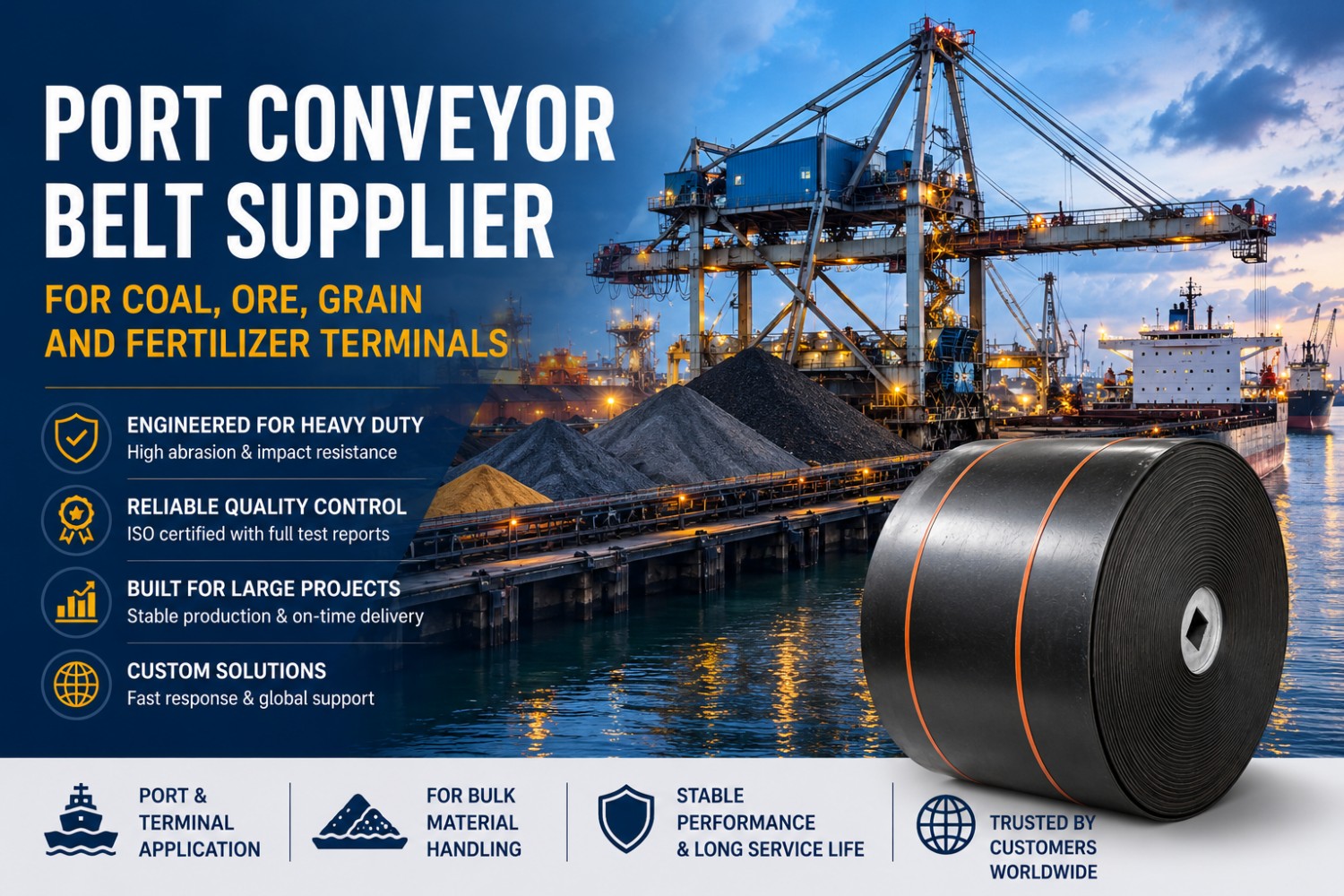
Port Conveyor Belt Supplier for Coal, Ore, Grain and Fertilizer Terminals
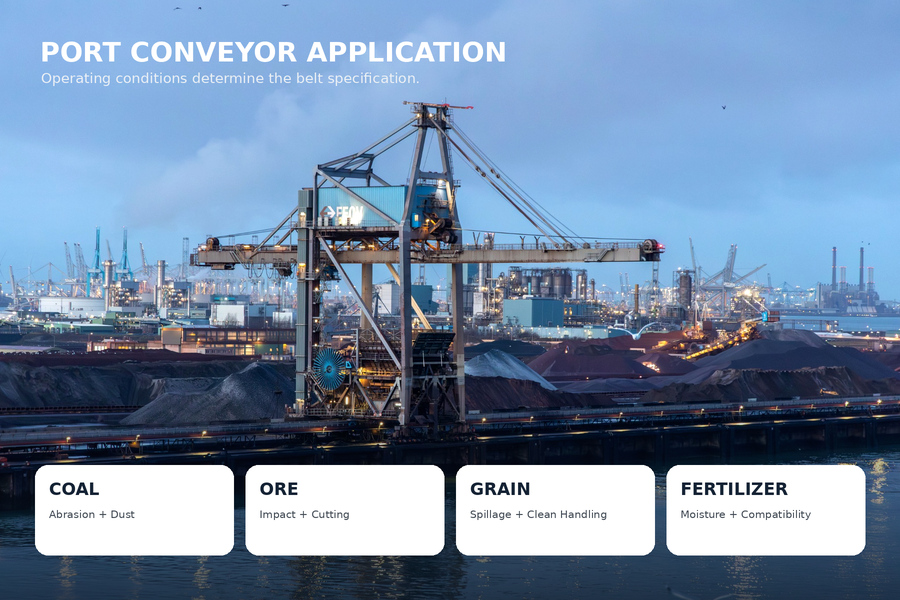
A port conveyor belt purchase can look straightforward on a tender sheet: belt width, length, tensile rating, cover thickness, quantity and delivery date. In practice, those fields are only the beginning. A coal terminal dealing with abrasive material and dust does not impose the same requirements as a grain terminal concerned with clean handling and spillage. Ore adds impact and cutting risk. Fertilizer may introduce moisture, contamination and application-specific chemical concerns.
For a procurement team, the real question is therefore not simply which port conveyor belt supplier can submit the lowest price. It is whether the supplier can understand the operating conditions, manufacture the approved specification consistently, provide useful inspection evidence and deliver the required quantity without creating additional project risk.
This guide explains how terminal operators, EPC contractors, distributors and project buyers can qualify a conveyor belt supplier before issuing a bulk order—and what information should be included in the RFQ so quotations can be compared on a technically meaningful basis.
Do not approve a port conveyor belt supplier from price, belt width and nominal strength alone. First establish the operating conditions and approved belt specification. Then verify manufacturing capability, material and dimensional control, relevant test documentation, production capacity, packaging and delivery planning. Quotations should only be compared commercially after the technical scope is aligned.
1. Why Port Conveyor Belt Procurement Needs More Than a Standard Price Comparison
Port and terminal conveyors often connect unloading equipment, stockyards, transfer towers, storage areas and ship-loading systems. A belt problem at one critical conveyor can therefore affect more than one piece of equipment. The commercial consequence of an incorrect belt is not limited to the replacement purchase price; installation planning, maintenance labor, production interruption and vessel or terminal schedules can also be affected.
The operating environment makes specification control equally important. Port conveyors can face long operating hours, outdoor exposure, dust, moisture, repeated loading cycles and multiple transfer points. The material itself changes the dominant risk.
| Material | Typical Procurement Concern | Specification Implication | What the Supplier Needs to Know |
|---|---|---|---|
| Coal | Abrasion, dust, continuous duty and project-specific fire/safety requirements | Cover properties and any required safety performance must match the approved specification | Material condition, conveyor location, required standard and existing specification |
| Iron ore / minerals | Abrasion, sharp particles, impact and heavy loading | Carcass, cover grade and cover thickness require careful review | Lump size, bulk density, loading arrangement, capacity and belt speed |
| Grain | Spillage, moisture, material control and application-specific safety requirements | Belt construction should be reviewed against the actual handling system and required compliance | Grain type, incline, transfer configuration, environment and required standard |
| Fertilizer | Moisture, contamination, abrasion and possible chemical exposure | Compound compatibility should be checked rather than assuming a general-purpose cover is suitable | Exact fertilizer, moisture, temperature, contamination and cleaning conditions |
SINOCONVE's port and bulk material handling solutions cover conveyor applications involving coal, ore, grain, fertilizer, cement and other bulk materials in ports, terminals, stockyards and loading systems.

2. Start Supplier Qualification With the Application, Not the Catalog
A supplier cannot reliably confirm a belt from a product name such as “heavy-duty port belt.” The procurement package needs enough operating information to establish what heavy duty means for that conveyor.
At minimum, the technical discussion should cover the conveyed material, belt width and length, required belt strength, carcass construction, top and bottom cover requirements, conveyor length, capacity, belt speed, incline, pulley information where relevant, splice requirements, environmental conditions and applicable technical standard.
If the purchase is a replacement, send the existing belt specification together with photographs, drawings or belt markings where available. If the existing belt has failed prematurely, describe the failure rather than asking the new supplier to reproduce the old specification without review.
“Same as existing belt” is not enough when the existing belt has been suffering repeated cover wear, edge damage, delamination, splice problems or abnormal elongation. Procurement should separate dimensional compatibility from performance suitability. Repeating an inadequate specification can repeat the same failure.
3. EP Fabric or Steel Cord: Do Not Make the Decision From Conveyor Length Alone
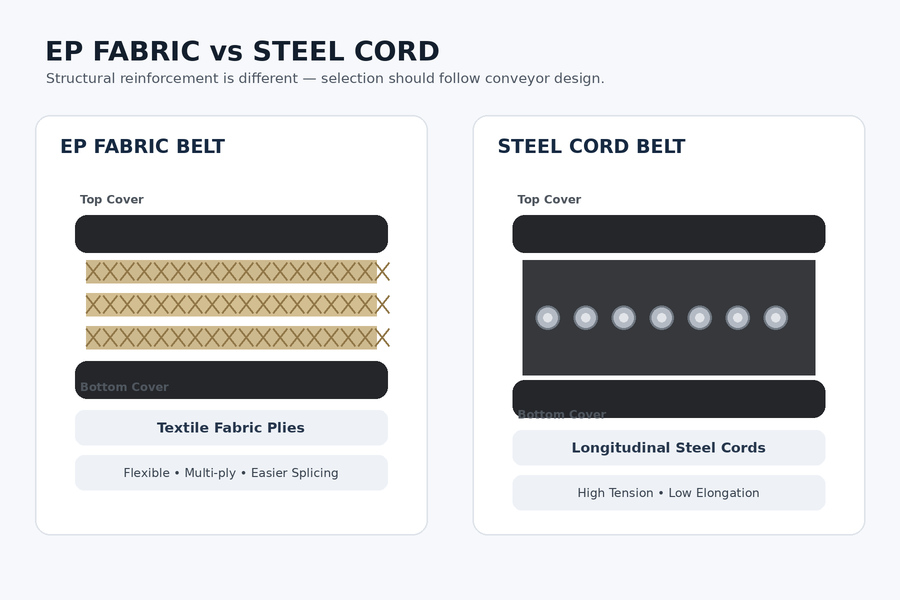
Both fabric and steel cord constructions can be relevant to bulk handling, but they solve different engineering requirements. The correct choice depends on calculated tension, conveyor geometry, loading conditions, take-up arrangement, pulley system and the approved conveyor design—not simply on whether the conveyor looks “long.”
An EP rubber conveyor belt uses textile reinforcement and can suit many industrial bulk-handling conveyors when the required tension and system design fall within the selected belt rating.
A steel cord conveyor belt becomes relevant where the conveyor design requires higher tensile capability and low elongation, including demanding long-distance and heavy-load systems. It should not, however, be specified merely because steel cord sounds more heavy duty. Pulley compatibility, splice requirements, inspection procedures and the conveyor's actual tension calculations still matter.
| Decision Point | EP Fabric Belt | Steel Cord Belt |
|---|---|---|
| Primary structural reinforcement | Textile fabric plies | Longitudinal steel cords |
| Typical selection logic | Suitable where the required belt rating and elongation behavior match the conveyor design | Considered for high-tension and low-elongation requirements |
| Procurement check | Fabric rating, ply construction, covers, dimensions and splice | ST rating, covers, cord construction, dimensions, splice and system compatibility |
| Do not decide from | Price per meter alone | The assumption that steel automatically means better |
4. What a Port Conveyor Belt RFQ Should Actually Contain
A technically complete RFQ reduces two problems at once. It reduces the chance of receiving an unsuitable belt, and it makes quotations easier to compare because suppliers are responding to the same requirement.
For a new project, the approved conveyor design and engineering specification should remain the controlling documents. For replacement procurement, the following information provides a practical starting point.
- Material: coal, ore, grain, fertilizer or exact bulk product.
- Material condition: dry/wet, abrasive, sharp, oily, hot, chemically aggressive or otherwise unusual.
- Material data: bulk density and maximum lump size where relevant.
- Conveyor duty: capacity, belt speed, conveyor length and incline.
- Belt dimensions: required width, length and total thickness where specified.
- Carcass: approved EP/fabric or steel cord rating and construction.
- Covers: top/bottom thickness and required cover properties.
- Interface data: pulley diameters and take-up information where needed for technical review.
- Splice: required joining method or project-approved splice specification.
- Compliance: required standard, test requirements and documentation.
- Commercial scope: quantity, individual roll lengths, packaging, labeling, destination and required delivery schedule.
The phrase required standard deserves particular attention. A tender should identify the actual technical or contractual requirement instead of simply listing several standard names. The buyer should also define which properties must be verified and what documentation is expected with the order.
5. Qualify the Factory Before Negotiating the Bulk Order
A supplier qualification review should establish whether the factory can manufacture the required construction and dimensions consistently—not merely whether it has produced “conveyor belts” before.
Ningbo Sinoconve Belt Co., Ltd. states that its conveyor belt factory was established in 1988 and has more than 35 years of manufacturing experience. Current company information identifies more than 200 employees, 26 engineers, a laboratory and 15 quality-control personnel.
For production, SINOCONVE reports eight fabric conveyor belt production lines and two steel cord conveyor belt production lines. Its supplied manufacturing information lists annual capacity of 10 million meters for fabric conveyor belts and 3 million meters for steel cord conveyor belts. Available manufacturing ranges stated by SINOCONVE include belt widths from 100 mm to 3000 mm, thicknesses from 3 mm to 100 mm, fabric ratings from EP100 to EP600 and steel cord ratings from ST500 to ST7500.
These numbers are useful during prequalification, but capacity alone should not decide supplier approval. A procurement team should connect capability to the specific tender: Can the factory manufacture the requested width and construction? Can it control the required cover and dimensions? Can it perform or arrange the tests requested in the purchase specification? Can it manage the required roll lengths and shipment schedule?
6. Ask for Quality Evidence That Relates to Your Order
“We have strict QC” is not enough evidence for a project purchase. Buyers should ask what is inspected, at which stage, against which agreed requirement and what records can accompany the shipment.
SINOCONVE's conveyor belt quality assurance process covers raw-material checks, production monitoring, dimensional inspection and performance testing. Relevant checks can include rubber compound evaluation, EP fabric testing, finished belt width and thickness, abrasion resistance, adhesion strength and tensile performance, depending on the product and order requirements.
For port procurement, inspection requirements should be agreed before production rather than requested only when the cargo is ready to ship. If a project requires specific certificates, test reports, third-party inspection or witness points, put these requirements into the RFQ and purchase order.
A certificate and a product test report answer different questions. Management-system documentation can support supplier qualification, while order-specific dimensional and performance records help verify the supplied belt. Define both requirements separately when the tender calls for them.
7. Compare Suppliers on an Equivalent Technical Basis
A common tender problem occurs when three suppliers appear to quote the same belt but have actually priced different technical scopes. One quotation may include the required cover grade and inspection documents. Another may substitute a general-purpose compound. A third may exclude special packaging or testing. The lowest total on the comparison sheet may therefore not represent the lowest quotation for the approved specification.
| Supplier Qualification Area | Evidence to Request | Warning Sign |
|---|---|---|
| Technical compliance | Clause-by-clause confirmation or clearly stated deviations | Supplier says “equivalent” without identifying what is equivalent |
| Manufacturing capability | Production range and capability relevant to the requested construction | General factory presentation with no connection to the tendered belt |
| Quality control | Inspection process and agreed test documentation | Only a generic quality statement |
| Commercial scope | Quantity, roll length, packaging, documentation and delivery scope | Low unit price with important scope exclusions |
| Deviation control | Written list of every technical or commercial exception | Unannounced substitutions after price approval |
A useful procurement rule is simple: normalize the technical scope first; compare price second.
8. Bulk Orders Need Production and Delivery Planning, Not Just a Lead-Time Promise
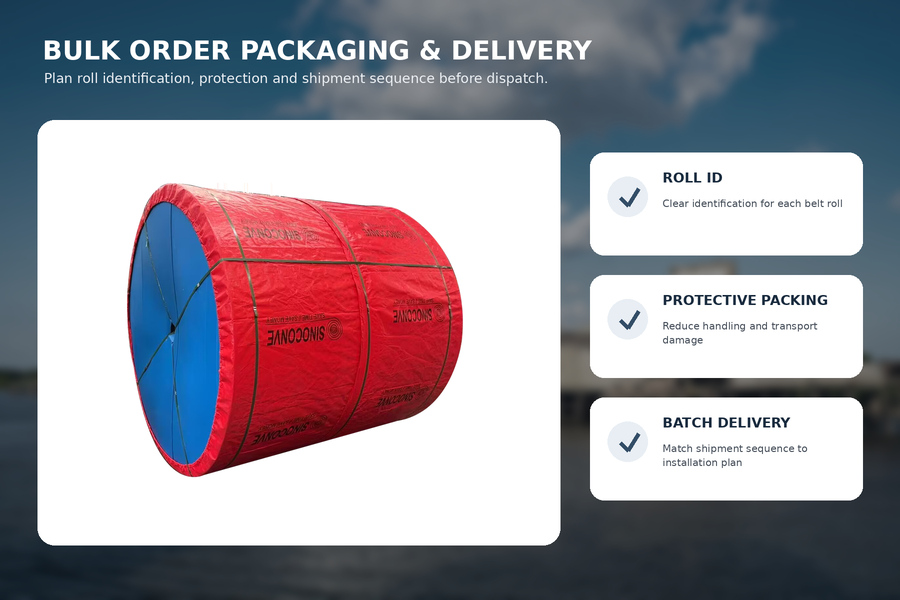
Port projects can involve multiple rolls, different conveyor sections and phased installation schedules. A single statement such as “30-day lead time” does not tell the buyer how a large project order will be controlled.
SINOCONVE's standard production lead time is normally around 30 days according to current company information. For urgent orders, production may be accelerated to approximately 15–20 days where scheduling allows. Because actual timing depends on specification, quantity and production status, project buyers should confirm the schedule for the specific order rather than treating these figures as an unconditional delivery guarantee.
For large tenders, discuss production sequencing, roll identification, packing lists, batch inspection, shipping arrangements and whether delivery should be made in one shipment or several planned batches.
Packaging also matters. SINOCONVE can use PVC board and iron-sheet protection for conveyor belt rolls, with palletizing where required, to help protect products during transportation. Packaging requirements should be agreed according to roll size, shipping method, destination and handling conditions.
9. MOQ and Commercial Terms Should Be Evaluated in the Project Context
SINOCONVE's stated minimum order quantity for conveyor belts is 50 meters. That can be relevant for distributors, maintenance replacement orders and smaller terminal requirements, but an MOQ should not be confused with the economic order quantity for a major port project.
For bulk procurement, the better commercial question is how the total order will be structured. Buyers should clarify the number of rolls, length per roll, spare-belt requirement, shipment sequence, labeling, export packing and documentation before comparing landed commercial offers.
Standard conveyor belt products normally carry a one-year warranty according to SINOCONVE's supplied policy. As with any industrial belt purchase, the warranty should be read together with the confirmed product specification, operating conditions and determination of whether a reported problem is attributable to product quality.
10. Five Questions to Ask Before Approving a Port Conveyor Belt Supplier
- Can you manufacture the exact approved construction?
Ask for confirmation of belt type, rating, width, cover requirements, dimensions and any project-specific properties. - Which inspections will be performed on my order?
Agree on dimensions, appearance, relevant performance testing and documentation before production. - What technical information is still missing from our RFQ?
A supplier that identifies missing application data can be more useful than one that quotes immediately from width and length alone. - How will deviations be controlled?
Any change to an approved construction, material requirement, test scope or packaging requirement should be communicated and approved rather than assumed. - How will the order be identified, packed and delivered?
For multi-roll tenders, roll identification and shipment planning can be as important to site execution as the belt itself. 
11. Frequently Asked Questions
11.1 What information should I send to a port conveyor belt supplier for quotation?
Send the conveyed material, belt width and length, required carcass or tensile rating, cover specification, conveyor duty, quantity and required standard. For technical review, also provide relevant information such as capacity, speed, incline, pulley dimensions, loading conditions, temperature and environment. Existing drawings or belt specifications are useful for replacement projects.
11.2 Can the same conveyor belt be used for coal, ore, grain and fertilizer?
Do not assume so. These materials create different abrasion, impact, moisture, contamination, chemical and safety conditions. Even where dimensions are identical, the required belt construction or cover properties may differ. Selection should follow the actual operating condition and approved project specification.
11.3 Is a steel cord conveyor belt always better for a port terminal?
No. Steel cord construction is useful where the conveyor design requires its tensile and elongation characteristics. EP fabric belts remain appropriate for many conveyors. The decision should follow conveyor tension and geometry, load, pulley arrangement and engineering requirements rather than a simple “steel is stronger” comparison.
11.4 What documents should I request before shipment?
Start with the documents specified in your contract or approved quality plan. Depending on the project, these may include dimensional inspection information, applicable product test reports, packing information and other agreed quality documentation. If third-party inspection is required, establish the scope before production.
11.5 Can SINOCONVE manufacture customized conveyor belts?
Yes. Conveyor belts are made to order rather than held as standard finished stock. SINOCONVE supports customization according to customer requirements, including belt dimensions, construction, performance requirements, logo and packaging. OEM/ODM production is also supported.
11.6 What is SINOCONVE's conveyor belt MOQ?
The stated MOQ for conveyor belts is 50 meters. Actual order planning should also consider the required construction, roll length, total quantity and project delivery arrangement.
11.7 How should procurement teams compare two conveyor belt quotations?
First check whether both suppliers have quoted the same carcass, covers, dimensions, performance requirements, tests, packaging and documentation. Record every deviation. Only after the technical and commercial scopes have been normalized should unit price and total order value be compared directly.

12. Prepare a Better Port Conveyor Belt RFQ
The strongest port conveyor belt tender is not necessarily the longest document. It is the one that clearly defines the application, approved technical requirements, verification method, commercial scope and acceptable deviations.
If you are sourcing belts for a coal, ore, grain or fertilizer terminal, prepare the existing belt specification or conveyor design data, material information, belt dimensions and strength requirement, cover requirements, quantity, required testing or standard, individual roll lengths, destination and target delivery schedule.
SINOCONVE can review these details before quotation. With a factory established in 1988, dedicated fabric and steel cord conveyor belt production lines, laboratory and QC resources, the company supports customized conveyor belt production for industrial and port bulk handling applications.
Send your conveyor specification, material information, required quantity and delivery destination to sales@sinoconve.com, or submit the project through the SINOCONVE quotation and contact page. Providing the technical scope before asking for final pricing helps the team confirm whether the requested belt can be manufactured to the project requirements.
Related Products & Solutions
- EP Rubber Conveyor Belt — for fabric-reinforced industrial and bulk material conveying applications.
- Steel Cord Conveyor Belt — for applications requiring high tensile capability and low elongation.
- Port & Bulk Material Handling Solutions — conveyor belt and roller solutions for terminals, stockyards and loading systems.
- SINOCONVE Product Catalog — browse conveyor belt and related material-handling product categories.