
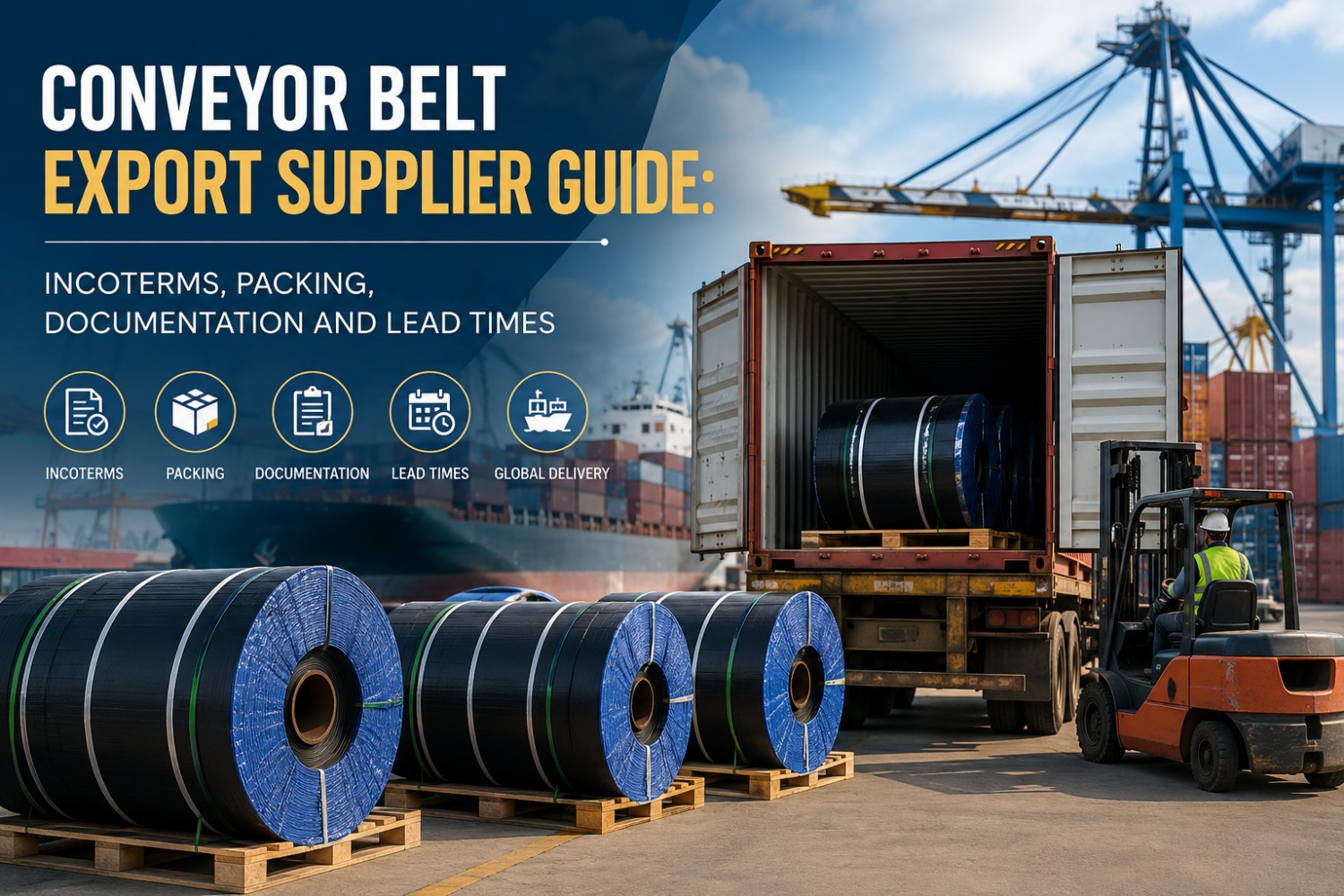
Conveyor Belt Export Supplier Guide: Incoterms, Packing, Documentation and Lead Times
For a global procurement team, choosing a conveyor belt export supplier is not finished when the belt specification and unit price are approved. The order still has to move from factory production to export packing, customs documentation, international transport and final receipt without creating avoidable delays or disputes.
This is where apparently similar quotations can carry very different commercial risk. One supplier may define the Incoterm, packing method, inspection documents and production schedule clearly before the purchase order. Another may leave those details until the cargo is almost ready. The difference often becomes visible only when a document needs correction, the belt requires stronger export protection, or the expected shipping date was based on an unrealistic production assumption.
This guide explains how global buyers should evaluate a conveyor belt export supplier across supplier qualification, Incoterms, export packing, documentation and lead-time control before releasing an international order.
Procurement Quick Answer
Do not compare export suppliers on FOB/CIF price and production days alone. First align the belt specification and quantity, then confirm the named Incoterm and place, packing construction, required shipping and quality documents, inspection points, production lead time, shipment readiness date and responsibilities for freight and customs. Commercial comparison becomes meaningful only after these items describe the same scope.
1. What Makes a Conveyor Belt Supplier Export-Ready?
A manufacturer can produce an acceptable conveyor belt without necessarily being a low-risk supplier for international procurement. Export orders add another layer of control: specification communication across companies and countries, packing for a longer logistics chain, document accuracy, shipping coordination and clear responsibility for costs and risks.
For this reason, supplier qualification should cover both manufacturing capability and export execution. Before placing a significant order, buyers should verify:
- whether the manufacturer can produce the required belt construction and dimensions;
- how the approved technical specification is controlled during production;
- what inspections and test documents can be provided;
- how conveyor belt rolls will be protected and identified for international transport;
- which Incoterm and named place or port will govern the quotation;
- which commercial, customs and transport documents are required;
- how production lead time is defined and monitored; and
- how deviations, document corrections or quality issues will be handled.
SINOCONVE's manufacturing capability provides one example of the information a buyer can examine during qualification. The conveyor belt operation has more than 35 years of manufacturing experience, more than 200 employees, 26 engineers, 15 quality-control personnel and a laboratory. Current company information lists eight fabric conveyor belt production lines and two steel cord conveyor belt production lines.
Those numbers are useful for initial screening, but capacity alone should not decide an order. Procurement should still connect the supplier's production envelope to the actual belt specification, required quantity, inspection scope and delivery schedule.
Buyer Verification Point: “We export worldwide” is not a supplier qualification criterion. Ask what happens between purchase-order confirmation and shipment release, who controls each step, and what evidence you will receive.
2. Freeze the Conveyor Belt Specification Before Discussing Export Terms
Logistics cannot compensate for an incomplete technical specification. Before comparing export quotations, make sure each supplier is pricing the same conveyor belt.
Depending on the application, the RFQ may need to define belt width and length, carcass or cord construction, required strength, cover thickness, cover performance, edge construction, surface or profile, splice requirement, marking, applicable standard and any project-specific acceptance criteria. For a replacement order, the current belt specification, drawings and operating information can help eliminate ambiguity.
SINOCONVE supplies and customizes rubber conveyor belts for industrial applications. According to the company's current production information, available manufacturing ranges include widths from 100 mm to 3,000 mm, thicknesses from 3 mm to 100 mm, fabric grades from EP100 to EP600 and steel cord grades from ST500 to ST7500.
These are manufacturing ranges, not recommendations for a particular conveyor. The correct construction still depends on the approved engineering requirement and operating conditions.
| RFQ Area | What the Buyer Should Provide | Why It Matters |
|---|---|---|
| Belt identification | Width, length, construction, strength and cover details | Prevents suppliers from quoting different technical scopes |
| Application | Conveyed material, operating environment and relevant conveyor data | Helps identify specification conflicts before production |
| Acceptance | Required standard, tests, reports and inspection requirements | Defines how conformity will be demonstrated |
| Commercial scope | Quantity, destination, requested Incoterm and target date | Allows a realistic export quotation and schedule |

3. Incoterms: Compare Responsibility, Not Just the Freight Number
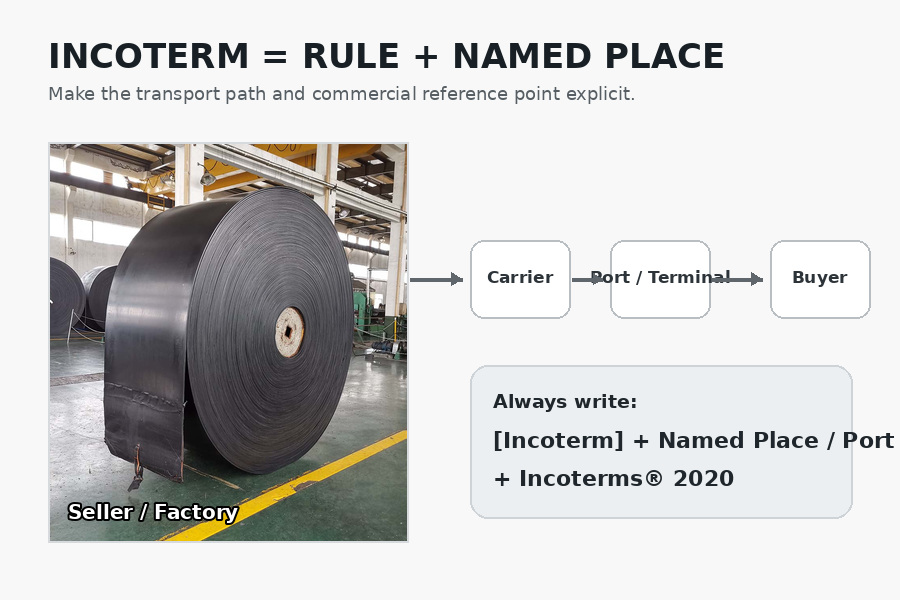
Incoterms® 2020 contains 11 trade rules used to allocate specified costs, risks and obligations between seller and buyer. For conveyor belt procurement, the important question is not which three-letter term appears most familiar. It is whether the selected rule matches the intended transport arrangement and whether both parties understand the named place and their respective responsibilities.
Terms such as FCA, FOB, CFR and CIF may appear in international industrial quotations, but they should not be treated as interchangeable price labels. For example, CIF includes seller-arranged freight and specified insurance obligations to the named destination port, while the point at which risk transfers should still be understood separately. FCA can be relevant where goods are handed to the buyer's carrier at an agreed location and can be used across modes of transport.
Procurement Rule
Always write the Incoterm together with the named place or port and the applicable version, for example, the agreed rule followed by the specific location and “Incoterms® 2020.” A three-letter abbreviation without a location leaves an important part of the commercial arrangement unclear.
Buyers should also avoid assuming that an Incoterm settles every contractual issue. Product specification, payment, title, quality acceptance, warranty, remedies, documentation and detailed delivery dates need to be addressed separately in the sales contract or purchase order as applicable.
4. Export Packing Is Part of Product Protection
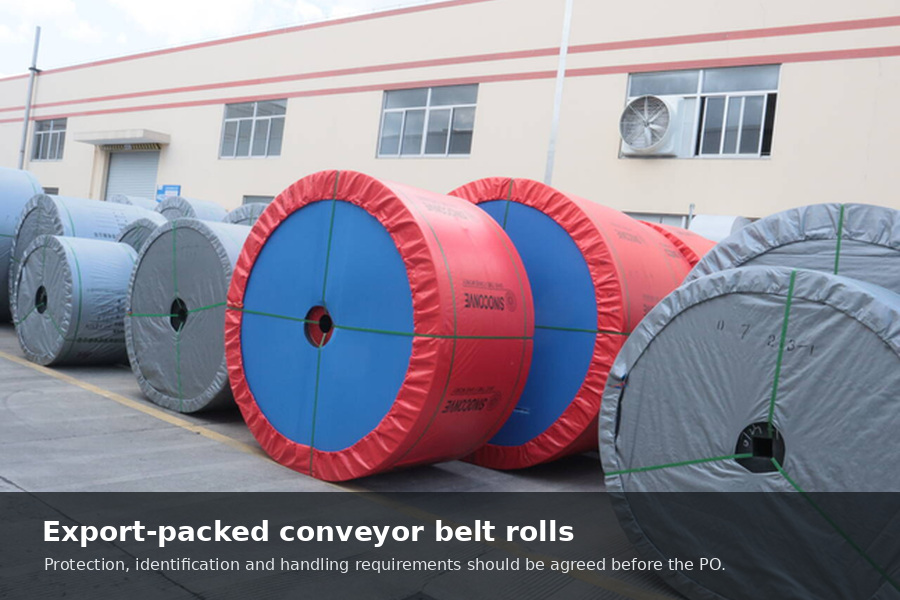
A conveyor belt roll may move through factory handling, truck transport, port storage, container loading, ocean freight and destination handling before installation. Packing therefore needs to be agreed as part of the purchase requirement rather than discussed only when production is complete.
SINOCONVE's confirmed export packing option for conveyor belts uses PVC board and iron-sheet protection, with palletizing available according to the order requirement. Customized logos and packaging can also be discussed.
The exact packing method should still follow the belt dimensions, roll size, handling method and shipment plan. Buyers should confirm packaging before the PO when the project has special lifting, storage, marking or destination requirements.
| Packing Check | What to Agree | Risk It Helps Control |
|---|---|---|
| Roll protection | Protection method appropriate to the ordered belt and route | Surface or edge damage during handling and transport |
| Identification | PO reference, belt specification, roll number and other agreed marks | Misidentification during receipt or project distribution |
| Handling | Roll dimensions, weight and handling requirements where applicable | Unsafe or unsuitable loading and unloading arrangements |
| Special packing | Destination or customer-specific requirements before production | Last-minute repacking and shipment delay |
5. Which Export Documents Should Be Agreed Before Shipment?
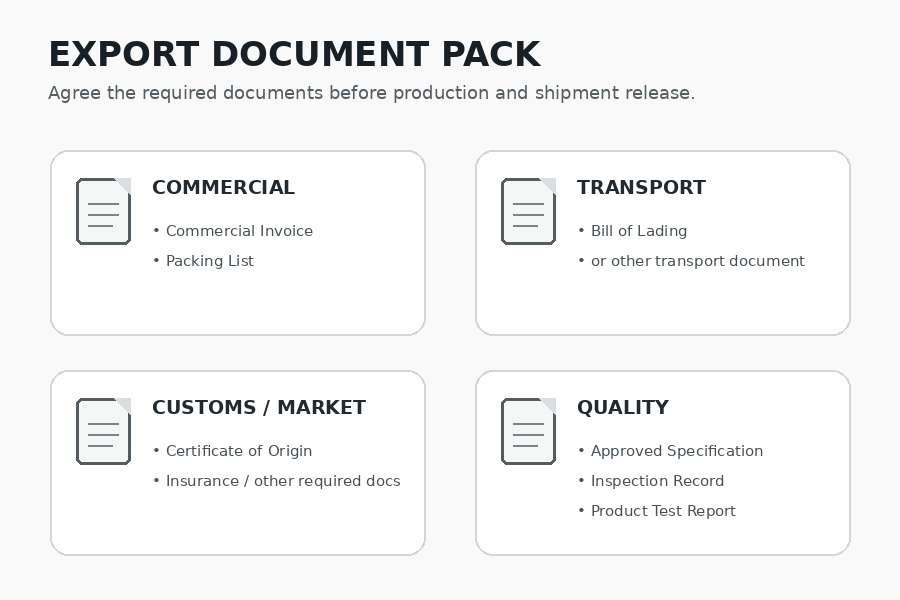
There is no universal document pack for every conveyor belt shipment. Requirements vary with the destination, Incoterm, payment method, customs rules, carrier, product and buyer's internal compliance procedures.
However, international shipments commonly involve documents such as a commercial invoice, packing list and transport document such as a bill of lading for ocean freight. Depending on the transaction and destination, buyers may also require a certificate of origin, insurance documentation, customs-related documents or other market-specific records.
Product and quality documentation should be controlled separately from commercial shipping documents. A procurement team may require an approved technical specification, inspection record, product test report or other agreed quality evidence before shipment release.
SINOCONVE states that ISO certification documents and product test reports can be provided. If a customer has a special standard or independent verification requirement, third-party testing can also be arranged. The important procurement step is to define the exact required documents before production instead of requesting an undefined “full certificate set” after the cargo is finished.
Documentation Warning: Do not assume that a company-level ISO certificate proves that a particular conveyor belt roll meets every technical requirement in your purchase specification. Company certification, product test reports, inspection records and shipping documents serve different purposes.
6. Quality Control Should Be Linked to Shipment Release
A reliable export process should not treat QC as a marketing statement. Buyers need to know what is checked, when it is checked and what evidence is available before the shipment leaves the factory.
SINOCONVE's confirmed quality process begins with incoming raw-material inspection. Production is monitored during manufacturing, and completed products undergo testing and final inspection before shipment. Its conveyor belt operation includes a laboratory and 15 quality-control personnel.
Depending on the agreed product requirement, the company's testing capabilities include evaluation of abrasion resistance, temperature resistance, tensile performance and oil resistance. Buyers should specify which characteristics actually matter to the ordered belt rather than requesting every available test.
For a deeper supplier-evaluation process, procurement teams can also use SINOCONVE's guide on how to evaluate a rubber conveyor belt manufacturer.
7. Lead Time: Ask What the Number Actually Includes
“30-day lead time” sounds precise, but it can describe different milestones. One supplier may count from deposit and technical approval to production completion. Another may use the same number for an estimated cargo-ready date. Neither automatically includes ocean transit, customs clearance or delivery to the final site.
SINOCONVE's current company information gives a general production lead time of around 30 days. For urgent requirements, an accelerated production arrangement may be discussed, with approximately 15–20 days indicated for applicable orders. The final schedule depends on the actual specification, quantity, production arrangement and order confirmation.
For conveyor belts, the current stated MOQ is 50 meters. Products are primarily manufactured to order rather than held as standard finished stock, which makes early specification confirmation especially important.
A Better Lead-Time Question
Instead of asking only “What is your lead time?”, ask: “From which event does your production lead time start, what approvals must be completed first, what is the planned cargo-ready date, and which logistics stages are outside that number?”
8. Build a Purchase Schedule Backward from the Required Date
Global procurement should separate manufacturing time from the total replenishment cycle. A practical schedule can include technical clarification, quotation approval, payment or financial release, production, inspection, document preparation, export handling, international transport, import clearance and inland delivery.
This distinction is particularly important for replacement belts. If the required-on-site date is fixed, the PO date should be calculated backward from the complete supply chain rather than from factory production time alone.
The same principle applies to urgent orders. Accelerating factory production does not automatically accelerate vessel availability, customs processes or destination delivery. Procurement should identify which stage is actually controlling the schedule before paying for an expedited solution.
9. Supplier Qualification Checklist for Global Procurement
| Qualification Area | What to Verify | Useful Evidence |
|---|---|---|
| Manufacturing | Can the factory make the required construction and dimensions? | Production range, equipment and approved technical proposal |
| Specification control | Is the final specification clear before production? | Approved datasheet, drawing or purchase specification |
| Quality | What will be inspected and tested? | Inspection plan and applicable test reports |
| Incoterms | Are cost, risk and transport responsibilities understood? | Named Incoterm, place/port and applicable version |
| Packing | Is the roll protected for the intended logistics route? | Packing specification, markings and pre-shipment photos if agreed |
| Documentation | Does the supplier know the required document pack? | Agreed document list before shipment |
| Schedule | What triggers lead time and when will cargo be ready? | Confirmed production and shipment milestones |
10. Common Export-Sourcing Mistakes
Comparing prices before aligning specifications. A lower quotation has little meaning if belt construction, test scope, packing or freight responsibility differs.
Using an Incoterm without a named place. Procurement should make the location and applicable Incoterms® version explicit rather than relying on a three-letter abbreviation.
Requesting documents after production. Special test reports, certificates, third-party inspections and destination-specific documents should be identified during RFQ or order review whenever possible.
Treating production lead time as total delivery time. Factory production and international transit are separate scheduling stages.
Leaving packing until shipment. Special protection, palletization, labels or customer branding can affect both cost and preparation time.
Approving a supplier from certificates alone. Supplier qualification should also examine production capability, order-specific QC, technical communication, repeatability and export execution.
11. Questions to Ask a Conveyor Belt Export Supplier Before the PO
- Can you confirm the complete belt specification you are quoting?
- Which specification, drawing or approved sample will control production?
- What tests and final inspections will be performed for this order?
- Which test reports or quality documents can accompany the shipment?
- What is the exact Incoterm, named place or port and applicable Incoterms® version?
- How will each belt roll be packed, protected and identified?
- When does production lead time start, and what is the expected cargo-ready date?
- What information or approvals do you need from us before production begins?
- Can special third-party inspection or testing be arranged if our project requires it?
- How are quality issues handled if a supplied product is confirmed to have a manufacturing problem?
These questions turn a generic supplier conversation into an auditable purchasing process. For additional controls before placing an overseas order, see what industrial buyers should check before ordering conveyor belts overseas and the conveyor belt sourcing guide.

12. FAQ
12.1 What Incoterm should I use when importing conveyor belts?
There is no single best Incoterm for every conveyor belt purchase. The appropriate rule depends on the transport mode, the parties' logistics capabilities, the desired allocation of freight responsibilities and the commercial arrangement. Define the named place or port and use the applicable Incoterms® version rather than selecting a term solely because it appeared on a previous quotation.
12.2 What documents should I request from a conveyor belt export supplier?
The exact list depends on the destination and transaction. Commercial invoices, packing lists and relevant transport documents are common, while certificates of origin, insurance or other customs documentation may be required in particular transactions. Separately, agree which product specification, inspection and test documents are required for technical acceptance.
12.3 How should conveyor belts be packed for export?
Packing should protect the ordered roll through the intended handling and transport chain and meet any agreed destination requirements. SINOCONVE can use PVC board and iron-sheet protection for conveyor belts, with palletizing available according to the order requirement. Buyers with special packing or marking requirements should specify them before production.
12.4 What is SINOCONVE's MOQ for conveyor belts?
The current company information states an MOQ of 50 meters for conveyor belts. Because conveyor belts are primarily manufactured to customer requirements rather than supplied as standard finished stock, buyers should confirm the specification and quantity when requesting a quotation.
12.5 How long does SINOCONVE take to manufacture a conveyor belt order?
General production lead time is approximately 30 days. For applicable urgent orders, an accelerated arrangement of around 15–20 days may be discussed. Actual timing should be confirmed for the specific belt construction, quantity and current production schedule.
12.6 Can SINOCONVE provide test reports?
Yes. SINOCONVE states that product test reports and ISO certification documentation can be provided. Third-party testing can also be arranged when customers have special standard requirements. Buyers should define the required test scope before production.
12.7 Should I select a conveyor belt export supplier mainly by price?
No. Price comparison should come after technical and commercial scope alignment. Compare the approved belt specification, quality evidence, packing, Incoterm, documentation, production schedule and supplier capability first. Otherwise, a lower quotation may simply exclude requirements included by another supplier.
13. Prepare a Better Conveyor Belt Export RFQ
For an export quotation that procurement can compare properly
Send SINOCONVE your required belt dimensions and construction, application or existing specification, quantity, destination, required standard or inspection documents, preferred Incoterm and target delivery date. Photos or drawings are useful where an existing conveyor or replacement belt needs to be matched.
SINOCONVE can review customized conveyor belt requirements and confirm the production, testing, packing and commercial scope before order release. Browse the industrial belt product range, submit an RFQ through the contact and quotation page, or email sales@sinoconve.com.
Related Products
- Rubber Conveyor Belts — industrial conveyor belt options for customized material-handling requirements.
- SINOCONVE Industrial Belt Products — browse conveyor belts, transmission belts, timing belts, V-belts and conveyor rollers.
- Product Catalogs — review available SINOCONVE product categories before preparing an RFQ.