
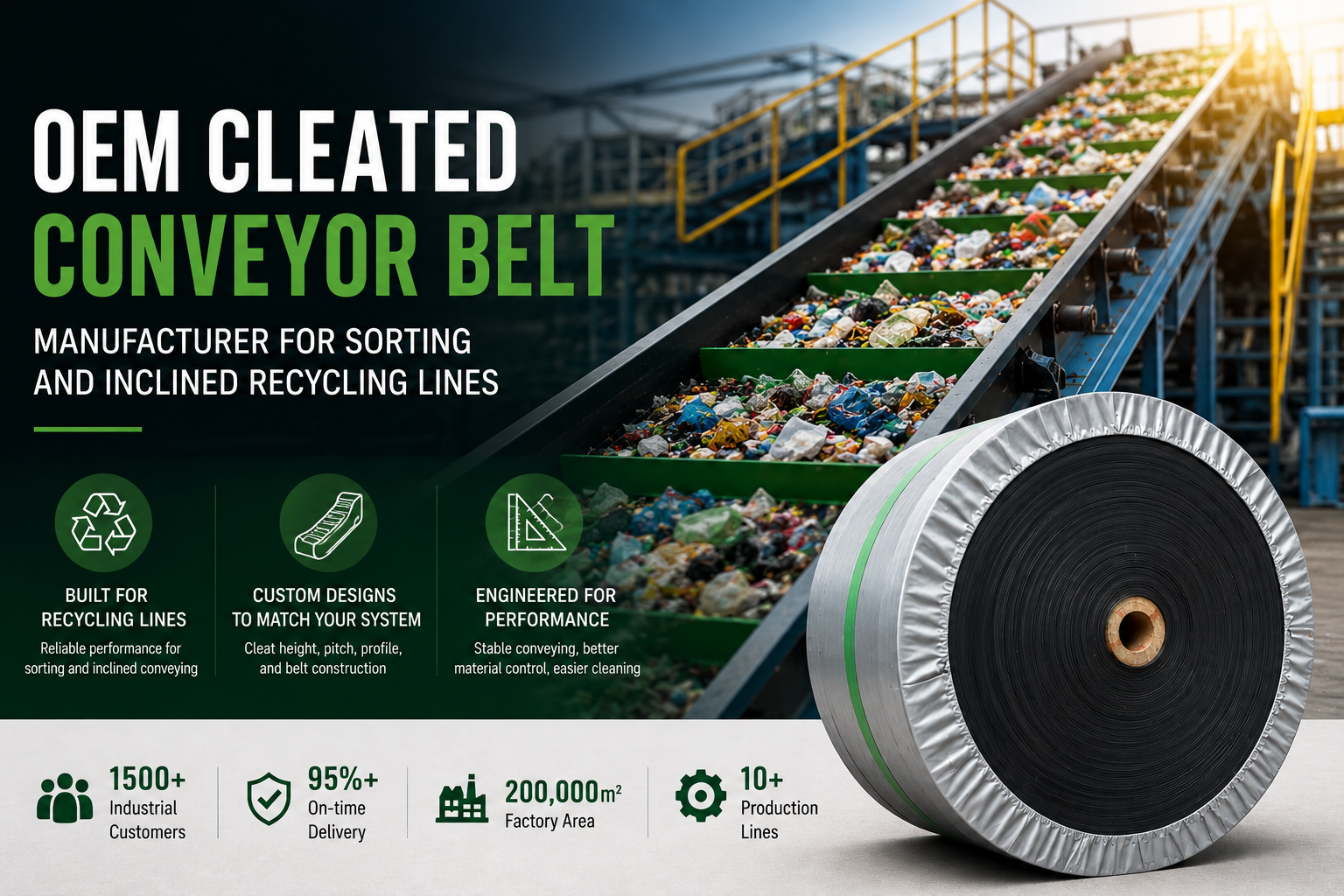
OEM Cleated Conveyor Belt Manufacturer for Sorting and Inclined Recycling Lines
A recycling conveyor rarely fails because someone forgot to specify that the belt needs cleats. The harder problems appear in the details: mixed material rolls back between flights, a tall cleat interferes with the discharge point, the belt will not flex correctly around the existing pulleys, or a replacement belt arrives with the right width but the wrong cleat pitch for the machine.
For an OEM, system builder, or recycling equipment manufacturer, buying a cleated conveyor belt is therefore a design-in and repeatability decision, not simply a belt purchase. Belt construction, cleat geometry, incline, pulley arrangement, splice, tracking and conveyed material all have to work as one system.
This guide explains what to define before requesting a quotation, how to compare a rubber or PVC cleated belt, and what an OEM buyer should verify before approving a custom belt for a sorting or inclined recycling line.
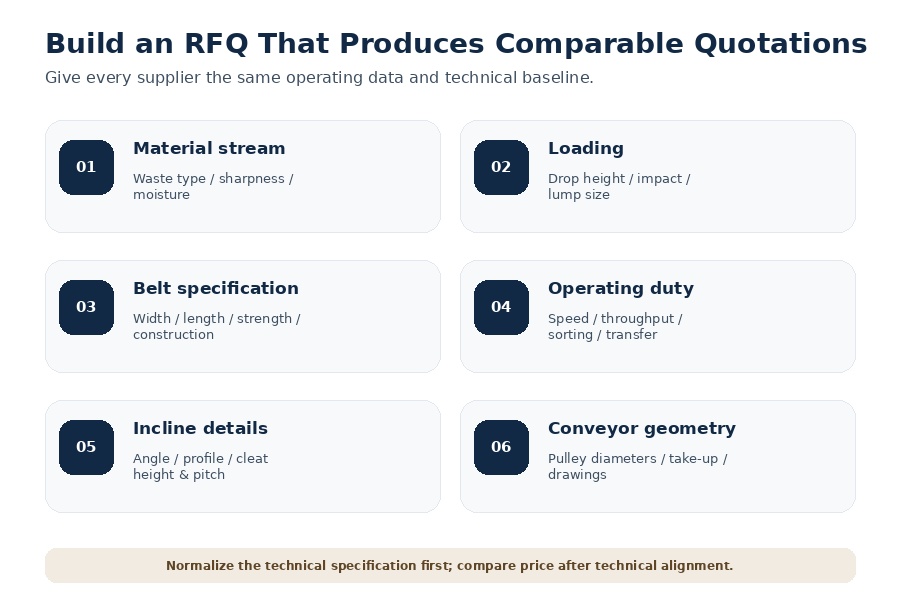
Quick Answer for OEM Buyers: Do not send an RFQ that says only “cleated conveyor belt, 600 mm wide.” For a usable quotation and drawing review, provide the material being conveyed, conveyor function, incline, belt width and developed length, cleat height/profile/pitch, pulley diameters, speed if known, joint requirement and either a conveyor drawing or clear photos of the existing belt and machine.
1. Why Recycling Lines Put Different Demands on a Cleated Conveyor Belt
A sorting line can contain horizontal inspection sections, short feeders, metering conveyors and inclined transfer conveyors within the same system. Their belt requirements are not necessarily interchangeable.
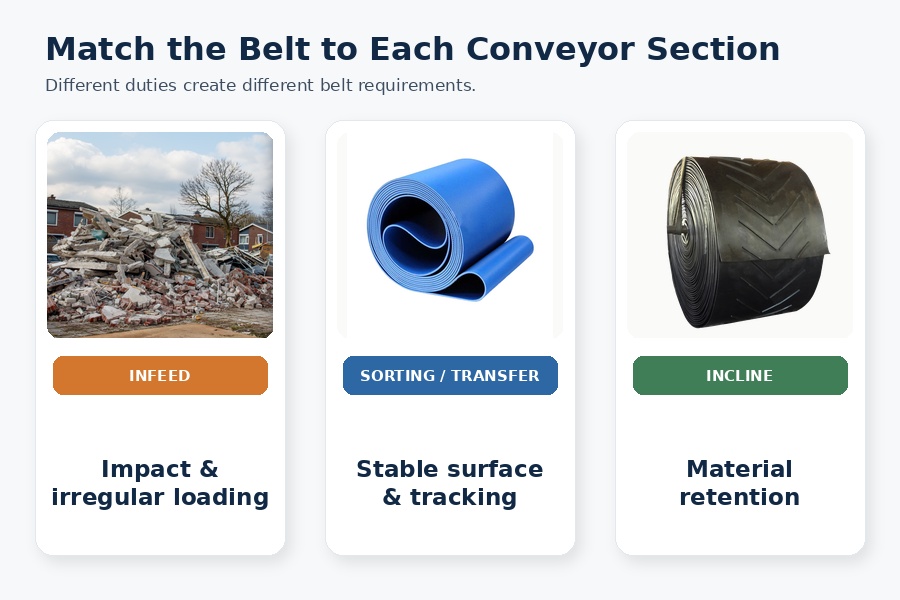
On an inclined conveyor, loose or irregular material tends to move relative to the belt under gravity. Cleats create physical holding points so the load does not depend on surface friction alone. This is particularly useful where pieces can roll, slide or accumulate at the bottom of an incline.
But adding larger cleats is not automatically an improvement. Cleat geometry changes loading, discharge, cleaning and the way the belt travels through the return path. The belt still has to bend around the pulleys and pass the conveyor structure without interference.
The engineering question is therefore:
What belt and cleat configuration keeps the actual material under control while remaining mechanically compatible with the OEM conveyor?
This is why a custom belt discussion should begin with the machine and material rather than with a catalogue profile.
2. Start With the Material Stream, Not the Belt Drawing
“Recyclables” is not a sufficient material description for an OEM quotation. A conveyor handling flattened cartons presents a different problem from one carrying mixed plastic containers, loose film, packaging scrap or irregular recovered material.
Before specifying the belt, describe the material characteristics that affect conveying behavior:
- Piece size and shape: Are the products flat, round, irregular or mixed?
- Typical and maximum load: Is the belt receiving a controlled feed or intermittent surges?
- Surface condition: Is the material normally dry, damp, dusty, dirty or contaminated?
- Sharp or abrasive pieces: Could the stream cut, gouge or wear the belt surface?
- Loose film or stringy material: Could it wrap around rotating components or catch around cleats?
- Required separation: Do the cleats merely prevent rollback, or must they create defined carrying pockets?
This information affects more than material choice. It helps determine cleat height, spacing, surface pattern and whether the proposed belt is appropriate for the loading and discharge arrangement.
RFQ Warning: If a supplier quotes from belt width, length and price target alone, important application assumptions remain unresolved. For an OEM project, those assumptions should be converted into a drawing or written specification before batch production.
3. PVC Cleated Belt or Rubber Cleated Belt?
For many sorting and lighter industrial conveying systems, a PVC cleated belt is a logical product category to evaluate. SINOCONVE's cleat PVC conveyor belt guide discusses this type of belt for inclined handling, including packaged goods, light parts, sorting lines and other lighter-duty applications.
Rubber cleated belts belong in the discussion when the operating conditions require a more heavy-duty belt construction or the material and environment impose different wear and impact demands. The choice should not be made from the word “recycling” alone.
| Selection Question | Why It Matters for PVC Cleated Belts | When to Reassess the Belt Construction |
|---|---|---|
| Material duty | Well suited to many light industrial, sorting and packaged-product conveyor layouts when the selected belt construction matches the duty. | Heavy impact, aggressive abrasion or sharp material may require a different construction. |
| Incline control | Fabricated cleats can provide defined holding points for products moving uphill. | Very steep conveying or significant edge containment may require another belt concept rather than simply taller cleats. |
| Pulley layout | The belt construction and cleats must remain compatible with the machine's bending and return path. | Small pulleys, complex transitions or restricted return clearance require closer engineering review. |
| Cleaning | PVC is used in many applications where a cleanable surface is useful. | Deep cleat pockets, sticky contamination or trapped debris can make the geometry harder to clean regardless of belt material. |
If the system builder is still deciding among available PVC structures, the broader PVC conveyor belt selection guide provides additional context on belt surfaces, structures and joining considerations.
4.Cleat Height and Pitch Should Follow Product Behavior
Cleat dimensions are among the most visible features on a drawing, which makes them easy to overemphasize. Height alone does not determine whether an inclined conveyor will work.
A cleat must be high enough to control the intended load, but unnecessarily tall cleats can create other problems. They can affect discharge, reduce available clearance and make cleaning around the profiles more difficult. Cleat spacing has similar trade-offs. Wide spacing may allow small or mobile pieces to shift between cleats; very close spacing creates more pockets and more profile area to clean.
For a new OEM design, the supplier should know at least:
- what the cleat is expected to control;
- maximum product or lump dimensions;
- the actual conveyor incline;
- how material enters each cleat pocket;
- how it leaves the belt at discharge;
- available clearance through the return section; and
- the required cleat orientation and spacing.
If an existing machine already works well, a sample, dimensioned drawing or clear photographs of the current belt can reduce ambiguity. SINOCONVE supports OEM/ODM customization based on customer drawings, samples and specific requirements.
5. The Incline Angle Cannot Be Reviewed in Isolation
An inclined conveyor belt needs enough material control for its operating angle, but there is no responsible universal incline figure that can be specified without considering the conveyed product and belt geometry.
Dry, flat pieces behave differently from round containers. Wet material behaves differently from clean packaged products.Feed consistency, belt speed and the way material lands on the belt also affect stability.
For this reason, an OEM should give the belt manufacturer the actual machine angle rather than describing the conveyor simply as “inclined.”
For applications requiring much stronger containment at high elevation changes, a conventional cleated belt may no longer be the most appropriate architecture.A sidewall conveyor belt system combines transverse cleats with lateral containment and should be evaluated as a different conveyor concept rather than treated as a taller version of an ordinary cleated belt.
6. Check Pulley Diameter and Return-Side Clearance Before Freezing the Drawing
One of the easiest OEM mistakes to avoid is approving the carrying surface while ignoring the rest of the belt path.
A cleated belt repeatedly bends as it travels around the conveyor pulleys.The selected belt construction, thickness, splice and cleat arrangement must therefore be compatible with the pulley system. The cleats also need physical clearance through the return side, rollers, guards and structural members.
Send the manufacturer the drive and tail pulley diameters and identify other small-diameter pulleys in the path. For a new machine, a conveyor GA drawing is more useful than a belt sketch alone because it shows where mechanical conflicts may occur.
This matters especially when a system builder is trying to make a conveyor more compact. Reducing pulley size or return clearance may solve a packaging problem in the machine frame while creating a new belt-flexing or interference problem.
7. Define the Splice as Part of the OEM Specification
The joint is part of the belt design. It should not be left until the machine is ready for assembly.
The correct approach depends on installation access, belt construction, pulley arrangement, maintenance strategy and whether the conveyor frame allows a pre-made endless belt to be installed. A factory endless belt may be attractive where joint continuity is important, but it can be inconvenient if the machine cannot be opened sufficiently for installation.
A field-installed joint can simplify replacement in some machines, but its compatibility with the belt, pulleys and operating conditions still has to be reviewed.
For OEM purchasing, put the intended joining method on the approved belt drawing or technical specification. That prevents a later order from arriving with the correct belt body but an unsuitable installation method.
8. Drawing Approval Is More Important Than a Long Product Description
Custom OEM orders introduce a commercial risk that catalogue purchasing does not: two companies can interpret the same short RFQ differently.
“PVC belt, green, with 50 mm cleats” still leaves many questions unanswered.Where does the first cleat start? What is the pitch? Are cleats perpendicular to travel? What are the edge distances? What is the final endless length? What joint is required?
For repeat projects, a controlled drawing should become the reference between the system builder and the belt manufacturer.
| Drawing Item | What the OEM Should Define | Risk If It Is Ambiguous |
|---|---|---|
| Belt dimensions | Width, required length and thickness/construction requirement | Fit or tracking problems |
| Cleat geometry | Profile, height,width/orientation and required shape | Poor product control or mechanical interference |
| Cleat pitch | Center-to-center spacing and start position | Incorrect pocket size or inconsistent feeding |
| Edge clearance | Distance from cleat/profile to belt edges | Conflict with guides or machine structure |
| Joint | Endless or specified field-joint requirement | Installation delays or pulley incompatibility |
| Direction | Travel direction where profile orientation makes it relevant | Incorrect assembly or material-control behavior |
Drawing control also improves repeat orders. The buyer can reference an approved revision rather than rebuilding the specification from emails, photographs and old purchase orders.
9. Sample Qualification Should Reproduce the Risk, Not Just Confirm the Color
For a new recycling machine or a substantially changed belt design, a sample can be useful, but only if the test answers a meaningful question.
A small material swatch can help confirm construction or surface details. It cannot reproduce every behavior of a full belt running over the actual pulley arrangement. Likewise, running an unloaded belt proves little about rollback, pocket loading or discharge under production conditions.
For a pilot or first-article evaluation, OEMs should observe the issues that could become expensive after volume production:
- tracking through the complete conveyor path;
- material rollback at normal feed conditions;
- cleat deformation or interference around the machine;
- loading consistency between cleats;
- discharge behavior;
- carryback and debris accumulation;
- joint behavior; and
- clearance at the return path and pulleys.
Standard or small test samples can be discussed with SINOCONVE before an order. For a custom OEM project, however, the acceptance method should reflect the actual design risk.
10. How to Qualify an OEM Cleated Conveyor Belt Manufacturer
A supplier's ability to manufacture a belt is only one part of OEM qualification. System builders also need to know whether the supplier can convert machine requirements into a controlled, repeatable product.
10.1 Customization Capability
Ask whether the manufacturer can work from drawings, physical samples and application requirements rather than only supplying catalogue sizes. SINOCONVE supports OEM/ODM production and customization according to customer drawings, samples and specific requirements.
That capability is relevant when a system builder needs custom dimensions, cleat arrangements, colors, logos or packaging. It does not remove the need for engineering review: the buyer and manufacturer still need to agree on what is technically suitable for the machine.
10.2 Quality Control and Documentation
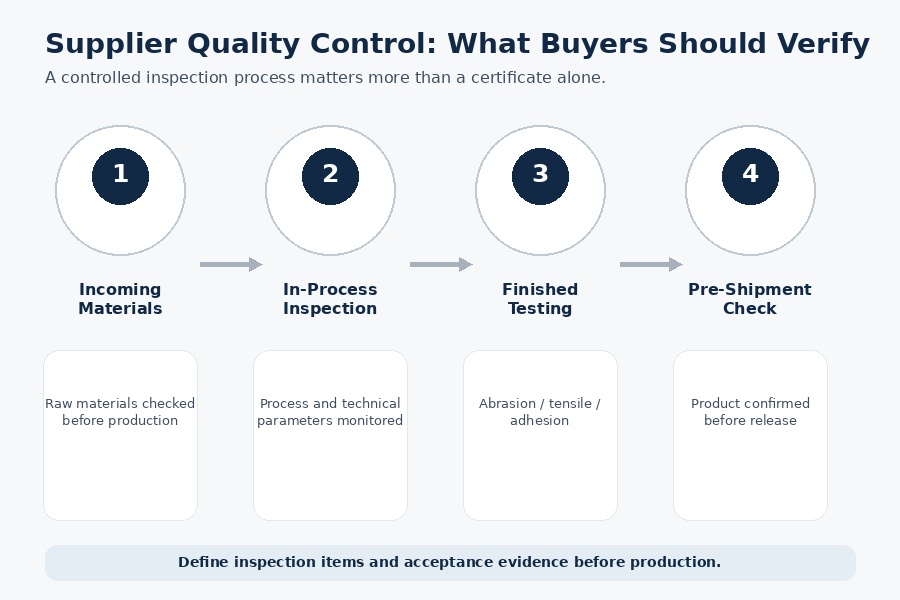
For repeat OEM orders, consistency matters as much as the first sample. SINOCONVE's confirmed quality process includes incoming raw-material inspection, production inspection and final testing/inspection before shipment. Product test reports can be provided, and third-party testing can be arranged when customers have specific standard requirements.
The company's broader manufacturing and quality-control information can be reviewed during supplier qualification.
For an OEM buyer, it is useful to agree before ordering which dimensions, visual details and documentation will be checked. Do not assume that a generic certificate automatically verifies every project-specific requirement on your drawing.
10.3 Manufacturing Experience and Project Communication
SINOCONVE's factory was established in 1988 and has more than 35 years of belt manufacturing experience. For custom projects, the practical value of that background is the ability to discuss belt construction and manufacturing requirements with a technical and product-development team rather than treating every inquiry as a standard catalogue order.
Still, supplier history should not replace project qualification. A system builder should approve the actual material, drawing, tolerances, sample where necessary, inspection requirements and packaging for the project being purchased.
11. Control the First Batch Before Scaling the Project
The commercial risk changes once a belt moves from prototype to repeat production.
One belt with the wrong cleat pitch creates an installation problem. A batch of belts with the same error can affect multiple machines, field commissioning dates and spare-parts inventory. This is why an OEM purchasing process should include a clear approval point before volume production.
A practical sequence is:
- Submit machine and application data.
- Confirm belt construction and cleat concept.
- Review the supplier drawing and critical dimensions.
- Approve a sample or first article where the project risk justifies it.
- Confirm the inspection criteria and required documents.
- Freeze the approved specification or drawing revision.
- Use that revision as the reference for repeat orders.
This does not eliminate every operating variable. It does eliminate many avoidable purchasing errors caused by incomplete specifications.
Buyer Takeaway: The cheapest quotation is difficult to evaluate when suppliers are quoting different assumptions. Drawing approval, material definition, cleat geometry and inspection scope make quotations more comparable and reduce the risk of discovering specification differences after production.
12. RFQ Checklist for a Custom Cleated Conveyor Belt
An OEM or recycling system builder can shorten technical clarification by sending the following information with the initial RFQ.
| Information | What to Provide |
|---|---|
| Application | Sorting, feeding, inspection, inclined transfer or another conveyor function |
| Conveyed material | Material type, size/shape, condition and any sharp, abrasive, wet or stringy content |
| Conveyor geometry | Incline angle, belt width, required length and relevant machine drawing |
| Cleats | Required profile/shape, height, pitch,orientation and edge clearance; attach the existing drawing or sample if available |
| Pulley system | Drive/tail pulley diameters and other restrictive pulleys |
| Operating data | Belt speed, target throughput/load and operating environment where known |
| Joint | Installation constraints and preferred joint/endless requirement |
| OEM requirements | Drawing revision, logo/color/packaging requirements, quantity and repeat-order plan |
| Quality requirements | Required inspection items, reports or customer-specific standard requirements |
If the current belt has already failed, add photographs of the belt, splice, cleats, pulleys, loading point and damaged area. A failure sample often communicates more than a generic statement such as “the old belt did not last.”

13. Frequently Asked Questions
Can a PVC cleated conveyor belt be used on a recycling sorting line?
Yes, PVC cleated belts can be considered for many light industrial sorting and inclined conveying applications. Suitability still depends on the material stream, impact and abrasion, contamination, incline, pulley arrangement and cleaning requirements. Heavy or aggressive recycling duties should be reviewed separately rather than assuming the same PVC construction will work.
What information does a cleated conveyor belt manufacturer need for an OEM quotation?
At minimum, provide belt dimensions, material being conveyed, incline, cleat geometry and pitch, pulley information, conveyor function and quantity. For a custom machine, include a drawing or photographs and explain installation and joint requirements.
Can SINOCONVE manufacture from a drawing or sample?
Yes. SINOCONVE supports OEM/ODM and custom production based on customer drawings, samples and specific requirements. Final construction should be technically reviewed and confirmed before production.
Should I specify cleat height from the old belt?
If the existing belt performs correctly, its dimensions are valuable reference data. If the existing design has rollback, discharge, clearance or cleaning problems, simply copying its cleat height may reproduce the same issue. Explain the failure or operating problem when requesting the replacement.
Is a taller cleat always better for an inclined conveyor?
No. Taller cleats may provide more physical support in some applications, but they also affect discharge, cleaning, bending and machine clearance.Height and pitch should be selected as part of the complete belt and conveyor geometry.
How should an OEM reduce risk before placing a larger project order?
Freeze the application requirements, approve the belt drawing and critical dimensions, define inspection criteria, and use sample or first-article validation where the project risk justifies it. Keep the approved revision as the repeat-order reference.
Can product test reports be supplied?
SINOCONVE can provide product test reports. If a customer has special standard or verification requirements, third-party testing can also be discussed. The required documents and acceptance criteria should be agreed before production rather than requested after shipment.
14. Prepare the Machine Data Before Requesting a Quote
For an OEM recycling conveyor, the best quotation starts with a better technical package.Send SINOCONVE the conveyor drawing or existing belt sample together with the material description, incline angle, belt dimensions, cleat profile and pitch, pulley diameters, joint requirement and planned order quantity. If the existing belt has a problem, include photos showing the failure and surrounding conveyor structure.
You can review the SINOCONVE PVC conveyor belt range or submit project details through the conveyor belt inquiry page. Technical and quotation information can also be sent to sales@sinoconve.com.
Related Products
For custom inclined handling and sorting-line applications where transverse cleats are required.
Product category for light industrial, sorting, packaging and material-handling applications.
An alternative raised-profile belt category for inclined conveying where the application calls for a molded profile rather than fabricated transverse cleats.
Related Articles
Cleat PVC Conveyor Belt for Inclined Handling
How cleat height, spacing, material behavior and conveyor layout affect selection.
Not All PVC Conveyor Belts Are the Same: How to Match the Right Type to Your Workflow
A broader guide to PVC belt structure and application matching.
OEM Conveyor Belt Manufacturer: What Industrial Buyers Should Check Before Ordering
Supplier qualification, customization and repeat-order considerations for OEM buyers.
Sidewall Conveyor Belt: When Steep Angle Conveying Saves Space
Useful when an inclined recycling conveyor needs substantially greater material containment.