
Mining Conveyor Belt Manufacturer for Quarry and Aggregate Projects: What Buyers Should Verify
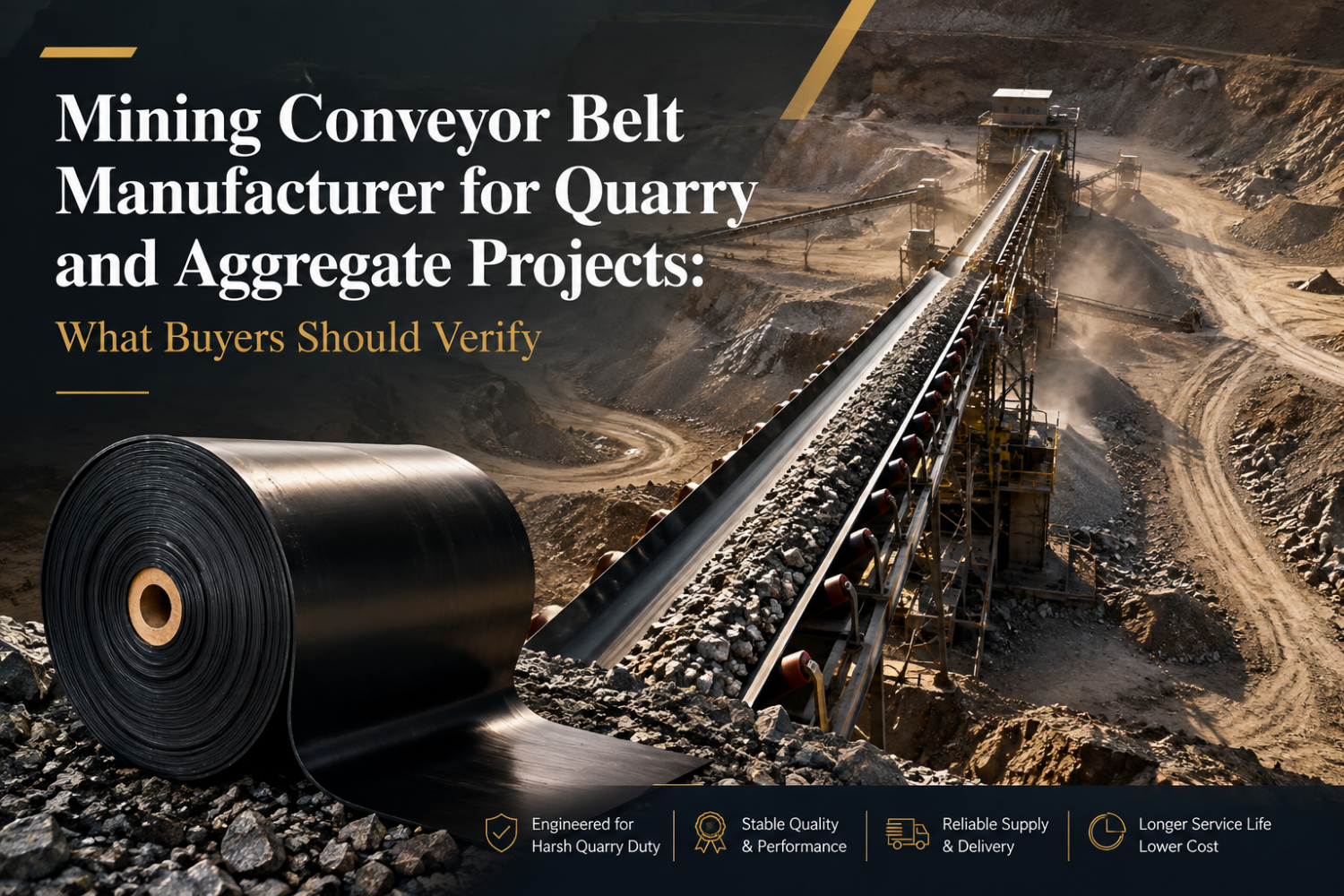
A quarry conveyor belt purchase can look straightforward on an RFQ: belt width, length, strength rating, cover thickness, quantity and delivery destination. The difficult part is deciding whether those numbers actually describe the belt the project needs. Crushed stone, limestone, gravel and other aggregates expose a belt to abrasion, loading impact, cutting and repeated flexing, while conveyor length, tension, pulley arrangement and transfer-point conditions add another set of demands.
For a procurement team, this makes supplier qualification more important than simply comparing price per meter. A mining conveyor belt manufacturer should be able to work from operating data, translate it into a controlled specification, manufacture that specification consistently, provide meaningful inspection documentation and support repeat orders. This guide explains what quarry and aggregate buyers should verify before approving a supplier or issuing a bulk purchase order.
Quick Answer: Do not qualify a mining conveyor belt supplier from a catalogue and quotation alone. Verify four things together: whether the proposed belt matches the conveyor duty, whether the factory can control the specified construction, whether the required inspection and test documentation is agreed before production, and whether production capacity and delivery commitments fit the project schedule.
1. Start With the Quarry Duty, Not the Supplier Catalogue
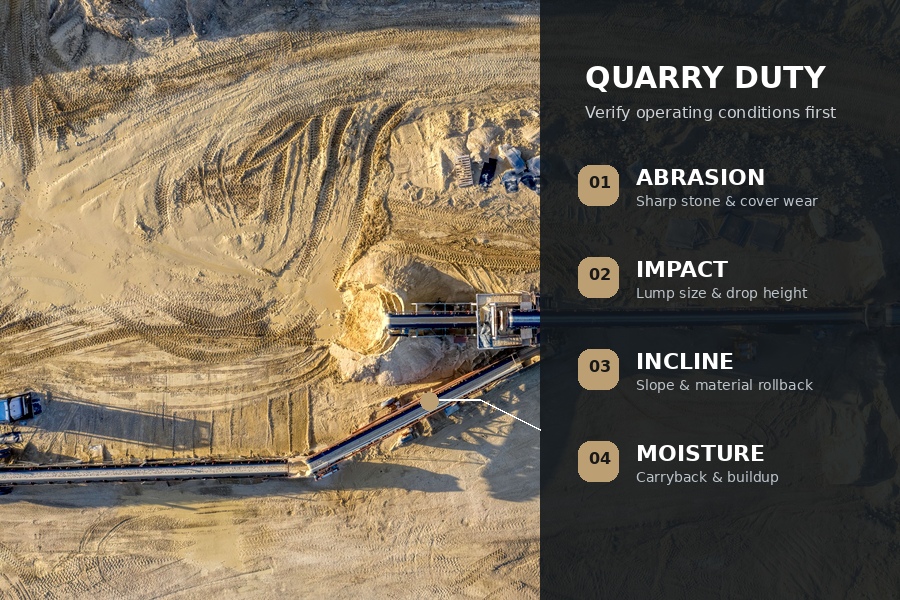
The same quarry can contain several conveyors with very different belt requirements. A short feeder below a crusher may receive severe impact from large lumps. A transfer conveyor may handle smaller but highly abrasive crushed material. A long stockpile conveyor may place greater emphasis on tension behavior, tracking and splice reliability. An inclined section introduces material-retention considerations that a horizontal conveyor does not.
This is why a request for a generic “heavy duty belt” is not a complete engineering specification.
Before asking a manufacturer for a quotation, buyers should describe at least the conveyed material, maximum lump size, loading condition, conveyor geometry, required capacity, belt speed where known, belt width, existing belt construction or approved design, pulley information and operating environment. If the purchase is a replacement, photographs of the old belt and its failure pattern can also be useful.
| Operating Condition | Main Risk | What the Buyer Should Verify |
|---|---|---|
| Sharp crushed stone or abrasive aggregate | Cover wear, cuts and gouging | Cover compound requirement, cover thickness and actual wear pattern |
| Large lumps falling at the loading point | Impact damage to cover and carcass | Lump size, drop height, loading-zone support and carcass requirement |
| Long or high-tension conveyor | Excessive elongation or inadequate tensile capacity | Required strength rating, conveyor design data, take-up arrangement and splice design |
| Inclined aggregate conveying | Rollback and material spillage | Incline angle, material behavior and whether smooth, chevron or sidewall construction is appropriate |
| Wet fines, clay or sticky material | Carryback, buildup and cleaning problems | Material moisture, cleaner arrangement, surface design and transfer conditions |
Buyers reviewing an existing quarry installation can also compare these conditions with SINOCONVE's rubber conveyor belt buying guide, which focuses on the relationship between operating conditions, carcass, cover and loading-zone problems.
2. Verify the Belt Construction Before Comparing Prices
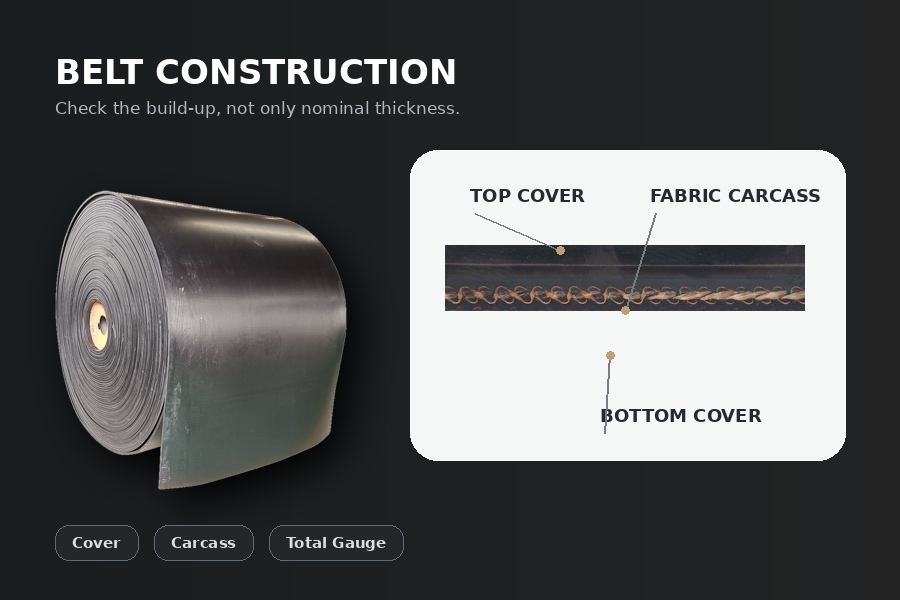
Two quotations can show the same width and nominal belt strength while representing materially different proposals. Procurement therefore needs a specification comparison, not only a commercial comparison.
2.1 Fabric or steel cord is an engineering decision
Fabric-reinforced belts are widely applicable to quarry and aggregate conveying, but steel cord construction becomes relevant when system tension, conveyor length and elongation requirements justify it. Neither construction is automatically “better.” The correct choice depends on conveyor design and duty.
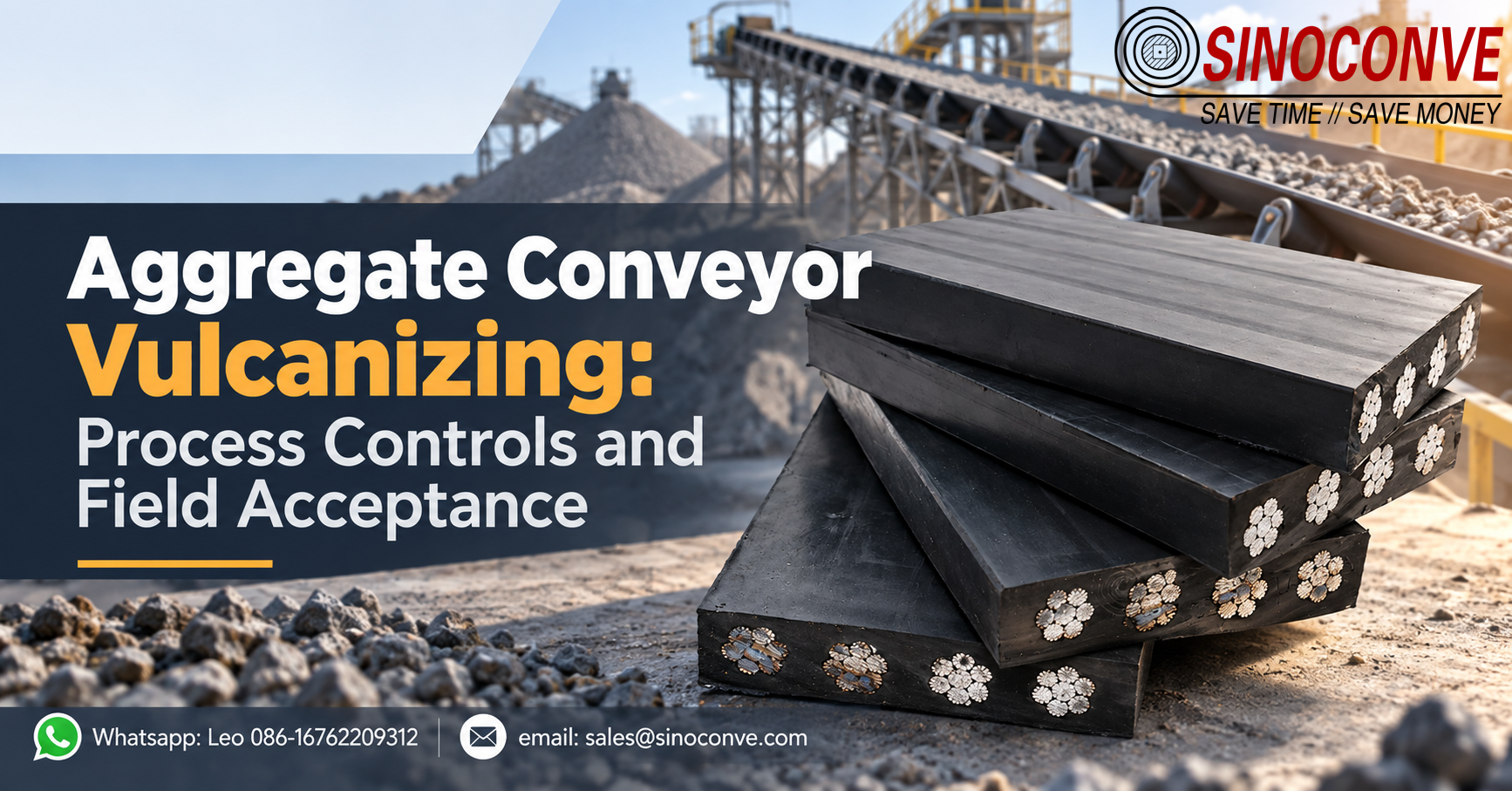
For general-use textile conveyor belting, ISO 14890:2026 specifies requirements for rubber- or plastics-covered textile construction used on flat or troughed idlers. Steel cord belts are covered separately; ISO 15236-1:2016 specifies design, dimensional and mechanical requirements for steel cord conveyor belts for general use.
The procurement implication is simple: do not change carcass type or strength rating merely because a supplier recommends a heavier-looking belt. If the conveyor already has an approved engineering specification, use that as the starting point. If a change is proposed, the supplier should review the relevant conveyor data rather than selecting from belt thickness alone.
2.2 Cover thickness and cover performance are different questions
A thicker top cover provides more sacrificial rubber, but thickness alone does not establish abrasion or cut resistance. Cover compound performance, conveyed material and loading conditions also matter.
This is particularly important around crushers and primary loading points. If the existing belt shows deep cuts and localized gouging rather than uniform surface wear, simply ordering more rubber may not address the root cause. Drop height, material trajectory, impact support and lump characteristics should also be reviewed.
SINOCONVE lists a dedicated stone crusher conveyor belt for quarry applications. Its published page also shows the type of dimensional, carcass and cover information buyers can compare during technical clarification.

3. Ask for Proof of Factory Capability That Relates to Your Order
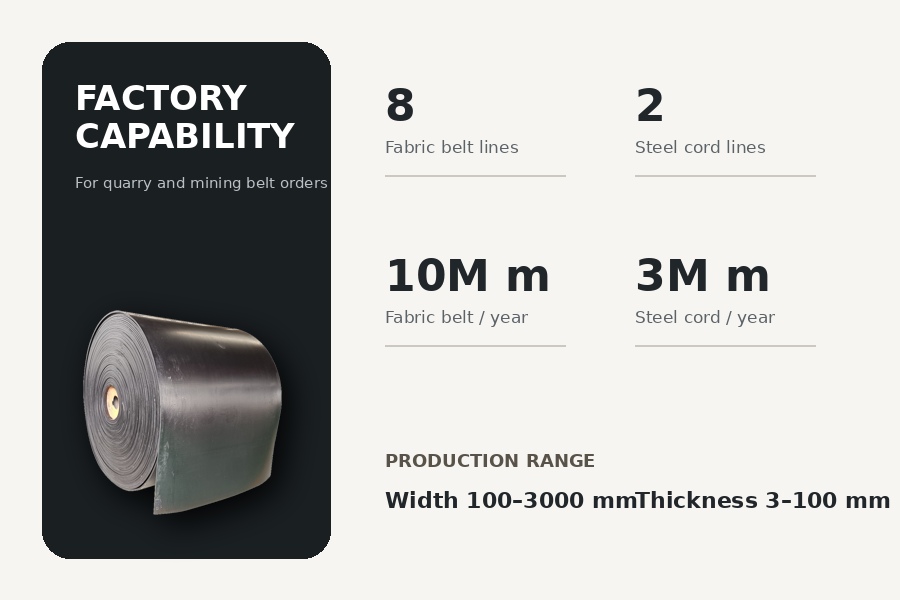
“Factory direct” has little procurement value unless the factory has equipment, controls and capacity relevant to the belt being ordered.
According to SINOCONVE's current company information, its conveyor belt operation has 8 fabric conveyor belt production lines and 2 steel cord conveyor belt production lines. Stated annual production capacity is 10 million meters of fabric conveyor belt and 3 million meters of steel cord conveyor belt. The supplied production range covers widths from 100 mm to 3,000 mm, thicknesses from 3 mm to 100 mm, fabric ratings from EP100 to EP600, and steel cord ratings from ST500 to ST7500.
These figures are useful for prequalification, but project buyers should still verify whether their exact belt construction, width, rating, quantity and requested delivery schedule fit the planned production slot. Published factory capacity does not by itself guarantee a specific order date.
Buyer Tip: For a large quarry project, ask the manufacturer to confirm the production route for your actual specification. A useful answer should identify whether the order is fabric or steel cord construction, whether the requested dimensions are within production capability, what inspection documents will accompany the order and what production schedule is being committed to.
Buyers who want a broader view of the manufacturer's production scope can review SINOCONVE's conveyor belt product range and manufacturing capability before sending the RFQ.
4. Quality Control Should Be Defined Before the Purchase Order
A statement such as “strict quality control” is not enough for a project order. The useful question is: what will be checked, at which stage, against which agreed requirement, and what documentation will the buyer receive?
SINOCONVE's supplied QC process starts with incoming raw-material inspection, continues with production inspection, and ends with finished-product testing and final inspection before shipment. The company states that product test reports can be supplied. Its published quarry belt information also describes checks covering belt dimensions and surface condition, with laboratory testing that includes abrasion, adhesion and tensile properties.
For procurement, the inspection plan should be tied to the purchase specification. Depending on the project, buyers may need to agree requirements for dimensions, belt construction, tensile properties, adhesion, cover performance or other application-specific characteristics. Special standard or third-party testing requirements should be identified during RFQ clarification rather than after production.
The company information supplied for this article states that SINOCONVE can manufacture to different market requirements with reference to DIN, RMA and ISO requirements, and that third-party testing can be arranged when customers have special standard requirements. This should not be interpreted as meaning that every belt automatically carries every standard or approval. The applicable standard and required evidence need to be written into the order.
5. Check Whether the Supplier Can Control Repeat Orders
One successful sample or first shipment does not automatically qualify a supplier for a multi-stage quarry project. Repeatability matters when replacement belts will be purchased over several maintenance cycles or when a distributor needs the same construction for recurring orders.
A practical repeat-order specification should remove ambiguity. Record the approved belt width and length, carcass type and rating, cover requirement, cover thicknesses, edge construction where relevant, splice requirement, marking, packaging and agreed inspection documentation. Keep the approved drawing, specification sheet or sample reference under revision control.
This becomes especially important with OEM and private-label procurement. Logo and packaging customization are useful commercially, but they should not replace technical identification. The buyer still needs a stable specification that both sides can reproduce on the next purchase order.
SINOCONVE supports conveyor belt customization and OEM/ODM production according to customer requirements. Its supplied company information also confirms customized logos and packaging options.
6. Production Capacity Matters Only When It Supports the Project Schedule
A quarry expansion or aggregate plant shutdown often has a fixed installation window. Late delivery can therefore cost more than a small difference in belt price.
SINOCONVE's current supplied commercial information states a normal conveyor belt lead time of approximately 30 days. For urgent requirements, a faster production channel may reduce this to approximately 15–20 days, subject to the specific order. The stated minimum order quantity for conveyor belts is 50 meters.
These numbers should be treated as commercial planning references rather than automatic promises for every RFQ. A wide steel cord belt, a customized construction and a straightforward fabric belt order do not necessarily create the same production schedule.
For a project purchase, ask the supplier to confirm:
- production lead time for the exact specification and quantity;
- whether the quotation means production completion or shipment readiness;
- inspection or third-party testing time if required;
- packing method and roll dimensions;
- number of rolls and length per roll;
- shipping destination and required delivery date;
- documentation that must be completed before dispatch.
7. Packaging Is Part of Heavy-Duty Belt Procurement
Quarry conveyor belts are heavy industrial products, but that does not make them immune to logistics damage. Edges, roll surfaces and packaging can be exposed during lifting, container loading, transshipment and outdoor handling.
SINOCONVE's supplied packing information includes PVC board and iron-sheet protection for conveyor belts, with palletizing available according to requirements. For a bulk export order, buyers should agree the roll configuration and protection method before shipment, especially when belts will spend significant time in sea freight or project-site storage.
Also check how each roll will be identified. Clear identification becomes valuable when one shipment contains different conveyor positions, belt strengths or roll lengths.
8. Compare Suppliers on Technical and Commercial Evidence
A low unit price can be attractive on a large RFQ, but price per meter is only meaningful after the competing quotations have been normalized to the same technical scope.
| Qualification Area | What to Verify | Warning Sign |
|---|---|---|
| Application review | Supplier asks about material, loading, conveyor geometry and existing specification | Quotation based only on width and length |
| Technical specification | Carcass, strength, covers, dimensions and relevant requirements are clearly defined | Generic “heavy duty” description without measurable specification |
| Factory capability | Production equipment and range fit the actual belt being purchased | Capacity claims with no connection to the proposed order |
| Quality documentation | Inspection scope and test-report requirements agreed before production | Certificates discussed only after the buyer requests them |
| Delivery | Lead time is confirmed against exact quantity and construction | One standard lead-time promise applied to every belt type |
| Repeatability | Approved specification can be referenced for future batches | Repeat orders depend on photographs or informal descriptions |
This comparison also helps buyers distinguish a manufacturing partner from a supplier that is simply responding to an RFQ. SINOCONVE's OEM conveyor belt manufacturer guide provides further points for evaluating customized and repeat-order supply.
9. What to Put in a Quarry Conveyor Belt RFQ
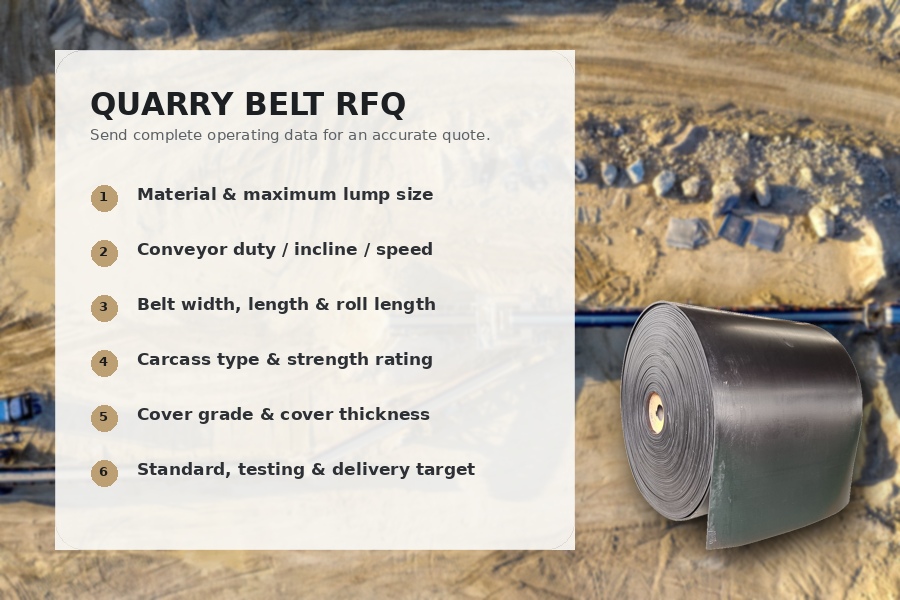
The quality of a quotation depends heavily on the quality of the RFQ. Sending only “EP conveyor belt, 1000 mm wide, please quote” forces the supplier either to ask for more information or make assumptions.
A more useful mining procurement package includes the information that changes belt selection and commercial planning.
| RFQ Item | What the Buyer Should Provide |
|---|---|
| Material | Crushed stone, limestone, gravel, ore or other material; include maximum lump size and moisture condition where relevant |
| Conveyor duty | Capacity, belt speed, incline and operating hours where available |
| Belt dimensions | Required width, length and roll-length requirements |
| Construction | Approved carcass type and strength rating, or conveyor design data if supplier review is required |
| Covers | Required cover grade/performance and top/bottom thickness according to the approved specification |
| Existing system | Current belt specification, pulley information and photos or drawings where a replacement is being evaluated |
| Compliance | Required standard, test documentation, inspection requirements and any third-party verification |
| Commercial scope | Quantity, destination, required delivery date, packaging and marking requirements |
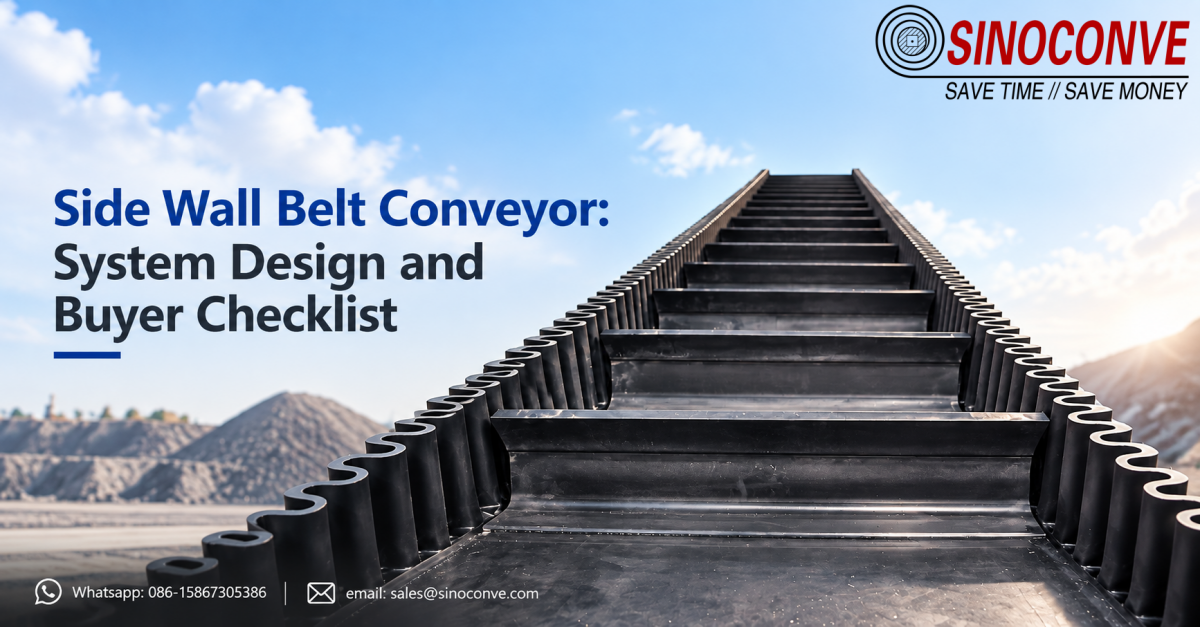
For steep quarry routes, tell the manufacturer the actual inclination and material behavior rather than simply requesting a patterned belt. Depending on the layout, the discussion may involve a chevron conveyor belt or, where significantly steeper lifting and material containment are involved, a sidewall conveyor belt for quarry handling.
10. Questions Buyers Commonly Ask
How do I compare two mining conveyor belt manufacturers?
Normalize the technical scope first. Compare the same carcass requirement, belt strength, cover specification, dimensions, inspection requirements, quantity and delivery terms. Then evaluate factory capability, QC documentation, repeat-order control, packaging, lead time and commercial terms. Comparing price before normalizing the specification can make a lower-specification belt appear artificially cheaper.
Is a thicker conveyor belt always better for a quarry?
No. Thickness must be considered together with carcass construction, cover properties, pulley compatibility and operating conditions. If the main problem is impact, misalignment or an unsuitable loading zone, adding thickness alone may not solve the failure mechanism.
When should a quarry consider a steel cord conveyor belt?
Steel cord construction becomes relevant when the conveyor design requires high tensile capacity and low elongation, particularly on long or high-tension systems. It should be selected from conveyor engineering requirements rather than on the assumption that steel cord is universally superior to fabric construction.
What documents should be requested before shipment?
The exact documentation depends on the purchase specification. Buyers should agree in advance which inspection and test reports are required, what standard or customer specification applies, how rolls will be identified and whether third-party inspection is necessary. Documentation requirements written into the RFQ and purchase order are easier to control than requests made after production.
Can SINOCONVE provide test reports?
Yes. SINOCONVE's supplied company information states that product test reports can be provided and that third-party testing can be arranged for special standard requirements. The exact test scope should be confirmed for the individual order before production.
What is SINOCONVE's MOQ and lead time for conveyor belts?
The currently supplied commercial information states a conveyor belt MOQ of 50 meters and a normal lead time of approximately 30 days. Urgent orders may be handled in approximately 15–20 days where production conditions allow. Buyers should obtain order-specific confirmation for the required construction, quantity and delivery schedule.

11. Qualify the Manufacturer Before You Qualify the Price
A quarry belt purchase should end with a commercial comparison, not start with one. First establish the operating duty. Then freeze the required construction, define the inspection evidence, verify that the manufacturer's production capability matches the order, and confirm that the project schedule is realistic. Once competing quotations describe the same technical scope, price becomes much more meaningful.
Ningbo Sinoconve Belt Co., Ltd. manufactures fabric and steel cord conveyor belts for mining, quarry and other bulk-material-handling applications. The factory was established in 1988 and has more than 35 years of manufacturing experience. Current supplied production information includes 8 fabric belt lines and 2 steel cord belt lines, with customized conveyor belt and OEM/ODM production available.
For a quarry or aggregate project RFQ, prepare the belt width and length, conveyed material and lump size, current or required carcass specification, cover requirement, conveyor operating data, quantity, required standard or test documentation, destination and delivery target. For a replacement problem, add photographs, drawings and the existing belt specification where available.
You can review SINOCONVE's conveyor belt products, submit the project through the contact and quotation page, or send the RFQ directly to sales@sinoconve.com. Providing the operating conditions with the RFQ gives the technical team a better basis for checking the specification before quotation.