
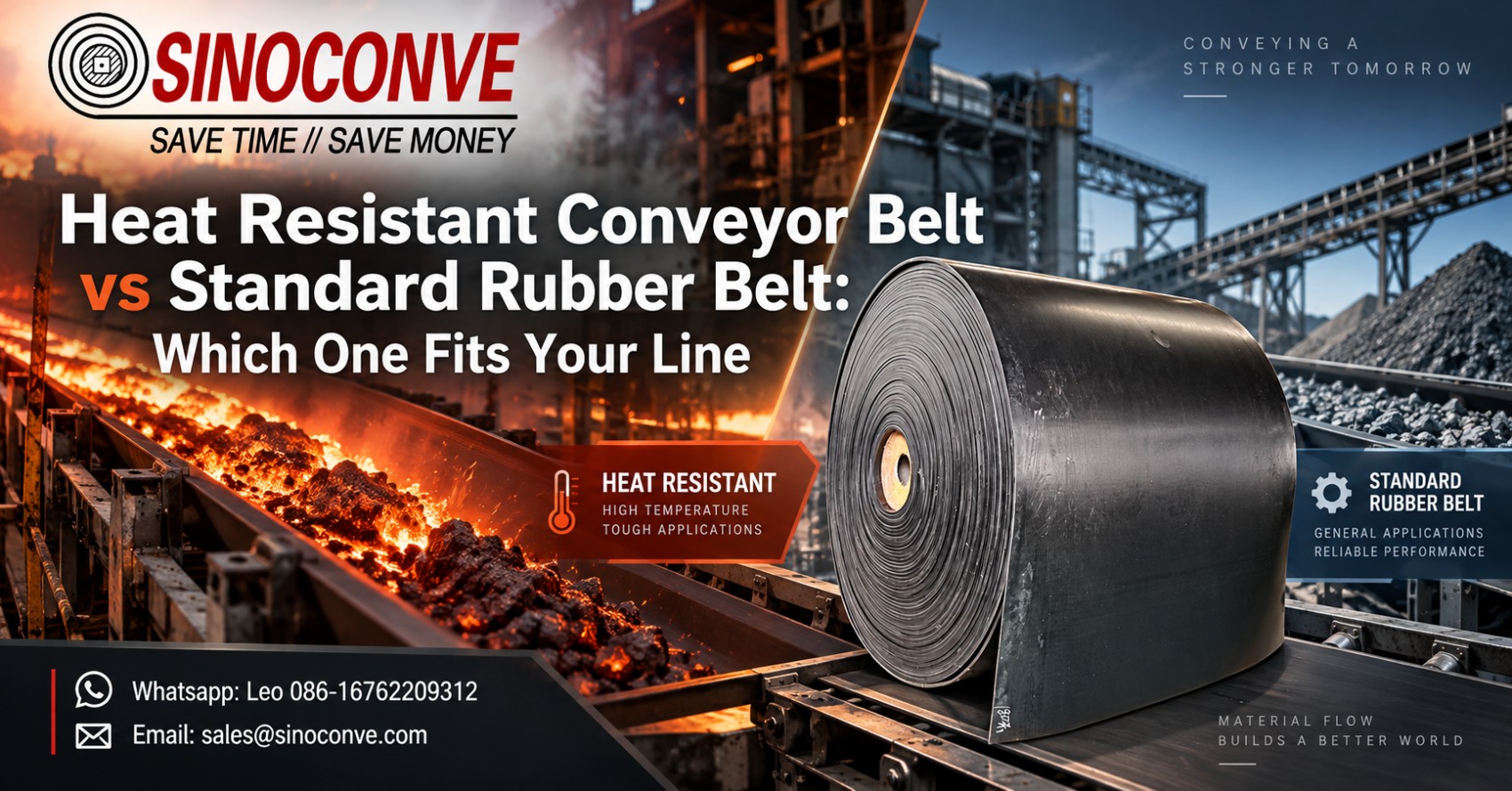
Two belts, same width, same tension rating. One costs roughly 20 percent more per meter. The other one is already in your warehouse, because it is the belt you have always bought.
Choosing between a heat resistant conveyor belt and a standard rubber belt looks like a price decision. It is not. It is a question about a single number that most purchase orders never carry: the peak surface temperature of the material where it touches the top cover. Get that number right and the choice takes two minutes. Get it wrong and you either pay for capability you do not need, or you pay far more in belt changes, splice labor and stopped production than the premium would ever have cost.
We build both belts. We have quoted standard EP belts onto hot duties and watched them come back hardened, cracked and separating inside eight months. We have also talked plants out of a high temperature conveyor belt because their measured duty was 70 °C and an abrasion grade was the honest answer. This article is that same conversation written down: what a standard belt can really take, where each heat grade sits, what the four heat-resistance routes inside a belt actually buy you, how the cost difference works out per ton of material moved, and how to verify a temperature claim before you sign anything.

01The Verdict Comes Before the Charts
Here is the whole decision rule in one line. Compare the peak surface temperature of the material at the loading point against the continuous temperature band of the belt you are considering. If normal operation sits inside the band and the peaks are rare and short, a standard belt with a heavier abrasion cover can serve you well. If normal operation sits at or near the top of the band, or the peaks arrive every shift, you need a heat grade. There is no third path, and no amount of cover thickness substitutes for compound chemistry.
That is the answer. The rest of this article exists because the number on the left side of that comparison is usually wrong in the documents we receive, and because the number on the right side means different things at different suppliers.
The number that decides it: peak material surface temperature
Not the kiln temperature. Not the process setpoint. Not the ambient air in the building. The surface temperature of the load where it contacts the top cover, at the loading zone and along the first few meters of carry. That is the figure we want before we quote, and we ask for it in writing.
What that number looks like in practice varies more than most design documents suggest. Clinker leaving a well-run grate cooler typically lands between 100 °C and 150 °C, and it climbs quickly after a kiln upset, a cooler stoppage or a burner imbalance. Sinter return fines commonly arrive between 120 °C and 180 °C. Foundry shakeout sand runs hot and heavier than people expect, often 130 °C to 200 °C depending on the casting cycle. Green coke and quenched coke follow the quench timing. Fertilizer prills after a cooler are often a mild 60 °C to 90 °C, which is exactly why so many fertilizer plants get away with a standard belt for years and then wonder why the cover on one line is crumbling.
One kiln discharge line we sized, a 1,200 mm belt on 150 m centers, ran a comfortable 135 °C average and still ate a belt in nine months. The shift log told the story: two clinker surges per shift at close to 195 °C, about twenty minutes each. The average was fine. The excursions were not. When a belt fails early, we ask the maintenance team for the upset events from the previous month rather than the normal operating temperature, because nine times out of ten the pattern is already in that log.
Why ambient temperature is the wrong instrument
Ambient air in a cement cooler building, a coke wharf or a foundry bay can sit at 45 °C to 70 °C for a full shift, and buyers sometimes quote that figure to us as their "belt temperature". It matters, but not in the way they think. A warm environment speeds up the ageing reactions in every ply, so a belt that lives at 60 °C ambient will not reach the service life of the same belt in a cool transfer tower. What ambient heat does not do is decide the grade. Only material contact does.
Radiant heat is a third case, and it produces a signature we recognize immediately. A belt passing under a hot kiln shell, beside a red-hot chute or below an unlagged duct bakes one edge or one half of the width while the rest of the belt stays cool. We have pulled belts where the cover on one side had hardened into a shell that cracked under a thumbnail while the opposite edge still flexed like new. A higher grade helps, but the real fix is usually a heat shield, wider skirt clearance or a change in the transfer chute position. Simple to describe, awkward to retrofit once the layout is fixed.
The cases where a standard belt is genuinely the right answer
Over-buying is a real cost, and we would rather point it out than quietly upgrade every quotation. A standard belt is the correct choice when the measured contact temperature stays below about 70 °C with no meaningful excursions, when contact time is short and the belt cools between loads, when the load is abrasive and the main wear mechanism is cutting rather than ageing, and when the line is short enough that a belt change costs hours rather than a shift.
An aggregate line moving dry stone at 55 °C does not need a heat compound. It needs a thicker abrasion cover and a proper impact zone. The same applies to a packaged goods line in an unheated bay. Spending the heat-grade premium there buys nothing you can measure.
Where buyers get this wrong is the middle ground, roughly 70 °C to 110 °C. That is the band where a standard cover still functions but ages fast, where the first sign of trouble is a cover that has lost its elasticity rather than one that has visibly burned. As a conveyor belt manufacturer, we see this constantly in cement and steel plants: a belt that was technically inside its rating for two years and then failed in the third, with a surface that looks like dried leather. If you are unsure which side of that line your duty falls on, our cluster reference on Heat Resistant Conveyor Belt Ultimate Guide (2026): Types, Grades and How to Choose walks through the grade classes in more depth than a comparison article can. For the field-level view of how modern compounds behave, the older notes on Heat Resistant Rubber Conveyor Belt: Modern Solutions are still worth reading.
02Where a Standard Rubber Belt Actually Stops
Standard belt covers are abrasion compounds. That is their design job: resist cutting, gouging and wear from dry bulk material, at ambient to moderately warm temperatures, for a long time. Heat resistance is a separate compounding problem, and the two pull in different directions. A cover tuned for maximum wear resistance tends to use a polymer system and filler package that ages poorly above about 70 °C. A cover tuned for heat resistance gives up some of that cut resistance and usually costs more.
What happens to rubber above its band
Heat ageing in a conveyor cover follows a fairly predictable sequence, and the sequence is why the failure always looks the same. First the plasticizers and process oils migrate out of the compound. The cover loses elongation and starts to feel stiff. Then surface oxidation takes over: the rubber hardens, develops a fine crack network, and eventually a shell that breaks away in flakes. Once those cracks reach the fabric, hot material and fines work into the plies, the bonding interface is attacked, and ply separation follows. By the time anyone sees a bulge at the edge, the carcass has been failing for weeks.
None of this looks dramatic at 90 °C. That is the trap. The belt holds tension, tracks normally and carries the load. It simply has a fraction of the flex life it was sold with, and one day the splice or the cover lets go in a way that appears sudden.
Typical temperature limits for standard covers
The table below is what we work with when a customer asks where a general-purpose belt stops. These are typical industry ranges for common compound families rather than a specification, and the final figure for any order has to be confirmed against the compound data on the drawing.
| Cover compound family | Typical continuous limit | Short peak | What it is designed for |
|---|---|---|---|
| Natural rubber (NR) based, heavy abrasion | about 60 °C | about 80 °C | Sharp stone, aggregate, high cut and gouge resistance at ambient |
| SBR based general purpose | about 60–70 °C | about 90 °C | General bulk handling, sand, gravel, packaged goods, dry grain |
| NR / SBR blend abrasion grade (DIN X type) | about 70 °C | about 100 °C for short contact | Crushed rock, limestone, iron ore at moderate temperature |
| Heat-modified general purpose (not a heat grade) | about 80 °C | about 110 °C | Warm duties where buyers want a margin on an existing standard belt |
| Standard EP belt with standard cover | cover limited, as above | cover limited, as above | The carcass is not the temperature limit; the cover is |
Typical ranges only. Confirm the finished compound limits against the technical data sheet and drawing for your specific order.
The carcass is rarely the limit, and why that matters for buying
EP and NN fabric plies carry tension. They are bonded to the covers through a skim layer, and they tolerate far more heat than the cover does, provided the cover keeps protecting them. That single fact kills a lot of bad specifications. If your belt is failing because of heat, buying a higher tensile carcass, a heavier ply count or a steel cord construction changes nothing about the failure. The money has to go into the cover compound, and often into cover thickness, because a thicker heat-resistant cover simply takes longer to reach the fabric.
We regularly quote a 4-ply EP500 with a 6 mm heat cover where the customer's original plan, a 5-ply EP630 with a 4 mm general-purpose cover, would have cost less per meter and failed considerably sooner. Same tension, better outcome, because the specification addressed the mechanism that was actually destroying the belt.
One more useful distinction for buyers of hot bulk duty. As a conveyor belt supplier we quote both a standard rubber conveyor belt construction and its heat-resistant equivalent on the same line, so the price gap is visible side by side. The gap is usually smaller than the cost of one unplanned belt change, which is the comparison that should decide the question.
03The Temperature Band × Material Matrix
Generic advice breaks down the moment you compare two hot duties. Cement raw meal and foundry shakeout sand both arrive hot, but they attack the belt differently: the first is fine, alkaline and mildly abrasive, the second is coarse, heavy and often carries a chemical binder residue. The matrix below is the starting point we use before any quotation is priced, and the left column is a temperature band rather than a temperature point because the peaks are what break belts.
How to read this matrix
Find your material. Note the peak band, not the average. Then read across to the recommended class and the note. If your material sits near a band boundary, or your plant runs excursions beyond the band on most shifts, step one class up. If you cannot measure your material temperature, measure it before ordering. A handheld pyrometer on the load at the transfer point costs far less than one wrong belt.
| Material | Typical peak surface temp | Recommended class | Note on cover and carcass |
|---|---|---|---|
| Cement clinker, cooler discharge | 100–150 °C, upsets near 190 °C | T2 (HR150) or T3 (HR180) if upsets are frequent | 6+2 mm or 8+3 mm cover, impact idlers at the load point, breaker fabric under the top cover |
| Cement raw meal, mill to silo | 50–80 °C | Standard belt with abrasion grade cover | Fine and mildly abrasive; thick abrasion cover beats a heat compound here |
| Iron ore sinter, return fines | 120–180 °C, spikes near 200 °C | T3 (HR180) or T4-class HR200 | Heavy carcass, thick cover, short exposure runs; consider steel cord on long centers |
| Foundry shakeout / molding sand | 130–200 °C | T4-class HR200, or a non-rubber solution above 200 °C | Abrasion, heat and often binder chemistry in the same load; measure on site |
| Coke, dry quenched or green | 90–160 °C depending on quench timing | T2 (HR150) as a baseline, HR180 where quench control is poor | Abrasive and edge-cutting; check skirt clearance and chute wear |
| Fertilizer prills and granules | 60–90 °C, higher directly after drying | T1 (HR120) combined with chemical-resistant cover where salts are present | Heat is rarely the only attack; chemical film and moisture decide the cover |
Bands are typical values we see across cement, steel, foundry and fertilizer duties. Confirm against measured site data and the approved drawing before ordering.
Three duty points, three different answers
A cement plant moving clinker at 135 °C with two 195 °C surges per shift lands on HR180, 6+3 mm cover, with a note about the loading chute. The same plant moving raw meal at 70 °C gets a standard belt with an abrasion grade cover and a thicker top cover, and that is the cheaper and longer-lasting answer. A fertilizer plant moving prills at 75 °C but sitting in a humid ammonium nitrate atmosphere lands on HR120 with a chemical-resistant cover compound, because heat alone would have suggested a standard belt while the salt film would have destroyed it.
That last example is the reason we treat the matrix as a starting point rather than an answer. Temperature gets you into the right neighbourhood. Chemistry, abrasion and moisture pick the house.
When a customer is running several of these duties on one site, from a crusher line to a kiln feed line, we usually propose one specification philosophy and vary only the cover class per line. Standardizing across a site means spare rolls actually fit more than one conveyor. If you are building that specification set, our wholesale conveyor belts catalog shows the heat, abrasion, oil and flame grades side by side with their cover thickness options, and the tensile data for our industrial conveyor belt range is a useful reference for the crusher and stockyard end of the plant.

04The Four Technical Routes Inside a Heat Resistant Belt
"Heat resistant" is not one recipe. It is a set of compounding decisions, and the route a supplier picks determines which problem gets solved and what you give up. These are the four routes we work with, in the order we usually consider them.
Route 1: an EPDM-based cover polymer
EPDM, an ethylene propylene diene monomer rubber, has a saturated backbone and that is exactly why it resists heat ageing. There are fewer reactive sites for oxygen to attack, so the hardening and cracking sequence is much slower. An EPDM cover is the workhorse answer for continuous duty in the 120 °C to 180 °C range.
What you give up is some resistance to hydrocarbon oils and a degree of adhesion-sensitive processing. EPDM also prefers certain bonding systems, which affects how the cover is cured onto the carcass. That is a mill and press discipline question, not something a buyer can inspect on arrival, which is why this route argues for buying from a supplier who compounds in-house rather than trading. We cut, calender and cure to the drawing inside our own conveyor belt factory, which is the only way we can guarantee that the cover on the belt matches the cover in the test report.
Route 2: kaolin and calcined clay fillers
Every rubber compound contains fillers, and the choice of filler is one of the quieter ways to buy heat resistance. Carbon black gives the best abrasion resistance. Kaolin, calcined clay and similar mineral fillers give lower heat build-up under flexing and a compound that ages more slowly, plus better electrical insulation. Heat-resistant covers typically run a substantial share of clay-type filler in place of part of the carbon black.
The cost is abrasion resistance. A heat cover with a heavy clay filler will wear faster on sharp, hot material than an abrasion-grade cover will. On a sinter line with sharp, hot fines, that matters, and the practical fix is thickness: buy the heat compound, but buy it at 8 mm instead of 6 mm. Route 2 is cheap and effective, and it is the reason a good heat cover is not simply "EPDM in a different colour".
Route 3: a flame retardant package layered onto heat resistance
Some hot duties also sit in an environment where fire is a live risk: coal handling areas near hot processes, enclosed transfer towers, dust-collection buildings.A flame resistant cover carries additives that stop a flame from propagating, usually verified against ISO 340 or a national equivalent method. When you need both properties, the compounding gets tighter, because flame retardant additives and heat-resistant filler systems compete for the same formulation space.
Our advice for these duties is blunt. Say both words on the RFQ. Buyers who write "fire resistant" when they mean "heat resistant" end up with a belt that passes a flame test and still hardens on 170 °C clinker. The distinction is set out clearly in Flame Resistant Conveyor Belt: What Buyers Need to Know, and it is worth reading before you write a technical specification for a coal or coke line.
Route 4: a heat barrier layer between cover and carcass
The most direct route is a physical barrier: a layer of heat-insulating compound or a treated fabric inserted between the top cover and the first ply. It slows heat travel from the cover to the bonding interface and the plies, which is where the expensive failure starts. On very hot short-run duties, especially where the peak comes through the cover faster than the compound can absorb it, this is the route that saves the carcass.
It is also the most expensive route per meter, and it adds thickness and weight. Some designs accept extra ply separation risk if the barrier is poorly bonded, which is a manufacturing quality question rather than a design one. We use barrier layers selectively, on foundry and sinter duties where the cover alone is doing too much work, and we say so when a customer asks for one on a duty that does not need it.
| Route | Problem it solves | What you give up | Typical use |
|---|---|---|---|
| EPDM cover polymer | Slow oxidative ageing of the cover, the main killer above 100 °C | Hydrocarbon oil resistance; demands tight compounding and cure control | Clinker, coke, sinter, general hot bulk duty |
| Kaolin and clay fillers | Internal heat build-up under flexing; lower cost heat resistance | Some cut and abrasion resistance; thickness has to compensate | Warm duties with moderate abrasion |
| Flame retardant package | Flame propagation in enclosed or coal-handling areas | Formulation freedom; usually a price step up | Coal, coke, enclosed transfer towers with heat present |
| Heat barrier layer | Heat reaching the bonding interface and the fabric plies | Cost, weight, extra thickness; needs good bonding discipline | Foundry sand, sinter, short high-peak runs |
Two routes are sometimes combined and sometimes not. A belt for a hot, oily scrap duty might use EPDM plus an oil-resistant modifier, accepting a narrower temperature band. A belt for coal with hot spots might use EPDM plus the flame retardant package. What almost never works is asking for all four at maximum level, because the formulation space runs out. Any supplier quoting you a belt that is simultaneously the best in every category is telling you which category they actually tested.
One habit has served us well on the commercial side too. The same plants that send us hot conveyor duties also run crusher drives, cooler fans and bucket elevators, and drive belting in a hot bay ages faster than the rated curve suggests. As a transmission belt manufacturer, we get asked to review those drives as part of the same conversation, because a warm bay with fine dust on the pulleys is hard on wrapped belts.
05The Decision Table: Standard, T1, T2 or T3
Two tables decide most of these projects. The first compares the two belt types on the things that actually differ. The second converts a duty description into a class. Read them together and you have a defensible specification you can put in a tender document.
Standard rubber belt versus heat resistant belt, side by side
| Item | Standard rubber belt | Heat resistant conveyor belt |
|---|---|---|
| Cover polymer base | NR, SBR or NR/SBR blend with carbon black filler | EPDM or heat-stabilized blend with clay-type filler |
| Practical continuous contact temperature | about 60–70 °C | 120 °C to 200 °C depending on class |
| Short peak tolerance | about 90–100 °C | 130 °C to 220 °C, and the count matters |
| Abrasion resistance for its grade | Best in class | Good, but usually one step behind a pure wear cover |
| Resistance to hydrocarbon oil | Depends on compound; a separate oil grade is common | Lower by default, because EPDM dislikes oil; needs a modified compound |
| Price per meter, same width and tension | Baseline | Typically 15–35 percent higher depending on class and cover thickness |
| Expected wear life on a hot duty | Short and hard to predict; cover hardens before it wears | Longer and more predictable when the class matches the duty |
| Special handling at installation | Standard vulcanized splice procedure | Same, but splice cure schedule must match the compound; do not guess |
| Right choice when | Contact temperature stays under about 70 °C with no excursions, and abrasion is the main wear driver | Contact temperature routinely exceeds 80 °C, or peaks reach 120 °C and above |
The price gap column is the one buyers zoom in on, and it is the least useful line in the table on its own. A 25 percent premium on a belt that lasts twice as long and takes one fewer change is not a cost. It is a saving with a delay on it, which is the subject of the next section.
The decision logic, in order
| Step | Question | If yes, then |
|---|---|---|
| 1 | Does the measured contact temperature exceed 70 °C in normal operation? | Move to a heat class. Standard belt is off the table. |
| 2 | Is the normal operating band under 120 °C with rare peaks? | T1 / HR120. Add wear thickness rather than climbing a class. |
| 3 | Is the normal band 120–150 °C, or are peaks in the 150–165 °C range? | T2 / HR150, 6 mm cover minimum on abrasive loads. |
| 4 | Are peaks repeatedly above 165 °C, or is the normal band 150–180 °C? | T3 / HR180, and check whether a heat barrier or steel cord carcass is justified. |
| 5 | Does sustained temperature exceed 200 °C? | Stop specifying rubber. Review the process, or move to a metal or hybrid conveyor. |
| 6 | Is there oil, chemical attack or flame exposure on top of the heat? | Add the second property to the compound and accept a narrower temperature band. |
Notice what is not in that list: price, brand and cover colour. Those come after the class is fixed, never before.
Three duty points through the logic
A steel plant moving sinter fines with a measured average of 140 °C and two to three excursions near 200 °C per shift steps to T3 / HR180 with an 8 mm cover and a heat barrier. Following the same logic, a foundry running shakeout sand at 190 °C on a short 40 m conveyor is at the top edge of rubber, so we would supply HR200 with a thick cover and simultaneously recommend reviewing the cooling time before shakeout, because the belt is being asked to absorb a process problem.
Then the third case, and the one that saves the most money. A quarry moving washed stone at 45 °C wants a heavy abrasion cover and a proper impact zone, not a heat class. Buyers sometimes ask for a heat grade here because the stone feels warm in summer and the previous belt failed at the loading point. That failure was impact and cutting, not heat. Selling them a heat belt would have charged a premium and left the real cause untouched. As a conveyor belt distributor partner network we work with in several regions, that misdiagnosis shows up constantly in stock orders, because the fastest way to sell a belt is to sell whatever is on the shelf.
When a hot duty also runs on an incline or in a confined space, the profile and drive side of the specification change too. Profiled belts, sidewall belts and drive belting all have their own temperature limits, and the drive side is easy to forget. A hot bay ages a wrapped V-belt manufacturer product faster than the rated curve suggests, and we treat the drive belting as part of the same review whenever the bay runs hot.
06First Cost vs Replacement Cycle vs Downtime
The premium on a heat grade looks obvious on a quotation and disappears the moment you include the things that surround a belt change. Belt price is maybe a third of the real cost on a hot line. Installation labor, splicing, crane time, cleaning, and above all lost production make up the rest. That is why we ask for production rate and the expected downtime per change before we quote two options, not after.
The formula we use
Cost per ton moved = (belt price + installation and splicing + lost production during each change) × number of changes, divided by total tons carried over the review period. Everything in that formula is measurable. Nothing in it requires trusting a claim about service life, because you supply the change interval from your own maintenance history.
Two inputs are worth arguing about in advance. The first is the loss rate during a stop, in tons per hour or currency per hour, because that number decides the ranking. The second is whether a hot-line belt change can be done during a planned shutdown. If it can, downtime compares differently and the premium looks smaller. If the belt fails on a Saturday night, the arithmetic changes completely.
A worked example on a cement clinker line
Here is a model we ran for a customer last year, shortened to the lines that matter. The line carries clinker, 150 m of belt, 1,200 mm wide, four-ply EP construction. Option one is a standard belt with a heavy abrasion cover. Option two is a heat resistant belt one class higher with a thicker cover. Both are priced from the same mill, same width, same tension, so the only differences are compound, cover thickness and the resulting change interval. The customer's own history gave us the change intervals; we did not invent them.
| Line item over 36 months | Standard belt on hot duty | Heat resistant belt, one class up |
|---|---|---|
| Belt price per meter (model) | USD 42 | USD 54 |
| Number of changes in 36 months | 3, roughly one per year | 2, roughly one per 18 months |
| Belt spend, 150 m per change | USD 18,900 | USD 16,200 |
| Splice material and labor, 2 splices per change | 3 changes | 2 changes |
| Lost production, 14 hours per change | USD 63,000 | USD 42,000 |
| Belt plus lost production, model total | USD 81,900 | USD 58,200 |
| Difference | — | about USD 23,700 less over three years |
Model figures are illustrative, based on a real customer pattern with rates rounded. Use your own belt price, downtime cost and change history.
The premium per meter here is USD 12, or about 28 percent. Over 150 m that is USD 1,800 extra per belt on a straight price comparison. One avoided change is worth more than that by an order of magnitude once the production loss is counted. This is the whole argument for heat grades in one table, and it is why we push buyers to give us their downtime figure rather than shopping on price per meter alone.
Where oversizing stops paying
The reverse is also true, and we would rather say it than oversell. Going up a class above the measured duty usually adds cost without adding life, because the belt was not the constraint any more. Once a belt reaches the point where abrasion, pulley diameter or splice quality drives the failure, another temperature class changes nothing. Two examples we see repeatedly: a plant paying for HR180 on a duty that peaks at 140 °C, and a plant specifying a heat barrier layer on a belt that simply needed a better impact zone. Both are money spent in the wrong place.
The practical rule. Fix the class from measured data, then spend any remaining budget on cover thickness at the loading zone and on the splice, because those two are where most early failures on hot lines actually begin.
07When Heat Arrives With Oil, Chemistry and Abrasion
Very few real duties are heat-only. On paper, the belt sees a temperature. In the plant, the same belt sees a temperature plus whatever else the material carries. Those extra attacks compound, and they change both the compound choice and the expected life. This is where most mis-bought belts come from, because a specification written around one property silently ignores the other two.
Heat plus oil
Oil and heat fight each other inside a compound, and the reason is chemistry rather than price. An oil-resistant compound uses a polymer system that will not swell badly when hydrocarbons sit on the cover. A heat-resistant compound, especially an EPDM-based one, is inherently poor with hydrocarbon oil because the polymer has no reactivity to grab a non-polar fluid but also very little compatibility with oil-based plasticizers. Push both properties at once and the compounder loses formulation room.
Our rule of thumb after years of these quotes. If the oil is a light film that appears occasionally, specify the heat grade first and accept a moderate oil resistance in the cover. If the load is genuinely oily, such as recycled scrap, oily foundry sand or grain with oil mist from the process, oil resistance has to lead, and the temperature band drops one step as a result. That is an honest trade, not a limitation we are hiding. A belt that swells at 120 °C and delaminates within a season is a far worse outcome than a belt rated 150 °C rather than 180 °C.
Heat plus chemical attack
Fertilizer, chemical and some steel plant duties deliver heat together with an aggressive film. Urea, ammonium nitrate, ammonium sulfate and phosphate rock all pull moisture from the air and sit on the cover as a damp, concentrated layer. Add 60 °C to 90 °C and the cover has to survive both the temperature and the salts. Ignore the chemical side and the compound will fail by swelling, cracking or bonding loss long before heat ageing would have finished it.
We treat chemical exposure as a materials question with three variables: the chemical family, the concentration and the contact time. Contact time is the one buyers leave out most often. Dilute fertilizer dust at ambient temperature is a completely different problem from saturated ammonium nitrate solution at 80 °C. Give us the chemical name, the concentration and the temperature, and we will say honestly whether a rubber cover is the right answer at all. For some concentrated acids it is not, and no cover thickness will rescue that duty.
Plants running both duties on one site often standardize: a heat-resistant compound with a chemical-resistant cover over a carcass with a protected bonding interface, so moisture carried into a splice cannot start ply separation. That construction choice is covered in more detail in Chemical Resistant Conveyor Belts: Engineered for Harsh, Corrosive Environments, which is also where we explain why some chemical families should never be handled on a rubber belt.
Heat plus abrasion: this one is solved with thickness
Abrasion and heat are the most common combination on cement, steel and foundry lines, and the good news is that the fix is usually straightforward. Heat compounds give up some cut and gouge resistance, so buy more of it: an 8 mm heat cover instead of 6 mm, breaker fabric under the top cover, and correct skirt rubber geometry so the load is not being dragged against a hard edge.
Measure the abrasion you actually have before deciding. Hot, coarse clinker at 400 t/h with a 1.5 m drop is a genuinely abusive loading condition, and the loading zone is where the belt will die. Hot fines at 80 t/h on the same plant with a gentle chute present a much milder problem, and a 6 mm cover with a good impact bed will last. Same material family, same temperature class, different cover decision.
A stacking table for combined duties
| Combination | What it does to belt life | How we handle it |
|---|---|---|
| Heat + light oil film | Cover softens and swells slightly; ageing accelerates | Heat grade first, moderate oil resistance added to the cover |
| Heat + heavy oil or grease | Swelling, delamination at the bonding interface | Oil resistance leads; accept one class lower temperature |
| Heat + salt or chemical film | Cover cracking, moisture into the plies, splice failure | Chemical-resistant cover, protected splice interface, chemical data from the plant |
| Heat + heavy abrasion | Fast cover wear exposes the heat-vulnerable carcass early | Heat compound at greater thickness plus breaker fabric and a proper impact zone |
| Heat + flame risk in an enclosed space | Fire propagation risk in addition to ageing | Both properties in one compound, verified against ISO 340 or equivalent |
Ask any supplier to state which of these combinations their compound was built for. A data sheet that lists one temperature and nothing else has answered a simpler question than the one your line is asking.
08How to Verify a Temperature Claim Before You Buy
Anyone can print a number on a technical data sheet. The question a buyer should ask is what the number is based on, and whether the belt you receive will match the sheet you approved. We make this easy for our own customers by shipping inspection records with the order, and we think it is fair to expect comparable evidence from anyone quoting you a heat grade.
What a temperature claim actually is
There are three different kinds of heat temperature statement, and suppliers often blur them. A compound rating is a design target based on the chemistry of the cover: that is the number your grade class should come from. A test result is a measured property on a specific sample under a defined ageing test, and it applies to that sample, not to every roll from the factory. A warranty is a commercial promise, and it usually carries conditions about material temperature, tonnage, loading conditions and maintenance that a buyer should read before relying on it.
When you see "up to 200 °C" with no context, ask three questions in the same email. Is that the continuous material contact temperature or a peak? What test supports it? And is the surface temperature based on measurement at the loading point or on a design assumption? Suppliers who build belts rather than trade them can answer all three in a paragraph. Our own heat resistant conveyor belt range is documented the same way we would want it documented if we were the buyer.
Which report items matter
Heat resistance does not appear as one line on a report. It shows up as a set of properties measured before and after ageing, and the change between the two is the real evidence. These are the items we would look at if we were buying.
| Report item | Why it matters for a hot duty |
|---|---|
| Cover tensile strength before and after ageing | The percentage retained tells you how fast the compound hardens; a big drop points at a cheap formulation |
| Elongation at break before and after ageing | Loss of elongation is the first sign of a cover that will crack at the smallest pulley |
| Hardness change after ageing | A large rise in Shore hardness means the cover is turning brittle |
| Abrasion loss of the cover (ISO 4649 method) | Quantifies the trade-off you accepted when you chose a heat compound over a wear compound |
| Adhesion between cover and carcass, and between plies | Bonding is what fails first in service when heat reaches the interface; measured in N/mm per specification |
| Carcass tensile and elongation, warp and weft | Confirms the tension rating matches the drawing, whatever the cover specification says |
| Flame test result where fire rating is specified | Separate property from heat resistance; needed on coal and enclosed duties |
Two practical notes on reading these documents. Values after ageing matter more than values before ageing, because a belt is delivered new and lives old. And a report that has no ageing stage at all is not a heat report, whatever its heading says.
What we send with a heat order
Incoming rubber and fabric checks with rheometer and tensile results. In-process records covering calendering and the build tension of the plies. Finished belt dimension and appearance checks, including width, thickness and cover thickness. Laboratory results for abrasion, adhesion and tensile properties, plus the ageing comparison where the grade calls for it. All of it travels with the shipment, and all of it is available for review at the quotation stage if a buyer wants to see the format before placing an order.
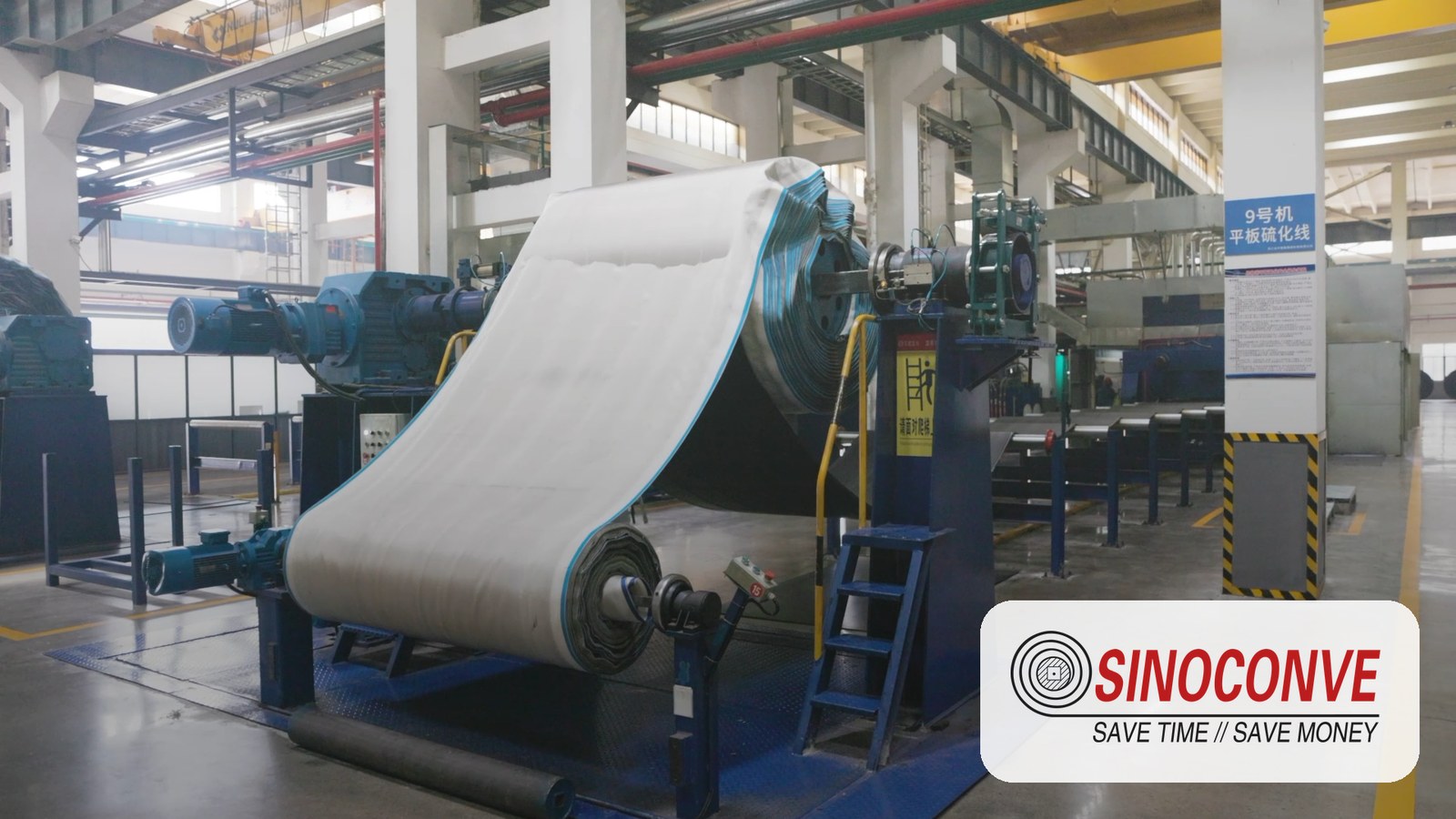
One field-level warning that has nothing to do with the report and everything to do with the result. The splice has its own cure schedule, and it must match the compound. A heat-resistant cover cured with the schedule used for a standard belt can arrive at the customer with correct factory test results and a weak joint, because the press time and temperature were set for a different rubber. When you buy a heat grade, ask for the splice cure parameters in writing and keep them with the belt record. That single sheet of paper prevents a category of failure that looks like a belt problem and is actually a procedure problem.
09Four Field Misuses That Kill Heat Resistant Belts
A correctly specified heat belt can still fail early, and when it does, the cause is usually in the operation rather than the rubber. These four patterns account for most of the premature failures we inspect on hot lines.
Misuse 1: treating the peak rating as a second continuous rating
The most common one, and the most expensive. A plant buys HR180, sees 195 °C peaks once a shift, and treats the belt as a 195 °C belt because it survived the first month. The peak budget was never meant to be spent continuously. Compounding that mistake, nobody writes the excursion count down, so when the cover starts cracking at month seven the belt gets the blame instead of the duty.
The fix is administrative, not technical. Put the continuous band and the allowed peak on the maintenance sheet, log the excursions, and review the log quarterly. If the excursions are frequent and unavoidable, the correct answer is a higher class or a process change, not a hope that the belt will keep absorbing it.
Misuse 2: an unmanaged local heat source
Radiant heat from a kiln shell, a red-hot chute, an unlagged duct or a leaking steam line bakes part of the belt while the rest stays cool. We have inspected belts where a 300 mm strip along one edge was hard and cracked and the remaining width was in good condition. The customer was ready to change grade. The real answer was insulation and clearance, costing a fraction of the belt.
Find these hot spots with an infrared thermometer on a walkdown. Check the belt at the point of maximum heat exposure, not at the drive end where it has already cooled. Any local reading more than about 40 °C above the general belt temperature deserves attention.
Misuse 3: hot material parked on a stopped belt
A stopped belt under a full load of hot material is a different duty from a moving belt. Heat cannot be carried away, contact time becomes indefinite, and the load sits in one place with full pressure on the cover while the rubber is at its softest. On some lines that is worse than any normal operating condition, and it happens for hours during the most ordinary events: a downstream jam, a power dip, a shift change with the chute full.
Two things help. Sequence the shutdown so the belt runs empty before stopping where the process allows it. Where it does not, ask for a compound with better static heat tolerance, or accept that the loading zone will need cover repair sooner, and plan for it rather than being surprised. Some of our cement customers keep a hot-vulcanizing repair crew on the maintenance calendar for exactly this reason.
Misuse 4: the splice fails first
Hot lines often fail at the joint before the cover gives up. There are three usual causes. The cure schedule for the splice did not match the heat compound. The splice was made in a hot, dusty, windy bay and contamination compromised the bond. Or the belt was installed with insufficient take-up travel, so the splice sits under tension above design and opens under fatigue at elevated temperature.
The third one is why we ask for take-up data before quoting a replacement belt on a hot line. A belt that is 40 mm short and pulled hard into a splice is a belt whose joint will fail in the warm part of the cycle every time. Correct length and correct tension are a bigger lever on joint life than most buyers expect, and they cost nothing extra.
Symptom to likely cause
| What you see | Most likely cause | What we check |
|---|---|---|
| Cover hard, shiny and cracking in a fine network | Long-term over-temperature, class too low for measured duty | Pyrometer readings along the carry side, shift log excursions, current compound class |
| One strip or edge hardened, other side like new | Local radiant heat source or hot spill point | Infrared walkdown, kiln shell temperature, chute condition and skirt clearance |
| Cover intact but ply separation and edge bulging | Heat reaching the bonding interface, or moisture in the splice | Cover thickness, adhesion report, splice history, whether water sits on the belt |
| Splice opens repeatedly at the same point | Wrong cure schedule for the compound, or insufficient take-up travel | Splice cure record, belt length, take-up position and remaining travel |
| Fast cover loss at the loading zone, sides still fine | Impact and abrasion, sometimes misread as a heat failure | Drop height, lump size, impact bed condition, skirt rubber and chute angle |
Three of those five answers can be checked with instruments the plant already owns. Do that before ordering a different grade, because ordering a different grade fixes only the first one.
10When Even a Heat Resistant Belt Won't Hold
There is a point where the belt stops being the right component, and a good supplier should say so rather than sell a more expensive compound. We turn down or redirect a handful of inquiries a year for exactly this reason.
Sustained temperatures above 200 °C
Rubber compounds have a practical ceiling. Above roughly 200 °C continuous, no cover chemistry in our range will give you a long service life, and anyone promising otherwise is selling you a belt with an eighteen-month warranty and a twelve-month reality. Short excursions above 200 °C can be managed with a class four compound, a heat barrier and a short exposure run. Sustained operation at 250 °C or beyond belongs to a different technology: steel pan conveyors, apron feeders, chain conveyors, vibrating or pneumatic systems, or a cooled belt design.
When the process, not the belt, is the problem
Before changing technology, look at whether the process can deliver cooler material. This is often the cheapest fix by a wide margin, and it is where we push hardest in our own customer conversations.
Extend cooling time or add a cooler stage so the material reaches the belt at a lower temperature. Improve quench control on coke so the discharge temperature is predictable rather than variable. Add a water spray where the material permits it, which drops surface temperature quickly at the cost of moisture. Shorten belt exposure by raising belt speed on a short run, so the material spends fewer seconds on the cover. Reposition or insulate a chute that radiates onto the belt. Re-sequence the shutdown so hot loads are not parked.
We have seen a foundry solve a heat problem entirely by adding forty seconds of cooling before shakeout. That change removed the need for a higher class on three conveyors, and it cost less than one belt. When a customer tells us the material is 220 °C and asks for a higher grade, we ask first what the cooling table looks like, because the second question is usually cheaper than the first.
How to tell you are at that point
Three signals tell us a duty has outgrown the belt. First, the same class fails repeatedly at short intervals despite a correct specification and correct installation. Second, the measured temperature exceeds the top of our range under normal, not exceptional, operation. Third, the downtime cost of each belt change has grown to the point where the acceptable interval is measured in weeks rather than months.
At that point the honest answer is a hybrid solution or a conveyor redesign, and we would rather contribute to that decision early than sell a fourth belt. Many plants run rubber for the cool end of a process and a metal or chain system for the hottest section, which is often the cheapest configuration overall. The transition point is worth modelling properly, on cooling curves and not on opinions.
If you are unsure which side of that line your plant sits on, send us the duty data and we will tell you plainly whether rubber is the answer. A belt we should not sell you is worse for both of us than a belt you should not have bought.

11Frequently Asked Questions
What temperature can a standard rubber belt handle before I need a heat grade?
Most standard covers based on natural rubber or SBR are comfortable up to about 60–70 °C continuous material contact temperature, with short peaks around 90–100 °C. Between 70 °C and 110 °C you are in the grey zone where the belt runs but ages much faster than its rating implies. Once normal operation passes about 80 °C, or peaks reach 120 °C and above, a heat class pays for itself. Measure the material surface, not the ambient air.
How do I measure the material temperature correctly?
Use a handheld infrared pyrometer on the load surface at the loading point and along the first few meters of carry, with the belt running normally. Take several readings across a shift, including a peak event if you can arrange it. Record the ambient temperature in the bay at the same time so you can separate the two. A single reading taken during a maintenance visit is better than a design document, but a week of readings is what actually lets us size the class correctly.
What is the difference between T1, T2, T3 and HR120 to HR200?
T classes are a laboratory statement about the cover compound under heat ageing; T1 is tested at 100 °C, T2 at 125 °C, T3 at 150 °C and T4 at 175 °C. The HR numbers are commercial designations where the number is the continuous material contact temperature the compound is designed around. We always convert a T class request into a temperature band in °C and °F on the drawing, because the band is what a maintenance team can compare against a pyrometer reading.
Can one belt handle cement clinker at 180 °C?
On a short line with occasional peaks, yes, with an HR180 class cover at 6 mm or more and careful attention to the loading zone. If 180 °C is your normal operating temperature rather than a peak, we would look at HR200 or a heat barrier layer, and we would also ask about cooling time between the cooler and the belt. Clinker at 180 °C normally means something upstream is running hot, and fixing that is cheaper than a class upgrade.
Does a heat resistant belt also resist oil and chemicals?
Not automatically. A heat grade is built for temperature, and an EPDM-based cover in particular resists hydrocarbon oil poorly. If your load carries oil, salt or process chemicals, the compound has to be built for both, and you should expect a narrower temperature band as a result. Give us the chemical name, concentration and contact temperature and we will tell you honestly whether a rubber cover is the right choice for that duty.
How much more does a heat resistant belt cost than a standard belt?
For the same width and tension rating, expect roughly 15 to 35 percent more per meter, depending on the class and the cover thickness.On a 150 m line that is a few thousand dollars extra on the first purchase, which is usually less than a single day of lost production. That is the comparison worth making, and it is why we ask for your downtime cost before quoting two options.
What is your MOQ and lead time for a heat resistant conveyor belt?
Our standard minimum for conveyor belting is around 50 m per specification. Normal production lead time is about 30 days, with a priority channel at 15 to 20 days for urgent replacements. Samples take 2 to 5 days. Payment is by T/T, typically 30 percent deposit with the balance before shipment, or L/C. Custom widths, cover thicknesses and stamping are available, and urgent hot-line replacements are exactly the situation the priority channel exists for.
Do you supply to DIN 22102, ISO, RMA or AS 1332 and provide test reports?
Yes. We build to DIN 22102, ISO, RMA, AS 1332, BS and SANS based requirements, and we state on the quotation which construction and grade it follows so the drawing and the delivered belt match. Inspection records cover incoming rubber and fabric checks, in-process calendering and dimension control, and laboratory abrasion, adhesion and tensile tests, and they ship with the order. Tell us at the RFQ stage if independent third-party inspection is required.
What actually happens if I keep running a standard belt at 120 °C?
The cover hardens, loses elongation and develops a crack network, usually within six to nine months rather than the two or three years you would see on a cool duty. Cracks let hot fines into the plies, and ply separation follows. The failure rarely looks like a burn. It looks like a cover that turned brittle and then came apart at the splice or the loading zone, which is why it is so often misread as a splice problem or a bad belt rather than a temperature problem.
Related Products You May Need
| Product | What it is for |
|---|---|
| Rubber Conveyor Belt | EP and NN fabric belts for quarry, cement and general bulk duty, the baseline construction for every heat grade we build. |
| EP Rubber Conveyor Belt | Polyester-nylon carcass belts from EP100 to EP630, the usual base for clinker, sinter and coke duty. |
| Heat Resistant Conveyor Belt | HR120 to HR200 compounds for clinker, sinter, foundry sand and hot fertilizer lines. |
| Steel Cord Conveyor Belt | For high tension and long centers, and for hot bulk duty where a textile carcass becomes the weak link. |
| Chevron and V-Belt Range | Profiled belts for inclines plus drive belting for crushers, cooler fans and elevators in hot bays. |
| Full Product Catalog | Every belt family, cover grade and cover thickness option in one view, with the standard each one follows. |
Related Blog Posts
- Heat Resistant Conveyor Belt Ultimate Guide (2026): Types, Grades and How to Choose
- Heat Resistant Rubber Conveyor Belt: Modern Solutions
- Heat resistant conveyor belt in cement plant clinker handling
- High temperature conveyor belt buyer's check
- Flame Resistant Conveyor Belt: What Buyers Need to Know
- Chemical Resistant Conveyor Belts: Engineered for Harsh, Corrosive Environments