
Conveyor Belt Manufacturer Quality Control: 10 Tests Industrial Buyers Should Ask About
A conveyor belt can arrive with the correct width, length and appearance and still expose a plant to an expensive purchasing mistake. For mining, cement, quarrying, ports and other heavy-duty operations, the harder questions concern what is inside the belt, whether the supplied construction matches the approved specification, and what evidence exists before the roll leaves the factory.
That changes how a buyer should evaluate a conveyor belt manufacturer quality control system. A factory tour, an ISO certificate and a statement that “every belt is inspected” are useful starting points, but they do not answer the same question as an order-specific test report.
This guide turns supplier qualification into 10 practical checks. The objective is not to demand every possible test on every order. It is to identify the tests, records and control points that actually reduce specification, production and shipment risk.
Quick Answer: Before approving a conveyor belt supplier, verify incoming-material controls, reinforcement testing, rubber compound control, dimensional inspection, tensile properties, adhesion, abrasion performance where relevant, special-property testing where required, production traceability and final pre-shipment release. The exact acceptance criteria should come from the purchase specification and applicable standard—not from a generic factory checklist.
1. Why “Strict Quality Control” Is Not Enough for Supplier Qualification
Most conveyor belt manufacturers can describe their quality system in reassuring language. Procurement needs to convert those claims into evidence.
Start by separating three questions:
- Can the factory make the required belt? This is a production-capability question.
- Does the factory control how the belt is made? This is a process and quality-system question.
- Does the supplied belt conform to the agreed requirement? This is an inspection, testing and documentation question.
A certificate alone cannot answer all three. Neither can a laboratory photograph or a single test report from a previous order.
For example, ISO 14890:2026 addresses rubber- or plastics-covered textile conveyor belts for general surface use. A tensile test, adhesion test or abrasion test addresses a narrower property through a defined method. A buyer therefore needs to know both what requirement applies and what evidence will demonstrate conformity.
RFQ Warning: Do not write only “belt must meet ISO/DIN” in a purchase specification. Identify the applicable standard or agreed specification, required edition where relevant, critical properties, acceptance values, test methods, reporting requirements and any third-party or witness inspection requirement.

2. Test 1: Incoming Raw Material Inspection
Conveyor belt quality control should begin before calendering, forming or vulcanization. Rubber ingredients, reinforcement materials and other inputs influence the properties of the finished belt, so a supplier audit should ask how incoming materials are identified, inspected and released for production.
The useful question is not simply, “Do you inspect raw materials?” Ask:
- Which incoming materials are inspected or tested?
- How are accepted and nonconforming materials identified?
- What records connect incoming material control to production?
- What happens when an incoming result falls outside the agreed requirement?
SINOCONVE's confirmed quality process starts with raw-material inspection before materials are released into production. Its published conveyor belt manufacturing and quality-control process also identifies rubber compound and EP fabric checks as part of material control.
For a factory audit, ask to see how the process works on actual production records rather than relying only on the written procedure.
3. Test 2: Reinforcement Tensile Strength and Elongation
The reinforcement carries the working tension of the belt. For an EP fabric belt, the carcass construction is therefore not a specification detail that should be verified only from a product label.
Relevant checks can include tensile strength and elongation of the reinforcement material. The buyer should also confirm that the ordered carcass construction and strength designation are transferred correctly into production.
This matters because two belts with the same external width and thickness can have different internal constructions. Visual inspection cannot establish that the carcass matches the approved requirement.
SINOCONVE's factory information states that EP fabric is checked for tensile strength and elongation. The company's current production information covers fabric conveyor belt manufacturing as well as steel cord belt manufacturing, so buyers sourcing different belt constructions should make sure the inspection plan matches the specific product family rather than applying a textile-belt checklist to every belt.
4. Test 3: Rubber Compound Control
A cover grade is more than a color and hardness impression. Rubber formulation and processing influence how the cover behaves, so compound control belongs upstream of finished-belt inspection.
SINOCONVE states that a moving die rheometer is used in rubber compound testing. For a procurement audit, the more important issue is how that control relates to the approved product: what is tested, what requirement applies, how results are recorded and what happens when a batch does not meet the internal or order requirement.
This distinction matters because a buyer cannot confirm compound consistency simply by inspecting the surface of a finished roll.
Buyer Tip: During a factory audit, follow one production order from material identification through forming, vulcanization, final inspection and test documentation. A traceable production example usually tells you more than viewing individual pieces of test equipment without seeing how their records connect.
5. Test 4: Finished Belt Dimensions and Visual Condition
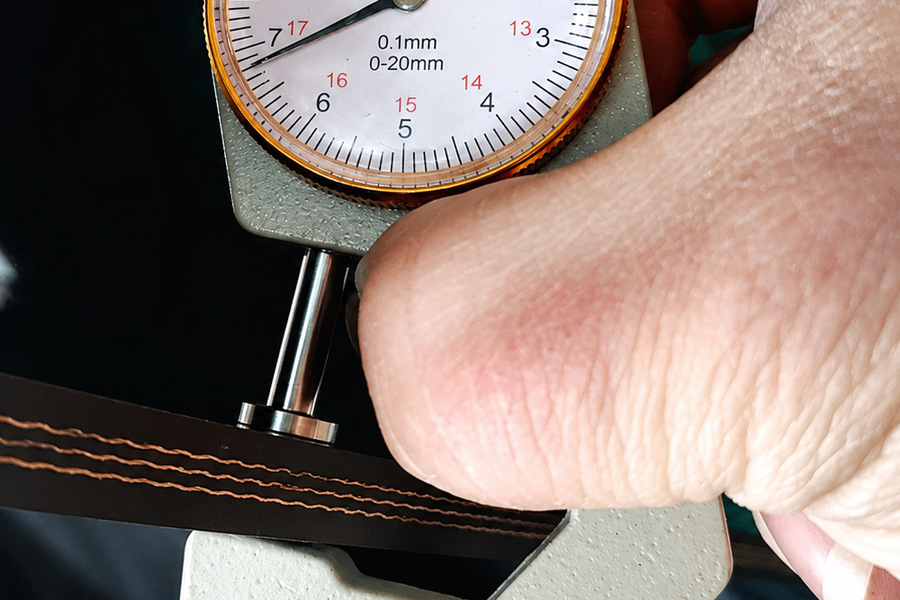
Dimensions sound basic, but dimensional errors can become installation problems. Width, total thickness, cover thickness where specified, length and other agreed dimensions should be connected to tolerances rather than treated as approximate catalogue values.
Visual inspection also matters. Surface defects, edge condition, marking and other visible characteristics should be checked before packing.
SINOCONVE states that its finished-belt inspection includes surface condition and dimensional checks such as length, width and thickness. For a custom order, buyers should put the required dimensions and tolerances into the purchase specification so the inspection team has an objective acceptance basis.
| Inspection Area | What the Buyer Should Define | Evidence to Request | Risk if Unclear |
|---|---|---|---|
| Width and length | Required dimensions and tolerances | Final dimensional inspection record | Installation or fit problem |
| Thickness / covers | Approved construction and applicable tolerances | Measurement record | Mismatch with approved belt construction |
| Surface and edges | Agreed visual acceptance requirements | Final inspection record or agreed photos | Defects discovered after arrival |
| Marking | Product, roll and customer identification required | Marking verification before packing | Receiving and traceability confusion |
6. Test 5: Finished Belt Tensile Strength and Elongation
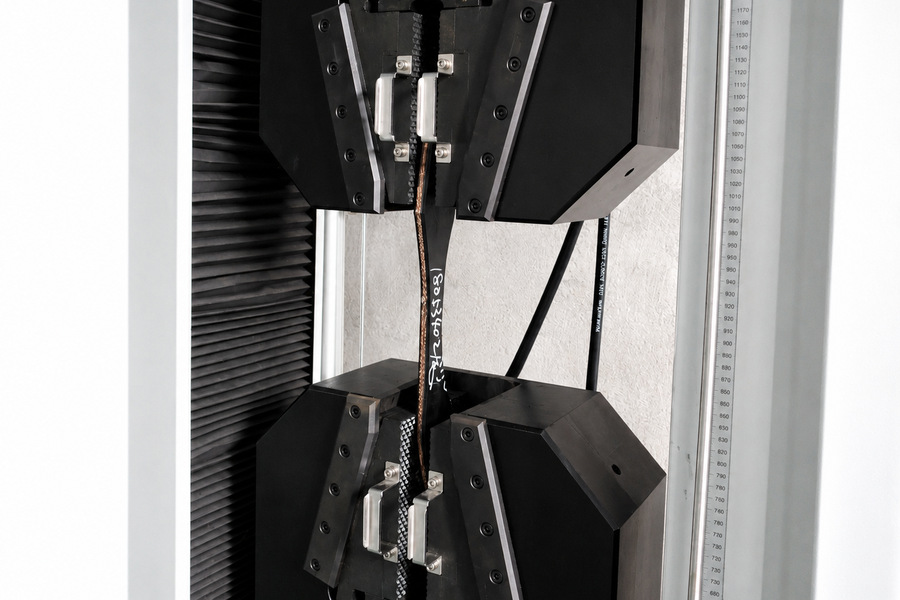
Where required by the applicable belt specification, full-thickness tensile testing provides evidence about the mechanical properties of the finished belt rather than only its incoming reinforcement.
Industrial buyers should avoid asking merely for “a tensile test.” Specify which product characteristic needs verification, the applicable method, acceptance requirement and how the reported sample relates to the supplied production lot.
This is particularly important when comparing quotations. A low price has little meaning if Supplier A is quoting against a defined construction and test scope while Supplier B is quoting a visually similar belt without equivalent acceptance requirements.
7. Test 6: Adhesion Between Belt Components
A conveyor belt works as a composite structure. The covers, reinforcement plies and bonding interfaces need to remain integrated under bending, loading and repeated service.
For applicable textile conveyor belts, ISO 252:2023 provides methods for determining adhesion strength between plies and between covers and the carcass. It does not apply universally to every conveyor belt construction; for example, the standard excludes steel cord reinforced belts.
That limitation is useful for procurement. It shows why buyers should not copy a list of familiar ISO numbers into every RFQ. The correct test method depends on the belt construction and the requirement being verified.
SINOCONVE includes adhesion strength among the performance tests available in its laboratory quality process. Before ordering, buyers should confirm whether adhesion testing is required for the specific order, the applicable method and what result will be reported.
8. Test 7: Abrasion Resistance Where Wear Is a Critical Risk
For belts handling abrasive ore, stone, aggregate or similar bulk material, cover wear can be a major procurement concern. Laboratory abrasion testing gives buyers a controlled way to compare or verify a rubber property.
ISO 4649:2024 specifies methods for determining abrasion resistance of vulcanized or thermoplastic rubber using a rotating cylindrical drum device. The standard is useful for comparative testing, quality control and specification compliance.
There is an important purchasing limitation: a laboratory abrasion result should not be converted directly into a promised field service life. Actual belt wear also depends on loading, material characteristics, transfer design, impact, belt speed, cleaning, alignment and other operating conditions.
Do Not Accept This Shortcut: “Lower laboratory abrasion loss means the belt will last X months longer.” A controlled abrasion test can compare a material property, but it does not by itself predict conveyor service life.
9. Test 8: Special Performance Tests Must Match the Application
A heavy-duty conveyor belt may require properties beyond general mechanical performance. Heat, oil, fire, cold, chemicals or electrical behavior can change the required compound, construction and verification plan.
The test should follow the operating risk.
| Operating Condition | Procurement Risk | Specification Implication |
|---|---|---|
| Abrasive bulk material | Accelerated cover wear | Define the required cover performance and applicable test criteria. |
| Hot conveyed material | Heat-related rubber degradation | Provide actual material and operating temperatures and agree the appropriate heat-resistant requirement. |
| Oil or grease exposure | Swelling or deterioration of an unsuitable cover | Identify the contaminant and exposure condition before selecting an oil-resistant compound. |
| Fire-sensitive application | Incorrect safety specification | State the required regulatory or project standard and applicable test scope rather than requesting generic “fire resistance.” |
ISO 340:2022, for example, specifies a laboratory-scale method for assessing a conveyor belt's reaction to an ignition flame source. That test has a defined scope; it should not be interpreted as automatically proving compliance with every mine, country or site-specific fire-safety requirement.
If your application needs a special belt, start from the operating condition and then identify the correct product and verification requirement. SINOCONVE's industrial conveyor belt product range includes multiple belt categories for different operating conditions.
10. Test 9: Production Traceability and Order Control
Traceability is not a laboratory test, but it is one of the most useful supplier-qualification checks because it connects the test result to the product being purchased.
Ask the conveyor belt manufacturer to explain how an approved customer specification becomes a production requirement. Then ask how the factory identifies the order through manufacturing, inspection, testing, marking and packing.
The objective is to avoid a common documentation gap: the supplier can show a technically impressive report, but the buyer cannot establish whether it relates to the ordered belt, the current batch or merely a representative product.
For repeat orders, traceability becomes even more important. A distributor, EPC contractor or plant buyer may reorder months later. The supplier should not have to reconstruct critical requirements from memory or scattered messages.
11. Test 10: Final Pre-Shipment Review and Quality Test Report
The final release check is where specification, physical product and documentation should meet.
Before shipment, confirm the items that matter for the purchase order: product identification, dimensions, visible condition, quantity, packing, marking and agreed test documentation. Where a quality test report is required, its contents should have been agreed before production rather than requested after the belt has already been packed.
SINOCONVE's confirmed QC process includes final testing and inspection before shipment. Product test reports can be provided, and third-party testing can be arranged when a customer has special standard requirements.
Third-party inspection is most useful when its scope is defined. The PO or inspection agreement should state who performs the inspection, which characteristics are checked, the method and acceptance criteria, whether witnessing is required, and how a nonconforming result will be handled.
12. How to Audit a Conveyor Belt Factory Beyond the Test List
Ten test questions are useful, but a factory audit quality control review should also determine whether the manufacturer has the people, equipment and production range required for the order.
SINOCONVE's conveyor belt factory was established in 1988. According to the company's confirmed current factory information, the operation has more than 200 employees, including 26 engineers and 15 quality-control personnel, with one laboratory. Production includes eight fabric conveyor belt lines and two steel cord conveyor belt lines.
The confirmed production range is 100–3000 mm in width and 3–100 mm in thickness, with fabric ratings from EP100 to EP600 and steel cord ratings from ST500 to ST7500. These figures describe SINOCONVE's manufacturing envelope; they do not mean every combination is automatically suitable for every conveyor.
A buyer should still provide the application and approved specification so manufacturability and suitability can be reviewed before an order is released. More information about the factory and manufacturing scope is available on the SINOCONVE conveyor belt manufacturer profile.
Factory Audit Question: Do not ask only “How many production lines do you have?” Ask which line will manufacture your belt construction, how the approved specification reaches that line, which process controls apply, who releases the finished order, and which records will be available afterward.
13. Turn Supplier Claims Into Verifiable Evidence
A strong procurement process replaces adjectives with evidence. This makes quotations easier to compare and reduces disagreement after production.
| Supplier Claim | Better Buyer Question | Evidence to Agree | Risk Reduced |
|---|---|---|---|
| “We have strict QC.” | What is inspected before, during and after production for my order? | Inspection flow and agreed records | Undefined acceptance |
| “We meet ISO/DIN.” | Which exact standard, edition and properties govern this order? | Approved technical specification | Standard mismatch |
| “Test report available.” | Which tests will be reported and how is the report linked to my production? | Order-specific agreed report scope | Irrelevant documentation |
| “We can customize.” | How is my drawing, sample or specification approved and controlled? | Approved drawing/specification/reference | Repeat-order variation |
| “Third-party inspection is possible.” | Can we define the test scope and witness points before production? | Inspection/test agreement | Disputes after manufacture |

14. What Procurement Should Put in the RFQ
Quality control becomes easier when the RFQ is technically clear. A manufacturer cannot verify a requirement that the buyer never defined.
For a heavy-duty rubber conveyor belt inquiry, provide the existing approved belt specification where available. If the belt is being selected for a new application or an existing belt has failed, include enough operating information for technical review.
- Conveyed material and relevant material characteristics
- Belt width and required length
- Required carcass or strength rating from the approved specification
- Top and bottom cover requirements
- Conveyor length, incline and relevant operating conditions where selection support is needed
- Temperature, oil, fire, chemical or other special exposure
- Required standard and project-specific acceptance criteria
- Required inspection and test report scope
- Quantity, packing and marking requirements
- Third-party or witness inspection requirements, if applicable
If an existing belt has failed, add photographs, the current belt marking/specification and a description of the failure location and operating condition. That information helps separate a product specification issue from problems involving loading, tracking, splicing, impact or conveyor geometry.
For a broader procurement framework, see the conveyor belt sourcing guide, which explains how specification, inspection planning and supply risk interact before a replacement order is released.
15. FAQ: Conveyor Belt Manufacturer Quality Control
15.1 What quality documents should I request from a conveyor belt manufacturer?
Request documents that match the purchase requirement. Depending on the order, this may include the approved technical specification, applicable certificate documentation, dimensional inspection records, product test report, packing information and any agreed third-party report. Do not assume that an ISO management-system certificate replaces product-specific inspection or testing.
15.2 Does an ISO certificate prove the conveyor belt meets my specification?
No. A management-system certificate and a product conformity requirement answer different questions. The buyer should identify the applicable belt specification, required properties, test methods and acceptance values separately.
15.3 Should every conveyor belt receive every laboratory test?
Not necessarily. The test scope should reflect the belt construction, applicable standard, purchase specification, production control plan and operating risk. Applying irrelevant tests adds paperwork without necessarily reducing procurement risk.
15.4 Is an abrasion test enough to predict conveyor belt life?
No. Abrasion testing can compare or verify a rubber property under controlled laboratory conditions. Actual service life also depends on conveyed material, loading, impact, belt speed, conveyor geometry, alignment, cleaning, maintenance and other site conditions.
15.5 When should a buyer request third-party testing?
Third-party testing can be appropriate when a contract, project specification, market requirement or buyer risk policy requires independent verification. Agree the laboratory, test method, sampling, acceptance criteria and timing before production or testing.
15.6 What should I check during a conveyor belt factory audit?
Review the production capability relevant to your belt, material controls, process inspection, laboratory capability, finished-product inspection, traceability, nonconformance handling, test records, specification control and final shipment release. Where possible, follow one actual order through the process.
15.7 Can SINOCONVE provide product test reports?
Yes. According to SINOCONVE's confirmed company information, product test reports can be provided. Third-party testing can also be arranged where customers have specific standard requirements. The required report and test scope should be confirmed before the order.
16. Qualify the Evidence Before You Qualify the Price
A reliable conveyor belt purchasing decision is not based on the longest test list. It is based on a clear chain: operating requirement → approved specification → controlled production → relevant inspection/testing → traceable evidence → shipment release.
Before comparing final quotations, make sure competing suppliers are quoting against the same belt construction, applicable requirements, inspection scope, documentation, packing and commercial conditions. Otherwise, the lowest quotation may simply contain fewer defined obligations.
If you are qualifying SINOCONVE for a new project, send the current belt specification or drawing, conveyed material, belt dimensions, required strength/construction, special operating conditions, applicable standard, quantity and required test documentation. The team can review the requirement before quotation through the SINOCONVE contact and RFQ page or by email at sales@sinoconve.com.
Related Products
- SINOCONVE Conveyor Belt Product Range — review available rubber conveyor belt categories before preparing the RFQ.
- EP Rubber Conveyor Belt — relevant for buyers evaluating textile-reinforced conveyor belt requirements.