
China Conveyor Belt Manufacturer Sourcing Guide for Global Industrial Buyers in 2026
A low conveyor belt quotation can become an expensive purchase if the specification is incomplete, the factory cannot reproduce the approved construction, or the shipment arrives without the documents required for acceptance. For importers, distributors, EPC contractors and industrial procurement teams sourcing from China, the real challenge is therefore not finding another conveyor belt supplier. It is identifying which manufacturer can convert your operating conditions into a controlled specification and deliver it consistently.
This 2026 sourcing guide explains how to evaluate a China conveyor belt manufacturer before placing a bulk order. It focuses on the issues that affect purchasing risk: factory capability, EP and steel cord production scope, quality control, test evidence, RFQ accuracy, customization, delivery planning and repeat-order consistency. The objective is simple: compare technically equivalent offers first, then compare price and commercial terms.
Procurement Quick Answer
Do not qualify a Chinese conveyor belt factory from price, catalog range or an ISO certificate alone. Send the same technical RFQ to each candidate, verify that the factory can manufacture the required construction, review its QC and test process, confirm documentation and packaging, and clarify how the approved specification will be controlled for production and repeat orders.
1. Why Sourcing a Conveyor Belt from China Requires More Than a Price Comparison
China has a large industrial manufacturing base, which gives international buyers access to multiple belt constructions, customized production and different commercial options. That choice is useful, but it also makes supplier comparison harder.
Two quotations labeled “EP conveyor belt” may not describe equivalent products. The quoted carcass rating may differ, but so can the number of plies, top and bottom cover thickness, rubber performance, dimensional tolerances, edge construction, splice preparation, inspection scope, packing and test documentation. A price-per-meter comparison is misleading until these differences are closed.
The same problem becomes more serious with heavy-duty conveyor belts. A mining project may be concerned with impact, cutting and abrasion. A cement plant may have separate belts for limestone and hot material. A port may combine long operating hours, moisture, abrasive bulk cargo and demanding replacement schedules. The product name alone does not define the duty.
Before looking for a factory, define what the conveyor actually requires. SINOCONVE's conveyor belt sourcing guide provides a complementary framework for connecting replacement risk, specification control and downtime planning.

2. Build the Technical RFQ Before Building the Supplier Shortlist
A manufacturer can only quote accurately against the information it receives. “EP belt, 1,000 mm wide, heavy duty” may be enough to start a conversation, but it is not enough to make several quotations technically comparable.
For an existing conveyor, begin with the approved belt specification, belt marking, drawings and available operating data. If the current belt is failing prematurely, include the failure history. Rapid top-cover wear, edge damage, delamination, excessive stretch and repeated splice problems do not necessarily have the same cause, so asking a new factory simply to copy the old belt may reproduce the existing problem.
| RFQ Item | What the Buyer Should Provide | Why It Matters |
|---|---|---|
| Conveyed material | Material type, maximum lump size, moisture, bulk density where available, and relevant heat, oil or chemical exposure | Helps define impact, abrasion and cover-performance requirements. |
| Conveyor duty | Capacity, belt speed, operating pattern and loading conditions | Separates the actual operating duty from a generic belt description. |
| Geometry | Width, required length, center distance, lift/incline, pulley diameters and take-up information where relevant | Influences strength, flexibility, elongation and system compatibility. |
| Belt construction | Approved EP/fabric or steel cord rating, ply construction, cover thickness and other specified construction details | Prevents bidders from pricing different constructions under the same general product name. |
| Splice | Required joining method, preparation requirements or project-approved splice specification | Avoids incompatibility between the supplied belt and the installation plan. |
| Compliance | Required standard, properties to be verified, test method and documentation requirements | A standard name without an acceptance requirement leaves room for different interpretations. |
| Commercial scope | Quantity, individual roll lengths, marking, packaging, destination and required schedule | Allows logistics and production requirements to be included in the quotation rather than added later. |
RFQ Warning: If every bidder receives a different set of follow-up answers, the final quotations may no longer have the same technical basis. Maintain a controlled RFQ revision and issue important clarifications to all shortlisted suppliers.
3. Verify That the Manufacturer Can Actually Produce Your Belt
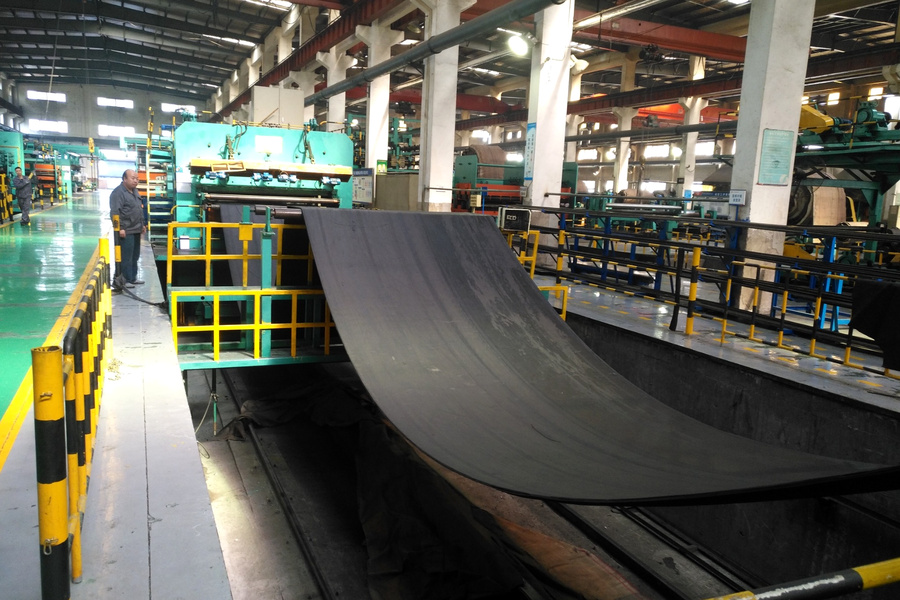
A factory audit should be specific to the product being purchased. Seeing rubber mixing, calendaring or vulcanizing equipment is useful, but the important question is whether the available equipment and process can manufacture your required construction, width, strength range and order volume.
This is particularly important when an importer intends to consolidate several product types with one supplier. A factory that is suitable for standard EP conveyor belts should not automatically be assumed to have the equipment or process control needed for high-strength steel cord production.
For initial qualification, ask the manufacturer to explain:
- which belt constructions are produced in-house;
- the production range relevant to your approved specification;
- which processes are performed internally and which, if any, are outsourced;
- how raw materials and reinforcement are identified and inspected;
- how the approved specification is transferred from sales to production;
- how finished dimensions and performance requirements are checked;
- how production records and test reports are linked to an order;
- how customized marking and export packaging are controlled.
4. Factory Size Is Evidence of Capacity, Not Proof of Product Quality
Procurement teams often ask for employee numbers, production lines and annual capacity. These are legitimate qualification questions, especially for bulk orders, but they should be interpreted correctly.
Ningbo Sinoconve Belt Co., Ltd. states that its conveyor belt factory was established in 1988 and has more than 35 years of manufacturing experience. The confirmed conveyor belt operation has more than 200 employees, including 26 engineers, 15 quality-control personnel and one laboratory. Production includes eight fabric conveyor belt lines and two steel cord conveyor belt lines.
The stated annual capacity is 10 million meters of fabric conveyor belt and 3 million meters of steel cord conveyor belt. The confirmed manufacturing range includes belt widths from 100 mm to 3,000 mm, thicknesses from 3 mm to 100 mm, fabric ratings from EP100 to EP600 and steel cord ratings from ST500 to ST7500.
Buyer Interpretation
Capacity data helps determine whether a factory belongs on the shortlist. It does not confirm that a specific order can ship immediately. Buyers should still obtain written confirmation for the required construction, quantity, production schedule and delivery date.
For higher-tension applications, buyers can also review SINOCONVE's steel cord conveyor belt category before discussing the project-specific ST construction.
5. Audit the Quality-Control Process, Not Just the Certificate
A management-system certificate and a product inspection report answer different questions. A certificate can form part of supplier qualification, but it does not by itself prove that the belt in your purchase order meets the agreed dimensions, construction and performance requirements.
A stronger supplier audit follows the order through the factory: incoming material inspection, reinforcement checking, rubber preparation, calendaring, forming, vulcanization, dimensional inspection, relevant performance testing, final inspection and packing.
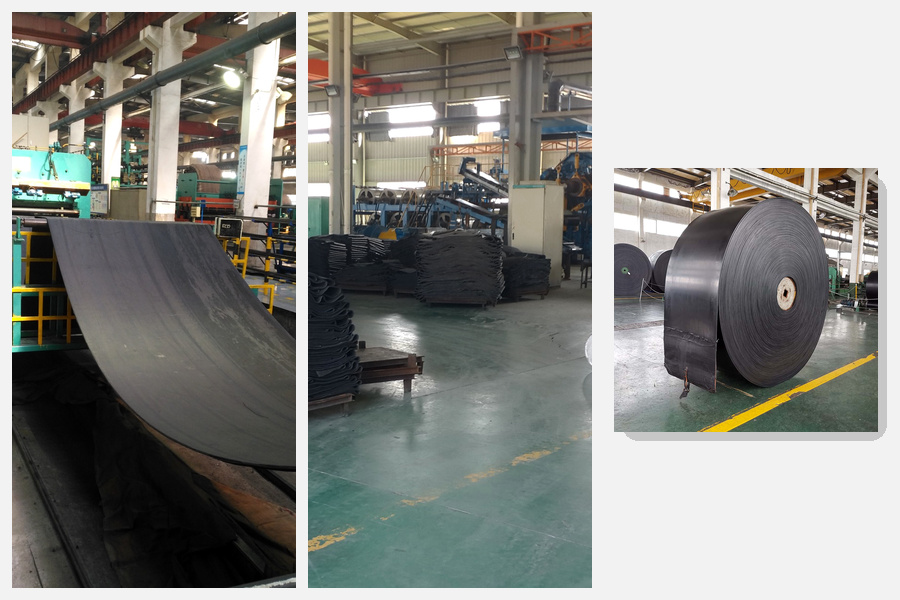
SINOCONVE's confirmed QC process includes raw-material inspection before production, in-process inspection and final testing and inspection before shipment. Its quality assurance process also documents checks covering EP fabric, belt dimensions, abrasion, adhesion and tensile performance where applicable. Product test reports can be supplied, and third-party testing can be arranged when a customer has specific requirements.
| Supplier Claim | Better Evidence to Request | Procurement Risk if Not Verified |
|---|---|---|
| “We have strict QC.” | Inspection flow, responsible personnel and actual inspection/test records | Quality remains a marketing statement rather than an auditable process. |
| “We meet international standards.” | Exact applicable standard, test properties, method and report format | Buyer and supplier may be using different acceptance criteria. |
| “We can make your specification.” | Approved datasheet, drawing or technical confirmation before production | Critical assumptions may only become visible after manufacturing. |
| “We can supply test reports.” | Confirm what will be tested, when, by whom and how the report relates to the order | A generic report may not provide the evidence required for shipment acceptance. |
6. Treat Standards as Technical Requirements, Not Logo Collections
Industrial belt RFQs often contain a row of abbreviations—ISO, DIN, RMA and others—without identifying what the buyer actually expects to be verified. This creates unnecessary ambiguity.
For example, ISO 14890 covers specifications for rubber- or plastics-covered conveyor belts of textile construction for general use. A new edition, ISO 14890:2026, was published in February 2026. Buyers working from older corporate specifications should therefore check which edition their contract, engineering document or tender requires rather than assuming that every reference has automatically been updated.
The procurement question should be: Which standard applies to this belt, which properties must comply, and what evidence must accompany the shipment?
SINOCONVE can manufacture conveyor belts with reference to applicable ISO, DIN, RMA and other customer-required standards. The required standard and testing scope should be confirmed for the individual order rather than inferred from a general supplier statement.
7. Separate Carcass Strength from Cover Performance
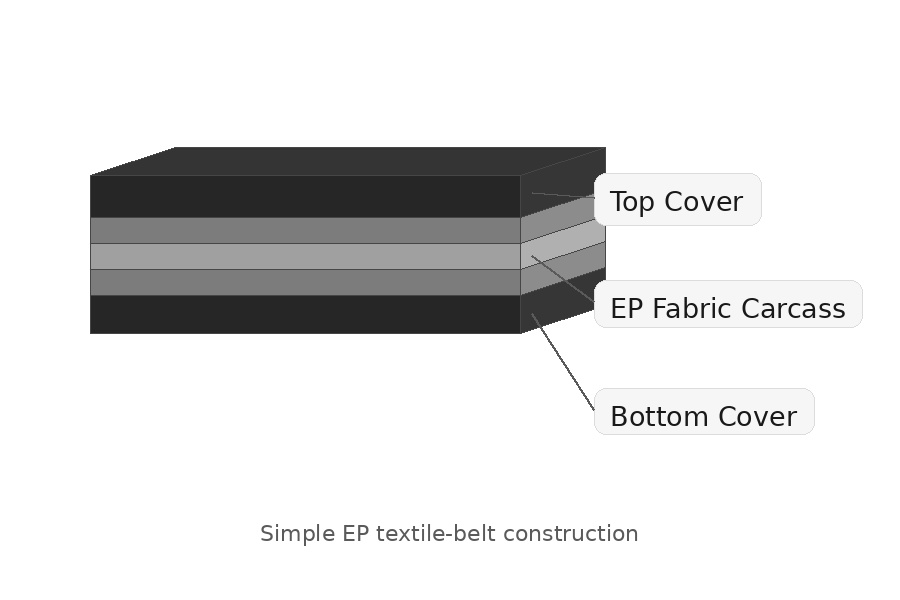
One common sourcing error is to use a higher EP rating as the answer to every heavy-duty application. Carcass strength and rubber cover performance solve different problems.
The carcass carries tensile load and influences elongation, troughability and belt behavior around the conveyor. The cover protects that structure from the conveyed material and working environment. If a quarry belt is losing its top cover rapidly because of abrasion or cutting, increasing nominal carcass strength alone does not directly solve the cover-wear mechanism.
Likewise, a cement or steel plant handling hot material needs the actual thermal duty reviewed rather than simply requesting a “stronger EP belt.” Material temperature at loading, continuous versus intermittent exposure, hot lump size, loading impact and cooling conditions can all matter. For these applications, the discussion should move toward a properly specified heat resistant conveyor belt.
This is also why “heavy duty conveyor belt” should be treated as a sourcing description, not a complete specification.
8. Use Samples Correctly Before a Bulk Order
A sample can be useful, but buyers should be clear about what it proves. A small piece can help confirm appearance, surface, branding, basic construction or selected laboratory properties. It cannot reproduce the mechanical behavior of a full belt running under the actual conveyor tension, loading, pulley and splice conditions.
SINOCONVE can provide standard samples or small test samples before a bulk order. For OEM and repeat-purchase programs, the more important control is to define what the approved sample represents and connect it to a controlled specification.
If a distributor approves color, marking and packaging from a sample but does not freeze carcass, cover, dimensions and acceptance criteria, the sample is not sufficient as the complete technical reference.
9. Check Customization and Repeat-Order Control
Factory-direct sourcing becomes especially relevant when the order is not a standard catalog item. SINOCONVE's conveyor belts are made to order rather than held as general finished-stock products and can be customized according to customer requirements. OEM/ODM support can include production from drawings or samples as well as logo, color and packaging customization.
For an importer or distributor, however, customization is only useful if it can be repeated. Ask how the manufacturer controls specification revisions, approved artwork, belt marking, labels and packaging from one purchase order to the next.
The OEM conveyor belt manufacturer guide explains why OEM purchasing should be treated as a specification-control process rather than simply adding a private label to a belt.
10. Evaluate MOQ, Lead Time and Packaging Together
Commercial terms should be reviewed after the technical scope is stable. SINOCONVE's confirmed minimum order quantity for conveyor belts is 50 meters. Normal production lead time is approximately 30 days; urgent orders may be discussed for a shorter production window, typically around 15–20 days depending on the actual specification and schedule.
These figures should be reconfirmed for every purchase order. A customized heavy-duty belt, a multi-specification distributor order and a straightforward repeat order do not necessarily occupy the same production window.
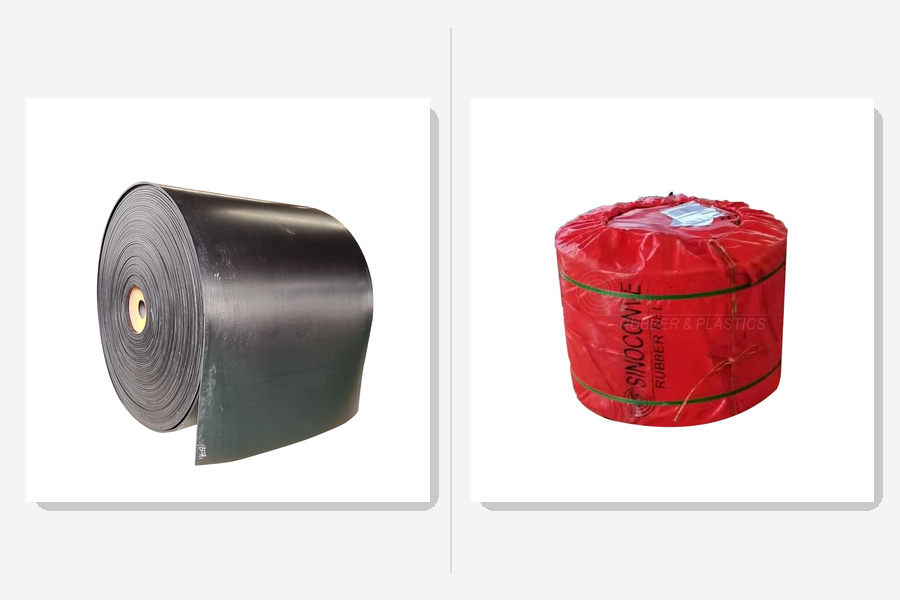
Packaging also belongs in the RFQ. SINOCONVE can use PVC board and iron-sheet protection for conveyor belt shipments, with palletizing where required, to reduce transport damage. Buyers should specify export marking, roll identification and any project-specific packing requirements before production is completed.
Procurement Tip: Control the Roll, Not Just the Total Quantity
For a bulk order, specify individual roll lengths as well as total quantity. Roll planning can affect installation, splicing, container loading, site handling and traceability. Do not leave roll configuration until the shipment is being packed.
11. Compare China Conveyor Belt Manufacturers with a Weighted Supplier Scorecard
A supplier scorecard prevents the purchasing decision from collapsing into a single price comparison. The weighting should reflect project risk. A distributor buying repeat EP belts may place more emphasis on consistency, MOQ and OEM control, while an EPC buyer purchasing a long-distance high-tension belt may give greater weight to technical capability, documentation and inspection.
| Qualification Area | What to Verify | Warning Sign |
|---|---|---|
| Technical review | Supplier asks about material, conveyor and approved specification | Final quotation issued from width and product name alone |
| Manufacturing capability | Equipment and production range match the required belt | Only general factory photographs or broad capability claims |
| Specification control | Quotation, approved datasheet and production requirement agree | Product descriptions change between documents |
| Quality evidence | Inspection process plus relevant test records | Certificate presented as the only proof of product quality |
| Delivery planning | Production timing is confirmed against specification and quantity | Delivery promise made before technical scope is known |
| Repeat orders | Revision, marking and approved-specification control | Every repeat order is treated as a new verbal specification |
| After-sales response | Defined process for technical review and nonconformance | No clear owner after shipment |
12. Red Flags Before You Release a Bulk Purchase Order
- The supplier quotes too quickly. A demanding application normally requires more information than belt width and length.
- The quotation does not identify the proposed construction clearly. You cannot compare suppliers if each is quoting against different assumptions.
- Factory capability cannot be connected to your belt type. General production photographs do not prove capability for a specific EP or ST construction.
- The certificate is used instead of product evidence. Management systems and finished-product acceptance are different layers of control.
- Test reports are generic. Establish what report will be supplied with your order and what it verifies.
- Critical parameters remain verbal. Important technical agreements should appear in the controlled order specification.
- The lowest price depends on an incomplete scope. Check packaging, marking, testing, roll length and other commercial inclusions before comparing totals.
- The delivery date is guaranteed before specification review. Production timing should reflect the actual belt and quantity.
13. Questions Global Buyers Commonly Ask
13.1 Is buying factory direct from China always cheaper?
Not necessarily. Factory-direct purchasing can reduce layers in the supply chain and make technical communication easier, but landed cost also includes inspection, documentation, freight, duties, inventory, payment terms and the cost of resolving a nonconforming order. Compare total procurement risk and landed value rather than factory price alone.
13.2 How do I verify whether a conveyor belt supplier is a real manufacturer?
Connect the supplier's claimed capability to your actual product. Review manufacturing equipment, production processes, technical personnel, QC workflow and relevant production range. For higher-risk orders, use a factory visit, video audit or independent third-party audit where appropriate.
13.3 What information should I send for an EP conveyor belt RFQ?
Provide the existing or required belt construction and strength, width, length, top and bottom cover requirements, conveyed material, conveyor duty, relevant geometry, splice requirements, required standards and inspection documents, quantity, roll lengths, packaging and destination. If replacing a failed belt, include photographs and failure history.
13.4 Should I ask every supplier for the same test report?
Yes, when comparing suppliers against the same acceptance requirement. Define the properties, applicable test methods and documentation expected before quotations are finalized. This makes technical comparison more meaningful than simply asking each supplier to “provide a test report.”
13.5 Can SINOCONVE supply samples before a bulk order?
Yes. Standard samples or small test samples can be provided. Buyers should specify what they want the sample to verify and remember that a small sample does not reproduce all operating conditions of a complete conveyor.
13.6 What is SINOCONVE's MOQ for conveyor belts?
The confirmed MOQ is 50 meters for conveyor belts. Because belts are customized rather than held as general finished stock, the exact specification and quantity should be reviewed before the order is confirmed.
13.7 What happens if a product quality problem is confirmed?
SINOCONVE carries out inspection before shipment. If a problem is confirmed to be caused by the product itself, the company works with the buyer on an appropriate resolution, which may include replacement, compensation or technical support depending on the circumstances.

14. Prepare the RFQ Before Requesting the Final Price
The safest way to source from a China conveyor belt manufacturer is to make the commercial comparison the last step, not the first. Define the conveyor duty, freeze the technical scope, verify manufacturing capability, agree on inspection evidence, and confirm packaging and delivery requirements. Then ask the shortlisted factories to price the same requirement.
SINOCONVE manufactures customized fabric and steel cord conveyor belts for industrial applications and supports OEM/ODM orders. To prepare a quotation, send the required belt specification, width and length, conveyed material, application or conveyor data, quantity, destination, required standard and any available drawings or photographs.
Need a technically comparable conveyor belt quotation?
Send SINOCONVE your current belt specification or project RFQ together with the operating information that affects selection. The technical scope can then be reviewed before the final commercial offer is prepared.
Email: sales@sinoconve.com | Contact & RFQ | Conveyor Belt Product Catalog
Related Conveyor Belt Products
| Product | When to Review It |
|---|---|
| Rubber Conveyor Belts | Start here when comparing the broader rubber conveyor belt range for industrial bulk handling. |
| EP Rubber Conveyor Belts | For fabric-reinforced belt requirements where the approved EP construction matches the conveyor design. |
| Steel Cord Conveyor Belts | For long-distance, higher-tension and other applications where the conveyor design requires steel cord reinforcement. |
| Heat Resistant Conveyor Belts | For cement, steel and other applications where thermal exposure is a defined part of the operating duty. |
Related Articles for Procurement Teams
- How to Evaluate a Rubber Conveyor Belt Manufacturer in China for Long-Term Supply — a deeper supplier-qualification checklist for repeat purchasing.
- Conveyor Belt Sourcing Guide: How to Reduce Replacement Risk and Downtime — how RFQ quality, specification control and delivery planning affect replacement risk.
- OEM Conveyor Belt Manufacturer: What Industrial Buyers Should Check Before Ordering — useful for distributors, importers and private-label projects.
- Fabric vs Steel Cord Conveyor Belt: Which One Fits Your Conveyor? — compares the two carcass families from a procurement and engineering perspective.
- Heavy-Duty Rubber Conveyor Belt Supplier Selection for Crushers and Screening Plants — focused on quarry and aggregate procurement.