
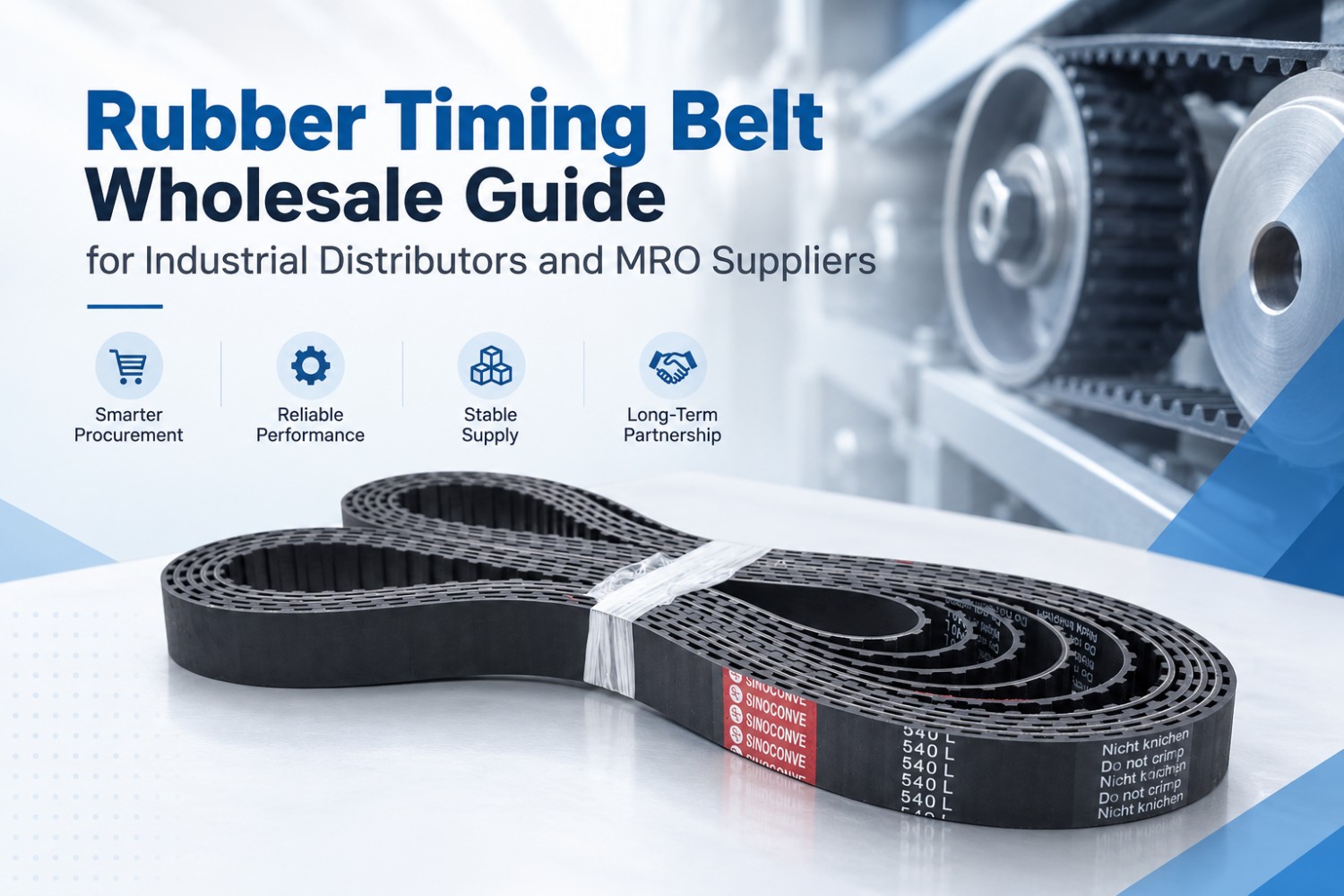
Rubber Timing Belt Wholesale Guide for Industrial Distributors and MRO Suppliers
A distributor rarely loses money on a rubber timing belt because the product name was wrong. The more expensive problems come from details that were never fixed before the purchase order: an incompatible tooth profile, an unclear length designation, inconsistent replacement batches, mixed carton labels, or an RFQ that allowed different suppliers to quote different constructions.
That makes rubber timing belt wholesale purchasing different from buying a few replacement belts for one machine. Industrial distributors and MRO suppliers need a product that fits the drive, but they also need repeatable specifications, manageable order quantities, identifiable SKUs, suitable packaging, quality documentation and a supplier that can reproduce the approved product when the next order arrives.
This guide focuses on that commercial and technical intersection: how to qualify a rubber timing belt supplier, prepare a comparable RFQ and reduce purchasing risk before moving from samples to bulk orders.
Quick Answer for Distributors: Do not qualify a timing belt wholesaler from unit price and catalog coverage alone. Freeze the belt identification first—profile, pitch, length or tooth count, width, construction and pulley compatibility—then verify sample-to-batch consistency, QC documentation, MOQ by SKU, branding, packaging, lead time and repeat-order control. A cheaper quotation is not cheaper if the belts cannot be reliably replenished under the same approved specification.

1. Rubber Timing Belt Wholesale Is a Repeat-Order Problem
A maintenance department replacing one known belt can often work from an existing marking or machine manual. A distributor has a harder job. Its inventory may need to support many machines, customers and replacement cycles, with multiple profiles and dimensions stored under local SKU numbers.
The first shipment is therefore only part of the supplier evaluation. The real test is whether the supplier can reproduce the approved specification six months or several orders later without forcing the distributor to restart identification from photographs and chat records.
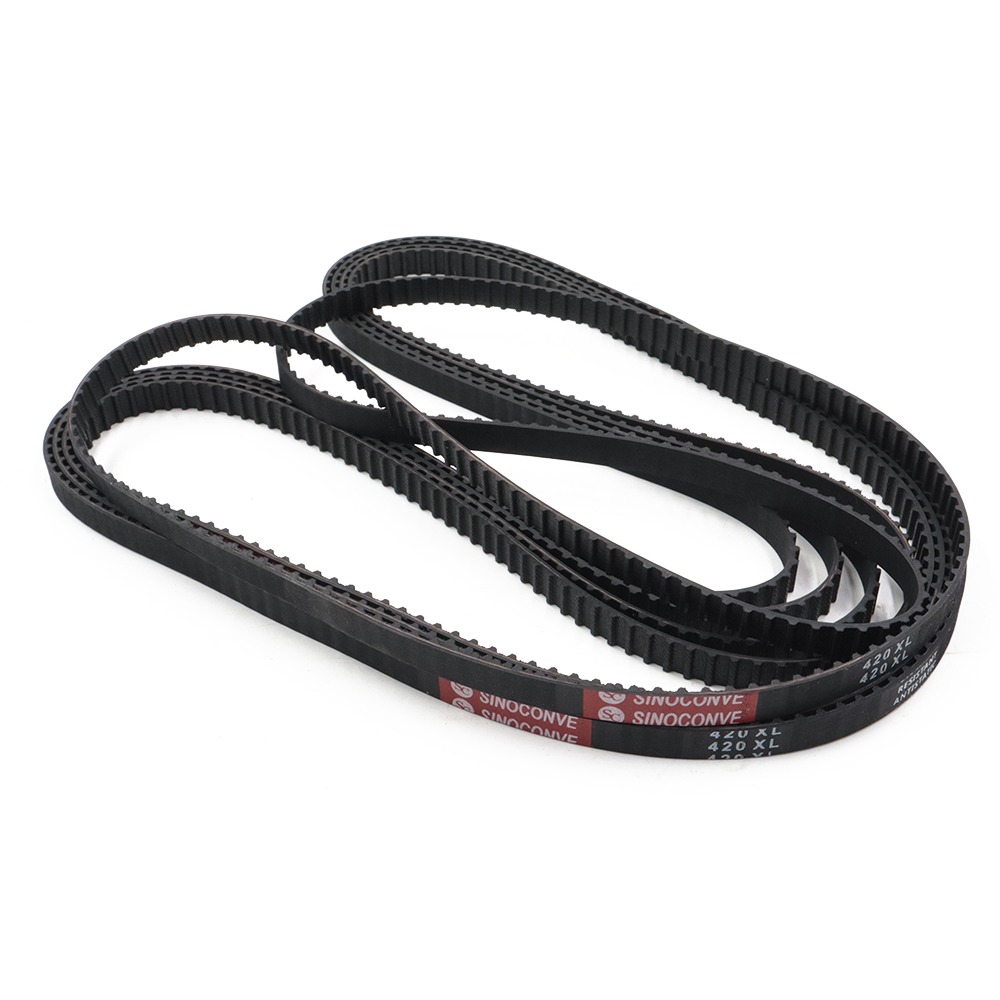
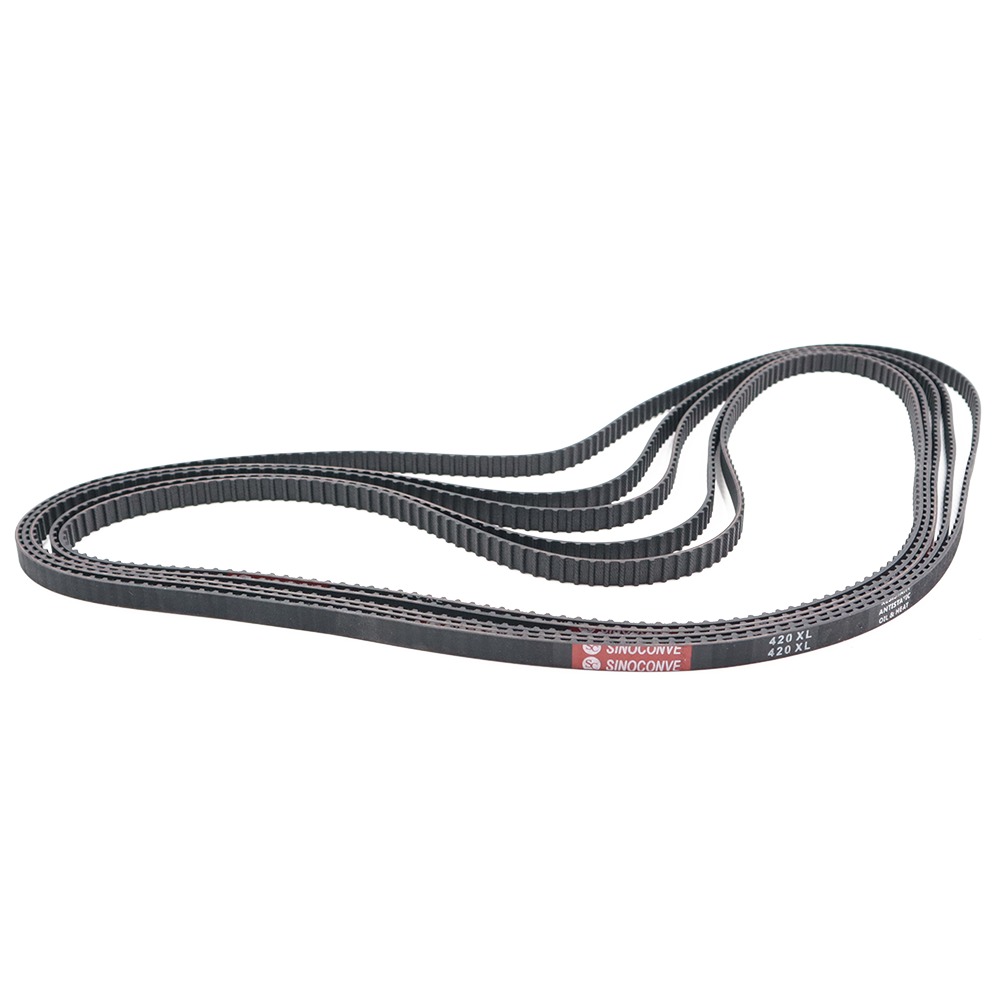
This is especially important for a synchronous belt. Unlike a friction drive, a timing belt transfers motion through engagement between molded belt teeth and matching pulley grooves. A belt that has approximately the right width and circumference can still be incompatible if the tooth geometry is wrong.
| Wholesale Decision | What the Buyer Should Verify | Risk if It Is Left Open |
|---|---|---|
| Belt identity | Profile, pitch, tooth count or pitch length, width and complete marking | A similar-looking belt may not correctly engage the pulley |
| Construction | Rubber body, reinforcement and tooth-facing construction required for the application | Fit may be correct while operating behavior differs from the approved belt |
| Repeat orders | Approved sample, specification revision and SKU identification | Later batches may be difficult to compare with the original approval |
| Commercial scope | Quantity by size, MOQ, packaging, logo and shipment requirements | A low unit price can create excess inventory or packaging rework |
2. Freeze the Technical Specification Before Comparing Prices
The fastest way to create a misleading supplier comparison is to request “rubber timing belts” followed only by a list of lengths. Different quotations may then be based on different profiles, materials, reinforcement, packaging or interpretation of the dimensions.
A wholesale RFQ should make each supplier quote the same technical basis.
2.1 Tooth profile and pitch come before price
The tooth system determines how the belt engages the pulley. Profiles that appear similar should not be treated as interchangeable simply because a nominal pitch or outside dimension looks close.
For an existing industrial drive, record the complete belt marking whenever possible. If the marking is missing or unclear, provide a sample, photographs and pulley information rather than asking a supplier to identify the belt from an approximate length alone.
SINOCONVE's current industrial timing belt selection guide also explains why tooth profile, pitch, width, length, pulley geometry, tension and operating conditions need to be considered as part of the same drive system.
2.2 Confirm width, tooth count and length designation
“Length” can create unnecessary RFQ errors if the parties are measuring or describing different references. For replacement sourcing, the safest approach is to preserve the original belt designation and supplement it with tooth count, width and profile information.
If a drawing controls the purchase, use the drawing revision as part of the inquiry. For an unfamiliar replacement belt, send the physical sample where practical.
2.3 Application data still matters
Two dimensionally compatible timing belts do not automatically face the same duty. Speed, transmitted power or torque, pulley size, duty cycle, tensioning arrangement and environmental exposure can affect what construction is appropriate.
Tell the supplier about heat, dust, moisture, oil exposure or other unusual conditions rather than assuming the phrase “industrial rubber timing belt” defines the complete requirement.
RFQ Warning: Do not approve a substitute merely because its nominal dimensions fit the machine. Confirm tooth geometry and pulley compatibility. In a synchronous drive, “almost the same profile” is not a controlled replacement specification.
3. Evaluate the Supplier as a Distributor, Not as a One-Time Buyer
A distributor's supplier qualification needs to go beyond “Can you make this size?” The more useful question is: Can you repeatedly supply this SKU under controlled technical and commercial conditions?
3.1 Product coverage should be verifiable
A large catalog is useful only when the required profiles and dimensions can actually be confirmed. Ask the supplier to review your SKU list rather than accepting a general claim that every timing belt is available.
SINOCONVE maintains a dedicated rubber timing belt catalog and timing-belt product range. For a wholesale project, the model list should still be checked against the buyer's exact requirements before an order is finalized.
3.2 Sample approval should define what happens next
A sample is useful for checking dimensions, pulley engagement, appearance, marking and application compatibility. It should not become an isolated piece of evidence that is disconnected from the bulk order.
For important SKUs, record what was approved: supplier part number, buyer SKU, dimensions, construction requirements, artwork version and packaging. If the specification changes, document the change rather than relying on a message thread.
SINOCONVE can provide standard samples or small test samples for evaluation. Buyers should provide the delivery address and identify the model or specification they need to test.
3.3 Ask what QC evidence is available
“Good quality” cannot be audited. Inspection stages and documentation can.
SINOCONVE's confirmed quality-control process includes raw-material inspection before production, in-process inspection and final testing and inspection before shipment. ISO certificates and product test reports can be provided, and third-party testing can be arranged when customers have specific requirements.
For a distributor, the important step is to state the required documentation in the purchase specification. A management-system certificate, a dimensional inspection record and a product performance report do not prove the same thing. Define what evidence your customer or internal QC team actually needs.
4. MOQ Should Be Evaluated at SKU Level
Wholesale buyers naturally ask about minimum order quantity, but total order value is only one side of the inventory decision. A distributor carrying many timing belt sizes can have a substantial purchase order while individual SKUs move slowly.
SINOCONVE's confirmed MOQ for V-belts is typically 30–50 pieces depending on the model. Because timing-belt orders vary by profile, size and customization, buyers should confirm the applicable MOQ for their actual timing-belt SKU list during quotation rather than assuming another belt category's MOQ applies.
This distinction matters. A supplier may be commercially suitable for high-volume core sizes but less suitable for a long tail of low-volume replacement models. The distributor should therefore divide its SKU list by demand rather than negotiate only one headline price.
| SKU Group | Purchasing Approach | What to Discuss with the Supplier |
|---|---|---|
| Fast-moving sizes | Prioritize repeatability and replenishment planning | Batch quantity, repeat lead time, identification and packaging |
| Medium-volume sizes | Balance unit economics against stock coverage | SKU MOQ and possibilities for mixed-model purchasing |
| Slow-moving sizes | Avoid buying excessive inventory solely for a lower unit price | Minimum production requirement and reorder feasibility |
| New or uncertain SKUs | Validate before committing to a larger range | Sample availability and approval procedure |
5. Private Label Requires More Than Logo Printing
For distributors building their own brand, the belt, marking, carton and local part number become one commercial product. A technically correct belt packed under the wrong SKU can still create a customer claim or warehouse problem.
SINOCONVE supports customization based on customer drawings, samples and requirements, including logo and packaging customization and OEM/ODM cooperation. The exact scope should be confirmed against the required model and order.
Before bulk production, approve:
- Belt identification: model, dimensions and required belt marking.
- Distributor SKU: the code used by your warehouse and customers.
- Logo artwork: spelling, dimensions and approved version.
- Packaging: carton, label and quantity per package where applicable.
- Language and market information: any buyer-specified labeling needed for the destination.
- Revision control: how future artwork or specification changes will be identified.
For a deeper review of this process, see SINOCONVE's private label timing belt supplier guide.
6. Price Comparison Only Works After the RFQ Is Comparable
For a B2B buyer, purchase-price reduction is useful only if it does not transfer cost somewhere else. A lower belt price can be erased by rejected dimensions, incorrect labeling, excess slow-moving stock, urgent replacement freight or time spent identifying undocumented repeat orders.
Instead of ranking quotations by unit price immediately, normalize the scope first.
| Comparison Item | What to Make Comparable | Why It Matters |
|---|---|---|
| Technical specification | Same profile, dimensions, construction and application basis | Prevents comparison of unlike products |
| Quantity | Quantity by individual SKU, not only total pieces | Shows the actual inventory commitment |
| Quality documentation | Agreed inspection and test documentation | Avoids documentation gaps after production |
| Branding and packing | Same marking, label and packaging scope | Prevents hidden repacking costs |
| Delivery basis | Production schedule and agreed commercial/shipping scope | Makes landed procurement planning more realistic |
The same principle applies when qualifying any industrial belt supplier: freeze the technical basis before treating quotation differences as savings.
7. Lead Time Needs to Be Connected to Specification Approval
SINOCONVE's general confirmed production lead time is around 30 days. For urgent requirements, a faster production channel may be discussed, with 15–20 days possible depending on the actual order and production arrangement.
Distributors should not convert those general figures into a guaranteed timing-belt delivery promise before the SKU list, quantity, customization and production schedule have been reviewed.
A more reliable purchasing sequence is:
- Submit the complete SKU and specification list.
- Resolve unclear profiles, dimensions and constructions.
- Approve samples where required.
- Freeze logo, marking and packaging files.
- Confirm quantity by SKU.
- Request the production and shipment schedule against the finalized scope.
This prevents the buyer from measuring lead time from the first inquiry even though technical information or artwork remains unapproved.
8. What Should Be in a Rubber Timing Belt RFQ?
A well-prepared RFQ shortens quotation time and makes competing offers easier to audit. It also tells the supplier that the buyer is controlling the specification rather than shopping only for a number.
Distributor / MRO Timing Belt RFQ Checklist
- Complete existing belt marking or buyer part number.
- Tooth profile and pitch, where known.
- Tooth count or specified pitch length.
- Belt width and quantity for each SKU.
- Matching pulley profile and pulley information for new applications.
- Machine/application and required speed, power or torque information where relevant.
- Operating conditions such as heat, dust, moisture or oil exposure.
- Drawing, sample or clear photographs for unidentified replacements.
- Required inspection or test documentation.
- Logo, marking, carton and private-label requirements.
- Destination and required shipment timing.
For a new drive design, engineering data should take priority over copying a belt from another machine. For an MRO replacement, the original marking, machine information and existing sample are usually the most useful starting points.
9. Common Wholesale Purchasing Mistakes
9.1 Buying by length and width alone
This ignores the tooth system. Always identify the profile and pulley compatibility as well.
9.2 Approving a sample without recording the approved specification
The sample proves little about future orders if neither party can identify exactly what was approved. Connect the sample to a part number, specification and revision.
9.3 Negotiating MOQ only at total-order level
A distributor's inventory risk exists at SKU level. Ask how quantities apply to individual sizes and customized products.
9.4 Comparing price before normalizing the scope
Different materials, packaging, inspection requirements or specifications can make apparently similar quotations commercially incomparable.
9.5 Assuming a certificate proves every product requirement
Certification and product-specific inspection evidence serve different purposes. Specify the documents and tests required for the actual order.

10. FAQ for Rubber Timing Belt Wholesale Buyers
What information is needed for a rubber timing belt wholesale quotation?
Start with the complete belt marking, profile, pitch, tooth count or length designation, width and quantity by SKU. For an unidentified replacement, add photographs or a sample. New applications should also include pulley and operating information.
Can I source a timing belt using only the old belt dimensions?
Dimensions help, but they are not enough to confirm compatibility. Tooth profile and pitch must match the pulley system. The original marking, pulley information or a physical sample can reduce identification risk.
Can SINOCONVE provide timing belt samples?
Standard samples or small test samples can be discussed for evaluation. Send the required model or specification together with your delivery address so availability can be confirmed.
Does SINOCONVE support OEM or private-label orders?
Yes. SINOCONVE supports customization based on drawings, samples and customer requirements, including logo and packaging customization and OEM/ODM cooperation. Specific feasibility should be confirmed for the required timing belt models and quantities.
What quality documents can buyers request?
SINOCONVE can provide ISO certificates and product test reports. Third-party testing can also be arranged when a customer has specific requirements. Buyers should define the required inspection items and documentation before production.
What is the lead time for a bulk order?
The confirmed general production lead time is around 30 days. Urgent production may be discussed, with 15–20 days possible depending on the order. Final timing should be confirmed after the model list, quantity and customization requirements are reviewed.
How should a distributor compare two timing belt suppliers?
Compare them against the same technical and commercial scope: profile compatibility, dimensions, construction, sample approval, QC evidence, SKU-level MOQ, private-label control, packaging, lead time, repeat-order identification and after-sales response. Compare unit price only after those items are aligned.
11. Prepare the RFQ Before Requesting a Bulk Price
A successful rubber timing belt wholesale program is built around repeatability. The belt must fit the pulley today, but the distributor also needs confidence that the same approved SKU can be identified, produced, inspected, packed and reordered without rebuilding the specification every time.
SINOCONVE supplies industrial timing belts and other transmission-belt products for distributor, MRO and industrial purchasing requirements. For a quotation, prepare your model list, complete belt markings, profile and dimensions, quantity by SKU, drawings or samples where necessary, packaging or branding requirements, required quality documentation and destination.
Browse the SINOCONVE timing belt range, submit your requirements through the request-a-quote page, or email sales@sinoconve.com. A complete RFQ gives both buyer and supplier a better basis for confirming compatibility, production scope and commercial terms before bulk production begins.
Related SINOCONVE Products
- Rubber and PU Timing Belt Product Range — browse SINOCONVE timing belt categories and available product options.
- Rubber Timing Belt Catalog — use the product catalog as a starting point before submitting your SKU list.
- H T-Type Industrial Rubber Timing Belt — a profile-specific product reference for industrial synchronous drives.
- XL T-Type Rubber Synchronous Belt — a timing-belt option for light machinery and synchronous transmission applications.