
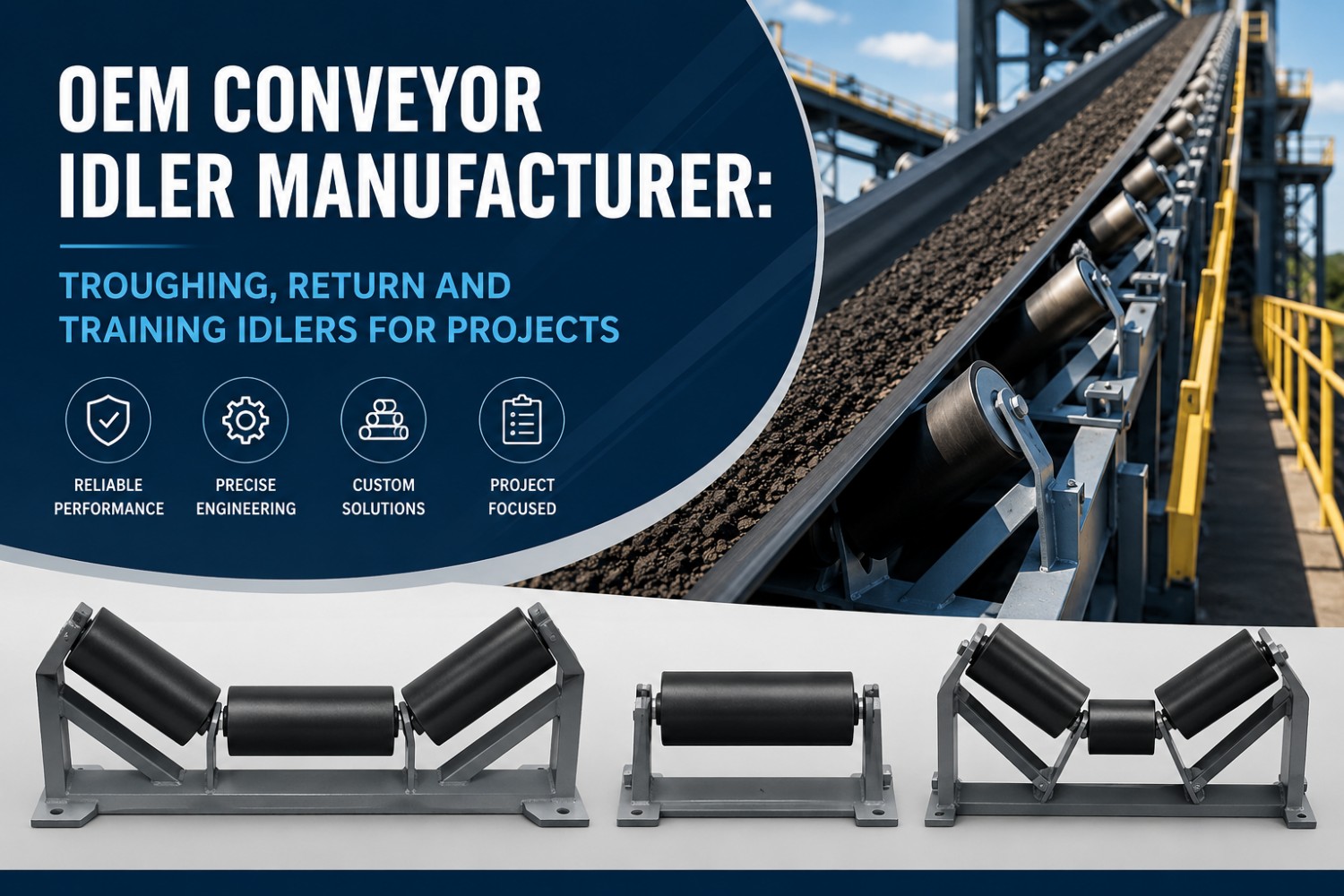
OEM Conveyor Idler Manufacturer: Troughing, Return and Training Idlers for Projects
For an EPC contractor or OEM, buying conveyor idlers is rarely a matter of finding a roller with the right diameter. A project may require hundreds or thousands of idlers across carrying runs, return runs and tracking positions. If frame geometry, shaft ends, trough angles, sealing arrangements or drawing revisions do not match the conveyor design, a low-priced order can quickly become a site problem.
This is why selecting a conveyor idler manufacturer should start with technical compatibility and supplier capability, not a catalog comparison alone. Troughing idlers must support the loaded belt in the intended profile, return idlers support the empty belt, and training idlers have a corrective role when tracking conditions require them. For OEM and project procurement, the real task is to define these duties clearly, control drawings and revisions, verify inspection requirements, and make sure production and delivery match the approved specification.
Quick Answer: An OEM conveyor idler supplier should be evaluated on more than roller size and price. Buyers should verify idler type, belt width, trough angle, roller and frame dimensions, shaft interfaces, bearing and sealing requirements, operating environment, applicable project standards, inspection documents, drawing control, quantity and delivery schedule before approving production.

1. Why Conveyor Idler Procurement Becomes a Project-Control Issue
A replacement roller purchased for maintenance and an idler package purchased for a new conveyor project are different sourcing tasks. In a project order, dimensional and documentation errors can be repeated across a large quantity of components.
Consider an apparently simple troughing idler. The quotation may identify the belt width and roller diameter correctly, yet still leave important questions unresolved: Does the frame match the conveyor stringer? Is the required trough angle correct? Are roller face lengths and gaps compatible with the belt geometry? Do the shaft ends fit the mounting arrangement? Has the supplier quoted rollers only or complete idler sets?
The same principle applies to return and training positions. A technically useful RFQ therefore defines each idler by its function, interface and operating conditions, rather than grouping everything under a generic description such as “conveyor roller.” Buyers who need an overview of the available product category can review SINOCONVE's conveyor roller range before preparing the project specification.
RFQ Warning: “Standard idler” is not a sufficiently controlled specification for an OEM or EPC package. Attach the approved drawing or define the dimensions, mounting arrangement, duty and applicable project requirements that determine interchangeability.
2. Troughing, Return and Training Idlers Do Different Jobs
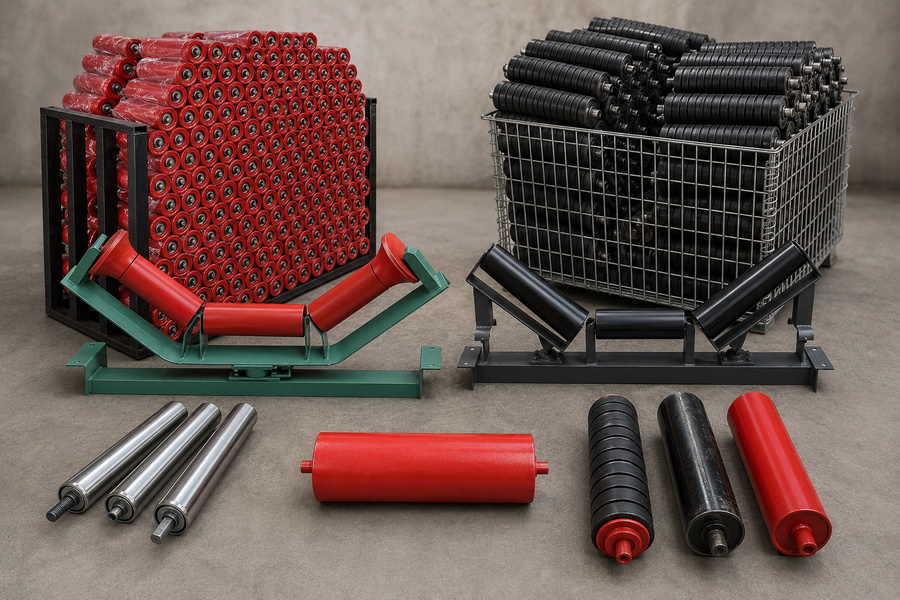
Separating idlers by duty is one of the first steps toward a quotation that can actually be compared. Although all three types support or influence the belt, their operating conditions and selection risks are not identical.
| Idler Type | Main Function | What the Buyer Should Define | Risk if Poorly Specified |
|---|---|---|---|
| Troughing idler | Supports the loaded belt and maintains the specified carrying profile. | Belt width, trough angle, roller arrangement, dimensions, spacing, load and frame interface. | Poor belt support, excessive sag, spillage, dimensional mismatch or uneven belt contact. |
| Return idler | Supports the unloaded belt on its return path. | Return configuration, dimensions, mounting, carryback conditions and environment. | Buildup, poor rotation, belt damage, vibration or tracking problems. |
| Training idler | Responds to belt deviation and assists tracking in an appropriate position. | Belt direction, location, frame arrangement, tracking problem and surrounding geometry. | The device may be unsuitable for the actual cause of mistracking or may mask a system fault. |
2.1 Troughing Idlers: Geometry Matters as Much as Roller Construction
A troughing idler normally uses multiple rollers to support the carrying side of a bulk-material belt. The assembly creates the required belt profile, so an OEM buyer needs to control more than the individual roller outside diameter.
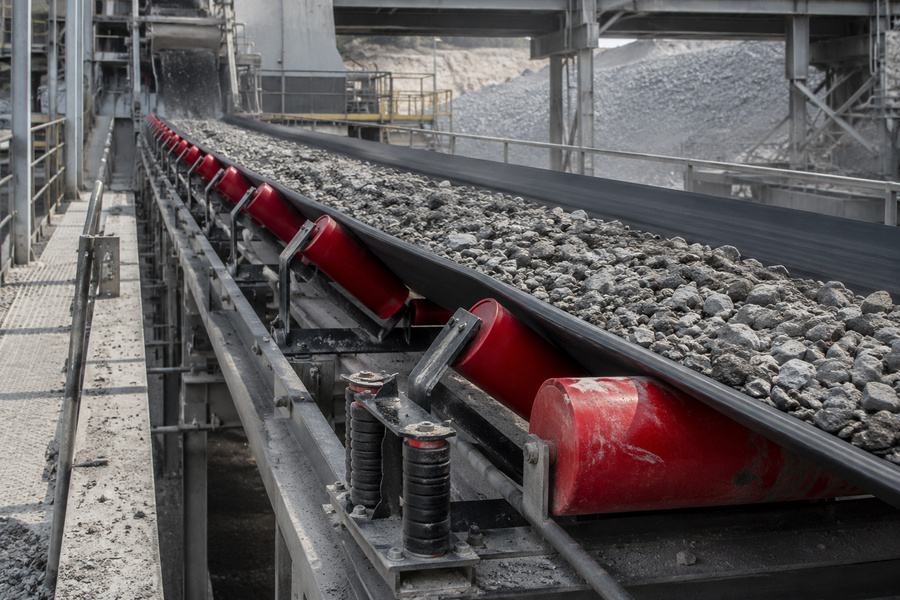
Frame geometry, trough angle, roller lengths, center-to-wing relationships and mounting positions must correspond with the conveyor design. Belt width alone cannot determine these details. The conveyed material, loading, belt speed, idler spacing and project design also affect the required duty.
This becomes especially important when a supplier is asked to manufacture from an existing OEM drawing. A dimension that appears minor on one set can become a repeated installation problem when multiplied across an entire conveyor.
2.2 Return Idlers: Carryback Changes the Operating Environment
The return side carries an unloaded belt, but that does not make the idler unimportant. Material adhering to the belt can reach the return run, accumulate around rollers or frames, and create additional resistance and tracking problems.
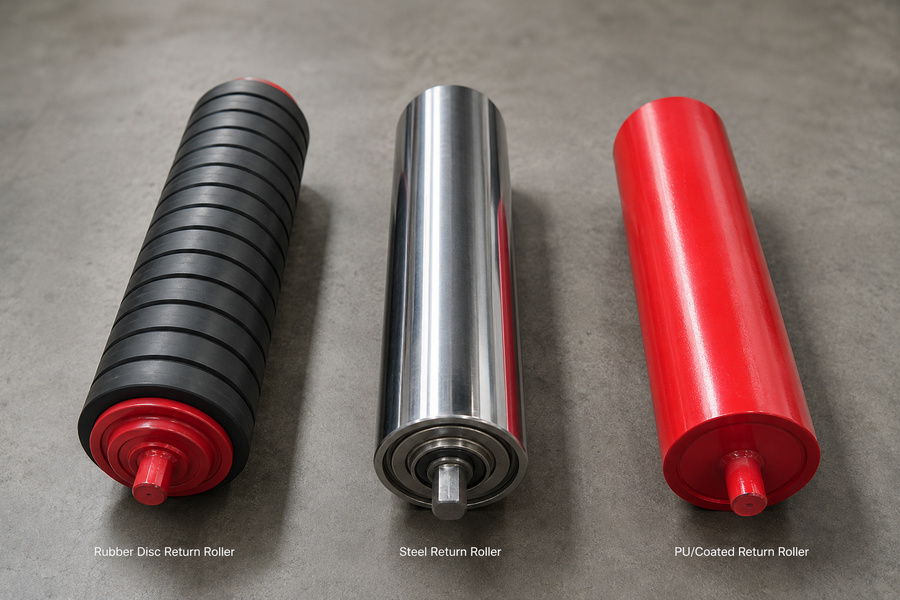
A return roller that stops rotating can also become a sliding surface against a moving belt. For procurement teams, the specification should therefore consider contamination, moisture, corrosion exposure and cleaning conditions rather than treating the return idler as a lighter version of the carrying idler.
2.3 Training Idlers: Corrective Hardware Is Not Root-Cause Repair
A training idler can assist belt tracking by reacting to lateral movement, but it should not be specified simply because a belt is running off-center. Persistent mistracking can originate from off-center loading, seized rollers, material buildup, pulley alignment, an uneven splice, incorrect tension or distorted conveyor structure.
SINOCONVE's technical article on the self-aligning roller and conveyor tracking explains this distinction in more detail. For an OEM project, the training arrangement should be reviewed as part of the conveyor geometry rather than used as a universal correction for alignment problems.
3. What an EPC or OEM RFQ Should Specify
The quality of the quotation depends heavily on the quality of the RFQ. Sending several manufacturers only a belt width and roller diameter forces each supplier to make assumptions. The resulting prices may look comparable while representing different constructions or scopes.
For a project RFQ, organize the technical information around the idler's actual interface with the conveyor.
| RFQ Item | What the Buyer Should Provide | Why It Matters |
|---|---|---|
| Idler position and type | Troughing, return, training, impact or other project-defined position. | Different positions have different load, contamination and support requirements. |
| Belt information | Belt width, speed and relevant construction/application information. | Defines the belt/idler interface and helps evaluate operating duty. |
| Roller dimensions | Tube outside diameter, face length, shaft dimensions and shaft-end details. | Controls physical fit and interchangeability. |
| Frame geometry | Trough angle, mounting centers, slots, brackets and approved drawings where applicable. | Prevents mismatch between the idler set and conveyor structure. |
| Operating conditions | Material, load, lump/impact conditions where relevant, dust, water, corrosion and temperature conditions. | Influences roller construction, bearing protection and suitability. |
| Bearing and sealing requirements | Approved bearing arrangement, seal requirements or project performance criteria. | Dust and moisture ingress are important failure risks in bulk-material handling. |
| Standards and inspection | Exact applicable standard, project specification, inspection plan and required documents. | Avoids vague claims of “standard compliance” without a defined acceptance basis. |
| Commercial scope | Quantity by item, spare quantity, delivery destination, packing and required delivery schedule. | Allows comparable quotations and better production planning. |
For replacement projects, photographs are useful but should not replace dimensional information. A marked-up drawing or verified sample can reduce ambiguity around shaft ends, mounting slots and frame dimensions. SINOCONVE also supports OEM/ODM development based on customer drawings, samples and specific technical requirements.
4. Bearing, Seal, Shaft and Shell Details Deserve Separate Review
Two rollers with the same external dimensions are not automatically equivalent. Internal construction determines how the roller responds to load, contamination and continuous rotation.
Bearings should be considered together with the actual radial load, rotational speed, shaft support and environment. A larger bearing designation alone does not prove that the complete roller is suitable.
Sealing becomes particularly important in dusty mines, cement handling, ports, aggregate plants and wet outdoor conveyors. If contaminants reach the bearing, increasing bearing size without addressing ingress may leave the underlying failure mechanism unchanged.
The shaft transfers roller loads into the supporting frame. Diameter, bearing spacing, end geometry and material specification need to match the mechanical and mounting requirements.
The shell must also maintain the required geometry while resisting wear, impact and deformation appropriate to the duty. Shell diameter, wall specification, roundness and runout criteria should therefore be discussed where they are relevant to the project.
For additional buyer checks on these details, see the SINOCONVE conveyor idler roller selection guide.
5. Standards Help Define the Purchase — but the Standard Name Is Not Enough
For bulk-material belt conveyor projects, CEMA Standard No. 502-2022 is a recognized reference covering CEMA Class B, C, D, E and F troughing, return and picking idlers. Depending on the project and market, other applicable dimensional or project requirements may also be specified.
The procurement lesson is more important than the standard name itself: a quotation that says “CEMA” does not by itself prove that every offered idler matches the project's required class, geometry, load basis, dimensions or inspection criteria.
The EPC or OEM should state the applicable standard and edition in the RFQ and identify any project-specific deviations. The supplier should then return a clear compliance statement or deviation list against that requirement.
Buyer Check: Treat a standard as an acceptance framework, not as a substitute for the approved drawing and project specification. Confirm which dimensions, performance criteria, tests and documents are actually included in the supplier's offer.
6. How to Qualify an OEM Conveyor Idler Manufacturer
For bulk orders, supplier qualification should answer two questions: Can this factory manufacture the approved product consistently, and can it control the order as a project?
That requires more evidence than a product photograph or catalog.
6.1 Technical Review Before Production
A capable supplier should be able to review drawings, specifications and operating conditions before manufacturing begins. Questions raised before production are usually cheaper to resolve than dimensional disputes after containers arrive on site.
For customized orders, drawing revision control matters. The purchase order, approved drawing, bill of materials and production documents should identify the same revision. Where a change is made, both parties need a controlled record of what changed and which version is released for manufacturing.
6.2 Quality Control and Inspection Documentation
Ningbo Sinoconve Belt Co., Ltd. follows a quality process that includes incoming raw-material inspection, production inspection and final testing before shipment. SINOCONVE has more than 35 years of manufacturing experience from a factory established in 1988, with more than 200 employees, including engineering and quality-control personnel.
For a project order, buyers should still define the documents they require for the specific idlers being purchased. Depending on the PO and agreed inspection plan, this may include dimensional inspection records, product test reports or third-party inspection requirements. Do not assume that a general company certificate automatically covers every project-specific acceptance criterion.
Buyers evaluating the broader manufacturing organization can review SINOCONVE manufacturing and quality capabilities.
6.3 OEM and Customization Capability
OEM procurement frequently involves an existing drawing, legacy component or special mounting interface rather than a catalog item. SINOCONVE supports OEM/ODM cooperation and customization according to customer drawings, samples and technical requirements.
That capability is most useful when the RFQ contains enough information to reproduce the required interface. For a replacement program, send the original drawing if available. If it is unavailable, provide measured dimensions, clear photographs and a sample where practical rather than relying on a model name alone.
7. Compare Conveyor Idler Quotations on the Same Technical Basis
A lower quotation is meaningful only when the offered scope is technically equivalent. One supplier may quote rollers only while another includes frames. One may use the buyer's specified seal arrangement while another substitutes its standard design. Packing, spare quantities, inspection documentation and drawing work may also be handled differently.
Before comparing the commercial totals, normalize the technical offers.
| Comparison Area | What to Verify Across Bidders |
|---|---|
| Technical scope | Roller only or complete idler set; idler type; dimensions; trough geometry; frame and mounting details. |
| Construction | Shell, shaft, bearing and seal requirements against the same specification. |
| Compliance | Applicable standard, edition, project specification and declared deviations. |
| Inspection | Required inspections, reports, certificates and third-party witnessing where specified. |
| Commercial scope | Quantity, spare units, packing, Incoterm or delivery basis, payment terms and exclusions. |
| Schedule | Drawing approval milestones, production period, inspection point and shipment date. |
This comparison is especially useful for EPC packages where purchasing teams receive bids in different formats. SINOCONVE's conveyor roller and pulley supplier guide for project procurement discusses similar interface and document-control risks for port conveyor systems.
8. Bulk Orders Need Production, Packaging and Delivery Planning
Large idler orders add a logistics problem to the engineering problem. The buyer may need different troughing, return and training assemblies delivered under one project, with each type clearly identified for site receiving and installation.
Ask the manufacturer how production batches, identification, inspection status and packing will be controlled. Item numbers on the purchase order should remain recognizable through drawings, packing lists and shipment documentation. This reduces the risk of site teams having to identify similar-looking components after arrival.
Delivery schedules should also reflect drawing approval and inspection requirements. SINOCONVE's general production lead time is normally around 30 days, with an expedited production channel potentially available for urgent orders. However, project idler schedules should be confirmed against the actual specification, quantity, customization and inspection scope before the PO is finalized.
For project planning, the SINOCONVE product catalog provides an entry point for conveyor roller and other material-handling product categories.
9. A Practical RFQ Checklist for EPC and OEM Buyers
Before sending an RFQ to a conveyor idler factory, check whether the purchasing package allows the supplier to quote without making major technical assumptions.
- Identify every idler position: troughing, return, training, impact or other project-specific configuration.
- Provide conveyor information: belt width, speed and relevant operating duty.
- Define the environment: conveyed material, dust, moisture, corrosion, temperature and impact conditions where applicable.
- Control dimensions: roller diameter, face length, shaft arrangement, trough angle, frame geometry and mounting interface.
- Attach drawings: use approved or clearly revision-marked drawings for OEM components.
- State construction requirements: shell, shaft, bearing, sealing and other project-defined details.
- Name the applicable standard: include the edition and any project-specific deviations or supplementary requirements.
- Define inspection: specify required reports, inspection points and third-party involvement before quotation.
- Separate quantities: distinguish installation quantities from commissioning or operational spares.
- State delivery requirements: destination, packing, identification, required schedule and commercial delivery basis.
If a supplier returns a quotation without addressing important missing data, ask which assumptions were used. An assumption list can reveal more about technical discipline than a long catalog.
10. Frequently Asked Questions
What is the difference between a conveyor roller and a conveyor idler?
A conveyor roller is the rotating cylindrical component. A conveyor idler usually refers to the support assembly, which may contain one or more rollers together with a frame. An RFQ should make clear whether the requirement is for replacement rollers or complete idler sets.
What information should I send to a conveyor idler manufacturer?
At minimum, provide the idler type, belt width, roller and frame dimensions, trough angle where applicable, mounting details, operating conditions, quantity and drawings. For engineered projects, also include the applicable standard, inspection requirements and document schedule.
Can a training idler solve conveyor belt mistracking?
It can help correct belt deviation under suitable conditions, but it should not replace diagnosis of the underlying problem. Off-center loading, seized rollers, pulley misalignment, material buildup, poor splicing, structural alignment or belt tension can all contribute to mistracking.
Should I specify CEMA for an idler project?
Use the standard required by the conveyor design, client specification or target market. CEMA Standard No. 502-2022 covers bulk-material belt conveyor troughing, return and picking idlers in defined CEMA classes. If it applies to the project, state the exact edition and required class rather than writing only “CEMA standard.”
How should I compare two conveyor idler suppliers?
First make the technical scope equivalent. Compare idler geometry, roller construction, bearing and sealing requirements, applicable standards, deviations, inspection documentation, drawing control, packing and delivery scope. Only then is the unit-price comparison meaningful.
Can SINOCONVE manufacture OEM conveyor idlers from drawings or samples?
SINOCONVE supports OEM/ODM cooperation and customized manufacturing according to customer drawings, samples and technical requirements. The feasibility, final construction, quantity and production schedule should be confirmed against the actual RFQ before manufacturing.
What documents should an EPC buyer request before shipment?
The exact package depends on the project specification. Buyers should define required dimensional inspection records, product test reports, certificates, packing documentation and any third-party inspection or witnessing requirements in the RFQ or purchase order rather than requesting them after production.

11. Prepare the Idler Package Before Requesting a Quote
A good conveyor idler quotation starts with a controlled technical package. For troughing, return or training idlers, prepare the belt width and speed, idler arrangement, roller and frame dimensions, trough angle, shaft and mounting details, operating environment, applicable standard, quantities, drawings and required delivery schedule. For replacement parts, include photographs and an existing sample where dimensions or interfaces are uncertain.
Ningbo Sinoconve Belt Co., Ltd. supports customized conveyor roller and idler requirements for industrial and project procurement. You can review the SINOCONVE conveyor roller product range or send the project package through the SINOCONVE RFQ page. Technical and purchasing inquiries can also be sent to sales@sinoconve.com.
Related Products
- Conveyor Roller – product category for industrial conveyor roller and idler requirements.
- SINOCONVE Conveyor Roller Catalog – product catalog entry for project and OEM sourcing.