
Industrial Belt Manufacturer for Cement Plants: Conveyor Belts, V-Belts and Rollers from One Supplier
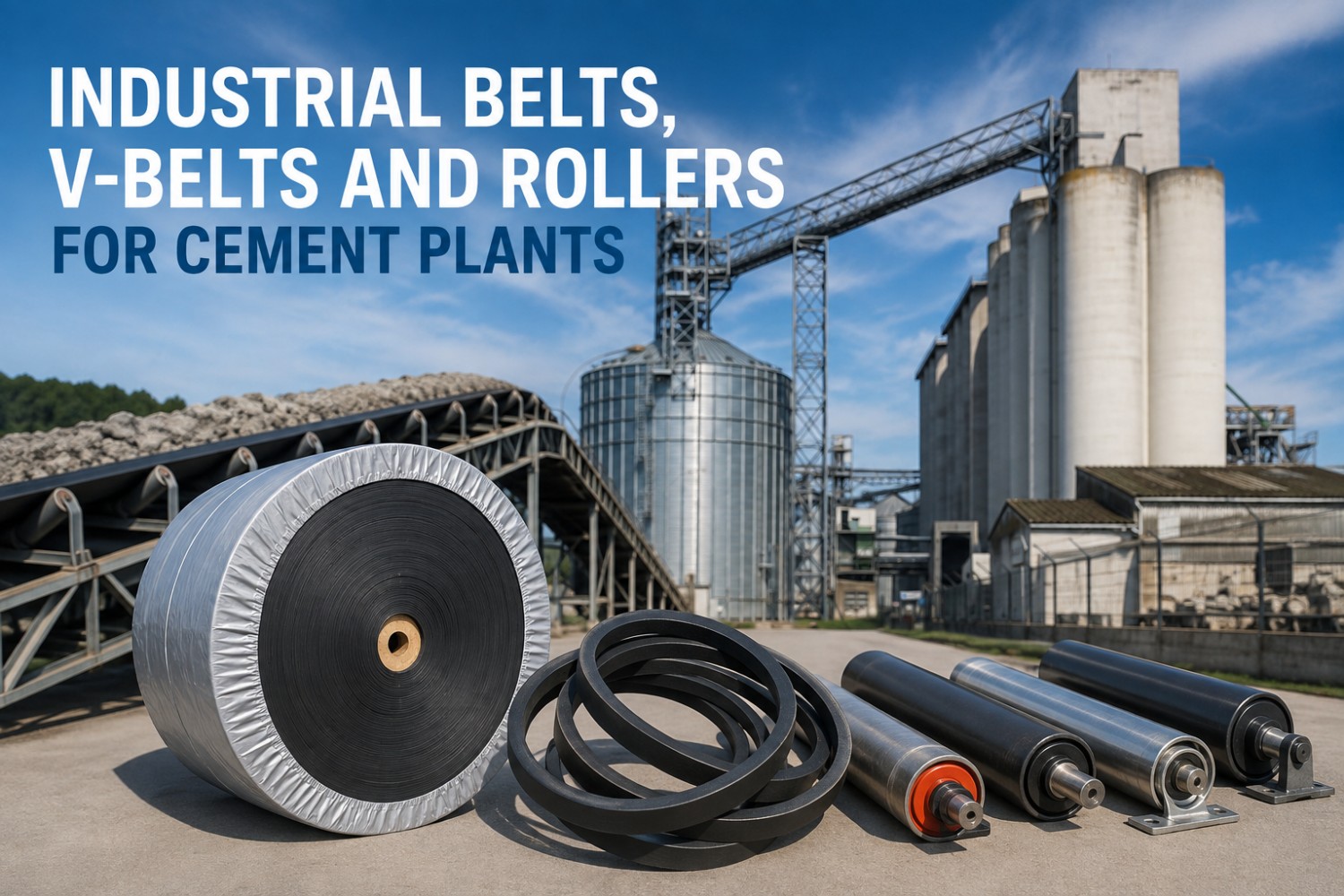
A cement plant rarely buys an industrial belt in isolation. The same procurement team may be sourcing abrasion-resistant conveyor belts for limestone, heat-resistant belts for clinker handling, V-belts for mechanical drives, and replacement conveyor rollers for material-handling lines. Buying these items from several vendors can widen the supplier base, but it also creates more specifications to reconcile, more quality documents to review, and more shipments to coordinate.
For plant procurement, the useful question is therefore not simply, “Who offers the lowest belt price?” It is whether an industrial belt manufacturer can cover the required product categories, understand the different operating conditions inside a cement plant, document quality consistently, and respond when specifications change.
This guide explains how cement plant buyers can evaluate conveyor belts, V-belts and rollers from one supplier without sacrificing the technical checks that each product still requires.
Quick Answer for Procurement Teams
Consolidating conveyor belts, V-belts and rollers with one industrial supplier can simplify RFQs, documentation, shipment planning and supplier management. It should not mean using one generic specification across the plant. Limestone, clinker, cement raw materials and mechanical drive systems impose different requirements. Qualify the supplier once at the organizational level, but verify each product against its actual duty.
1. Why Cement Plant Belt Procurement Is More Complex Than a Single RFQ
A cement plant contains several material-handling and mechanical drive duties with very different failure mechanisms. Limestone entering the plant can subject a conveyor belt to impact and abrasion. Hot clinker adds thermal stress. Fine material creates dust and carryback concerns. Long conveyor runs introduce tension and tracking considerations. V-belts operate under an entirely different set of mechanical conditions.
This matters commercially because a quotation can be dimensionally correct and still be technically incomplete. Width, length and quantity may identify what fits, but they do not necessarily identify what will survive.
Procurement teams should separate two questions:
- Supplier qualification: Can this manufacturer consistently produce, inspect, document, pack and deliver the required industrial products?
- Application qualification: Is the particular belt, roller or V-belt specification appropriate for this operating position?
A supplier capable of covering several categories can reduce procurement complexity, but only if it maintains this distinction. A broad catalog is useful. Application-specific verification is more important.

2. Start with the Conveyor Belt Duty, Not the Belt Name
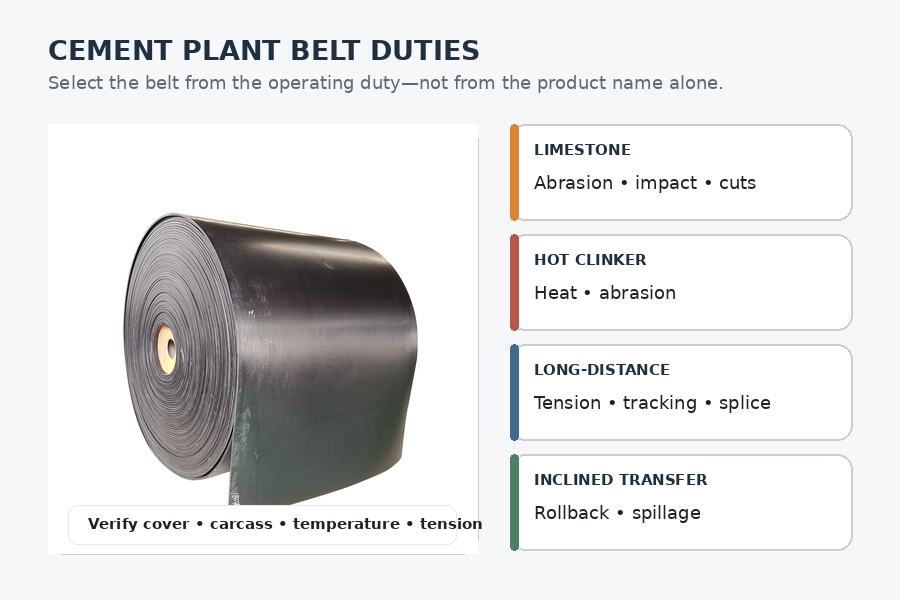
Conveyor belts normally deserve the most detailed technical discussion because cement production exposes different conveyors to substantially different material conditions.
For buyers comparing an industrial rubber conveyor belt, the material being conveyed should be identified before the belt construction is finalized.
| Cement Plant Duty | Main Operating Concern | What Procurement Should Verify | Risk if Overlooked |
|---|---|---|---|
| Limestone / crushed raw material | Abrasion, impact and cuts at loading points | Cover properties, carcass construction, cover thickness and loading conditions | Accelerated cover damage or carcass exposure |
| Hot clinker | Heat combined with abrasion | Actual material temperature, peak temperature exposure, cover compound and abrasion requirement | Hardening, cracking or premature cover deterioration |
| Long-distance conveying | Tension, elongation and splice performance | Required belt strength, conveyor geometry, take-up arrangement, pulley data and splice method | Tracking, tension or splice problems |
| Inclined material transfer | Material rollback or spillage | Incline angle, material characteristics, capacity and suitable belt surface/configuration | Reduced capacity and excessive spillage |
Clinker is a good example of why specification by product name is insufficient. Heat resistance does not remove abrasion from the application. Likewise, a highly abrasion-resistant general-purpose cover is not automatically suitable for elevated material temperatures. Buyers dealing with this position can review SINOCONVE's technical discussion of heat-resistant conveyor belts for cement plant clinker handling before preparing the RFQ.
RFQ Warning: Do not ask suppliers to quote a clinker conveyor simply as “heat-resistant belt, 1,000 mm width.” Include the operating temperature information and the mechanical duty. A supplier cannot responsibly confirm the cover compound, carcass or construction from width alone.
3. Fabric or Steel Cord: Let Conveyor Design Determine the Construction
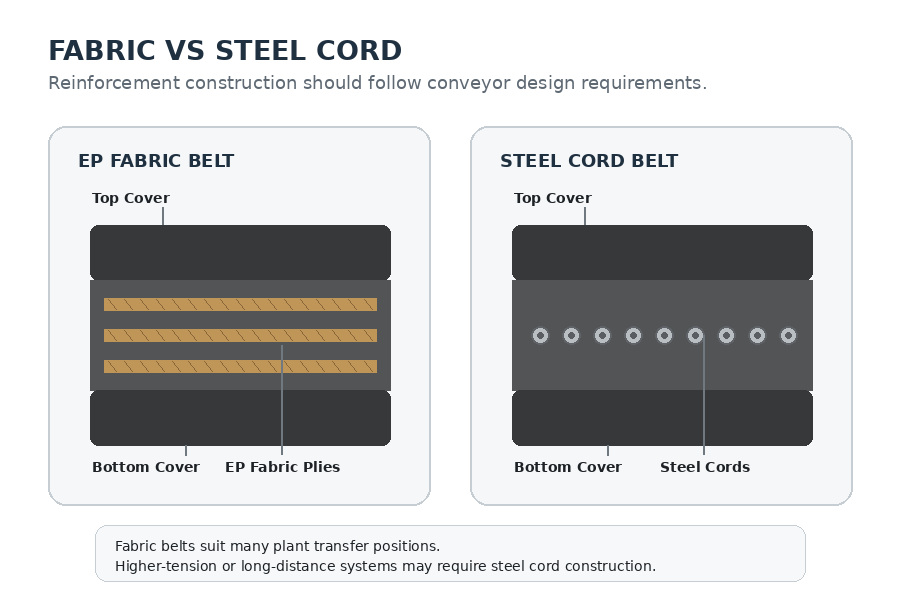
The reinforcement structure is another purchasing decision that should not be reduced to “stronger is better.” Fabric and steel cord constructions behave differently, and the correct choice depends on conveyor length, required tension, take-up arrangement, pulley configuration, loading conditions and the approved conveyor design.
Fabric-reinforced belts can be appropriate across many plant transfer positions where the required strength and conveyor geometry suit the construction. Higher-tension or long-distance systems may require steel cord construction. The final rating should come from the conveyor design requirements rather than from a supplier's generic recommendation.
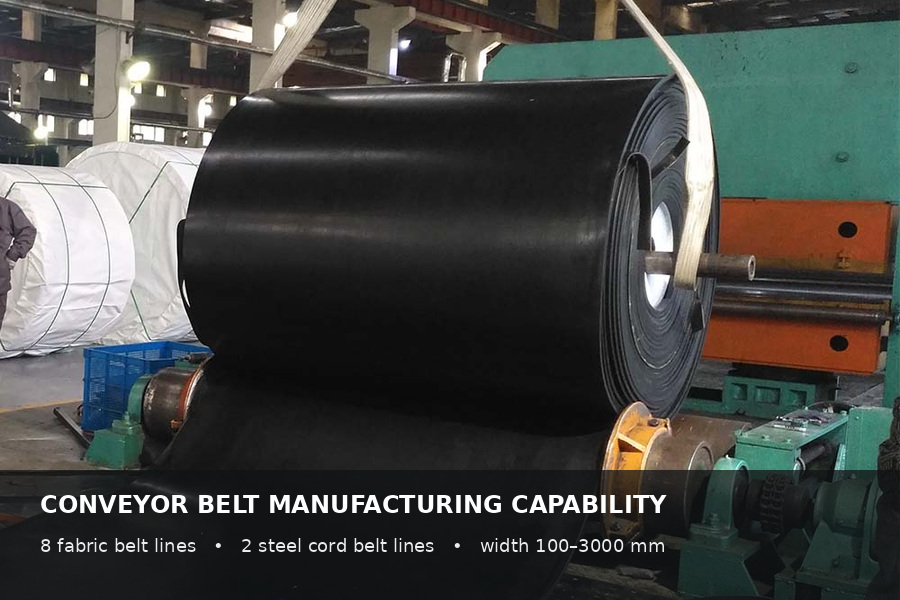
SINOCONVE's confirmed manufacturing range includes fabric conveyor belts from EP100 to EP600 and steel cord belts from ST500 to ST7500, with manufacturing capability for belt widths from 100 mm to 3,000 mm and thicknesses from 3 mm to 100 mm. These figures describe manufacturing capability; they are not recommended specifications for every cement conveyor.
That distinction matters during supplier qualification. A broad production range shows whether a manufacturer can potentially accommodate different requirements. Engineering data determines which construction should actually be ordered.
4. Do Not Treat Conveyor Rollers as Commodity Accessories
Rollers are easier to overlook because individual units are relatively small compared with an entire conveyor belt. Their condition, however, directly affects the belt-support system.
A seized or poorly rotating roller can create localized friction. Incorrect roller dimensions can disturb belt support and tracking. Contamination and dust can challenge bearing and sealing arrangements. Impact positions have different requirements from ordinary carrying or return positions.
When requesting a conveyor roller, provide enough information for dimensional and duty matching rather than sending only a photograph.
- Roller type and position on the conveyor
- Tube diameter and face length
- Shaft dimensions and mounting arrangement
- Existing drawing or sample dimensions where available
- Load and operating environment
- Dust, moisture or other contamination conditions
- Required quantity
For replacement procurement, the safest approach is usually to work from an approved drawing or carefully verified dimensions. SINOCONVE also provides a more detailed conveyor roller selection guide covering the questions buyers should check before ordering.
5. V-Belts Need a Separate Power-Transmission Check
A cement plant may use V-belts on fans, pumps, auxiliary machinery and other belt-driven equipment, but they should not be specified using conveyor-belt logic. The V-belt transmits power between pulleys rather than carrying bulk material.
Replacement purchasing should start with the existing belt designation and drive requirements. Section/profile, effective or reference length as applicable to the belt system, pulley configuration, number of belts in the drive and equipment operating conditions all affect compatibility.
For multi-belt drives, procurement should also pay attention to matching requirements rather than assuming that unrelated replacement belts can simply be combined on the same drive.
SINOCONVE's V-belt product category includes multiple wrapped and cogged V-belt types. For an RFQ, however, the buyer should send the actual belt designation, quantity and available equipment or pulley information instead of selecting from appearance alone.
6. What Should a Cement Plant Verify in an Industrial Belt Manufacturer?
A supplier audit should move beyond the question “Do you manufacture conveyor belts?” Plant procurement needs evidence that the supplier can control repeat orders and communicate what is actually being supplied.
6.1 Manufacturing Capability
Check whether the factory has production equipment appropriate for the belt constructions being purchased. SINOCONVE's provided factory information lists eight fabric conveyor belt production lines and two steel cord conveyor belt production lines. The stated annual production capacity is 10 million meters of fabric conveyor belt and 3 million meters of steel cord conveyor belt.
Capacity figures are relevant when evaluating bulk orders, but they should not be mistaken for a delivery commitment. Actual lead time still depends on specification, quantity, production scheduling and order confirmation.
6.2 Quality Control and Testing
Supplier qualification should establish what happens before, during and after production.
SINOCONVE states that incoming raw materials are inspected before production, production processes are subject to inspection, and finished products undergo final testing and inspection before shipment. The conveyor belt operation includes 15 quality-control personnel and a laboratory, with 26 engineers included in the provided factory information.
Product test reports can be provided for shipment, and third-party testing can be arranged when customers have specific standard requirements.
This is more useful to a procurement department than a generic “high quality” statement because it gives the buyer specific points to include in the supplier qualification questionnaire.
6.3 Standards Need to Match the Purchase Specification
For general textile-construction conveyor belting, ISO 14890:2026 is the current international specification covering rubber- or plastics-covered conveyor belts for general surface use on flat or troughed idlers. A standard reference should still be checked against the actual product and project requirement; mentioning ISO in a quotation does not by itself establish that every application-specific property has been verified.
Likewise, electrical conductivity, flame behavior and other safety-related properties are separate questions when the operating environment requires them. Buyers should specify the applicable project or plant requirements in the RFQ and request the relevant test documentation rather than relying on a broad statement such as “international standard belt.”
6.4 Repeat-Order Control
Cement plants and MRO distributors often need the same specification again months later. Supplier qualification should therefore ask how the manufacturer identifies the approved construction, compound, dimensions, markings and packaging for repeat orders.
For customized products, drawing numbers, specification sheets, approved samples and purchase-order records should be clear enough that a repeat purchase does not become a new interpretation exercise.
7. Why One Supplier Can Simplify Plant Procurement
Consolidating conveyor belts, rollers and industrial V-belts can reduce the administrative side of sourcing. The purchasing department has fewer vendors to qualify, fewer commercial terms to manage and potentially fewer shipments to coordinate.
The strongest case for consolidation is therefore process consistency rather than the claim that one manufacturer is automatically best at every product.
| Procurement Area | Potential Benefit of Consolidation | What Still Requires Verification |
|---|---|---|
| Supplier qualification | Fewer organizations to audit and maintain | Capability for each relevant product category |
| RFQ communication | One commercial contact can coordinate multiple product groups | Separate technical specifications for each item |
| Documentation | Potentially more consistent document handling | Required inspection and test records per product/order |
| Logistics | Opportunity to coordinate shipments | Packing method, dimensions, weight and delivery schedule |
| Repeat orders | Centralized supplier and specification history | Revision control and consistency with the approved specification |
The limitation is important: supplier consolidation should never override engineering suitability. If one product cannot meet the approved specification, administrative convenience is not a reason to accept it.
8. SINOCONVE Manufacturing and Commercial Capabilities Relevant to Plant Buyers
Ningbo Sinoconve Belt Co., Ltd. supplies conveyor belts, transmission belts and related conveyor components for industrial applications. Its factory was established in 1988, providing more than 35 years of manufacturing experience.
For conveyor belt production, the company's provided manufacturing data includes more than 200 employees, 26 engineers, 15 quality-control personnel and one laboratory. The factory operates eight fabric conveyor belt lines and two steel cord conveyor belt lines.
Customization is available according to customer requirements, including OEM/ODM production, customer drawings or samples, logo customization and packaging customization. SINOCONVE's broader industrial product catalog provides procurement teams with a starting point for reviewing conveyor belt, conveyor roller and power-transmission categories.
For standard commercial planning, the confirmed MOQ is 50 meters for conveyor belts and typically 30–50 pieces for V-belts depending on the model. Normal stated production lead time is around 30 days. For urgent requirements, a 15–20 day production arrangement may be possible subject to confirmation.
These figures should be reconfirmed against the exact specification and quantity at quotation stage rather than treated as an unconditional delivery promise.
9. Packaging Is Part of Supplier Qualification for Imported Belts
Plant procurement does not end at final inspection. A correctly manufactured belt can still arrive damaged if export packaging is inadequate for handling and transportation.
SINOCONVE's provided packaging information states that conveyor belts can be protected with PVC board and iron sheet and can be palletized to reduce transport damage. V-belts are normally packed in cartons, with woven-bag packaging also available. Customized logos and packaging are supported.
For a bulk international order, buyers should confirm packaging before shipment, particularly where rolls will undergo container loading, port handling, inland transport or temporary site storage.
Buyer Tip: Include packing requirements in the purchase specification instead of discussing them only after production. This is especially useful when several belt rolls, rollers and smaller transmission products are being consolidated into the same procurement program.
10. Build a Better Cement Plant RFQ
The quality of a supplier's quotation depends heavily on the information supplied by the buyer. “Conveyor belt for cement plant” is a sourcing category, not a complete technical specification.
A practical RFQ should separate the product groups.
| Product | What the Buyer Should Provide | Why It Matters |
|---|---|---|
| Conveyor belt | Width, length, existing/required strength and construction, conveyed material, material temperature where relevant, capacity, belt speed, incline, pulley data, cover requirement and splice information | Determines whether the proposed construction fits both the conveyor and material duty |
| Conveyor roller | Roller type, diameter, face length, shaft/mounting dimensions, drawing or sample data, duty and quantity | Prevents dimensional and application mismatch |
| V-belt | Existing designation/profile, length information, number of belts per drive, quantity and equipment information | Supports correct replacement and drive compatibility |
| Commercial data | Quantity, destination, required delivery date, packaging requirement, documentation and inspection requirements | Allows a more complete quotation and realistic production/shipping discussion |
If the existing conveyor belt has failed, add photographs of the damaged cover, edges, splice, loading point and nearby pulleys. Failure evidence can reveal information that the old purchase specification does not contain.
11. A Practical Supplier Qualification Checklist
Before adding an industrial belt supplier to an approved vendor list, procurement and engineering teams can work through the following checks:
- Product scope: Can the supplier cover the belt and component categories actually used by the plant?
- Manufacturing scope: Are the required belt constructions within the factory's confirmed production capability?
- Application review: Does the supplier ask about conveyed material, temperature, load, conveyor configuration and existing specification before recommending a belt?
- QC process: Are incoming material, in-process and final inspection controls defined?
- Documentation: Can the required product test reports and supporting documents be supplied?
- Customization: Can drawings, samples, markings and packaging requirements be controlled for OEM or project orders?
- Repeatability: Is there a clear method for identifying the approved specification on future orders?
- Packaging: Is export protection suitable for the transport route and product form?
- Commercial fit: Do MOQ, production schedule and payment terms suit the plant's procurement plan?
- Problem resolution: Is there a defined process for technical review if a product issue is reported?
Price belongs on this list, but it should be compared after technical scope has been normalized. A lower quotation built around a different cover, carcass, roller construction or V-belt specification is not a direct price comparison.
12. Frequently Asked Questions
Can a cement plant source conveyor belts, V-belts and rollers from the same manufacturer?
Yes, provided the supplier has verified capability for each product category. Consolidation can simplify supplier management and commercial coordination, but each item still needs its own technical specification. Conveyor belts, rollers and V-belts perform different mechanical functions and should not be qualified using one generic checklist.
What information is most important when ordering a cement plant conveyor belt?
Start with the conveyed material and the approved conveyor data. Width and length are basic dimensions, but buyers may also need belt strength/construction, cover requirement, material temperature, loading conditions, capacity, speed, incline, pulley information and splice requirements. The exact list depends on the conveyor.
Does clinker require a different conveyor belt from limestone?
Often, yes. Clinker can introduce elevated temperature together with abrasion, while limestone duties are commonly dominated by abrasion, impact and cutting depending on lump size and loading conditions. The actual specification should be based on measured or defined operating conditions rather than the material name alone.
What standard applies to general textile conveyor belting?
ISO 14890:2026 specifies requirements for rubber- or plastics-covered conveyor belts of textile construction for general surface use on flat or troughed idlers. Buyers should still verify whether the project requires additional properties, tests or another applicable standard for the particular application.
What is SINOCONVE's MOQ for cement plant belts?
The confirmed minimum order quantity for conveyor belts is 50 meters. For V-belts, the MOQ is generally 30–50 pieces depending on the model. Project requirements should be confirmed during quotation.
How long does SINOCONVE normally need for production?
The stated normal lead time is approximately 30 days. For urgent orders, production in approximately 15–20 days may be possible through an expedited arrangement, subject to the actual product specification, quantity and production schedule.
Can buyers request test reports before shipment?
SINOCONVE states that product test reports can be provided. Third-party testing can also be arranged where a customer has specific standard or inspection requirements. Required documentation should be written into the RFQ and purchase agreement before production.
Can SINOCONVE manufacture customized industrial belts?
Yes. SINOCONVE supports customized conveyor belts and OEM/ODM requirements based on customer specifications, drawings or samples. Logo, color and packaging customization are also available where applicable.

13. From Supplier Search to a Qualified RFQ
For a cement plant, finding an industrial belt manufacturer is only the first procurement step. The stronger sourcing process connects plant conditions to specifications, specifications to supplier capability, and supplier capability to inspection and repeat-order control.
Using one supplier for conveyor belts, V-belts and rollers can reduce commercial complexity, particularly for bulk orders and recurring MRO procurement. The value disappears, however, if consolidation leads to generic specifications. Keep the technical requirements specific to each conveyor and drive while standardizing the supplier-management process around them.
If you are preparing a cement plant RFQ, send SINOCONVE the existing belt or roller specification, drawings where available, conveyed material and operating conditions, required quantities, applicable standards or test requirements, and delivery destination. For replacement failures, include photographs of the worn belt, splice, loading point or damaged components.
You can review the SINOCONVE product catalog, submit requirements through the contact and quotation page, or email sales@sinoconve.com. This gives the technical and production teams enough information to review the requirement before a quotation is finalized.