
Bulk Material Handling Conveyor Belt Manufacturer for High-Throughput Port Projects
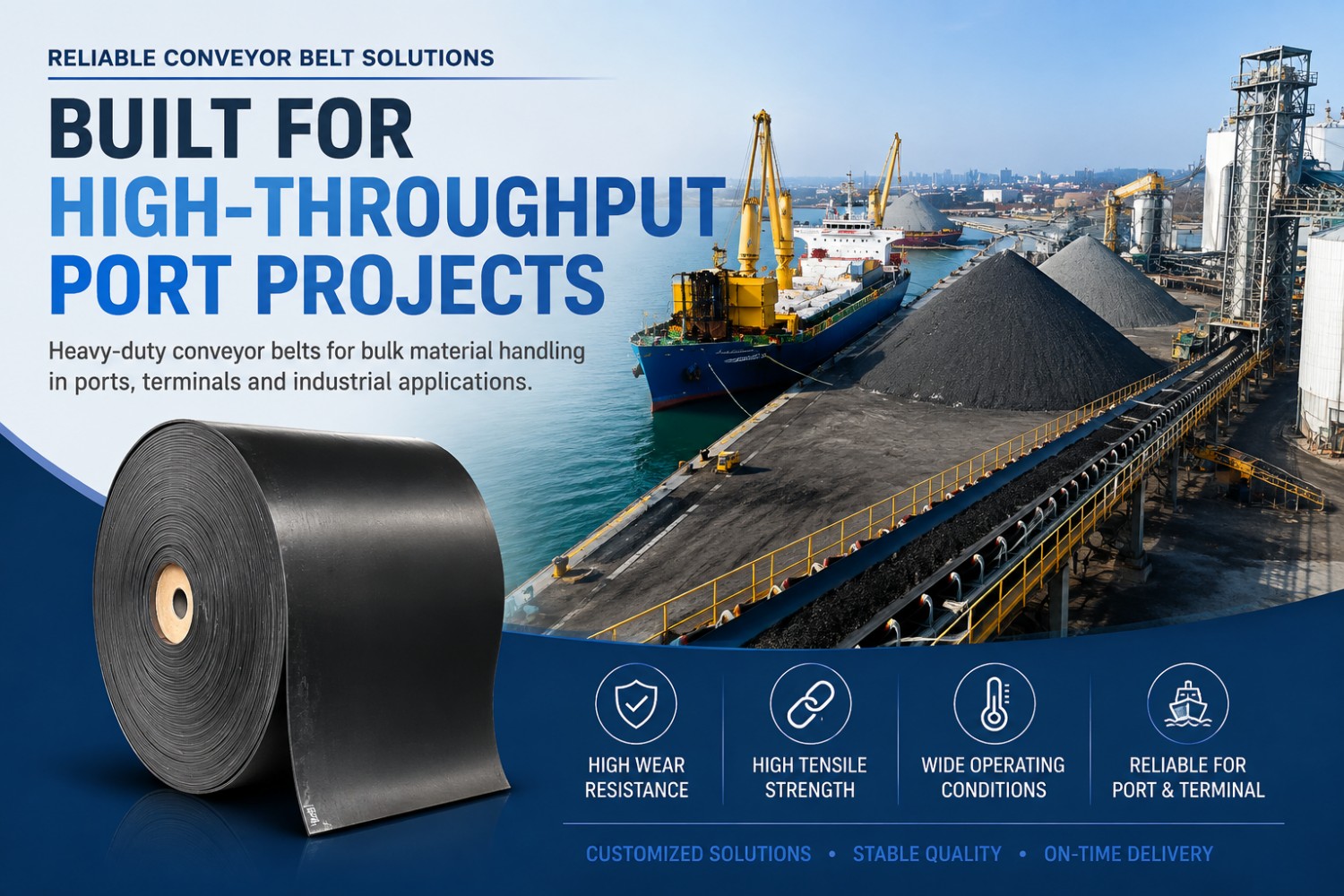
For a high-throughput port terminal, conveyor belt procurement is rarely a simple replacement-parts purchase. The belt sits inside a system where ship unloading, stockyard transfer, reclaiming and loading schedules are connected. A belt problem on a critical route can therefore affect more than one conveyor—and the commercial consequences can extend beyond the price of the belt itself.
That changes how an EPC contractor or terminal procurement team should evaluate a bulk material handling conveyor belt manufacturer. Product width and tensile rating matter, but they are only part of the qualification process. Buyers also need to establish whether the manufacturer can translate project operating data into a controlled specification, manufacture repeatable batches, document inspection results, protect the belt for sea freight and respond when technical questions arise.
This guide focuses on those supplier-side decisions: what information should go into the RFQ, what evidence should be requested during technical evaluation, and how to reduce procurement risk before a large port conveyor belt order is released.
Quick Answer for EPC and Terminal Buyers
Do not approve a conveyor belt supplier from a catalogue specification alone. For a port project, verify the manufacturer's production range, quality-control process, testing documentation, customization capability, production capacity, packaging method and ability to review the actual conveyor duty. The RFQ should describe the material, conveyor geometry, required belt construction, operating conditions, project standard, quantity and delivery requirements clearly enough for technically comparable bids.
1. Why Port Conveyor Belt Procurement Is a Project Decision

Ports and bulk terminals combine several conditions that make belt procurement demanding. Material volumes can be high, conveyor routes may be long, loading points can introduce significant impact, and outdoor equipment is exposed to moisture, contamination and changing weather. Coal, ore, aggregate, fertilizer and other bulk commodities also impose different abrasion, impact, chemical and safety requirements.
The first procurement mistake is therefore to use “heavy duty” as if it were a complete specification. It is not. A heavy duty conveyor belt still has to be matched to the required tension, material characteristics, loading conditions, conveyor geometry and operating environment.
Construction choice illustrates the issue. An EP fabric belt may be suitable for many bulk-handling conveyors, while a steel cord construction becomes relevant when calculated tension, conveyor length and elongation requirements move beyond the practical range of a fabric construction. Steel cord is not automatically the better purchase simply because the project is large. The conveyor design has to justify it.
Buyers reviewing this decision can compare SINOCONVE's rubber conveyor belt range and EP rubber conveyor belt options before defining the technical inquiry.

2. Build the RFQ Around the Conveyor Duty, Not a Generic Belt Name
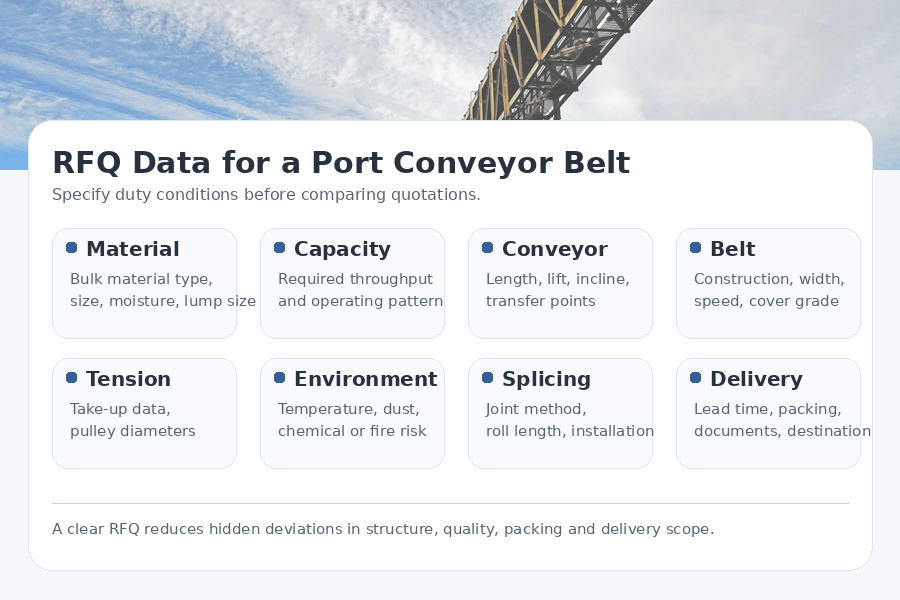
A quotation is only as comparable as the RFQ behind it. If one bidder interprets “heavy duty” as a thicker cover, another as a higher carcass rating and another as a specialty compound, the purchasing team may receive three prices for three materially different products.
For EPC procurement, the RFQ should separate project requirements from supplier proposals. Approved drawings, belt schedules and engineering calculations should remain the governing documents where available. The manufacturer can then quote against the same technical basis rather than filling gaps with assumptions.
| RFQ Item | What the Buyer Should Provide | Why It Matters |
|---|---|---|
| Conveyed material | Commodity, bulk density, maximum lump size, moisture and relevant material characteristics | Influences loading, impact, abrasion and cover-compound requirements. |
| Conveyor geometry | Belt width and length, center distance, lift/incline, pulley diameters and take-up arrangement | Required for reviewing strength, flexibility, elongation and system compatibility. |
| Operating duty | Design capacity, belt speed, operating hours and start/stop conditions where relevant | Helps distinguish continuous high-throughput duty from less demanding service. |
| Belt construction | Required carcass/strength rating, cover grade, top and bottom cover thickness and edge requirements | Prevents bidders from pricing different constructions under the same description. |
| Splicing | Specified splice method and relevant project requirements | The belt and splice system need to be treated as compatible parts of the same duty. |
| Project requirements | Applicable standard, inspection requirements, documentation, marking and packaging | Creates a common technical and commercial basis for bid comparison. |
| Commercial scope | Roll lengths, quantities, destination, project schedule and required delivery date | Allows the manufacturer to evaluate production and shipment planning before commitment. |
RFQ Warning: Avoid asking several manufacturers for a “quarry belt,” “crusher conveyor belt” or “port belt” and comparing only price per meter. Those descriptions identify an application, not a complete engineering specification.
3. Supplier Qualification: What Should an EPC Buyer Actually Verify?
An approved-vendor review should answer a practical question: can this manufacturer repeatedly produce the required belt and provide evidence that the delivered product matches the approved specification?
A factory profile is useful, but evidence should move beyond photographs and marketing statements. For conveyor belt procurement, the most relevant qualification areas are production capability, specification range, quality control, testing, documentation and project communication.
3.1 Confirm the manufacturer's real production envelope
SINOCONVE's conveyor belt factory was established in 1988 and has more than 35 years of manufacturing experience. Based on the company's current production information, the conveyor belt operation has more than 200 employees, including 26 engineers and 15 quality-control personnel, supported by a laboratory.
Production includes eight fabric conveyor belt lines and two steel cord conveyor belt lines. Confirmed annual capacity is 10 million meters of fabric conveyor belt and 3 million meters of steel cord conveyor belt. The stated manufacturing range covers belt widths from 100 mm to 3000 mm and thicknesses from 3 mm to 100 mm, with fabric ratings from EP100 to EP600 and steel cord ratings from ST500 to ST7500.
These figures are useful at the prequalification stage because they establish a manufacturing envelope. They should not, however, replace project-specific confirmation. An EPC buyer should still ask the supplier to confirm that the exact width, construction, roll length, quantity and delivery schedule in the project RFQ can be produced.
3.2 Review both fabric and steel cord capability where the project requires it
A large terminal can contain conveyors with different duties. Shorter transfer conveyors may not need the same construction as a long, high-tension trunk conveyor. Supplier evaluation is stronger when it establishes which constructions can actually be manufactured rather than assuming that one belt type will cover the entire terminal.
For long-distance or higher-tension applications, the technical team may also review the engineering considerations in SINOCONVE's steel cord conveyor belt selection guide. The final construction should follow the conveyor design and approved project specification.
4. Quality Control Needs Evidence, Not a General “High Quality” Claim
Supplier qualification becomes more useful when the EPC team asks how conformity is controlled at different stages of manufacturing. A certificate can form part of vendor documentation, but it does not by itself prove that a particular roll meets every requirement in a project specification.
SINOCONVE's confirmed quality process starts with incoming raw-material inspection. Production is monitored during manufacturing, followed by final testing and inspection before shipment. The company has stated that its laboratory and quality-control equipment can evaluate properties including abrasion resistance, temperature resistance, tensile performance and oil resistance as applicable to the product requirement.
SINOCONVE can provide ISO certification documentation and product test reports. Where a customer's project requires special standards or independent verification, third-party testing can also be discussed.
Buyer Verification Point
For a technical submittal, state exactly which documents must accompany the bid, which are required before production, and which must accompany the shipment. This prevents “test report available” from being interpreted differently by the buyer and supplier.
For large orders, buyers may consider requesting documentation that identifies the relevant product, specification and inspection result clearly enough to support traceability within the agreed project documentation system. The exact document package should be agreed during technical clarification rather than after the belts are already manufactured.
5. Technical Submittals Should Close Gaps Before the Purchase Order
A technical submittal is most valuable when it exposes differences between the RFQ and the manufacturer's proposal before those differences reach production.
For a port conveyor belt package, the review may include belt construction, dimensions, strength designation, cover requirements, splice-related requirements, applicable project standard, roll arrangement, marking, inspection documents and packaging. The exact list depends on the EPC specification.
Deviations deserve particular attention. If a supplier proposes an alternative construction, the deviation should be visible rather than buried in a quotation. Procurement teams can then route it back to the responsible engineer for technical acceptance.
| Supplier Evidence | What It Helps Verify | Buyer Check |
|---|---|---|
| Technical data / agreed specification | What the supplier proposes to manufacture | Compare line by line with the approved RFQ. |
| Quality-system certification | Presence of a documented management framework | Check scope, issuing body and validity where required by the project. |
| Product test report | Specified tested properties of the product | Confirm that the report and acceptance criteria correspond to the ordered requirement. |
| Third-party test, when specified | Independent verification of defined requirements | Agree test scope and acceptance criteria before testing. |
| Packing proposal | How rolls will be protected for handling and transport | Check against shipment method, lifting and site-storage plan. |
6. Production Capacity Matters Only When It Matches the Project Schedule
High-throughput terminal projects can require substantial belt quantities, but headline factory capacity should not be confused with guaranteed availability for a specific purchase order. Existing production commitments, specification complexity, inspection hold points and shipment planning all affect the actual schedule.
SINOCONVE's confirmed standard production lead time is normally around 30 days. For urgent requirements, an expedited production channel may reduce this to approximately 15–20 days depending on the order. Those figures should still be reconfirmed against the actual specification and quantity before an EPC schedule is committed.
This is especially important for a project involving several belt constructions or staged deliveries. Instead of asking only “What is your lead time?”, procurement can ask the manufacturer to confirm production timing against each required batch, inspection point and shipment milestone.
7. Packaging Is Part of Port-Project Risk Control
A conveyor belt can pass factory inspection and still arrive at site with handling or transport damage if packing is not appropriate for the logistics route. Port and EPC buyers should therefore treat packing as part of the purchase specification rather than an afterthought.
For conveyor belts, SINOCONVE can use PVC board and steel-sheet protection and can palletize where required to reduce transport damage. Customized logos and packaging can also be discussed as part of an OEM/ODM order.
The buyer should communicate how the rolls will travel and how they will be handled at destination. Roll dimensions and weights, lifting arrangements, container or other shipping constraints, storage conditions and identification requirements should be clarified before packing is finalized.
Procurement Principle: A low unit price does not compensate for a belt that cannot be identified, handled, stored or installed correctly when it reaches the terminal. Logistics requirements belong in the RFQ.
8. Compare Conveyor Belt Manufacturers on Procurement Risk, Not Price Alone
Commercial comparison is necessary, but technically unequal bids can make the lowest price misleading. Before normalizing quotations, the purchasing team should establish whether bidders have priced the same construction, quality requirements, testing scope, packing and documentation.
| Evaluation Area | Stronger Procurement Evidence | Warning Sign |
|---|---|---|
| Technical review | Supplier requests operating and conveyor data before finalizing the proposal. | Immediate recommendation based only on width or application name. |
| Manufacturing scope | Factory can identify its production range and confirm the RFQ is inside it. | Unclear answers about where or how the specified belt is produced. |
| Quality evidence | Inspection process and agreed test documentation can be defined. | Only general quality claims with no document discussion. |
| Deviations | Alternatives and exceptions are declared for engineering review. | Substitutions appear only after order placement. |
| Delivery | Schedule is confirmed against quantity, specification and inspection requirements. | A standard lead time is promised without reviewing the order. |
9. What SINOCONVE Can Support for a Port or EPC Conveyor Belt RFQ
Ningbo Sinoconve Belt Co., Ltd. manufactures rubber conveyor belts for bulk-material applications including mining, quarrying, cement, power, port and logistics operations. For project procurement, the relevant advantage is not simply having a broad product catalogue; it is the ability to discuss a customized specification against the buyer's operating and project requirements.
Conveyor belts are produced to order rather than treated as a standard stocked product. The confirmed minimum order quantity for conveyor belts is 50 meters, although large EPC and terminal packages should be evaluated by their actual roll schedule and total requirement.
Customization can include dimensions, construction and other product requirements based on the customer's specification, drawing or sample. Logo and packaging customization and OEM/ODM cooperation are also available. Buyers can review the broader SINOCONVE conveyor belt product catalog when preparing an inquiry.
For projects where abrasion, impact and heavy bulk loads dominate, procurement teams should avoid copying an existing quarry belt or crusher conveyor belt specification without checking whether the port conveyor has the same tension, loading geometry, speed and material conditions. SINOCONVE's rubber conveyor belt buyer guide provides additional selection points for that review.
10. FAQ for EPC and Terminal Procurement Teams
What should be included in a port conveyor belt RFQ?
At minimum, provide the approved belt specification and relevant conveyor data: material handled, belt width and length, required carcass or strength rating, cover requirements, conveyor geometry, capacity, speed, pulley information, splice requirements, applicable project standard, quantity, roll arrangement, inspection/documentation requirements and destination. If an existing belt is being replaced, drawings, belt markings and failure photographs can provide useful additional context.
Should a port project use a fabric belt or steel cord conveyor belt?
Neither construction is automatically correct for every port conveyor. The choice depends on calculated tension, route length, elongation limits, pulley geometry, take-up arrangement and other design conditions. Fabric belts can be appropriate for many conveyors; steel cord becomes relevant where the engineering duty requires higher tension capacity and lower elongation.
How should an EPC buyer compare conveyor belt quotations?
Normalize the technical scope before comparing price. Check construction, strength rating, covers, dimensions, standards, testing, documentation, packaging, roll lengths, delivery terms and declared deviations. A lower quotation based on a different technical scope is not a direct commercial comparison.
Can SINOCONVE provide product test reports?
Yes. SINOCONVE can provide product test reports as part of its quality documentation. ISO certification documentation is also available. If a project specifies additional third-party testing, the required test scope and acceptance criteria should be discussed before production.
What is SINOCONVE's normal conveyor belt lead time?
The confirmed general lead time is approximately 30 days. For urgent requirements, an expedited channel may allow approximately 15–20 days depending on the order. EPC buyers should request project-specific confirmation based on specification, quantity, inspection requirements and required shipment date.
Can SINOCONVE manufacture customized conveyor belts?
Yes. SINOCONVE supports customized conveyor belt production based on customer requirements and can work from specifications, drawings or samples. OEM/ODM, logo and packaging customization are also supported. Technical requirements should be confirmed before production.

11. Prepare the Technical Package Before Requesting a Quote
For a high-throughput port project, the most effective first contact with a conveyor belt manufacturer is not “send your best price.” It is a controlled technical inquiry that gives both engineering and procurement enough information to identify deviations early.
Before requesting a quotation, prepare the belt schedule or existing specification, conveyed-material information, belt width and required lengths, carcass/strength requirement, cover requirement, conveyor capacity and speed, key pulley and take-up information, splice requirement, project standard, required quantity, destination and delivery schedule. Where relevant, attach drawings or photographs.
Discuss Your Port Conveyor Belt RFQ with SINOCONVE
Send the technical package to sales@sinoconve.com, or use the SINOCONVE Request a Quote page. The team can review the requested specification, customization requirements, documentation and production schedule before quotation.
For broader product information, visit the SINOCONVE conveyor belt manufacturer website.
Related Products & Technical Articles
- Rubber Conveyor Belt Products — explore conveyor belt options for industrial bulk-material handling.
- EP Rubber Conveyor Belt — product category for fabric-reinforced conveyor belt applications.
- Steel Cord Conveyor Belt Selection Guide for Heavy-Duty Use — key considerations for long-distance and higher-tension conveying.
- Rubber Conveyor Belt: What Buyers Should Check First — a practical guide to specification and purchasing checks.
- How to Extend Conveyor Belt Service Life in Mining Applications — system-level factors affecting heavy-duty belt performance.