
Engineered belt solutions for demanding industries worldwide

Professional Transmission Belt Manufacturer Leading Industry Innovations

  • product introduction
Posted by SINOCONVE On Jun 09 2026

As a professional transmission belt manufacturer, SINOCONVE leads the industry in producing high-quality components essential for mechanical systems. This expertise ensures that transmission belts are engineered to handle the demands of various applications, from industrial machinery to automotive systems. With a focus on durability and performance, SINOCONVE's products, such as the V-Belt, exemplify precision engineering that minimizes downtime and enhances efficiency. In this article, we'll delve into the intricacies of transmission belt manufacturing, exploring its key features, applications, and the benefits of partnering with a specialized manufacturer like SINOCONVE.

Understanding Transmission Belt Manufacturing

Transmission belt manufacturing involves advanced processes that start with selecting premium-grade materials, such as high-tensile rubber and reinforced cords, to create products like the SINOCONVE V-Belt. A transmission belt manufacturer must prioritize factors like anti-static properties and oil resistance to ensure longevity in harsh environments. For instance, the SINOCONVE V-Belt models, ranging from B-59 to B-62, are designed with specific sizes to fit diverse machinery setups, allowing for seamless integration and reduced slippage. This technical precision is achieved through rigorous quality control, where engineers test for tensile strength and flexibility, ensuring that each transmission belt can withstand vibrational stresses without compromising speed transmission. By focusing on these elements, a professional transmission belt manufacturer like SINOCONVE delivers components that optimize mechanical performance and reliability.

Key Features and Innovations in Transmission Belts

The core innovations in transmission belts, particularly those from a reputable transmission belt manufacturer, include enhanced material compositions that provide superior grip and reduced wear. The SINOCONVE V-Belt, for example, incorporates premium-grade rubber with advanced tensile cords, which not only increases its flexibility but also minimizes noise and vibration during operation. Transmission belts are engineered to maintain consistent power delivery, making them ideal for applications in engines of varying scales. From small agricultural tools to large industrial setups, these belts exhibit oil-resistant properties that prevent degradation in contaminated environments. As a transmission belt manufacturer, SINOCONVE ensures that each product undergoes testing for anti-static features, which is crucial for safety in explosive atmospheres. This level of technical detail underscores the importance of selecting belts that balance strength with adaptability, ultimately extending the lifespan of connected machinery.

Applications and Benefits Across Industries

Transmission belts play a vital role in numerous sectors, including automotive, agricultural, and manufacturing, where they facilitate efficient power transfer and motion control. A professional transmission belt manufacturer like SINOCONVE designs these components to handle specific challenges, such as high-speed operations in automotive engines or heavy-load conditions in industrial conveyors. For instance, the SINOCONVE V-Belt's robust construction allows it to perform reliably in agricultural machinery, reducing maintenance needs and improving overall productivity. In technical terms, the belt's design minimizes energy loss through slippage, which translates to cost savings and enhanced operational efficiency. Transmission belt manufacturers also focus on customization, offering variations that adapt to different environmental factors, such as temperature extremes or chemical exposures. By integrating these belts into systems, businesses can achieve greater reliability and performance, making them a cornerstone of modern mechanical engineering.

The Advantages of Partnering with a Specialized Manufacturer

When choosing a transmission belt manufacturer, the benefits extend beyond product quality to include expert support and innovation. SINOCONVE, as a leading professional transmission belt manufacturer, provides tailored solutions that align with industry standards, ensuring compatibility and ease of installation. Transmission belts from such sources are backed by warranties and technical assistance, which helps in troubleshooting and optimizing system performance. This partnership approach allows for ongoing improvements, such as developing belts with enhanced heat resistance for high-demand applications. Ultimately, relying on a dedicated transmission belt manufacturer fosters long-term efficiency and reduces operational risks, solidifying their role in advancing mechanical reliability across global markets.
Featured Blogs

Tag:

Share On
Featured Blogs
Heat Resistant Conveyor Belt Ultimate Guide (2026): Types, Grades and How to Choose

Heat Resistant Conveyor Belt Ultimate Guide (2026): Types, Grades and How to Choose

A heat resistant conveyor belt is not one product — it is a family of constructions chosen by peak material temperature, not by the average on the drawing. This guide walks through the grade table used in practice (T1/T2/T3 alongside HR120–HR200 cover compounds), what each grade actually survives in service, and how to read a supplier's temperature claim before you accept it. You will find a selection matrix that maps material temperature, peak excursions and material characteristics to a recommended cover compound and carcass, plus notes on cement clinker, sinter, foundry sand and fertiliser duties where heat, oil and chemical attack arrive together. We also cover carcass construction, cover thickness, edge protection, total cost of ownership, and the mistakes that shorten belt life in high-temperature service. As a conveyor belt manufacturer we explain what we ask before quoting, how MOQ and lead time work, and how to write a specification that gets comparable offers.

V-belt Ultimate Guide (2026): Profiles, Sizes and How to Choose

V-belt Ultimate Guide (2026): Profiles, Sizes and How to Choose

Most V-belt failures start with the wrong section, not a bad belt. This guide explains how a V-belt actually transmits torque through the pulley groove, then gives the section table you need — A/B/C/D/E alongside SPZ, SPA, SPB and SPC, with top width, pitch width and height — and why the belt section has to match the groove it runs in. It includes a full worked selection example: design power from a 30 kW motor at 1,470 rpm with a 1.5 service factor, section choice, datum length, number of belts and belt speed check. We also cover what to do when grooves are worn, when to specify cogged, wrapped or raw-edge belts, the difference between industrial and agricultural duty, and where multi-ribbed PK belts take over. A transmission belt manufacturer's view on installation, tensioning, maintenance intervals and the failure modes we see in the field, plus MOQ, lead time and how to get comparable quotations.

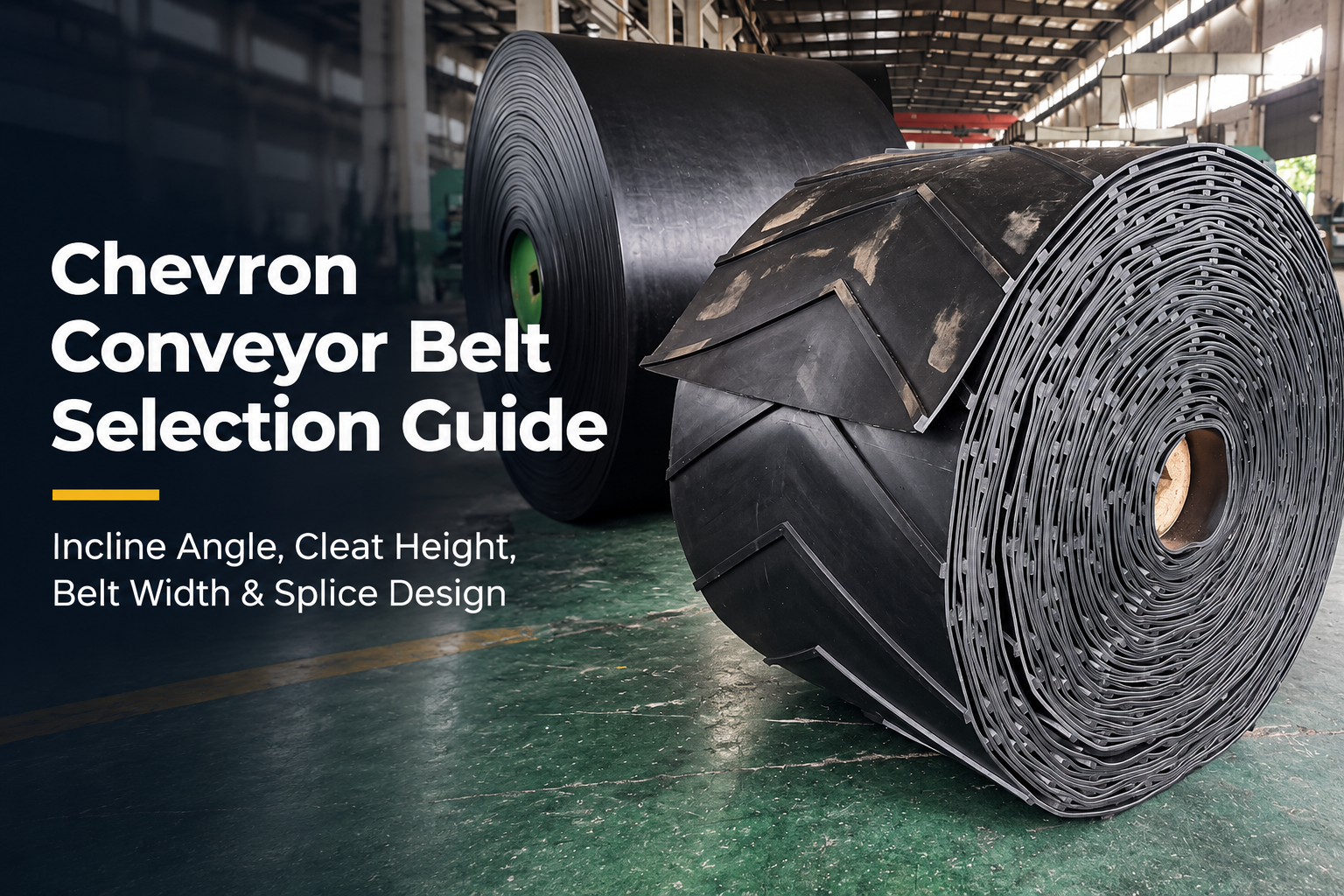
Chevron Conveyor Belt Ultimate Guide (2026): Types, Grades and How to Choose

Chevron Conveyor Belt Ultimate Guide (2026): Types, Grades and How to Choose

Chevron conveyor belts only pay off when the incline genuinely exceeds what a flat belt can hold — and choosing the pattern is where most projects go wrong. This guide sets out the decision in order: confirm the real incline after the chute and skirt modifications, then match cleat height and pattern spacing to material size and angle, then check width, carcass and cover grade. It includes a pattern table covering C5, C10 and C15 cleats with cleat width, pitch and height, an incline-to-pattern matrix, and a comparison of chevron, T-cleat and herringbone profiles. We also cover chevron versus corrugated sidewall belts, port and bulk terminal duties, how to splice a profiled belt so the cleats realign, carryback and spillage control, and the selection checklist we use before quoting. Written by a conveyor belt manufacturer that supplies profiled belts into quarry, port and aggregate operations, with MOQ and lead time guidance.

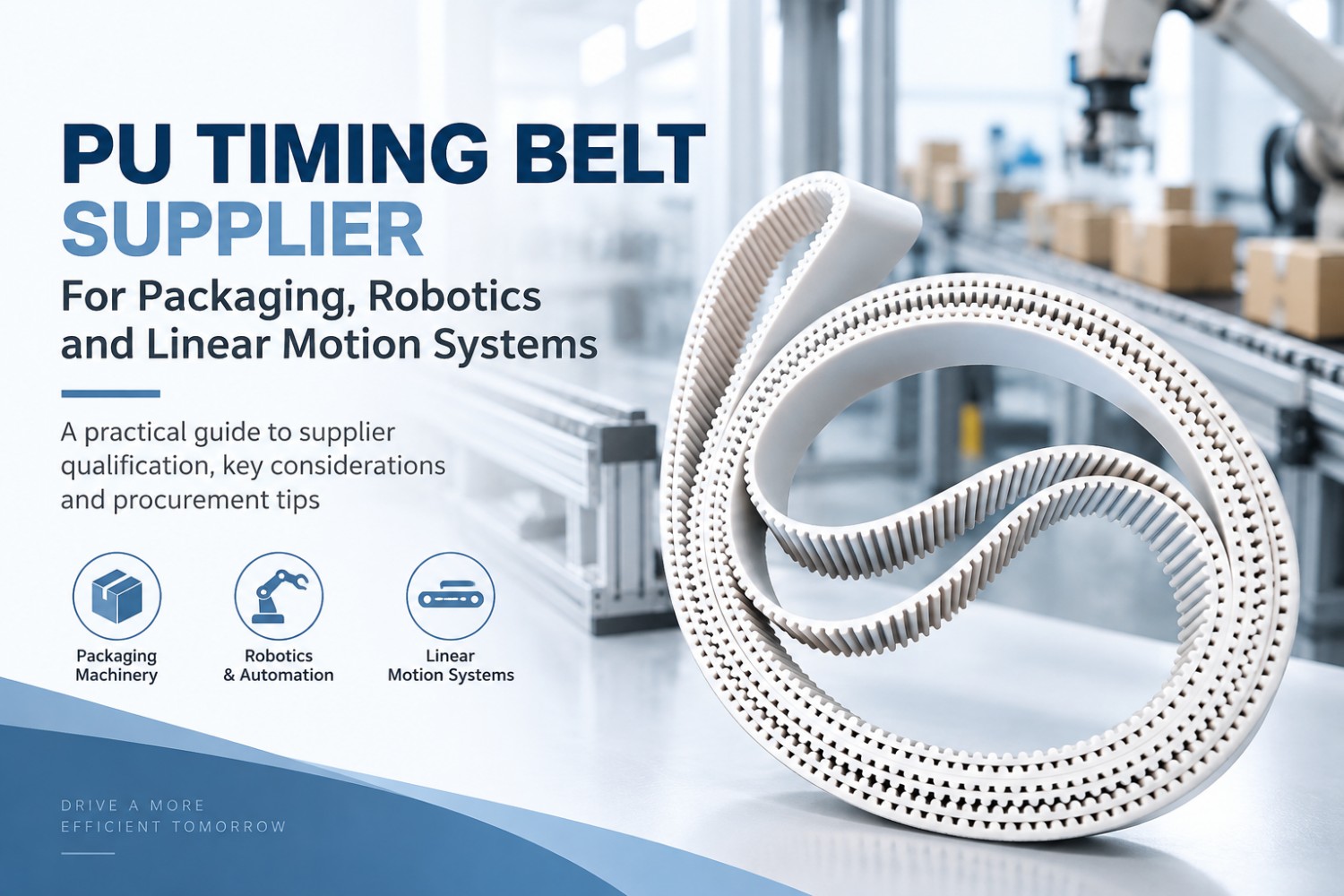
PU Timing Belt Supplier for Packaging, Robotics and Linear Motion Systems

PU Timing Belt Supplier for Packaging, Robotics and Linear Motion Systems

Selecting a PU timing belt supplier for packaging, robotics or linear motion systems requires more than comparing belt price and delivery. OEM buyers need to verify tooth and pulley compatibility, tensile-member construction, working surfaces, motion conditions, sample approval and batch consistency. This guide explains how to qualify polyurethane timing belts technically and commercially, what information belongs in an RFQ, which supplier red flags deserve attention, and how to move from prototype validation to repeatable bulk sourcing.

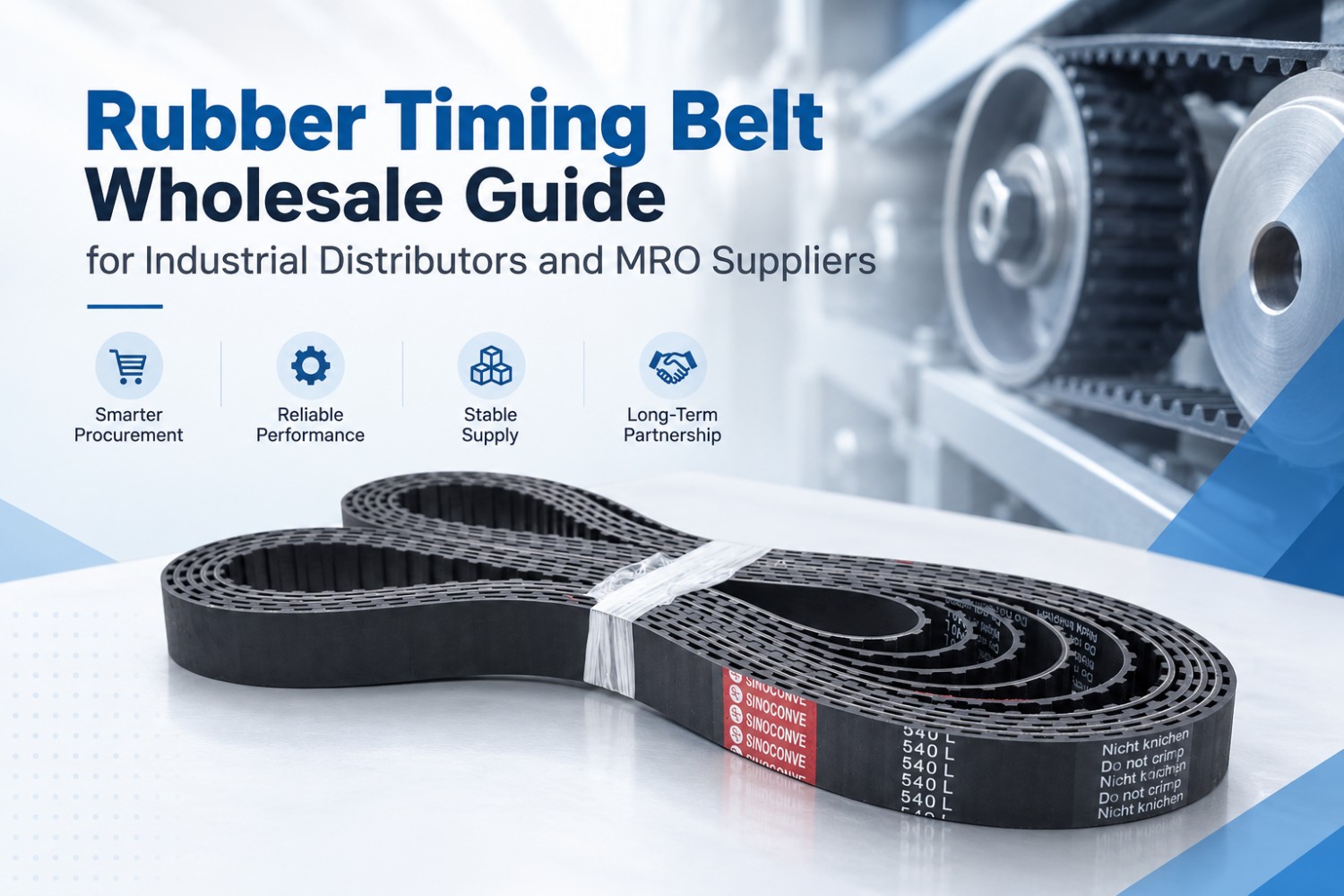
Rubber Timing Belt Wholesale Guide for Industrial Distributors and MRO Suppliers

Rubber Timing Belt Wholesale Guide for Industrial Distributors and MRO Suppliers

Wholesale timing belt purchasing requires more than comparing unit prices. Industrial distributors and MRO suppliers need to control tooth profile, dimensions, pulley compatibility, sample approval, batch consistency, MOQ, private labeling, QC documentation and repeat-order identification. This guide explains how to prepare a technically comparable rubber timing belt RFQ, evaluate supplier capability, manage multi-SKU inventory risk and verify the commercial details that matter before moving from samples to bulk orders.

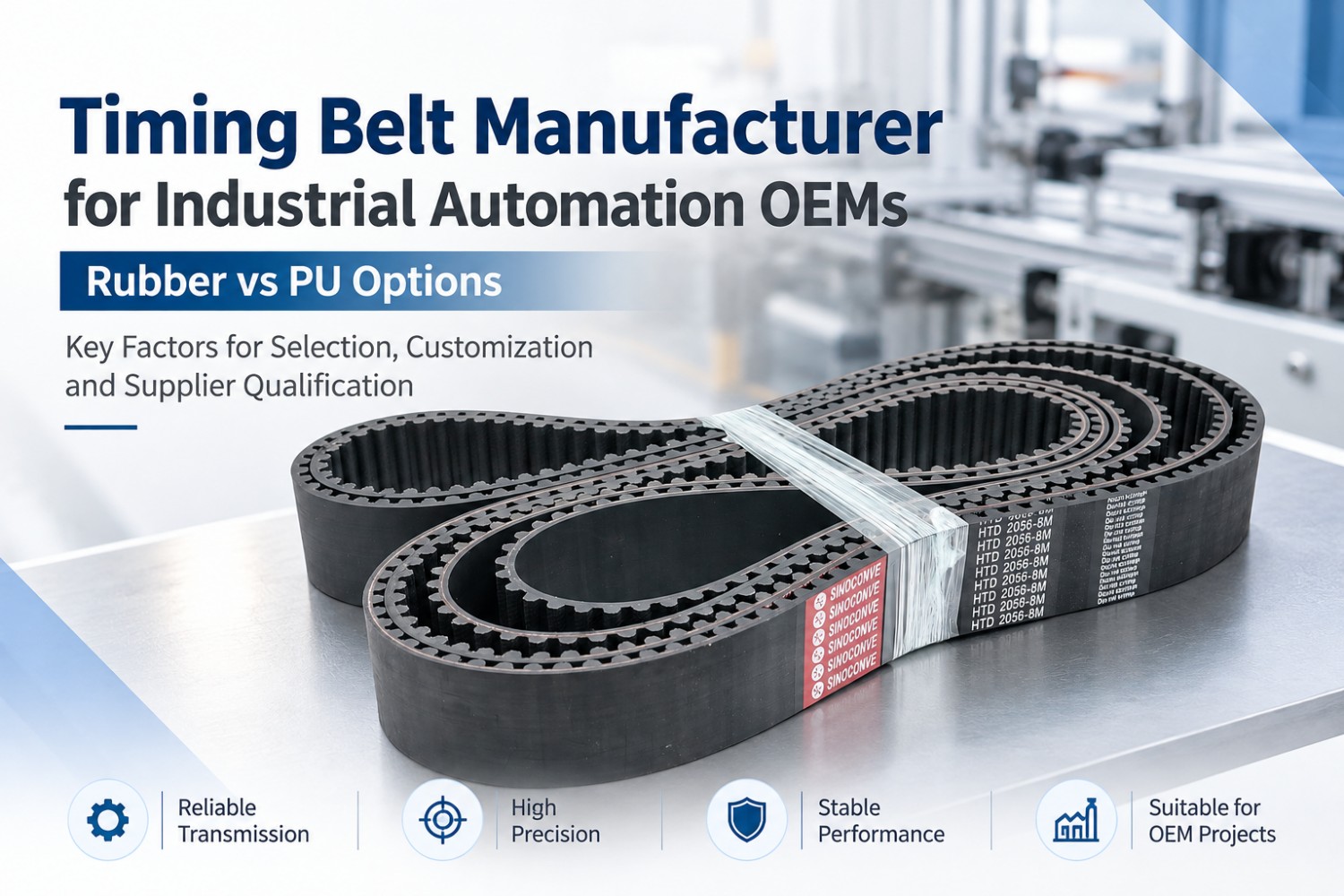
Timing Belt Manufacturer for Industrial Automation OEMs: Rubber vs PU Options

Timing Belt Manufacturer for Industrial Automation OEMs: Rubber vs PU Options

Industrial automation OEMs need more than a timing belt quotation: they need a repeatable specification that works from prototype through mass production. This guide explains how to evaluate a timing belt manufacturer, compare rubber and PU options, verify tooth and pulley compatibility, control drawings and sample approval, and define quality requirements for repeat orders. It also provides a practical RFQ framework for OEM buyers sourcing custom synchronous belts for automation machinery, packaging systems, indexing equipment and other precision drives.

Explore more

We are committed to providing you with better products and services. Welcome to browse more content for details